Charlotte Residents Defend Community as ICE Arrives for Latest Trump Immigration Crackdown

Spread the love

Original article by Julia Conley republished form Common Dreams under Creative Commons (CC BY-NC-ND 3.0). 
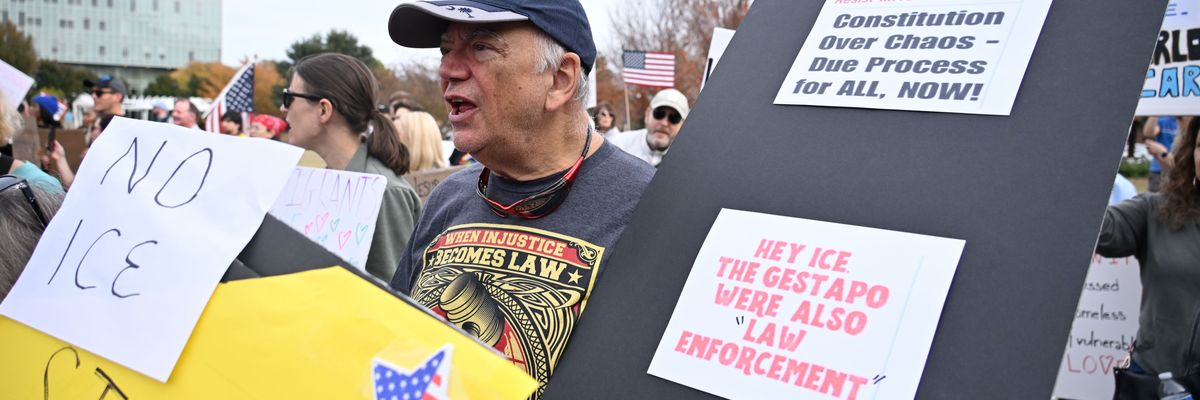
Protesters gather at First Ward Park for the ‘No Border Patrol In Charlotte’ rally to raise their voices for the immigrant community and against US Border Patrol activity in Charlotte, North Carolina on November 15, 2025. (Photo by Peter Zay/Anadolu via Getty Images)

“In a scenario where this administration is trying to sow division,” said one local organizer, “we see an organic movement of community members trying to provide support and assistance.”

In Charlotte, North Carolina, the Trump administration’s latest anti-immigration crackdown garnered headlines over the weekend both for “how inhumane and aggressive” the operations by US Border Patrol and Immigration and Customs Enforcement were, as one journalist said, and the action that local residents immediately took to protect their neighbors from arrests and raids.

“I just started recording them,” said Rheba Hamilton after federal agents pulled up to her house in a vehicle and intimidated two Latino men who were decorating the trees in her yard. “They left.”

As the agents pulled away, she yelled, “Get the hell out of my yard, you assholes!”

https://www.instagram.com/reel/DRGczMkDlBF/

Hamilton, who told The New York Times she had tried to warn the workers against hanging the Christmas lights due to the deportation operations, said it was “terrifying” to see Border Patrol agents on her property.

“I was concerned about this happening,” Hamilton said. “We’ve got great people here… Nobody’s going to regret moving here if you come here with the right kind of heart, and that includes our immigrants.”

Hamilton filmed the Border Patrol agents after North Carolina Gov. Josh Stein, a Democrat, called on Charlotte residents to “bear witness” to ICE arrests and raids at businesses and homes as the Trump administration launched “Operation Charlotte’s Web”—the latest stop on its nationwide attack on immigrant and Latino communities, which has also unfolded in Chicago and other cities.

“If you see any inappropriate behavior, use your phones to record and notify local law enforcement, who will continue to keep our communities safe long after these federal agents leave,” said Stein last week.

Operation Charlotte’s Web began as the administration released the names of more than 600 people detained in the Chicago area whose arrests may have violated a court order, and revealed that just 16 of them had an alleged criminal history.

More than 3,000 people in all have been arrested in the Chicago area since ICE and other federal agencies began “Operation Midway Blitz” in September.

Border Patrol Commander-at-large Gregory Bovino reported that at least 81 people were arrested in Charlotte by the end of the weekend, with the mass arrests completed in about five hours, and claimed that those who were taken into custody had “significant criminal and immigration history”—similar claims that have been made about the operations in Chicago.

The local advocacy group Siembra NC said “the most immigrants were arrested in a single day in state history” on Saturday.

The community development group CharlotteEast told the Guardianon Sunday that it had received an “overwhelming” number of reports from residents about Customs and Border Protection (CBP) agents in the area, including at places that were previously protected under the Biden administration from immigration enforcement.

“The past two hours we’ve received countless reports of CBP activity at churches, apartment complexes, and a hardware store,” executive director Greg Asciutto told the outlet.

The Charlotte Observer reported that congregants at a church in east Charlotte “scattered into the woods” after masked federal agents arrived and detained a member while the church community was doing yard work.

“The agents asked no questions and showed no identification before taking one man away, whose wife and child were inside at the time,” the newspaper reported. “Inside the church, women and children sobbed as they wondered whether their loved ones had been taken.”

Sam Stein of the Bulwark noted that community members “got the heads up and ran to the woods to confront ICE agents with, among other things, deafening whistles. ICE responded by threatening to throw gas canisters at them.”

Advocates handed out whistles—like those used by many in Chicago in recent weeks—to local residents on Sunday, and hundreds of people packed a training session on Friday night where Carolina Migrant Network advised them on banding together to stop ICE from raiding their communities.

A grocery store, Compare Foods, also announced it would be offering free delivery to keep people from having to venture out while federal agents are in the city.

“For all those customers who don’t feel comfortable coming to the store in person, they can shop online, and then we will have it delivered through our delivery service to their home,” said Omar Jorge, owner of the local chain.

Manolo’s Bakery, meanwhile, closed over the weekend for the first time in its 28-year history, with owner Manolo Betancur telling the Observer, “We need to protect our families [from] family separation.”

Stefania Arteaga of the Carolina Migrant Network told the Guardian that the grassroots weekend efforts show “allies are learning how to help their neighbors” in the city.

“In a scenario where this administration is trying to sow division,” she said, “we see an organic movement of community members trying to provide support and assistance.”

Daniel Nichanian of Bolts magazine said Charlotte—which is not near a US border—likely was chosen as President Donald Trump’s latest target because of a “war” between ICE and Mecklenburg County Sheriff Gary McFadden, going back to 2018 when McFadden was among five Black Democrats who won sheriff elections in the state on the promise of ending cooperation with ICE.

The agency targeted Charlotte two years later, posting billboards that showed mugshots of immigrants arrested in the area.

As with other cities Trump has targeted for mass deportation operations this year, crime has been falling in Charlotte, with an 8% decrease in overall crime last month compared to a year prior, and a 20% reduction in violent crimes.

Original article by Julia Conley republished form Common Dreams under Creative Commons (CC BY-NC-ND 3.0). 

Donald Fuhrump says that Amerikkka doesn't bother with crimes or charges anymore, not being 100% Amerikkkan and opposing his real estate intentions is enough.
Donald Fuhrump says that Amerikkka doesn’t bother with crimes or charges anymore, not being 100% Amerikkkan and opposing his real estate intentions is enough.
Elon Musk urges you to be a Fascist like him, says that you can ignore facts and reality then.
Orcas discuss Donald Trump and the killer apes' concept of democracy. Front Orca warns that Trump is crashing his country's economy and that everything he does he does for the fantastically wealthy.
Orcas discuss Donald Trump and the killer apes’ concept of democracy. Front Orca warns that Trump is crashing his country’s economy and that everything he does he does for the fantastically wealthy.

Continue ReadingCharlotte Residents Defend Community as ICE Arrives for Latest Trump Immigration Crackdown

Bill Gates Gave $3.5M to Think Tank Run by Climate Crisis Denier Bjorn Lomborg 

Spread the love

Original article by Rei Takver republished from DeSmog.

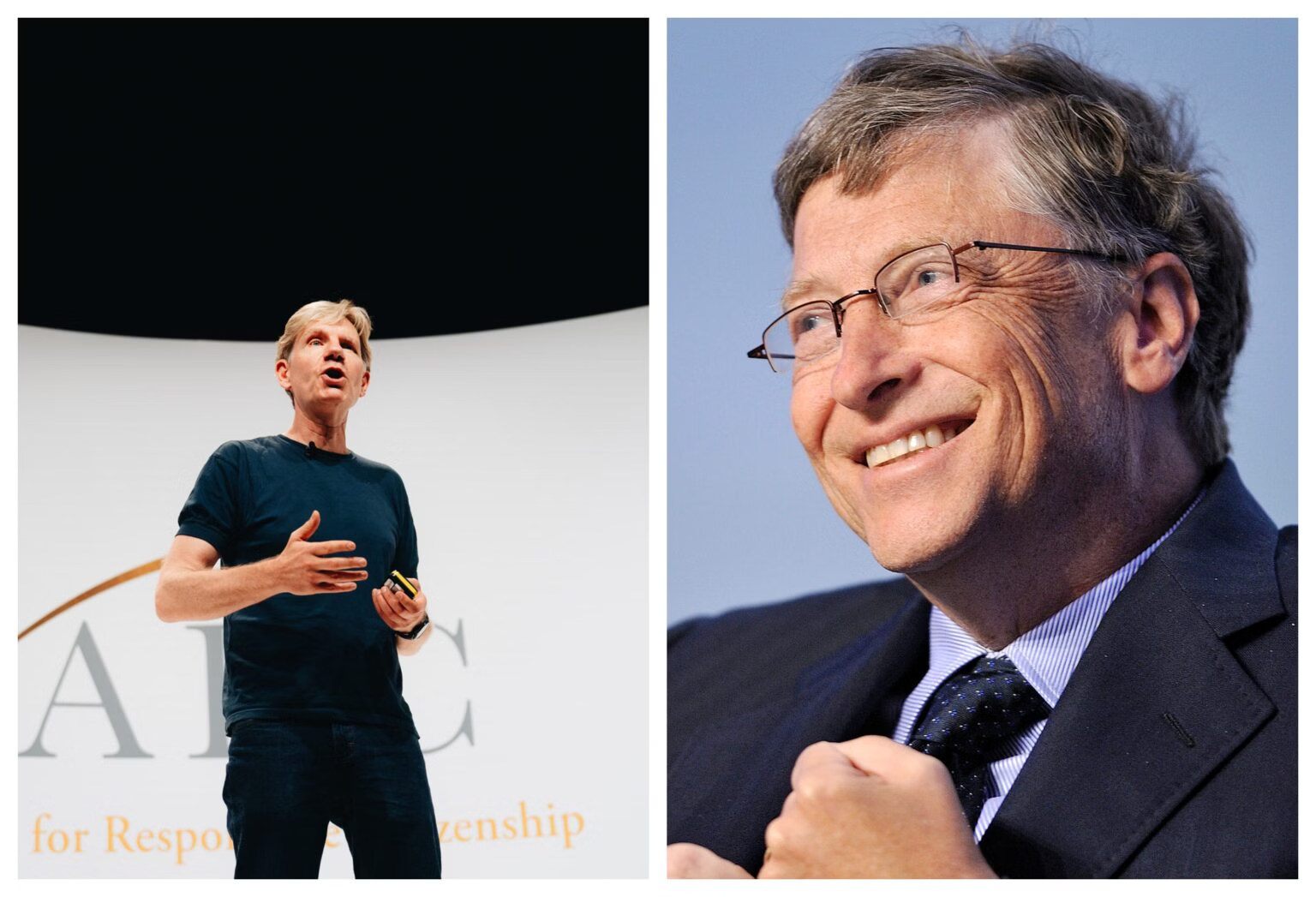
Left, Bjorn Lomborg speaks at the Alliance for Responsible Citizenship Conference in 2023. Credit: ARC Forum, C0 Right, billionaire Microsoft founder and philanthropist Bill Gates. Credit: DOE/Ken Shipp, C0

Tax records reveal that the billionaire’s foundation has donated for years to Lomborg’s Copenhagen Consensus Center.

Bill Gates’ charity has donated more than $3.5 million to a think tank run by the Danish academic and climate crisis denier Bjørn Lomborg, according to U.S. tax records reviewed by DeSmog.

The donations, which were made between 2017 and 2022, were listed on IRS 990 Forms filed by the Gates Foundation. Those donations went to the Copenhagen Consensus Center, which describes itself as a “think tank that researches the smartest solutions for the world’s biggest problems, advising policy-makers and philanthropists how to spend their money most effectively.”

The center was created by Lomborg, who for years has argued in op-eds, lectures, and broadcast media that there are more important global issues to prioritize than climate change, writing in April that “it is not the existential threat that some would have us believe.”

Those views align closely with a controversial memo Gates recently published during the lead-up to the United Nations COP30 climate summit in Belém, Brazil, in which the philanthropist, who is worth an estimated $118 billion, argued that climate change “will not lead to humanity’s demise.”

The Microsoft founder and longtime public health philanthropist claimed that a “doomsday outlook” about the future of the climate is “causing much of the climate community to focus too much on near-term emissions goals” and that is “diverting resources from the most effective things we should be doing to improve life in a warming world.”

Gates’ “tough truths” post came on the heels of the United Nations Secretary General António Guterres noting that it is now “inevitable” that the world is on track to at least temporarily burst past the 1.5 degrees C (2.7 degrees F) warming target of the Paris Agreement, with “dramatic consequences.”

Gates’ arguments have drawn outcries of dismay from some of the world’s top climate scientists, who have pointed out that “this memo is already being championed by those seeking to misinform and sow doubt about climate change and delay climate progress–up to and including the executive branch of the United States government.”

But Lomborg is full of praise for the billionaire who has frequently donated to his think tank.

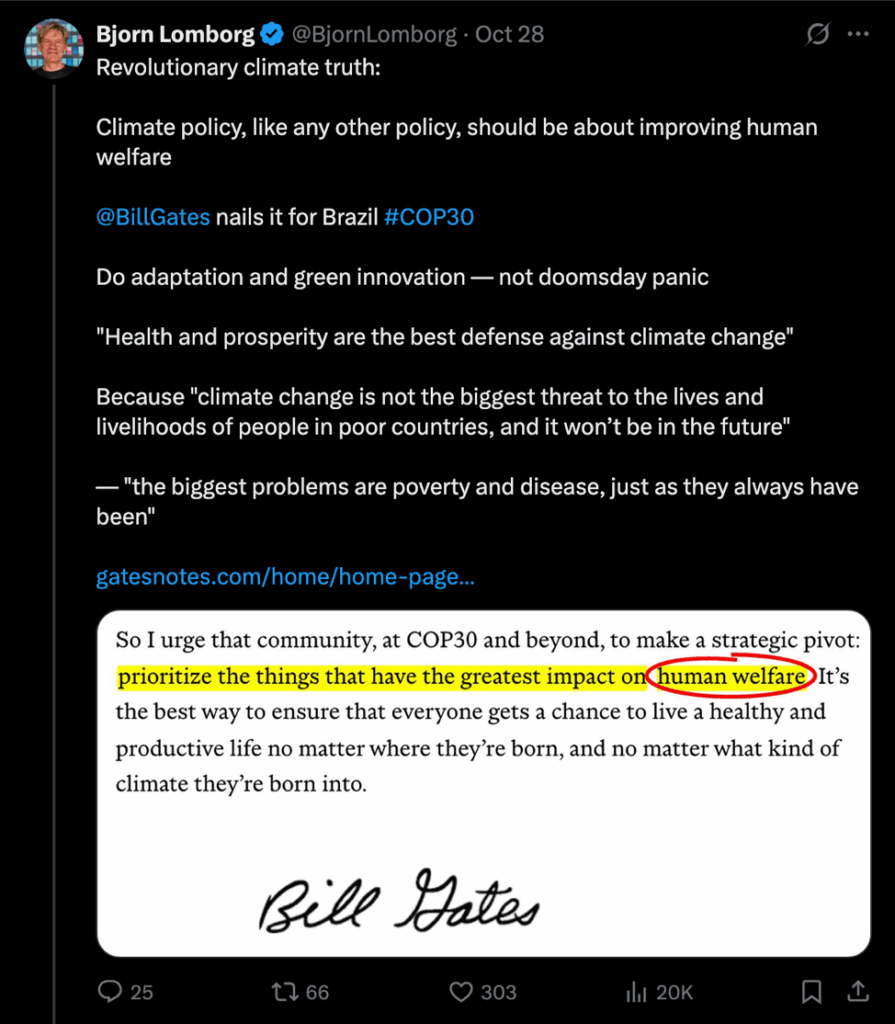
“Revolutionary climate truth: @BillGates nails it,” he posted on X.

Bjorn Lomborg praises Bill Gates' climate memo in a tweet on X:"Revolutionary climate truth: "@BillGates nails it for Brazil #COP30"
Bjorn Lomborg praises Bill Gates’ climate memo in a tweet: “Revolutionary climate truth: @BillGates nails it for Brazil #COP30”

The Gates Foundation and the Copenhagen Consensus Center didn’t respond to a request for comment.

“He’s read some of my stuff”

In total, the Gates Foundation (formerly known as the The Bill & Melinda Gates Foundation) has donated $3,519,491 to Lomborg’s think tank. The most recent tax filing on record includes a 2022 donation to the Copenhagen Consensus Center worth $1.25 million, which went to support “community engagement grantmaking.”

Lomborg’s center credits the Gates Foundation with providing “financial support” for a 2021 report identifying development priorities for Africa. That report ranked climate solutions such as “resilience to drought” and “solar energy for unreliable grids” in the bottom third of a list of investment opportunities for the continent.

The report ranked objectives such as “family planning,” “R&D for agricultural yield increase,” and “tobacco control” at the top of the list. “All other things equal, the policies producing high returns should be funded before the ones with low return,” it noted.

Africa faces unfairly high costs to adapt to climate extremes, such as droughts, heatwaves, and floods, according to a 2024 World Meteorological Organization report.

The relationship between Lomborg and Gates goes back at least as far as 2014.

That year, DeSmog reported that Gates had published a blog post promoting Lomborg’s views. In the post, Gates argued that as rich countries “push to get serious about confronting climate change,” telling poorer countries not to rely on fossil fuels is wrong.

“For one thing, poor countries represent a small part of the carbon-emissions problem. And they desperately need cheap sources of energy now to fuel the economic growth that lifts families out of poverty. They can’t afford today’s expensive clean energy solutions, and we can’t expect them wait for the technology to get cheaper,” Gates wrote.

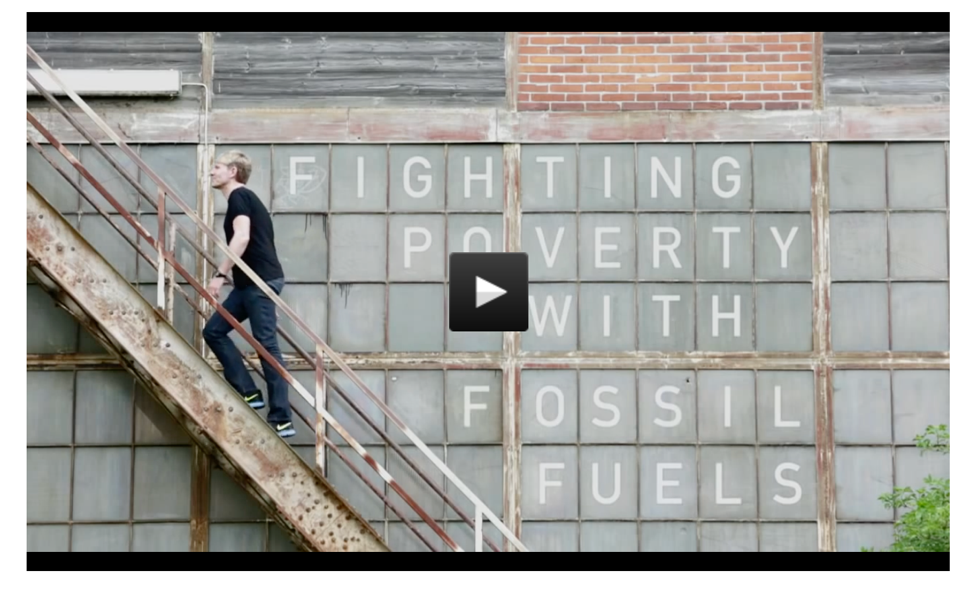
Alongside Gates’ 2014 post was a “GatesNotes”-branded video where Lomborg said it was “hypocritical” for the developed world to deny poor countries access to fossil fuels when so much of the developed world is still fueled on them. 

In the video, Lomborg can be seen climbing a staircase with the words “Fighting poverty with fossil fuels” painted behind him.

This GatesNotes video shows Lomborg climbing a rusty outdoor staircase against a brick and metal backdrop with the words "Fighting poverty with fossil fuels."
Bill Gates was featuring the work of climate crisis denier Bjorn Lomborg at least as far back as 2014. This GatesNotes video shows Lomborg against a backdrop with the words “Fighting poverty with fossil fuels.”

As recently as 2023, Lomborg co-authored a GatesNotes post with Gates arguing that the UN Sustainable Development Goals are “too much of a good thing” because they say the world is not “stepping up to fund all of them.”

In response to the October 28 Gates climate memo, Lomborg told Newsweek that “I’ve met with Mr. Gates himself several times. He’s read some of my stuff.” However, Lomborg did not directly take credit with influencing Gates’ views in the “Three Tough Truths about Climate” memo.

Deniers Celebrate Gates

Shortly after the memo’s release, U.S. President Donald Trump declared on his social media platform Truth Social: “I (WE!) just won the War on the Climate Change Hoax. Bill Gates has finally admitted that he was completely WRONG on the issue. It took courage to do so, and for that we are all grateful. MAGA!!!”

Trump is not alone in his celebration. Several long-time climate crisis deniers are cheering the statement from Gates, including Robert Bradley of the Institute for Energy Research, a nonprofit that attacks renewables and criticizes decarbonization plans.

Alex Epstein, who himself has cited Lomborg as an influence, said last week that “we should celebrate that Bill Gates has seen the light.” Epstein, the “fossil fuel philosopher” who helped shape the clean energy cuts in Trump’s domestic policy bill, claimed that Gates’ memo is in part a response to a Trump administration that “that is pro-fossil fuel and very anti-climate catastrophist.”

Gates’ backsliding on climate is not just words, it’s money and resources. For instance, in March, he made deep cuts to the climate policy staff of Breakthrough Energy, the “clean energy” organization he founded in 2015 and whose work he touted in his October 28 memo.

Explaining his “pivot” on climate change during an interview on CNBC, Gates said, “I’ll let the temperature go up 0.1 degree to get rid of malaria. People don’t understand the suffering that exists today.” Afterwards, Lomborg took to X to praise Gates, writing, “Exactly right!”
 
 Arguments like this have garnered sharp criticism from climate leaders.
 
Gates is wrong to frame climate change and human well-being as disconnected, zero-sum issues, argues climate scientist Katharine Hayhoe. “We are nowhere near maxing out investment in & implementation of [solutions] that benefit people, health, climate and nature at the same time,” the Texas Tech professor and chief scientist at The Nature Conservancy posted on Bluesky. “[The climate, pollution, and nature crises] are already actively amplifying poverty, hunger, and division.”

“There is no greater threat to developing nations than the climate crisis,” Michael Mann, University of Pennsylvania climate scientist, told CNN in response to the Gates memo. “He’s got this all backwards.” 


Original article by Rei Takver republished from DeSmog.

Elon Musk urges you to be a Fascist like him, says that you can ignore facts and reality then.
Donald Trump urges you to be a Climate Science denier like him. He says that he makes millions and millions for destroying the planet, Burn, Baby, Burn and Flood, Baby, Flood.
Nigel Farage urges you to ignore facts and reality and be a climate science denier like him and his Deputy Richard Tice. He says that Reform UK has received £Millions and £Millions from the fossil fuel industry to promote climate denial and destroy the planet.
Continue ReadingBill Gates Gave $3.5M to Think Tank Run by Climate Crisis Denier Bjorn Lomborg 

‘Inviting the Fox Into the Henhouse’: Canada Delegation to COP30 Loaded with Fossil Fuel Representatives

Spread the love

Original article by Taylor Noakes republished from DeSmog.

Fossil fuel lobbyists in the Canadian delegation include representatives of the Canadian Association of Petroleum Producers (CAPP), a lobby group that represents Canada’s oil and natural gas producers. Credit: C2C Journal

Delegation’s composition consistent with new KBPO report revealing this year’s U.N. climate talks have the largest number of fossil fuel lobbyists to date.

Lobbyists and representatives of Canada’s oil and gas industry are part of Canada’s official delegation to this year’s U.N. climate talks in Brazil, in keeping with the high number of fossil fuel representatives in attendance at the summit. 

About a dozen individuals representing fossil fuel interests were part of the 240-person Canadian delegation, according to documents reviewed by DeSmog as well as a Nov. 12 Canadian Press article.  

“Fossil fuel lobbyists have no place at the U.N. climate negotiations,” Emilia Belliveau, program manager of energy transition with Environmental Defence, said in a statement to DeSmog.

“Their presence here with official badges from Canada undermines the work of Canadians attending COP30 who are genuinely working to advance climate action,” she said. 

This year’s U.N. climate talks have the single largest share of fossil fuel lobbyists in attendance to date. Some 1,600 people — or one out of every 25 attendees — are fossil industry or related lobbyists, according to an analysis by Kick Big Polluters Out (KBPO), an alliance of climate and justice organizations that push to remove fossil fuel companies and their lobbyists from influencing climate negotiations and policymaking.

The presence of so many Canadian fossil fuel sector representatives exemplifies the report’s findings.
 
“It demonstrates the extent by which the current government is aligned with oil industry interests,” Patrick Bonin, the Bloc Québécois’ environment and climate change critic, said in a statement to DeSmog. 

“The oil and gas industry is the biggest lobby in Canada,” Bonin continued, “so it’s like inviting the fox into the henhouse … Giving them access to the delegation gives them far greater influence than regular participants.” 

Fossil fuel lobbyists in the Canadian delegation include representatives of the Canadian Association of Petroleum Producers (CAPP), a lobby group that represents Canada’s oil and natural gas producers; Tourmaline Oil, Canada’s largest natural gas producer; CarbonAi; the International Emissions Trading Association (IETA), the Global CCS Institute; and the gas industry advocacy group Energy for a Secure Future.

Huge Industry Presence

KBPO’s analysis reveals that fossil fuel lobbyists at COP30 outnumber every national delegation except for Brazil, the host country. The number of lobbyists also represents a 12 percent increase over last year’s COP conference held in Baku, Azerbaijan.

Fossil fuel lobbyists received two-thirds more passes to COP30 than the total number of delegates from the 10 most climate-affected nations on Earth, the KBPO report said. This highlights “how industry presence continues to dwarf that of those on the frontlines of the climate crisis,” KBPO said in a statement that accompanied the report’s release.

The influence of major trade associations at COP30 is palpable, with the IETA bringing 60 representatives, including delegates from oil and gas giants ExxonMobil, BP, and TotalEnergies. These associations are “a primary vehicle for fossil fuel influence, according to a KBPO statement.  

Kathleen Sullivan, global managing director with IETA, is in the COP30 Canadian delegation. It also includes Jay Averill, assistant vice president of communications with CAPP; Scott Volk and Tim Shaw of Tourmaline Oil; and Todd Smith, Ontario’s former energy minister who advocated for an expansion of nuclear power. Smith left office in August 2024 to become vice president of marketing and business development with CANDU Energy Inc., a manufacturer of nuclear reactors.

The Canadian delegation also includes several representatives from Energy for a Secure Future, a lobby group that advocates for continued fossil fuel use to ensure “energy affordability.” The group states on their website that “our gas energy can respond to the needs of our friends around the world who are facing punishing energy costs and are left with options that drive up global emissions.”

Canadian “Carbon Bombs”

However, Canada’s natural gas industry is a major contributor of rising global emissions. The nation’s natural gas resources have been described as “carbon bombs” for their potential to release billions of tonnes of CO2 into the atmosphere, according to a 2024 DeSmog article.

“The spectacle of Canada’s COP delegation [serving as] a Trojan horse for fossil fuel interests like Tourmaline and the CAPP is shocking,” said James Browning, executive director of F Minus, a climate accountability group. F Minus recently issued a report detailing numerous conflicts of interest that have resulted from Canadian environmental organization sharing lobbyists who also serve major polluters.
 
 “Lobbying decisionmakers in secret is really just another day at the office for these climate denialists, given the failure of Canada’s lobbyist disclosure system to fully capture the extent of their dealings with Canadian officials,” Browning said in a statement to DeSmog. 

“COP may be 5,000 kilometres away, but the deeper scandal here is that Tourmaline’s and CAPP’s lobbyists enjoy a similar, extraordinary level of secrecy in their meetings with government officials every day in Ottawa,” he said.

CAPP has misled the public about emissions from Canada’s oil and gas sector, and has  campaigned against anti-greenwashing laws. Heather Feldbusch, one of Pierre Poilievre’s campaign’s inner circle, was formerly a lobbyist with Alberta Counsel Inc., which represents Tourmaline.

“At the COP negotiations two years ago, governments took a historic step by committing to transition away from fossil fuels in energy systems in a just, orderly, and equitable manner,” Keith Stewart, senior energy strategist with Greenpeace Canada, said in a statement to DeSmog. “By including fossil fuel lobbyists in our official delegation, Canada is undermining that global effort and risks being seen as negotiating in bad faith.” 

“CAPP has been fighting against effective climate action for decades and should be shown the door, not the red carpet,” he added.

Another organization with a stake in fossil fuels included in the Canadian delegation is the Global CCS Institute, a carbon capture advocacy group based in Australia. Critics have long argued that carbon capture is an expensive false solution designed to give fossil fuel production an air of social acceptability. Canadian Prime Minister Mark Carney has used the term “low carbon oil” in reference to carbon capture, despite experts arguing that the term is nonsense.

“Inviting fossil fuel lobbyists into global climate negotiations is as misguided as letting the tobacco industry write health policy, and Canada is compounding the problem by weakening its own greenwashing rules” Sabaa Khan, director general, Quebec and Atlantic Canada, with the David Suzuki Foundation, said in a statement to DeSmog.

DeSmog reached out to Keean Nembhard, press secretary for Canadian environment minister Julie Dabrusin, but did not receive a statement by press time.

Original article by Taylor Noakes republished from DeSmog.

Continue Reading‘Inviting the Fox Into the Henhouse’: Canada Delegation to COP30 Loaded with Fossil Fuel Representatives

With US ‘Paying the Price for Trump’s Mistakes,’ He Ends Tariffs for Bananas, Beef, Coffee, and More

Spread the love

Original article by Jessica Corbett republished from Common Dreams under Creative Commons (CC BY-NC-ND 3.0).

Shoppers browse produce at Sabor Tropical Supermarket in Miami Beach, Florida on July 23, 2022. Photo by: Jeffrey Greenberg/Universal Images Group via Getty Images

Although President Donald Trump didn’t actually confess that his global trade war is driving up the cost of groceries for Americans, he did finally drop his dubiously named “reciprocal” tariffs on key imports on Friday.

According to a White House fact sheet, Trump’s new executive order ends his tariffs on beef; cocoa and spices; coffee and tea; bananas, oranges, and tomatoes; other tropical fruits and fruit juices; and fertilizers.

The New York Times had reported Thursday that “the Trump administration is preparing broad exemptions to certain tariffs in an effort to ease elevated food prices that have provoked anxiety for American consumers.”

The reporting drew critiques of the administration’s economic policies, including from members of Congress such as Senate Finance Committee Ranking Member Ron Wyden (D-Ore.), who said that “Trump just admitted it: Americans are footing the bill for his disastrous tariffs.”

“While this move may alleviate some of the cost increases Trump caused, it will not stop the larger problems of rising inflation, business uncertainty, and economic damage done by Trump’s crazy tariff scheme.”

Also responding to the Times reporting, Sen. Elizabeth Warren (D-Mass.) wrote on social media Friday: “After months of increasing grocery prices, Donald Trump is finally admitting he was wrong. Americans are literally paying the price for Trump’s mistakes.”

More lawmakers and other critics piled on after Trump issued the order. CNN‘s Jim Sciutto said: “Trump administration now acknowledging what economists and business leaders have told us from the beginning: that tariffs are driving up prices.”

MeidasTouch and its editor in chief, Ron Filipkowski, also called out the president on social media, with the outlet sarcastically noting, “But Trump said his tariffs don’t raise prices.”

https://embed.bsky.app/embed/did:plc:t6ubj2wlhc34awzcymh3qpur/app.bsky.feed.post/3m5mrgzllz22t?id=8128174723413667&ref_url=https%253A%252F%252Fwww.commondreams.org%252Fnews%252Ftrump-food-tariff&colorMode=system

OR, Trump Admits His Tariffs Caused Grocery Prices to Rise.

Ron Filipkowski (@ronfilipkowski.bsky.social) 2025-11-14T22:52:26.406Z

Congressman Don Beyer (D-Va), who serves on the House Ways and Means Subcommittee on Trade, said in a Friday statement that “President Trump is finally admitting what we always knew: His tariffs are raising prices for the American people.”

“After getting drubbed in recent elections because of voters’ fury that Trump has broken his promises to fix inflation, the White House is trying to cast this tariff retreat as a ‘pivot to affordability,’” Beyer said, referencing Democrats who won key races last week, from more moderate Mikie Sherrill and Abigail Spanberger, the incoming governors of New Jersey and Virginia, to democratic socialist Mayors-elect Zohran Mamdani of New York City and Katie Wilson of Seattle.

In addition to those electoral victories for Democrats, last week featured a debate over Trump’s trade war at the US Supreme Court. According to Beyer: “The simple truth is that Republicans want credit for something they think the Supreme Court will force them to do anyway, after oral arguments before the court on Trump’s illegal abuses of trade authorities went badly for the administration. Trump is still keeping the vast majority of his tariffs in place, and his administration is also planning new tariffs in anticipation of a Supreme Court loss.”

“The same logic—that Trump’s tariffs are driving up prices on coffee, fruit, and other comestibles—is equally true for the thousands of other goods on which his tariffs remain,” he continued. “While this move may alleviate some of the cost increases Trump caused, it will not stop the larger problems of rising inflation, business uncertainty, and economic damage done by Trump’s crazy tariff scheme.”

“Only Congress can do that, by reclaiming its legal responsibility under the Constitution to regulate trade, and permanently ending Trump’s trade war chaos,” he stressed. “All but a handful of Republicans in Congress are still refusing to stand up to Trump, stop his tariffs, and lower costs for the American people, and unless they find a backbone, our economy will continue to suffer.”

https://embed.bsky.app/embed/did:plc:qxudeqrdbv6676vzjssrhllo/app.bsky.feed.post/3m5mrcrvkp22m?id=3415354401869237&ref_url=https%253A%252F%252Fwww.commondreams.org%252Fnews%252Ftrump-food-tariff&colorMode=system

Huh. Trump dropped the tariffs on coffee, beef, and tropical fruit to LOWER PRICES. I thought other countries paid for those?

Angry (@angrystaffer.bsky.social) 2025-11-14T22:50:04.132Z

As the Associated Press noted Friday, “The president signed the executive order after announcing that the U.S. had reached framework agreements with EcuadorGuatemalaEl Salvador, and Argentina designed to ease import levies on agricultural products produced in those countries.”

Trump’s order also came just a day after Democrats on the congressional Joint Economic Committee released a report showing that US families are paying roughly $700 more each month for basic items since Trump returned to office in January—with households in some states, such as Alaska and California, facing an average of over $1,000 monthly.

The president has floated sending Americans a $2,000 check, purportedly funded by revenue collected from his tariffs, but as Common Dreams reported Wednesday, economist Dean Baker of the Center for Economic and Policy Research crunched the numbers and found that the proposed “dividend” doesn’t add up.

Original article by Jessica Corbett republished from Common Dreams under Creative Commons (CC BY-NC-ND 3.0).

Orcas discuss how Trump was re-elected and him being an obviously insane, xenophobic Fascist.
Continue ReadingWith US ‘Paying the Price for Trump’s Mistakes,’ He Ends Tariffs for Bananas, Beef, Coffee, and More

Ecuador: When legitimate protest becomes ‘terrorism’

Spread the love

Original article by Rose Barboza republished from Open Democracy under a Creative Commons Attribution-NonCommercial 4.0 International licence

Indigenous demonstrators shout slogans during a demonstration at Parque Central Cayambe, Ecuador, as part of the national strike on October 1, 2025
 | Felipe Stanley/Agencia Press South/Getty Images

Taking from Trump’s playbook and reviving colonial trope, President Noboa labelled Indigenous protesters ‘terrorists’

Recent years have seen Western governments extoll their democratic values while leading increasingly harsh crackdowns on dissent, with activists arrested and accused of terrorism.

Now, Ecuador has gone even further. President Daniel Noboa’s far-right government met recent nationwide anti-austerity protests with a brutality that has left two protesters dead, 473 injured, 12 missing, and 206 detained, according to the Alliance of Human Rights Organisations of Ecuador.

A 31-day national strike erupted on 22 September, nine days after Noboa removed fuel subsidies, raising the price of diesel by 55% from $1.80 to $2.80 per gallon. The demonstrations, which disrupted the movement of goods and people across the country as protesters blocked main roads, were led by Ecuador’s largest Indigenous organisation, the Confederation of Indigenous Nationalities, which represents many of the people who will be the hardest hit by the price hikes.

The government responded by imposing a state of emergency and deploying troops to break up protesters, leading to state-inflicted violence that drew criticism from civil rights groups in Ecuador and across the world.

Human Rights Watch reported it had “verified 15 videos” of “soldiers or police officers forcibly dispersing peaceful demonstrations and using tear gas and other ‘less lethal’ weapons recklessly and indiscriminately”, while Amnesty International warned of “excessive use of force against protesters by the security forces, possible arbitrary arrests, as well as the opening of abusive criminal proceedings and freezing of bank accounts belonging to social leaders and protesters”.

The unrest came as Ecuadorian voters prepare to vote on a series of referendums on 16 November. Perhaps the most controversial question they will answer is over whether to accept foreign military bases on Ecuador’s territory.

The ballot does not explicitly refer to the United States, but it may as well do; this week, US homeland security secretary Kristi Noem made her second visit to the Latin American country in four months to scout out locations for new US military bases.

Noboa’s government has long pushed for greater alignment with the US. While Ecuadorian opposition leaders warn that US military bases would threaten Ecuador’s sovereignty, both Noboa and Donald Trump’s administrations argue that they would help to stop transnational crime gangs from using the country to smuggle drugs from South America into the US.

Although polls suggest a slight majority of voters are against the bases, many are still undecided. Regardless of how they vote, Trump’s influence over Noboa’s government is already clear from the reaction to the recent Indigenous-led demonstrations. Taking from the US president’s playbook, ministers accused protesters of carrying out “terrorist acts” – directly echoing language used against activists in the US – and at least 13 people have been charged with terrorism after allegedly attacking the offices of police in Otavalo, a city in northern Ecuador.

This decision to cry terrorism is part of a strategy to turn social discontent into a security threat. Rather than answering the demands of protesters – the majority of whom were the poor people, transport workers and Indigenous peoples who will be hardest hit by fuel price increases – the government has chosen to criminalise dissent and militarise social conflict to protect its austerity measures from popular resistance.

But protest is not terrorism. It is the democratic voice of those who suffer most from inequality.

Unequal sacrifices

In Ecuador, an oil-producing country, the dispute over fuel subsidies is a recurring issue.

The subsidies have kept prices for petrol and diesel artificially low since the 1970s, but consecutive governments have argued they put too much strain on the national budget, costing the state billions, while international financial institutions have criticised them for “distorting” the economy. In 2022, the subsidies were equivalent to around 2% of Ecuador’s GDP, according to a report by the Ministry of Economy and Finance.

But for farmers, truck drivers and informal workers, the subsidies provide indispensable respite from low incomes and rising living costs. Therein lies the clash: what governments see as an easy way to make savings on their balance sheet will mean hunger for many ordinary people.

One key measure of the cost of living in Ecuador is the monthly price of the ‘basic family basket’, a government-defined set of goods needed to sustain a family of four, including food, clothing, medicine, household items and transport costs. In May this year, the price of that basic family basket reached $812, while the monthly minimum wage remained at $470. This disparity will only worsen with the removal of the diesel subsidy, which will make transport, food and the production of goods more expensive.

Previous attempts to scrap the fuel subsidies have caused the social unrest that has marked Ecuadorian politics in recent years. Two previous governments tried to do so in 2019 and 2022. Both instances sparked huge demonstrations that forced ministers into U-turns.

This time, Noboa’s government, which was elected in 2023, does not appear to be backing down. The Confederation of Indigenous Nationalities eventually called off their strike on 23 October in the wake of the state’s brutal repression, having been unable to secure any concessions.

If the government does succeed in removing the subsidies, it will lead to rising costs that will not be borne equally across Ecuador, a plurinational and multi-ethnic country where wealth is concentrated in certain areas and among certain racial groups.

The most recent data finds that 72% of the population self-identifies as mestizo, a term that refers to a person of mixed European and Indigenous American ancestry. The next largest demographic group is the Montubio people (7.4%), a rural ethnic group from coastal Ecuador; followed by Afro-Ecuadorians (7.2%), who also primarily live in the coastal provinces; then Indigenous people (7%) who largely live in the highlands and Amazon; and white people (6.1%), who have historically been based in larger cities.

The Afro-Ecuadorians and Indigenous populations in the country’s Amazon and rural coastal provinces will suffer most from the increases in transport and labour costs. Many of the families who will be affected are already impoverished, with a 40% poverty rate in these areas, far above the national rate of 28%.

Ecuador’s coast is dominated by export-oriented agribusiness and ports; the Andean highlands by public administration, services and manufacturing; while the oil extraction in the Amazonian east accounts for a large part of the country’s national income, without translating into local well-being.

The paradox is evident: the territories that produce wealth also face the greatest inequalities and deficits in health, education and basic services.

Women will also be hit harder by the removal of the fuel subsidies than men. The country’s 3.6% unemployment rate masks key gender inequalities; among women the rate is 4.6%, compared to 2.8% among men. Similarly, only 27% of women have access to adequate employment, with sufficient income and stability, compared to 41% of men, according to official figures.

The greater job insecurity created by rising food and household goods prices will disproportionately affect women. They will be forced to work longer hours to survive, particularly where they are responsible for the care of children or elderly relatives – another burden that disproportionately falls on women.

There is no neutrality in austerity: there is a regressive redistribution that privileges fiscal balance at the expense of the country’s most impoverished.

‘Terrorism’ and state coercion

While protests started in the immediate aftermath of the announcement on 13 September that the subsidies would be scrapped, the coordinated national strike began on 22 September.

Over the following 31 days, news broadcasts were full of images of this resistance across Ecuador: closed roads in Cuenca, pots and pans banging in Quito, women and children fleeing tear gas in San Rafael de la Laguna.

President Noboa imposed a state of emergency in many provinces, a measure that suspends constitutional guarantees such as the freedom of assembly, the inviolability of the home and correspondence, and the freedom of movement due to curfews. Last year, the Constitutional Court issued a warning to the president over the repeated use of this tool, which it said should be applied only in “extraordinary” circumstances.

By also condemning the protesters as “terrorists”, the government aims to delegitimise collective action, depoliticise the dispute over income and enable repression. Labelling Indigenous people as ‘offenders’ revives an old colonial trope of ‘internal enemies’, where racialised bodies are seen as a threat to order.

Noboa’s discourse is also part of a well-known Latin American genealogy: during the years of counterinsurgency, the labels of ‘subversion’ and ‘terrorism’ justified massacres, states of siege and arbitrary detentions. Today, that same language is being revived to shield a neoliberal model that is based not on consensus but on coercion.

For now, the question is not whether Ecuador can sustain fuel subsidies in the long term, but who gets to decide this. Removing subsidies without dialogue or progressive compensation mechanisms is governing against the majority.

A truly democratic policy would require real dialogue with Indigenous, Afro-Ecuadorian and peasant organisations, and including their voices in defining policies on the prices of utilities, including fuel, water and energy.

Wage and labour reform is also needed to link the minimum wage to the cost of the basic basket of goods and reduce gender and ethnic gaps, as well as territorial investment in the Amazon and rural areas to provide health, education and basic services. Finally, the demilitarisation of social conflict and the repeal of laws that criminalise protest.

The Noboa government seems to be choosing another path: shielding austerity with repression. But labelling those who defend life and bread for their families as terrorists does not resolve the conflict: it deepens it.

Protest is the language of those who refuse to be expelled from history by a model that promises order in exchange for inequality and silence.

*Rose Barboza is a Brazilian researcher and doctoral candidate in Social Sciences at the Centre for Social Studies, University of Coimbra, Portugal. She specialises in transitional justice, feminist epistemologies and critical race theory. Her current work explores comparative cases of state repression and social movements across Latin America.

Open Democracy free Daily Email

Get one whole story, direct to your inbox every weekday. Sign up now

Original article by Rose Barboza republished from Open Democracy under a Creative Commons Attribution-NonCommercial 4.0 International licence

Crisis in Ecuador: Days of Mourning and Rage

Ecuador has no winners – both sides will pay for peace

The most dangerous ‘school’ in the UK: Army must end child recruitment

Inside British Army’s child training college where violent abuse is the norm

Continue ReadingEcuador: When legitimate protest becomes ‘terrorism’