Chancellor Rachel Reeves delivers a speech in the media briefing room of 9 Downing Street in central London, ahead of the Budget later this month, November 4, 2025
ACADEMICS and campaigners have called on Chancellor Rachel Reeves to drop “dangerous and damaging” NHS private finance plans ahead of the autumn Budget next week.
The government is considering new PFI-style deals to build “neighbourhood health centres” under plans to move care from hospitals into community settings.
In their 10-year NHS plan, ministers set out the possibility of relying on public-private partnerships (PPP) to fund the centres, fuelling concerns that taxpayers could be left footing the bill for high borrowing costs.
Campaigners gathered outside the Department of Health and Social Care yesterday in a protest organised by We Own It to demand a halt to the plans.
The anti-privatisation group has also co-ordinated a letter, signed by 50 academics, which calls on Ms Reeves to “abandon this dangerous and damaging proposal and fund public services through direct taxation or borrowing.”
Signed by figures such as Lord Sikka, the letter calls the arguments for private finance “bogus” and warns Ms Reeves that “using private capital in the NHS is no different from a family buying their home using a payday loan.”
Campaigners have warned about the dangers of risking a repeat of disastrous PFI (private finance initiative) schemes, in which private firms funded the building of hospitals, while high-interest repayments were made over the long term.
Research by the Institute for Public Policy Research found that for just £13 billion of investment, the NHS was landed with an £80bn bill.
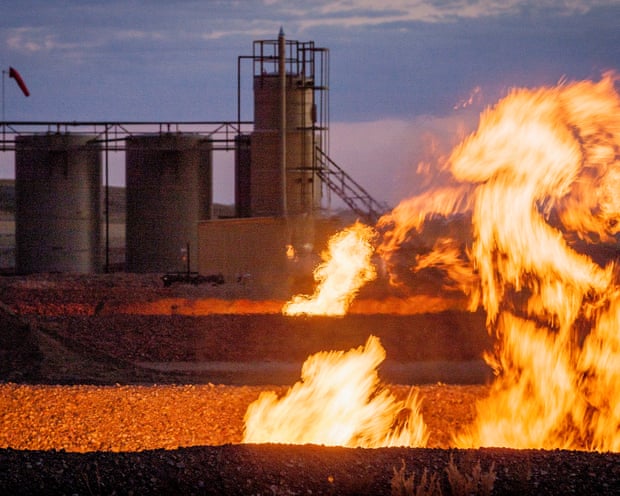
More than 160 governments are nominally signed up to the global methane pledge. Photograph: Orjan F Ellingvag/Corbis/Getty Images
Analysis published at Cop30 summit shows adhering to pledges offer world hope of avoiding climate breakdown
Sticking to three key climate promises – on renewables, energy efficiency and methane – would avoid nearly 1C of global heating and give the world hope of avoiding climate breakdown, analysis published at the Cop30 climate summit suggests.
Governments have already agreed to triple the amount of renewable energy generated by 2030, double global energy efficiency by then, and make substantial cuts to methane emissions.
If they follow through on these promises – still a big if, even though countries are meeting for climate crisis talks in Brazil this week – it would be a “gamechanger”, shaving 0.9C from projected temperature rises this century, according to the Climate Action Tracker coalition.
Achieving all of these measures, among G20 countries alone, would reduce global greenhouse gas emissions by 18bn tonnes in 2035 – enough to cut the rate of global heating by a third in the next decade, and halve it by 2040.
Bill Hare, chief executive of Climate Analytics, one of the organisations behind the report, said: “If [governments] achieve this by 2035, it would be a gamechanger, quickly slowing the rate of warming in the next decade and lowering global warming this century from 2.6C to about 1.7C.”
Orcas comment on killer apes destroying the planet by continuing to burn fossil fuels.Donald Trump urges you to be a Climate Science denier like him. He says that he makes millions and millions for destroying the planet, Burn, Baby, Burn and Flood, Baby, Flood.Nigel Farage urges you to ignore facts and reality and be a climate science denier like him and his Deputy Richard Tice. He says that Reform UK has received £Millions and £Millions from the fossil fuel industry to promote climate denial and destroy the planet.
The proportion of patients who said there were always enough nurses on duty improved from 55.7% in 2023 to 57.9% in 2024. Photograph: Jeff Moore/PA
Findings of CQC survey from November 2024 lead experts to say waiting in such settings has become normalised
Corridor care has become the new normal in England, experts have said, as a national survey found that one in five patients admitted to hospital had to wait in such settings.
The report by the Care Quality Commission also found that nearly 10% of patients waited more than 24 hours to be admitted to hospital and 17.5% waited 12 to 24 hours.More than half of all patients waited more than six hours.
Nearly half waited in a treatment bay, but 18% had to wait in a corridor, 31% in a waiting room and 1%, or 361 patients, said they had to wait in a storage room or cupboard in November last year.
The CQC’s chief inspector of hospitals, Dr Toli Onon, said trolley waits were regrettable and must not become the norm. She said it was great to see improvements since but that reports of lengthy waits and patients whose health had deteriorated was a real concern.
Keir Starmer says that the Labour Party under his leadership is intensely relaxed about assaulting those least able to defend themselves – the very poorest and most vulnerable.
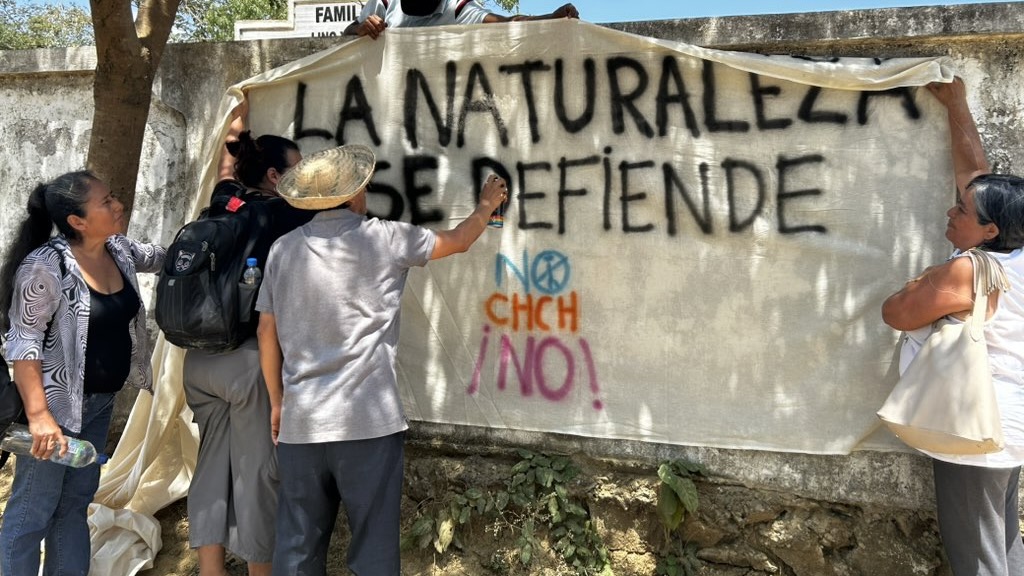
Community members in Santa Elena, Ecuador, painting a banner reading “Defend nature, VOTE NO”. The grassroots nature of the “NO” campaign appears to have given it greater success. Photo: NOchchNO / X
The government has suffered a harsh and resounding defeat to its political and economic plans. In this article, we present the results and offer some explanations for the outcome of November 16.
In a massive defeat for President Daniel Noboa’s neoliberal program, Ecuador overwhelmingly voted “No” on all four questions in the national referendum held on November 16. The result is a crushing blow for the government, who had hoped a victory would help pave the way for a structural transformation of the Ecuadorian state.
The election was organized at the request of right-wing President Noboa who called for a referendum in September of this year, hoping to achieve the economic elites’ long-awaited dream of converting Ecuador’s legal framework into a neoliberal one.
What were the referendum’s four questions?
The first question asked Ecuadorians whether foreign military bases should be allowed in Ecuador, something that is prohibited by the current constitution. Noboa appealed to the deep sense of insecurity felt by people in the country as a result of the historic crisis of violent crime, in which drug trafficking gangs are fighting over territory.
The government claimed that the installment of foreign military personnel would help reduce insecurity, although the opposition argued that it was an excuse to align the country with Washington’s geopolitical interests.
The next two questions were called “bait questions” by the opposition. They argued that the questions were less overtly ideological and employed a kind of electoral populism to exploit the widespread dissatisfaction with the political class, with the hope of garnering support for the more extreme parts of the referendum. The “bait questions” had to do with reducing the number of legislators and eliminating state funding for political parties.
The opposition, however, claimed that both measures would have benefited the ruling party, as they would have reduced the representation of small provinces and prevented political parties without wealthy contributors from running election campaigns.
Finally, the most important question had to do with the creation of a constituent assembly to draft a new neoliberal constitution, which is the great desire of the country’s economic elites.
Though the government was not particularly vocal about this, its silence about its intentions only provoked anxiety among voters, who saw this obscurity as a sign that the new constitution would reduce rights won in past decades.
The results
After the initial results were announced, several media outlets repeated the phrase “No one expected these numbers.” The latest polls had predicted that Noboa would win on all four questions, although it was known that the gap between the YES and NO votes had narrowed on the questions about military bases and the convening of a constituent assembly.
However, the president’s defeat was crushing. Not even on the so-called “bait questions” did Noboa manage to win over the majority of Ecuadorians, who clearly said “No” to the executive branch’s neoliberal project.
The government had prepared celebrations in Quito and Guayaquil, but the YES campaign headquarters were empty and the few Noboa supporters present were clearly shocked. Many expected the president to make statements to the press and his supporters, but Noboa did not appear.
He left only a brief message on X: “We consulted the Ecuadorian people, and they have spoken. We fulfilled our promise: to ask them directly. We respect the will of the Ecuadorian people. Our commitment remains unchanged; it is strengthened. We will continue to fight tirelessly for the country you deserve, with the tools we have.”
Thus, some analysts have claimed that Noboa is announcing his refusal to back down from his plan to neoliberalize the economy and the state, although he’s been forced to do so by other means. Currently, the ruling party has a majority in the National Assembly, but it will now be more difficult for it to carry out the reforms it proposes due to the votes of the independents who support it and who may hesitate to give their support to the government, as well as a Constitutional Court that has already put a stop to several of the president’s laws that undermine the legal structure of the state.
However, it is important to consider that if all the votes had been against the government, the results between one question and another would not have fluctuated so much. This is because there was a difference in voting, especially between questions 1 and 4, compared to questions 2 and 3. In this regard, some analysts have highlighted a flawed political communication strategy and the ruling party’s election campaign.
Questions loomed regarding, which foreign armed troops would come to the country to go where (there was much speculation that it would be in the Galapagos, one of the natural treasures most cherished by Ecuadorians). Also murky was the content of the constitution that the government wanted (Noboa literally said that the day after winning the referendum he would reveal the structure of the new constitution, not before).
However, attributing the government’s defeat solely to its communication failures is insufficient and dangerous, as it overshadows the enormous efforts of various political groups, social movements, and citizen collectives that campaigned for the NO vote.
Thus, the NO campaign had to be carried out in an almost artisanal manner. No political party (not even Correísmo) took the lead in the NO campaign, so funding was almost non-existent. The various videos on social media, discussions, interviews, etc., were produced by civil society, which did what it could with the little it had.
However, this accidental strategy proved to be fundamental, because, as it was “ordinary people” who ran the campaign, many undecided Ecuadorians felt that their “peers” were speaking directly to them, and not on behalf of a political party that would probably have been stigmatized by the ruling party.
Several government spokespeople began to suggest possible constitutional changes if the yes vote won, such as labor flexibility, the elimination of some rights of Indigenous peoples’ (such as Indigenous justice), the elimination of the rights of nature (something in which the country is a pioneer), and the elimination of free tuition for university students, among others. This, coupled with Noboa’s silence, allowed the opposition to organize a successful political campaign that appealed to an anti-neoliberal spirit that remains in the country.
Ecuador does not yield to neoliberalism: a historic struggle
Similarly, national workers’ strikes in the 1980s, Indigenous mobilizations in the 1990s, and in the last six years have stopped attempts to neoliberalize the country in the streets, a historical trend that continues to be confirmed today.
Faced with enormous popular rejection, the 1998 Constitution, with its clear neoliberal slant, was drafted in a military barracks, behind closed doors, with the almost exclusive participation of the Ecuadorian right.
That constitution, which opened the door to the dollarization of the country and the infamous bank holiday (in which thousands of Ecuadorians lost their savings to save the banks in crisis) was replaced by the 2008 Constitution, in which more than 150 social and political organizations went to the Assembly to demand that their claims be included.
Thus, this constitution, now clearly endorsed with full popular legitimacy, brought together a series of rights that had been demanded and won over decades by various groups of citizens. Perhaps this is why the government’s strategy of calling the current constitution “Correísta,” “Castro-Chavista,” etc., did not have the expected impact. People recognized that the country’s poor administration does not mean that the constitution is negative.
On the contrary, they saw in the ruling party’s plans something more dangerous than political antipathy toward Correísmo, which is why several people on the right and left who oppose the return of Correísmo voted NO in the 2025 referendum, which the government did not expect.
What will happen now?
For now, it remains to be seen how this sharp defeat will impact the country’s governability. Several right-wing intellectuals have called on the government to change its strategy, namely to start delivering clear results to Ecuadorians beyond advertising spots and smokescreens.
For now, changes are expected in the ministries and spokespersons of a government that, despite having been elected twice to govern, has lost in the referendums it has called and which have sought to introduce neoliberal changes.
This was the case in the 2024 referendum, also called by Noboa, in which he won on several questions to increase his power over security, but lost on the two economic questions, which sought to approve hourly work and subject Ecuador to international arbitration by international courts.
However, the defeat in 2025 is much deeper, as it implies a widespread rejection of a government that has lost much of the support of voters who trusted its administration but do not see results, which has increased mistrust. Today, the government has come to better understand sociologist Max Weber’s famous phrase: “Politics is a matter of faith and responsibility.”
A projection urges leaders to “get serious” about drawing down fossil fuel emissions in Rio de Janeiro, Brazil ahead of the United Nations Climate Change Conference on November 5, 2025. (Photo by Fabio Teixeira/Anadolu via Getty Images)
“We need to make sure that any and all plans towards a fossil fuel-free future are built with community and frontline needs at the heart, and implemented in a way that does not leave vulnerable communities behind.”
Despite concerns over the presence of hundreds of corporate lobbyists peddling “false solutions” at the United NationsClimate Change Conference in Belém, Brazil, campaigners on Monday expressed optimism about the “remarkable speed” with which global support has grown at the summit for a Transition Away From Fossil Fuels Roadmap.
Brazilian President Luiz Inácio Lula da Silva opened the Leader’s Summit on November 6 with a call for the TAFF Roadmap, which would build on the 2023 conference’s (COP28) promise to “transition away from fossil fuels” in a “just, orderly, and equitable manner.”
He urged leaders to map out how their countries will “overcome dependence on fossil fuels,” reverse deforestation, and mobilize resources to achieve those goals, as the presidencies of this year’s conference (COP30) and last year’s released a Baku to Belém Roadmap with a plan to mobilize $1.3 trillion per year in climate finance for developing countries.
350.org found on Monday that within nine days, support for the TAFF Roadmap grew from one to 62 countries.
Suluafi Brianna Fruean, a 350.org Pacific Council elder, acknowledged that a call for “a transition away from fossil fuels is not a new concept for the Pacific, it’s a demand we’ve made at every COP and every room we’ve been in.”
Still, she said, “the growing support for a roadmap to this reality is a sign that the age of fossil fuels is over. We need to make sure that any and all plans towards a fossil fuel-free future are built with community and frontline needs at the heart, and implemented in a way that does not leave vulnerable communities behind.”
“The presidency calls on developing countries to lead, prioritize public, grant-based, concessional finance to protect the world’s most vulnerable, and break the vicious debt cycle. However, it misses the urgency to simplify direct access to finance for communities, especially Indigenous peoples.”
350.org analyzed public statements and written inputs from countries and country groups to the COP30 presidency, and released its analysis of the conference’s momentum as the Brazil presidency released its “consultation text.”
That document lays out options for a final agreement at COP30, including “the ingredients for a highly ambitious outcome,” said 350.org.
Options in the text include establishing a three-year program to implement Article 9.1 in the Paris Agreement, which requires wealthy countries to finance adaptation and a transition away from fossil fuels for the Global South; tripling adaptation finance; and implementing Article 3.5 of the UN Framework Convention on Climate Change, which requires parties to support an economic system that leads “to sustainable economic growth and development in all parties… thus enabling them better to address the problems of climate change.”
“Finance is the engine of climate action. The presidency calls on developing countries to lead, prioritize public, grant-based, concessional finance to protect the world’s most vulnerable, and break the vicious debt cycle,” said Fanny Petitbon, France team lead for 350.org. “However, it misses the urgency to simplify direct access to finance for communities, especially Indigenous peoples, who hold solutions on the ground yet face enormous barriers to securing the funds needed to scale them up.”
A second package of options is set to be released in the coming days and “will cover the more technical negotiating areas,” according to the World Wildlife Fund (WWF).
Andreas Sieber, associate director of policy and campaigns at 350.org, credited Lula with injecting “real momentum into a global roadmap to move away from fossil fuels.”
But Sieber noted that Brazil recently gave its state-owned oil and gas company, Petrobras, license to drill a well in the Amazon rainforest, and Brazil is still one of the top 10 producers of crude oil globally.
“Lula spoke powerfully about justice and cooperation in a divided world, highlighting the need to get rid of fossil fuels and accelerate the energy transition,” Sieber toldArgus Media after the Leaders’ Summit. “But he cannot be both a champion of climate justice and one of the world’s biggest oil expanders.”
350.org added that in a TAFF Roadmap, “finance, technology transfer, and capacity-building must be central pillars—not peripheral details—if the transition is to lift up communities rather than deepen inequality.”
WWF also applauded the “momentum” at COP30, and urged “decisive political leadership” in order to “get back on track to the 1.5°C Paris Agreement temperature limit.”
Manuel Pulgar-Vidal, WWF global climate and energy lead, and the president of COP20, said that “COP30 could make history by agreeing on roadmaps for both a transition away from fossil fuels and to combat deforestation. It must also respond to the emissions gap in national climate plans, and make advances on finance, including to help countries adapt to climate change.”
Donald Trump urges you to be a Climate Science denier like him. He says that he makes millions and millions for destroying the planet, Burn, Baby, Burn and Flood, Baby, Flood.Nigel Farage urges you to ignore facts and reality and be a climate science denier like him and his Deputy Richard Tice. He says that Reform UK has received £Millions and £Millions from the fossil fuel industry to promote climate denial and destroy the planet.Orcas comment on killer apes destroying the planet by continuing to burn fossil fuels.

 Chancellor Rachel Reeves delivers a speech in the media briefing room of 9 Downing Street in central London, ahead of the Budget later this month, November 4, 2025