‘Time for Them to Leave’: Charlotte Communities Rise Up Against ICE Invasion

Spread the love

Original article by Brett Wilkins republished from Common Dreams under Creative Commons (CC BY-NC-ND 3.0). 
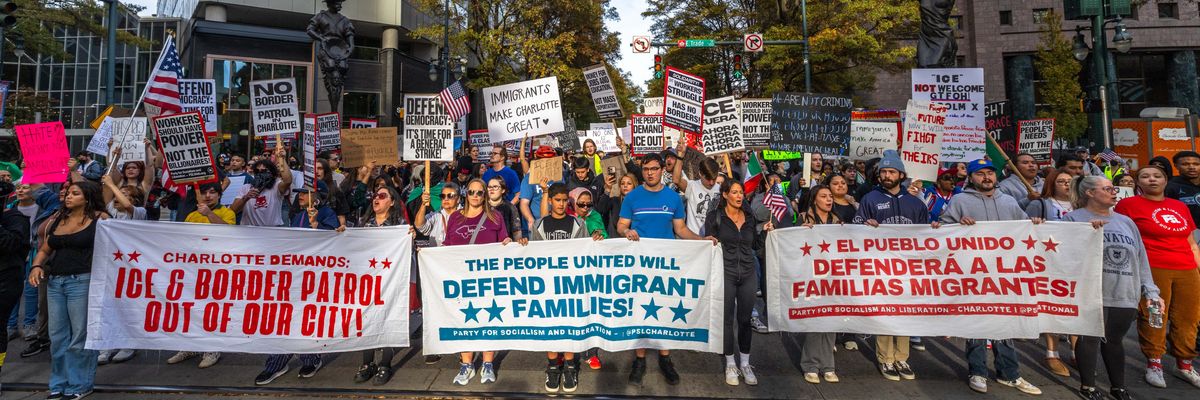
Protesters march through uptown after gathering at First Ward Park for the “No Border Patrol In Charlotte” rally on November 15, 2025 in North Carolina’s largest city. (Photo by Grant Baldwin/Getty Images)

“I want to keep my neighbors protected because they deserve protection and they deserve to live in a world where they’re not scared,” said one woman patrolling the streets of Charlotte with a whistle.

Backlash against the Trump administration’s assault on immigrant communities—in which some US citizens are also getting caught up—is growing in Charlotte, North Carolina this week, as over 30,000 students staged walkouts to protest the federal invasion, people rallied to condemn the arrest of day laborers, and communities mobilized to protect their friends and neighbors targeted by federal agents.

Hundreds of people gathered outside the Home Depot on North Wendover Road Wednesday morning, lining both sides of the street, holding signs supporting immigrants and denouncing US Immigration and Customs Enforcement (ICE) and Border Patrol agents, and cheering as motorists honked in support.

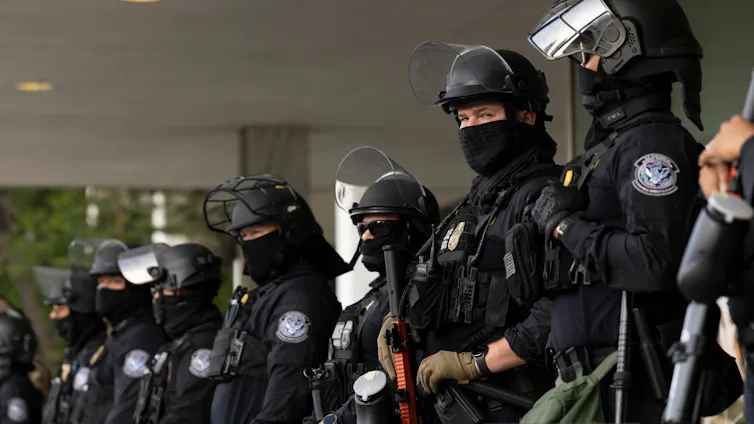
The protest came on the fifth—and reportedly penultimate—day of Operation Charlotte’s Web, which the Department of Homeland Security claimed targeted the “worst of the worst criminal illegal aliens.” The Mecklenburg County Sheriff’s Office said Thursday that it has been informed by federal officials that Operation Charlotte’s Web has wrapped up.

The administration’s “worst of the worst” claim does not seem supported in the vast majority of the hundreds of arrests made in the Charlotte area, as ICE and US Customs and Border Protection (CBP) agents have targeted locations including a church, grocery stores, construction sites, homes, and hardware store parking lots where day laborers gather every morning in search of work.

“From guns being drawn on pedestrians, windows broken at restaurants and US citizens being detained and later released, it is clear that CBP’s main mission is to disrupt public safety and everyday life in Charlotte,” Zamara Saldivar of the Carolina Migrant Network told WFAE at the Home Depot protest.

Protester Norm Perreault told the Charlotte Observer that “they say they’re deporting the worst of the worst, but day laborers are the best of the best.”

Former Charlotte Mayor Jennifer Roberts, a Democrat, was also at the Home Depot demonstration, where she declared: “We are here to support the immigrant community. We know they’re an integral part of our economy, education, culture, and growth.”

“It’s time for them to leave,” Roberts said of the federal invaders. “We need business to get back to normal. We need our schools to be able to educate our children.”

On Monday, an estimated 30,000 Charlotte-Mecklenburg Schools students walked out of their classrooms in protest of the crackdown. Students marched, held signs, and chanted messages including, “No borders, no nations, stop the deportations!”

“It’s stressful seeing my mom ‘cuz, like, she struggled with bills already going to work. I mean, even without her going to work, she’s struggling even more.” said one unidentified student protester from East Mecklenburg High School told WCNC, discussing his family’s fear of being targeted during the crackdown.

Another unidentified East Mecklenburg High student lamented “little kids losing their parents by ICE and getting taken, seeing them cry, and that, like, it breaks my heart seeing them like that.”

East Mecklenburg High multilingual teacher David Gillespie told WJBF that “a school should be a safe place for a child to come. They should be able to come here to get their education, they should be able to come here and spend time with their friends, socialize, they should feel secure.”

“I’m not sure which of my students I’m going to see again,” Gillespie said in a separate interview with WCNC. “Whether because their parents were involved in detainments or because their parents have to make that unfortunate safety calculus—Is it worth it to send my kids to school and put myself at risk?”

Parent Portia James told WBTV that she supports the walkout as an avenue for “students to be able to say something and voice their opinion in a positive way.”

“This is not the kind of behavior that we want in Charlotte going forward,” James said of the federal crackdown.

This week’s demonstrations followed Saturday’s “No Border Patrol in Charlotte” rally and march, which drew thousands of protesters to First Ward Park and the city’s streets.

Concern is also growing over federal agents arresting and terrorizing US citizens who legally follow, monitor, and record their activities. Vigilant residents have been confronting federal agents, shouting, blowing whistles, and recording them. Federal agents have also seized US citizens who’ve shown proof of their citizenship.

“Our country is facing a constant constitutional assault unlike we’ve experienced in many decades,” David Bier, director of immigration studies at the libertarian Cato Institute, said on X Wednesday. “Don’t give an inch of your freedom.”

Undaunted, some democracy defenders have taken to mocking the invaders:

Others are mobilizing to resist the invasion and protect their immigrant relatives, friends, and neighbors. Residents have formed volunteer patrols, parents and educators have monitored schools and surrounding areas for agents, and church parishioners armed with whistles are alerting community members when “la migra esta aquí”—the immigration agents are here.

On Saturday, Manolo’s Latin Bakery, which has operated in Charlotte for 28 years, was rocked as federal agents in tactical gear chased, tackled, and arrested people outside the business.

“I have seen these people in SUVs, cars that are not marked with their faces covered… throwing immigrants to the floor and taking them away,” owner Manolo Betancur told Queen City News on Saturday, saying he would temporarily shut down his business.

“I’m going to close the door right now,” he said. “Yeah, I’m not going to risk my customers… I don’t want to risk myself even though I am an American citizen. Because the way they look, because they’re way that my accent, because the way that I talk, they’re just going to throw me down to the floor.”

Local resident Beth Clements told CNN Thursday that she’s been outside the bakery for three days wearing a yellow vest and whistle.

“I’m going to walk the streets with my whistle,” she said, “and I want to keep my neighbors protected because they deserve protection and they deserve to live in a world where they’re not scared.”

Original article by Brett Wilkins republished from Common Dreams under Creative Commons (CC BY-NC-ND 3.0). 

Orcas discuss Donald Trump and the killer apes' concept of democracy. Front Orca warns that Trump is crashing his country's economy and that everything he does he does for the fantastically wealthy.
Orcas discuss Donald Trump and the killer apes’ concept of democracy. Front Orca warns that Trump is crashing his country’s economy and that everything he does he does for the fantastically wealthy.
Donald Fuhrump says that Amerikkka doesn't bother with crimes or charges anymore, not being 100% Amerikkkan and opposing his real estate intentions is enough.
Donald Fuhrump says that Amerikkka doesn’t bother with crimes or charges anymore, not being 100% Amerikkkan and opposing his real estate intentions is enough.

Continue Reading‘Time for Them to Leave’: Charlotte Communities Rise Up Against ICE Invasion

European left urges solidarity with Venezuela amid growing US aggression

Spread the love

Original article by Ana Vračar republished from peoples dispatch under a Creative Commons Attribution-ShareAlike 4.0 (CC BY-SA) license.

Protest against US and UK sanctions on Venezuela. Photo: Venezuela Solidarity Campaign

Left parties and organizations across Europe are calling for respect for Venezuela’s sovereignty and action against escalating US aggression in the Caribbean.

European leaders continue to subordinate themselves to the Trump administration, including on the United States’ escalating military threats against Venezuela. Shortly before this month’s CELAC–EU summit in Colombia, several high-ranking figures, including European Commission President Ursula von der Leyen, German Chancellor Friedrich Merz, and French President Emmanuel Macron, suddenly announced they would not attend the meeting. Their move has widely been understood as an attempt to avoid displeasing US President Donald Trump at a moment of mounting US aggression in Latin America.

Read more: A brief overview of US military interventions in the Americas

In contrast, left parties in the region warn against this approach. Instead of supporting US militarism, they insist, Europe should uphold international law, respect the sovereignty of Latin American states, and push for diplomacy over war.

“We are witnessing an unprecedented military escalation in 20 years, a multifaceted aggression that threatens not only Venezuela, but any project of sovereignty and social justice in Latin America,” the Workers’ Party of Belgium (PTB-PVDA) wrote in response to the situation. Italy’s Potere al Popolo echoed this concern, noting that US interests in Latin America have remained unchanged for decades. “On the one hand, it’s about securing access to the immense oil, water, and raw materials reserves, but also to the food production capacities of the Latin American continent (an economic and trade war),” the party wrote. “On the other hand, they want to stifle the efforts of progressive and socialist governments (an ideology war).”

For left organizations from Greece to Britain, there is little doubt that the current US threats against Venezuela amount to a push for regime change. Most see this as yet another step that could trap Latin America and the rest of the world into an even deeper cycle of violence. Despite such concerns, most European governments have not shown any sign of questioning US plans or proposing alternatives. Just the opposite: in addition to skipping multilateral discussions with Latin American counterparts, some have even chosen to reduce diplomatic representation in the region.

Belgium recently announced it would close several diplomatic missions, including those in Havana and Rio de Janeiro. The PTB-PVDA warned against this decision, emphasizing that it is both dangerous and short-sighted. “This is a very bad idea,” said party General Secretary Peter Mertens. “At a time when international law and international relations are already under heavy pressure, and US President Donald Trump is announcing new military aggressions in the Caribbean region, we need more diplomacy.”

Read more: US deploys aircraft carrier and threatens invasion of Venezuela

Peace networks and organizations are similarly calling for a change of approach. Belgian associations Vrede and Intal appealed to parliamentary bodies to take action in light of recent US announcements regarding the launch of its new military initiative, Operation Southern Spear. “Venezuela is risking being plunged into chaos similar to the most devastating conflicts of recent decades, and a prolonged instability could arise across the region,” the groups wrote.

They also warned that Belgium has legal and political obligations to uphold international law and therefore support peaceful solutions. Similar calls have appeared in Britain, where several MPs and peace networks have criticized Prime Minister Keir Starmer for failing to oppose the US militarization drive. “There are deep fears that US military intervention in Venezuela would be the first step in a wider military escalation by Trump in Latin America,” their appeal warns. “The US has a long history of interference in the continent, where so-called ‘regime change’ has caused widespread suffering and lasting harm.”

The Venezuela Solidarity Campaign in Britain also urged action, saying: “The task now is to maximize support for solidarity with Venezuela on the basis of respect for Venezuela’s sovereignty, a recall of the US fleet, and end to US military aggression in Latin America and the Caribbean.”

Read more: From Palestine to Venezuela: The US is behind the door

Those calling for solidarity with Venezuela are well aware that their initiatives stand in stark contrast to the interests of powerful actors poised to benefit from the escalation. “War is beneficial for some, not least those who are well aware that Venezuela sits on the world’s largest oil reserves,” Jeremy Corbyn noted for the Stop the War Coalition.

Despite anticipating a response from conservative and right-wing forces, left parties and progressive networks insist that now is the time to intensify solidarity. “Trump is responding to the crisis of US hegemony with greater militarization of the world. Europe – including Giorgia Meloni’s government – is following suit by increasing military spending and attacking the rights of the working class,” Potere al Popolo stated. “Today, more than ever, we have a duty to stop this expanding war economy, as the dockworkers demonstrated with their recent general strikes and as millions around the world showed by marching for peace.”

Original article by Ana Vračar republished from peoples dispatch under a Creative Commons Attribution-ShareAlike 4.0 (CC BY-SA) license.

Orcas discuss how Trump was re-elected and him being an obviously insane, xenophobic Fascist.
Continue ReadingEuropean left urges solidarity with Venezuela amid growing US aggression

Between invasion and diplomacy: Trump’s options with Venezuela

Spread the love

Original article by Pablo Meriguet republished from peoples dispatch under a Creative Commons Attribution-ShareAlike 4.0 (CC BY-SA) license.

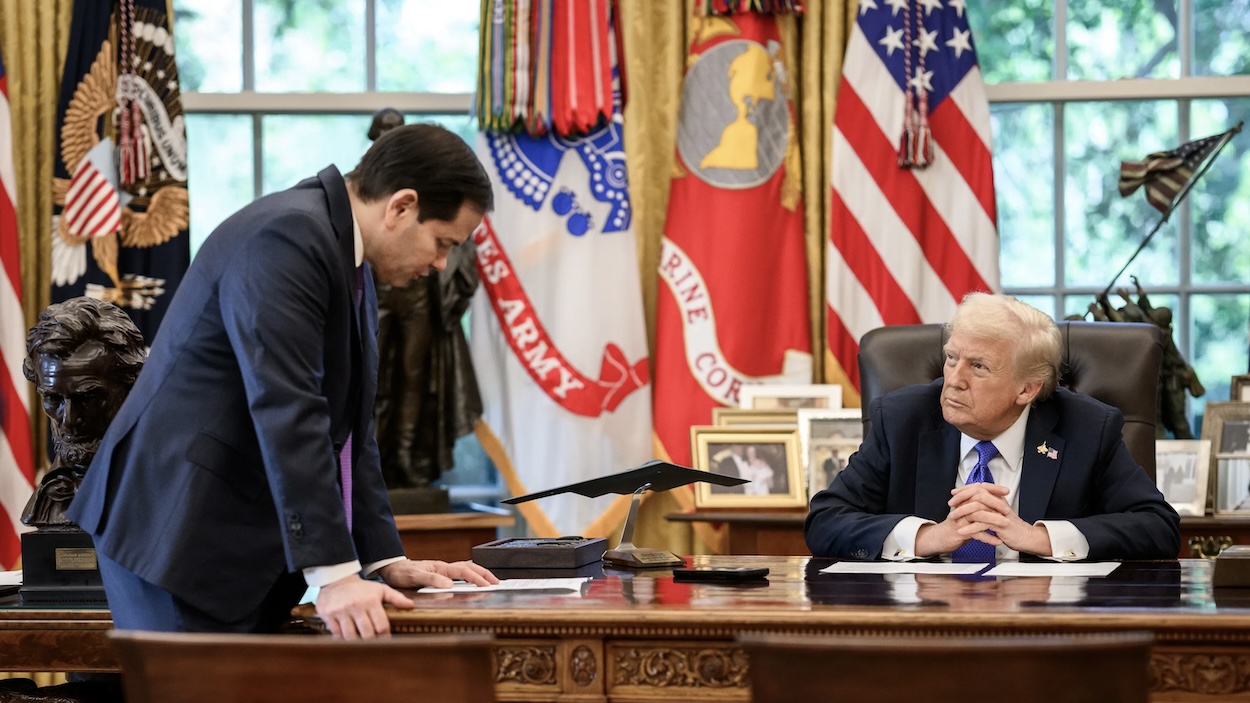
US President Donald Trump and US Secretary of State Marco Rubio in the Oval Office. Photo: The White House

While Trump increases military pressure in the Caribbean Sea, he hasn’t ruled out the possibility of resuming talks with Caracas. Meanwhile, Maduro supports the diplomatic route and rejects the possibility of war

At a press conference on November 17, US President Donald Trump stated that he does not rule out using his armed forces in Venezuela. This military buildup has involved the Pentagon deploying thousands of soldiers to the Caribbean Sea and to countries collaborating with Washington in the so-called Southern Spear military operation. Most recently, the USS Gerald R. Ford, the largest aircraft carrier in the United States, arrived in the Caribbean to, according to the Pentagon, “combat transnational threats”.

The Trump administration claims that a large amount of the drugs entering the United States comes from Venezuela, whose government is allegedly part of a criminal structure called the “Cartel of the Suns”.

Caracas has flatly denied these accusations and claimed that they are part of a justification to overthrow the Venezuelan government (which controls the world’s largest oil reserves) and thus force a change of direction in the country that is aligned with Washington’s economic and geopolitical interests.

Washington insists on its accusations

On November 16, the US State Department announced that it will designate the Cartel of the Suns (Cartel de los Soles) a foreign terrorist organization. Defense Secretary Marco Rubio stated: “The Cartel of the Suns, along with other designated foreign terrorist organizations, including the Aragua Train and the Sinaloa Cartel, are responsible for terrorist violence throughout the hemisphere, as well as drug trafficking to the United States and Europe.”

According to US authorities, this designation gives the US military carte blanche to attack the assets and infrastructure of what they consider to be part of the Cartel de los Soles, despite the fact that a large number of international law experts argue that this is not sufficient to legally justify an attack outside its borders.

Despite these warnings, the Trump administration has already launched attacks on small boats in the Caribbean Sea that, according to Washington, were carrying drugs to the United States, although no reliable evidence has yet been presented to prove this. Dozens of deaths have been reported so far.

Read More: From Palestine to Venezuela: The US is behind the door

The big question arising from the recent military and administrative maneuvers by the United States is whether Washington will dare to attack Venezuelan territory on the grounds that it is an attack to destroy a terrorist organization. For the moment, Trump has moved forward with these measures, although he has been cautious in stating that the attack will take place.

Trump says he will speak with Maduro soon

While the Trump administration increases pressure on Venezuela, even authorizing covert actions in the Caribbean country according to the New York Times, it also claims that there may be an open channel of communication with Caracas.

This was seemingly confirmed at the November 17 press conference, when, in response to questions from reporters about possible communication with Maduro, Trump said, “At some point, I will talk to him.”

Maduro’s response

In response to these statements, the Venezuelan president reacted by saying that the conversation should take place: “Only through diplomacy can differences be resolved … Anyone who wants to talk to Venezuela will talk face to face, but the Venezuelan people cannot be allowed to be massacred.”

Maduro warned that one of the consequences of a possible military invasion of Venezuela would be the loss of legitimacy of the Trump administration: “A war against Venezuela would be the political end of his leadership and his name. [Some people are trying to push Trump to] make the most serious mistake of his entire life.” He also said that public opinion in the United States is increasingly rejecting a possible military intervention in South America.

For now, Washington wants to maintain all options available when negotiating with Maduro’s government, whether through military or diplomatic means. Thus, Trump is deploying his military and intelligence assets in South America while keeping the lines of communication open with Maduro. For its part, the Venezuelan government is betting on diplomacy while preparing for a possible military invasion that would seek to end more than 25 years of Chavista rule, although such an operation could have unforeseen effects in the region, even for Washington.

Original article by Pablo Meriguet republished from peoples dispatch under a Creative Commons Attribution-ShareAlike 4.0 (CC BY-SA) license.

Donald Fuhrump says that Amerikkka doesn't bother with crimes or charges anymore, not being 100% Amerikkkan and opposing his real estate intentions is enough.
Donald Fuhrump says that Amerikkka doesn’t bother with crimes or charges anymore, not being 100% Amerikkkan and opposing his real estate intentions is enough.
Orcas discuss how Trump was re-elected and him being an obviously insane, xenophobic Fascist.

Continue ReadingBetween invasion and diplomacy: Trump’s options with Venezuela

How the rich world is fortifying itself against climate migration

Spread the love
US Customs and Border Protection field officers during ICE deportation protests in Los Angeles, June 2025. Matt Gush / shutterstock

Andrea Rigon, UCL

The UK has announced much harsher rules for asylum seekers including the prospect of more deportations for those whose applications fail. The US is trebling the size of its deportation force. The EU is doubling its border budgets. And in the coming decades, hundreds of millions of people might be displaced by ecological changes.

In the face of this challenge, those countries which are most responsible for climate change have two options. Either they can share resources more equitably, and fund adaptation plans on a massive scale. Or they can prevent others from accessing resources and liveable land through physical and regulatory walls, enforced through mass deportation.

Recent events show that, faced with this choice, many governments are choosing not to share resources to anywhere near the extend needed, and are instead building higher walls.

Climate change is already making life unliveable in some parts of the world. According to a 2020 report from thinktank the Institute for Economics and Peace (IEP), 2.6 billion people face high or extreme water stress. By 2040, this may jump to 5.4 billion. Droughts, heatwaves, floods, cyclones, food shortages and related conflicts will force millions from their homes.

The IEP warns that up to 1.2 billion people globally might be displaced by 2050, while even the more-cautious World Bank predicts 216 million climate migrants.

Most of these people will move internally within nations, but this too is likely to mean more walls and borders. In very unequal countries, internal migration has already triggered security-driven responses, with a rise in gated communities and other segregated living arrangements to keep the poorer away from the wealthy.

Many other climate migrants will be pushed to travel internationally. It’s likely their motivation will be characterised by many as economic rather than due to climate change. But it’s misleading to separate “economic” from “climate” migrants. When drought kills crops in Somalia or floods wash away farmland in Pakistan, the loss of income is inseparable from the climate shocks that caused it.

Even before the worst impacts hit, climate change is already woven into the economic pressures that push people to move – shrinking harvests, emptying wells and ruining livelihoods. The most severe climate-driven displacement is still ahead, but it has already begun.

Importantly, these pressures come with inequalities in causing climate change and bearing the costs. The richest 1% of the world’s population produces as much carbon as the poorest two-thirds, according to a study of global emissions in 2019 by Oxfam. Northern Europe and the US alone account for 92% of historical emissions.

Those who have contributed the least to climate change are the worst affected and often have the fewest resources to adapt, forcing many people to migrate.

More walls, more deportations

In this context, governments of wealthier countries are massively increasing spending on migration policing. In the US, proposed funding levels are extraordinary.

Recent legislation allocates nearly US$30 billion (£22 billion) to the Immigration and Customs Enforcement agency (Ice) for enforcement and deportation operations – roughly three times its current budget.

The US has also authorised US$45 billion for new detention centres – a 265% increase, more than the entire defence budget of Italy – and US$46.6 billion for additional border walls. Under this plan, Ice would become the largest US law enforcement agency, three times the size of the FBI.

Donald Trump’s policies can be easily labelled as the excess of one would-be autocrat, but this is a global trend across the political spectrum, albeit implemented with more acceptable language by the centre-left.

Introducing the UK Labour government’s new asylum and returns policy, Prime Minister Keir Starmer said: “We need an approach with a stronger deterrent effect and rules that are robustly enforced.” But previously-supportive MPs from his own party have warned this will mean “Ice-style raids” to deport asylum seekers.

The European Commission’s 2028–34 budget proposal earmarks €25.2 billion (£21.7 billion) for border management and €12 billion for migration, plus €11.9 billion for the Frontex border agency – more than double its current resources.

All this effectively triples current migration and border spending. In 2024, the EU ordered 453,000 non-EU nationals to leave, and actually deported 110,000 of them.

This is part of a much wider pattern, with borders today being far more militarised than at the end of the cold war. After decades of globalisation, states are now reterritorialising, building armoured fortifications against unwanted flows.

In the past two decades, more than 70 new international barriers have gone up, including Poland’s barbed-wire fence with Belarus, Greece’s steel wall on the Turkish border, Turkey’s stone wall on its Iranian border, and the new sections of the infamous wall between the US and Mexico.

Israel has built an “iron wall” around Gaza and border fences through much of the West Bank. Supposedly built to prevent Palestinians moving into Israel, these barriers have become a clear example of migration control tied to power grabs for land and resources.

A crossroads for human rights

Resource-driven migration pressures are rising just as the world is hardening its borders. In July 2025, the International Court of Justice declared that countries have a legal responsibility to address and compensate for climate change – and can be held accountable for their emissions. It is another signal that as humanity, we are at a crossroads.

The world can either prioritise universal human rights by sharing resources. Or it can attempt to protect a small, wealthy minority through walls, mass deportations and border violence on an unprecedented scale.

Andrea Rigon, Professor, Politecnico di Milano, and, UCL

This article is republished from The Conversation under a Creative Commons license. Read the original article.

Keir Starmer refuses to be outcnuted by Nigel Farage's chasing the racist bigot vote.
Keir Starmer refuses to be outcnuted by Nigel Farage’s chasing the racist bigot vote.
Climate science denier Nigel Farage explains that it's simple to blame asylum-seekers or Muslims for everything.
Climate science denier Nigel Farage explains that it’s simple to blame asylum-seekers or Muslims for everything.
Continue ReadingHow the rich world is fortifying itself against climate migration

“We Will REPLACE LABOUR”: Zack Polanski Says Labour’s Time Over

Spread the love

Keir Starmer says that the Labour Party under his leadership is intensely relaxed about assaulting those least able to defend themselves - the very poorest and most vulnerable.
Keir Starmer says that the Labour Party under his leadership is intensely relaxed about assaulting those least able to defend themselves – the very poorest and most vulnerable.
Keir Starmer objects to criticism of the IDF. He asks how could anyone object to them starving people to death, forced marches like the Nazis did, bombing Gaza's hospitals and universities, mass-murdering journalists, healthworkers and starving people queuing for food, killing and raping prisoners and murdering children. He calls for people to stop obstructing his genocide for Israel.
Keir Starmer objects to criticism of the IDF. He asks how could anyone object to them starving people to death, forced marches like the Nazis did, bombing Gaza’s hospitals and universities, mass-murdering journalists, healthworkers and starving people queuing for food, killing and raping prisoners and murdering children. He calls for people to stop obstructing his genocide for Israel.
Orcas discuss Genocide-supporting and complicit Zionists. Donald Trump, Keith Starmer, David Lammy, Rachel Reeves, Angela Rayner and Wes Streeting are acknowledged as evil genocide-complicit and supporting cnuts.
Continue Reading“We Will REPLACE LABOUR”: Zack Polanski Says Labour’s Time Over