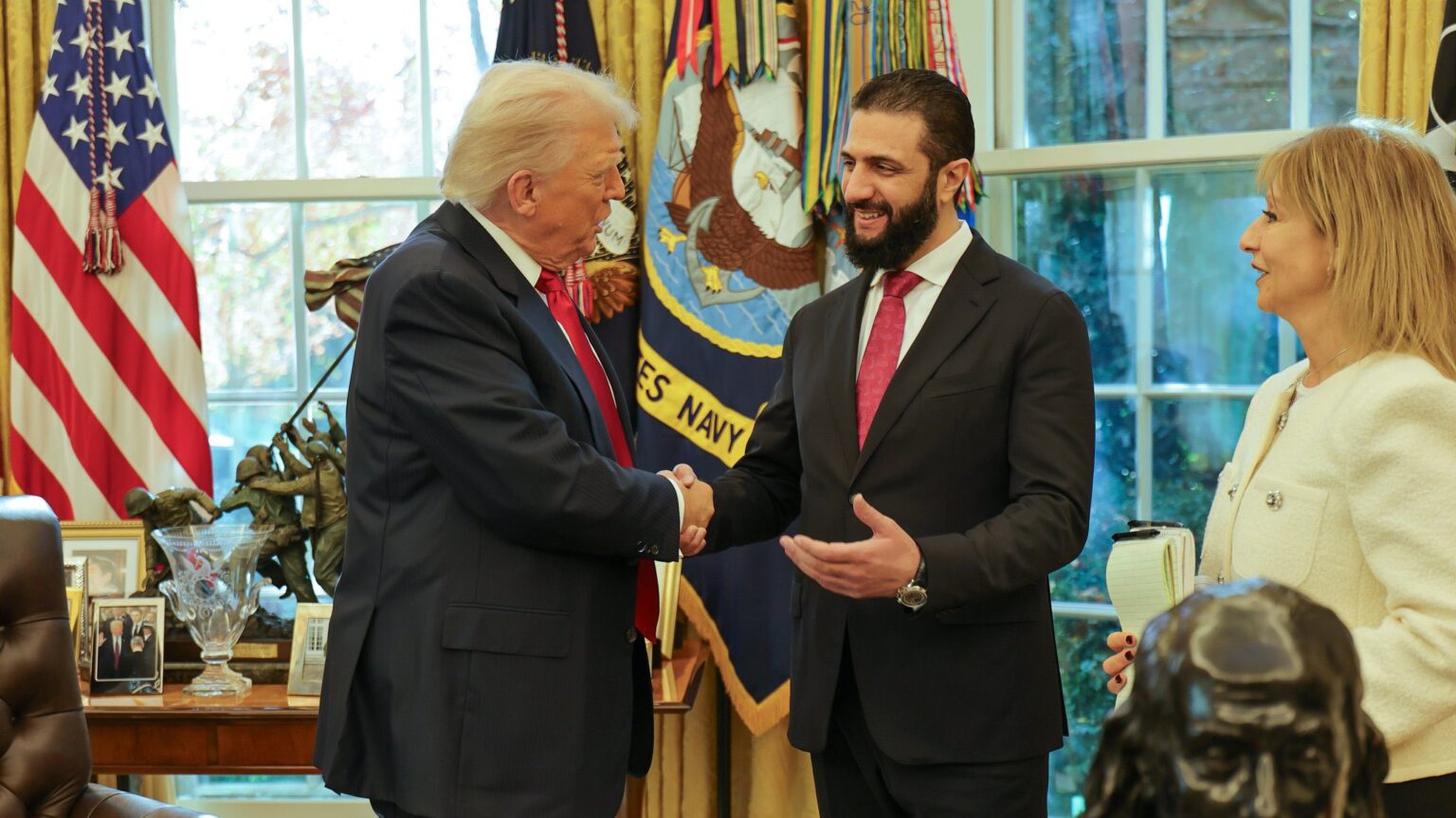
Syrian interim President Ahmad al-Sharaa meets US President Donald Trump at the White House Nov. 10. Photo: Syrian presidency
The visit of Syria’s interim president to Washington has once again showcased the ambivalence of US counter-terrorism policy, which changes according to temporal interests.
Syrian interim President Ahmad al-Sharaa arrived in Washington on Monday, November 10, to discuss various issues of mutual interest with US President Donald Trump.
The occurrence, which marks Al-Sharaa’s first visit to the United States has stirred controversy, and invited the mockery of critics, as it came a mere two days after Al-Sharaa was removed from the US Specially Designated Global Terrorist (SDGT) sanctions list.
This in turn has exposed the ambivalence of US counter-terrorism policy, which apparently designates or revokes persons and organizations from terrorism lists based on US interests at any given moment.
One day before being revoked from the SDGT sanctions list, the United Nations Security Council had also adopted a US resolution to remove Al-Sharaa and his Interior Minister, Anas Khattab, from sanctions targeting members and supporters of terrorist groups, including ISIS and Al-Qaeda.
Furthermore, Al-Sharaa’s visit followed the onset of a large-scale military campaign by Syria’s government forces on Saturday, November 8, against “terrorist cells” affiliated with ISIS in different governorates, according to the Syrian Ministry of Interior.
In what was interpreted as paving the way for Al-Sharaa to remain in office after Syria’s transitional period ends, Trump praised the former Al-Qaeda militant, saying:
“He’s a very strong leader, he comes from a very tough place. He’s a tough guy. I like him. I get along with the president, the new president of Syria, and we’ll do everything we can to make Syria successful because that’s part of the Middle East.”
Al-Sharaa says the visit marks new beginning for strategic relations with the US
For his part, Al-Sharaa considered his visit a new beginning for strategic relations between his country and the United States. During an interview with Fox News following his meeting with Trump on Monday, Syria’s new ruler said:
“For the past sixty years, Syria has been isolated from the rest of the world, and the relations were cut off between the United States and Syria. This is the first time a Syrian president has visited the White House since the establishment of Syria in the 40s of the last century.”
“After the fall of the former regime, Syria has entered into a new era and this will build on a new strategy specially with the United States,” Al-Sharaa added.
Syria joins US-led international coalition against ISIS
When he was asked whether he committed to having his country join the US-led international coalition to fight ISIS in the West Asia region, Al-Sharaa answered:
“We have fought many battles against ISIS over the past ten years and endured great suffering, losing a significant number of men. While there are reasons for the US military presence in Syria, this presence must now be coordinated with the Syrian government. We need to discuss these issues and reach an agreement regarding ISIS.”
On Tuesday, November 11, Syria’s information minister, Hamza al-Mustafa, and a US official announced that Syria signed a “political declaration” with the coalition, confirming that it will have a role in “combating terrorism and supporting regional stability”.
However, Al-Mustafa clarified that “the agreement is political and until now contains no military components.”
Al-Sharaa offers extraction of Syria’s gas to become US ally
Al-Sharaa also told Fox News that he discussed with Trump future investment opportunities in Syria, particularly the extraction of gas by the United States.
“We talked about the investment opportunities in the future in Syria, so that Syria is no longer looked at as a security threat. It is now looked at as a geopolitical ally. And it’s a place where the United States can have great investments, especially extracting gas,” he noted.
Regarding Syria’s future relation with Israel, Al-Sharaa ruled out the possibility of joining the “Abraham Accords”, but he expressed his hope that the Trump administration will help his country to reach a security agreement with Israel to end its occupation of the Golan Heights.
“I believe that the situation in Syria is different from the situation of the countries that signed on to the Abraham Accords. Syria has borders with Israel, and Israel has occupied the Golan Heights since 1967. We are not going to enter into negotiations directly right now. Maybe the United States administration with President Trump will help us reach this kind of negotiation.”
Nevertheless, Al-Sharaa provided contradictory statements regarding the involvement of his government in negotiations with Israel during an interview with The Washington Post on the same day of being interviewed by Fox News.
The American newspaper cited Syria’s transitional leader saying:
“We are engaged in direct negotiations with Israel, and we have gone a good distance on the way to reach an agreement. But to reach a final agreement, Israel should withdraw to their pre-Dec. 8 borders.”
US declares partial suspension of sanctions on Syria following Al-Sharaa-Trump meeting
As both nations are looking forward to bolstering mutual security and economic interests, Al-Sharaa told The Washington Post that lifting the sanctions is essential for maintaining stability, which is, in turn, linked to economic development.
It is worth noting that shortly after the meeting, the United States Treasury Department announced that the Trump administration suspended key provisions of the Caesar Act sanctions on Syria for 180 days.
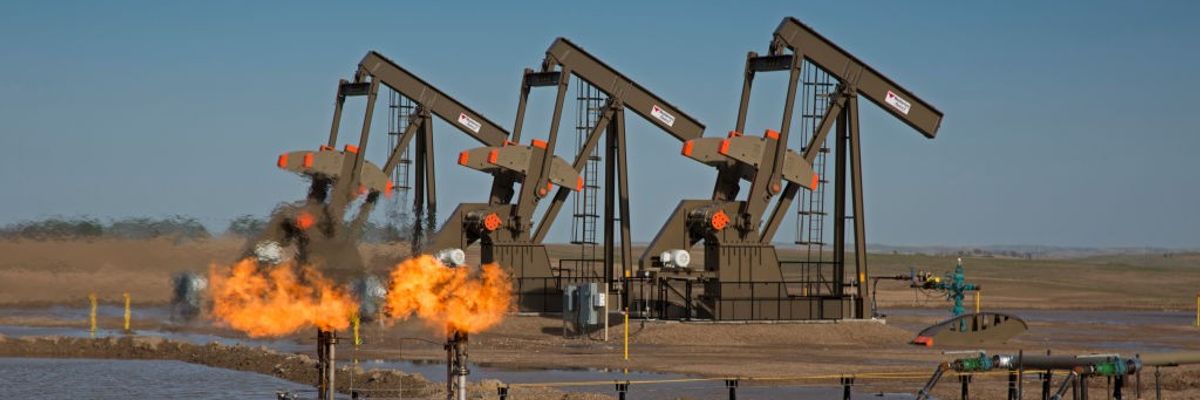
Natural gas is flared off as oil is pumped in the Bakken shale formation in Watford City, North Dakota. (Photo by Jim West/UCG/Universal Images Group via Getty Images)
“Without rapid, deep emissions cuts—over 50% by 2030—overshooting 1.5°C becomes ever more likely, with severe consequences for people and ecosystems,” one expert said.
Despite new national policies submitted ahead of the United Nations COP30 climate conference in Belém, Brazil, the world remains on track for a disastrous 2.6°C of fossil fuel-driven warming, according to an annual analysis released on Thursday.
Climate Action Tracker (CAT) said the 2025 report marked the fourth year in a row in which there had been “little to no measurable progress” in its warming predictions for 2100 based on the current policies and commitments of 40 countries.
“The world is running out of time to avoid a dangerous overshoot of the 1.5°C limit,” Climate Analytics CEO Bill Hare said in a statement. “Delayed action has already led to higher cumulative emissions, and new evidence suggests the climate system may be more sensitive than previously thought. Without rapid, deep emissions cuts—over 50% by 2030—overshooting 1.5°C becomes ever more likely, with severe consequences for people and ecosystems.”
Under the Paris Agreement, countries are required to submit nationally determined contributions (NDCs) every five years outlining their plans to slash greenhouse gas emissions and adapt to the impacts of the climate crisis. However, CAT found that nearly none of the 40 countries it analyzed had updated their 2030 NDCs or announced sufficiently ambitious 2035 NDCs ahead of COP30, which began on Monday. This means that the projected warming based on 2030 and 2035 targets remained at 2.6°C above preindustrial levels.
“We have said it before, and we will keep saying it: We are running out of time.”
“A world at 2.6°C means global disaster,” Hare toldThe Guardian, adding that it would likely trigger key tipping points such as the death of coral reefs, the transformation of the Amazon rainforest into grassland, the destabilizing of ice sheets, and the collapse of the Atlantic Meridional Overturning Circulation.
“That all means the end of agriculture in the UK and across Europe, drought and monsoon failure in Asia and Africa, lethal heat and humidity,” Hare explained. “This is not a good place to be. You want to stay away from that.”
CAT also made temperature projections based on existing policies and actions; pledges and targets, including binding long-term targets; and an optimistic scenario including net-zero targets. In 2025, the temperature projection for existing policies dropped from 2.7°C to 2.6°C, mostly due to a change in methodology, and the “optimistic scenario” remained the same at 1.9°C. However, the “pledges and targets” projection increased from 2.1°C to 2.2°C, predominately due to President Donald Trump’s decision to withdraw the US from the Paris Agreement.
Other major carbon polluters China and the European Union did not update their plans with the ambition required to meet the Paris goals.
— ClimateActionTracker @catclimate.bsky.social (@climateactiontr) November 13, 2025
The analysis comes a week after the UN Environment Programme released its Emissions Gap Report, which found that NDCs put the world on track for 2.3-2.5°C of warming, while current policies put it on track for 2.8°C.
Overall, CAT blamed the lack of progress on the continued growth of fossil fuel production and use. It noted that several major countries had continued to expand fossil fuels, from India, China, and Indonesia building more coal plants to Japan and Saudi Arabia championing gas as a “bridge fuel.”
“Worst of all,” the report authors wrote, “the United States is actively shutting down offshore wind projects, rolling back renewable energy incentives, cutting curbs on carbon pollution, and actively expanding oil and gas production.”
However, despite their grim projections, CAT did see hope in the massive rollout of renewable energy, which generated more power than coal for the first time in 2025.
“While not at the pace needed, our analysis shows that the Paris Agreement works,” said Niklas Höhne, of CAT partner the NewClimate Institute, in a statement.
Höhne continued:
Back in 2015, our current policies scenario led to 3.6°C of warming by 2100. Today, 10 years later, our latest projections show that this has been reduced by roughly 1°C to around 2.6°C. The Paris Agreement has rewritten the rules of global climate action—sparking investment, innovation, and reforms that would simply not have happened without it.
But governments need to speed up the pace now. Although emissions have risen, the exponential pace of the renewable energy expansion allows us to now reduce emissions much faster than previously thought. Governments can strengthen or overachieve 2030 targets, implement robust policies, and ensure transparency and accountability to deliver on the Paris Agreement promise and safeguard a sustainable future.
The faster governments act, the faster they can close the “targets gap” between current emissions and how far they have to fall to keep the 1.5°C goal within reach. This gap is expected to grown by as many as 2 billion metric tons between 2030 and 2035 alone.
The longer we wait, the larger the "targets gap": from 2030 to 2035, the gap between climate targets and the pathways to 1.5°C is projected to grow up to two billion tonnes, up from 26-29 GtCO2e in 2030, to 26-31 GtCO2e by 2035. pic.twitter.com/ityn6p9wOC
— ClimateActionTracker @catclimate.bsky.social (@climateactiontr) November 13, 2025
CAT said that current research indicates that implementing the most ambitious policies could limit peak warming to 1.7°C. This could be achieved by reaching net-zero carbon dioxide emissions before 2050, reaching net-zero greenhouse gas emissions in the 2060s, and removing carbon dioxide from the atmosphere. Under this scenario, global temperatures would return to below 1.5°C by the end of the century.
“We have said it before, and we will keep saying it: We are running out of time,” said report lead author Sofia Gonzales-Zuñiga.
“Every new fossil gas deal the EU makes, every new coal plant built in China, every fossil gas expansion project in Australia, every exported barrel from Norway, every tonne of LNG Japan pushes into neighboring Asian countries, costs billions to people elsewhere in the world as they deal with increasingly extreme weather events,” Gonzales-Zuñiga continued. “These are not abstract policy choices—they are physical realities with human consequences. The atmosphere does not negotiate, and it does not wait.”
Orcas comment on killer apes destroying the planet by continuing to burn fossil fuels.Donald Trump urges you to be a Climate Science denier like him. He says that he makes millions and millions for destroying the planet, Burn, Baby, Burn and Flood, Baby, Flood.Nigel Farage urges you to ignore facts and reality and be a climate science denier like him and his Deputy Richard Tice. He says that Reform UK has received £Millions and £Millions from the fossil fuel industry to promote climate denial and destroy the planet.
A Doral, Florida resident checks out at a Walmart on October 10, 2025. (Photo by Jeffrey Greenberg/Universal Images Group via Getty Images)
“While President Trump claimed that he would bring down prices, the reality is that Americans have seen their costs soar even higher since he took office.”
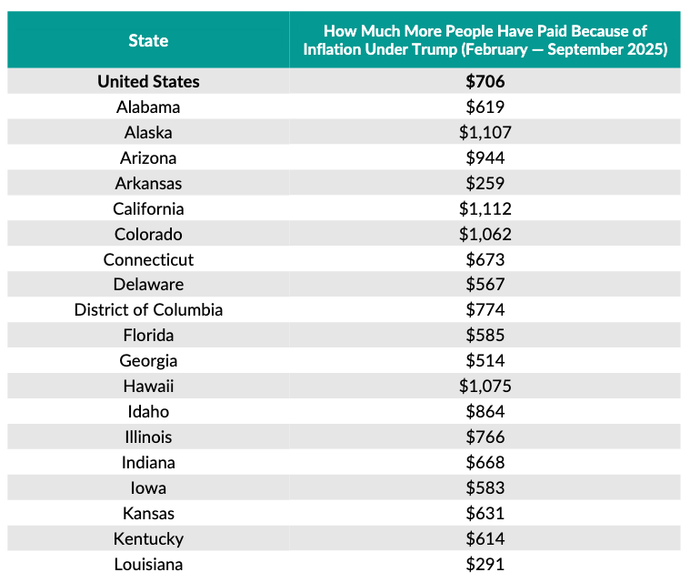
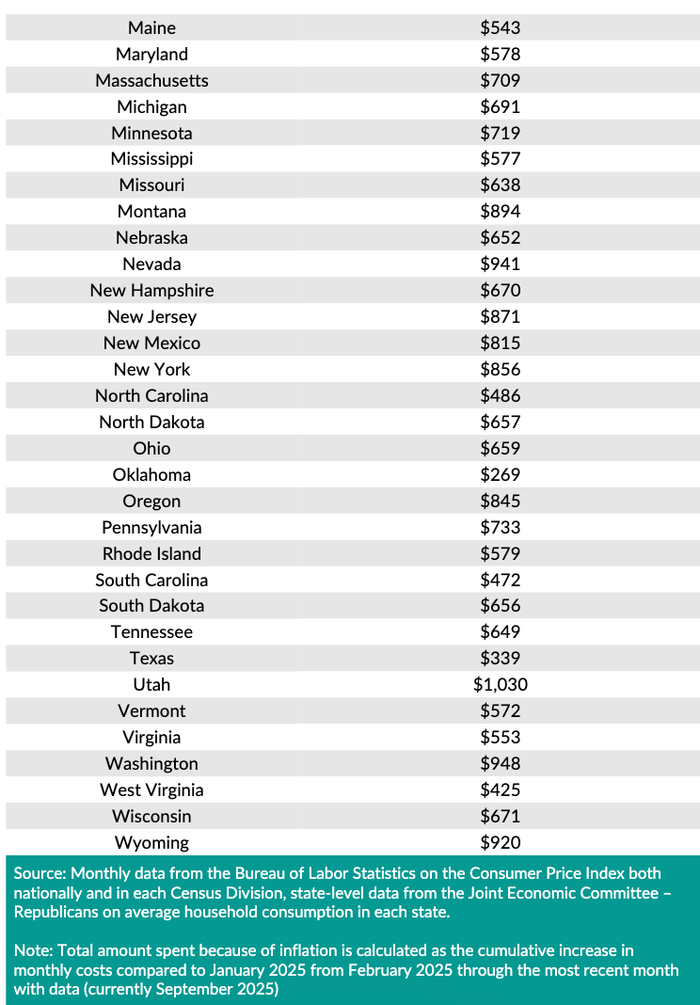
Democrats on the congressional Joint Economic Committee released a report Thursday detailing how much more the average American family in every US state is having to spend monthly to cover the rising costs of food, shelter, energy, and other necessities under the leadership of President Donald Trump.
The panel released its report on the same day the Trump administration was supposed to publish the October Consumer Price Index (CPI) data. The closely watched CPI report was delayed by the shutdown, and the Trump White Housesaid Wednesday that it’s likely the figures will never be released.
Deploying the same methodology that Republicans used to track cost increases under former President Joe Biden, JEC Democrats found that the average US family is spending roughly $700 more per month on basic items since Trump took office in January, pledging to bring prices “way down.”
“While President Trump claimed that he would bring down prices, the reality is that Americans have seen their costs soar even higher since he took office,” said Sen. Maggie Hassan (D-NH), the JEC’s ranking member. “As families across the country spend more to pay their bills and put food on the table, Democrats and Republicans should be working together to lower costs. Instead, President Trump is pushing ahead with reckless tariffs that continue to fuel inflation and drive prices up even higher.”
In some states—including Alaska, California, and Colorado—average families are spending over $1,000 more per month to maintain their living standards as costs continue to rise, in part due to Trump’s erratic tariff regime.
The report’s findings run directly counter to Trump’s triumphant rhetoric on inflation and the US economy more broadly.
CNN‘s Daniel Dale noted earlier this week that Trump has been on a “lying spree about inflation,” falsely claiming that “every price is down” and that “everybody knows that it’s far less expensive under Trump than it was under Sleepy Joe Biden.”
“None of that is true,” Dale wrote. “Prices are up during this administration. Average prices were 1.7% higher in September than they were in January, according to the most recent figures from the federal Consumer Price Index, and 3% higher than they were in September 2024. There has been inflation every month of the term, and far more products have gotten costlier than cheaper.”
“Inflation not only very much continues to exist but has been accelerating since the spring,” Dale added. “As of September, the year-over-year inflation rate had increased for five consecutive months.”
Orcas discuss Donald Trump and the killer apes’ concept of democracy. Front Orca warns that Trump is crashing his country’s economy and that everything he does he does for the fantastically wealthy.Orcas discuss how Trump was re-elected and him being an obviously insane, xenophobic Fascist.
Colombian President Gustavo Petro speaks during the Amazon Cooperation Treaty Organization Summit in Bogotá on August 22, 2025. (Photo by Raul Arboleda/AFPvia Getty Images)
“Intelligence is not for killing,” said Gustavo Petro, who has strongly criticized the US president.
Colombian President Gustavo Petro sat down with NBC News in Bogotá on Wednesday to discuss his decision to stop sharing intelligence with the United States over the Trump administration’s deadly boat bombings allegedly targeting drug runners in the Caribbean and Pacific.
Petro announced Tuesday that he halted “communications and other agreements with US security agencies” over the boat attacks that have killed at least 76 people. That same day, the UK government also stopped sharing intelligence related to suspected drug-trafficking vessels.
In the fight against drug trafficking, “intelligence is key,” Colombia’s leftist president told NBC chief foreign correspondent Richard Engel in Spanish. “The more we coordinate, the better. But intelligence is not for killing.”
Critics have stressed that even if the boats are transporting drugs, US President Donald Trump’s strikes are illegal. Asked by Engel whether he believes the vessels were carrying drugs, Petro said: “Maybe, or maybe not. We do not know. They are poor boatmen hired by gangsters. The gangsters don’t sit on the boats.”
Petro is one of the few world leaders who has publicly stood up to Trump. The Colombian leader told NBC, “He’s a barbarian, but anyone can change.”
As the New York Timespointed out Wednesday: “For Mr. Petro, a former rebel during Colombia’s long and brutal internal conflict, defiance is nothing new. Those who know him describe a man propelled by his convictions—a lifelong critic of corruption and inequality who became the fiery face of Colombia’s left.”
The Trump administration has responded forcefully to Petro’s critiques. In September, it revoked the Colombian president’s visa over his remarks to protesters in New York City, where he was to address the United Nations General Assembly. During the speech, Petro urged the UN to open criminal proceedings over the boat bombings.
In October, Petro accused the administration of murdering a Colombian fisherman in one of the boat strikes. Trump then halted aid to the country. As Bloombergreported Thursday, “The US has given Colombia about $14 billion this century, the most in the Americas, much of it to help fight guerrillas and traffickers.”
The Trump administration last month also sanctioned Petro, his family members, and Colombian Interior Minister Armando Alberto Benedetti. As Engel noted, the US has also sanctioned Venezuelan President Nicolás Maduro. Even though experts have contested Trump’s claim that “we have a lot of drugs coming in from Venezuela,” the country and its leader are key targets of Trump.
In addition to bombing boats off the Venezuelan coast, Trump has sent a US aircraft carrier to the region, authorized Central Intelligence Agency operations in Venezuela, and is considering strikes within the country. Maduro has ordered the deployment of nearly 200,000 soldiers and accused Trump of pushing for “regime change,” with his sights set on “oil, gas, gold, fertile land, and water.”
During the NBC interview, Petro was critical of Maduro, saying, “I believe there has been no legitimate leadership in Venezuela for some time.”
However, he also expressed concern about the possibility of Trump waging war on Colombia’s neighbor. As Petro put it, “He wants to frighten us.”
Donald Fuhrump says that Amerikkka doesn’t bother with crimes or charges anymore, not being 100% Amerikkkan and opposing his real estate intentions is enough.Orcas discuss Donald Trump and the killer apes’ concept of democracy. Front Orca warns that Trump is crashing his country’s economy and that everything he does he does for the fantastically wealthy.Orcas discuss how Trump was re-elected and him being an obviously insane, xenophobic Fascist.
The world’s fossil-fuel use is still on track to peak before 2030, despite a surge in political support for coal, oil and gas, according to data from the International Energy Agency (IEA).
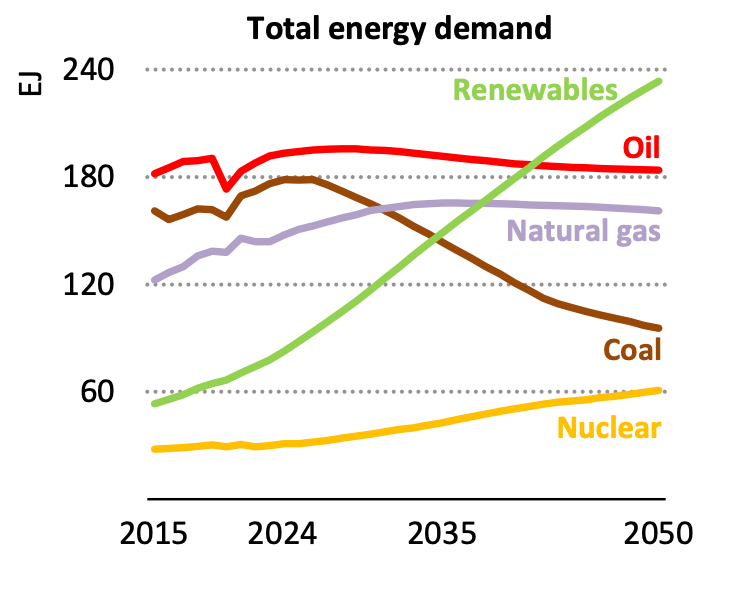
The IEA’s latest World Energy Outlook 2025, published during the opening days of the COP30 climate summit in Brazil, shows coal at or close to a peak, with oil set to follow around 2030 and gas by 2035, based on the stated policy intentions of the world’s governments.
Under the same assumptions, the IEA says that clean-energy use will surge, as nuclear power rises 39% by 2035, solar by 344% and wind by 178%.
Still, the outlook has some notable shifts since last year, with coal use revised up by around 6% in the near term, oil seeing a shallower post-peak decline and gas plateauing at higher levels.
This means that the IEA expects global warming to reach 2.5C this century if “stated policies” are implemented as planned, up marginally from 2.4C in last year’s outlook.
In addition, after pressure from the Trump administration in the US, the IEA has resurrected its “current policies scenario”, which – effectively – assumes that governments around the world abandon their stated intentions and only policies already set in legislation are continued.
If this were to happen, the IEA warns, global warming would reach 2.9C by 2100, as oil and gas demand would continue to rise and the decline in coal use would proceed at a slower rate.
This year’s outlook also includes a pathway that limits warming to 1.5C in 2100, but says that this would only be possible after a period of “overshoot”, where temperature rise peaks at 1.65C.
The IEA will publish its “announced pledges scenario” at a later date, to illustrate the impact of new national climate pledges being implemented on time and in full.
The IEA’s annual World Energy Outlook (WEO) is published every autumn. It is regarded as one of the most influential annual contributions to the understanding of energy and emissions trends.
The outlook explores a range of scenarios, representing different possible futures for the global energy system. These are developed using the IEA’s “global energy and climate model”.
The latest report stresses that “none of [these scenarios] should be regarded as a forecast”.
However, this year’s outlook marks a major shift in emphasis between the scenarios – and it reintroduces a pathway where oil and gas demand continues to rise for many decades.
This pathway is named the “current policies scenario” (CPS), which assumes that governments abandon their planned policies, leaving only those that are already set in legislation.
If the world followed this path, then global temperatures would reach 2.9C above pre-industrial levels by 2100 and would be “set to keep rising from there”, the IEA says.
The CPS was part of the annual outlook until 2020, when the IEA said that it was “difficult to imagine” such a pathway “prevailing in today’s circumstances”.
It has been resurrected following heavy pressure from the US, which is a major funder of the IEA that accounts for 14% of the agency’s budget.
For example, in July Politico reported “a ratcheted-up US pressure campaign” and “months of public frustrations with the IEA from top Trump administration officials”. It noted:
“Some Republicans say the IEA has discouraged investment in fossil fuels by publishing analyses that show near-term peaks in global demand for oil and gas.”
The CPS is the first scenario to be discussed in detail in the report, appearing in chapter three. The CPS similarly appears first in Annex A, the data tables for the report.
The second scenario is the “stated policies scenario” (STEPS), featured in chapter four of this year’s outlook. Here, the outlook also includes policies that governments say they intend to bring forward and that the IEA judges as likely to be implemented in practice.
In this world, global warming would reach 2.5C by 2100 – up marginally from the 2.4C expected in the 2024 edition of the outlook.
Beyond the STEPS and the CPS, the outlook includes two further scenarios.
One is the “net-zero emissions by 2050” (NZE) scenario, which illustrates how the world’s energy system would need to change in order to limit warming in 2100 to 1.5C.
The NZE was first floated in the 2020 edition of the report and was then formally featured in 2021.
The report notes that, unlike in previous editions, this scenario would see warming peak at more than 1.6C above pre-industrial temperatures, before returning to 1.5C by the end of the century.
This means it would include a high level of temporary “overshoot” of the 1.5C target. The IEA explains that this results from the “reality of persistently high emissions in recent years”. It adds:
“In addition to very rapid progress with the transformation of the energy sector, bringing the temperature rise back down below 1.5C by 2100 also requires widespread deployment of CO2 removal technologies that are currently unproven at large scale.”
Finally, the outlook includes a new scenario where everyone in the world is able to gain access to electricity by 2035 and to clean cooking by 2040, named “ACCESS”.
While the STEPS appears second in the running order of the report, it is mentioned slightly more frequently than the CPS, as shown in the figure below. The CPS is a close second, however, whereas the IEA’s 1.5C pathway (NZE) receives a declining level of attention.
Number of mentions of each scenario per 100 pages of text. Source: Carbon Brief analysis.
US critics of the IEA have presented its stated policies scenario as “disconnected from reality”, in contrast to what they describe as the “likely scenario” of “business as usual”.
Yet the current policies scenario is far from a “business-as-usual” pathway. The IEA says this explicitly in an article published ahead of the outlook:
“The CPS might seem like a ‘business-as-usual’ scenario, but this terminology can be misleading in an energy system where new technologies are already being deployed at scale, underpinned by robust economics and mature, existing policy frameworks. In these areas, ‘business as usual’ would imply continuing the current process of change and, in some cases, accelerating it.”
In order to create the current policies scenario, where oil and gas use continues to surge into the future, the IEA therefore has to make more pessimistic assumptions about barriers to the uptake of new technologies and about the willingness of governments to row back on their plans. It says:
“The CPS…builds on a narrow reading of today’s policy settings…assuming no change, even where governments have indicated their intention to do so.”
This is not a scenario of “business as usual”. Instead, it is a scenario where countries around the world follow US president Donald Trump in dismantling their plans to shift away from fossil fuels.
More specifically, the current policies scenario assumes that countries around the world renege on their policy commitments and fail to honour their climate pledges.
For example, it assumes that Japan and South Korea fail to implement their latest national electricity plans, that China fails to continue its power-market reforms and abandons its provincial targets for clean power, that EU countries fail to meet their coal phase-out pledges and that US states such as California fail to extend their clean-energy targets.
Similarly, it assumes that Brazil, Turkey and India fail to implement their greenhouse gas emissions trading schemes (ETS) as planned and that China fails to expand its ETS to other industries.
The scenario also assumes that the EU, China, India, Australia, Japan and many others fail to extend or continue strengthening regulations on the energy efficiency of buildings and appliances, as well as those relating to the fuel-economy standards for new vehicles.
In contrast to the portrayal of the stated policies scenario as blindly assuming that all pledges will be met, the IEA notes that it does not give a free pass to aspirational targets. It says:
“[T]argets are not automatically assumed to be met; the prospects and timing for their realisation are subject to an assessment of relevant market, infrastructure and financial constraints…[L]ike the CPS, the STEPS does not assume that aspirational goals, such as those included in the Paris Agreement, are achieved.”
Only in the “announced pledges scenario” (APS) does the IEA assume that countries meet all of their climate pledges on time and full – regardless of how credible they are.
The APS does not appear in this year’s report, presumably because many countries missed the deadlines to publish new climate pledges ahead of COP30.
The IEA says it will publish its APS, assessing the impact of the new pledges, “once there is a more complete picture of these commitments”.
Fossil-fuel peak
In recent years, there has been a significant shift in the IEA’s outlook for fossil fuels under the stated policies scenario, which it has described as “a mirror to the plans of today’s policymakers”.
In 2020, the agency said that prevailing policy conditions pointed towards a “structural” decline in global coal demand, but that it was too soon to declare a peak in oil or gas demand.
By 2021, it said global fossil-fuel use could peak as soon as 2025, but only if all countries got on track to meet their climate goals. Under stated policies, it expected fossil-fuel use to hit a plateau from the late 2020s onwards, declining only marginally by 2050.
There was a dramatic change in 2022, when it said that Russia’s invasion of Ukraine and the resulting global energy crisis had “turbo-charged” the shift away from fossil fuels.
As a result, it said at the time that it expected a peak in demand for each of the fossil fuels. Coal “within a few years”, oil “in the mid-2030s” and gas ”by the end of the decade”.
This outlook sharpened further in 2023 and, by 2024, it was saying that each of the fossil fuels would see a peak in global demand before 2030.
This year’s report notes that “some formal country-level [climate] commitments have waned”, pointing to the withdrawal of the US from the Paris Agreement.
The report says the “new direction” in the US is among “major new policies” in 48 countries. The other changes it lists include Brazil’s “energy transition acceleration programme”, Japan’s new plan for 2040 and the EU’s recently adopted 2040 climate target.
Overall, the IEA data still points to peaks in demand for coal, oil and gas under the stated policies scenario, as shown in the figure below.
Alongside this there is a surge in clean technologies, with renewables overtaking oil to become the world’s largest source of energy – not just electricity – by the early 2040s.
In this year’s outlook under stated policies, the IEA sees global coal demand as already being at – or very close to – a definitive peak, as the chart above shows.
Coal then enters a structural decline, where demand for the fuel is displaced by cheaper alternatives, particularly renewable sources of electricity.
The IEA reiterates that the cost of solar, wind and batteries has respectively fallen by 90%, 70% and 90% since 2010, with further declines of 10-40% expected by 2035.
(The report notes that household energy spending would be lower under the more ambitious NZE scenario than under stated policies, despite the need for greater investment.)
However, this year’s outlook has coal use in 2030 coming in some 6% higher than expected last year, although it ultimately declines to similar levels by 2050.
For oil, the agency’s data still points to a peak in demand this decade, as electric vehicles (EVs) and more efficient combustion engines erode the need for the fuel in road transport.
While this sees oil demand in 2030 reaching similar levels to what the IEA expected last year, the post-peak decline is slightly less marked in the latest outlook, ending some 5% higher in 2050.
The biggest shift compared with last year is for gas, where the IEA suggests that global demand will keep rising until 2035, rather than peaking by 2030.
Still, the outlook has gas demand in 2030 being only 7% higher than expected last year. It notes:
“Long-term natural gas demand growth is kept lower than in recent decades by the expanding deployment of renewables, efficiency gains and electrification of end-uses.”
In terms of clean energy, the outlook sees nuclear power output growing to 39% above 2024 levels by 2035 and doubling by 2050. Solar grows nearly four-fold by 2035 and nearly nine-fold by 2050, while wind power nearly triples and quadruples over the same periods.
Notably, the IEA sees strong growth of clean-energy technologies, even in the current policies scenario. Here, renewables would still become the world’s largest energy source before 2050.
This is despite the severe headwinds assumed in this scenario, including EVs never increasing from their current low share of sales in India or the US.
The CPS would see oil and gas use continuing to rise, with demand for oil reaching 11% above current levels by 2050 and gas climbing 31%, even as renewables nearly triple.
This means that coal use would still decline, falling to a fifth below current levels by 2050.
Finally, while the IEA considers the prospect of global coal demand continuing to rise rather than falling as expected, it gives this idea short shrift. It explains:
“A growth story for coal over the coming decades cannot entirely be ruled out but it would fly in the face of two crucial structural trends witnessed in recent years: the rise of renewable sources of power generation, and the shift in China away from an especially coal-intensive model of growth and infrastructure development. As such, sustained growth for coal demand appears highly unlikely.”
Elon Musk urges you to be a Fascist like him, says that you can ignore facts and reality then.Donald Trump urges you to be a Climate Science denier like him. He says that he makes millions and millions for destroying the planet, Burn, Baby, Burn and Flood, Baby, Flood.Nigel Farage urges you to ignore facts and reality and be a climate science denier like him and his Deputy Richard Tice. He says that Reform UK has received £Millions and £Millions from the fossil fuel industry to promote climate denial and destroy the planet.