Category: Nigel Farage

  • Tech bros will tell you that geoengineering will save us, it won’t

    Spread the love

    Article by Ella Gilbert republished from OpenDemocracy under a Creative Commons Attribution-NonCommercial 4.0 International licence.

    Credit: antechdesigns

    As the latest UNEP reports we will blow past 1.5°C, we must prioritise solutions that work, rather than focusing on complex, unproven technologies

    For anyone who’s been paying attention, it’s no surprise that the United Nations Environment Program (UNEP) reports that  we will now inevitably blow past the global average temperature threshold of 1.5°C above pre-industrial levels.

    Climate scientists like myself have been warning for years that we are about to cross this invisible red line, while quietly worrying that global average temperatures will end up being double that. Personally, I said goodbye to 1.5°C several years ago, but it still feels momentous to see it written in print, and that too by the UN.

    The target to keep warming to 1.5°C above pre-industrial temperatures isn’t some hard red line in the sand, because all warming carries some risk, but it’s relevant because limiting warming to 1.5°C gives us a good chance of avoiding some of the worst impacts of climate heating. We’ve already had a glimpse of what this looks like in the myriad heatwaves, wildfires, floods, droughts and storms that have made headlines this year.

    Every tenth of a degree of heating means real-terms impacts for peoples’ lives, livelihoods and property, and increases the risk of the extreme events that we’ve already seen tragically claim so many lives. It also increases the likelihood of exceeding critical tipping points such as the collapse of the West Antarctic Ice Sheet, beyond which there’s no return.

    We’ve already had single years that have exceeded the 1.5°C limit, but the widely discussed Paris Agreement target is a multi-year average. That means we won’t know we’ve reached it until it’s in the rearview mirror, but it’s also possible to “overshoot” 1.5°C, temporarily peak at higher temperatures, and then bring them back down – and that’s now the best-case scenario outlined by UNEP. 

    This would mean we would have to take drastic action to bring temperatures back down again rather than continuing to drive them ever upwards. Which, in the current political climate, feels like a bit of a stretch.

    Temperatures won’t stabilise until we reach net zero emissions, where we remove as much carbon from the atmosphere as we add to it. Until then, we will still be increasing greenhouse gas concentrations in the atmosphere and turning up the dial on the thermostat. Net zero isn’t a nice to have, despite what certain parts of the political spectrum would have you believe, it’s an essential if we want to have a liveable planet. 

    In fact, UNEP’s latest report points to the need to take action beyond net zero: 

    Once we have limited heating to 2°C or below — which currently feels optimistic — we will have to roll out carbon dioxide removal (CDR) to reduce temperatures on an enormous scale.

    CDR often connotes high-tech solutions to suck carbon dioxide out of the atmosphere, but it can also mean one of the oldest technologies in the world: trees. That’s why restoring nature and preventing deforestation is so important for climate action.

    But UNEP reports that CDR only works if we limit heating to 2C or below. As the stakes of climate heating continue to rise, another idea is moving from the sidelines to centre-stage: geoengineering, or deliberate technological interventions to alter the Earth’s climate. 

    Geoengineering is a spectrum, ranging from the comparatively reasonable and well-researched (injecting particles into the stratosphere to reflect incoming sunlight and cool the surface, much like major volcanic eruptions have done) to downright barmy (launching mirrors into space – you can imagine which silicon valley billionaires love that idea). And while there are sensible (if heated) scientific discussions about how to actually do it, there are also some very serious ethical and governance hurdles to overcome. 

    The tech bros will tell you that geoengineering will save us and allow us to keep doing what we’re doing while still ‘fixing’ climate change. But beware any arguments that downplay the importance of emissions cuts. We can’t simply geoengineer our way out of this crisis.

    For example: who decides when to deploy? What happens if an intervention makes things better for some and worse for others? How do we safeguard against bad actors acting unilaterally? These questions are largely unanswered, and that’s before we get to the scientific questions around unintended consequences, like disrupting the Arctic food chain while trying to refreeze ice, or what happens if we stop the intervention, resulting in a so-called termination shock, where temperatures would shoot back up with devastating effect.

    In some senses the climate crisis is relatively simple: we’re pumping planet-heating carbon dioxide into the atmosphere, and it’s heating the planet. To reverse it, we need first to stop adding planet-heating carbon dioxide to the atmosphere, and then to start removing it.

    The good news is that we do know what we need to do to achieve that. Climate action is less a knowledge problem, and more an implementation one. 

    Proponents of geoengineering argue that it’s not an either/or between emissions cuts and major interventions. But in a world with finite resources, expensive and unproven geoengineering solutions should not be a priority, rather, we should prioritise the simple stuff we know works: decarbonising energy production, improving public transport, retrofitting and building greener housing, reducing meat and dairy consumption, restoring natural ecosystems.

    That said, we are now committed to some level of change, and we need to behave as such. That means we need to prepare for the sea level rise that’s to come, and adapt societies, behaviours and infrastructure to a less predictable and more extreme climate. 

    If the summer of 2026 has taught us anything in the UK, it’s that our houses, schools, offices, railways, emergency services, power networks and public transport are simply not fit for purpose in the heat. Nor are they built to withstand the wet, stormy, flood-prone autumn and winter that is on its way. We’re not equipped to deal with the rapidly extremifying climate or the weather whiplash it brings. Simply put: our infrastructure was built for a climate that no longer exists.

    If we are to survive the coming decades, we need to build preparedness and climate resilience into our society. Extreme events are already exposing our vulnerabilities, and if we thought 2026 was bad, count my words: we ain’t seen nothing yet.

    In the wake of our hottest summer on record, it’s abundantly clear that we need to slash emissions to save lives, and at the same time prepare for the changes that are now committed. 

    The geoengineers are right about one thing: It’s not an either/or. We have to reduce emissions to net zero and remove carbon from the atmosphere and adapt to what’s in store. There’s no other safe option.

    Dr. Ella Gilbert  is a climate scientist and multi-award-winning presenter with a PhD in Antarctic climate change.

    Article by Ella Gilbert republished from OpenDemocracy under a Creative Commons Attribution-NonCommercial 4.0 International licence.

    Donald Trump urges you to be a Climate Science denier like him. He says that he makes millions and millions for destroying the planet, Burn, Baby, Burn and Flood, Baby, Flood.
    Donald Trump urges you to be a Climate Science denier like him. He says that he makes millions and millions for destroying the planet, Burn, Baby, Burn and Flood, Baby, Flood.
    Nigel Farage urges you to ignore facts and reality and be a climate science denier like him and his Deputy Richard Tice. He says that Reform UK has received £Millions and £Millions from the fossil fuel industry to promote climate denial and destroy the planet.
    Nigel Farage urges you to ignore facts and reality and be a climate science denier like him and his Deputy Richard Tice. He says that Reform UK has received £Millions and £Millions from the fossil fuel industry to promote climate denial and destroy the planet.
    Elon Musk urges you to be a Fascist like him, says that you can ignore facts and reality then.
    Elon Musk urges you to be a Fascist like him, says that you can ignore facts and reality then.
  • Who funds Reform? Farage’s party bags £15m from crypto and finance donors

    Spread the love

    Article by Ethan Shone republished from OpenDemocracy under a Creative Commons Attribution-NonCommercial 4.0 International licence.

    Darren Staples/Bloomberg via Getty Images

    Reform has accepted more large donations than any other party in 2026, despite mounting funding scandals, new data shows

    Nigel Farage’s party received large donations totalling almost £15m in the first six months of this year, according to Electoral Commission records, including millions of pounds from a crypto billionaire who was pardoned by Donald Trump last year. 

    Reform’s fundraising operations continue to prove highly effective in spite of its ongoing scandals. The party is amassing a massive financial war chest ahead of the next general election, which many in Westminster believe could take place as soon as next autumn.

    The latest donations data comes as Reform suspends two senior aides pending an investigation, after an undercover sting exposed their alleged role in facilitating secret donations, including from impermissible donors overseas. Rival parties said they have reported Reform to the police, while the Electoral Commission said it is “considering all relevant information” and is “in touch with the Met Police”. Reform has denied any wrongdoing.

    The events have overshadowed the party’s conference in Birmingham this weekend, and are the latest in a series of scandals the party has faced over its funding this year. In July, openDemocracy travelled to Montenegro to investigate the lives and business interests of key Reform allies and donors, including ‘Posh George’ Cottrell and billionaire crypto investor Christopher Harborne, in the glamorous coastal resort of Tivat.

    At the same time, a number of news reports raised serious questions about Cottrell and Farage, after The Sunday Times reported the Clacton MP had failed to disclose in-kind support from the 32-year-old convicted fraudster. The allegations led to calls for an investigation by parliamentary authorities, which were already probing a £5m gift that Farage allegedly failed to declare having received from Harborne.

    Reform’s crypto funding

    The latest data shows Reform continues to bring in significantly more from large donations than the other parties: £5.3m in the second quarter of 2026, compared to £3.6m for Labour and £2.8m for the Conservatives. 

    That brings the party’s total donations this year to almost £15m, meaning it has accepted almost twice as much as Labour (£8m) and more than double the Conservatives (£7m).

    Reform receives the vast majority of its funding from a small number of high-value donors, with Harborne, a crypto investor based in Thailand, by far the party’s most significant donor to date. 

    Now, the party has added another crypto billionaire with offshore links to its ranks of mega donors; Sheffield-born Ben Delo gave the party £4m in April, following two £2m donations in January and March. 

    British crypto entrepreneur Delo has rapidly become one of Reform UK’s largest individual donors, having given the party £8m across the first half of 2026 – £4m in each quarter. If he continues this trend throughout the rest of the year, he could surpass Harborne’s current total.  

    Delo is one of many Reform donors with strong interests in the crypto sector. He was a software engineer at IBM and later built high-frequency trading systems at JPMorgan and GSA Capital in Hong Kong, before co-founding cryptocurrency derivatives exchange BitMEX. In 2020, US federal authorities charged the BitMEX founders with violating the Bank Secrecy Act over inadequate anti-money-laundering controls; Delo pleaded guilty in 2022, paid a $10m penalty and served 30 months’ probation, which ended in December 2024. Trump pardoned him in March 2025.

    Delo’s latest donations come after the government imposed a £100,000 cap on donations from overseas residents in March 2026. At the time, Delo said he would move back to the UK to sidestep the restriction, and he has reportedly signalled plans to keep funding the party from Britain going forward. 

    Big finance and former Tories

    Reform also continues to add new donors with interests in the financial sector. Over the past year, senior figures in the party have engaged with lobbyists in the City of London, seeking both policy ideas and financial support. 

    Lucas Bitencourt, a young finance entrepreneur, gave the party £100,000, while private equity firm Bryden Capital gave £50,000 and a Jersey financial adviser who works with “the world’s first bitcoin investment fund” gave £25,000. 

    A Scottish corporate lawyer specialising in private equity and technology continues to provide funding, giving £100,000 in May. He has now given the party £300,000 in total. 

    An investment firm linked to Chelsea owner Todd Boehly – a significant donor to conservative politics in the US – also gave the party £75,000. 

    Robert Jenrick, Reform’s Treasury spokesman, also received a significant donation after defecting to the party from the Conservatives. Jenrick received £50,000 from a donor with ties to financial services and crypto, Michael Cohen of Capital Group, an investment firm that the Wall Street Journal last year reported was “ploughing billions into crypto”.

    Three former Tory donors continue to make up a significant portion of Reform’s funding base: Bassim Haidar, Johan Christofferson and Roger Nagioff all contributed six-figure sums in recent months and have now given over a million between them since the last election. Excluding Harborne, who gave Boris Johnson £1m in 2022, former Tory donors have given Reform over £3m since the 2024 vote. 

    Article by Ethan Shone republished from OpenDemocracy under a Creative Commons Attribution-NonCommercial 4.0 International licence.

    Nigel Farage is scathing at the £250,000 cost to the taxpayer of his unnecessary and ridiculous Clacton-on-Sea election campaign that he caused to avoid scrutiny and acccountability for the £5MILLION 'gift' that he didn't declare.
    Nigel Farage is scathing at the £250,000 cost to the taxpayer of his unnecessary and ridiculous Clacton-on-Sea election campaign that he caused to avoid scrutiny and acccountability for the £5MILLION ‘gift’ that he didn’t declare.
    Nigel Farage urges you to ignore facts and reality and be a climate science denier like him and his Deputy Richard Tice. He says that Reform UK has received £Millions and £Millions from the fossil fuel industry to promote climate denial and destroy the planet.
    Nigel Farage urges you to ignore facts and reality and be a climate science denier like him and his Deputy Richard Tice. He says that Reform UK has received £Millions and £Millions from the fossil fuel industry to promote climate denial and destroy the planet.
    Nigel Farage admits to being a whore willing to do anything for someone with a big fat wallet and asks whether drinking pints and smoking fags is not enough for the stupid plebs.
    Nigel Farage admits to being a whore willing to do anything for someone with a big fat wallet and asks whether drinking pints and smoking fags is not enough for the stupid plebs.
  • With Planet Set to Overshoot 1.5°C Threshold, Emissions Must Still Be Cut Rapidly to Limit Damage: UN Report

    Spread the love

    Article by Julia Conley republished from Common Dreams under Creative Commons (CC BY-NC-ND 3.0).

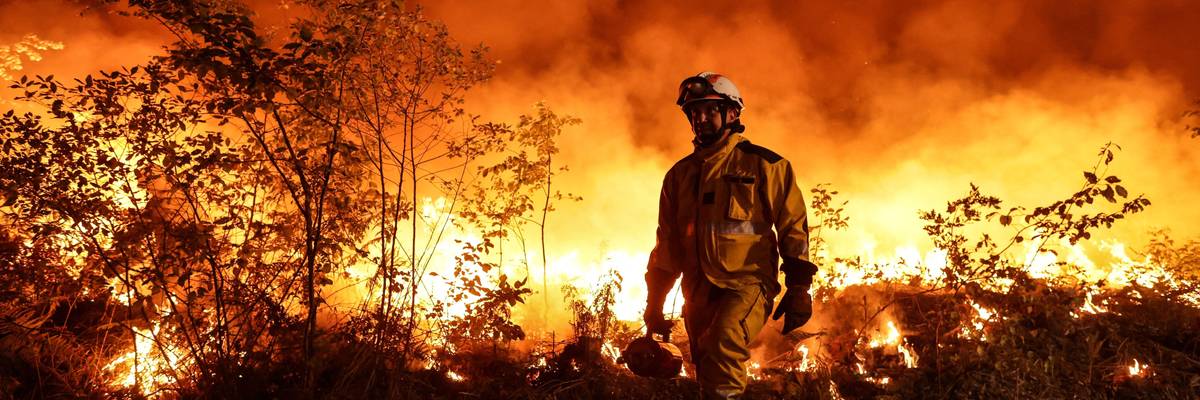
    Tactical firefighters set a backfire to a plot of land to prevent the wildfire from spreading as the winds change in Louchats, France, on July 17, 2022. (Photo by Thibaud Moritz/AFP via Getty Images)

    “Overshoot doesn’t have to mean surrender,” said one campaigner. “The size and length of that overshoot is still being written by the decisions governments make this year.”

    The world has officially moved past the point where preventing a temperature rise above 1.5°C will be possible, scientists said in a United Nations report released Wednesday, which made clear that communities can expect sea levels to continue rising, heatwaves to intensify, and hurricanes, wildfires, and flooding to become more frequent and dangerous—all climate impacts that experts have long warned about as policymakers have failed to rapidly draw down greenhouse gas emissions.

    But the authors of the report, published by the UN Environment Program (UNEP) and titled “Limiting Overshoot,” emphasized that the inevitable temperature rise must not be viewed as a point of no return, and that steps can and must be taken to ensure the overshoot of the 1.5°C goal is only temporary.

    RECOMMENDED…

    US-POLITICS-VOTE-TEXAS

    Talarico Protests as Texas Swing County Plans to Close 92 Polling Places

    US President Donald Trump

    ‘The President of the United States Is Mentally Unwell’: Deranged Trump Posts AI Slop of Iran Bombing

    The best-case scenario is now a peak global temperature of 1.8°C, said the report’s dozens of authors, with an “overshoot, peak, and decline” pathway still possible before the end of this century if policymakers ensure that planet-heating fossil fuel emissions are drastically reduced—starting immediately.

    The report is the first ever to establish the inevitability of overshooting the 1.5°C goal that countries were tasked with working toward when the Paris climate agreement was signed in 2015, and to chart a path toward ensuring the planet can ultimately make its way back down to 1.5°C—hopefully limiting the time above the threshold to a few decades.

    If the world remains above 1.5°C over preindustrial temperatures long-term, said UNEP Executive Director Inger Andersen, “there are no good outcomes.”

    Last year, global temperatures were already about 1.3°C to 1.4°C above the preindustrial average, The Washington Post reported, and the effects on the Earth have been made clear as wildfires have engulfed parts of Canada and South America; a glacial collapse led to flooding that killed more than 1,000 people in Nepal last week; and extreme heat killed more than 1,000 people across Europe this summer.

    “Across the globe, extreme heatwaves are already proving that climate impacts will strike faster, hit harder, and last longer—costing more lives and causing deeper disruption,” said Andersen. “Now is the time we must double down on climate action. We can—and must—get on the right path. By cutting greenhouse gas emissions, strengthening resilience and adaptation, and ensuring exceedance of 1.5°C is as small and short as possible.”

    The scientists said planet-heating fossil fuel emissions must be slashed by 55% by 2035 and almost entirely eliminated by the middle of the century to limit the global temperature rise to 1.8°C above preindustrial levels.

    Climate scientist Joeri Rogeli of Imperial College London, a lead author of the report, told the Post that swift action is crucial, as “for every five years that humanity delays reducing emissions… the peak temperature the world will ultimately face rises by at least a 10th of a degree.”

    The scientists emphasized that avoiding the 1.5°C limit would have been a less daunting goal than reversing the temperature rise. Policies that continue allowing oil, gas, and coal companies to extract fossil fuels will make both goals difficult to achieve.

    The report was released weeks after President Donald Trump terminated offshore wind energy projects in the US—the latest of several renewable energy projects he’s killed—and moved to take ownership of Venezuelan oil fields. Recent global climate summits have been attended by an outsized number of corporate lobbyists for fossil fuel industries, weakening the climate commitments that have come out of the meetings.

    Fenton Lutunatabua of 350.org Pacific noted that the report was also released as Pacific countries meet at the 55th Pacific Islands Forum Leaders Meeting.

    “All eyes are on one of the world’s largest fossil fuel exporters, Australia, and how they act on this urgent warning,” said Lutunatabua. “The climate crisis is here and any delay in mitigation, in phasing out coal, oil, and gas, will only make our adaptation pressures harder and more expensive to bear.”

    The report emphasizes that even if the world is able to reduce planetary heating once global temperatures shoot above 1.5°C, some impacts of continued fossil fuel extraction will be irreversible, including the melting of glaciers and the extinction of some species.

    But UN Secretary-General António Guterres was among those who said “an overshoot of ambition” is now required to mitigate the damage as much as possible.

    “This summer’s scorching heat, raging wildfires, and deadly floods are a warning of what lies ahead. We must make the overshoot above 1.5 degrees as small and short as possible,” said Guterres.

    Along with rapidly cutting emissions, the report calls “carefully governed carbon dioxide removal (CDR)—the process of removing carbon from the air and storing it through afforestation or other means—an essential part of the mix.”

    CDR methods—from planting forests to act as carbon sinks to technological fixes—come with limitations and are potentially reversible. Forests that are planted could be destroyed by wildfires, while CDR technology is largely unproven and can be energy-intensive—negating many of the benefits.

    “Overall, even optimistic CDR scaling is unlikely to deliver a temperature reversal beyond a few tenths of a degree this century,” reads the report. “This emphasizes the importance of focusing on reducing greenhouse gas emissions.”

    Richard Betts, a climate scientist at the University of Exeter and another report author, told the Post that CDR cannot be relied upon as a “get-out-of-jail-free card.”

    At 350.org, head of campaigns and networks Savio Carvalho said that “there is no version of ‘limiting overshoot’ that doesn’t start with ending new coal, oil, and gas expansion today.”

    “This report confirms what communities on the frontlines of the climate crisis have been telling us for years: that delay is not a neutral act, it is a decision,” said Carvalho. “We’ve just watched a glacier collapse bury Himalayan communities under mud and water, and we’re watching Pacific nations lose land to the sea in real time. UNEP is right that overshoot doesn’t have to mean surrender: The size and length of that overshoot is still being written by the decisions governments make this year, on fossil fuel phase-out, technology transfer, and on finance for the countries least responsible and most exposed.”

    Murat Kurum, Türkiye’s minister of environment, urbanization, and climate change and the president-designate of the 31st UN Climate Change Conference (COP31), said the upcoming summit scheduled for November “must turn this urgency into concrete action.”

    “Every fraction of a degree matters, and every year spent in overshoot increases climate risks and the potential for irreversible losses,” said Kurum. “The Overshoot Report makes clear that exceeding 1.5°C should not be seen as a new destination, but as a pathway we must urgently work to minimize and reverse. This requires rapid and sustained emissions reductions, alongside ambitious adaptation to protect people, communities, and ecosystems.”

    “We need to accelerate global electrification, reduce methane emissions from waste, strengthen the climate resilience of cities, and enhance the resilience of marine and coastal ecosystems,” he added. “The choices we make today will determine how high temperatures peak, how long they remain there, and how safely we can return to 1.5°C.”

    Article by Julia Conley republished from Common Dreams under Creative Commons (CC BY-NC-ND 3.0).

    Donald Trump urges you to be a Climate Science denier like him. He says that he makes millions and millions for destroying the planet, Burn, Baby, Burn and Flood, Baby, Flood.
    Donald Trump urges you to be a Climate Science denier like him. He says that he makes millions and millions for destroying the planet, Burn, Baby, Burn and Flood, Baby, Flood.
    Nigel Farage urges you to ignore facts and reality and be a climate science denier like him and his Deputy Richard Tice. He says that Reform UK has received £Millions and £Millions from the fossil fuel industry to promote climate denial and destroy the planet.
    Nigel Farage urges you to ignore facts and reality and be a climate science denier like him and his Deputy Richard Tice. He says that Reform UK has received £Millions and £Millions from the fossil fuel industry to promote climate denial and destroy the planet.
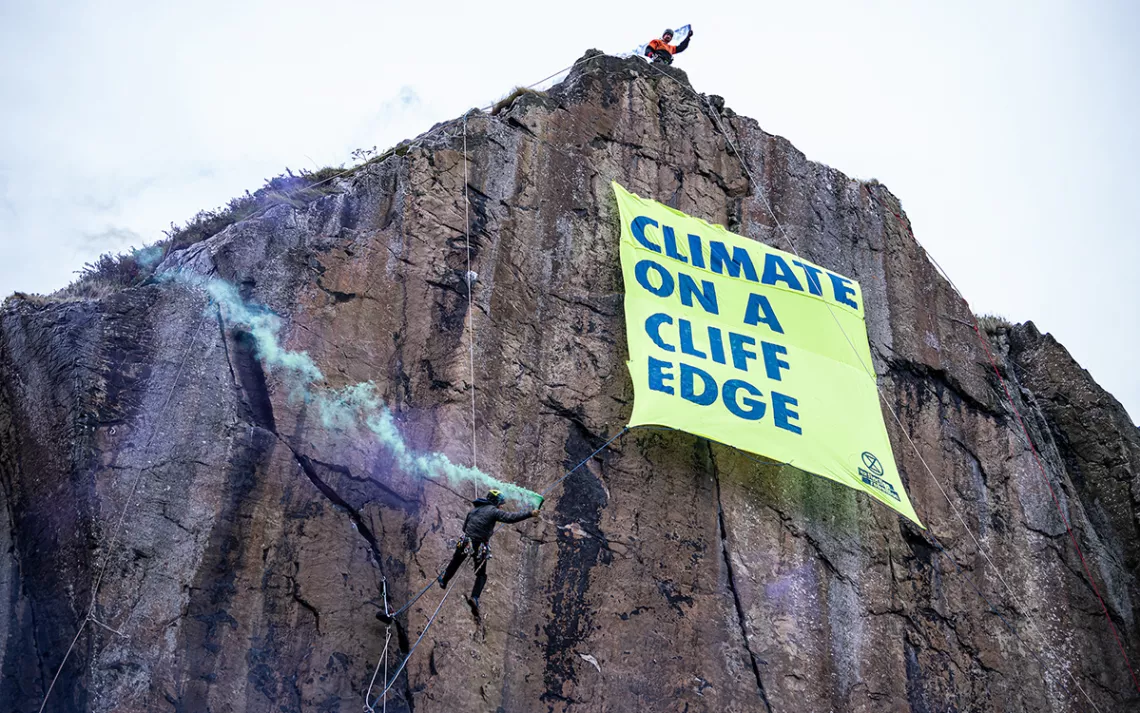
    Experienced climbers scale a rock face near the historic Dumbarton castle in Glasgow, releasing a banner that reads “Climate on a Cliff Edge.” One activist, dressed as a globe, symbolically looms near the edge, while another plays the bagpipes on the shores below. | Photo courtesy of Extinction Rebellion and Mark Richards
    Experienced climbers scale a rock face near the historic Dumbarton castle in Glasgow, releasing a banner that reads “Climate on a Cliff Edge.” One activist, dressed as a globe, symbolically looms near the edge, while another plays the bagpipes on the shores below. | Photo courtesy of Extinction Rebellion and Mark Richards

    Natural Disaster Expert: Elites Have NO PLAN for Climate Collapse. Aaron Bastani meets Bill McGuire

  • ‘Declare a Worldwide Climate Emergency’: Death Toll in Nepal-Tibet Floods Tops 1,000

    Spread the love

    Article by Jessica Corbettrepublished from Common Dreams under Creative Commons (CC BY-NC-ND 3.0).

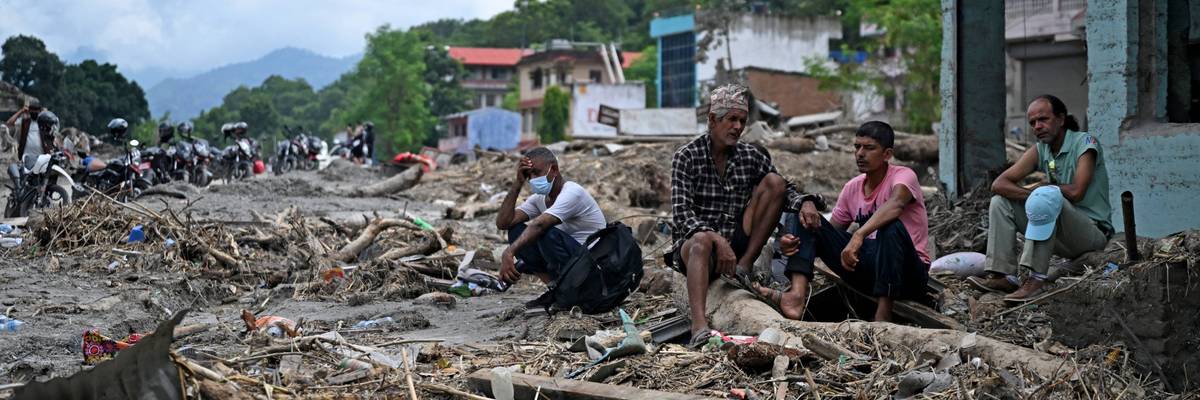
    Residents sit beside debris following flash floods in Devighat, in Nepal’s Nuwakot district, on August 31, 2026. (Photo by Arun Sankar/AFP via Getty Images)

    “The glacial collapse and deluge,” one scientist said, “was the structural failure of a mountain itself, nature’s latest commentary on the deadly consequences of human-caused planetary warming.”

    With more than 1,000 people dead as of Tuesday and rescue teams still searching for the thousands missing after a glacial collapse in the Himalayas that created a flooding crisis in Nepal and Tibet last week, campaigners, politicians, and scientists reiterated the need for global climate action.

    China confirmed at least 16 people are dead and 546 are missing in Tibet, including 261 foreign nationals, while Nepal reported 1,003 deaths and 3,916 more unaccounted for, including 583 foreigners, according to The Associated Press. Among those missing in Nepal are about 900 workers from a dozen hydropower projects, 500 of whom are believed to be trapped in tunnels.

    RECOMMENDED…

    A flash flood and mudslide swept through Nepal's Rasuwa district along the border with Tibet

    With 350+ Dead and 1,300 Missing, Nepal Carnage Seen as Climate Disaster

    US-POLITICS-VOTE-TEXAS

    Talarico Protests as Texas Swing County Plans to Close 92 Polling Places

    Thousands have been rescued since last Wednesday, and as the AP noted, “authorities in Nepal have been burying bodies in temporary graves until they can be identified. They are preserving DNA samples, photographing distinguishing facial features, and recording other identifying details. Each body is assigned a reference number to help families identify and claim the remains later.”

    Nepali Prime Minister Balendra Shah has emphasized in recent days that “the flood in the Bhote Koshi River in Rasuwa was not an ordinary flood,” and “it is now time for us to strongly raise with the international community the issue of the disasters we are experiencing as a result of climate change.”

    In a Monday interview with The New York Times, Maheshwar Dhakal from Nepal’s Ministry of Agriculture, Forest, and Environment also linked the disaster to human-caused climate change and said that “those who have contributed the least are suffering the most.”

    Dhakal estimated the recovery cost at $5 billion, and shared his government’s letter to the United Nations’ fund for such disasters, which says in part that “early action in Nepal would send a signal that the fund is capable of responding with humanity, speed, flexibility, and solidarity when climate-vulnerable countries face losses and damages beyond their capacity to address alone.”

    Declare a world-wide #climate emergency www.nytimes.com/live/2026/08… #nepal #floods #flooding

    — Nikolas Kozloff (@nikolaskozloff.bsky.social) 2026-08-27T20:29:42.867Z

    Stefan Rahmstorf, a scientist at the Potsdam Institute for Climate Impact Research in Germany, highlighted on social media Tuesday that experts have long warned about the kinds of disasters seen in the Himalayas over the past week.

    “Why are climate scientists not surprised about mountains being destabilized by glacier melt and permafrost thaw?” he asked. “Because they have long predicted that as a result of global heating.”

    Bill McGuire, professor emeritus of geophysical and climate hazards at University College London, wrote in a Tuesday column for The Guardian that “the increasingly temperamental behavior of the Earth beneath our feet teaches us that global heating is all-pervasive. It will intrude into every aspect of our lives and livelihoods, and leave no part of the planet untouched. As the world processes the horror of the events in Nepal and Tibet, it is a lesson that we ignore at our peril.”

    Also writing for the British newspaper on Tuesday, Michael Mann, a renowned climate scientist at the University of Pennsylvania, similarly stressed that “the glacial collapse and deluge in Nepal and Tibet was not a freak weather event; it was the structural failure of a mountain itself, nature’s latest commentary on the deadly consequences of human-caused planetary warming. And it was the exclamation point on a summer of extremes, illustrating with a sole unnatural disaster the apocalyptic future that lies in store if we fail to take dramatic climate action.”

    Mann pointed to the lack of such action in the United States—the world’s largest historical climate polluter—where President Donald Trump openly courted Big Oil on the campaign trail and has served the climate-wrecking fossil fuel industry’s interests since returning to the White House last year, from declaring a national energy emergency and ditching the Paris Agreement, again, to waging a war on renewable power projects.

    “Trump and enabling congressional Republicans continue to double down on policies favoring fossil fuel extraction and dependence at the very time we need to be moving even more quickly away from fossil fuels toward clean energy,” Mann wrote. “These extreme events underscore the urgency of taking action now, and—while there are many things we can do—one of the greatest opportunities Americans will have to affect climate policy is the upcoming midterm election. You can make support for urgent and dramatic climate action a litmus test issue as you go to the voting booth.”

    Highlighting that dozens of Americans are among those still missing in Asia, the US-based watchdog group Public Citizen argued on social media Tuesday that “this isn’t just a climate change catastrophe. It’s a crime. For decades, Big Oil knew fossil fuels would lead to disasters like this. Big Oil must be held accountable.”

    In 2024, the group published a legal memo detailing how local or state prosecutors in the United States could bring criminal charges against Big Oil for deaths from extreme heat made more likely by the fossil fuel-driven climate emergency. With rapidly advancing attribution science, the approach could also be applied to other disasters linked to the human-caused crisis.

    Greenpeace International also demanded accountability for the industry on Tuesday, saying that “it makes us SICK to think of people losing their homes, their livelihoods, and the people they love to fires, floods and storms, while fossil fuel companies make billions. A FRACTION of those obscene profits could help communities rebuild. MAKE POLLUTERS PAY.”

    “Make oil, coal, and gas corporations pay their fair share for the damage they cause,” the advocacy group added. “Introduce new taxes or fines on them to help communities at home and around the world rebuild from climate disasters and invest in climate solutions.”

    Article by Jessica Corbettrepublished from Common Dreams under Creative Commons (CC BY-NC-ND 3.0).

    Donald Trump urges you to be a Climate Science denier like him. He says that he makes millions and millions for destroying the planet, Burn, Baby, Burn and Flood, Baby, Flood.
    Donald Trump urges you to be a Climate Science denier like him. He says that he makes millions and millions for destroying the planet, Burn, Baby, Burn and Flood, Baby, Flood.
    Nigel Farage urges you to ignore facts and reality and be a climate science denier like him and his Deputy Richard Tice. He says that Reform UK has received £Millions and £Millions from the fossil fuel industry to promote climate denial and destroy the planet.
    Nigel Farage urges you to ignore facts and reality and be a climate science denier like him and his Deputy Richard Tice. He says that Reform UK has received £Millions and £Millions from the fossil fuel industry to promote climate denial and destroy the planet.
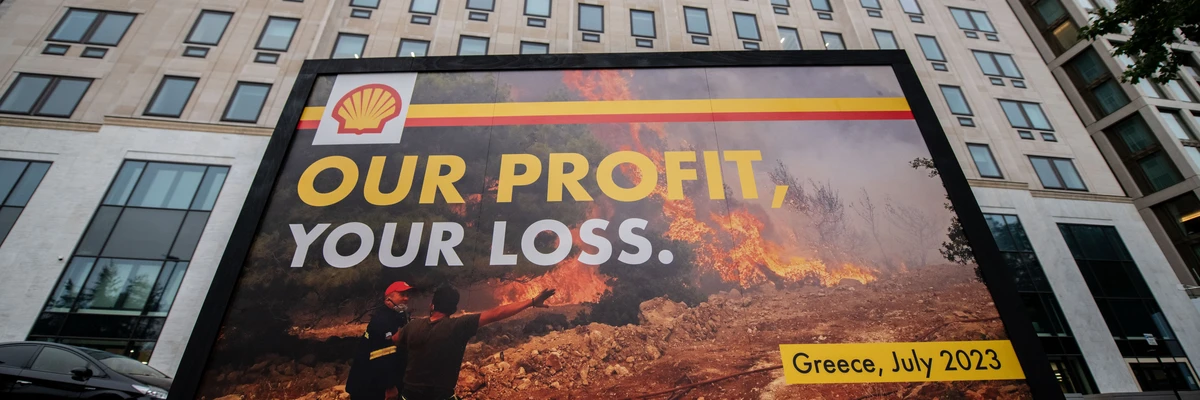
    Greenpeace activists display a billboard during a protest outside Shell headquarters on July 27, 2023 in London.
    Greenpeace activists display a billboard during a protest outside Shell headquarters on July 27, 2023 in London. (Photo: Handout/Chris J. Ratcliffe for Greenpeace via Getty Images)

    Natural Disaster Expert: Elites Have NO PLAN for Climate Collapse. Aaron Bastani meets Bill McGuire