Perhaps, there was a time when governments declared war on poverty. After all, no economy can flourish whilst masses are in poverty and can’t buy the goods and services produced by businesses. Now, the British state has declared war on low and middle income families.
The squeeze on workers has reduced their share of the gross domestic product (GDP), in the form of wages and salaries, from 65.1% in 1976 to around 50% at the end of second quarter of 2023. Between1980 and 2014, real GDP growth averaged around 2.2% per year and the economy has grown sporadically since then. However, most people have seen little benefit of that growth.
One study estimates that “if wages had continued to grow as they were before the financial crash of 2008, real average weekly earnings would be around £11,000 per year higher than they currently are – a 37 per cent lost wages gap”. The real average earnings are unchanged since 2005.
…
The war on the poor cannot provide economic or social stability. It has destroyed lives and inhibited social development. The institutions of government need to listen to saner voices, trade unions and non-governmental organisations to build a fair and just society through redistribution, higher public investment and by freeing themselves from the shackles of neoliberal economics.
Prem Sikka is an Emeritus Professor of Accounting at the University of Essex and the University of Sheffield, a Labour member of the House of Lords, and Contributing Editor at Left Foot Forward.
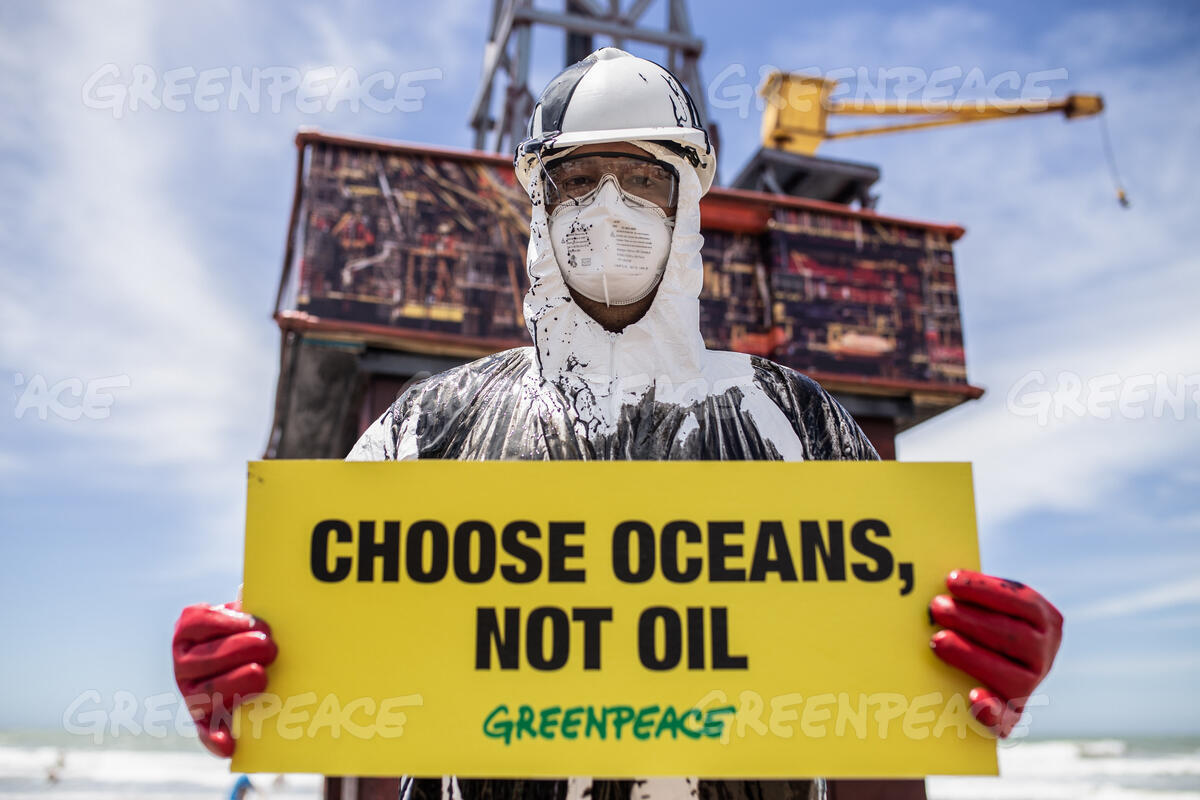
LONDON, Oct 19 (Reuters) – Britain’s decision to authorise new licences for oil and gas exploration in the North Sea was lawful, London’s High Court ruled on Thursday, dismissing a legal challenge by Greenpeace.
The environmental campaign group had argued Britain’s failure to assess the greenhouse gases produced by consuming oil and gas – so-called end-use or downstream emissions – rendered its offshore energy plan unlawful.
But lawyers representing Britain’s Department for Energy Security and Net Zero said at a hearing in July that ministers were not required to assess end-use emissions, though they nonetheless considered them.
Judge David Holgate rejected Greenpeace’s case on Thursday, saying in a written ruling that the decision not to assess end-use emissions was not irrational.
While the Southern Ocean around Antarctica has been warming for decades, the annual extent of winter sea ice seemed relatively stable – compared to the Arctic. In some areas Antarctic sea ice was even increasing.
In 2018 the international scientific community agreed to produce the first marine ecosystem assessment for the Southern Ocean. We modelled the assessment process on a working group of the Intergovernmental Panel on Climate Change (IPCC). So the resulting “summary for policymakers” being released today is like an IPCC report for the Southern Ocean.
This report can now be used to guide decision-making for the protection and conservation of this vital region and the diversity of life it contains.
Sea ice is to life in the Southern Ocean as soil is to a forest. It is the foundation for Antarctic marine ecosystems.
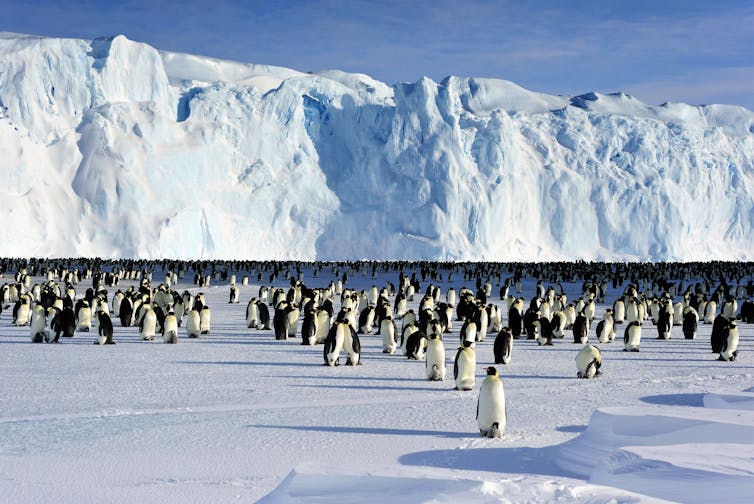
Less sea ice is a danger to all wildlife – from krill to emperor penguins and whales.
The sea ice zone provides essential food and safe-keeping to young Antarctic krill and small fish, and seeds the expansive growth of phytoplankton in spring, nourishing the entire food web. It is a platform upon which penguins breed, seals rest, and around which whales feed.
The international bodies that manage Antarctica and the Southern Ocean under the Antarctic Treaty System urgently need better information on marine ecosystems. Our report helps fill this gap by systematically identifying options for managers to maximise the resilience of Southern Ocean ecosystems in a changing world.
An open and collaborative process
We sought input from a wide range of people across the entire Southern Ocean science community.
We sought to answer questions about the state of the whole Southern Ocean system – with an eye on the past, present and future.
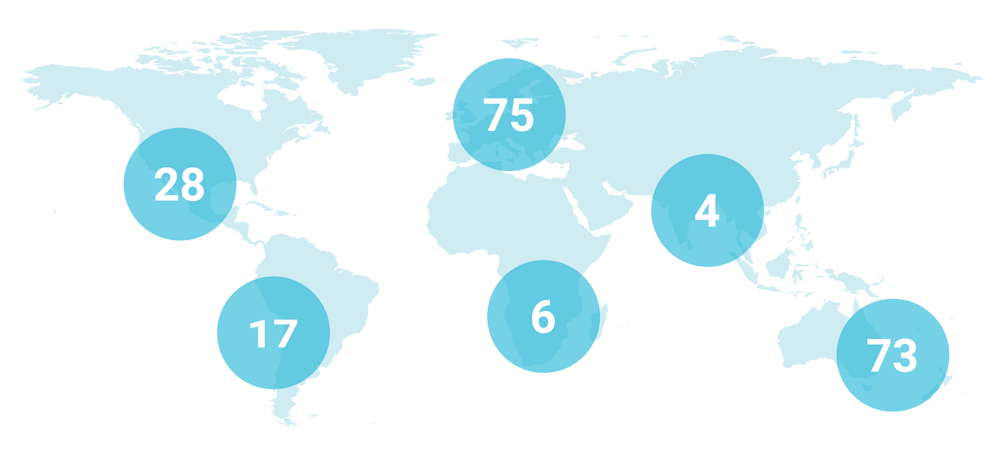
Our team comprised 205 authors from 19 countries. They authored 24 peer-reviewed papers. We then distilled the findings from these papers into our summmary for policymakers.
We deliberately modelled the multi-disciplinary assessment process on a working group of the IPCC to distill the science into an easy-to-read and concise narrative for politicians and the general public alike. It provides a community assessment of levels of certainty around what we know.
We hope this “sea change” summary sets a new benchmark for translating marine research into policy responses.
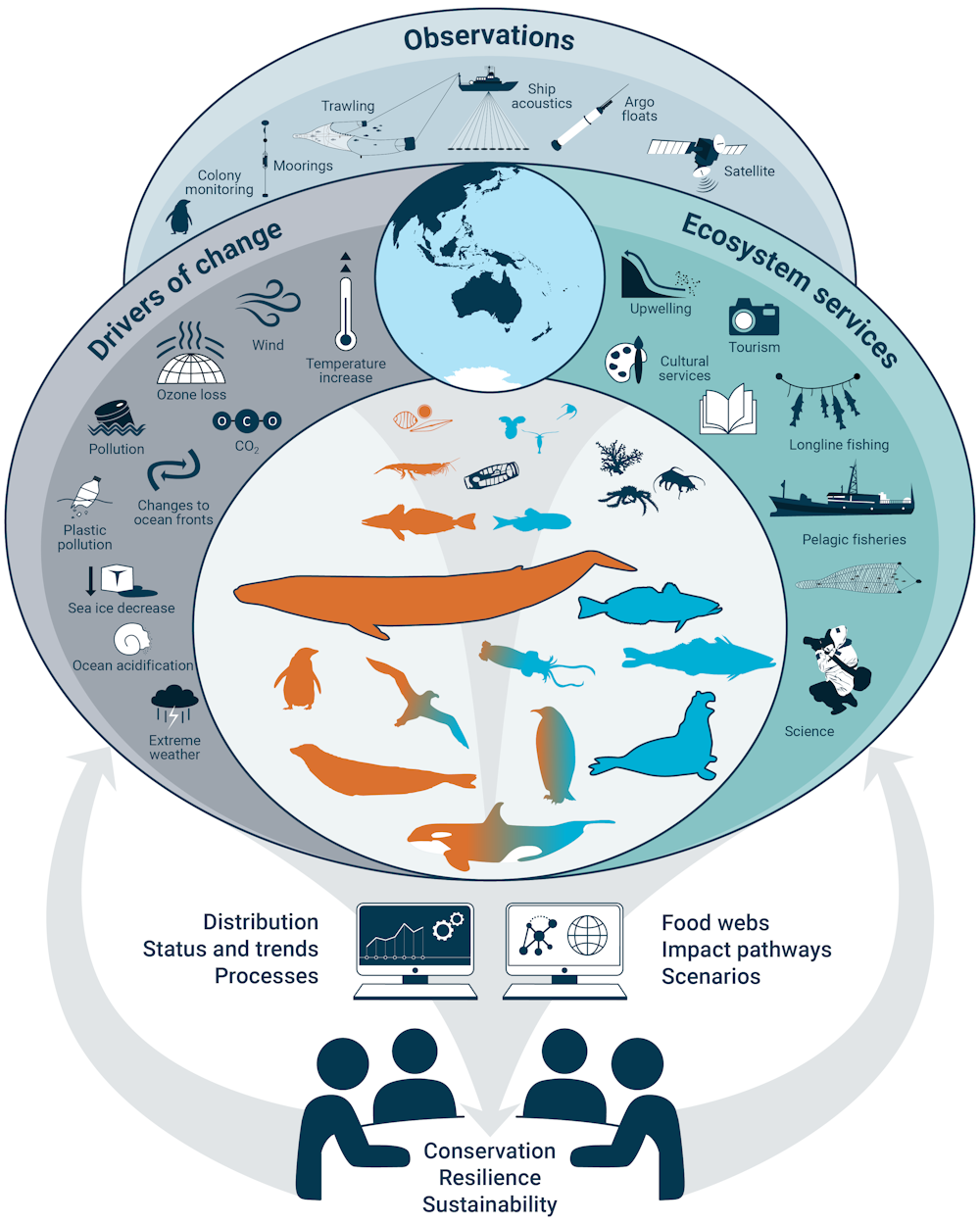
Southern Ocean habitats, from the ice at the surface to the bottom of the deep sea, are changing. The warming of the ocean, decline in sea ice, melting of glaciers, collapse of ice shelves, changes in acidity, and direct human activities such as fishing, are all impacting different parts of the ocean and their inhabitants.
These organisms, from microscopic plants to whales, face a changing and challenging future. Important foundation species such as Antarctic krill are likely to decline with consequences for the whole ecosystem.
The assessment stresses climate change is the most significant driver of species and ecosystem change in the Southern Ocean and coastal Antarctica. It calls for urgent action to curb global heating and ocean acidification.
It reveals an urgent need for international investment in sustained, year-round and ocean-wide scientific assessment and observations of the health of the ocean.
We also need to develop better integrated models of how individual changes in species along with human impacts will translate to system-level change in the different food webs, communities and species.
What’s next?
Our report will be tabled at this week’s international meeting of the Commission for the Conservation of Antarctic Marine Living Resources in Hobart.
The commission is the international body responsible for the conservation of marine ecosystems in the Southern Ocean, with membership of 26 nations and the European Union.
It is but one of the bodies our new report can assist. Currently assessments of change in habitats, species and food webs in the Southern Ocean are compiled separately for at least ten different international organisations or processes.
The Southern Ocean is a crucial life-support system, not just for Antarctica but for the entire planet. So many other bodies will need the information we produced for decision-making in this critical decade for action on climate, including the IPCC itself.
Beyond the science, the assessment team has delivered important lessons about how coordinated, collaborative and consultative approaches can deliver ecosystem information into policymaking. Our first assessment has taken five years, but this is just the beginning. Now we’re up and running, we can continue to support evidence-based conservation of Southern Ocean ecosystems into the future.
Jewish Americans and allies are lined up after being arrested during an October 18, 2023 protest calling for a cease-fire in Gaza at the U.S. Capitol in Washington, D.C. (Photo: Ariel Gold/X)
“Cease-fire is the first step to stop the ongoing genocide by the Israeli military of the over 2 million Palestinians in besieged Gaza,” asserted Jewish Voice for Peace.
Hundreds of Jewish Americans and allies were arrested at the U.S. Capitol on Wednesday during a protest demanding members of Congress push Israel for an immediate cease-fire in Gaza, where nearly 3,500 Palestinians have been killed over 12 days of relentless Israeli bombardment.
Thousands of protesters led by members of Jewish Voice for Peace (JVP), IfNotNow, Jews for Racial and Economic Justice (JFREJ), and other groups rallied on the Capitol grounds and inside the building, where hundreds of people took part in a sit-in.
Their chanted slogans—including “not in our name” and “cease-fire now”—resounded thunderously under the Capitol Rotunda, while at other times they clapped their hands and sang with solemn determination in Hebrew.
“We’re here to say: not in our names, and never again,” JVP declared. “And we’ll continue our civil disobedience until Congress calls for a cease-fire in Gaza, or until they force us to leave.”
Thank you to our Jewish allies from across the country who joined in solidarity to call for a #CeasefireNOW.
“Cease-fire is the first step to stop the ongoing genocide by the Israeli military of the over 2 million Palestinians in besieged Gaza, unable to leave,” the group continued. “In the past week, over 3,000 Palestinians, including 1,000 children, were murdered by Israeli and U.S. bombs. Over 1 million people are displaced. We have the power to stop this violence.”
“What we know from past Israeli state atrocities against Palestinians is that the bombs only stop once there is a sufficient mass outcry from the international community,” JVP added. “It’s on us to build that outcry—as fast as we possibly can.”
Speaking outside the Capitol, U.S. Rep. Rashida Tlaib (D-Mich.)—the only Palestinian American in Congress—said that “the majority of Americans are literally against oppression.”
“They are,” she insisted. “They are against occupation. They are against human rights violations. If you just tell them the truth, they will be on our side. So we have to speak the truth.”
BREAKING: One of the most powerful speeches ever heard on the Washington Mall by @RashidaTlaib warning President Biden and Democrats about their rejection of Palestinian lives and calling for a ceasefire with @jvplive and @IfNotNowOrg. pic.twitter.com/IjePzvNTur
Tlaib had a message for President Joe Biden, who has declared his “rock-solid and unwavering support” for Israel, which he visited Wednesday and receives nearly $4 billion in annual U.S. military aid.
“I want him to know, as a Palestinian American and also as someone of the Muslim faith: I’m not gonna forget this,” she vowed. “And I think a lot of people are not gonna forget this.”
At the UN, the US objected to a resolution calling for a humanitarian ceasefire in Gaza. Think about that.
Rep. Cori Bush (D-Mo.), who led a resolution with Tlaib and 14 progressive co-sponsors calling on Biden to push for a cease-fire, also spoke at the rally.
“We thank our Jewish community for being out here saying ‘Never Again’,” she said.
Author and activist Naomi Kleintold the demonstrators that “it’s crucial that we become huge, become unignorable, and throw all our support behind this brave legislation.”
JVP, IfNotNow, and peace activist Ariel Gold—who was at the event—said hundreds of protesters were arrested.
Hundreds of American Jews and allies are being arrested at Congress while demanding a ceasefire and end to the genocide in Gaza. @jvplivepic.twitter.com/3bZUAuwNSg
Wednesday’s protest and arrests followed a string of Jewish-led peace demonstrations across the nation, including two major rallies in Washington, D.C. IfNotNow’s website lists many events planned in cities around the country in the coming days.
“The Israeli military is preparing for a massive ground invasion of Gaza. Israeli and American leaders are dehumanizing Palestinians with vitriolic rhetoric that calls to mind the most hysterical days of… [the] War on Terror,” JVP said Wednesday. “We know where this will lead: genocide.”
For 75 years, the Israeli government has illegally occupied Palestinian land and ethnically cleansed their communities.
Now, Gaza is facing genocide with full support from the U.S. and we're here as Jews to refuse complicity and say never again, for anyone. pic.twitter.com/i7kpr4L0ek
“Many of us are mourning our Israeli and Palestinian friends and loved ones,” the group continued. “We are in pain and grief, trying to process a week of horrific violence that has left so many that we know injured, traumatized, kidnapped, or killed.”
“But we refuse to let our grief be weaponized to justify the murder of more Palestinians,” JVP added. “As American Jews, we demand a cease-fire now. No genocide in our name.”
Indigo Rumbelow at Green Gathering, Chepstow 5 August 2023
Roger Hallam at Green Gathering, Chepstow 5 August 2023
22/10/23 10.30pm Full disclosure: An imbecile in a car drove into me on my bicycle, expect that you cyclists are well aware that they often don’t pay attention of follow the rules of the road. I’m not seriously injured but injured enough that it is unlikely that I will be marching with JSO on this occasion.