Category: politics

  • Government has ‘no plans’ to stop arms sales to Israel despite civilian deaths

    Spread the love

    Original article by Adam Bychawski republished from OpenDemocracy under a Creative Commons Attribution-NonCommercial 4.0 International licence.

    Human rights groups say UK is ignoring its own rules on arms exports after hundreds of Palestinians killed
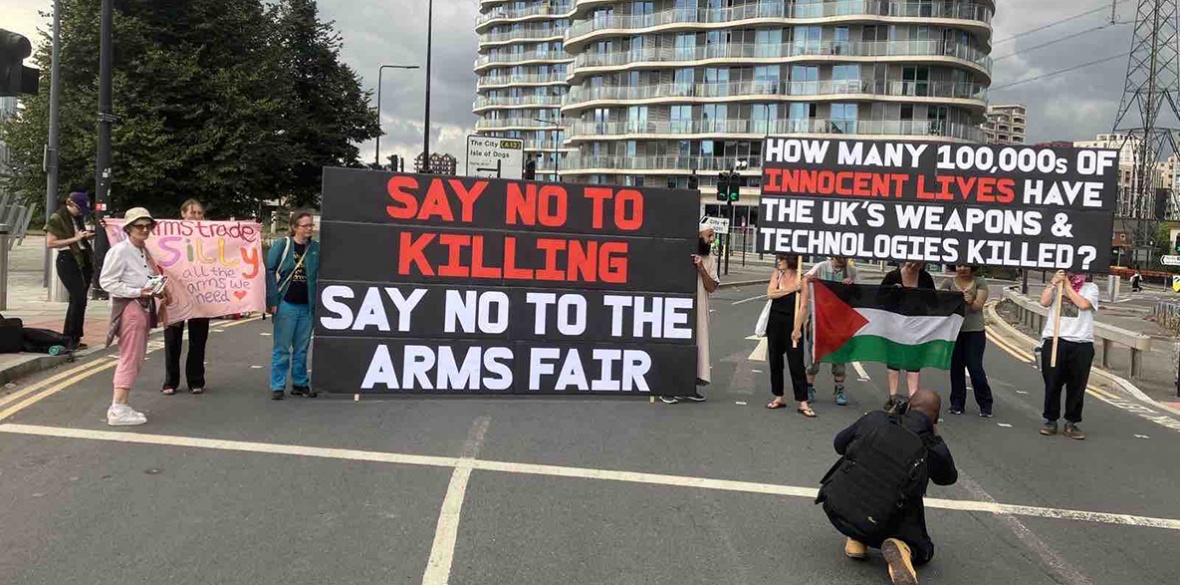
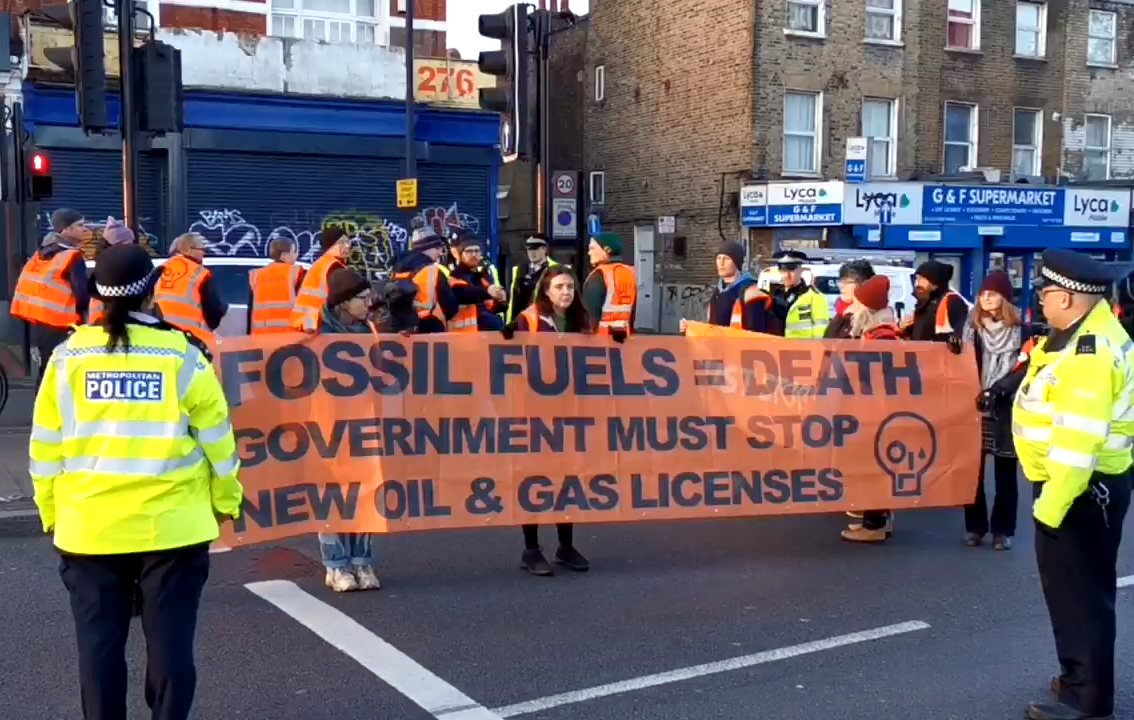
    Campaigners block the road in East London outside the DSEI arms fair Photo: @CAATuk / Twitter
    Campaigners block the road in East London outside the DSEI arms fair Photo: @CAATuk / Twitter

    The UK government has no plans to suspend arms sales to Israel, despite human rights campaigners warning its exports have been used to kill civilians, openDemocracy has been told.

    The UK has approved millions of pounds worth of licences for military equipment to Israeli forces since 2015. They include components for F-35 fighter jets, which can deliver ground strikes and have been recently pictured in social media posts from the Israeli Air Force.

    In response to Hamas’ attack on Israel which killed hundreds of civilians, Israeli forces have fired thousands of bombs into Gaza since 7 October. As of yesterday, 2,750 Palestinians have been killed and 9,700 wounded in Israeli air strikes on the Gaza strip, according to the Palestinian health ministry. This figure was given before an attack on al-Ahli Arab hospital that reportedly killed 500 people.

    Francesca Albanese, the UN’s special rapporteur on the situation of human rights in the Palestinian territories, warned last week that “Palestinians are in grave danger of mass ethnic cleansing”.

    openDemocracy asked the Department of Business and Trade if it would suspend and review its export licences for arms to Israel in light of the reported civilian killings. In response, the department said the licences were “under continual review” but there were “no immediate plans to stop arms export licences to Israel”.

    Emily Apple, media coordinator for the Campaign Against the Arm Trade, said: “It is disgusting that the Department for Business and Trade is refusing to suspend and review arms licences to Israel given the mounting evidence of war crimes committed by Israel in Gaza.

    “UK industry is responsible for 15% of the components used in the F35 stealth combat aircraft that are being used in airstrikes, and the UK is therefore complicit in war crimes committed by the Israeli government.”

    Any UK company wishing to export military goods to other nations must apply for a licence to do so. The government has a number of criteria that must be met before licences can be granted. 

    One of the criteria is to “not grant a licence if [the department] determines there is a clear risk that the items might be used to commit or facilitate a serious violation of international humanitarian law”.

    Officials are also told not to grant licences if there is a “likelihood that the items would be used in the territory of another country other than for legitimate purposes including national or collective self defence”.

    The campaign group Palestine Action, which has taken direct action in the UK against Israeli arms company Elbit, said it was “no surprise” that the UK government is continuing to allow arms exports.

    “Numerous weapons factories, including ones owned by Israel’s largest weapons firm, continue to operate on our doorsteps, who market their weapons as “battle-tested” on the captive population of Gaza,” a spokesperson for the group said.

    The UK has in the past paused export licences in response to reports that its criteria may have been breached.

    In 2019, the then foreign secretary Dominic Raab suspended arms exports to NATO ally Turkey after it invaded Syria, on the grounds that it risked worsening the humanitarian crisis in the country.

    The UK revoked some arms licences to Israel in 2009 after hundreds of Palestinians were killed in airstrikes by Israeli forces. During the 2o14 conflict, the government warned it would suspend licences again if hostilities continued, but ultimately did not go-ahead with the decision.

    The decision to continue supplying arms to Israel comes after MPs and campaign groups raised concerns about a growing lack of transparency from the government over exports licences.

    In October, an enquiry led by MPs found that despite pledges from the government to improve transparency “progress has been limited” and that “there is a worrying lack of openness and data on compliance”.

    The Campaign Against the Arms Trade told openDemocracy that there is a “disturbing lack of transparency over arms sales to Israel”.

    “The UK government has hidden behind exemptions and refused to supply CAAT with data regarding recent exports by Elbit subsidiaries, and a large proportion of UK sales are hidden by open export licences where it is impossible to monitor the amount of weapons sold,” it said. 

    Sacha Deshmukh, Amnesty International UK’s chief executive, urged the government to reverse its decision to continue supplying Israel with arms.

    “The UK’s arms export system is based on the principle of avoiding a clear risk of British weapons being used to commit serious violations of international law. There’s mounting evidence that Israel’s military conduct in Gaza during the last week has included indiscriminate attacks which have killed and injured large numbers of Palestinian civilians.

    “The government needs to follow its own rules and urgently suspend export licences for all arms transfers to Israel that risk being used to commit further unlawful attacks.”

    Original article by Adam Bychawski republished from OpenDemocracy under a Creative Commons Attribution-NonCommercial 4.0 International licence.
  • Tory candidate for Tamworth posted chart telling parents who can’t feed kids to ‘f*** off’

    Spread the love

    https://leftfootforward.org/2023/10/tory-candidate-for-tamworth-posted-chart-telling-parents-who-cant-feed-kids-to-f-off/

    Andrew Cooper is standing for the party in Tamworth.

    With two by-elections set to take place this Thursday following the resignation of two Tory MPs, this week is a crucial test for Rishi Sunak ahead of the next general election.

    Yet one of the Tory by-election candidates, Andrew Cooper, who is standing for the party in Tamworth is revealed to have posted a chart telling parents who can’t feed kids to ‘f*** off’, causing yet another headache for the Tories.

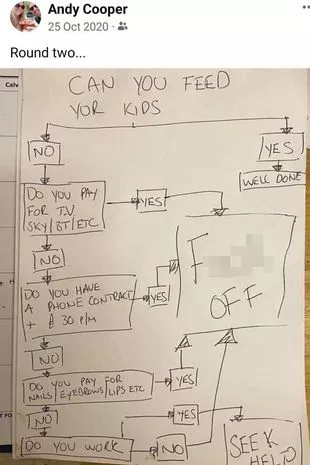
    The story, first reported in the Mirror, reveals that in 2020 Cooper posted on Facebook a diagram drawn in pen on a piece of paper asking the question: “Can you feed your kids?” It said that those who have subscriptions for TV services such as Sky, as well as mobile phone contracts or get their nails done should “f*** off”. The diagram suggested that parents who do none of these but do not work should also “f*** off”.

    …

    Andrew Cooper prospective Tory MP for Tamworth's diagram telling parents to feck off
    Andrew Cooper prospective Tory MP for Tamworth’s diagram telling parents to feck off

    https://leftfootforward.org/2023/10/tory-candidate-for-tamworth-posted-chart-telling-parents-who-cant-feed-kids-to-f-off/

  • Protesters occupy City Of London insurers’ offices demanding they reject climate-wrecking projects in UK and Africa

    Spread the love
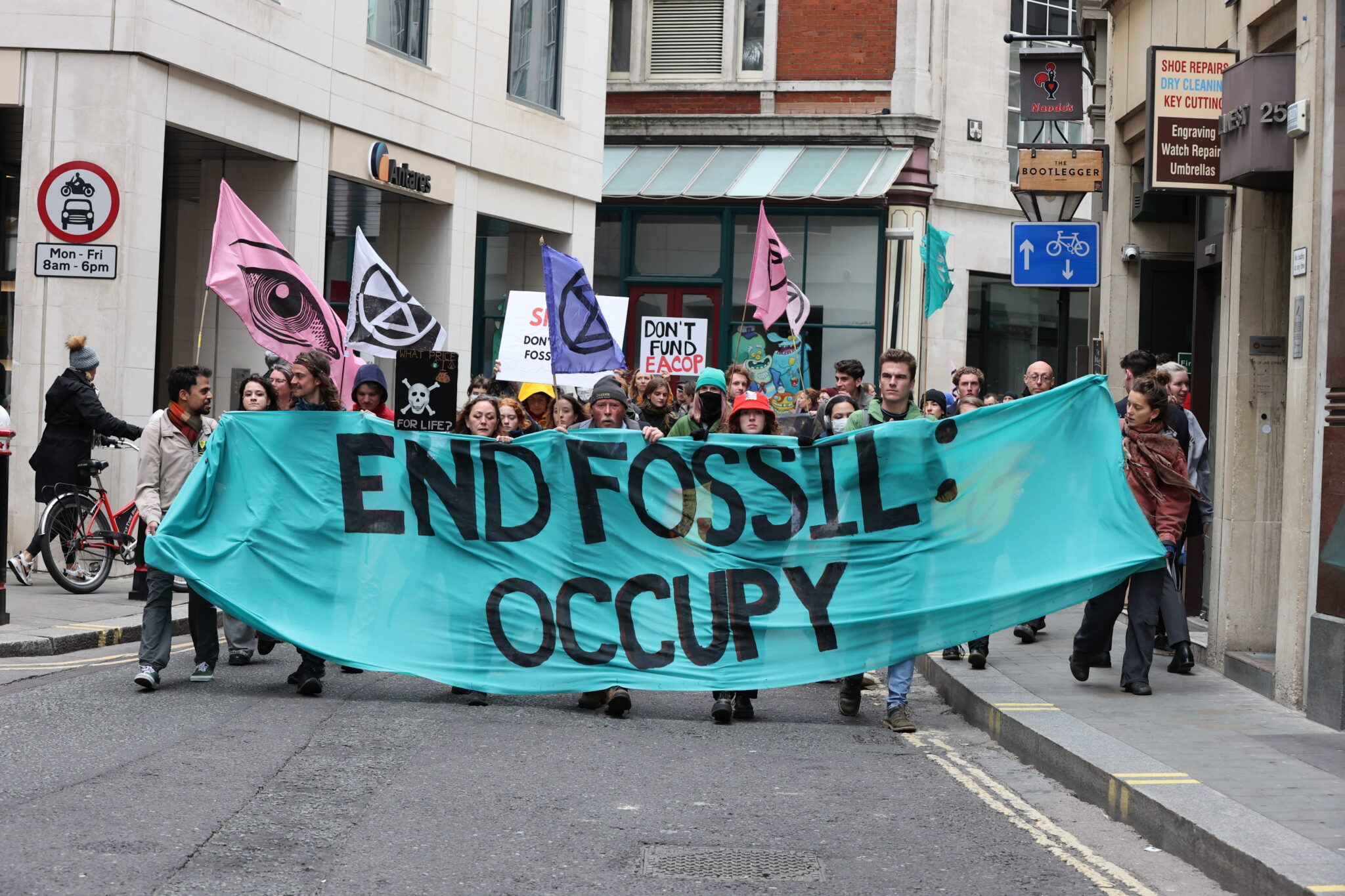
    Extinction Rebellion occupy Lloyds of London insurance companies 18 October 2023.
    Extinction Rebellion occupy Lloyds of London insurance companies 18 October 2023.

    Ten City of London insurance companies are targeted by activists calling on them to stop insuring West Cumbia coalmine and East Africa Crude Oil Pipeline NOW!

    Hundreds of protesters occupied City of London offices of ten Lloyd’s of London insurers demanding they rule out insuring the proposed West Cumbria coal mine and the East Africa Crude Oil Pipeline (EACOP).

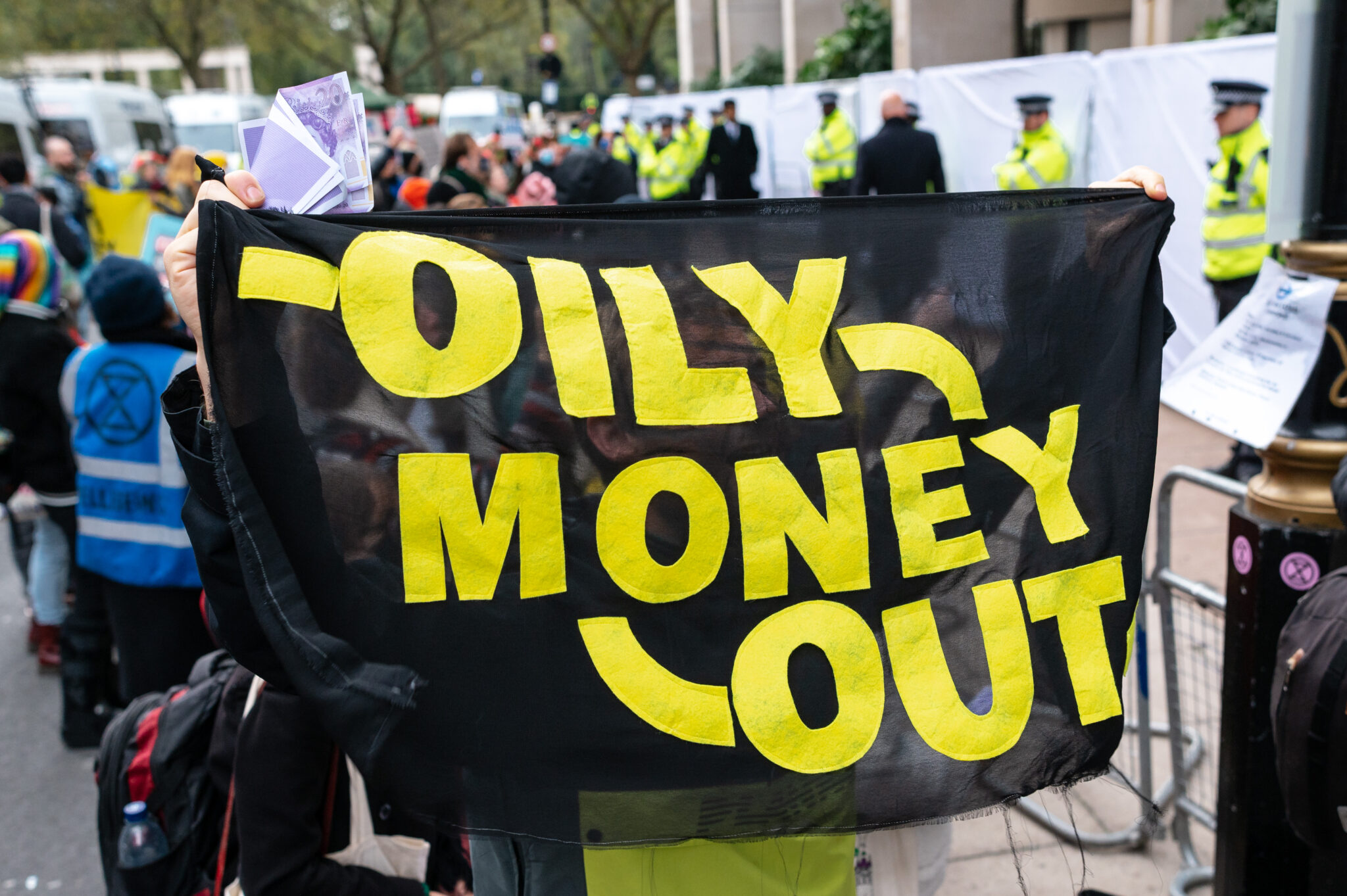
    The occupations started as a huge crowd gathered outside Standard Bank. The protests are in collaboration with Fossil Free London’s “Oily Money Out” mass action – at which Greta Thunberg was arrested yesterday – and in solidarity with Extinction Rebellion Gauteng in South Africa.  In Johannesburg activists were recently met with brutality by security personnel hired by Standard Bank as they peacefully called for dialogue to end the financing of new coal projects.

    The protesters marched waving banners saying “Don’t Insure EACOP” and “Don’t Insure West Cumbria Mine” to three high profile buildings including the “Walkie Talkie” where in a coordinated swoop, activists occupied the office foyers of Ascot, Talbot, Chaucer, Markel, Allied World, CNA Hardy, Tokio Marine Kiln, Sirius International and Lancashire Syndicates. The activists are staging a sit-in and refusing to leave.

    Insurers from Lloyd’s of London have come under increasing pressure to rule out offering insurance to both the West Cumbria coal mine and EACOP, including protests at offices across the UK with hundreds of students entering the job market refusing to work for them.

    Claude Fourcroy, a spokesperson for Money Rebellion said: “We are calling on all the banks and insurers behind the West Cumbria mine and East Africa Crude Oil Pipelines to cut their ties now. Both of these projects will fuel climate breakdown. Lloyd’s of London and the insurers in its market sit at the centre of a web of climate wreckers in the City of London, alongside Barclays and HSBC.”

    Community members from Cumbria and Uganda joined the protests, sharing the united call to insurers and banks to stop underwriting fossil fuel projects.  The UK Climate Change Committee warned that the West Cumbria Mine would increase UK’s domestic emissions and make the government’s legally-binding domestic emissions budgets difficult to meet.

    The massive 1443 km East Africa Crude Oil Pipeline will wreak havoc on communities, jeopardise ecosystems and water supplies. and eliminate the possibility of Earth remaining habitable. There can be no new fossil fuels anywhere if global heating is to remain under 1.5C.

    Scientists say we are dangerously close to crossing the globally agreed threshold of 1.5C this year. Neither project will proceed without financial and insurance backing.

    Andrew Taylor, Coal Action Network said: “West Cumbria Mining Ltd wants to dig coal here right up until 2049 – when we’re supposed to have reached net zero by 2050! They’re not looking at the impact of how burning it would damage the climate and nature.  The UK government talks about us having energy security but the truth is, if the mine goes ahead, 85% of the coal would be exported.”

    Patience, a youth activist from Fridays for Future Uganda said: “We have gathered here today to demand that insurers cut ties with EACOP. By supporting this deadly fossil fuel project they undermine any climate commitments they have made. People in Uganda are facing human rights violations in the name of this project. This has to end.”

    Fossil Free London is simultaneously disrupting the Canary Wharf offices of Total Energies, a majority shareholder in EACOP.

    The protests come on the second day of the Fossil Free London “Oily Money Out” protests targeting the Energy Intelligence Forum at the InterContinental Park Lane Hotel in London, where fossil fuel corporations, including Shell, Total and Equinor, are talking to government ministers. The Forum is taking place in the run up to the COP28 Climate Conference, which has already been captured by the fossil fuel industry, with the appointment of Al Jaber, chief executive of the Abu Dhabi National Oil Company (ADNOC) as the COP28 President.

    Banner reads Oily Money Out. Protests London 18 October 2023.
    Banner reads Oily Money Out. Protests London 18 October 2023.


    Joanna Warrington, campaigner with Fossil Free London said: “We can’t allow London to welcome the climate-wrecking elite when droughts, floods, and wildfires rage across the world. London’s banks and finance sector have been ignoring all the warning signs while pouring billions into fossil fuel expansion. Their profit is our loss. Financing new fossil fuel developments is incompatible with a safe future.”

  • Just Stop Oil founders arrested in dawn raids

    Spread the love

    Just stop oil founders Indigo Rumbelow and Roger Hallam were arrested in separate raids this morning after police forced entry to their homes, searched belongings and confiscated papers. 

    Just Stop Oil protesting in London 6 December 2022.
    Just Stop Oil protesting in London 6 December 2022.

    Just Stop Oil said: 

    “We will not be intimidated by our criminal government. Not content with cheering on war crimes in Gaza, by maxing out our oil and gas reserves they are complicit in the greatest crime in human history. New oil and gas will result in unimaginable suffering and destroy the lives and livelihoods of billions of people. No one has ever voted for this, there has never been a democratic mandate to destroy the habitable world. 

    “Just Stop Oil supporters are deeply committed to stopping all new oil and gas. If our government refuses to do what is right to protect humanity, then people will step up to do what needs to be done. 

    “The painful truth right now is that our politicians and corporations have no intention of acting in accordance with the fundamental interests of either our young people or the country as a whole. Whether those in charge realise that they are committing the crime of genocide, is not the question. For this is how it will be seen by the next generation and all future generations. Our friends in police custody and languishing in prison understand this very well as do we.”

    Comment by dizzy: Roger Hallam appears to get arrested and imprisoned regularly.

    Video is from November 2022. Just Stop Oil are no longer blocking the M25 motorway.

    16.40 update: Just Stop Oil are claiming that Indigo Rumbelow and Roger Hallam were arrested as a result of short speeches they gave at a festival this summer. Here are those speeches.

    19.40 Uncertain why he was arrested over that speech, he didn’t seem to say anything outrageous. For example, he didn’t encourage people to engage in violence. Is it that the UK government is so intolerant? Are there some really nasty laws now prohibiting debate?

    Indigo Rumbelow’s speech …

    19.50 Indigo talks really well. Recommended.

    19/10/23 I’ve seen a video of Roger Hallam getting arrested where charges of conspiracy were discussed – so it would seem that they were not arrested for giving these speeches.

  • Why heating your home this winter may be even harder than last year

    Spread the love
    Daisy Daisy/Shutterstock

    Aimee Ambrose, Sheffield Hallam University; Lucie Middlemiss, University of Leeds, and Neil Simcock, Liverpool John Moores University

    Domestic energy prices more than doubled during 2022 compared with the year before. This meant that the number of UK households in fuel poverty who could not afford to heat their homes to a safe level rose from 4.5 million to 7.3 million.

    The UK government attempted to alleviate the impact of rocketing bills with a package of support measures. This included capping the unit cost of electricity and gas, a £400 rebate to all households using mains gas for heating and £200 for those using alternative fuels, and a further £650 “cost of living payment” to claimants of means-tested benefits.

    Many of these schemes ended in spring 2023. And with wholesale gas costs and the government’s energy price cap having come down somewhat, you could be forgiven for thinking that the worst of the energy crisis has passed.

    But that’s not the case for many billpayers – in fact, this winter is likely to be worse than the last for many households.

    The energy price cap, introduced in 2019 by market regulator Ofgem, limits how much people pay for each unit of gas and electricity. The latest price cap, set on October 1 2023, means that a typical household will pay £1,834 a year for energy – less than £2,000 for the first time in 18 months.

    This might sound like good news, but it’s still a substantial increase on the pre-crisis cap. In August 2021, the most a typical household could expect to pay in a year for energy was £1,277.

    Although the unit prices of electricity and gas have fallen, there has been a steep increase in standing charges. These are a levy on all energy bills which cover the costs associated with supplying energy to homes.

    Standing charges have gone up from around £186 a year pre-crisis to just over £300 now – effectively adding £110 to bills.

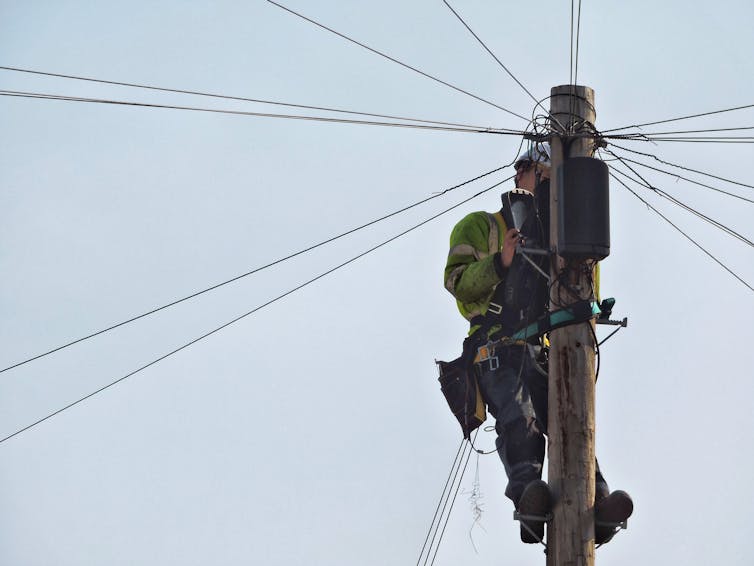
    An engineer atop of wooden electricity transmission pole.
    Standing charges pay for the upkeep of the UK’s energy supply network.
    KingTa/Shutterstock

    Standing charges are regressive because they are the same for everyone, regardless of how much energy you consume. Poorer households often use much less energy than wealthier ones, so standing charges make up a larger proportion of their energy costs.

    In fact, some low-income households use such small amounts of energy that they are paying little more than their standing charges.

    Energy bill rebates ended

    The £400 energy bill rebate paid to all households last winter has now ended. Meanwhile, cost of living payments to claimants of means-tested benefits have increased from £650 to £900 a year. This will be helpful to those who qualify, but one third of households eligible for means-tested welfare payments do not claim them due to stigma, lack of awareness or bad experiences with the assessment process, and so will receive no assistance.

    Many households who do receive these cost of living payments will spend it on other expenses, such as food, rather than heating their home. This reflects the fact that energy is often seen by struggling households as something that can be rationed.

    If you’re in a household that does not qualify for the cost of living payment then the savings of around £150 that resulted from the lowering of the cap will soon be more than cancelled out by the lack of a rebate.

    Cold homes can kill

    Despite the financial support offered last winter, average levels of energy debt for people contacting Citizens Advice in England and Wales have risen sharply over the last year, from around £1,400 per household on average in March 2022 to £1,711 in July 2023. One-third of UK energy customers are now in arrears.

    So although energy bills have fallen slightly, many households are less resilient to financial shocks than they were in early 2022. Volatile energy prices are predicted to last until the end of the decade.

    Research last winter found that households in fuel poverty were underheating their homes, causing damp and mould that can create serious health problems and exacerbating anguish and stress. The health risks of a cold home increase with repeated exposure.

    A PVC window frame with black mould growing on it.
    Poorly heated homes are at risk of damp.
    Burdun Iliya/Shutterstock

    As temperatures begin to fall again, a range of measures are urgently needed to prevent a crisis worse than that of last winter.

    What can be done to help?

    Since energy prices are expected to remain high for years, long-term solutions are vital. There must be increased investment in efforts to insulate the UK’s leaky housing stock. But with winter just weeks away, what can the government do right now?

    To start, it could offer greater energy bill rebates. Given the scale of the fuel poverty problem, eligibility for these rebates must be wide enough for anyone on a below average income to receive help.

    Alternatively, the government could make the rebates universal again, and potentially recoup the costs by increasing taxes on the most wealthy or energy company profits. At the very least, unclaimed energy bill support from last winter should be used to support those likely to struggle in the coming winter, rather than being returned to the treasury.

    Cut funding for government-backed advice services could also be restored. And there are reforms to the retail energy market that could be implemented fairly quickly, such as bringing standing charges in line with levels of usage.

    More fundamentally, there are a number of proposals that would be fairer than the current system and could be implemented together for maximum impact. These include a “green power pool”, which would ensure that the cheap power generated by renewables such as wind and solar benefits those most in need first and foremost, social tariffs (discounted energy bills for low-income households), or a national energy guarantee that would secure access to enough free energy to meet everyone’s basic needs.

    The government’s forthcoming autumn statement must not sidestep these issues if people in fuel poverty are to stay safe and warm this winter.


    Imagine weekly climate newsletter

    Don’t have time to read about climate change as much as you’d like?

    Get a weekly roundup in your inbox instead. Every Wednesday, The Conversation’s environment editor writes Imagine, a short email that goes a little deeper into just one climate issue. Join the 20,000+ readers who’ve subscribed so far. The Conversation


    Aimee Ambrose, Professor of Energy Policy, Member of Fuel Poverty Evidence and Trustee of the Fuel Poverty Research Network, Sheffield Hallam University; Lucie Middlemiss, Professor in Environment and Society, University of Leeds, and Neil Simcock, Senior Lecturer in Geography, Liverpool John Moores University

    This article is republished from The Conversation under a Creative Commons license. Read the original article.