Campaigners slam Western governments for continuing to arm Israel as Palestinians in Gaza search desperately for food, water and shelter amid the bombs
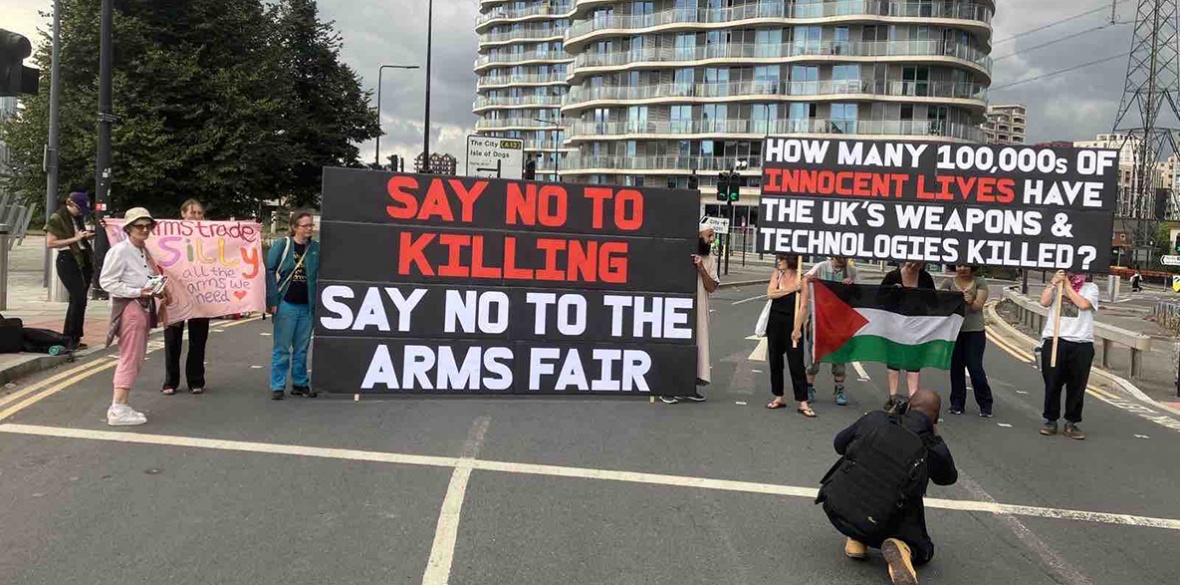
Campaigners block the road in East London outside the DSEI arms fair Photo: @CAATuk / Twitter
ACTIVISTS have slammed the scheduled visit of United States President Joe Biden to Israel on Wednesday as the relentless bombardment of Gaza leaves Palestinians searching desperately for food, water and shelter.
The visit was announced just as Iran issued a stern warning to the Israelis that it may intervene in the conflict.
Israel bombed areas of southern Gaza where it had previously told Palestinians to flee, killing dozens of people on Tuesday.
…
British companies provide 15 per cent of the components for the F-35 stealth combat aircraft that Israel is currently using in the bombardment of Gaza, in contracts worth £336 million, Campaign Against Arms Trade (CAAT) said.
The group is demanding the government revoke all licences for arms exports and is backing calls from Palestine trade unions for workers to refuse to build or export weapons to Israel.
CAAT’s Emily Apple said: “There should be no hierarchy when it comes to the killing of civilians.
“However, in continuing to arm Israel, this government is showing that it does not value Palestinian lives.
“Through its arms sales, and particularly through the supply of components for the F-35s, the UK is complicit in war crimes in Gaza.
New research shows household debt has hit five-year high
BRITAIN’S energy crisis is “growing by the week,” campaigners warned today after research found that household debt has hit a five-year high of £216 as winter approaches.
The number of homes already owing money to their energy provider is up 11 per cent on last year, according to a survey by comparison website Uswitch.
Of those in arrears on their gas and electricity bills, 40 per cent say their debt is higher than last year and 28 per cent believe their position is about the same as 12 months ago.
Almost one in seven say they have gone from being in credit a year ago to owing money now.
More than half of households are worried about how they will pay their energy bills this winter and 49 per cent say they will wear extra layers of clothing at home so that they can manage with less heating.
And 25 per cent say they will not turning their heating at all, even when it is cold.
The conflict in the Middle East has led British political actors to try and redefine what is ‘acceptable speech’
Police and protesters at the March for Palestine in London on Saturday | Mark Kerrison/In Pictures via Getty Images
As a humanitarian crisis unfolds in the Middle East, the UK government and its backers in the media have sought to marginalise and silence dissenting voices by targeting protest movements showing solidarity with the Palestinian cause.
Hundreds of people in Israel were killed, just over a week ago, in a brutal attack by Hamas. In response, Israel has moved swiftly against Hamas and the Palestinian population living in the Gaza strip. It has cut off their electricity and prevented the entry of food, water and medical supplies as it commences a devastating bombardment of homes and civilian infrastructure, leaving hundreds dead.
The reaction to these unfolding events in Britain has been one of shock and anger. Amongst the political class, a closing of the ranks has occurred, shoring up support for Israel as it strikes against the Palestinian population. And as part of this, political actors have sought to demarcate new boundaries on what is acceptable speech in the UK.
Foreign secretary James Cleverly on Tuesday urged pro-Palestinian protesters to stay at home. And home secretary Suella Braverman wrote to police chiefs asking them to take action against acts of protest that – in whose eyes it was not clear – might indicate support for Hamas.
She singled out the waving of the Palestinian flag in particular as being illegitimate “when intended to glorify acts of terrorism”, and asked that the police “consider whether chants such as: ‘From the river to the sea, Palestine will be free’ should be understood as an expression of violent desire to see Israel erased from the world” and therefore a “racially aggravated” crime.
The Telegraph has also reported that Robert Jenrick, the immigration minister, has commissioned officials in the Home Office to consider how they could revoke visas and expel foreign students who “praise Hamas”.
There are undoubtedly circumstances in which the use of particular chants or imagery could be inflammatory or even threatening. But the purpose of these statements is not to protect British communities (that much is clear from Braverman’s failure to issue a similar letter warning against attacks on Muslim or pro-Palestinian groups). The purpose is rather to intimidate would-be protestors and delegitimise criticism of Israel by aligning it with criminality.
The government’s views on acts of protest are mirrored by the official opposition: a diktat sent out by Labour Party general secretary David Evans warned members, councillors and MPs against attending pro-Palestine demonstrations. Labour has gone further still by also forbidding debate on Israel-Palestine in local party branches – a censorship not even attempted by Tony Blair during the lead-up to the Iraq war.
The results of Braverman’s provocation can already be seen. On Wednesday, Greater Manchester Police arrested four people for breaching the peace “during events… marking the Hamas-Israel conflict”, later de-arresting three of them. A video taken at the scene of the arrest and posted online shows a young man being led into a police van, a Palestine flag wrapped around his shoulders, as concerned onlookers shout at officers: “He has done nothing wrong,” and: “Freedom of speech.”
The Metropolitan Police Service itself appears to have ruled out any crackdown on people waving the Palestinian flag. But on Thursday night, the Palestinian Literature Festival was forced to cancel a book launch for Jewish American journalist Nathan Thrall’s latest book ‘A Day in the Life of Abed Salama: A Palestine Story,’ “after the Metropolitan Police Service contacted the host organisation and asked that it be cancelled ‘due to security concerns’.”
And at London’s ‘March for Palestine’ demonstration on Saturday, legal observers from Black Protest Legal Support witnessed the police make arrests of protesters who had refused to remove the ‘keffiyeh’ – a chequered black and white scarf that is symbolic of Palestinian nationalism and is traditionally worn around the head. In a statement, the Met Police confirmed four arrests for failing to remove face coverings that concealed the arrestee’s identity – at least one person has been subsequently charged, whilst others have been referred to youth offending teams.
These events (and the statements that preceded them) should be of concern not just to advocates of the Palestinian cause, but to anyone concerned about the erosion of democratic norms: here is the government using the murder of Israeli civilians abroad to attack free speech and the right to protest here in the UK.
One lawyer who spoke to openDemocracy this week linked Braverman’s crackdown on Palestinian flag-waving to the Public Order Act. That piece of legislation (which received royal assent in May 2023) was intended to break the backs of the climate movement, making it far easier for police forces to deem acts of protest illegal and criminalise those in attendance or organisers, for even minor disruption.
And last year, the Met Police used the spectre of Covid to target and criminalise those protesting against police brutality at a vigil for Sarah Everard, who was murdered by police officer Wayne Couzens.
Each crisis – climate, Covid, war – is seized upon by the state, government and media, as an opportunity to stifle dissent and curtail free speech. And it is through this framing that we can understand the response of the political and media establishment in the UK to Israel-Palestine: not simply as solidarity with the Israeli people but as an opportunity to attack our rights.
Attacks on freedom of speech relating to Palestine are not new. Palestinians in Britain have long experienced marginalisation and silencing, especially when giving voice to views on the “Palestinian experience of colonialism”.
This has been seen in particular within academia, which has become a battleground over acceptable speech on Israel-Palestine. In British schools, pupils have been sanctioned for expressing vocal support for Palestine, including with detentions and suspensions. Fear about reprisals, including referrals to the government anti-extremism programme Prevent, has been described as having a ‘chilling effect’ on engagement of students with the topic of Palestine.
This is part of a broader effort by the UK Home Office to identify protest movements and left-wing struggles as being outside of acceptable debate, with recent changes to the training on Prevent categorising “socialism” and “anti-fascism” under the heading “terrorist ideologies”. This process of delegitimisation is often backed by the media. In recent days attacks on free speech on Palestine have intensified.
On Wednesday, a report in the Times was published that “identified a dozen academics at Oxbridge and Russell Group universities who have posted statements appearing to justify the weekend’s attacks on Israel”. In one case, an academic had simply called for solidarity with the Palestinian struggle.
Much of the right-wing press has also chosen this moment to campaign for the BBC to refer to Hamas as a terrorist organisation, a term the BBC says does not meet impartiality rules – with the front page headline of Thursday’s Daily Mail eschewing proclamations on the outbreak of war and instead asking: “The King Calls Them Terrorists, Why Can’t The BBC?”. Defence secretary Grant Shapps also criticised the BBC on Radio 4 over the decision in a combative interview. The prominence this demand has been given raises questions about the priorities of the British press at such a high stakes moment.
Gaza is already partially reduced to rubble by Israeli airstrikes. More than two million people are experiencing total siege, bombardment and the removal of all basic human rights. Chemical weapons have now been confirmed as being in play and preparations are underway for a ground offensive by Israeli troops, with the 1.1 million Palestinians living in the most populated area of Gaza given 24 hours to move further south. This will almost certainly mean further atrocities.
The government and opposition both stand steadfastly behind Israel. Number 10 has said the UK will send surveillance aircraft and two Royal Navy ships to the eastern Mediterranean in plans “to support Israel”. The foreign secretary, James Cleverly, has himself travelled to Israel to “underline UK’s unwavering solidarity in the face of terror”. And both the leader of the opposition, Keir Starmer, and his shadow attorney general, Emily Thornberry, have refused to criticise Israel’s actions in Gaza or describe the “collective punishment” of civilians as a war crime.
This shocking complicity must be loudly challenged. Yet, as with the arrival of any shocking event, the political class moves quickly to turn the dial down ever further on legitimate speech.
If a ceasefire does arrive, without dissenting voices, the missing context – the dislocation of Palestinians in 1948, the occupation of the West Bank since 1967 and the 16-year blockade of Gaza – will continue not to be heard. As long as this silencing act continues, both the Palestinian and Israeli people will continue to suffer.
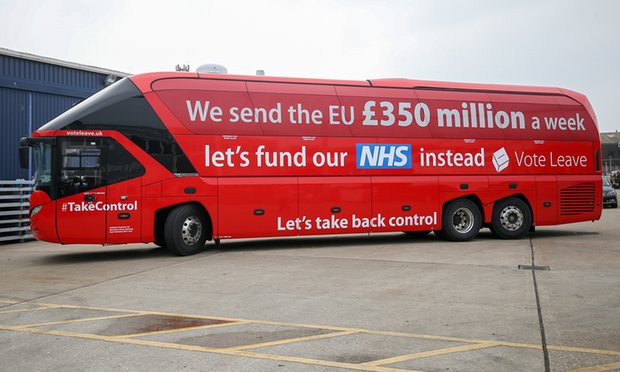
That’s a funny-looking bus, it’s Boris’s lying anti-EU bus promoting money for the NHS when all the anti-EU shites are anti-NHS Neo-Liberal shites.
‘The Prime Minister’s key pledge of reducing the size of the waiting list by March 2024 is looking more and more in doubt.’
The number of people stuck on NHS waiting lists has reached a record high, despite promises from ministers to eliminate lengthy backlogs.
Figures released on October 12, show that as of the end of August there were 8,998 people waiting for treatment for over 18 months, a sharp increase from 7,289 in July. Overall waiting list figures have reached a record high, with 7.75m people waiting for treatment at the end of August, up from 7.68m in July, marking the highest figure since records began in 2007.
The government had promised that all patients who had been waiting for 18 months for an operation in hospital would be treated by April. The following month, the health secretary Steve Barclay admitted that the government had not met its target. Failure to eliminate 18-month backlogs is embarrassing for Sunak, who made ‘cut waiting lists’ one of this five key promises. In January, the Prime Minister had said that “lists will fall, and people will get the care they need more quickly.”
Major fossil fuel firms have committed tens of millions in finance to UK universities since 2022, DeSmog can reveal.
Many of these commitments have been accepted by institutions that have actively pledged to divest from oil and gas companies.
According to freedom of information requests submitted by DeSmog, more than £40.4 million has been pledged to 44 UK universities by 32 oil, coal and gas companies since 2022 in the form of research agreements, tuition fees, scholarships, grants, and consulting fees.
Most of the funding spans the current academic year, with a handful of projects running for a number years, up to as far as 2027.
The largest contributors were Shell, Malaysian state-owned oil company Petronas, and British Petroleum (BP). These three companies account for over 76 percent of the total figure awarded, having committed £20.98 million, £5.19 million, and £4.89 million respectively.
A further 10 companies made up nearly 20 percent of the remaining contributions during this period: Sinopec, Equinor, BHP Group, Total Energies, Eni SPA, Saudi Aramco, ExxonMobil, Kellas Midstream, Ithaca Energy, and Chevron.
Previous reporting from openDemocracy and the Guardian found that, between 2017 and December 2021, £89 million had been given to UK universities from some of the world’s biggest fossil fuel companies.
These partnerships have shown no sign of abating. DeSmog’s research shows an additional £40 million committed by fossil fuel firms since 2022, despite pledges from 102 higher education institutions to divest from the industry.
The universities in receipt of the most money were: Exeter, Imperial College London, Heriot-Watt, Manchester, Cambridge, Oxford, Royal Holloway, Queen Mary London, and Teesside.
“Young people care so deeply about protecting the planet because their futures are on the line,” said Green Party MP Caroline Lucas. “Yet fossil fuel giants are putting that future at risk with their planet-wrecking pollution, and then attempting to youthwash their reputation by handing over dirty money to universities”.
“If we’re going to tackle the climate emergency and secure a liveable future for the next generation, educational institutions should cut all ties with fossil fuel companies immediately.”
These figures do not include a total for Durham University, which declared that it had research agreements involving fossil fuel firms totalling £1.7 million but did not declare the sums that the oil and gas firms had contributed to these agreements.
These figures also do not include the amount held in fossil fuel investments by these universities. Our research indicates that at least 18 higher education institutions held direct investments in 25 fossil fuel companies over the relevant time period, collectively worth a further £8.1 million.
Many top universities also hold stakes in high-value pooled investment funds that are pouring hundreds of millions into fossil fuel giants. Research conducted by the student campaign group People & Planet estimates that, as of July 2022, as much as £319 million was still held in these funds by universities across the UK, including some institutions that have made promises to divest.
More than 65 percent of the country’s higher education institutions have refused to make further fossil fuel investments. This would potentially remove £17.7 billion from the reach of the industry, while 51 universities have yet to divest from oil and gas
Laura Clayson, climate campaigns manager at People & Planet, told DeSmog: “we say to those 51 universities left to divest: the student movement will remain unwavering in its demands for justice until our victory list includes every single one of you.”
The Leaderboard
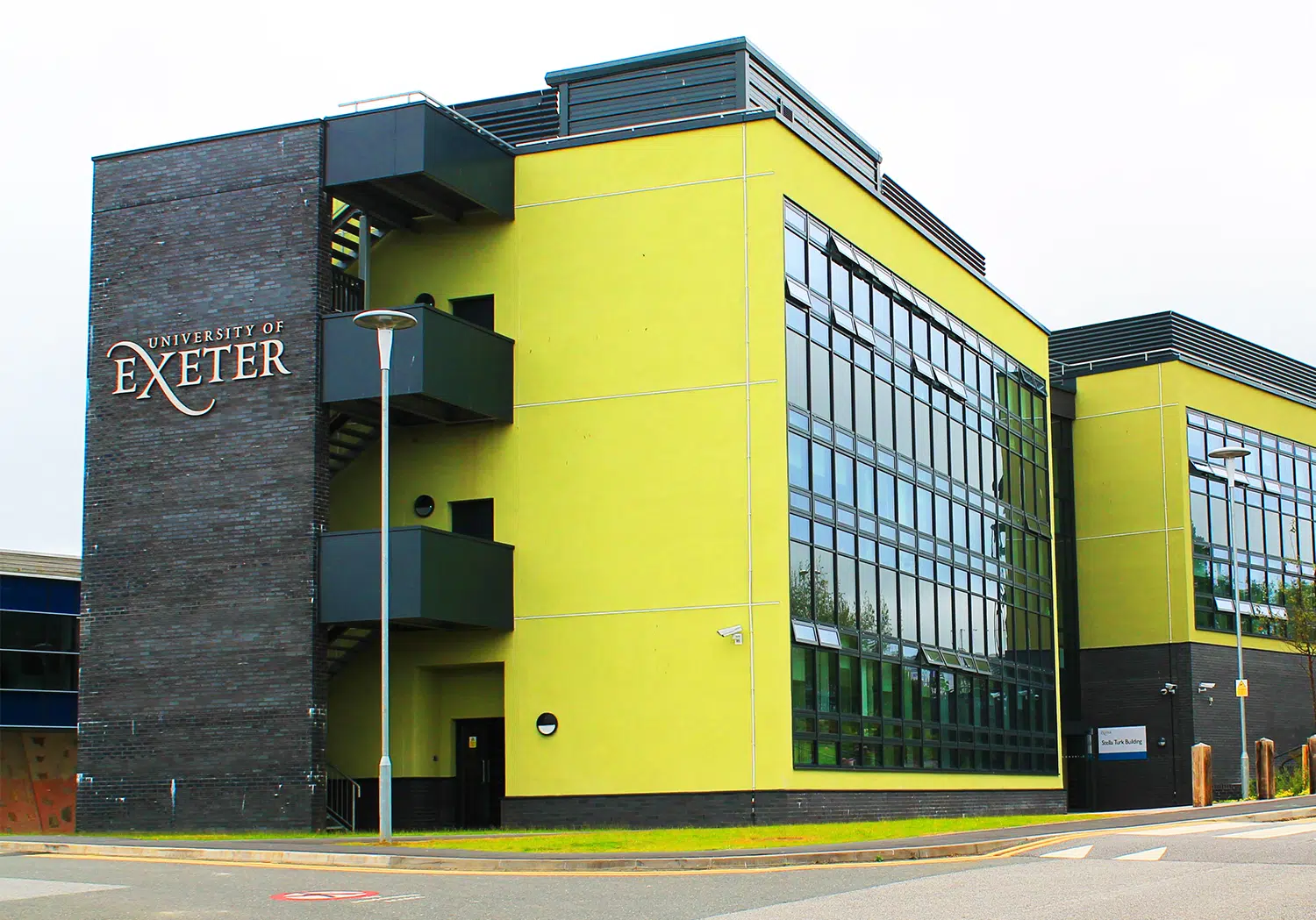
The University of Exeter has received the most from fossil fuel firms since 2022, having signed a £14.7 million, five-year deal with Shell in November, as revealed by Byline Times. The project is to work on “carbon storage and sequestration”, and continues a 15-year relationship between the university and the oil giant.
According to the contract award notice, the project is part of a “wider Shell-led research programme focused on sequestration which aligns with Shell’s target to be a net-zero emissions energy business by 2050”.
Last year, Shell produced only 0.02 percent of its energy from renewable sources, analysis by Greenpeace has revealed. The company also recently abandoned plans to cut oil production by 1-2 percent each year until 2030, and will be investing £33 billion in oil and gas production between 2023 and 2035, compared to just £8-12 billion in “low-carbon” products.
Shell claims that it has reduced oil production more quickly than expected, though the company’s planned emissions between 2018 and 2030 are estimated to account for nearly 1.6 percent of the global carbon budget.
A spokesperson for the firm said: “We remain committed to becoming a net zero emissions energy business by 2050… It remains our view that global energy demand will continue to grow and be met by different types of energy – including oil and gas.”
New research from the University of Queensland shows that more than half of the world’s top fossil fuel producers will fail to meet climate targets unless they expand plans to decarbonise, while a major report from the UN has warned that the world will miss its climate targets unless it commits to “phasing out all unabated fossil fuels”.
A University of Exeter spokesperson said that its work with Shell will “contribute to the global race to net zero.”
Imperial College London has received the second most from fossil fuel firms since 2022. This follows a long association with oil and gas giants, which gave £54 million to the university between 2017 and 2021.
A spokesperson for Imperial told DeSmog that it pledged in 2020 it will only engage in research partnerships “with fossil fuel companies where the research forms part of their plans for decarbonisation, and only if the company demonstrates a credible strategic commitment to achieving net-zero by 2050”.
The university has maintained a working relationship with 13 fossil fuel companies since 2022.
The largest beneficiaries of fossil fuel financial commitments since 2022
Exeter
£14,700,000
Imperial College London
£6,725,769
Heriot-Watt
£6,005,844
Manchester
£3,077,268
Cambridge
£2,821,437
Oxford
£1,209,221
Royal Holloway
£740,657
Queen Mary London
£587,956
Teesside
£500,000
The University of Manchester houses the BP Centre for Advanced Materials (ICAM) research unit, a collaboration between BP and leading universities in the UK and US, including Manchester, Cambridge, and Imperial. The ICAM website states that the centre supports “BP’s ambitions to become a net zero company by 2050”.
BP generated just 0.17 percent of its energy from renewable sources in 2022 and, in the first half of last year, the company spent more than 10 times more on new oil and gas projects than it did on “low carbon” energy. In 2022, 92.7 percent of all activity for both BP and Shell went into fossil fuel investment.
As with Shell, BP posted record profits in 2022 worth some £23 billion. At the same time, it scaled back plans to cut emissions by 2050 on the grounds that it needs to keep investing in new oil and gas to meet consumer demand. BP did not respond to our request for comment.
The University of Manchester’s funding agreements with BP stretch back to 2008, when it was selected by the fossil fuel giant to run its Projects and Engineering College.
Hundreds of people have subsequently completed BP’s courses at the university, with Manchester describing the partnership as a “strategic alliance that has a major impact on both organisations”. The university has also received money from Shell and TotalEnergies.
A spokesperson for Manchester told DeSmog: “Since 2019 all new research funded in the BP ICAM has been focused on topics in materials sciences that support the energy transition, providing research to support BP’s goal to become a net zero company by 2050.”
Since 2022, Durham University’s research projects have included contributions and commitments from BP, ExxonMobil, and the China Petroleum and Chemical Corporation (Sinopec).
The university also previously partnered with the universities of Edinburgh and Leeds to form the Engineering and Physical Sciences Research Council’s Centre for Doctoral Training in Soft Matter and Functional Interfaces (SOFI CDT), which has been sponsored by industrial partners including Infineum, a joint venture between ExxonMobil and Shell.
Durham University is also a sponsor of the GeoNetZero CDT, a PhD research and training programme focused on geoscience and the energy transition, which has 11 other university partners; Heriot-Watt, Aberdeen, Birmingham, Dundee, Exeter’s ‘Camborne School of Mines’, Keele, Newcastle, Nottingham, Plymouth, Royal Holloway and Strathclyde.
From 2020 to 2022, CDT recruited 16 PhD students per year, funded in part by the oil and gas firm NEO Energy, which pledged £2.5 million alongside academic partners.
The centre is based out of the Shell Building at Heriot-Watt University’s School of Energy, Geoscience, Infrastructure and Society, and has nine core industry partners: BP, Cairn Energy, Chrysaor, China National Offshore Oil Corporation (CNOOC), Equinor, ExxonMobil, NEO Energy, Shell, and Total Energy.
A spokesperson for Heriot-Watt told DeSmog: “Heriot-Watt University and our Centres for Doctoral Training (CDTs) are committed to a rapid and just energy transition, led by our world-class research and teaching… The GeoNetZero CDT is a new programme of PhD research and training set up to address key areas in geoscience and their role in the low carbon energy transition and challenge of net zero.
“We work in collaboration with the energy sector to develop education and research opportunities related to net zero, responsible consumption of oil and gas, and the transition to renewable energy sources.”
Studentships
Fossil fuel companies pledged to fund scholarships and tuition fees across at least 17 universities in 2022.
The Italian multinational Eni funded a scholarship programme at the University of Oxford’s Saïd Business School in 2022 called the Africa Scholarship, as well as a scholarship programme with St Anthony’s College, Oxford.
Oxford has previously said that it “receives funding from and donations from companies and organisations from the fossil fuel sector” typically at an average of £3 million a year in research funding and £2 million in philanthropic donations. It says that the research funding is equivalent to less than 1 percent of the university’s research turnover.
Kellas Midstream also funds a set of scholarships at Teesside University, while Cardiff receives over £870,000 from TotalEnergies for its OneTech Futures graduate programme, which began in 2018 and runs through to 2025.
Shell has given the University of Aberdeen £150,000 for new “Transition Scholarships” for the coming academic year, funding research into “key challenges around net zero and reducing emissions”.
The university, based in Europe’s “oil capital” on the coastline of the UK’s North Sea oil and gas fields, pledged to divest from fossil fuels in 2021 – saying that it planned on excluding fossil fuel extraction companies from its £52.7 million investment portfolio by 2025.
A report commissioned by the University of Cambridge and led by Nigel Topping, a former UN climate action champion, last year recommended that the institution halt all funding from fossil fuel companies, including for research or philanthropic purposes. Cambridge itself took £2.8 million from Shell, BP, and BHP Billiton in 2022, and has reportedly received around £3.3 million per year from the industry since 2017.
A spokesperson told DeSmog: “The University of Cambridge only accepts funding from energy companies where it is sure that the resulting collaboration will help the UK and global society move to renewable or decarbonised energy. An enhanced set of criteria created in 2021 includes a written assessment from non-conflicted experts on whether the purpose of the proposed collaboration contributes meaningfully to the energy transition.”
A spokesperson for the University of Strathclyde said: “The University of Strathclyde is committed to supporting the energy transition to a sustainable, renewable energy system and the delivery of net zero targets by 2050. Much of the University’s work in the achievement of a sustainable and zero carbon economy is carried out in collaboration with industrial partners in the energy sector.”
A spokesperson for Royal Holloway, University of London, said: “At Royal Holloway, University of London, we are committed to developing and implementing activities that support environmental sustainability and a solution-based approach to net zero.”
The University of Bradford refused to reveal how much it received in partnerships with both Sinopec and the Saudi chemicals company SABIC, citing the commercial interests of the companies.
A deal struck between the University of Surrey and BP, running from 2019-2022, was also withheld because of a non-disclosure agreement in place.
A number of other universities refused our freedom of information requests or failed to respond to repeated requests for comment. This included the universities of East Anglia, Nottingham, Birmingham, Plymouth, Loughborough, Bishop Grosseteste, and Oxford Brookes.
Additional reporting by Joey Grostern and Sam Bright
UPDATE: 5 October 2023 – This article previously erroneously listed Scottish Power as a fossil fuel company. The firm has now been removed from the article and Strathclyde University removed from the largest recipients of fossil fuel funding.