News review

Spread the love

It’s time to stop the private train firms in their tracks

Sam Bogg rails against a system that’s seen fares rise and services get worse while the fat cats get a first class seat

Sky-high ticket prices. Overcrowded trains. Bumper profits for private firms. Massive bonuses for bosses. The reality of Britain’s privatised railways was brought to everyone’s attention last week as another year of above inflation fare increases sparked protests at 40 stations.

But just how do the rail firms keep getting away with it? When the Tories privatised British Rail in 1994 they said the free market would bring us cheaper, more reliable and comfortable rail travel—and it wouldn’t cost taxpayers a thing.

However, privatisation has done none of this. In fact it has cost the public purse much more. In 1994, £1.14 billion of public money was spent on British Rail.

But in 2011 the public subsidy for the private railways hit £11 billion. Transport commentator Christian Wolmar expects this to increase further to over £18 billion by 2018.

A recent study also found that Britain’s railways were less efficient, more expensive and less comfortable than those in France, Spain, Germany and Italy, all of which are majority public-owned.

Rail fares in Britain are an average of ten times higher than they are on the continent. This is because no matter how they perform, train firms are given a free hand to jack up the fares …

The Public Thinks Tax Dodging Is Morally Wrong – Now It’s Time for Action


We’ve heard a lot in recent months about the immorality of tax dodging from both David Cameron and George Osborne. It turns out the public agree with them but crucially don’t think they’re doing enough about it.

Research published this week by ComRes has revealed 56% of British adults believe that tax avoidance by multinational companies (while a technically legal way of reducing what they owe the taxman) is morally wrong and half of people think it should be made illegal.

Only 4% think tax avoidance by multinationals was ‘morally justifiable’ and just 4% described it as ‘fair’.

In June the Prime Minister described Jimmy Carr’s offshore tax arrangements as ‘morally wrong’ and in March his Chancellor lambasted aggressive tax avoidance as ‘morally repugnant’. Even Treasury Minister David Gauke got in on the act, questioning the morality of tradesmen taking cash in hand to avoid tax.

Despite these strong words the survey, commissioned by Christian Aid, showed that the public did not feel the Government rhetoric was being matched by action. Seventy-four per cent felt that David Cameron should be demanding international action to tackle tax evasion and avoidance, yet only 38% believed the Government is genuine in their desire to combat the problem.

Britain won’t budge over ‘safe passage’ for Assange

The UK has insisted it will not grant Julian Assange “safe passage” to Ecuador as the row over his asylum continues.

Downing Street said the government was obliged to extradite Assange to Sweden where he faces questioning over sex assault claims, which he denies.

The Wikileaks founder has been staying at Ecuador’s London embassy since June.

South American nations have pledged support for Ecuador after the UK said it could legally enter the building.

The UK Supreme Court in May dismissed Assange’s bid to reopen his appeal against extradition and gave him a two-week grace period before extradition proceedings could start.

“We hope that we can reach a diplomatic solution and we are doing what we can to achieve that,” Prime Minister David Cameron’s spokesman said.

“Under our law, having exhausted all the options of appeal, we are obliged to extradite him to Sweden. It is our intention to carry out that obligation.”

Last week, Ecuador described as a “threat” a UK letter that drew attention to the Diplomatic and Consular Premises Act 1987, which could allow it to potentially lift the embassy’s diplomatic status to allow police to arrest Assange for breaching his bail terms.

Ecuador’s president, Rafael Correa, has suggested Assange could co-operate with Sweden if assurances are given that there would be no extradition to a third country.

Continue ReadingNews review

NHS news review

Spread the love

Austerity NHS told to sell soul abroad

The government pressed on with privatisation of the NHS yesterday with a new plan that will see it become a US-style profit-making machine abroad while ramming through crippling cuts at home.

From the autumn, the Department of Health and UK Trade and Investment will invite British hospitals to exploit international patients at new foreign branches to fill the funding gaps caused by the coalition’s cuts.
The scheme was reportedly inspired by US hospitals such as Baltimore’s Johns Hopkins which have set up similar international branches.

Allegedly upfront investment could only be drawn from income received from private patients and any profits made abroad would be channelled back into British hospitals.
But campaigners say it will create an NHS where privatisation is the norm.

Patients Association chief executive Katherine Murphy said: “The guiding principle of the NHS must be to ensure that outcomes and care for patients comes before profits.
“At a time of huge upheaval in the health service, when waiting times are rising and trusts are being asked to make £20 billion of efficiency savings, this is another concerning distraction.
“The priority of the government, hospital trusts and clinicians should be NHS patients.”
Royal College of Nursing general secretary Dr Peter Carter also warned the move would be a distraction with organisations looking abroad “when they should be concentrating on fixing what’s under their own nose first.”


Bolton hospital job cuts will hit patient care: Unison


A union has warned that anticipated job losses at a Greater Manchester hospital will impact on patient care.

It follows the news that about 200 posts are expected to go across Bolton NHS Foundation Trust, due to a savings plan to fill financial gaps.

A Unison representative said the cuts would affect front-line services being provided at Royal Bolton Hospital.

David Wakefield, the newly appointed trust chairman, said patient services were safe.

The trust requires savings of up to £20m to become financially stable.

‘No-one else’

Harry Hanley, Unison branch secretary, said he expected the job losses to be greater than predicted.

He said: “They’re saying it won’t affect front-line services, but it is going to because we are a team.

“For example if you take away medical records staff from the team, who is going to do the work?

“It will all fall down on front-line staff as there’s no-one else there to do it.”

Continue ReadingNHS news review

News review

Spread the love
  • Craig Murray writes on UK threats to invade the Ecuadorian embassy for its insolence in granting asylum to Julian Assange. Of course UK Neo-Cons in support of US Neo-Cons have absolutely no right to invade the embassy. Assange has not even been charged with an offence FFS.
  • Former friend, Murdochist and spin doctor to Prime Minister David Cameron – Andy Coulsdon – appeared in court yesterday on phone hacking charges. Murdochist friend and associate to Prime Minister David Cameron – Rebekah Brooks – due to appear at seperate phone hacking hearings in September.
  • Louise Mensch’s seat of Corby to be lost to Labour

This will be, beyond any argument, a blatant breach of the Vienna Convention of 1961, to which the UK is one of the original parties and which encodes the centuries – arguably millennia – of practice which have enabled diplomatic relations to function. The Vienna Convention is the most subscribed single international treaty in the world.

The provisions of the Vienna Convention on the status of diplomatic premises are expressed in deliberately absolute terms. There is no modification or qualification elsewhere in the treaty.

Article 22

1.The premises of the mission shall be inviolable. The agents of the receiving State may not enter
them, except with the consent of the head of the mission.
2.The receiving State is under a special duty to take all appropriate steps to protect the premises
of the mission against any intrusion or damage and to prevent any disturbance of the peace of the
mission or impairment of its dignity.
3.The premises of the mission, their furnishings and other property thereon and the means of
transport of the mission shall be immune from search, requisition, attachment or execution.

Not even the Chinese government tried to enter the US Embassy to arrest the Chinese dissident Chen Guangchen. Even during the decades of the Cold War, defectors or dissidents were never seized from each other’s embassies. Murder in Samarkand relates in detail my attempts in the British Embassy to help Uzbek dissidents. This terrible breach of international law will result in British Embassies being subject to raids and harassment worldwide.

The government’s calculation is that, unlike Ecuador, Britain is a strong enough power to deter such intrusions. This is yet another symptom of the “might is right” principle in international relations, in the era of the neo-conservative abandonment of the idea of the rule of international law.


Dark day for Andy Coulson and Co as wheels of justice begin to turn

Andy Coulson, David Cameron’s former spin doctor, was among seven former News of the World employees who saw their normal roles reversed yesterday as they sat together behind a glass panel in Westminster Magistrates’ Court.

The veteran editors and reporters will have watched dozens of court cases in their long careers, but always from the press benches. Yesterday the six journalists, together with the private investigator Glenn Mulcaire, were in the dock, being stared at by a huge, curious throng of members of their old profession.

The prosecutor said the six journalists were accused of conspiring to hack the phones of as many as 600 people. In addition to the general charge of conspiracy, Coulson, a former editor of the now defunct News of the World, is also accused of being implicated in targeting the phones of the murdered schoolgirl Milly Dowler, the former Labour Cabinet ministers David Blunkett and Charles Clarke, and the footballer George Best’s son Calum.

They spoke only to confirm their names and addresses, but what might have been a very brief court appearance became substantially longer when Westminster’s deputy chief magistrate, Daphne Wickham, decided that the full list of charges should be read out.

The list – so long that it took a clerk a full 20 minutes to get through it – was studded with famous names of alleged hacking targets, including four Cabinet ministers from the Tony Blair years – Mr Blunkett, Mr Clarke, Tessa Jowell and John Prescott – the fire brigade union leader Andy Gilchrist, the former Liberal Democrat MP Mark Oaten, as well as such household names as Jude Law, Angelina Jolie, Brad Pitt, Sir Paul McCartney, Heather Mills, Sven-Goran Eriksson, Wayne Rooney and Delia Smith.

Although none of the defendants is accused of hacking everyone on that list, each is accused of targeting some of them.

The defendants sat impassively through this litany, except for 72-year-old Stuart Kuttner, a News of the World journalist for more than 30 years, who shook his head repeatedly when the three charges against him were read.

The name of News International’s former chief executive, Rebekah Brooks, also cropped up in the indictment. She is due to appear at a separate hearing on 3 September. Coulson and his fellow defendants were bailed to appear at Southwark Crown Court on 26 September.


Tories facing heavy defeat in Mensch seat by-election poll by the party reveals


David Cameron is facing a resounding defeat by Labour in the Corby by-election, the Tories’ own polling revealed last night.

The seat is being fought after the sitting MP, Conservative A-lister Louise Mensch, decided to leave Northamptonshire for New York to spend more time with her American husband and three children.

Labour looks set to seize Corby in November after a survey commissioned by Tory tycoon Lord Ashcroft put Labour support at 52 per cent, the Conservatives at 37 per cent and the Lib Dems at 7 per cent.

Lord Ashcroft said Labour was set for a ‘comfortable win’ but added he was surprised that Labour’s lead was not bigger.

27/11/13 Having received a takedown notice from the Independent newspaper for a different posting, I have reviewed this article which links to an article at the Independent’s website in order to attempt to ensure conformance with copyright laws.

I consider this posting to comply with copyright laws since
a. Only a small portion of the original article has been quoted satisfying the fair use criteria, and / or
b. This posting satisfies the requirements of a derivative work.

Please be assured that this blog is a non-commercial blog (weblog) which does not feature advertising and has not ever produced any income.

dizzy


Continue ReadingNews review

News review

Spread the love
  • ConDem Conservative and Liberal-Democrat Conservative coalition government protects Tony Blair by refusing to release pre-Iraq war cabinet minutes
  • The corporate press promotes Tony Blair

Tony Blair’s Iraq meetings to remain secret after government veto

The government has vetoed an order by the independent freedom of information watchdog to release the minutes of cabinet meetings held immediately before the invasion of Iraq in March 2003.

The decision was announced on Tuesday by Dominic Grieve, the attorney general, the only minister to have access to papers of a previous administration, in this case Tony Blair’s Labour government.

Grieve said he issued a certificate under the Freedom of Information Act vetoing disclosure after consulting former Labour ministers, his cabinet colleagues, and the leader of the opposition, Ed Miliband.

He described the case as “exceptional” and one where, in his view, the public interest demanded the papers should be kept secret. He says he took into account “serious potential prejudice to the maintenance of effective cabinet government”.

The attorney said he also considered the fact that “the issue discussed was exceptionally serious, being a decision to commit British service personnel to an armed conflict situation”, that the issue “remains the focus of both domestic and international interest”, and that “Iraq remains very much a live political issue in its own right” with links to the “overall security situation in the Middle East and the perceived link between the terror threat to the UK and military action in Iraq”.

Grieve noted that most of those present at the cabinet meetings in March 2003 were still MPs or “otherwise active in public life”.

Christopher Graham, the information commissioner, had argued that the “exceptional gravity and controversy” of the matters discussed meant that minutes of the cabinet meetings on 13 and 17 March 2003, days before the invasion, should be disclosed.

One of the reasons Grieve gave for vetoing disclosure was that the Chilcot inquiry meant the invasion of Iraq was still a “live” issue. Yet the panel chaired by Sir John Chilcot is being prevented by Whitehall mandarins from disclosing key documents relating to the decision to invade Iraq.

The March 2003 cabinet minutes are believed to be among them. The continuing dispute between Chilcot and Whitehall officials over disclosure is a main reason why his report has been delayed.

In a separate move last week, the Foreign Office appealed against a judge’s ruling that extracts of a conversation between Blair and George Bush days before the invasion of Iraq must be disclosed. It argued that revealing Blair’s comments to Bush on the telephone on 12 March 2003 would present a “significant danger” to UK-US relations.

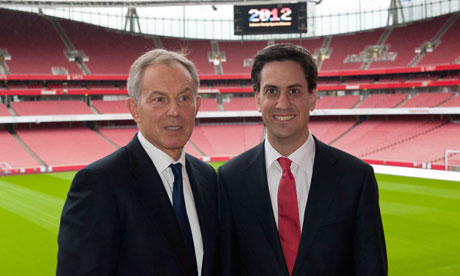
Tony Blair and Ed Miliband


The Return Of The King – Tony Blair And The Magically Disappearing Blood

By David Cromwell

How many war crimes does a western leader have to commit before he is deemed persona non grata by the corporate media and the establishment? Apparently there is no limit, if we are to judge by the prevailing reaction to Tony Blair’s return to the political stage.

On July 11, it was announced that Blair would be ‘contributing ideas and experience’ to Labour leader Ed Miliband’s policy review. He will apparently provide advice on how to ‘maximise’ the economic and sporting legacies of the 2012 London Olympics.

The Guardian described the announcement mildly as a ‘controversial move’; not necessarily in the country at large, the paper claimed, but ‘perhaps especially within the Labour party’. One Guardian headline declared ‘Return of the king’.

The ‘left-wing’ John Harris did his bit in the Guardian to smooth Blair’s path:

‘He’s only 59, the picture of perma-tanned vitality and keen to “make a difference”. Could a fourth stint in No 10 even be on the cards? We shouldn’t rule it out.’

Harris declared ‘that for all his mistakes, transgressions and howling misjudgments, there remains something magnetic about his talents.’
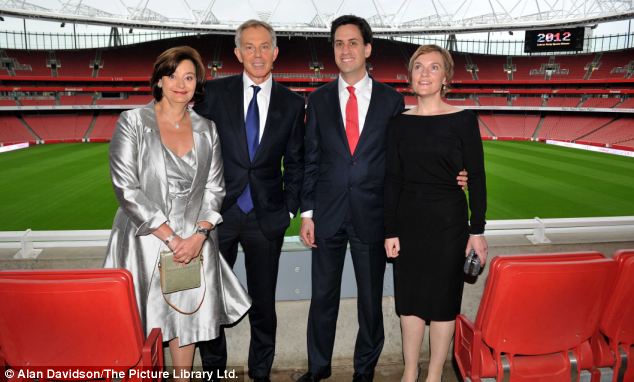
Blairs and Milibands

When Blair appeared at a Labour fundraising dinner at Arsenal’s Emirates stadium, Harris noted that:

‘He was greeted by the obligatory crowd of protesters, still furious about his role in the Iraq war.’

That’s the curious thing about peace protesters; endlessly ‘furious’ about the country being dragged into an illegal war that led to the deaths of around one million people, created four million Iraqi refugees, devastated Iraq’s infrastructure, generated untold suffering and burned obscenely huge sums of public money in times of ‘austerity’. Perhaps we Brits should simply display that famed stiff upper lip and move on. Certainly that’s what Richard Beeston, foreign editor of The Times, suggested in 2009:

‘All this happened six years ago. Get over it.’ (‘The war went wrong. Not the build-up. Stop obsessing about the legality of invading Iraq. The campaign itself was the real disaster’, The Times, February 26, 2009.)

A recent Times editorial welcomed Blair’s return:

‘Labour is coming together, drawing on its best available talent and starting to get serious again. (Editorial, ‘A year in politics’, The Times, July 14, 2012)

The second coming of Blair was launched by a friendly chat on the BBC’s Andrew Marr show. Marr, of course, is well-known as a totally impartial political analyst and a ‘congenial and knowlegable [sic] interviewer’ (to quote a cable from the US embassy in London to Hillary Clinton).

The PR onslaught continued when London’s Evening Standard published an interview with the former PM on the day he ‘guest-edited’ the paper. Would he like to be prime minister again one day? ‘Sure’, he replied. A supportive Financial Times interview with editor Lionel Barber proclaimed:

‘Five years after leaving power, Tony Blair wants back in. He is ready for a big new role. But what exactly is driving him? And can he persuade the world to listen?’

Unnamed ‘friends’ and ‘allies’ were quoted, no doubt passing on the Blair-approved message:

‘Friends say he is desperate to play a bigger role, not because he has any ambition to run for high office but because he wants to be part of the argument. “He would really like to be the centre of attention again,” says one long-time ally.’

A Guardian editorial did its bit to help:

‘he seems to have mellowed a touch since his book [‘A Journey’, published in 2011]; maybe he’s even learnt a little respect for international law.’ (‘Unthinkable? Tony Blair for PM again.’)

The paper continued:

‘Besides, this is no time to fret about the policy details – there is the showbiz to consider. In 2007 John Major likened Mr Blair’s long goodbye to Nellie Melba; the coming comeback must demonstrate he is more like Sinatra and Elvis. There can only be one true heir to Tony Blair, and that is Tony Blair II.’

Could the vanguard of British liberal journalism really be making an editorial call for the return of Blair? It shouldn’t be a total surprise. Recall that even in the wake of the supreme international crime of invading Iraq, the Guardian still called for its readership to re-elect Blair at the 2005 general election.


Continue ReadingNews review

News review

Spread the love
    • UK in worst recession since 1955
    • Nick Clegg sent white powder and called a “devil worshipper” by a nun
    • Insane Tony Blair calls himself insane


Never had it so bad: UK recession is the worst since Fifties

GDP figures yesterday showed the economy shrank for the third quarter in a row – down 0.7 per cent between April and June – meaning the UK is in its worst recession since 1955.

  • But as Conservative Chancellor George Osborne and Prime Minister David Cameron insisted yesterday there was no need for a change from their austerity policy, Mr Cable demanded what he termed a “Plan A-plus” to help boost growth in the UK.Business leaders also called for a rethink, criticising the government’s lack of growth policies….


Nick Clegg Abusive Letters Calling Lib Dem Leader ‘Devil-Worshipper’


Sister Ruth Augustus pictured in 2004

A nun has been found guilty of sending threatening letters containing white powder to parliamentary figures including Nick Clegg, whom she accused of being a “devil-worshipping Freemason”.

Sister Ruth Augustus, 71, was found guilty on six counts of hoaxes involving noxious substances before Harrow Crown Court on Wednesday after the jury took only two-and-a-half hours to deliver a verdict.

Augustus, of Leyton, east London, was found to have sent the letters to Clegg and three others, each with allegations scrawled on the envelopes.

On a letter sent to the Lib Dem leader, the nun wrote the phrases “devil worshipping”, “freemason”, “sex with 30 plus women” and “your poor Catholic wife and children”.

Justifying why she sent the letters to the Lib Dem leader, Augustus said he had “lied about all the tuition fees and everything else, keeping those Tory millionaires and rats in government”.

“He boasted about all the women he’s had sex with. He’s an atheist singing hymns in the Albert Hall.”

Commons committee slams Blair on FoI

Tony Blair: nutter
Tony Blair: nutter

The Commons Justice Select Committee has criticised former Prime Minister Tony Blair for failing to cooperate with its investigation into impact of Freedom of Information (FoI).

“We deplore Mr Blair’s failure to cooperate with a committee of the House,: Sir Alan Beth, the Chair of the Justice Select Committee said. “Former prime minister Tony Blair described himself as a ‘nincompoop‘ for his role in the legislation, saying that it was ‘antithetical to sensible government’. Yet when we sought to question Mr Blair on his change of opinion he refused to defend his views before us and submitted answers to our written questions only after our report was agreed, and after a press report had appeared, suggesting we might criticise his failure to give evidence.”

Mr. Blair was in office when the FoI law was brought in but since then the former Prime Minister has said it was one of the worst legislation his government brought in.  However, the Justice Select Committee in its report concluded that FoI has been a “significant enhancement of democracy” and not hindering better governance.


Continue ReadingNews review