Climate Deniers to Converge on Reform Conference

Spread the love

Original article by Sam Bright republished from DeSmog

Campaigners say Farage is showing “open contempt” for the British public.
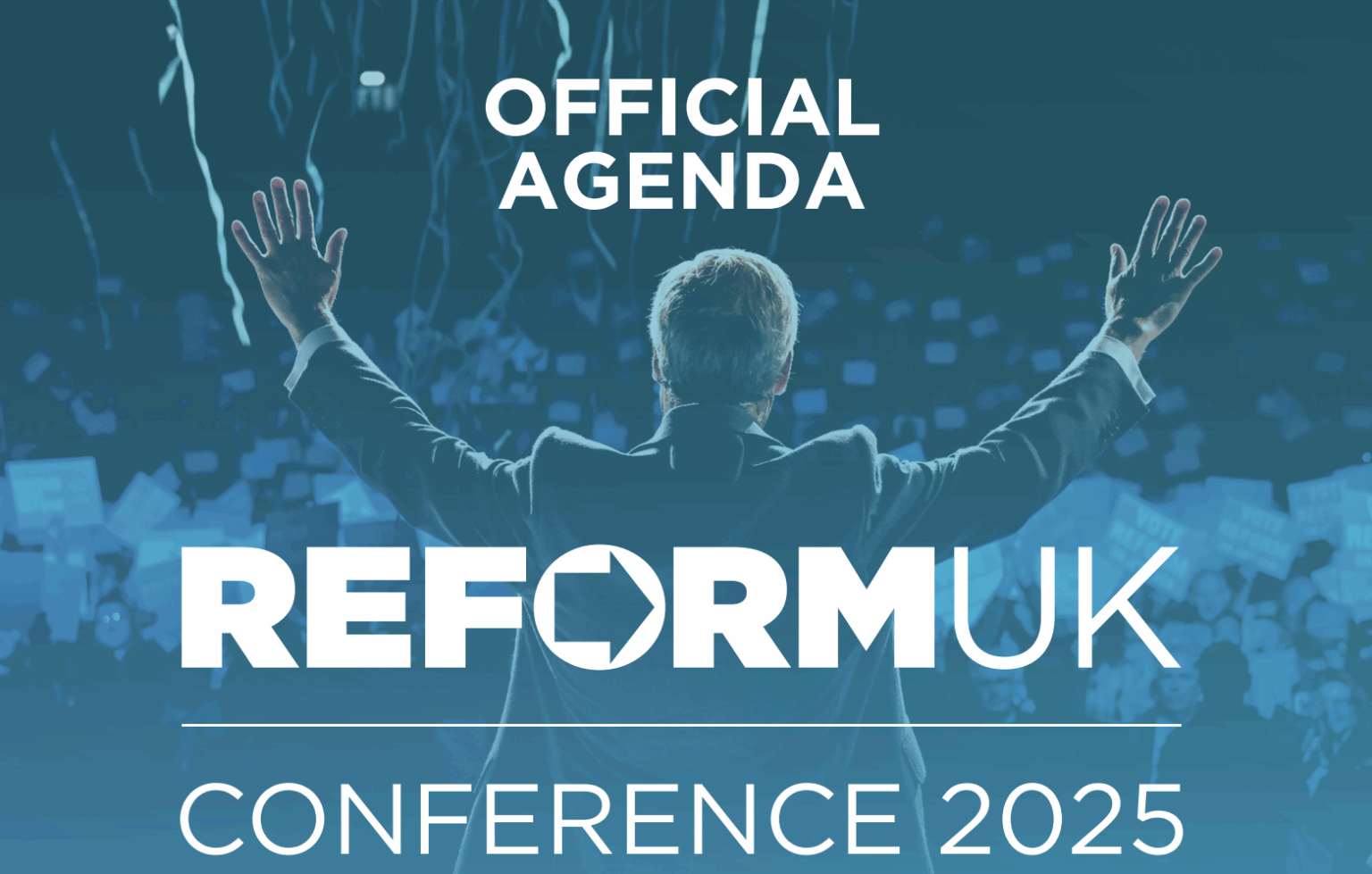
A screenshot of Reform’s 2025 party conference agenda. Credit: Reform UK

Nigel Farage’s Reform UK is hosting a number of radical anti-climate groups at its conference this weekend, DeSmog can report.

They include the Heartland Institute, a group close to Donald Trump’s administration, which has called human-induced climate change a “delusion”.

The conference will also play host to Net Zero Watch, the campaign arm of the Global Warming Policy Foundation, which has claimed that carbon dioxide has been “mercilessly demonised”.

Reform is also giving a platform to a number of groups belonging to the Tufton Street network – an alliance of anti-government campaign outfits that lobby for more fossil fuel extraction and keep their donors a secret.

For the second year in a row, DeSmog has been banned from attending the event, which will be held in Birmingham.

The conference will also feature Together, a prominent anti-vaccine conspiracy theory group that has launched a campaign against the UK’s 2050 net zero emissions target.

“By giving a platform to climate deniers like Net Zero Watch and the Heartland Institute, Reform is showing open contempt for the British public already living with the realities of climate breakdown,” said Tessa Khan, executive director of the research and campaign group Uplift.

“Homes are being flooded again and again, farmers are losing billions to drought, and Scotland’s firefighters are battling wildfires. This is not theory – it’s people’s lives and livelihoods at stake,” Khan said.

“Reform’s deluded energy policy wilfully ignores the fact that the UK has already burnt most of its gas. Official projections show, even with new drilling, the UK will be 94 percent reliant on expensive, dirty imports by 2050. All this while Reform seeks to block the UK from profiting from some of the world’s best resources for offshore wind.

“Our dangerous dependence on fossil fuels is exactly why energy bills are so high and why millions of families across the UK have been driven into fuel poverty. Reform knows this. And it simply does not care.”

Most senior Reform politicians, including Farage, deny basic climate science. At the Alliance for Responsible Citizenship conference in February, the Reform leader said it was “absolutely nuts” for CO2 to be considered a pollutant. In the same month, Farage’s deputy Richard Tice told Sky News: “There’s no evidence that man-made CO2 is going to change the climate. Given that it’s gone on for millions of years, it will go on for millions of years.”

Last month, Reform’s Great Lincolnshire Mayor Andrea Jenkyns said in an interview with Times Radio: “Do I believe that climate change exists? No.”

They have expressed these views despite representing areas exposed to the worst effects of extreme heat.

Reform received 92 percent of its donations between the 2019 and 2024 UK elections from polluting sources and climate science deniers, while its treasurer Nick Candy has claimed the party is actively raising money from oil executives.

In Farage’s constituency of Clacton, 68 percent of the public is worried about rising temperatures, according to a YouGov poll published last August – slightly above the national average of 66 percent.

A recent report by the New Economics Foundation found that Reform’s climate policies would cost more than 60,000 jobs and wipe £92 billion off the UK economy. The science of climate change is also unequivocal: scientists at the UN’s Intergovernmental Panel on Climate Change (IPCC) have stressed that “it is a statement of fact, we cannot be any more certain; it is unequivocal and indisputable that humans are warming the planet”.

DeSmog previously revealed that Reform is offering access to Farage during the conference in exchange for hefty donations. A sum of £250,000 buys 10 seats at a champagne breakfast with the Reform leader during the two-day event, as well as “chauffeur-driven travel”, a personal assistant, and the sponsor’s logo on the main conference stage and battle bus.

Reform didn’t respond to DeSmog’s request for comment.

Below is a summary of the key anti-climate groups to be given a platform at Reform’s conference.

Heartland Institute

The Heartland Institute is a U.S. climate science denial group with close ties to the Trump administration.

It has denied that humans are driving climate change, which it has called a “delusion”. The group claims it is “the world’s most prominent think tank supporting scepticism about man-made climate change”.

Heartland received at least $676,000 between 1998 and 2007 from U.S. oil giant ExxonMobil, and has received donations from foundations linked to the owners of Koch Industries – a fossil fuel giant and a leading sponsor of climate science denial.

The Heartland Institute previously told DeSmog that it ”stands resolute in its mission to advance sound science, economic prosperity, and individual liberty”. It added that “our support comes from a diverse array of individuals and organisations who share our vision for a freer, more prosperous world.”
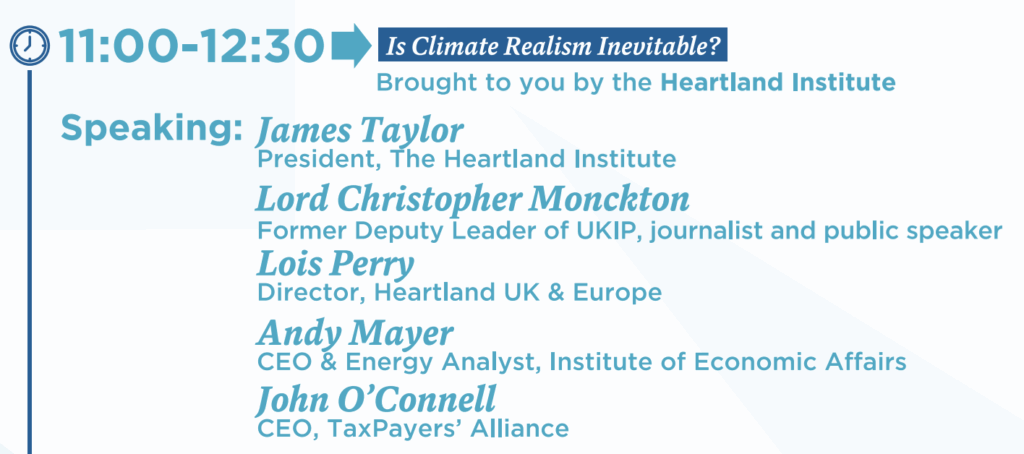
Heartland was one of the groups involved in drafting Project 2025, the radical blueprint for Trump’s second term, which proposed reversing climate policies, slashing restrictions on fossil fuel extraction, scrapping state investment in renewable energy, and gutting the Environmental Protection Agency (EPA). 

Earlier this month, President Trump hired Roy Spencer, a policy advisor at the Heartland Institute and a former fellow at the Heritage Foundation – the key group behind Project 2025 – as an advisor to the Department of Energy.

Heartland’s UK-EU director Lois Perry has claimed that the institute boasts “very strong affiliations” with “certain big individuals” in Trump’s team.

Nigel Farage attended a fundraising dinner for the institute in September 2024 during which he called for more fossil fuel extraction and the victory of Trump in November’s presidential election, saying: “Let’s get Trump back; let’s drill baby drill”.

He also advocated what he called “a bit of reverse colonialism”.

“Maybe it’s time that Heartland came and set up in Britain and Europe and brought some of the wisdom that you’ve brought to the American debate,” he said – adding: “I’d love to see Heartland on the other side of the pond.”

Farage soon got his wish. In December, Heartland announced it was setting up a UK-EU branch. The Reform leader was the “special guest of honour” at the group’s launch event in London, which also featured disgraced former Conservative prime minister Liz Truss.

Cementing his Heartland links, Farage headlined an invite-only event in June this year entitled “Net Zero: The New Brexit?” held at 55 Tufton Street.

As revealed by DeSmog, Heartland has been working closely with far-right politicians in Europe to undermine the bloc’s green reforms.

Perry, who is speaking at Reform’s conference, has previously said she does not believe climate change is caused by humans. She has said it’s her “personal belief” that climate change “is happening” but “is not man made”.

Like Farage, Perry is a former leader of the UK Independence Party (UKIP). She used to run the anti-net zero pressure group CAR26, which has claimed that carbon dioxide is “essential to all life” and that its “welcome growth has greened our planet saving countless human and other lives”.

She recently claimed on a Heartland Institute podcast that she “knows for a fact” Farage credits Heartland with helping to shape Reform’s climate policies.

Heartland Institute president James Taylor told DeSmog: “Climate realism and energy realism are gaining traction throughout the world. The Heartland Institute appreciates that the Reform Party is on board and recognises Heartland as the global leader courageously providing truthful information on these topics. We also appreciate the encouragement and support provided by many policymakers among the UK Conservative Party. A rising tide lifts all boats and we are excited to be prominently leading the charge in the UK and throughout Europe.”

Institute of Economic Affairs

The Institute of Economic Affairs (IEA) is a radical anti-government campaign group that is part of the Tufton Street network.

The IEA, which has close ties to Liz Truss, advocates for increased fossil fuel production and against state-led climate action.

The IEA is a prominent supporter of the continued and extended use of fossil fuels. The group has advocated for the ban to be lifted on fracking for shale gas, calling it the “moral and economic choice”. The IEA has also said that the ban on new North Sea oil and gas licences is “madness”, has criticised the windfall tax imposed by the UK on fossil fuel firms, and said that the previous government’s commitment to “max out” the UK’s oil and gas reserves was a “welcome step”.

In 2018, Greenpeace’s investigative journalism unit Unearthed revealed that the IEA had received funding from oil major BP every year since 1967. In response to the story, an IEA spokeswoman said: “It is surely uncontroversial that the IEA’s principles coincide with the interests of our donors.” 

The IEA also received a £21,000 grant from U.S. oil major ExxonMobil in 2005. The IEA is a member of Atlas Network, a Washington-based umbrella organisation that suppors over 450 “free market” groups around the world. Both the IEA and Atlas were founded by Antony Fisher. Fisher’s daughter, Linda Whetstone, was chair of the Atlas Network as well as a director of the IEA until her death in December 2021.

The IEA does not publicly declare its donors, and it’s not known if the pressure group has received funding from BP or ExxonMobil in more recent years.

The group is currently under investigation by the Charity Commission. The IEA was approached for comment.

TaxPayers’ Alliance

The TaxPayers’ Alliance (TPA), based in 55 Tufton Street, also campaigns in favour of fossil fuel extraction and against climate policies.

The group, which claims to be a grassroots movement while being supported by anonymous private donors, has supported ending the windfall tax on oil companies, scrapping the UK’s 2050 net zero target, and restarting fracking.

The TPA was approached for comment.

Net Zero Watch

Reform’s conference will also feature Net Zero Watch – one of the UK’s most notorious anti-climate campaign groups – on a panel entitled “Drill baby drill: abandoning net zero and restoring energy abundance”.

Net Zero Watch is the campaign arm of the Global Warming Policy Foundation (GWPF), which is led by Conservative peer Lord Craig Mackinlay.

Net Zero Watch has urged the government to “recommit to fossil fuels”, including “a new fleet of coal fired power stations”, and has called for renewable energy from wind and solar to be “wound down completely”. From May 2023 to 2025, Reform’s Andrea Jenkyns sat on the Net Zero Watch board.
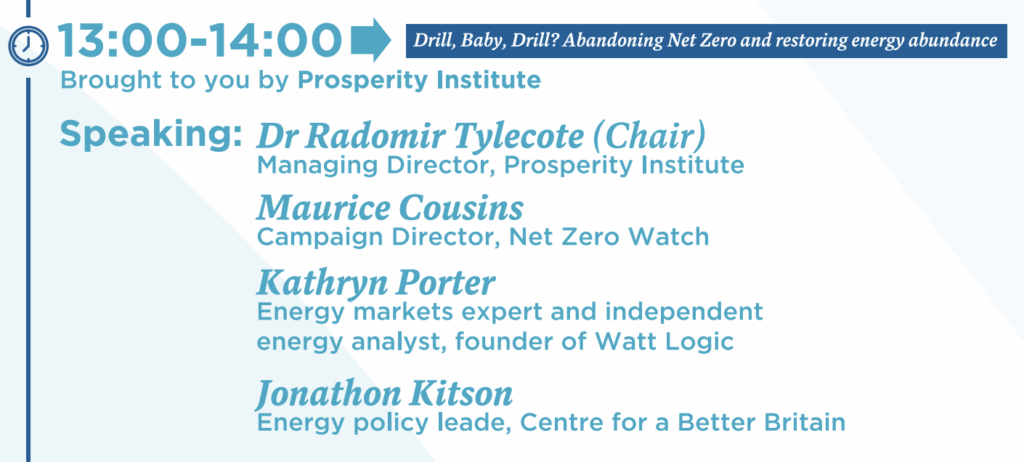
In a report published last March, the GWPF claimed it was “naive and entirely unrealistic” to believe that CO2 is causing climate change, that record global temperatures are “normal”, and that “there is no observational evidence for any global climate crisis”.

The group has previously expressed the view that carbon dioxide has been “mercilessly demonised”, when in fact it is a “benefit to the planet” and should be “two or three times” higher than its current level.

Net Zero Watch campaign director will be speaking alongside Kathryn Porter, a fossil fuel industry consultant who has written several reports for the GWPF and Net Zero Watch.

Net Zero Watch and the GWPF were approached for comment.

Prosperity Institute

The Prosperity Institute – formerly known as the Legatum Institute – is hosting several events at Reform conference.

A pro-Brexit think tank, the Prosperity Institute is run by the Dubai-based investment firm Legatum Group, which co-owns the anti-climate broadcaster GB News alongside hedge fund mogul Paul Marshall. GB News employs Farage to the tune of more than £300,000 a year.

In May, after Reform’s local election gains, Prosperity published an article entitled “Farage has the power to defund Net Zero” which claimed that “energy bills have skyrocketed, industries have fled and living standards have fallen” due to the UK’s climate policies.

According to the Spectator Australia, at a Prosperity Institute event in July, Farage said he would need the think tank to bring “fresh young talent into current affairs” and provide “policy solutions we can give to the electorate next time round”.

He said “the great revolution that took place from 1979” – a reference to the election of Margaret Thatcher – was based on the “hard work and good thinking” of neo-liberal economists like Keith Joseph and Milton Friedman.

“That in many ways is your role today”, he told the Prosperity Institute audience – urging the group to produce “the ammunition” to “those of us on the front lines”.

As revealed by DeSmog, the Prosperity Institute previously donated £50,000 to the New Conservatives – a faction of the Conservative Party.

Centre for a Better Britain

The conference will also feature the Centre for a Better Britain – a new Reform-aligned think tank set to launch this month.

The group is funded by Mark Thompson, an investor with interests in metals, fossil fuels, and renewable energy, and his business associate David Lilley, a senior metals trader and former Conservative donor who has given over £270,000 to Reform.

The Centre for a Better Britain, which is attempting to raise £25 million – including from Trump donors – intends to “support Reform with policy development, briefing and rebuttal,” according to plans seen by the Financial Times.
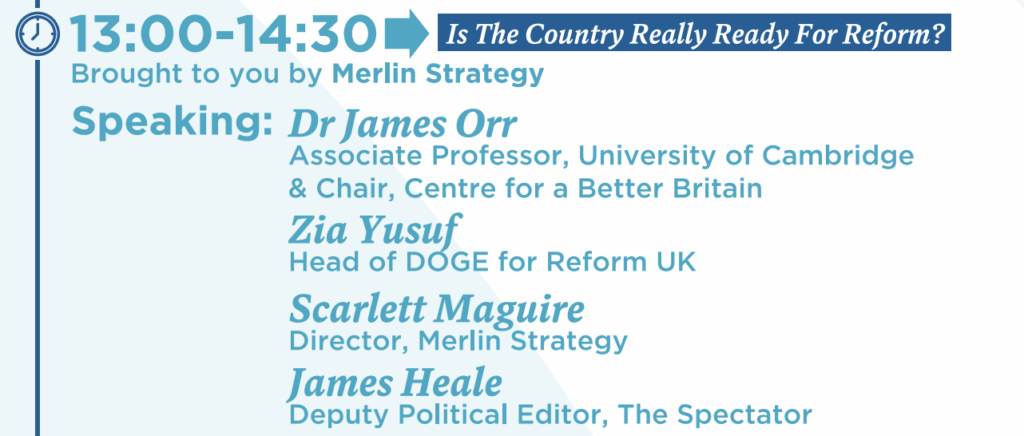
The think tank is chaired by James Orr, a Cambridge academic who has been described as the “philosopher king” of U.S. Vice President JD Vance.

Orr has expressed radical anti-climate positions, claiming in an interview with the European Conservative last month that the UK’s energy policies are “crazy” and that the pursuit of net zero is “fiscal suicide”.

At an event in Hungary last month hosted by the oil-funded think tank Mathias Corvinus Collegium (MCC), Orr also accused the UK of adopting a “naive and dangerous” approach to Russia’s invasion of Ukraine and instead praised Hungary’s approach, which has seen the country systematically block and delay EU military aid packages, and sanctions on Russian oligarchs.

In the European Conservative interview, Orr suggested the war was a “regional Slavic conflict”.

“It is a conflict happening in the world that I don’t care very much about,” he added.

Farage, who used to appear regularly on state broadcaster Russia Today, has previously said that Putin is the world leader that he most admires, though he has also called him a “bad man”.

Together and Farmers to Action

Established in 2021 to oppose mandatory Covid-19 protection measures, such as lockdowns and vaccines, Together has since launched a “no to net zero” campaign that calls for the UK to scrap climate policies.

In January last year, the group said it was “incredible” that the then prime minister Rishi Sunak should “mindlessly assert ‘Covid vaccines are safe’” in a post on X. It has also backed a report which called for the government to pause its vaccination programme over a number of widely debunked conspiracy theories about its safety, including that the vaccine alters human DNA. 
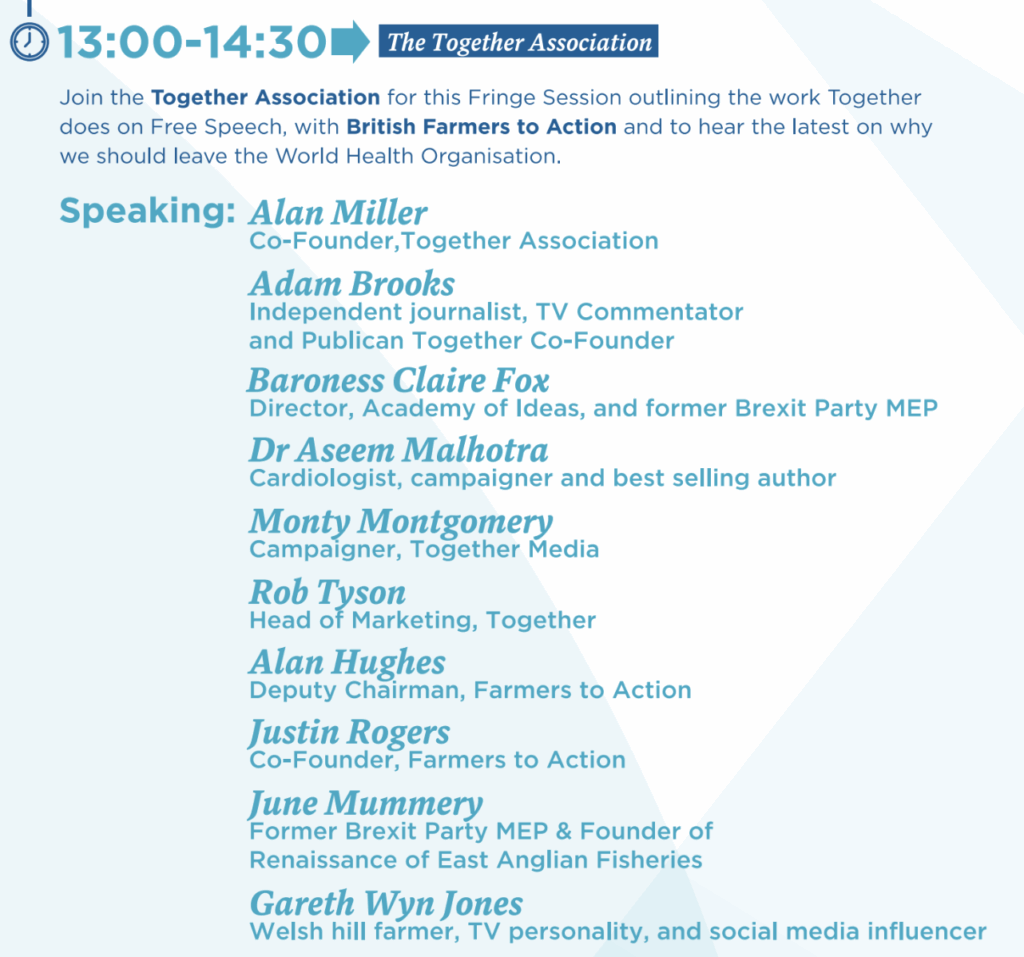
Together has recently partnered with Farmers To Action – a protest group also set to feature at Reform’s conference. The group has used recent anti-inheritance tax campaigns to spread anti-climate views.

The leader of Farmers to Action, Justin Rogers, has claimed that “climate change is one of the biggest scams that has ever been told”, propagated by “our governments and their puppet masters.” He has also claimed that oil and gas are renewable, and that carbon dioxide cannot be dangerous because it “feeds plants”. 

At an event co-hosted by Together and Farmers to Action in February, Farage endorsed a conspiracy theory popular among the far-right.

Speaking in front of around 50 tractors at Belmont Farm in North London, Farage insinuated that the Labour government had a “sinister agenda” to acquire “lots of land because they’re planning for another five million people to come into the country”. 

This claim is borne from the “Great Replacement” conspiracy theory, which holds that progressive immigration policies are a mechanism to replace white people in the West, and has been cited by Donald Trump in recent months.

Farmers to Action and Together were approached for comment.

Original article by Sam Bright republished from DeSmog

Nigel Farage urges you to ignore facts and reality and be a climate science denier like him. He says that Reform UK has received millions and millions from the fossil fuel industry to promote climate denial and destroy the planet.
Nigel Farage explains the politics of Reform UK: Racism, Fake anti-establishmentism, Deregulation, Corporatism, Climate Change Denial, Mysogyny and Transphobia.
Nigel Farage reminds you that he's the man that brought you Brexit and asks what could possibly go wrong.
Nigel Farage reminds you that he’s the man that brought you Brexit and asks what could possibly go wrong.
Continue ReadingClimate Deniers to Converge on Reform Conference

Is a shift quietly underway in British politics?

Spread the love

Original article by Paul Rogers republished from Open Democracy under a Creative Commons Attribution-NonCommercial 4.0 International licence.

Up and down the country, Jeremy Corbyn is drawing large crowds | Jeff J Mitchell/Getty Images

As Nigel Farage dominates headlines, Jeremy Corbyn is being overlooked by the media – just as he was in 2017

In May 2017, British Conservative prime minister Theresa May called a snap election three years early, despite having a comfortable majority in Parliament and having told the country she would not do so.

May was polling well and assumed it would be easy to push Jeremy Corbyn’s Labour opposition to a crushing defeat, winning an even bigger majority that would strengthen her hand in Brexit negotiations. Most pundits agreed this was the likely outcome.

But on polling day, May failed dismally. The Tories lost their majority. Corbyn, despite having faced bitter opposition from within his own party since being elected leader two years earlier, somehow managed to reach out over them to speak to a much wider public.

Something had happened to the body politic that had been missed by the media. Now, with the announcement of Corbyn and former Labour MP Zarah Sultana’s new party, a similar shift is underway – and is once again flying under the radar.

As I wrote for openDemocracy at the time, back in 2017, Corbyn was drawing large crowds across the country ahead of the election. When his rallies and meetings were held in public spaces, thousands turned up, often at short notice. If scheduled for indoor venues, these would be full to bursting, and he often had to repeat his speech to those waiting outside.

In one sense, there had already been signs of something going on below the political surface. When Corbyn first ran for the party leadership in 2015 – a contest in which he was the runaway winner – there were early indications that he was attracting considerable support from the grassroots.

A year later, strong opposition from within his own party led to a leadership challenge that he won, again achieving a hugely positive reaction at public meetings in spite of his internal critics.

History is repeating itself. Corbyn and Sultana’s new left-wing offering – not yet officially named but for now known as Your Party – may be a work in progress, but the enthusiasm with which it has been greeted is palpable.

Some 800,000 people have signed up to support the idea. If just a quarter follow through to become members when it is formally established, it may well become the UK’s largest political party by membership overnight, given the collapse in Labour membership.

The idea that a new decidedly left party could come to the fore and acquire serious political power may seem impossible, given Westminster’s First Past the Post voting system, but just look at what is happening across the UK political scene, especially in England.

It’s hard to say how many groups have sprung up across the country to form local concentrations of support for Your Party in the past four or so weeks, but it almost certainly runs into the many hundreds. In the West Yorkshire council where I live, two groups have already met, with two more due to do so in the next week, all with loose coordination yet covering the whole area of the metropolitan council.

In contrast, Labour’s practised and experienced membership bureaucracy is seeing support ebbing away. Accurate, up-to-date figures are not easy to come by, but the party reportedly had 309,000 members six months ago, down from a peak of 532,000 under Corbyn in 2019. Some constituency party treasurers are reporting recent membership losses of up to a third over the past year alone.

There are many factors involved in this decline, not least the Labour leadership maintaining a marked degree of austerity and failing to confront Nigel Farage and Reform UK head-on. But perhaps the key problem is the party’s even greater failure to confront Benjamin Netanyahu and his Israeli government over the appalling genocide they are inflicting in Gaza. This issue, probably more than any other, is leading Labour activists who would normally be at the forefront of projecting its policies to leave the party in droves.

Can Labour’s decline and Your Party’s rise, not to mention the current considerable strength of Farage and Reform UK, lead to a radical re-ordering of the political environment in England? Several things suggest it could be possible.

For a start, we’re likely three years away from a general election being called. That gives enough time for Reform’s weaknesses to show themselves.

The party is substantially trading on fear, principally of migrants, but which commonly extends to a more general ‘fear of the other’. Corbyn is particularly effective at countering this head-on with hope, which is thoroughly appealing and especially so to younger people, as can be seen in new polling showing that one in five 16 and 17-year-olds would vote for Corbyn and Sultana’s new party.

Reform is also vulnerable in its attempts to claim it is standing up for the ordinary person against a woke and distant elite. That simply doesn’t add up; given the considerable wealth floating around the Reform leadership and its funders, it is not difficult to present them as the true elite.

Finally, a serious weakness for Reform and the Tories is their Cnut-like denial of climate breakdown and their addiction to fossil carbon. The folly of that stance may well come to haunt them over the next three years, as more and more ordinary people across the UK experience floods, or wildfires, or other climate crisis-related weather phenomena.

Then there is the other side of the political scales, starting with the election this week of Zack Polanski as the Green Party leader. Polanski has not yet ruled out working with Sultana and Corbyn, and there is time for local electoral pacts to be negotiated in forthcoming elections, especially the many local elections and the Scottish and Welsh national elections taking place next May.

We also should not discount the Liberal Democrats, who have considerable geographical concentrations, north and south of the border. In Scotland, in particular, there are plenty of new, younger politicians coming through, just as there are in the Scottish National Party. Your Party is also likely to lead to the emergence of new political figures on the progressive left in the coming months, while others may decide to defect from Labour to the party.

A couple of other elements are worth watching, too. Sultana, Polanski and Corbyn are all highly committed politicians and very effective communicators. Expect to see a lot more of them, even on the legacy media.

Of them, Corbyn is key. He is not remotely a rabble-rouser, yet for the past ten years, he has maintained a formidable and dedicated network of supporters – even at very difficult times. It is very easy to dismiss what he stands for as being from the past, but perhaps it is actually from the future.

Original article by Paul Rogers republished from Open Democracy under a Creative Commons Attribution-NonCommercial 4.0 International licence.

Experiencing issues with this image not appearing. I suspect because it's so critical of Zionist Keir Starmer's support of and complicity in Israel's genocides.
Genocide denier and Current UK Prime Minister Keir Starmer is quoted that he supports Zionism without qualification. He also confirms that UK air force support has been essential in Israel’s mass-murdering genocide. Includes URLs https://www.declassifieduk.org/keir-starmers-100-spy-flights-over-gaza-in-support-of-israel/ and https://youtu.be/O74hZCKKdpA
UK Labour Party government ministers Keir Starmer, Angela Rayner and Rachel Reeves explain that they are partners complicit in Israel's Gaza genocide. The UK has provided Israel with arms, military and air force support. They explain that they don't do gas chambers but do do forced marches, starvation, destroy hospitals, mass-murders of journalists and healthcare workers.
UK Labour Party government ministers Keir Starmer, Angela Rayner and Rachel Reeves explain that they are partners complicit in Israel’s Gaza genocide. The UK has provided Israel with arms, military and air force support. They explain that they don’t do gas chambers but do do forced marches, starvation, destroy hospitals, mass-murders of journalists and healthcare workers.
Nigel Farage urges you to ignore facts and reality and be a climate science denier like him. He says that Reform UK has received millions and millions from the fossil fuel industry to promote climate denial and destroy the planet.
Continue ReadingIs a shift quietly underway in British politics?

Zack Polanski becomes Green party leader – what happens next?

Spread the love
Zack Polanski is the new leader of the Green party. Alamy/Ron Fassbender

Louise Thompson, University of Manchester

Zack Polanski is the new leader of the Green party in England and Wales after winning a leadership election promising a programme of “eco-populism”. Polanski beat incumbent leader Adrian Ramsay and his partner on the ticket, Ellie Chowns.

It’s been just over a year since the party celebrated its best ever results in the most recent general election. In July 2024, it doubled its vote share and quadrupled its representation in the House of Commons to four MPs.

The same election saw terrible results for the Conservatives and even for Labour, despite its win, raising questions about whether two-party politics was well and truly over. Since then, as professor John Curtice has vividly described, things have started to look even shakier.

This year’s local election saw a “record-breaking” fragmentation of the vote in which less than a quarter of local council seats went to the two main parties. The Greens now hold over 800 seats in more than 170 different councils, adding to their electoral portfolio – which also includes two members of the House of Lords and three London Assembly members.

While Polanski will be celebrating today, party members will look to him to raise their electoral fortunes even further. The electoral challenge for the Greens in England and Wales is two-pronged.

First, the party needs to maintain its position in the seats it has already secured. Its four MPs have fairly comfortable majorities, the smallest being Chowns’ 5,800 majority in North Herefordshire. Second, and perhaps most importantly, it needs to maximise its success in the 40 constituencies where it came second. All but one of these constituencies were won by Labour, which makes Labour voters the prime targets.

My research has shown how the Green party has followed a policy of “total engagement” in recent years. It takes its parliamentary work very seriously, using any and every opportunity to get its message across, even in lower-priority policy areas.

The goal here is to build credibility with the electorate. Small parties tend to want voters to think they are bigger than they are, so they can present themselves as realistic contenders for taking on the heavy work and responsibility of government. Caroline Lucas did a fantastic job of this, punching well above her weight as the party’s only MP between 2010 and 2024.

Together, the Green MPs have made over 380 contributions in the House of Commons. Chowns in particular has been a prolific backbencher, making 161 contributions, while the previous co-leaders Carla Denyer and Ramsay have been much quieter.

With Polanski sitting in the London Assembly rather than the House of Commons, this will inevitably change. The four Green MPs will collectively have more time on their hands and, with the right direction from their new leader, will have the space to be more strategic in their parliamentary activities.

Outsiders

But the Greens have always acted as something of an atypical party too, keeping one foot outside Westminster. Lucas was regularly involved in activism, joining protesters campaigning against tuition fee increases and fracking and to support refugees, to name just a few. She was even arrested in 2013 after joining a protest against energy firm Cuadrilla in Sussex (she was later cleared of all charges in court).

The new Green MPs have continued in this vein, with Sian Berry joining a peaceful protest against far-right agitators in Brighton last year and Chowns pressing the government to water down anti-protest laws.

The new leadership will need to decide whether this strategy enhances their electoral appeal. Does it highlight the Greens’ distinctiveness from the establishment parties, or does it imply they aren’t responsible enough to manage being a party of significant size? The answer depends on who you ask. Polanski has participated in several protests in the past, so chances are this activism will continue to be a core feature of Green party politics.

An added complication for the Greens is that two other parties are also chasing left-leaning voters. One of these is Reform UK. Although associated with rightwing views on social issues, the party came second in many Labour seats in 2024 and needs to appeal to both sides of the political spectrum.

This may explain why the Greens have focused their efforts on highlighting Reform’s failures. Berry, for instance, recently challenged Nigel Farage and his colleagues to publish a log of all their meetings since entering the Commons, arguing that it would be in the public interest.

The other outside threat is Jeremy Corbyn and Zarah Sultana’s new and currently nameless party of the left. While we know little about this party’s policy platform right now, it seems to be veering towards a similarly bottom-up democratic model of organisation which has long been favoured by the Greens – possibly even with co-leaders.

The challenge for the Greens will be to better establish their niche on the left, to ensure they capture voters who are disillusioned with Keir Starmer’s wobbly start. Part of the solution could be to focus on a handful of key policy areas which go beyond the Green party’s niche of environmental issues. At the moment, its MPs take something of a scattergun approach in the Commons, contributing on everything from local buses and universal credit to Ukraine and the Middle East.

Some of the most recent questions asked during Prime Minister’s Questions by Greens hint at the options they might pursue. Ramsay has pushed for a wealth tax on the super rich, and an end to the two-child benefit cap. Both Corbyn and Sultana have, of course, been outspoken on these issues in the past.

If the Greens can’t forge a different path to this new left party, they may have no choice but to consider an electoral pact to avoid splitting the anti-Labour vote right down the middle.

Louise Thompson, Senior Lecturer in Politics, University of Manchester

This article is republished from The Conversation under a Creative Commons license. Read the original article.

Continue ReadingZack Polanski becomes Green party leader – what happens next?

Treaties like the ECHR protect everyone in the UK, not just migrants

Spread the love
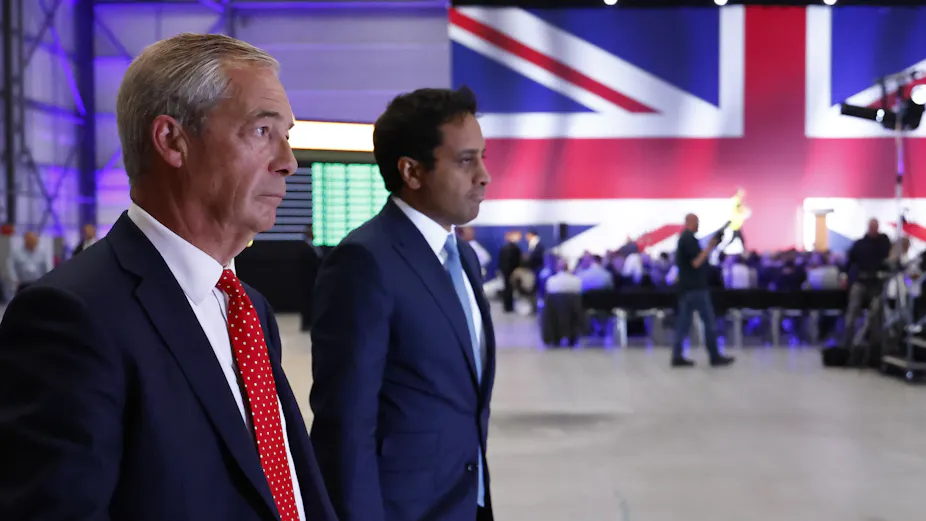
Reform’s Nigel Farage and Zia Yusuf arrive at an airplane hangar to lay out their deportation plans. Tolga Akmen/EPA-EFE

Alice Donald, Middlesex University and Joelle Grogan, University College Dublin

Reform UK has laid out plans for an “emergency programme” to address illegal immigration. The party argues its plans, which include expanding immigration detention capacity from the current roughly 2,200 places to 24,000, would enable the deportation of up to 600,000 people over a parliamentary term.

The plans would require removing legal protections against mass deportation without due process. Specifically, Reform has called for repealing the Human Rights Act (HRA) 1998 and permanently withdrawing the UK from the European Convention on Human Rights (ECHR). Nigel Farage has also proposed disapplying for five years the 1951 Refugee Convention, the UN Convention against Torture and the Council of Europe anti-trafficking convention, although these treaties do not, in fact, allow for temporary suspension.

Beyond the apparent logistical challenges are serious political repercussions. The Good Friday Agreement requires the rights and freedoms in the ECHR and recourse to the European Court of Human Rights to be part of the law in Northern Ireland. Withdrawing would require a renegotiation of the agreement. A showdown would also ensue with the devolved assemblies in Wales, Scotland and Northern Ireland.

Reform has touted its plan as a “legal reset”. But it is better understood as a total rejection of the UK’s postwar international commitments to protect the human rights of everyone within its jurisdiction.

These commitments, and others, have cemented the UK at the heart of the rules-based international order. This is the foundational idea that countries are bound by the legal commitments they make to each other and everyone within their jurisdiction. Successive governments have viewed this as both a moral imperative and a core aspect of the UK’s foreign and defence policies.

Reform’s plan would be an unprecedented and drastic rupture with almost eight decades of commitment to human rights protections. It would have far-reaching implications for all people in the UK, not just refugees.

How the ECHR protects everyone

If the UK withdrew from the ECHR, everyone living in the UK would lose the ability to take cases to the European Court of Human Rights if they fail to get justice domestically.

ECHR rights have been invoked to protect victims of domestic abuse, children and disabled people. The right to private and family life, the application of which has been (inaccurately) criticised for preventing deportation, is the same right relied on to protect privacy in the workplace or from surveillance, to uphold the dignity of older and disabled people in residential care, and to secure legal protection for LGBTQ+ people.

The ECHR alone has provided redress to victims of crime who have been failed by state investigations, like the survivors and bereaved families of the Hillsborough disaster or the victims of the “black cab rapist” John Worboys. Ironically, Reform UK has repeatedly argued for protection of free speech, which is protected primarily by the ECHR.

The wider cost of UK withdrawal from international treaties would be the loss of influence and reputation. These treaties are benchmarks for international cooperation, and foundational to international order. Pulling out of the UN convention against torture and the anti-trafficking convention would signal the UK’s abandonment of global principles to combat torture, modern slavery, sexual exploitation and trafficking, including the illegal trade in human organs.

Far from enabling the UK to control migration, a do-it-alone stance would harm the ability of future governments to do so. Removing the UK from the negotiating table would forfeit the opportunity to shape and benefit from cooperation to tackle a global challenge. We have seen this before: UK withdrawal from the EU took it out of the Dublin system and ongoing EU-wide efforts to manage migration and returns, just as small boat arrivals increased.

Beyond this, removals require treaties with other countries. Treaties require political will, mutual benefit, time and trust that the signatories will hold to their commitments. Where these are lacking, as evidenced by the failed and costly Rwanda policy, receiving countries can extract a very high price from the UK.

Could the rights be replaced?

To implement these plans, a Reform government would need to pass legislation through parliament to repeal the Human Rights Act (HRA). If successful, this would pave the way for the UK to give notice to the Council of Europe to withdraw from the ECHR.

Without the HRA, there is no equivalent protection to the ECHR elsewhere in UK law. The common law, a body of law developed over centuries by judicial decisions as distinct from laws passed by parliament, would continue to provide some protection for rights, including personal liberty, access to justice, the right to a fair trial and the prohibition of torture.

Common law principles would still guide British judges when making decisions about mass detention and deportation without due process. It is also possible that a new bill of rights could be enacted, containing a similar or identical catalogue of rights to the ECHR.

The most important difference would be how rights would be protected in practice. Would any replacement, like the HRA, oblige public authorities and the government to uphold rights in their decisions and actions? And would it allow higher courts to declare a law incompatible with human rights, flagging to parliament that the law should be reconsidered?

Human rights protections are invisible to most people living in the UK. The expectation that police and your local council must treat you fairly, that health and care services must respect your dignity, and that there will be legal remedy if the state fails you, is so normalised that it would be inconceivable to think it could disappear within the UK.

But it is the invisible integration of individual rights within the UK system that makes this both a lived and legal reality. Stripping away these protections would leave us all naked.


Want more politics coverage from academic experts? Every week, we bring you informed analysis of developments in government and fact check the claims being made.

Sign up for our weekly politics newsletter, delivered every Friday.


Alice Donald, Professor, Middlesex University and Joelle Grogan, Senior Visiting Research Fellow, UCD Sutherland School of Law, University College Dublin

This article is republished from The Conversation under a Creative Commons license. Read the original article.

Climate science denier Nigel Farage explains that it's simple to blame asylum-seekers or Muslims for everything.
Climate science denier Nigel Farage explains that it’s simple to blame asylum-seekers or Muslims for everything.
Nigel Farage reminds you that he's the man that brought you Brexit and asks what could possibly go wrong.
Nigel Farage reminds you that he’s the man that brought you Brexit and asks what could possibly go wrong.

Continue ReadingTreaties like the ECHR protect everyone in the UK, not just migrants

There’s an obvious way to challenge Nigel Farage. But Keir Starmer won’t do it

Spread the love

https://www.theguardian.com/commentisfree/2025/aug/27/nigel-farage-keir-starmer-brexit-truth

 Composite: Guardian Design/GB News/YouTube

Labour’s reluctance to name Brexit as the cause of so many problems hasn’t stopped Reform’s rise. It’s time to try the truth

By Rafael Behr

So begins another chapter in the liberation struggle. Released from bondage to the EU, Britain finds itself subjugated to a more insidious foe. The border that should have been sealed is wide open. The foreign hordes are still coming, but their passage is no longer directed by bureaucrats from Brussels. This time, national emancipation depends on breaking the tyranny of human rights lawyers.

That is the plot to Nigel Farage’s Brexit sequel, previewed on Tuesday in an airport hangar in Oxfordshire. The Reform UK leader laid out plans for “mass deportation” of migrants – all who arrive without permission, plus those who are here already and came by illicit channels.

Tens of thousands will be targeted. There would be cash incentives for anyone volunteering to leave. Refusers would be rounded up, detained in camps and flown to their countries of origin or, if those places won’t have them, some other place. A remote island, maybe. The exchequer would remunerate receptive governments.

If deportees face the likely prospect of torture or death on arrival, well, that would be unfortunate but not sufficient grounds to stop the flights.

Are we really going to spend the next four years watching Farage leaf casually through the familiar playbook, running the same campaign to the fawning applause of the same courtier commentariat? Is it too much to expect a Labour government to raise, by way of rebuttal, the Reform leader’s proven failure as an arbiter of the national interest? We tried listening to him. His probity and judgment were sold as the product called Brexit. It turned out to be a piece of shit. Enough people already know this is the truth, but it would be liberating to hear it from the prime minister.

https://www.theguardian.com/commentisfree/2025/aug/27/nigel-farage-keir-starmer-brexit-truth

Climate science denier Nigel Farage explains that it's simple to blame asylum-seekers or Muslims for everything.
Climate science denier Nigel Farage explains that it’s simple to blame asylum-seekers or Muslims for everything.
Nigel Farage reminds you that he's the man that brought you Brexit and asks what could possibly go wrong.
Nigel Farage reminds you that he’s the man that brought you Brexit and asks what could possibly go wrong.

Continue ReadingThere’s an obvious way to challenge Nigel Farage. But Keir Starmer won’t do it