To keep global warming below 1.5°C, greenhouse gas emissions had to peak no later than 2025. That was a key finding of the IPCC’s most recent major report on the topic, published a few years ago. Yet when we surveyed UK MPs and members of the public in four countries, fewer than 15% could identify this deadline correctly.
This matters. If politicians and voters underestimate how urgently we have to fight climate change, they are less likely to back the tough policies needed. Instead, they risk assuming we have more time, all while climate change targets slip further out of reach.
Our study, published in the journal Communications Earth and Environment, found that across Britain, Canada, Chile and Germany, about one-third of respondents thought emissions only had to peak by 2040 or later. In the UK, we also surveyed MPs. We found Labour politicians were more likely than Conservatives to answer correctly, but overall awareness was low in both groups.
Among the public, younger people, those worried about climate change, and those less prone to believing conspiracy theories were the most likely to know the right answer. But overall, the pattern was clear: most people – and most MPs – don’t grasp the urgency of the situation.
The distribution of responses was remarkably similar across the four countries. Kenny and Geese (2025)
Why awareness matters
Knowing the scientific facts does not automatically spur action. But political priorities are shaped by what MPs or their constituents consider as urgent (MPs sometimes cite a lack of urgency from constituents as an excuse for not taking climate actions even when they are concerned about it).
If neither MPs nor their voters realise how pressing the problem is, climate change risks being overlooked in favour of other issues. That MPs were largely not aware that much more immediate action was required may help explain why, by mid-2024, the UK was already behind the pace required to meet its own emissions reduction targets.
Partisan divides reinforce the problem. In our survey, 2019 Labour voters were more likely to know the correct 2025 deadline than those who voted Conservative. Political differences in knowledge were greater than the gap between MPs and the public, suggesting that party identity or political ideology, not just parliamentary expertise, is a factor in level of awareness.
Many of those Conservative MPs were replaced by new Labour MPs in the 2024 election, so perhaps a repeat survey today would show greater awareness of climate change among parliamentarians. But even Labour MPs are still not very likely to appreciate the urgency.
Labour-Tory was a bigger divide than public-politician. Kenny and Geese (2025)
The communication challenge
The IPCC and other big institutions produce authoritative reports, but they are not always written in a manner accessible to non-specialists. Policymakers are inundated with these reports and are expected to absorb huge amounts of information, digest it, and act on it. Crucial findings can get lost in the detail. If the urgency of climate action is not communicated clearly and memorably, it is less likely to be a factor in forming policy.
In the UK, scientists have long made “global greenhouse gases need to peak by 2025 for 1.5°C” a centrepiece of public and political communications. For example, it is there in the slogan of the Tyndall Centre, the major climate research hub where we work, that this is a Critical Decade for Climate Action.
But our findings suggest this message is not cutting through, with either politicians or the public. If deadlines are misunderstood, policies will inevitably not go far enough.
Make timelines impossible to ignore
The science is clear: emissions really did need to peak this year for a chance of staying within 1.5°C. A number of studies suggest this target is now effectivelyunreachable given the lack of substantial progress in recent years, but the urgency remains.
To close the gap between science and politics, communications must be sharper. Reports need to highlight timelines and consequences in ways that are impossible to ignore. Politicians and the public need to understand not just the scale of the climate crisis, but how immediate it is.
John Kenny, Research Fellow (Public Engagement with Climate Change), School of Environmental Sciences, University of East Anglia and Lucas Geese, Research Fellow, Tyndall Centre and School of Environmental Sciences, University of East Anglia
UK Conservative Party leader Kemi ‘not a genocide’ Badenoch explains her reality that the Earth is flat, the Moon is made of cheese and that she was born from
Unicorn horn dustNigel Farage urges you to ignore facts and reality and be a climate science denier like him. He says that Reform UK has received £Millions and £Millions from the fossil fuel industry to promote climate denial and destroy the planet.Orcas discuss how Trump was re-elected and him being an obviously insane, xenophobic Fascist.
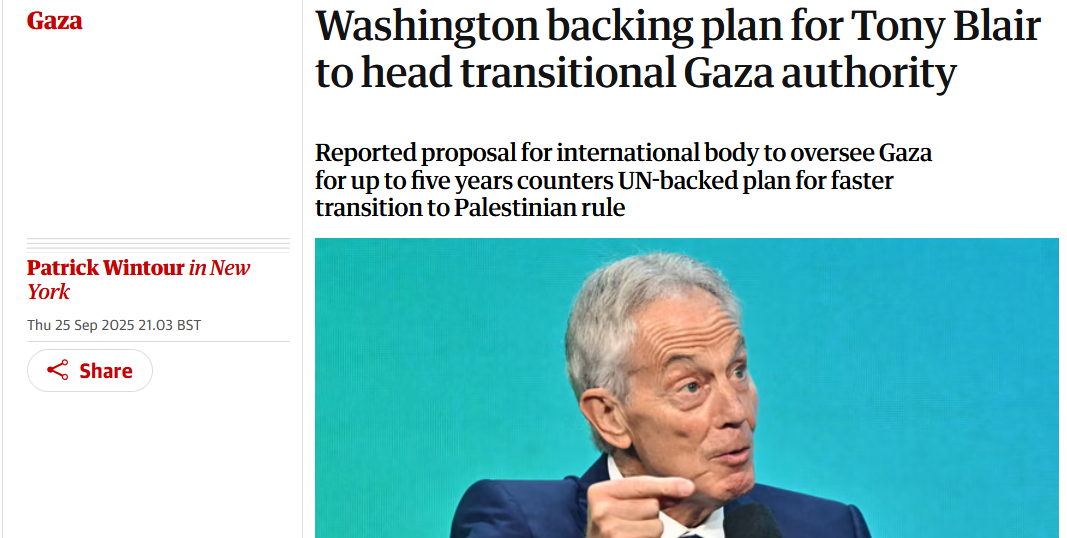
Yesterday saw two announcements. Starmer is to introduce compulsory digital ID cards in the UK, and Tony Blair is put forward by the White House to be the colonial administrator of Gaza for five years.
The political economy of the world appears locked in a vertiginous downward spiral. You don’t have to scratch very hard to find that Tony Blair’s hand is also behind the compulsory ID plan. He has been pushing it for nearly thirty years, and now it comes with added links to Larry Ellison, Palantir and Israel.
The government will be able to garner and centralise knowledge of everything about you. Every detail of your financial transactions, your DNA, your family, your medical records, your education, employment and accommodation. It will be a very short time before the digital ID is linked to your social media accounts and your IP access to monitor your browsing.
There is already the intention to control us through our access to financial services. I have spoken with one of the women charged for protesting outside the Leonardo factory in Edinburgh. She has had her bank accounts cancelled – simply losing the money in them – and cannot open a new account. You may recall they tried to debank Nigel Farage. The campaign to defend Julian Assange suffered multiple banking cancellations.
The desire of the state to control people politically through their ability to carry out ordinary transactions is not in doubt. It is demonstrated. Once you have a compulsory digital ID linked to transactions – which will follow very swiftly, I am quite certain – they will be able to simply switch off your ability to pay for anything. Add this to a digital currency which tracks all of your expenditure – all the key elements of which are already installed – and total control will be in place.
Starmer is trying to dress up a digital ID as an immigration control – whether you support immigration control or not, the notion that it will make a significant difference is nonsense. Landlords, employers, banks and lawyers already have to check the ID and status of their clients. For those bent on evasion, one more piece of bureaucracy will make little difference. It is the law-abiding who will be enmeshed in the system of control.
Increases in state surveillance and restrictions on personal freedom are always falsely framed as protection against a terrible threat – paedophiles or fraudsters or immigrants or Russians. Yet despite an ever-shrinking area of personal freedom, none of these real or invented threats ever actually recedes.
Starmer is the most unpopular PM in history. Attempting to force through this deeply unpopular measure is going to cause him real difficulties in parliament. The calculation is that Reform will oppose the measure on libertarian grounds, and that this will allow Starmer to show himself as tougher on immigration than Reform. The breathtaking cynicism of this is typical of the Starmer government, which believes in nothing except their own power.
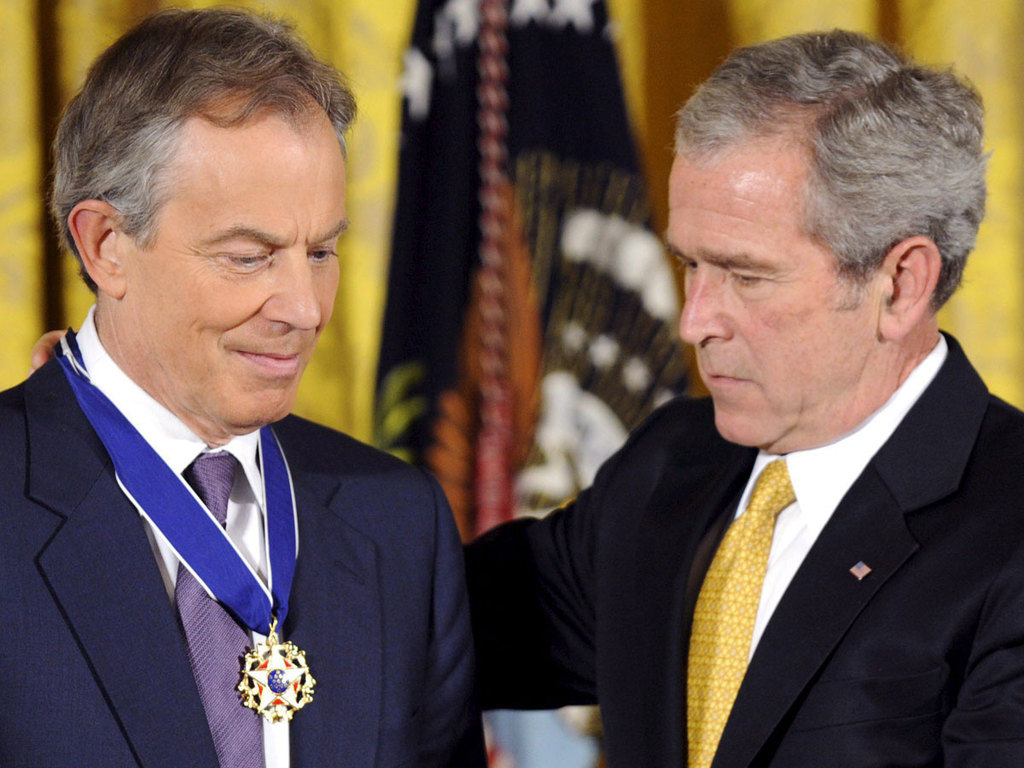
As for Blair being made effectively Governor of Gaza, this is so sickening as to be beyond belief. The man who killed a million Iraqis on the basis of lies about WMD, who has made hundreds of millions of pounds through PR services to dictators, whose Tony Blair Institute has drawn up “Gaza Riviera” plans for Trump, and who has been discussing with western oil companies the takeover of Gaza’s gas field, is touted to administer the mass grave which Gaza has become.
In any reasonable world this would be impossible. The degeneration of western society is profound. There are no ethics in play beyond the dominance of power, wealth and greed. Blair manages to embody these in one person.
Genocide denier and Current UK Prime Minister Keir Starmer is quoted that he supports Zionism without qualification. He also confirms that UK air force support has been essential in Israel’s mass-murdering genocide. Includes URLs https://www.declassifieduk.org/keir-starmers-100-spy-flights-over-gaza-in-support-of-israel/ and https://youtu.be/O74hZCKKdpAKeir Starmer objects to criticism of the IDF. He asks how could anyone object to them starving people to death, forced marches like the Nazis did, bombing Gaza’s hospitals and universities, mass-murdering journalists, healthworkers and starving people queuing for food, killing and raping prisoners and murdering children. He calls for people to stop obstructing his genocide for Israel.Orcas discuss Genocide-supporting and complicit Zionists. Donald Trump,
Keith Starmer, David Lammy, Rachel Reeves, Angela Rayner are called
evil genocide-complicit and supporting cnuts.
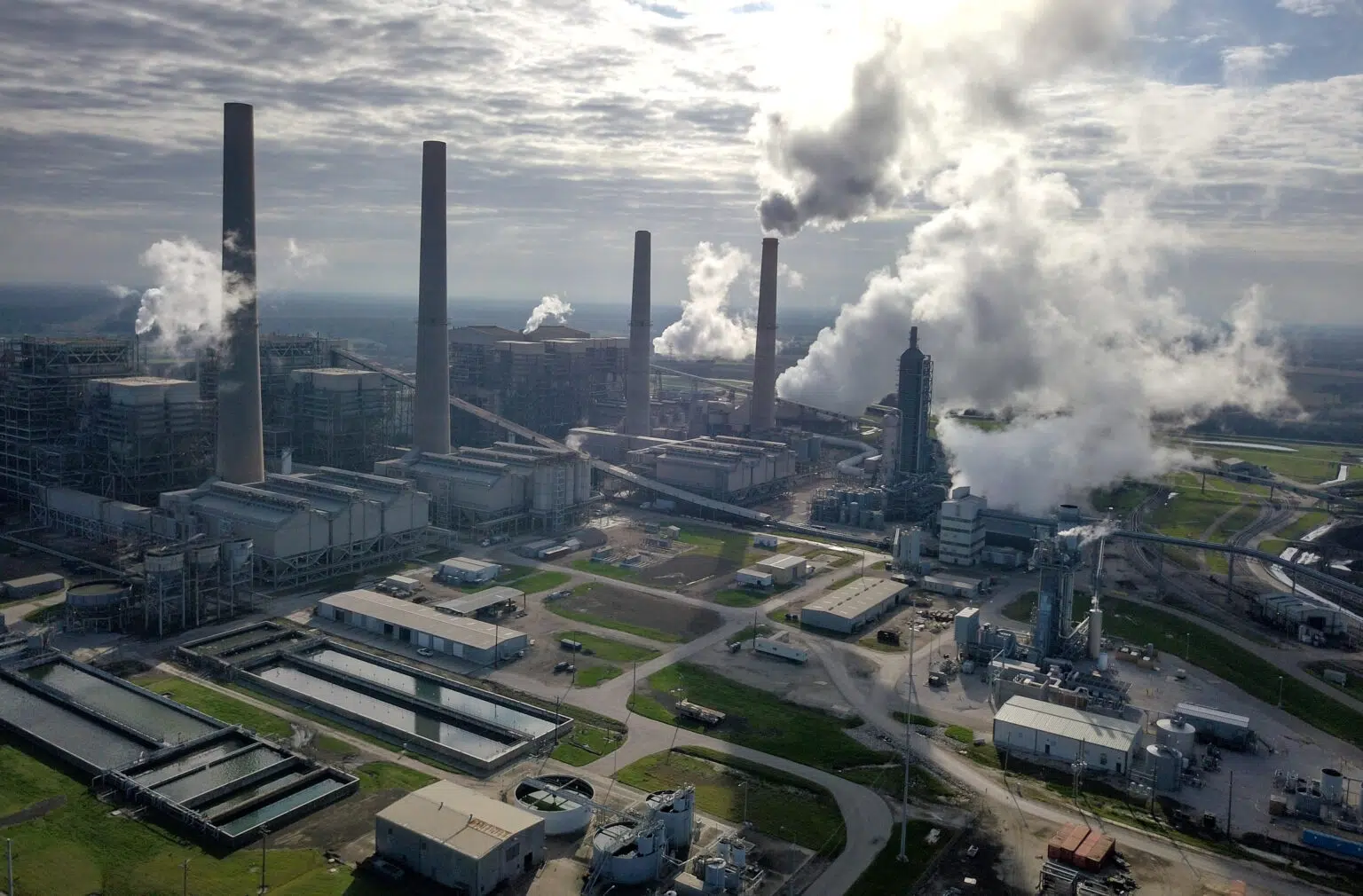
Carbon capture faces significant skepticism from environmentalists who note that the industry’s past is littered with failed projects, missed targets, and an overall net increase in emissions. Credit: Matt Hrkac (CC BY-NC-ND 2.0)NDLA,
CCS can “no longer be considered an unlimited” climate solution, researchers caution after concluding most storage options are in risky regions
As the Trump administration seeks to wipe away environmental rules covering the oil, gas, and coal industries, fossil fuel producers and sellers are reassuring buyers that carbon capture and storage (CCS) could slash climate-altering emissions from a growing range of fossil-fuel projects — like blue hydrogen, LNG export terminals, and data centers.
“That’s right: data centers,” fossil fuel giant ExxonMobil wrote in December, adding that the need for more data centers for AI could represent a fifth of the world’s demand for carbon capture by 2050.
Now, a study published in the journal Nature calls attention to another issue that could loom in the future if CCS were to really take off — a lack of easy-to-develop locations where captured carbon can be buried underground.
The vast majority of places where you can find the kinds of sedimentary rocks that allow carbon dioxide to be stored underground sit in higher risk zones or in areas like the Arctic that are potentially off-limits for practical or political reasons, the study found.
That has big implications for the energy transition, since once carbon dioxide is put into storage, it’s supposed to stay there for as long as possible. Any storage sites we use today can’t be expected to be available for future generations — not just the children and grandchildren of people alive today but “more than ten generations into the future,” the study notes.
“This study should be a gamechanger for carbon storage,” coauthor Joeri Rogelj, director of research at the Grantham Institute at Imperial College London, said in a statement when the study was announced. “It can no longer be considered an unlimited solution to bring our climate back to a safe level. Instead, geological storage space needs to be thought of as a scarce resource that should be managed responsibly to allow a safe climate future for humanity.”
In fact, there may be only enough practical storage to potentially reverse between 0.4 and 0.7 degrees Celsius of warming — a tiny fraction of the five or six degrees experts previously estimated, the researchers said.
The carbon storage that is available “should be used to halt and reverse global warming,” Rogelj added, “and not be wasted on offsetting on-going and avoidable CO2 pollution from fossil electricity production or outdated combustion engines.”
On Track to ‘Overshoot’
International plans to limit climate change tend to assume that we can “overshoot” on climate pollution, pushing the Earth’s climate into dangerous territory past 1.5 or 2 degrees Celsius of warming. That’s because, the argument goes, carbon capture and storage could come to the rescue if we go too far, letting us draw carbon dioxide levels back down.
The new study calls that assumption into question, highlighting uncertainty about how effective carbon removal will be at curbing climate change, in addition to concerns over difficulties in accessing underground carbon storage.
“With current trends suggesting warming up to 3°C this century, using all of the safe geological storage wouldn’t even get us back to 2°C,” said lead author Matthew Gidden, research professor at the Center for Global Sustainability at the University of Maryland.
Industry estimates, like those from the Oil and Gas Climate Initiative (OGCI), suggest the world has plenty of storage potential to keep 14,000 gigatons of carbon dioxide buried below ground and out of the atmosphere.
That would be “more than enough to meet projected needs for CCUS [carbon capture, use and sequestration] over the coming century,” the OGCI wrote in a 2023 report it called a “playbook for regulators, industrial emitters and hub developers.”
The new study, however, takes a closer look at where that storage is located — and in particular whether it’s in regions at higher risk of earthquakes or groundwater contamination like locations deep in the ocean, or in the Arctic and Antarctic circles. The study concludes that nearly 90 percent of that storage capacity is in less-than-desirable locations.
The researchers estimate there’s just 1,460 gigatons worth of “prudent” storage available worldwide — a tenth of the industry estimates.
Some earlier estimates stretch even higher, suggesting there’s around 40,000 gigatons of CO2 storage capacity worldwide.
“These estimates are also important as they remove all the technical constraints from assessment and assume that cost and engineering challenges will pose no issue in the future,” coauthor Siddharth Joshi, a research scholar at the Integrated Assessment and Climate Change Research Group, told DeSmog, adding that “the shock value of technical potentials is enough to sometimes drive an industry forward.”
At the same time, focusing only on larger capacity estimates can create a “false sense of abundance,” Gidden noted, if policy-makers think the world has more room for overshoot than carbon storage can really offer.
The Nature study raises big questions about how the world’s carbon storage should be used long term.
“As [the study authors] point out, if we act to reduce emissions now, we probably have enough storage, but that ceases to be true really, really soon,” Rob Anex, professor at the University of Wisconsin-Madison who researches carbon capture technology, told Canada’s CBC News. “Global emission rates are so high that the window of time in which geologic storage is practical is shutting really, really fast.”
Trump Backs Carbon Capture Subsidies
Despite the federal government’s retreat from climate action, including Trump’s January executive order withdrawing the U.S. from the Paris Agreement, the Trump administration has moved to protect and expand some federal subsidies for CCS.
Lucrative tax credits for using captured carbon for enhanced oil recovery were expanded this summer as part of Trump’s “One Big Beautiful Bill Act.”
Given this political climate, experts didn’t expect to see a major direct impact from the study for blue hydrogen projects and other proposals aiming to use carbon storage.
“The pragmatist in me says it’s unlikely,” Anika Juhn, energy data analyst for the Institute for Energy Economics and Financial Analysis (IEEFA), told DeSmog. “I don’t see government taking those kinds of steps.”
The Nature study follows a precautionary approach to carbon storage, she noted. “The precautionary principle says if we don’t really know about it, then maybe we shouldn’t be rushing headlong into just applying this technology everywhere as fast as possible,” she said. “I think that’s really where the strength of it is, saying if you are interested in doing it safely, here are some key aspects that you should really focus on.”
“Because their estimate is so prudent, it really doesn’t reflect at all current industry practice,” Juhn noted.
So far, there’s not a lot of carbon storage operating worldwide, with the Nature study pointing out existing projects currently store just 49 megatons per year, with 416 megatons worth “either planned or in construction.” Meanwhile, annual global emissions from fossil fuels topped 37,400 megatons last year, according to the World Meteorological Organization, another record high.
But that small CCS industry has already caused significant safety incidents — including well blowouts and a major 2020 CO2 pipeline leak that hospitalized dozens of people.
Concerns over the potential for groundwater contamination — one of the factors highlighted in the Nature study — have already begun curbing real-world carbon storage availability at the state and local level.
Take, for example, Illinois, home to the nation’s first dedicated carbon storage project, the Archer-Daniels-Midland (ADM) carbon storage site in Decatur, Illinois.
Carbon injections were halted at ADM’s site a year ago, after the company discovered leaks below ground. “Given the extreme depth and the multiple layers of shale and other confining rock up to the surface, at no time was there an impact to the surface or groundwater sources, nor any threat to public health,” ADM said at the end of August, announcing the restart of operations at its Decatur site.
But the incident appears to have hit a nerve in the state, where nearly a million people rely on the Mahomet Aquifer in Champaign, Illinois, as their sole source of drinking water.
This summer, Illinois passed a law banning carbon storage below that aquifer, making roughly 15 percent of the state’s counties off limits for carbon storage. ADM’s leak had reached within about six miles of the Mahomet Aquifer, Taxpayers for Common Sense notes.
The Nature study notes that most of the carbon storage in operation today doesn’t actually offer any net climate benefit — because it’s used for enhanced oil recovery, which, the researchers wrote, “overall results in net-positive CO2 emissions.”
“After decades of bold projections, only around 10 million tons of CO₂ are captured and permanently stored each year (excluding enhanced oil recovery), representing less than 0.03% of annual global fossil fuel emissions,” Kevin Anderson, professor of Energy and Climate Change at the University of Manchester, said in a statement responding to the study. “Rather than serving as a credible mitigation technology, CCS has largely functioned as a rhetorical device to delay robust fossil fuel regulation.”
Donald Trump urges you to be a Climate Science denier like him. He says that he makes millions and millions for destroying the planet, Burn, Baby, Burn and Flood, Baby, Flood.Nigel Farage urges you to ignore facts and reality and be a climate science denier like him. He says that Reform UK has received millions and millions from the fossil fuel industry to promote climate denial and destroy the planet.
Party leader Nigel Farage (left) and Head of policy Zia Yusuf during a Reform UK press conference at the Royal Horseguards Hotel, London, September 22, 2025
Farage’s proposal to to scrap indefinite leave to remain branded ‘yet more performative politics from a bunch of millionaires who do not live in the real world’
REFORM’S plans to scrap indefinite leave to remain would destroy the NHS and rip families apart, unions and campaigners warned today.
Party leader Nigel Farage insisted the move would save billions despite a think tank that he cited the figures from saying they were inaccurate.
…
Unison general secretary Christina McAnea said: “These cruel proposals from Reform UK will cause chaos, leave the economy reeling and tear apart communities.
“The effect on the NHS and social care workforce would be no less than catastrophic, with thousands of essential, dedicated staff being shown the door. It’ll be impossible to maintain vital public services.
“Scapegoating migrants and spreading anxiety won’t solve any of the country’s deep-seated problems. It will simply make them worse.”
GMB national secretary Rachel Harrison said: “Apart from being morally repugnant, this half-baked policy is also completely unworkable.
“Our public services — especially the NHS — and our care sector are utterly reliant on migrant workers.
“Without them our care and health sectors would collapse.
“This is yet more performative politics from a bunch of millionaires and their pals who do not live in the real world.”
Nigel Farage explains the politics of Reform UK: Racism, Fake anti-establishmentism, Deregulation, Corporatism, Climate Change Denial, Mysogyny and Transphobia.Elon Musk urges you to be a Fascist like him, says that you can ignore facts and reality then.Nigel Farage urges you to ignore facts and reality and be a climate science denier like him. He says that Reform UK has received millions and millions from the fossil fuel industry to promote climate denial and destroy the planet.
Reform UK has suspended one of its councillors while the party investigates him over alleged online comments about wanting to kill Keir Starmer.
The suspension came after the party was presented with details indicating that John Allen, a Reform UK Northumberland county councillor, had posted comments online about wanting to shoot the prime minister.
Nigel Farage, the party’s leader, last week challenged police to arrest social media users who he said had been using TikTok to call for him to be shot.
Reform was presented with details of the alleged comments after an investigation by the antifascist group Hope Not Hate.
A Reform UK spokesperson said on Friday: “Cllr Allen has been suspended pending investigation.”
Allen, who is also an appointee to the Northumbria police and crime panel and sits on a number of committees, neither confirmed nor denied that he was behind the YouTube account @johnallen7807 when he was asked by the Guardian.
That account has made repeated calls for Starmer to be killed. In recent years, it has posted comments indicating it is likely to be Allen’s account, such as an announcement last month that the handle user had been elected to Northumberland county council for Reform.
…
Nigel Farage explains the politics of Reform UK: Racism, Fake anti-establishmentism, Deregulation, Corporatism, Climate Change Denial, Mysogyny and Transphobia.Nigel Farage urges you to ignore facts and reality and be a climate science denier like him. He says that Reform UK has received millions and millions from the fossil fuel industry to promote climate denial and destroy the planet.






 Party leader Nigel Farage (left) and Head of policy Zia Yusuf during a Reform UK press conference at the Royal Horseguards Hotel, London, September 22, 2025

