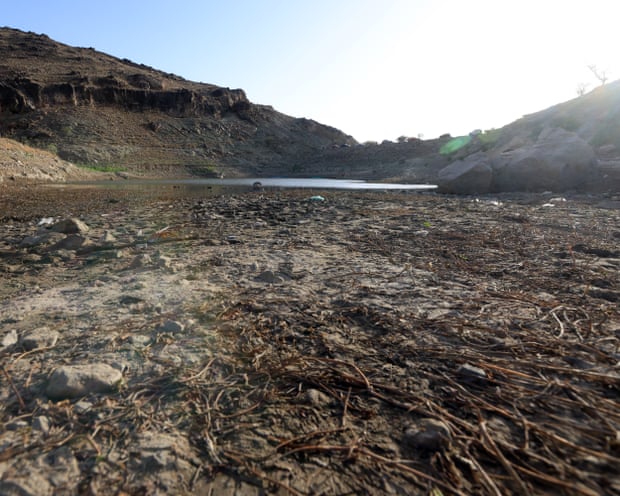
Rising temperatures will increase the risk of extreme droughts like the one currently affecting Yemen. Photograph: Yahya Arhab/EPA
Data also shows small but ‘shocking’ likelihood of year 2C hotter than preindustrial era before 2030
There is an 80% chance that global temperatures will break at least one annual heat record in the next five years, raising the risk of extreme droughts, floods and forest fires, a new report by the World Meteorological Organization (WMO) has shown.
For the first time, the data also indicated a small likelihood that before 2030, the world could experience a year that is 2C hotter than the preindustrial era, a possibility scientists described as “shocking”.
Coming after the hottest 10 years ever measured, the latest medium-term global climate update highlights the growing threat to human health, national economies and natural landscapes unless people stop burning oil, gas, coal and trees.
The update, which synthesises short-term weather observations and long-term climate projections, said there was a 70% chance that five-year average warming for 2025-2029 will be more than 1.5C above preindustrial levels.
…
The Met Office’s Leon Hermanson, who led the production of the report, said 2025 is likely to be one of the three warmest years on record.
Chris Hewitt, director of climate services at the WMO, described a “worrying picture” for heatwaves and human health. However, he said it was still not too late to limit warming if fossil fuel emissions are cut.
Orcas comment on killer apes destroying the planet by continuing to burn fossil fuels.Neo-Fascist Climate Science Denier Donald Trump says Burn, Baby, Burn.Elon Musk urges you to be a Fascist like him, says that you can ignore facts and reality then.
He is calling for the scrapping of the two-child benefit cap and restoring the winter fuel payment to all pensioner
Nigel Farage’s tax and spend plans were slammed as “fantasy economics” as Reform UK claimed it could save a massive £225 billion over five years by scrapping net zero projects.
Mr Farage’s party also wants the threshold for paying the basic rate of income tax to be dramatically increased from £12,570 to £20,000.
…
Reform sources said the £225 billion figure of savings from ditching net zero projects was based on a report by the Institute for Government.
But the IfG stressed that the bulk of this green investment, highlighted in the paper called “Paying for Net Zero” was due to come from the private sector, not public funds.
Jill Rutter, senior fellow at the IfG, told The Standard: “Cancelling private investment does not save the Government money.”
…
Nigel Farage reminds you that he’s the man that brought you Brexit and asks what could possibly go wrong.Elon Musk urges you to be a Fascist like him, says that you can ignore facts and reality then.
Tesla sales across Europe plunged by half last month even as growth in the electric car market picked up pace
LONDON — Tesla sales across Europe plunged by half last month even as growth in the electric car market picked up pace, according to data released Tuesday.
The numbers are the latest indication of how much the Tesla brand is suffering because of the backlash against billionaire CEO Elon Musk over his far-right views.
Sales of Tesla vehicles in 32 European countries tumbled 49% to 7,261 in April from 14,228 in the same month the previous year, according to the figures released by the European Automobile Manufacturers’ Association, or ACEA.
At the same time, sales of battery-electric vehicles by all manufacturers rose about 28%. Meanwhile, sales of gasoline and diesel powered cars slumped.
Elon Musk urges you to be a Fascist like him, says that you can ignore facts and reality then.Neo-Fascist Climate Science Denier Donald Trump says Burn, Baby, Burn.
The 2015 Paris agreement committed countries to keeping the global temperature increase “well below 2°C”, which is widely interpreted as an average of 1.5°C over a 30-year period. The Paris agreement has not yet failed, but recent high temperatures show how close the Earth is to crossing this critical threshold.
Climate scientists have, using computer simulations, modelled pathways for halting climate change at internationally agreed limits. However, in recent years, many of the pathways that have been published involve exceeding 1.5°C for a few decades and removing enough greenhouse gas from the atmosphere to return Earth’s average temperature below the threshold again. Scientists call this “a temporary overshoot”.
If human activities were to raise the global average temperature 1.6°C above the pre-industrial average, for example, then CO₂ removal, using methods ranging from habitat restoration to mechanically capturing CO₂ from the air, would be required to return warming to below 1.5°C by 2100.
Get your news from actual experts, straight to your inbox.Sign up to our daily newsletter to receive all The Conversation UK’s latest coverage of news and research, from politics and business to the arts and sciences.
Do we really understand the consequences of “temporarily” overshooting 1.5°C? And would it even be possible to lower temperatures again?
Faith that a temporary overshoot will be safe and practicable has justified a deliberate strategy of delaying emission cuts in the short term, some scientists warn. The dangers posed by remaining above the 1.5°C limit for a period of time have received little attention by researchers like me, who study climate change.
To learn more, the UK government commissioned me and a team of 36 other scientists to examine the possible impacts.
How nature will be affected
We examined a “delayed action” scenario, in which greenhouse gas emissions remain similar for the next 15 years due to continued fossil fuel burning but then fall rapidly over a period of 20 years.
We projected that this would cause the rise in Earth’s temperature to peak at 1.9°C in 2060, before falling to 1.5°C in 2100 as greenhouse gases are removed from the atmosphere. We compared this scenario with a baseline scenario in which the global temperature does not exceed 1.5°C of warming this century.
Our Earth system model suggested that Arctic temperatures would be up to 4°C higher in 2060 compared to the baseline scenario. Arctic Sea ice loss would be much higher. Even after the global average temperature was returned to 1.5°C above pre-industrial levels, in 2100, the Arctic would remain around 1.5°C warmer compared to the baseline scenario. This suggests there are long-term and potentially irreversible consequences for the climate in overshooting 1.5°C.
As global warming approaches 2°C, warm-water corals, Arctic permafrost, Barents Sea ice and mountain glaciers could reach tipping points at which substantial and irreversible changes occur. Some scientists have concluded that the west Antarctic ice sheet may have already started melting irreversibly.
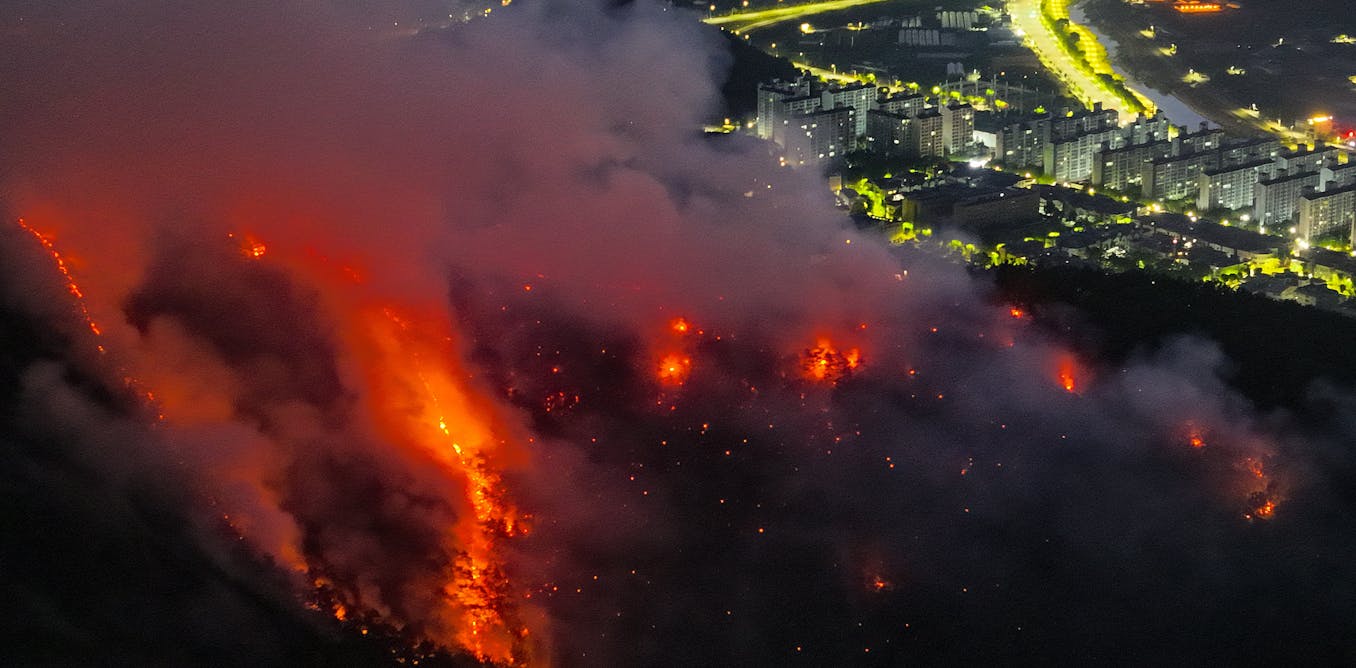
Our modelling showed that the risk of catastrophic wildfires is substantially higher during a temporary overshoot that culminates in 1.9°C of warming, particularly in regions already vulnerable to wildfires. Fires in California in early 2025 are an example of what is possible when the global temperature is higher.
Our analysis showed that the risk of species going extinct at 2°C of warming is double that at 1.5°C. Insects are most at risk because they are less able to move between regions in response to the changing climate than larger mammals and birds.
The impacts on society
Only armed conflict is considered by experts to have a greater impact on society than extreme weather. Forecasting how extreme weather will be affected by climate change is challenging. Scientists expect more intense storms, floods and droughts, but not necessarily in places that already regularly suffer these extremes.
In some places, moderate floods may reduce in size while larger, more extreme events occur more often and cause more damage. We are confident that the sea level would rise faster in a temporary overshoot scenario, and further increase the risk of flooding. We also expect more extreme floods and droughts, and for them to cause more damage to water and sanitation systems.
Floods and droughts will affect food production too. We found that impact studies have probably underestimated the crop damage that increases in extreme weather and water scarcity in key production areas during a temporary overshoot would cause.
We know that heatwaves become more frequent and intense as temperatures increase. More scarce food and water would increase the health risks of heat exposure beyond 1.5°C. It is particularly difficult to estimate the overall impact of overshooting this temperature limit when several impacts reinforce each other in this way.
In fact, most alarming of all is how uncertain much of our knowledge is.
For example, we have little confidence in estimates of how climate change will affect the economy. Some academics use models to predict how crops and other economic assets will be affected by climate change; others infer what will happen by projecting real-word economic losses to date into future warming scenarios. For 3°C of warming, estimates of the annual impact on GDP using models range from -5% to +3% each year, but up to -55% using the latter approach.
We have not managed to reconcile the differences between these methods. The highest estimates account for changes in extreme weather due to climate change, which are particularly difficult to determine.
We carried out an economic analysis using estimates of climate damage from both models and observed climate-related losses. We found that temporarily overshooting 1.5°C would reduce global GDP compared with not overshooting it, even if economic damages were lower than we expect. The economic consequences for the global economy could be profound.
So, what can we say for certain? First, that temporarily overshooting 1.5°C would be more costly to society and to the natural world than not overshooting it. Second, our projections are relatively conservative. It is likely that impacts would be worse, and possibly much worse, than we estimate.
Fundamentally, every increment of global temperature rise will worsen impacts on us and the rest of the natural world. We should aim to minimise global warming as much as possible, rather than focus on a particular target.
Orcas comment on killer apes destroying the planet by continuing to burn fossil fuels.Neo-Fascist Climate Science Denier Donald Trump says Burn, Baby, Burn.Elon Musk urges you to be a Fascist like him, says that you can ignore facts and reality then.
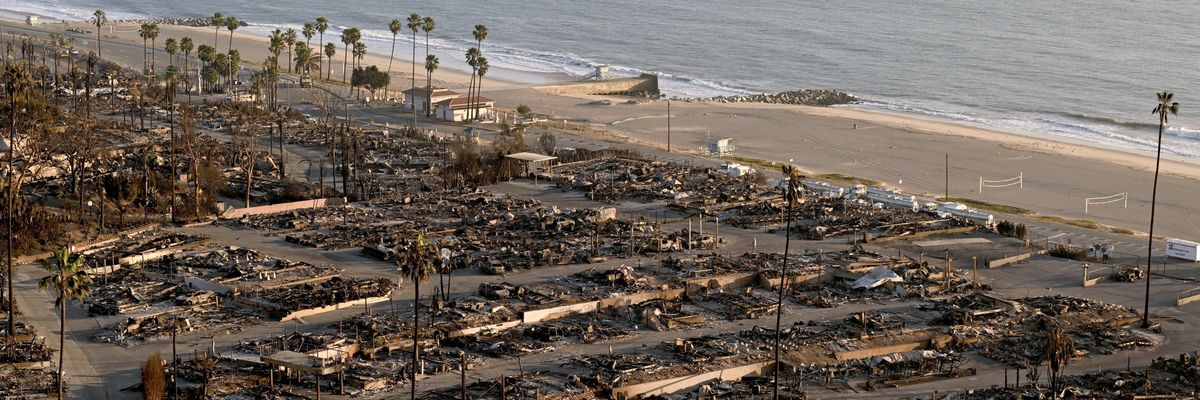
Damaged structures and homes are seen after the Palisades fire in the Pacific Palisades neighborhood of Los Angeles on January 11, 2025. (Photo: Axelle/Bauer-Griffin/GC Images)
“Their philosophy is, if we ignore it, it’s not a problem,” said one meteorologist.
On the heels of the news that higher-than-average temperatures continued globally in April, one of the United States’ top science agencies announced Thursday that it will no longer update a database that tracks climate disasters that cause billions of dollars in damage.
As of Thursday, the Billion Dollar Weather and Climate Disasters database on the National Oceanic and Atmospheric Administration’s (NOAA) website was replaced with a message saying there have been no such events in 2025 through April 8.
That flies in the face of an analysis by the National Centers for Environmental Information, which has maintained the database and said before it was taken down that six to eight billion-dollar climate disasters have happened so far this year, including the wildfires that devastated parts of Los Angeles in January and caused an estimated $150 billion in damage.
The World Weather Attribution said in late January that planetary heating, fueled by greenhouse gas emissions, caused weather conditions in Southern California that made the fires 35% more likely.
Hundreds of people have been laid off from NOAA in recent weeks as the so-called Department of Government Efficiency, led by billionaire tech CEO Elon Musk, has pushed to slash government spending, and those who have lost their jobs include scientists who helped maintain the database.
NOAA spokesperson Kim Doster told The Washington Post that in addition to staff changes, “evolving priorities” were also partially behind the retiring of the database, which will now show disasters that occurred only between 1980-2024.
Between 2020-24, the number of billion-dollar disasters averaged 23 per year, compared to just a few per year in the 1980s.
“This Trump administration move is the dumbest magic trick possible: covering their eyes and pretending the problem will go away if they just stop counting the costs. Households across the country already have to count these costs at their kitchen table as they budget for higher insurance costs and home repairs. Families and retirees dipping into their savings or going bankrupt to recover from wildfires and hurricanes know what disasters cost,” said Carly Fabian, senior insurance policy advocate with Public Citizen’s Climate Program. “Hiding the national tallies will only undermine our ability to prepare and respond to the climate crisis. Deleting the data will exacerbate the devastating delays in acting to slow climate change, and the impacts it is having on property insurance and housing costs.”
NOAA’s “evolving priorities” have also included decommissioning other datasets, including one tracking marine environments and one tracking ocean currents.
Without NOAA’s Billion Dollar Weather and Climate Disasters database, Jeremy Porter, co-founder of the climate risk financial modeling firm First Street, told CNN that “replicating or extending damage trend analyses, especially at regional scales or across hazard types, is nearly impossible without significant funding or institutional access to commercial catastrophe models.”
“What makes this resource uniquely valuable is not just its standardized methodology across decades, but the fact that it draws from proprietary and nonpublic data sources (such as reinsurance loss estimates, localized government reports, and private claims databases) that are otherwise inaccessible to most researchers,” he said.
Chris Gloninger, a meteorologist who resigned from an Iowa news station after receiving threats for his frank, science-based coverage of climate disasters, said the retiring of the database suggests the Trump administration is “okay with spending billions of dollars on disasters.”
Billion dollar disasters are a way to track how our weather is turning more extreme because of #climatechange
— Chris Gloninger, CCM, CBM (@ChrisGloninger) May 8, 2025
“Every dollar that we spend on mitigation or adaptation saves $13 in recovery costs,” said Gloninger. “But their philosophy is, if we ignore it, it’s not a problem.”
Elon Musk urges you to be a Fascist like him, says that you can ignore facts and reality then.Neo-Fascist Climate Science Denier Donald Trump says Burn, Baby, Burn.Orcas discuss how Trump was re-elected and him being an insane, xenophobic Fascist.