Reform UK deputy leader Richard Tice at the count for the Hamilton, Larkhall and Stonehouse by-election at the South Lanarkshire Council headquarters in Hamilton, June 5, 2025
MULTIMILLIONAIRE Reform UK MP Richard Tice’s attack on public-sector pensions exposes the party’s anti-working class character.
The claim that “gold-plated” pensions for public servants such as health and education workers are an impossible burden on the taxpayer is classic divide-and-rule propaganda.
Tice wants an end to defined benefit pension schemes, which provide a predictable income in retirement. But the scandal is not that these schemes still exist in the public sector but that they have been steadily withdrawn across the private sector.
Pensions are deferred wages and attacks on retirement income form part of the decades-long assault on working-class living standards, with wages accounting for a shrinking share of GDP since the 1970s while the share taken in profits and rents has risen.
Britain is not broke: rather we are living through what the Sunday Times Rich List has called a “golden age of the super rich.” British billionaires increased their wealth by £35 million every single day last year; banks and energy companies post record-breaking profits year on year.
Nigel Farage explains the politics of Reform UK: Racism, Fake anti-establishmentism, Deregulation, Corporatism, Climate Change Denial, Mysogyny and Transphobia.Elon Musk urges you to be a Fascist like him, says that you can ignore facts and reality then.
VOTERS want the wealthiest to be taxed more to protect public services, according to a new TUC poll published today.
The union body survey found that nearly two thirds of Britons agree with increasing taxes for higher brackets to avoid cuts to public services.
Looking to Chancellor Rachel Reeves’s Spending Review this Wednesday, the TUC called for tax rises for the wealthy and businesses.
TUC general secretary Paul Nowak said: “The spending review can be the next key step in the government’s plan to rebuild Britain and deliver industrial renewal.
“Communities are still crying out for meaningful change after more than a decade of Tory austerity and neglect.
“The global outlook is challenging, but leaving our decimated public services without sufficient investment would risk both future growth and public trust.
“The message from voters is clear. They want the government to protect and rebuild our public services.”
The online game is targeted at pupils as young as seven
Equinor, the company looking to develop the Rosebank oil field in the North Sea, has funded a computer game aimed at UK school children, promoting the idea that fossil fuels are part of a green energy mix.
In an unusually frank admission of lobbying children, a web page promoting the game stated that it “aligns with our work to build future talent pipelines and secure permission to operate at a time of sensitivity around fossil fuels, particularly in light of . . . the Rosebank development”. The story was first revealed by the Norwegian news publication E24.
Rosebank – the UK’s largest untapped oilfield – was greenlit by the Conservative government in 2023, prompting condemnation from climate campaigners. That decision was ruled unlawful by the courts in January this year because it had not taken into account the carbon emissions created by burning any oil and gas produced. Equinor, Norway’s state energy company, continues preparation work on the site under its joint venture with Shell. [*1]
The game lets players choose between renewable energy or fossil fuels to power their city.
Marketing agency We Are Futures, which describes itself as “the go-to partner for building advocacy for brands amongst young people”, developed Equinor’s schools-based, curriculum-linked education programme, Wonderverse. It also received support from the Association for Science Education (ASE), a UK membership organisation for science teachers and technicians.
The game was promoted on ASE’s School Science website, which also stated: “With over two-thirds of teens believing the oil and gas industry causes more problems than it solves, Wonderverse helps lay misconceptions to rest by exploring some of the challenges involved in a just energy transition.”
The ASE web page, which has been taken down since the story first broke, said the programme, aimed at 7–14 year olds, is “designed to spark wonder for science and the future of energy”. It includes a game, in which players attempt to build a city that survives until the year 2050, and in-school education materials to “showcase how modern cities use energy resources and the ways the energy transition can be managed”.
While players are encouraged to invest in research into renewable energy, TBIJ successfully ran a city powered by oil and some renewables until 2050. Meanwhile, scientists say there must be huge declines in the use of coal, oil and gas to reach net zero emissions by 2050 and avoid further catastrophic climate change.
Screenshot from Game Over screen of Energy Town
Charlotte Howell, who leads the climate campaign group Parents for Future, was shocked that Equinor was behind an energy-themed game aimed at UK schoolchildren. She told E24: “We want to know how this can be allowed. I’m horrified that Equinor, as a partly state-owned company, is working against UK ambitions on climate. They are lobbying directly against our children.”
Tessa Khan, executive director at climate campaign group Uplift, said it was “morally indefensible” to pretend that the UK needed Rosebank for energy security when in reality it would accelerate the climate crisis.
Khan told TBIJ: “It’s one thing for Equinor to mislead the public about the benefits of new oil fields like Rosebank, but it is quite another to target children with blatant fossil fuel propaganda disguised as ‘education’. This so-called ‘computer game’ is not about learning – it’s about teaching the next generation to see oil and gas as inevitable, when the climate science could not be clearer that we need to leave new fossil fuels in the ground.”
Equinor told TBIJ it was not aware of the promotional material associated with the game until notified by media, and denied that rolling out the school game is part of a lobbying campaign to promote developing Rosebank.
A spokesperson said: “The overall intention and aim for Wonderverse and Energy Town is to provide schools and teachers with a suite of high-quality resources to help students learn more about where energy comes from, whilst building … the employability skills needed to successfully enter employment. The learning resources have been awarded a green tick by the Association for Science Education, assuring the programme’s quality for use in schools.” They also said the game was developed using data from the International Energy Agency.
ASE’s School Science website provides free online science resources for teachers and students. The site was sponsored by partners including ExxonMobil, which ASE describes as “the world’s leading nongovernmental energy company aiming to meet world energy demand in an economically, environmentally and socially responsible manner”. ExxonMobil is the world’s third most polluting company, according to Carbon Majors, a database of historical fossil fuel production data.
A spokesperson for ASE said the promotional text was provided via briefing materials from We Are Futures. They said the School Science website was no longer actively maintained and will be decommissioned, and that ExxonMobil is no longer a partner of ASE.
We Are Futures, which also works for the UK government and BP, did not respond to a request for comment.
After the court ruling in January, Equinor is set to reapply to the UK government for approval to develop Rosebank. This time it must include information about the emissions that will be produced by burning the oil extracted from Rosebank. According to Uplift, those emissions could be more than the combined annual CO2 emissions of all 28 lowest-income countries in the world, including Uganda, Ethiopia, and Mozambique. Equinor is reportedly “confident” that the project will go ahead and expects it to start up in 2026 or 2027.
Khan said: “If Equinor is serious about supporting the next generation, it should start by walking away from Rosebank and using its power and influence to focus solely on renewable energy. That’s the only way to really protect our children’s future.”
Reporter: Josephine Moulds Environment editor: Rob Soutar Deputy editor: Chrissie Giles Editor: Franz Wild Fact checker: Frankie Goodway Production editor: Sasha Baker
TBIJ has a number of funders, a full list of which can be found here. None of our funders have any influence over editorial decisions or output.
*1 by dizzy. Equinor is attempting to develop the Rosebank oil field in partnership with Ithaca Energy, not Shell.
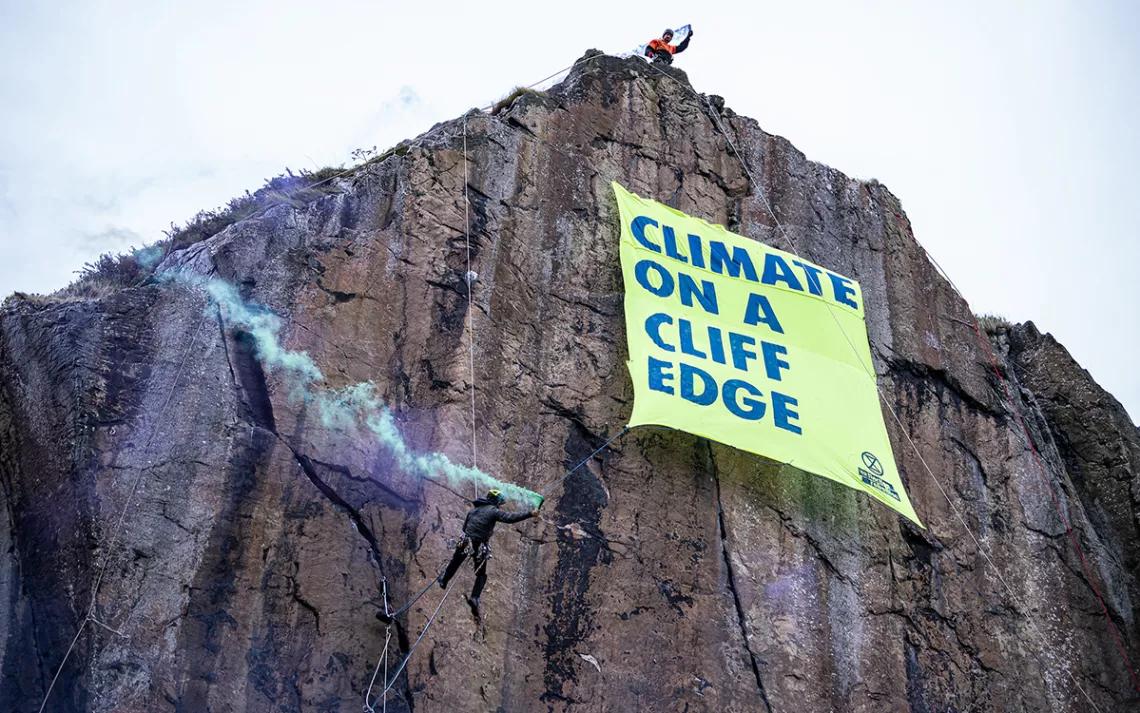
Campaigners take part in a Stop Rosebank emergency protest outside the U.K. Government building in Edinburgh, after the controversial Equinor Rosebank North Sea oil field was given the go-ahead Wednesday, September 27, 2023. (Photo: Jane Barlow/PA Images via Getty Images)Experienced climbers scale a rock face near the historic Dumbarton castle in Glasgow, releasing a banner that reads “Climate on a Cliff Edge.” One activist, dressed as a globe, symbolically looms near the edge, while another plays the bagpipes on the shores below. | Photo courtesy of Extinction Rebellion and Mark RichardsGreenpeace activists display a billboard during a protest outside Shell headquarters on July 27, 2023 in London. (Photo: Handout/Chris J. Ratcliffe for Greenpeace via Getty Images)
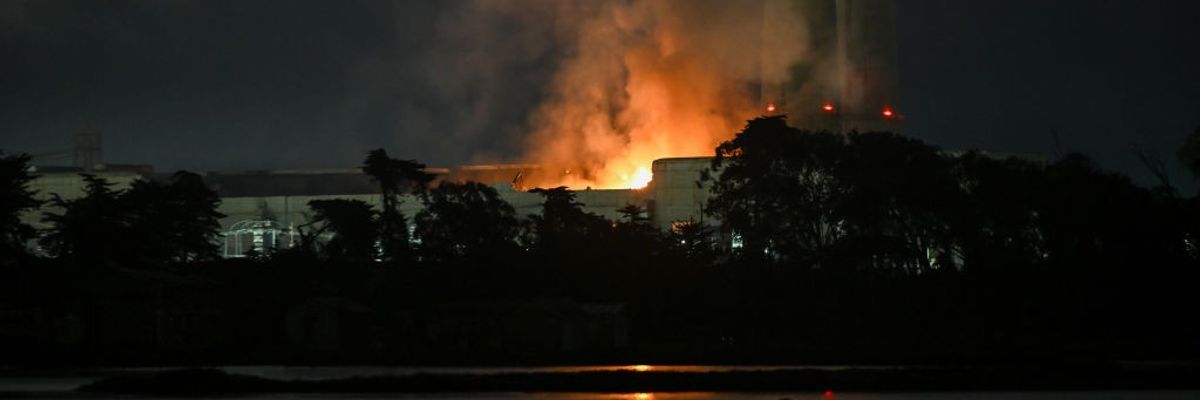
A view of flames and giant smoke is seen over the sky as a fire erupted at the natural gas Moss Landing Power Plant in Moss Landing of Monterey Bay, California, United States on January 17, 2025. (Photo: Tayfun Coskun/Anadolu via Getty Images)
Scientists said that atmospheric carbon dioxide concentrations peaked above 430 parts per million for the first time in perhaps 30 million years.
The concentration of carbon dioxide in the atmosphere peaked above 430 parts per million in 2025—the highest it has been in millions of years—according to data released by the National Oceanic and Atmospheric Administration and Scripps Institution of Oceanography at the University of California, San Diego on Thursday.
The news was overshadowed by the explosive feud between U.S. President Donald Trump and his erstwhile backer Elon Musk, but climate activist Bill McKibben argued that it was ultimately more consequential.
“In the long run, this is actually going to be the important news of the day—CO2 in the atmosphere passes another grim milestone,” McKibben wrote on social media.
In the long run, this is actually going to be the important news of the day–co2 in the atmosphere passes another grim milestone
Carbon dioxide has been accumulating in the atmosphere due primarily to the human burning of fossil fuels, as well as by the clearing of forests and other natural carbon sinks. There, it acts as a greenhouse gas, trapping heat from the Earth, and is the primary gas responsible for the rise of global temperatures by approximately 1.1°C from the 1850 -1900 average. This warming has already had a host of dramatic impacts, from extreme weather events to sea-level rise to polar ice melt, and scientists warn these impacts will only accelerate under current energy policies, which put the world on track for around 3°C of warming by 2100.
The last time that atmospheric CO2 concentrations topped 430 ppm was most likely more than 30 million years ago, Ralph Keeling, who directs the Scripps CO2 Program, told NBC News.
“It’s changing so fast,” he said. “If humans had evolved in such a high-CO2 world, there would probably be places where we wouldn’t be living now. We probably could have adapted to such a world, but we built our society and a civilization around yesterday’s climate.”
“While largely symbolic, passing 430 ppm should be a wake-up call.”
Scripps and National Oceanic and Atmospheric Administration both measure carbon dioxide levels from NOAA’s Mauna Loa Observatory in Hawaii, where Charles Keeling began taking measurements in 1958. As CO2 levels rise over time, they also follow a seasonal cycle—peaking in May before falling in the Northern Hemisphere summer and rising again in the fall.
This May, Scripps Oceanography calculated an average of 430.2 ppm for 2025, which is 3.5 ppm over the average for May 2024. NOAA’s Global Monitoring Laboratory, meanwhile, calculated a monthly average of 430.5 ppm, a 3.6 ppm jump from the year before and the second-steepest yearly climb since 1958.
“Another year, another record,” Keeling said in a statement. “It’s sad.”
JUST IN: Atmospheric carbon dioxide (CO2) concentrations have peaked for the year at 430.5 ppm.📈 This is 3.6 ppm higher than last year and the second largest May-May increase in the 67-year Mauna Loa record. In 2023, the CO2 peaked at 424 ppm. 🔗: https://t.co/adhNurvOtEpic.twitter.com/t1VUSCeKgU
The news comes two months after Mauna Loa daily measurements surpassed 430 ppm for the first time in March, which Plymouth Marine Laboratory professor Helen Findlay called “extremely disappointing and worrying.”
“While largely symbolic, passing 430 ppm should be a wake-up call, especially given the accelerated response we are seeing of glaciers and ice sheets to current warming,” Dr. James Kirkham, chief scientist of the Ambition on Melting Ice coalition of governments, said at the time.
“This upward trajectory is a direct result of continued fossil fuel use, likely exacerbated by emissions from extreme wildfires last year, methane leaks from fossil fuel extraction and possibly greater permafrost emissions, alongside decreased ability of very warm oceans to absorb CO2,” Kirkham said.
The monthly record also comes a little more than a week after a United Nations report warned that there was a small chance global temperatures could surpass 2°C in at least 1 of the next 5 years, only a decade after world leaders pledged in the Paris agreement to keep global temperatures “well-below” that level.
“Carbon emissions are still rising, and the atmosphere is going to keep heating further until greenhouse gas concentrations stabilize,” Matt Kean, who chairs Australia’s Climate Change Authority, wrote in response to the Scripps and NOAA figures. “What sort of climate do we want to leave our children and those who come after them?”
Orcas discuss Donald Trump and the killer apes’ concept of democracy. Front Orca warns that Trump is crashing his country’s economy and that everything he does he does for the fantastically wealthy.Neo-Fascist Climate Science Denier Donald Trump says Burn, Baby, Burn.Elon Musk urges you to be a Fascist like him, says that you can ignore facts and reality then.
A conceptual rendering of the proposed AI datacentre. Image: Northumberland County Council
Does he think we’re stupid?
When Keir Starmer announced the creation of a £10 billion AI datacentre at Blyth in Northumberland last year, it was with a promise that the site would bring 4,000 jobs to the north-east of England.
For an ex-mining town, once home to two coal power stations, this was welcome news. The area had been let down once before: the new “artificial intelligence datacentre” will open on a site once destined to host Britishvolt, the startup planning to employ 3,000 people making batteries for electric vehicles that collapsed spectacularly in 2023.
However, it has since emerged that the true figure for job creation is closer to just 300 to 400 permanent staff, a tenth of what Starmer promised. Other media outlets have noted the yawning gap between Starmer’s hype and the disappointing reality. But the apparent willingness of the government to launder dodgy figures provided by the PR machine of a rapacious private equity firm has not been scrutinised – until now.
When asked in January by Labour MP Chi Onwurah what the evidential basis for the 4,000 claim was in a parliamentary question, Chris Bryant, a minister in the culture and science department, said that it had been supplied by Northumberland County Council.
However, in a freedom of information request seen by Novara Media sent by Foxglove, a legal campaign group monitoring big tech, the council revealed that that source was in fact Blackstone, the vampiric US private equity giant behind the data centre’s construction. The 4,000 figure came from Blackstone’s “evidence of the anticipated job creation numbers” put forward in the planning application.
Martha Dark, Foxglove’s co-executive director, said that Starmer had either “willingly promoted US Blackstone-owned developer QTS’s PR spiel on jobs, in effect laundering the dubious credibility of the claim through association with his office – or he didn’t know the claim came from them.

 Reform UK deputy leader Richard Tice at the count for the Hamilton, Larkhall and Stonehouse by-election at the South Lanarkshire Council headquarters in Hamilton, June 5, 2025


 The game lets players choose between renewable energy or fossil fuels to power their city.
 Screenshot from Game Over screen of Energy Town