NSW, Queensland and Tasmania experienced hottest winters with spring likely to deliver hotter than average temperatures too
Image of a kangaroo.
Australia’s winter of 2023 was the warmest since official records began in 1910, with average daily temperatures 1.53C above the long-term average.
According to data from the Bureau of Meteorology released on Friday, the 2023 winter beat the previous record of 1.46C above the average set in 1996. Every winter since 2012 has been warmer than the 30-year average calculated from 1961 to 1990.
Global heating and weather conditions that delivered sunny days were behind the record, scientists said.
…
Dr Andrew King, a climate scientist at the University of Melbourne, said the winter warmth was “pretty consistent with the trend towards warming that we have already seen and expect to continue as we keep emitting greenhouse gases”.
King said the high-pressure systems that brought the extra warmth were “part of the story”, adding “we would not get the temperatures that we have seen this winter really happening without human-caused climate change”.
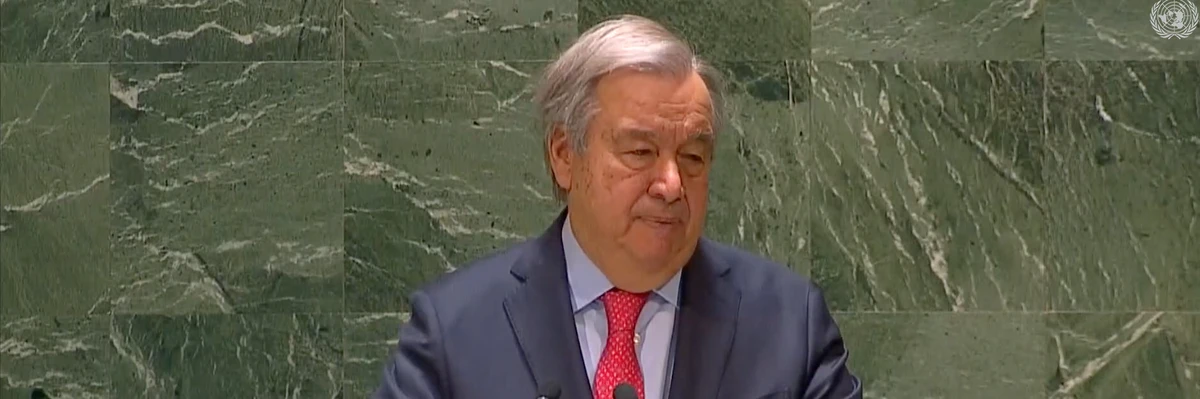
United Nations Secretary-General António Guterres speaks at a meeting of the United Nations General Assembly in New York City on February 6, 2023. (Photo: United Nations)
Original article by Kenny Stancil republished from Common Dreams under Creative Commons (CC BY-NC-ND 3.0). Feel free to republish and share widely.
“No more baby steps. No more excuses. No more greenwashing,” said U.N. Secretary-General António Guterres. “No more bottomless greed of the fossil fuel industry and its enablers.”
United Nations Secretary-General António Guterres made clear Monday that securing a livable planet depends on stopping the “bottomless greed of the fossil fuel industry and its enablers.”
In a speech to the General Assembly, Guterres called for an end to “the merciless, relentless, senseless war on nature” that “is putting our world at immediate risk of hurtling past the 1.5°C temperature increase limit and now still moving towards a deadly 2.8°C.”
2023 must be “a year of reckoning,” the U.N. chief said as he outlined his priorities for the months ahead. “It must be a year of game-changing climate action. We need disruption to end the destruction. No more baby steps. No more excuses. No more greenwashing.”
Scientists have warned repeatedly that scaling up the extraction and burning of coal, oil, and gas is incompatible with averting the most catastrophic consequences of the climate emergency. Nevertheless, hundreds of corporations—bolstered by trillions of dollars in annual public subsidies—are still planning to ramp up planet-heating pollution in the years ahead, prioritizing profits over the lives of those who will be harmed by the ensuing chaos.
“I have a special message for fossil fuel producers and their enablers scrambling to expand production and raking in monster profits: If you cannot set a credible course for net-zero, with 2025 and 2030 targets covering all your operations, you should not be in business,” said Guterres. “Your core product is our core problem.”
“We need a renewables revolution, not a self-destructive fossil fuel resurgence,” he added.
In order to halve global greenhouse gas emissions this decade, the U.N. chief said, the world needs “far more ambitious action to cut carbon pollution by speeding up the shift from fossil fuels to renewable energy—especially in G20 countries—and de-carbonizing highest emitting industrial sectors—steel, cement, shipping, and aviation.”
In addition, he continued, the world needs “a Climate Solidarity Pact in which all big emitters make an extra effort to cut emissions, and wealthier countries mobilize financial and technical resources to support emerging economies in a common effort to keep 1.5°C alive.”
“We need a renewables revolution, not a self-destructive fossil fuel resurgence.”
“Climate action is impossible without adequate finance,” Guterres noted. “Developed countries know what they must do: At minimum, deliver on commitments made at the latest COP. Make good on the $100 billion promise to developing countries. Finish the job and deliver on the Loss and Damage Fund agreed in Sharm El-Sheikh. Double adaptation funding. Replenish the Green Climate Fund by COP28. Advance plans for early warning systems to protect every person on earth within five years. And stop subsidizing fossil fuels and pivot investments to renewables.”
Like the 26 annual U.N. climate meetings that preceded it, COP27 ended last November with no commitment to a swift and just global phase-out of coal, oil, and gas.
In an effort to avoid a repeat performance at COP28 in the United Arab Emirates this December, Guterres intends to convene a “Climate Ambition Summit” in September.
“The invitation is open to any leader—in government, business, or civil society,” Guterres said Monday. “But it comes with a condition: Show us accelerated action in this decade and renewed ambitious net-zero plans—or please don’t show up.”
“COP28 in December will set the stage for the first-ever Global Stocktake—a collective moment of truth—to assess where we are, and where we need to go in the next five years to reach the Paris goals,” he continued.
Guterres added that “humanity is taking a sledgehammer to our world’s rich biodiversity—with brutal and even irreversible consequences for people and planet. Our ocean is choked by pollution, plastics, and chemicals. And vampiric overconsumption is draining the lifeblood of our planet—water.”
In 2023, the world “must also bring the Global Biodiversity Framework to life and establish a clear pathway to mobilize sufficient resources,” said the U.N. chief. “And governments must develop concrete plans to repurpose subsidies that are harming nature into incentives for conservation and sustainability.”
“Climate action is the 21st century’s greatest opportunity to drive forward all the Sustainable Development Goals,” Guterres stressed. “A clean, healthy, and sustainable environment is a right we must make real for all.”
Guterres’ speech was not limited to the climate and biodiversity crises. He also emphasized the need for a “course correction” on devastating wars and raging inequality, calling for a new global economic architecture that foregrounds the needs of the poor instead of allowing the richest 1% to capture nearly half of all newly created wealth.
“This is not a time for tinkering,” said the U.N. chief. “It is a time for transformation.”
Original article by Kenny Stancil republished from Common Dreams under Creative Commons (CC BY-NC-ND 3.0). Feel free to republish and share widely.
Major energy firms including BP BP.L, Chevron CVX.N and Saudi Aramco 2222.SE are among the 1,500 business leaders gathering for the annual meeting in the Swiss resort of Davos, where global threats including climate change are on the agenda.
“We are demanding concrete and real climate action,” said Nicolas Siegrist, the 26-year-old organiser of the protest who also heads the Young Socialists party in Switzerland.
The annual meeting of global business and political leaders opens in Davos on Monday.
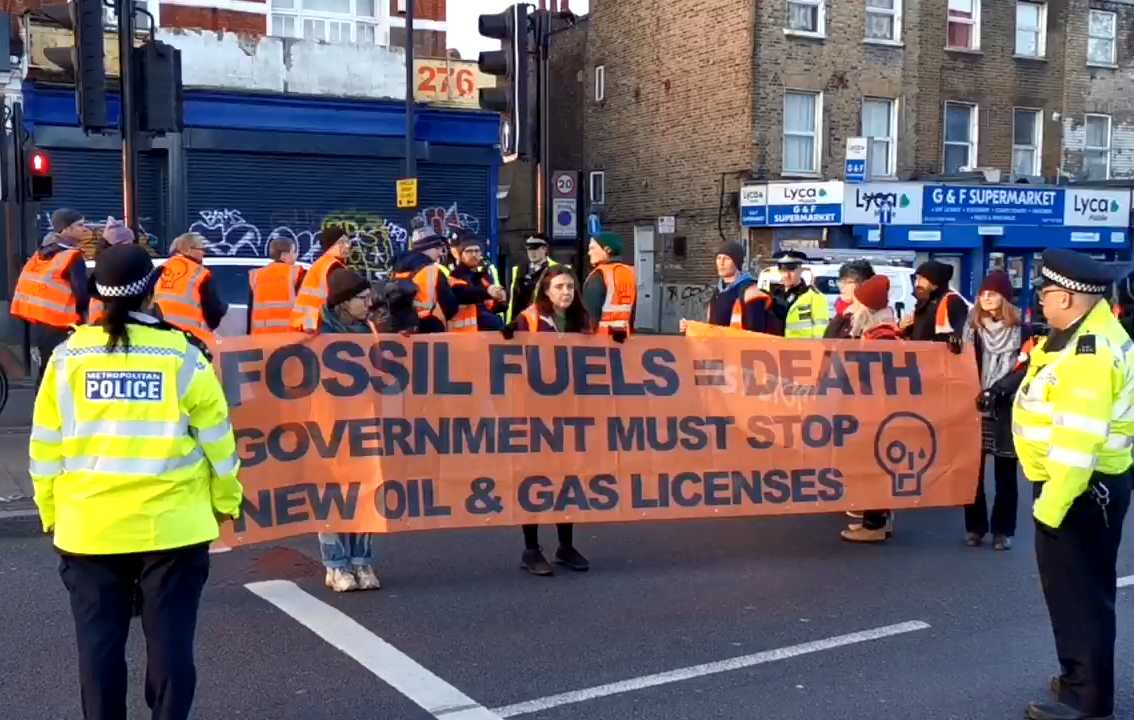
“It’s 2023 and XR has quit,” Just Stop Oil said in a statement. “But it’s 2023, and we are barrelling down the highway to the loss of ordered civil society, as extreme weather impacts tens of millions, as our country becomes unrecognisable … there is now a need to face reality.
“We must move from disobedience into civil resistance – this is what the nurses and paramedics are doing. They are on the frontline of the harm being wreaked on us and have said no more.”
Insulate Britain said its supporters remained prepared to go to prison. “Insulate Britain supporters remain committed to civil resistance as the only appropriate and effective response to the reality of our situation in 2023,” its statement said.
Next year is forecast to be one of the hottest on record with global average temperatures forecast to be about 1.2C above what they were before humans started to drive climate change, the UK Met Office predicts.
If correct, it would be the 10th year in a row to see global average temperatures reach at least 1C above what they were in pre-industrial times, measured as the period 1850-1900.
The current hottest year in records dating back to 1850 is 2016, a year that saw an ‘El Niño’ climate pattern in the Pacific which pushes up global temperatures on top of global warming trends.