Britain likely to generate more electricity from wind, solar and hydro than fossil fuels for the first year ever in 2023
Spread the love
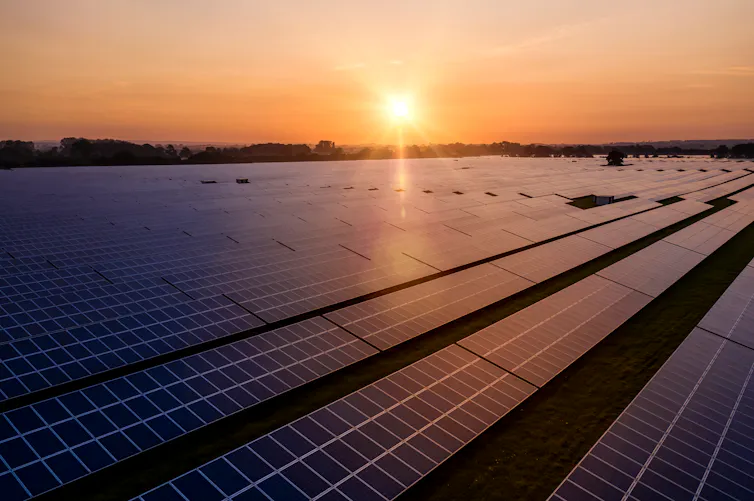
Solar now provides about 5% of Britain’s electricity.
StudioFI / shutterstock

Grant Wilson, University of Birmingham; Joseph Day, University of Birmingham, and Katarina Pegg

There are many milestones to pass in the transition from a high to low-carbon sustainable energy system. There is the first hour without coal, or oil, or gas generation (or all of them together) and the point when the last coal, oil or gas power plant (or all of them together) are finally retired.

Another milestone that feels important is the first year when renewables generate more electricity than fossil fuels. For the past three months we have been tracking the data for Great Britain (not Northern Ireland, which shares an electricity grid with the Republic of Ireland) and we believe it is on track to pass this milestone in 2023, but it will be very close.

Using the broadest definition, renewables actually first overtook fossil fuels in the odd, COVID-affected year of 2020 (although not in the subsequent years of 2021 and 2022). However, that includes 5% or so of Britain’s electricity that is generated through “biomass” plants (which burn wood pellets, often imported from forests in America).

Trees can of course be regrown, so biomass counts as renewable. But the industry has its critics and it’s not globally scalable in the same way as the “weather-dependent” renewables: wind, solar and to a certain degree hydro power.

When we use this narrower, weather-dependent definition that is more appropriate for a global transition, then there is a very good chance these renewables will overtake fossil fuels for the first time ever in 2023. Once this milestone has been passed, we also think it is unlikely (though not impossible) that gas and coal will ever again generate more of Britain’s electricity than wind, solar and hydro over a full year.

Whether Britain passes the milestone in 2023 will come down to the final few days of the year (from here on we’ll use “renewables” to refer to the tighter, biomass-excluding definition).

The chart above can be used to track progress and will update with the latest data each day. The lines show the running total of the difference between how much electricity has been generated by renewables and fossil fuels.

When the line is increasing, this shows more renewables than fossil fuels for that period. The horizontal axis shows the day of the year, so, if at any point the line is above the zero axis, that indicates that the year so far has had more renewable than fossil fuel generation. If the red line ends the year above zero, then Britain will have achieved the milestone.

(One caveat is that we know from the official statistics published later that there are some differences from “missing” and estimates for embedded generation; this typically only accounts for around 1%-2% of the final total.)

It depends on the weather

As we write this, with ten days of data left in 2023, renewables are very slightly ahead (by just over 1000 GWh – about the same level as a peak day of electrical demand). However if they are to stay ahead it will depend on the weather – especially the wind.

The reasoning here is that Britain uses less electricity over the holiday period due to less industrial and commercial demand. As wind power is clean and has become cheaper, it tends to be used first, meaning when demand is low or it is sufficiently windy there is less need to generate electricity with fossil fuels.

There are nuances around this such as where the generation is located, and the amount of electricity imported from other countries, but the general principle of renewables taking market share away from fossil fuels is a factor of Britain’s electrical market.

An important area to also highlight is the continued drop in electrical demand. 2023 is on track to have a lower demand than 2022, which itself was lower than the COVID-impacted year of 2020 (against our predictions) due to record prices. The drop in electrical demand means that additional generation was not needed, much of it inevitably from fossil fuels.

Additional milestone also likely to be passed

However 2023 could be the first year where renewable generation exceeds domestic electricity demand (homes comprise 36% of total electrical demand). This means the annual electricity generated by Britain’s wind turbines, solar panels and hydro resource will now be greater than that consumed over the year by its 29 million households.

The above bar chart demonstrates the trend towards this point since 2009. In the first half of 2023, renewable output was less than domestic electrical demand by 1.5 TWh (1500 GWh), but strong renewable performance since then means it is likely to end the year with total generation in excess of household demand.

If either of the milestones described here do not happen for 2023, then they will almost certainly occur in 2024, during which another 1.7 GW of offshore wind capacity will begin generating and Britain’s last coal-fired power station is scheduled to cease producing electricity altogether.The Conversation

Grant Wilson, Associate Professor, Energy Systems and Data Group, Birmingham Energy Institute, University of Birmingham; Joseph Day, Postdoctoral Research Assistant, Energy Systems and Data Group, University of Birmingham, and Katarina Pegg, PhD Student, Energy Systems and Data Group, University of Birmingham

This article is republished from The Conversation under a Creative Commons license. Read the original article.
Continue ReadingBritain likely to generate more electricity from wind, solar and hydro than fossil fuels for the first year ever in 2023

Fossil CO₂ emissions hit record high yet again in 2023

Spread the love

Pep Canadell, CSIRO; Corinne Le Quéré, University of East Anglia; Glen Peters, Center for International Climate and Environment Research – Oslo; Judith Hauck, Universität Bremen; Julia Pongratz, Ludwig Maximilian University of Munich; Philippe Ciais, Commissariat à l’énergie atomique et aux énergies alternatives (CEA); Pierre Friedlingstein, University of Exeter; Robbie Andrew, Center for International Climate and Environment Research – Oslo, and Rob Jackson, Stanford University

Global emissions of fossil carbon dioxide (CO₂), in yet another year of growth, will increase by 1.1% in 2023. These emissions will hit a record 36.8 billion tonnes. That’s the finding of the Global Carbon Project’s 18th annual report card on the state of the global carbon budget, which we released today.

Fossil CO₂ includes emissions from the combustion and use of fossil fuels (coal, oil and gas) and cement production. Adding CO₂ emissions and removals from land-use change, such as deforestation and reforestation, human activities are projected to emit 40.9 billion tonnes of CO₂ in 2023.

The world’s vegetation and oceans continue to remove about half of all CO₂ emissions. The rest builds up in the atmosphere and is causing increasing warming of the planet.

At current emission levels, the remaining carbon budget for a one-in-two chance to limit warming to 1.5°C will likely be exceeded in seven years, and in 15 years for 1.7°C. The need to cut emissions has never been so urgent.

Emissions from every fossil source are up

Fossil CO₂ emissions now account for about 90% of all CO₂ emissions from human activities. Emissions from every single fossil source increased this year compared to 2022:

  • coal (41% of global CO₂ emissions) up 1.1%
  • oil (32%) up 1.5%
  • natural gas (21%) up 0.5%
  • cement (4%) up 0.8%.
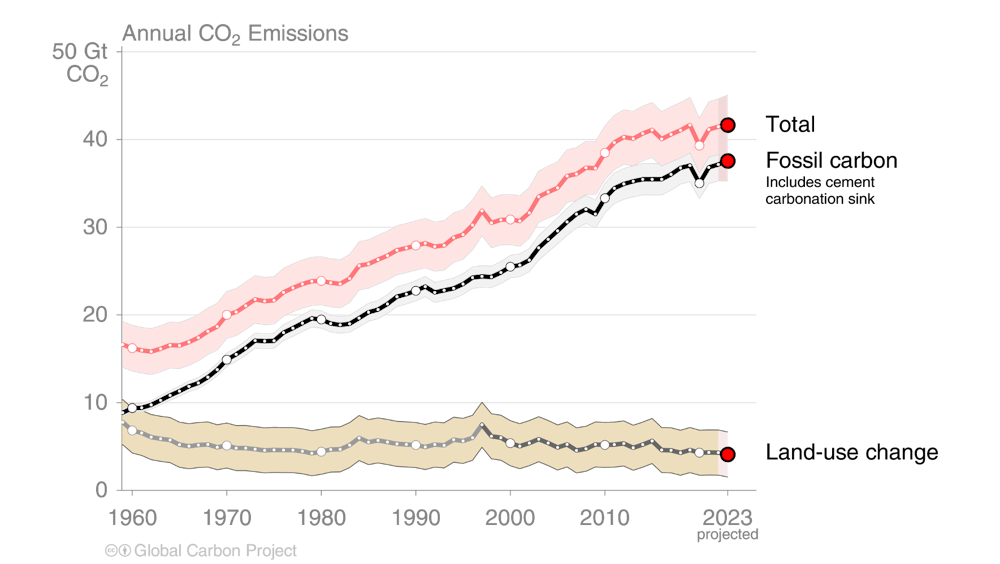
Line graph showing emissions from fossil fuels, land-use changes and total emissions from 1960 to 2023
All fossil fuel sources are driving the increase in total CO₂ emissions.
Global Carbon Budget 2023/Global Carbon Project, CC BY

Although global emissions have increased, the picture for individual countries is more diverse. There are some signs of progress towards decarbonisation.

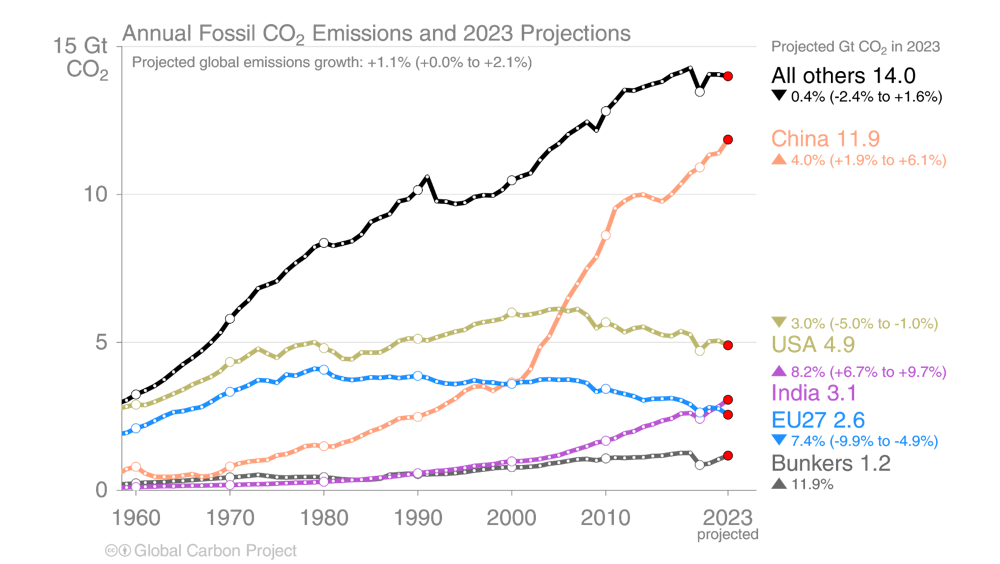
China’s emissions (31% of the global total) increased by 4% with growth in all fossil fuel sources. The highest relative growth was from oil emissions. This was in part due to the transport sector’s recovery after COVID-19 pandemic shutdowns.

The United States’ emissions (14% of global) are down by 3%. The rapid retirement of coal-fired power plants drove most of this decline. US coal emissions are the lowest since 1903.

India’s emissions (8% of global) increased by 8.2%. Emissions for all fossil fuels grew by 5% or more, with coal the highest at 9.5%. India is now the world’s third-largest fossil CO₂ emitter.

European Union emissions (7% of global) are down by 7.4%. This decline was due to both high renewable energy penetration and the impacts on energy supply of the war in Ukraine.

During the decade of 2013-2022, 26 countries had declining fossil CO₂ emission trends while their economies continued to grow. The list includes Brazil, France, Germany, Italy, Japan, Portugal, Romania, South African, United Kingdom and USA.

Emissions by individual countries from 1960 to 2023
Individual country performances vary widely, but there are some signs of progress towards decarbonisation.
Global Carbon Budget 2023/Global Carbon Project, CC BY

Total CO₂ emissions are near a peak

While fossil CO₂ emissions continue to increase, net emissions from land-use change, such as deforestation (CO₂ source), minus CO₂ removals, such as reforestation (CO₂ sink), appear to be falling. However, estimates of emissions from land-use change are highly uncertain and less accurate overall than for fossil fuel emissions.

Our preliminary estimate shows net emissions from land-use change were 4.1 billion tonnes of CO₂ in 2023. These emissions follow a small but relatively uncertain decline over the past two decades.

The declining trend was due to decreasing deforestation and a small increase in reforestation. The highest emitters are Brazil, Indonesia and the Democratic Republic of the Congo. These three countries contribute 55% of net global CO₂ emissions from land-use change.

When we combine all CO₂ emissions from human activities (fossil and land use), we find very little trend in total emissions over the past decade. If confirmed, this would imply global CO₂ emissions from human activities are not growing further but remain at very high record levels.

Stable CO₂ emissions, at about 41 billion tonnes per year, will lead to continuing rapid CO₂ accumulation in the atmosphere and climate warming. To stabilise the climate, CO₂ emissions from human activities must reach net zero. This means any residual CO₂ emissions must be balanced by an equivalent CO₂ removal.

Nature’s a big help, with a little human help

Terrestrial vegetation and ocean absorb about half of all CO₂ emissions. This fraction has remained remarkably stable for six decades.

Besides the natural CO₂ sinks, humans are also removing CO₂ from the atmosphere through deliberate activities. We estimate permanent reforestation and afforestation over the past decade have removed about 1.9 billion tonnes of CO₂ per year.

This is equivalent to 5% of fossil fuel emissions per year.

Other non-vegetation strategies are in their infancy. They removed 0.01 million tonnes of CO₂.

Machines (direct air carbon capture and storage) pulled 0.007 million tonnes of CO₂ out of the atmosphere. Enhanced weathering projects, which accelerate natural weathering processes to increase the CO₂ uptake by spreading certain minerals, accounted for the other 0.004 million tonnes. This is more than a million times smaller than current fossil fuel emissions.

The remaining carbon budget

From January 2024, the remaining carbon budget for a one-in-two chance to limit global warming to 1.5°C has been reduced to 275 billion tonnes of CO₂. This budget will used up in seven years at 2023 emission levels.

The carbon budget for limiting warming to 1.7°C has been reduced to 625 billion tonnes of CO₂, with 15 years left at current emissions. The budget for staying below 2°C is 1,150 billion tonnes of CO₂ – 28 years at current emissions.

Reaching net zero by 2050 requires total anthropogenic CO₂ emissions to decrease on average by 1.5 billion tonnes of CO₂ per year. That’s comparable to the fall in 2020 emissions resulting from COVID-19 measures (-2.0 billion tonnes of CO₂).

Without additional negative emissions (CO₂ removal), a straight decreasing line of CO₂ emissions from today to 2050 (when many countries aspire to achieve net zero CO₂ or the more ambitious net zero for all greenhouse gases) would lead to a global mean surface temperature of 1.7°C, breaching the 1.5°C limit.

Renewable energy production is at a record high and growing fast. To limit climate change fossil and land-use change, CO₂ emissions must be cut much more quickly and ultimately reach net zero.The Conversation

Pep Canadell, Chief Research Scientist, CSIRO Environment; Executive Director, Global Carbon Project, CSIRO; Corinne Le Quéré, Royal Society Research Professor of Climate Change Science, University of East Anglia; Glen Peters, Senior Researcher, Center for International Climate and Environment Research – Oslo; Judith Hauck, Helmholtz Young Investigator group leader and deputy head, Marine Biogeosciences section a Alfred Wegener Institute, Universität Bremen; Julia Pongratz, Professor of Physical Geography and Land Use Systems, Department of Geography, Ludwig Maximilian University of Munich; Philippe Ciais, Directeur de recherche au Laboratoire des science du climat et de l’environnement, Institut Pierre-Simon Laplace, Commissariat à l’énergie atomique et aux énergies alternatives (CEA); Pierre Friedlingstein, Chair, Mathematical Modelling of Climate, University of Exeter; Robbie Andrew, Senior Researcher, Center for International Climate and Environment Research – Oslo, and Rob Jackson, Professor, Department of Earth System Science, and Chair of the Global Carbon Project, Stanford University

This article is republished from The Conversation under a Creative Commons license. Read the original article.

Continue ReadingFossil CO₂ emissions hit record high yet again in 2023

U.S. Expected to Reach New Record for Fossil Fuel Production This Year

Spread the love

https://www.ecowatch.com/fossil-fuel-production-us-2023.html

Construction cranes at the Golden Pass LNG Terminal in Sabine Pass, Texas, on April 14, 2022. The Washington Post / Getty Images

The year 2023 is already expected to be the hottest on record, following a record-hot summer. But despite this, the U.S. is expected to reach record numbers in fossil fuel production for the year.

Liquified natural gas exports from North America are expected to double through 2027, the Energy Information Administration (EIA) recently reported. Most of the liquified natural gas projects under construction in North America are in the U.S., particularly concentrated in the Gulf of Mexico, where a major oil spill with over 1 million barrels of crude oil was recently discovered.

The latest short-term energy outlook from EIA forecasted that for 2023, crude oil production in the U.S. will reach 12.9 million barrels per day, up from 11.27 million barrels per day in 2021 and 11.91 million barrels per day in 2022. Further, the administration estimated that in 2024, U.S. crude oil production will reach 13.15 million barrels daily.

Overall, U.S. officials predict that oil and gas production will likely continue reaching near-record levels year after year to 2050, The Guardian reported.

“It’s particularly alarming to see the projections of record U.S. oil and gas production year after year until 2050,” Michael Lazarus, a senior scientist at Stockholm Environment Institute, told The Guardian. “The U.S. is locking in production for years that makes it hard to meet climate goals. It’s out of sync and it needs reckoning.”

https://www.ecowatch.com/fossil-fuel-production-us-2023.html

Continue ReadingU.S. Expected to Reach New Record for Fossil Fuel Production This Year

Tories branded ‘totally reckless’ as 2023 set to be hottest year on record

Spread the love

https://leftfootforward.org/2023/11/tories-branded-totally-reckless-as-2023-set-to-be-hottest-year-on-record/

The Tories have also been accused of running a “government of destruction”

Image of InBedWithBigOil by Not Here To Be Liked + Hex Prints from Just Stop Oil's You May Find Yourself... art auction. Featuring Rishi Sunak, Fossil Fuels and Rupert Murdoch.
Image of InBedWithBigOil by Not Here To Be Liked + Hex Prints from Just Stop Oil’s You May Find Yourself… art auction. Featuring Rishi Sunak, Fossil Fuels and Rupert Murdoch.

Leading climate scientists have said that 2023 will go down in history as the hottest year on record, as the climate crisis continues to accelerate. Samantha Burgess, the deputy director of the Copernicus Climate Change Service today said: “We can say with near certainty that 2023 will be the warmest year on record, and is currently 1.43C above the pre-industrial average.”

The news is a stark warning that governments are failing to get a grip on the climate emergency mere weeks before a crucial climate summit in Dubai later this month. World leaders will be meeting for the COP28 summit from November 30 to December 12 in pursuit of international agreements to reduce carbon emissions.

It also comes just one day after Rishi Sunak’s government used the King’s Speech to confirm plans for further licensing of oil and gas fields in the North Sea.

As a result, the Tory government has come under heavy criticism for its climate policies. Green Party co-leader Carla Denyer branded the government ‘totally reckless’ for continuing to push ahead with more fossil fuel extraction.

https://leftfootforward.org/2023/11/tories-branded-totally-reckless-as-2023-set-to-be-hottest-year-on-record/

Continue ReadingTories branded ‘totally reckless’ as 2023 set to be hottest year on record