This work by Middle East Monitor is licensed under a Creative Commons Attribution-NonCommercial-ShareAlike 4.0 International License.
Israeli Prime Minister Benjamin Netanyahu gives a speech in Jerusalem on August 13, 2025.[Photo by RONEN ZVULUN/POOL/AFP via Getty Images]
Israeli Prime Minister Benjamin Netanyahu “is doing everything” to prevent the establishment of an official commission of inquiry into the events of Oct. 7, 2023, former military intelligence officer Barak Seri said, Anadolu reports.
In a Saturday post on the US social media company X, Seri said Netanyahu was “warned and alerted” ahead of the attacks, but that “he ignored it all.”
“This is why Netanyahu is personally blocking the establishment of an inquiry commission,” he said.
Earlier Saturday, Israeli newspaper Yedioth Ahronoth reported that Netanyahu received warnings about a possible Hamas attack ahead of Oct. 7, 2023, but did not convene a meeting to discuss them.
Citing unnamed security officials, the outlet said Netanyahu did not share the warnings with the Shin Bet, Mossad or the Military Intelligence Directorate, known as Aman.
Meanwhile, US magazine The Atlantic reported that former Egyptian intelligence chief Abbas Kamel secretly visited Israel 11 days before the Oct. 7 events to alert Tel Aviv about a possible Hamas attack.
There has been no official Egyptian comment on the claim.
Following the Oct. 7 events, Israel launched a brutal offensive on the Gaza Strip, killing nearly 74,000 people, injured around 175,000 others and turned the entire enclave into ruins.
Despite a ceasefire that took effect in October 2025, Israel has continued its daily attacks on Gaza, killing more than 1,400 Palestinians and injuring nearly 5,000 others, according to Gaza’s Health Ministry.
UK Prime Minister Andy Burnham admits to blatently lying and engaging in deception to become leader of the UK Labour Party and Prime Minister.Keir Starmer objects to criticism of the IDF. He asks how could anyone object to them starving people to death, forced marches like the Nazis did, bombing Gaza’s hospitals and universities, mass-murdering journalists, healthworkers and starving people queuing for food, killing and raping prisoners and murdering children. He calls for people to stop obstructing his genocide for Israel. New Labour UK Prime Minister Andy Burnham continues Labour party policy of active support and complicity in Israel’s genocide.
This work by Middle East Monitor is licensed under a Creative Commons Attribution-NonCommercial-ShareAlike 4.0 International License.
Hamas’ armed wing, the Izz ad-Din al-Qassam Brigades hold a Palestinian flag as they destroy a tank of Israeli forces in Gaza City, Gaza on October 07, 2023. [Hani Alshaer – Anadolu Agency]
The Arab Book Fair in Istanbul, held in the second week of last August, featured an important new book: “The Dictionary of Resistance: The Al-Aqsa Flood and Its Centrality in the Coming Great Change” by Prof. Dr. Saif al-Din Abdel-Fattah, Professor of Political Theory and Thought at Cairo University.
In this book, Abdel-Fattah closely follows the Al-Aqsa Flood since its outbreak on October 7, 2023. We met the political thinker and discussed with him his vision of the Flood, the role of resistance against the occupation, his interpretation of Palestinian steadfastness, and the regional and global reactions — both popular and official.
We also touched on his expectations for the future of the Palestinian cause in light of the Flood and its repercussions. Below is the full dialogue:
1. Your reading of the Al-Aqsa Flood from the very first day was unique. You even stopped your then-ongoing series of articles titled “Ambiguous Concepts” and immediately began what you called “The Dictionary of Resistance.” Why did you consider this event so early on as worthy of such a shift?
It is important to emphasise that speaking about the Flood has a story. My interest in resistance and its role goes back to an earlier period, when I supervised the distinguished researcher Basheer Abu al-Qaraya’s dissertation entitled “The Intifada Model.” It was a valuable study about resistance when it took the form of an uprising.
So, when the Al-Aqsa Flood erupted on 7 October 2023, it was essential to address this major event. It was not just another incident — I sensed that it would have a tremendous impact and far-reaching echoes. I therefore halted my “Ambiguous Concepts” series and immediately turned to focus on the Flood.
I saw that the continuity of the event and escalation of its effects warranted close monitoring, exploring its different dimensions and perspectives, and reflecting on the idea of resistance and everything tied to it; the Palestinian cause and the state of the Muslim Ummah in light of this Flood.
I regarded the Flood as one of God’s extraordinary days — a day that highlights the methodology of Tawhid (monotheism), its link to the meanings of struggle and resistance, and its potential to build the Ummah and its future. Hence began the important series “The Dictionary of Resistance,” which I started publishing on 13 October 2023.
Political thinker Saif al-Din Abdel-Fattah.
2.When your book was published in August 2025, it carried the subtitle “The Al-Aqsa Flood and Its Centrality in the Coming Great Change.” This phrase has great significance. Could you elaborate on what you mean by this “great change,” and how you see the Flood as central to it?
As mentioned earlier, this matter relates to the value and stature of the event not only historically but also for the future — and its centrality to the great coming change. There are certain catalysts for the Ummah, and one of the most important of them was the Flood.
The Al-Aqsa Flood of 7 October expressed a form of centrality for the Ummah, even if the response was not as strong as hoped. This day’s centrality lay in several things, most importantly that it directly confronted the Zionist entity — one of the greatest acts of resistance and struggle against it.
This confrontation confirmed two important points:
That the ultimate liberation of Jerusalem, Al-Aqsa Mosque, and Palestine is possible.
That this artificial, fragile entity — no matter how strong or arrogant it appears — is inherently vulnerable not only to defeat but to disappearance altogether.
The idea of Israel’s demise is not, as some dismissively say, mere wishful thinking by dreamers in our Arab and Islamic world. Rather, it is being discussed at multiple levels — even among Zionist thinkers themselves and globally. Some now openly speak of foreseeing the end of this fabricated entity. Mass demonstrations worldwide have confirmed the call for the full liberation of Palestine, the return of Palestinians to their land, and for those who occupied it to return to where they came from, since they have no legitimate claim to it.
As for the “great change,” it is inevitable. Catalysts like the Flood — and earlier, the Battle of the Sword of Jerusalem and the stone-throwing Intifadas — are preludes to it. This great change will affect the entire region — the Arab and Muslim world, which has long been fragmented for many reasons.
The time has come to view this change wisely, with balance and determination, and to invest in ensuring it becomes a change for us and not against us. This requires awareness of the divine laws (sunan) governing such transformations. Without that awareness, we cannot manage this coming change.
This transformation will touch all the factors that led to the Ummah’s decline, weakness, and backwardness. It will mark a historical turning point of great importance — raising questions of how, why, and when change should occur, and by what means. The great change is inevitable, and everyone must prepare for it. The Ummah must seize the opportunity of the Flood and others like it to strengthen its unity, collective identity, and effectiveness, and to reclaim its rightful place.
3.You often speak of “comprehensive civilisational resistance.” What do you mean by that, especially in the context of the Al-Aqsa Flood?
Resistance is not limited to weapons and military confrontation. It is a broad, comprehensive concept that encompasses all aspects of life. It includes culture, education, knowledge, economy, media, and values.
When we speak of civilizational resistance, we are talking about a project that mobilizes all resources of the Ummah in confronting oppression, occupation, and colonialism. The Al-Aqsa Flood showed us that true resistance integrates military steadfastness with cultural, intellectual, and spiritual dimensions.
This comprehensive vision of resistance is essential if we want the Flood to lead to lasting change, not just temporary victories.
4. In your writings, you often contrast two concepts: “weakness” and “steadfastness.” How do you see these ideas reflected in the Palestinian experience?
There is a difference between weakness and steadfastness. Weakness means surrender, loss of will, and collapse in the face of aggression. Steadfastness, however, is the ability to persevere, to endure trials, and to transform suffering into strength.
The Palestinians have embodied steadfastness in its most profound sense. Despite siege, displacement, massacres, and continuous war, they have preserved their identity, culture, and will to resist. This is not weakness; it is resilience that inspires the entire Ummah.
The Flood brought this distinction to light once again. It showed that the occupation, despite its weapons and Western support, is fragile, while the steadfastness of the oppressed Palestinians is stronger than the aggressor’s power.
5. Some argue that October 7, 2023, was just a military operation, while you see it as an event of “civilizational meaning.” How do you explain this?
Indeed, the Flood was a military operation in form, but in content it carried civilisational significance. It was not only about breaking through a border or capturing soldiers. It symbolised a confrontation between truth and falsehood, between an oppressed people and an occupying power.
Its meanings extended beyond the battlefield:
– It revived the centrality of Palestine in the global conscience.
– It disrupted the normalisation projects that sought to erase the cause.
– It exposed Western hypocrisy in supporting occupation and covering up genocide.
Thus, the Flood was not a passing military event but a moment that restructured the intellectual, cultural, and moral narrative worldwide.
6. The “normalisation” trend and the Abraham Accords have been heavily debated. How did the Flood affect these projects, in your view?
Normalisation sought to make the occupation a natural, accepted reality — to erase Palestine from memory. The Abraham Accords were presented as if they marked the end of the conflict.
But the Flood came like a thunderbolt that shattered these illusions. It reminded everyone — Arabs, Muslims, and the world — that the occupation is illegitimate and that Palestine remains the central cause.
Many who once promoted normalisation now feel ashamed and silenced. The popular will in the Arab and Muslim worlds, which always rejected normalisation, has found new strength. The Flood restored the cause to its rightful place at the heart of our identity and our future.
7. You emphasise the role of psychological warfare. How do you see this playing out in the context of the Flood and the ongoing war on Gaza?
Psychological warfare is central to this battle. The occupation has long depended on instilling fear, despair, and hopelessness among Palestinians and Arabs. It wants us to believe it is invincible.
But the Flood shattered this image. 7 October showed that the enemy is not invincible, that its security doctrine can be breached, and that its army can be humiliated. This was a massive psychological blow to the Zionist entity and its supporters.
On the other hand, the Palestinians and the wider Ummah gained psychological strength. Hope was revived, faith in resistance renewed, and the certainty that liberation is possible became stronger.
The occupation continues its massacres to try to restore its deterrent image, but even here it is failing — the more it kills, the more it exposes its moral bankruptcy to the world.
8. What about the media dimension? How did the media shape the perception of the Flood and its aftermath?
Media is part of the battlefield. The occupation has global media institutions, Western political cover, and propaganda machinery. But today, alternative media, social media, and citizen journalism have exposed its crimes in real time.
The images from Gaza — the bombed homes, the massacred families, the steadfast children — have reached every corner of the earth. They cannot be hidden anymore.
This has changed global public opinion. For the first time, millions in the West are openly condemning Israel and questioning their governments’ blind support for it. The media war is no longer one-sided; it has become a space of resistance too.
9. In your book you speak of “epistemological frameworks” in reading the Flood. Could you explain what you mean?
Yes. The way we understand events depends on the frameworks of knowledge we use. If we view the Flood through a purely military or political lens, we reduce it to numbers — casualties, rockets, statistics.
But if we adopt a civilisational framework, we see its deeper meanings: the revival of identity, the reaffirmation of the cause, the exposure of global injustice, the awakening of the Ummah.
It is essential to build our own epistemology of resistance, rooted in our values and history, rather than adopting the narrow frameworks imposed by Western media or political elites. Only then can we grasp the true magnitude of the Flood.
10. Some analysts argue that the Flood has isolated Palestinians further. Others say it has revived the cause. Where do you stand?
Without hesitation, I say: the Flood has revived the cause. Palestine today is more central than it has been in decades.
Look at the global demonstrations: in London, New York, Cape Town, Jakarta, Istanbul, and beyond — millions marched for Gaza. Universities witnessed unprecedented solidarity. Even Jewish voices around the world rose to condemn Zionist crimes.
Yes, Western governments continue to support the occupation, but their peoples are shifting. The moral tide is turning. And within the Arab and Muslim worlds, the cause has returned to the center of consciousness, after years of neglect.
So, far from isolating the Palestinians, the Flood has connected them more deeply to global movements for justice and liberation.
11. Looking ahead, what do you foresee for the future of the Palestinian cause after the Flood?
The Flood has already reshaped the landscape. The Palestinian cause has re-emerged as a defining issue — not only regionally but globally.
In the near future, I expect:
– Greater polarisation: between those who stand for justice and liberation and those who support oppression and genocide.
– Deepening crisis for the Zionist entity: militarily, politically, and morally. It will face existential questions more seriously than ever before.
– Strengthened resolve among Palestinians: the conviction that steadfastness and resistance can achieve what negotiations and concessions never could.
In the long run, I believe the Flood will be remembered as the opening chapter of the decline of the occupation and the revival of the Ummah. The road is long, but the direction has been set.
12. What practical lessons should Muslims and pro-Palestinian movements draw from the Flood?
Several key lessons:
Unity of the cause: Palestine must remain central to our identity, politics, and culture. Any attempt to sideline it is betrayal.
Resistance is multidimensional: military struggle is vital, but so is intellectual, cultural, media, and economic resistance.
Steadfastness is power: the Palestinian model shows that endurance and faith can overcome even the most brutal oppression.
Awareness of divine laws (sunan): change comes through struggle, sacrifice, and preparation, not wishful thinking.
Mobilising global solidarity: the Flood proved that millions around the world are ready to oppose injustice — this must be cultivated and organized.
13. Finally, how do you personally sum up the meaning of the Al-Aqsa Flood?
For me, the Flood is one of those historic days in which God grants the oppressed people a victory that transcends the battlefield. It is a day that unmasks falsehood, revives faith, and restores dignity.
It showed us that liberation is not only possible — it is inevitable. The Flood reconnected us to Palestine, to Al-Aqsa, and to our collective destiny.
It is both a test and a promise: a test of our awareness, unity, and action — and a promise that justice will prevail, no matter how long it takes.
This work by Middle East Monitor is licensed under a Creative Commons Attribution-NonCommercial-ShareAlike 4.0 International License.
Genocide denier and Current UK Prime Minister Keir Starmer is quoted that he supports Zionism without qualification. He also confirms that UK air force support has been essential in Israel’s mass-murdering genocide. Includes URLs https://www.declassifieduk.org/keir-starmers-100-spy-flights-over-gaza-in-support-of-israel/ and https://youtu.be/O74hZCKKdpAKeir Starmer objects to criticism of the IDF. He asks how could anyone object to them starving people to death, forced marches like the Nazis did, bombing Gaza’s hospitals and universities, mass-murdering journalists, healthworkers and starving people queuing for food, killing and raping prisoners and murdering children. He calls for people to stop obstructing his genocide for Israel.Orcas discuss Genocide-supporting and complicit Zionists. Donald Trump, Keith Starmer, David Lammy, Rachel Reeves, Angela Rayner and Wes Streeting are acknowledged as evil genocide-complicit and supporting cnuts.
Atmospheric carbon dioxide (CO₂) rose faster in 2024 than in any year since records began – far faster than scientists expected.
Our new satellite analysis shows that the Amazon rainforest, which has long been a huge absorber of carbon, is struggling to keep up. And worryingly, the satellite that made this discovery could soon be switched off.
Systematic measurements of CO₂ in the atmosphere began in the late 1950s, when the Mauna Loa observatory in Hawaii (chosen for its remoteness and untainted air) registered about 315 parts per million (ppm). Today, it’s more than 420ppm.
But just as important is the rate of change. The annual rise in global CO₂ has gone from below 1ppm in the 1960s to more than 2ppm a year in the 2010s. Every extra ppm represents about 2 billion tonnes of carbon – roughly four times the combined mass of every human alive today.
Across six decades of measurements, atmospheric CO₂ has gradually increased. There have been some large but temporary departures, typically associated with unusual weather caused by an El Niño in the Pacific. But the long-term trend is clear.
In 2023, CO₂ in the atmosphere grew by about 2.70ppm. That’s a large step up, but not too unusual. Yet in 2024, it was an unprecedented 3.73ppm.
How satellites observe atmospheric CO₂
Until recently, we could only monitor CO₂ through stations on the ground like the one in Hawaii. That changed with satellites such as Nasa’s Orbiting Carbon Observatory (OCO-2), launched in 2014.
The OCO-2 satellite analyses sunlight reflected from Earth. Carbon dioxide acts like a filter, absorbing specific wavelengths of light. By observing how much of that specific light is missing or dimmed when it reaches the satellite, scientists can accurately calculate how much CO₂ is in the atmosphere.
But air is always on the move. The CO₂ above any one point can come from many sources – local emissions, nearby forests, or air carried from far away. To untangle this mix, scientists use computer models that simulate how winds move CO₂ around the globe.
They then adjust these models until they match what the satellite sees. This gives us the most accurate estimate possible of where carbon is being released and where it’s being absorbed.
The decade-long data record from OCO-2 allows us to put 2023 and 2024 into historical context.
The result
From the satellite data, we infer that the largest changes in CO₂ emissions and absorption during 2023 and 2024, compared with the baseline year of 2022, were over tropical land.
Data from 2023 and 2024 shows the areas where more carbon was emitted (in red) and withdrawn (blue) compared with the ‘normal’ year of 2022. The Amazon stands out in both years. Feng et al
The largest change was over the Amazon, where much less CO₂ is being absorbed. Similar slowdowns also appeared over southern Africa and southeast Asia, parts of Australia, the eastern US, Alaska and western Russia.
Conversely, we detected more carbon being absorbed over western Europe, the US and central Canada.
Other data backs this up. For instance, plants emit a faint glow as they photosynthesise – remarkably, we can see this glow from space. Measurements of this glow along with vegetation greenness both show that tropical ecosystems were less active in 2023 and 2024.
Our analysis suggests that warmer temperatures explain most of the Amazon’s reduced capability to absorb carbon. Elsewhere in the tropics, changes in rainfall and soil moisture were more important.
Why 2023 and 2024 were special
In many ways, these years resembled previous El Niño years such as 2015-16, when drought and heat led to less carbon absorption and more wildfires. But what’s interesting about 2023-24 is that the responsible El Niño event was comparatively weak.
Something else must be amplifying the effect. The most likely culprit is the extensive, record-breaking drought that has gripped much of the Amazon basin. When plants are already stressed by a lack of water, even modest warming can push them beyond their tolerance, reducing their ability to absorb carbon.
Small boats left stranded as the Tapajós river (a major Amazon tributary) dries up in late 2023. Tarcisio Schnaider / shutterstock
Roughly half of the CO₂ emitted by humans stays in the atmosphere. The other half is absorbed, more or less equally, by the land and the oceans. If drought or heat means plants are less able to absorb carbon, even temporarily, more of our emissions will remain in the air.
Our ability to meet climate targets relies on nature continuing to provide this vital carbon storage.
Satellite shutdown
It’s not yet clear whether 2023-24 is a short-term blip or an early sign of a long-term shift. But evidence points to an increasingly fragile situation, as tropical forests are stressed by hot and dry conditions.
Understanding exactly how and where these ecosystems are changing is essential if we want to know their future role in the climate, and whether drought will delay their recovery. One step is to urgently send scientists to tropical ecosystems to document recent changes in person.
That’s also where satellites like OCO-2 come in. They offer global and almost real-time coverage of how carbon dioxide is moving between the land, oceans and atmosphere, helping us separate temporary effects like El Niño from deeper changes.
Yet, despite being fit and healthy and having enough fuel to keep it going until 2040, OCO-2 is at risk of being shut down due to proposed Nasa budget cuts.
We wouldn’t be blind without it – but we’d be seeing far less clearly. Losing OCO-2 would mean losing our best tool for monitoring changes in the carbon cycle, and we will all be scientifically poorer for it.
The Amazon is sending us a warning. We must keep watching – while we still can.
Orcas comment on killer apes destroying the planet by continuing to burn fossil fuels.Donald Trump urges you to be a Climate Science denier like him. He says that he makes millions and millions for destroying the planet, Burn, Baby, Burn and Flood, Baby, Flood.Nigel Farage urges you to ignore facts and reality and be a climate science denier like him and his Deputy Richard Tice. He says that Reform UK has received £Millions and £Millions from the fossil fuel industry to promote climate denial and destroy the planet.
This year is now virtually certain to beat 2023 as the hottest year on record, Carbon Brief analysis shows.
It will also be the first full year to surpass 1.5C above pre-industrial levels across the majority of observational records.
In this latest “state of the climate” quarterly update, Carbon Brief finds:
The year 2024 has seen record warm temperatures for seven of the nine months of the year where data is so far available.
The world, as a whole, has warmed approximately 1C since 1970 – and 1.2C to 1.4C since the mid-1800s.
A strong El Niño event contributed to exceptionally high global temperatures early in the year, but record or near-record temperatures persisted despite the fading of El Niño in recent months.
Record global temperatures have been seen across many regions of the planet over the first nine months of the year.
Global temperatures are closely aligned with the projections from climate models.
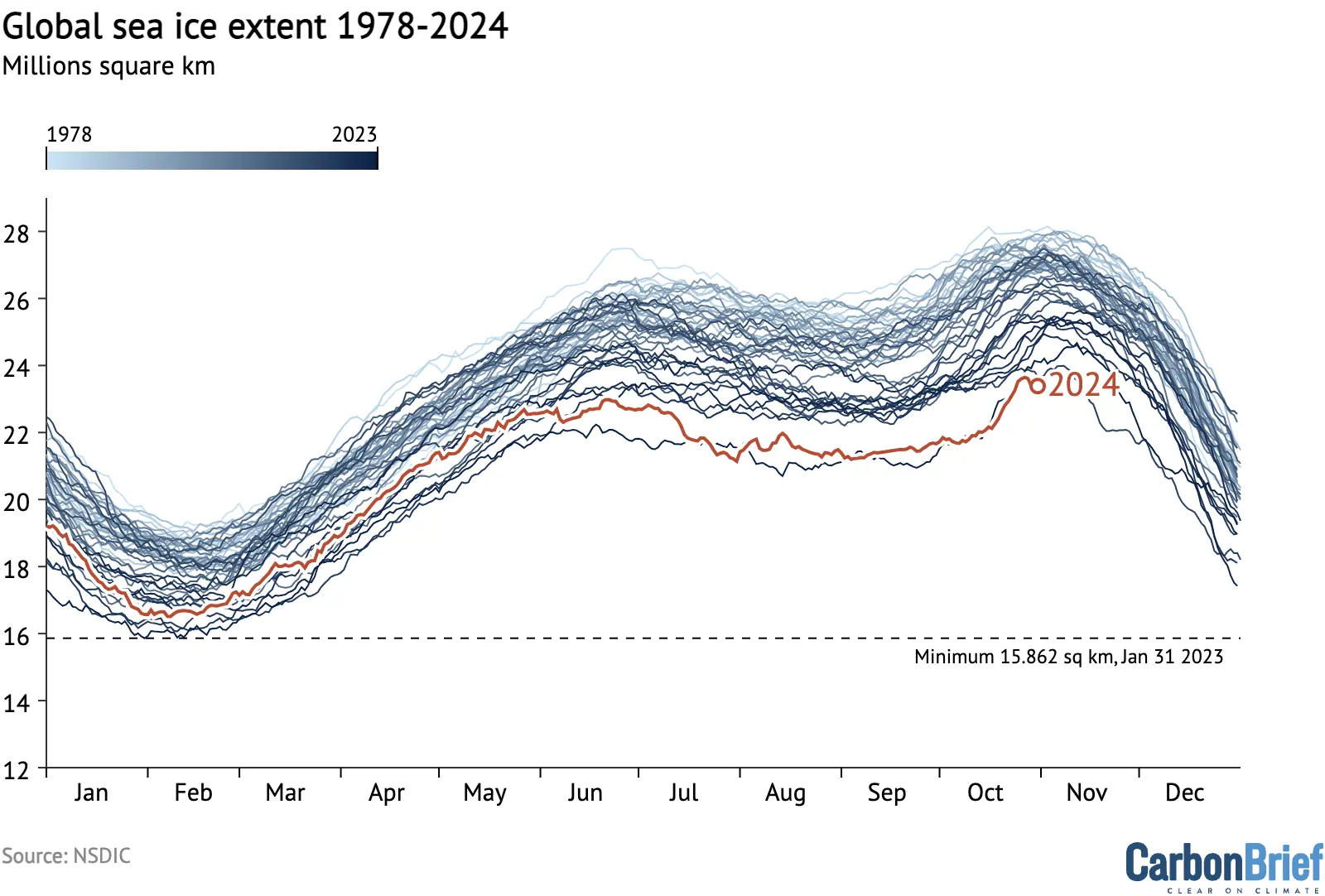
Global sea ice extent is currently at record lows and Antarctic sea ice has spent much of the year at near-record lows – second only to those seen in 2023.
The figure below shows Carbon Brief’s estimate of where 2024 temperatures will end up in each of the groups, based on the year to date and expected El Niño-Southern Oscillation (ENSO) conditions in the tropical Pacific for the remainder of the year.
The dots reflect the best estimate, while the whiskers show the two sigma (95%) confidence interval of the projections. The prior record year (2023 in all groups) is shown by the coloured square. https://interactive.carbonbrief.org/state-of-the-climate/24-Q3/projections.htmlCarbon Brief’s project of 2024 annual global average surface temperatures for each group, along with 95% confidence intervals and prior record (2023) values. 1.5C above pre-industrial (1850-1900) levels is shown by a dashed line. The average projection represents a composite of all five records following the WMO approach. Chart by Carbon Brief.
In all cases, the projected global average temperature for 2024 is virtually certain to exceed the prior record set in 2023.
Three of the five groups (Hadley, Berkeley and Copernicus/ECMWF) are very likely to show annual temperatures exceeding 1.5C above pre-industrial levels (defined here as the 1850-1900 period), while the NASA record has a roughly 40% chance of exceeding 1.5C. Only NOAA’s record is unlikely to show global temperatures above 1.5C this year.
These differences in warming since pre-industrial across different datasets primarily result from choice of ocean records used, as well as differences in approaches to filling in gaps between observations in the early part of the records (e.g. pre-1900s). It reflects the uncertainty in the degree of warming since the mid-1800s, with projected 2024 temperatures ranging from 1.44C (NOAA) to 1.61C (Berkeley Earth).
The figure also provides a composite average of the five different datasets, following the approach used in the sixth assessment report (AR6) from the Intergovernmental Panel on Climate Change (IPCC) and by the WMO. Carbon Brief’s analysis finds that 2024 will be the first year above 1.5C in the composite average.
This provides a way to determine the first year where we can reasonably say that the world has passed that warming level – even though 2023 exceeded 1.5C in the Berkeley Earth dataset and 2024 will not exceed 1.5C in the NOAA dataset.
(It is important to note that exceeding 1.5C in a single year is not equivalent to breaching the Paris Agreement limit. The goal is generally considered to refer to long-term warming – typically over two or three decades – rather than annual temperatures that include the short-term influence of natural fluctuations in the climate, such as El Niño.)
The figure below shows the annual temperatures from each of these groups between 1970 and present, with the year-to-date 2024 temperatures for each record shown as individual points. https://interactive.carbonbrief.org/state-of-the-climate/24-Q3/records_2024_to_date.htmlAnnual global average surface temperatures from NASA GISTEMP, NOAA GlobalTemp, Hadley/UEA HadCRUT5, Berkeley Earth and Copernicus/ECMWF (lines), along with 2024 temperatures to date (January-September, coloured shapes). Each series is aligned by using a 1981-2010 baseline, with warming since pre-industrial based on the IPCC AR6 estimate of warming between pre-industrial and the 1981-2010 period. Chart by Carbon Brief.
There is strong agreement between the different temperature records, with all of them showing approximately 1C warming between 1970 and present. Global temperatures have been around 1.3 above pre-industrial levels in recent years (with a range of 1.2C to 1.4C across the different temperature datasets, reflecting that the differences between them are larger in the 1800s and early 1900s).
As the chart below shows, 2024 (purple line) started out remarkably warm as a result of a strong El Niño event that built in 2023 (red) and peaked near the beginning of the year.
However, global temperatures have remained quite elevated despite the fading of El Niño conditions, setting records through June and remaining quite close to 2023’s exceptional highs in recent months.
Overall, 2024 has set or tied all-time records for seven of the 10 months available to-date in the ERA5 record. (This record uses weather model-based reanalysis to combine lots of different data sources over time.)https://interactive.carbonbrief.org/state-of-the-climate/24-Q3/monthly_global_temperature_anomalies_Q3_2024.htmlTemperatures for each month from 1940 to 2024 from Copernicus/ECMWF ERA5. Anomalies plotted with respect to a 1850-1900 baseline. Chart by Carbon Brief.
While human emissions of CO2 and other greenhouse gases are responsible for effectively all of the Earth’s long-term warming, temperatures in any given year are strongly influenced by short-term variations in the Earth’s climate that are typically associated with El Niño and La Niña events.
These fluctuations in temperature between the ocean and atmosphere in the tropical Pacific help make some individual years warmer and some cooler.
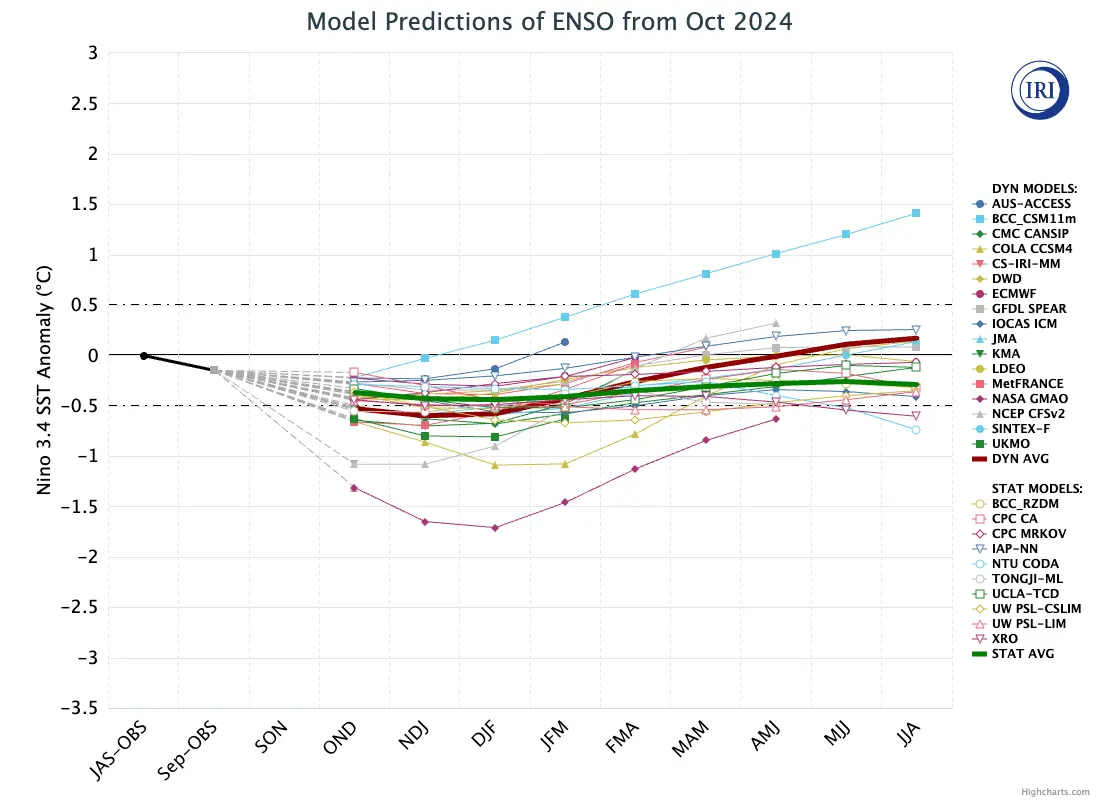
The figure below shows a range of different ENSO forecast models produced by different scientific groups. The values shown are sea surface temperature variations in the tropical Pacific – the El Niño 3.4 region – for three-month periods.
El Niño Southern Oscillation (ENSO) forecast models for overlapping three-month periods in the Niño3.4 region (July, August, September – JAS – and so on) for the remainder of 2024 and then into the spring and summer of 2025. Credit: CPC/IRI ENSO forecast.
Most models expect neutral conditions in the tropical Pacific, with only a few crossing the -0.5C Niño 3.4 sea surface temperature (SST) anomaly that represents the development of a formal La Niña event.
This should result in relatively cooler temperatures in 2025, though it is possible that the year ends up warmer than anticipated given the continuation of high temperatures in recent months – despite the absence of El Niño conditions.
Large areas of record warmth
While global average temperatures are an important indicator of changes to the broader climate system over time as a result of human activities, these impacts will differ as some regions experience more rapid warming or extreme heat events than is reflected in the global average.
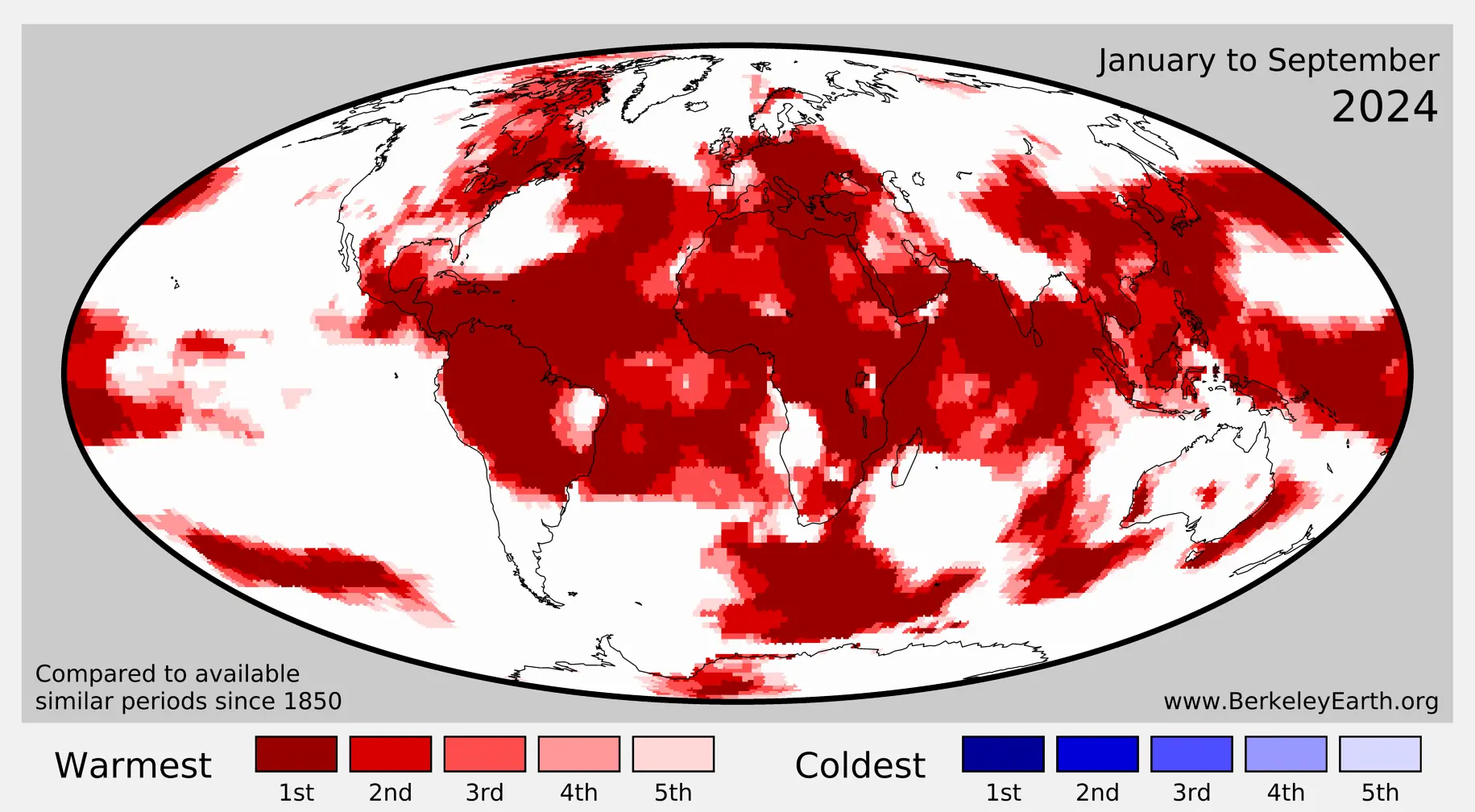
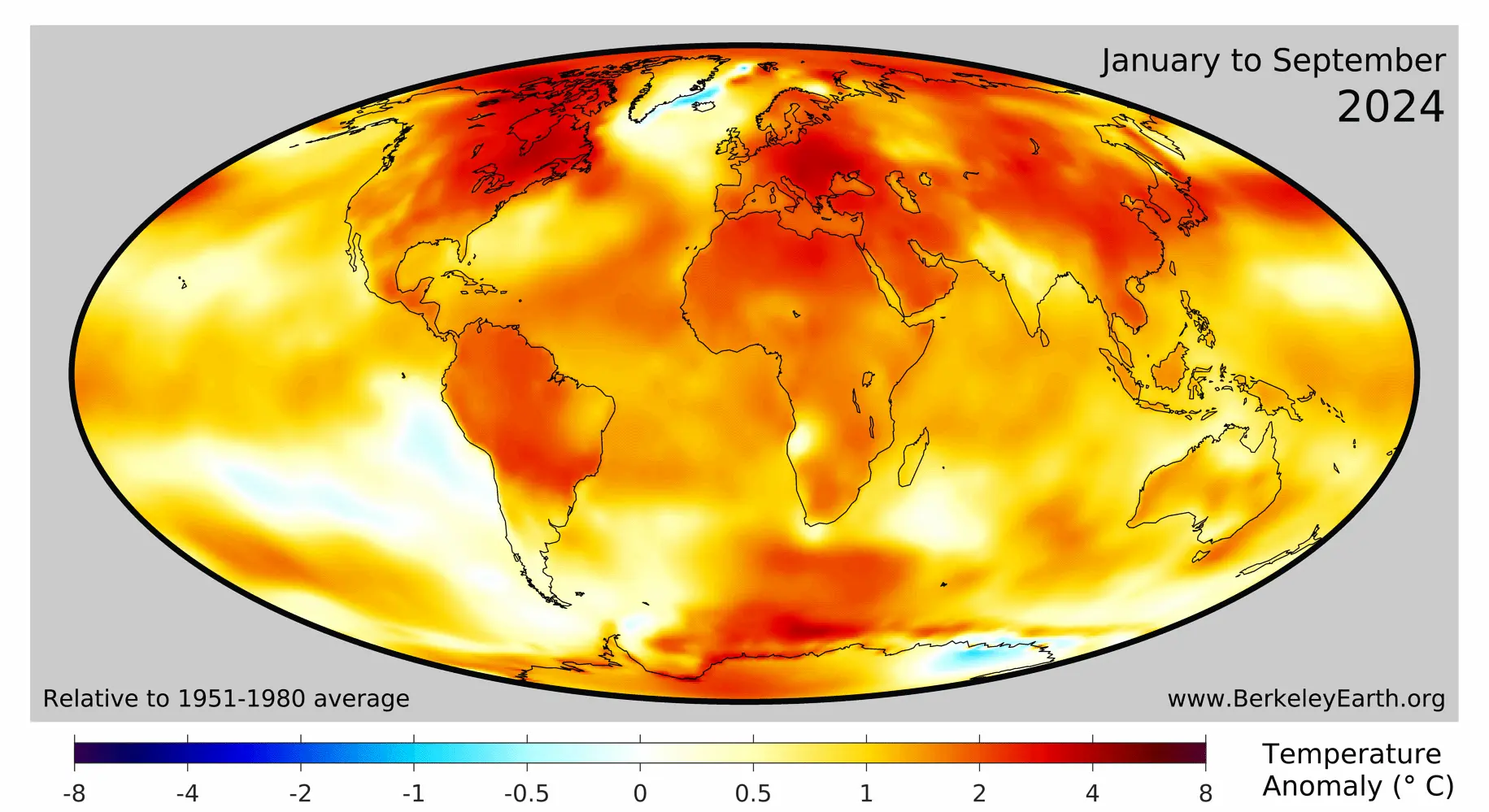
The figure below shows the parts of the world that saw record warm or cold temperatures over the first three quarters of 2024 (January through to September) in the Berkeley Earth dataset compared to all prior years since global temperature record began in 1850.
Map of year-to-date (January-September) regions that set new records (warmest through to fifth warmest). Note that no regions set cold records for the year-to-date in 2024. Credit: Berkeley Earth
Notably, no area on Earth saw record cold (or even the second, third, fourth or fifth coldest temperatures on record). Nearly all of Central America and large parts of South America saw their warmest year to date on record, as did much of eastern Europe, Africa, China, south-east Asia, and Korea.
The figure below shows the temperature anomaly over the first nine months of the year compared to the 1951-80 baseline period used by Berkeley Earth. Warming was particularly pronounced over land regions, with many areas already showing warming of 1.5C or 2C above that baseline.
Map of year-to-date (January-September) global surface temperatures. Anomalies are shown relative to the 1951-80 period following the convention used by Berkeley Earth. Credit: Berkeley Earth
Temperatures are tracking climate model projections
Climate models provide physics-based estimates of future warming given different assumptions about future emissions, greenhouse gas concentrations and other climate-influencing factors.
The figure below shows the range of individual models forecasts featured in AR6 – known collectively as the CMIP6 models – between 1970 and 2030, with grey shading and the average projection across all the models shown in black. Individual observational temperature records are represented by coloured lines.https://interactive.carbonbrief.org/state-of-the-climate/24-Q3/model_obs_comps_Q3_2024.htmlTwelve-month average global average surface temperatures from CMIP6 models and observations between 1970 and 2024. Models use SSP2-4.5 forcings after 2015.Anomalies plotted with respect to a 1981-2010 baseline. Chart by Carbon Brief.
While global temperatures were running below the pace of warming projected by climate models for much of the period between 2008 and 2022, the past two years have been closer to the model average.
However, the CMIP6 models may be biassed a bit too warm, with a subset of “hot” models pushing up the average. The IPCC used an approach that weighted models based on how well they reproduced historical temperatures, rather than simply averaging all the models together.
Excluding these hotter models from the analysis results in observations over recent years much closer to the multi-model average and near the centre of the uncertainty range across all models. It also reveals that the past two years – 2023 and 2024 – have been near the upper end of the model range.https://interactive.carbonbrief.org/state-of-the-climate/24-Q3/model%20_obs_comps_filtered_Q3_2024.htmlTwelve-month average global average surface temperatures from CMIP5 models and observations between 1970 and 2024. Models use SSP2-4.5 forcings after 2015. Anomalies plotted with respect to a 1981-2010 baseline. Chart by Carbon Brief.
Record low global sea ice extent
Highly accurate observations of Arctic and Antarctic sea ice have been available since polar-observing satellites became available in the late 1970s.
Arctic sea ice extent during the first three-quarters of 2024 has been below or at the low end of the historical 1979-2010 range, but has not seen any record daily lows.
Antarctic sea ice, on the other hand, set new all-time low records for a few days in July and September, and has generally been the second lowest on record (after 2023) from June onwards.
The figure below shows both Arctic (red) and Antarctic (blue) sea ice extent in 2024, the historical range in the record between 1979 and 2010 (shaded areas) and the record lows (dotted black line).
Unlike global temperature records (which only report monthly averages), sea ice data is collected and updated on a daily basis, allowing sea ice extent to be viewed through to the present day.https://interactive.carbonbrief.org/state-of-the-climate/24-Q3/sea_ice.htmlArctic and Antarctic daily sea ice extent from the US National Snow and Ice Data Center. The bold lines show daily 2024 values, the shaded area indicates the two standard deviation range in historical values between 1979 and 2010. The dotted black lines show the record lows for each pole. Chart by Carbon Brief.
Global sea ice extent is estimated by combining both Arctic and Antarctic sea ice extent. The figure below shows global sea ice extent in each year, with 2024 shown in red. Currently global sea ice extent is at record-low levels, below the prior record for this date set in 2023.
Methodological note
A statistical multivariate regression model was used to estimate the range of likely 2024 annual temperatures for each group that provides a temperature record. This model used the average temperature over the first six months of the year, the average ENSO 3.4 region value during the first nine months of the year and the average predicted ENSO 3.4 value during the last three months of the year to estimate the annual temperatures.
The model was trained on the relationship between these variables and annual temperatures over the period of 1950-2023. The model then uses this fit to predict both the most likely 2024 annual value for each group, as well as the 95% confidence interval. The predicted ENSO 3.4 region values for the last three months of 2024 are taken from the IRI plume forecast.
The percent likelihood of different year ranks for 2024 is estimated by using the output of the regression model, assuming a normal distribution of results. This allows Carbon Brief to estimate what percent of possible 2024 annual values fall above and below the temperatures of prior years for each group, as well as the likelihood of the year exceeding 1.5C in each record.
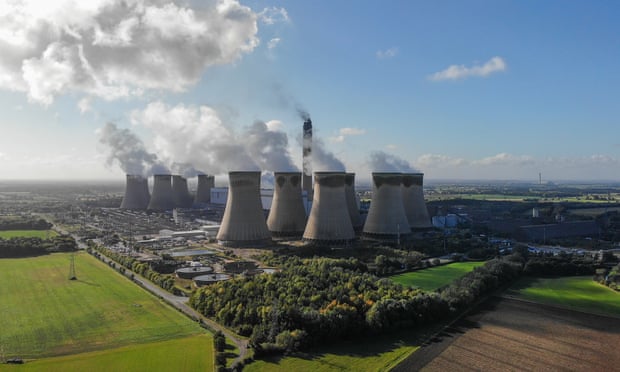
Drax was responsible for 11.5m tonnes of CO2 last year, or nearly 3% of the UK’s total carbon emissions. Photograph: SOPA Images/LightRocket/Getty Images
Drax received £22bn in subsidies despite being UK’s largest emitter in 2023, though company rejects ‘flawed’ research
The Drax power station was responsible for four times more carbon emissions than the UK’s last remaining coal-fired plant last year, despite taking more than £0.5bn in clean-energy subsidies in 2023, according to a report.
The North Yorkshire power plant, which burns wood pellets imported from North America to generate electricity, was revealed as Britain’s single largest carbon emitter in 2023 by a report from the climate thinktank Ember.
The figures show that Drax, which has received billions in subsidies since it began switching from coal to biomass in 2012, was responsible for 11.5m tonnes of CO2 last year, or nearly 3% of the UK’s total carbon emissions.
Drax produced four times more carbon dioxide than the UK’s last remaining coal-fired power station at Ratcliffe-on-Soar in Nottinghamshire, which is due to close in September. Drax also produced more emissions last year than the next four most polluting power plants in the UK combined, according to the report.