BBC host Victoria Derbyshire (left) and US senator Bernie Sanders on Newsnight in October (Image: BBC)
HUNDREDS of people complained to the BBC after a host challenged US senator Bernie Sanders’s description of Israel’s government as “extremist”.
A new complaints report from the BBC has revealed that more than 600 people complained that it was “inappropriate” for Newsnight host Victoria Derbyshire to challenge the description.
At the time, Israel’s government was led by the now-interim prime minister Benjamin Netanyahu, who is wanted for arrest by the International Criminal Court for alleged crimes against humanity.
Israeli Prime Minister Benjamin Netanyahu waves to supporters at Likud party headquarters in Jerusalem following the release of the first exit poll results in Israel’s general election, Wednesday, Oct. 28, 2026. Photo: AP
Analysts say Israel’s two main political blocs uphold ethnic cleansing policies against Palestinians and people of the region, while differences between them are only related to internal affairs.
Israelis headed to voting centers on Tuesday, October 27, in legislative elections to choose the members of the parliament, known as the Knesset.
The event marks Israel’s first general election since the October 7 attacks, which Netanyahu’s government expanded into a multi-front regional war.
Who is competing in the elections?
For many, these elections serve as a direct referendum on Prime Minister Benjamin Netanyahu and the far-right bloc he heads.
The Pro-Netanyahu Bloc
This bloc comprises the National Liberal Party (Likud) led by Netanyahu, the Religious Zionist Party (HaTzionut HaDatit) led by current Finance Minister Bezalel Smotrich, and Jewish Power Party (Otzma Yehudit) led by National Security Minister Itamar Ben-Gvir.
The coalition advocates for the consolidation of Israeli rule throughout the occupied Palestinian territories, explicitly rejects the possibility of Palestinian statehood, promotes the expansion of settlements and the implementation of hardline security measures against Palestinians. It also calls for disavowing the Oslo Accords, and the total disarmament of Hamas.
The anti-Netanyahu bloc
The primary competitor to Netanyahu and his coalition is the bloc led by Gadi Eisenkot, a former military chief of the Israeli forces. It represents a center-right to center-left opposition when it comes to Israeli internal affairs, but of course not to Palestinians and their destiny.
Eisenkot is the architect of the “Dahiya Doctrine,” an Israeli military strategy that calls for applying massive, disproportionate firepower and the widespread destruction of civilian infrastructure in order to create long-term deterrence, and discourage the local population from supporting any force resisting Israel.
He was also a member of Netanyahu’s war cabinet for the first eight months of Israel’s genocide in Gaza.
Eisenkot’s bloc includes the Yashar Party, led by Eisenkot, and the Together alliance (Beyachad), led by former prime minister Naftali Bennett. It also includes The Democrats (HaDemokratim) – a merger of the Labor and Meretz parties – led by Yair Golan, a retired IDF Major General.
Israel Is Our Home Party (Yisrael Beiteinu) led by Avigdor Liberman, is also part of Eisenkot’s coalition.
Liberman, who formerly held ministerial portfolios in the Israeli government as minister of finance, defense, foreign affairs, strategic affairs, transportation, and national infrastructure alongside being a deputy prime minister, is known for his hawkish stances towards Palestinians.
Defending the use of live ammunition by Israeli forces against Palestinian demonstrators during the 2018 Gaza border protests (known as the Great March of Return), Liberman stated:
“There are no innocents in Gaza.”
Although the components of this coalition are united by their goal to oust Netanyahu, they remain deeply aligned with their political rival’s traditional right-wing stance regarding the Palestinian cause.
The coalition opposes the creation of an independent Palestinian state, while supporting the ongoing military operations in the Gaza Strip, the West Bank and other parts of West Asia, and maintaining existing settlement frameworks.
Some of the coalition’s affiliated parties further encourage separating Israeli and Palestinian populations, and retaining complete Israeli security control over strategic areas such as the Jordan Valley. They also demand the full demilitarization of any future Palestinian entity.
Others call for the dismantling of the Palestinian Authority, the annexation of Area C in the West Bank, and the entrenchment of discriminatory policies against Arab citizens in Israel.
The Arab-led lists
The Arab-led lists represent the minority of Palestinian citizens in Israel (also known as Arab-Israelis), a community that makes up roughly 21% of Israel’s total population, estimated at 10.3 million.
Even though both lists fight for the same minority group’s rights, they hold opposing views on the goals, values, and strategy needed to represent them effectively.
While representing a minority, these lists hold a critical and often polarizing role in Israeli elections, as they frequently act as a critical balance of power that strongly determines whether a governing coalition can be formed.
These lists include the Joint List and the United Arab List.
The Joint List
The Joint List consists of:
The Democratic Front for Peace and Equality (Hadash) led by Yousef Jabareen, a prominent Palestinian legal scholar, academic, and politician.
The Arab Movement for Renewal (Ta’al) led by Dr. Ahmad Tibi, a prominent Palestinian politician, who has served as a member of Knesset since 1999.
The National Democratic Alliance (Balad) led by a prominent Palestinian politician and historian Sami Abu Shehadeh.
The coalition advocates for Palestinian self-determination and civil rights, for an end to the Israeli occupation, and for the establishment of an independent Palestinian state along the 1967 borders with Jerusalem as its capital.
It also demands full legal equality and state recognition for Palestinian Arab citizens as an indigenous national minority, and calls for immediate government and law enforcement intervention to curb the increase in organized crime in Arab municipalities.
Structural reforms to secure building rights, expand municipal boundaries, and stop punitive home demolitions are top priorities on the Joint List’s agenda.
The United Arab List
The United Arab List (Ra’am) is an Islamist and conservative political party led by Mansour Abbas, a prominent Palestinian politician, whose party was the first independent Arab-Muslim faction to join an Israeli government.
Unlike traditional Arab political lists, Ra’am demonstrates a willingness to ally with Jewish political parties in government. It uses a pragmatic, integration-focused strategy to gain political influence and enhance the socioeconomic wellbeing of Arab-Israeli citizens.
Ra’am prioritizes the immediate domestic needs of Arab communities inside Israel, such as fighting local organized crime, improving public infrastructure, securing budgets, and resolving housing issues.
Netanyahu is alarmed by surging Arab voter turnout
Media reports indicated that Arab citizens voted in numbers not seen in decades, which in turn pushed Netanyahu to launch an urgent social media campaign, warning of the growing participation of Arabs.
Urging his supporters to go out and vote, Netanyahu appeared in a video, accusing Ra’am of bribing voters with envelopes of cash in the southern areas occupied by Israel.
“My brothers and sisters, Likud voters, this is an emergency call, because they are trying to steal the election from us. This morning, the police announced something serious and unusual. They caught three of Ra’am’s senior financial figures with envelopes of cash in the south. This is criminal. They will get to everyone. You have been warned, the voter turnout in the Arab sector in the south is incomparably higher than in the Jewish sector. You must go out and vote,” Netanyahu said.
He also claimed that left-wing women escorted Arab women to the polls.
Shortly before polls closed at 10:00 pm local time, the final reported voter turnout reached 74.3%, the highest in decades, with exit polls showing no clear winner, and pointing to a political deadlock.
It is expected that the final tally and initial results will be published between Thursday afternoon, October 29, and Friday morning, October 30, while the official results will be announced on November 4, 2026.
All roads lead to genocide, no matter which bloc wins
While many are looking forward to the loss of Netanyahu’s bloc in the elections, hoping that a new government will be less brutal against Palestinians and people across the West Asia region, analysts suggest that Eisenkot’s bloc adopts the same Zionist ethnic cleansing-based ideology.
In an interview with BreakThrough News, Israeli-American author, activist and founder of Palestine House of Freedom Miko Peled argued that there are no differences between the two competing blocs when it comes to issues like Israel’s war on Iran, the mass killing in Gaza, forcing Palestinians to flee the besieged enclave. Meanwhile, disputes on the internal Israeli issues – mainly the draft of ultra-orthodox jews in the military and initiating an independent inquiry into the failure of the army and intelligence on the October 7 attacks – remain serious.
Former Chief of General Staff and leader of the Yashar party, Gadi Eisenkot holds an election rally ahead of Israeli parliamentary (Knesset) elections in Tel Aviv, Israel, on October 25, 2026. [Saeed Qaq – Anadolu Agency]
In the past, many Palestinians and Arabs followed Israeli elections closely. They did so not because they entertained illusions that a Zionist leader would deliver peace and justice, dismantle the occupation or remove illegal settlements. Rather, they feared that some Israeli leaders were worse than others. They hoped to avert the worst-case scenario.
Over time, however, that distinction gave way to the belief that all Israeli leaders were essentially the same. This is not pessimism. It is experience.
Consider, for example, the expansion of illegal Jewish settlements during the Oslo peace process under Israeli Prime Minister Yitzhak Rabin.
Between 1992 and 1995, the number of Israeli settlers in the West Bank, excluding East Jerusalem, increased from 111,673 to 140,235 – a rise of more than 25 per cent, according to the Palestinian Central Bureau of Statistics (PCBS), drawing on Israeli statistical records.
The same pattern continued under the Labour government of Prime Minister Ehud Barak.
Within his first six months, Barak’s government issued tenders for 3,196 settlement housing units, exceeding the annual average under his right-wing predecessor, Benjamin Netanyahu.
When Naftali Bennett formed a coalition government in June 2021 that included the Arab party Ra’am, settlement expansion continued unabated.
According to the Israeli settlement watchdog Peace Now, the Bennett–Lapid government advanced plans for 7,292 settlement housing units during its first year, a 26 per cent increase over the annual average recorded under previous Netanyahu governments.
The settlements are themselves a driving force behind the occupation. They require land, and therefore land confiscation; protection, and therefore an expanded military presence; water, roads and infrastructure, and therefore the appropriation of Palestinian resources. Together, these elements deepen dispossession and generate further Israeli violence.
According to the PCBS, the West Bank contained 645 Israeli settlement sites, outposts and other occupation installations by the end of 2025, including 350 settlement outposts.
The Palestinian Colonization and Wall Resistance Commission, a Palestinian Authority body, reported that Israeli authorities targeted approximately 29,335 dunums of Palestinian land through declarations of so-called “state land” between October 2023 and August 2026 – one of the largest waves of such land appropriation since Oslo.
By September 2026, the Commission had also documented the advancement or consideration of plans for more than 18,000 additional settlement housing units across the West Bank and occupied East Jerusalem.
By the end of 2023, the West Bank had experienced its deadliest year for Palestinians since the UN began systematically recording casualties in 2005.
The Colonization and Wall Resistance Commission documented 23,827 attacks by Israeli forces and settlers against Palestinians and their property during 2025 alone. In the first seven months of 2026, settler attacks increased by 63 per cent compared with the corresponding period of the previous year.
Typically, this violence, carried out by the Israeli occupation army and armed illegal settlers, is contextualised within the ongoing genocide in Gaza. But violence in the West Bank also serves another purpose beyond collective punishment: the confiscation of Palestinian orchards, the annexation of land, the expansion of settlements and the crushing of Palestinian resistance, including non-violent opposition to this colonial enterprise.
Any Israeli candidate in the 27 October elections who supports settlement expansion does so with full knowledge of its consequences: further dispossession, military occupation, annexation and violence.
The difference between Prime Minister Benjamin Netanyahu, Finance Minister Bezalel Smotrich and National Security Minister Itamar Ben-Gvir, and politicians presented as less extreme, is often one of language, strategy and timing.
Former Israeli military chief and Yashar party leader Gadi Eisenkot, for example, openly supports the expansion of Israeli settlements in the occupied West Bank, despite his reputation as a more “moderate” alternative to Netanyahu.
Who among Israel’s leading political figures is promising to end the genocide, lift the siege, ensure unrestricted humanitarian aid, restrain the army or investigate violations of international law? None.
Israeli media have spent the past three years reporting on major disagreements between the government, military establishment, intelligence agencies and political opposition over what should happen in Gaza.
Yet Eisenkot has pledged to end Hamas’s rule in Gaza within 18 months of taking office, whether through US President Donald Trump’s framework or through continued war.
For his part, Yesh Atid leader and former Prime Minister Yair Lapid has proposed placing Gaza under Egyptian administration for up to 15 years, effectively shifting responsibility for Israel’s actions onto Arab states.
Former Prime Minister Naftali Bennett, meanwhile, supports continued Israeli military control until Palestinian groups are disarmed.
The disagreement, therefore, is often over how Israel should achieve its objectives, rather than whether those objectives should change.
Other major disagreements primarily concern Israeli society: the conscription of ultra-Orthodox Jews, judicial reform and accountability for the failures of 7 October.
But these disputes should not be confused with the questions that matter most to Palestinians.
If Netanyahu succeeds in forming another right-wing coalition, the policies of occupation, settlement expansion and military confrontation will continue, potentially with renewed momentum.
If Israel produces a broader coalition, its members may reach compromises over judicial reform, conscription and other domestic disputes. The occupation, however, is unlikely to become the central point of disagreement.
More troubling still, even a government leaning towards the centre-left might succeed in presenting Israel to the international community as a country ready to move beyond the image it acquired during three years of genocide, without fundamentally changing its conduct on the ground.
The international community must therefore remain vigilant. It cannot allow a future Israeli government to present itself as a peacemaker, or sell the illusion of a newly reformed Israel, while continuing to invest in settlements, occupation, war and genocide.
The views expressed in this article belong to the author and do not necessarily reflect the editorial policy of Middle East Monitor.
This work by Middle East Monitor is licensed under a Creative Commons Attribution-NonCommercial-ShareAlike 4.0 International License.
Donald Trump calls for help from NATO allies in securing the Strait of Hormuz despite saying on 7 March 2026 that they don’t need people to join wars after they’ve already won. He’s challenged with the claim that he lies as much as the IDF.
UK Prime Minister Andy Burnham admits to blatently lying and engaging in deception to become leader of the UK Labour Party and Prime Minister. He asks who could possibly object to the IDF starving people to death, conducting forced marches like the Nazis did, bombing all Gaza’s hospitals and universities, mass-murdering journalists, healthworkers and starving people queuing for food, killing and raping prisoners and murdering children. He says they’ve got a genocide to do for Israel and to stop objectingEd Miliband says that he and the Labour Party are full of shit criminalising people holding signs as terrorists despite anything he says.
Israel has been building settlements in the occupied West Bank for decades. But Britain’s new ban on the import of settlement goods comes in a response to a major escalation in construction over the past four years, which an International Court of Justice advisory opinion in 2024 concluded is illegal and must stop.
Most striking are recent steps to build a new settlement bloc known as E1 on the outskirts of Jerusalem. First planned as long ago as 1999, but progressing significantly over the past year or so, the E1 bloc would mark a major change to the geography of the West Bank.
Current plans allow for thousands of housing units in the settlement, as well as commercial properties and regional services. The project would establish a new urban area that would connect the large settlement of Maale Adumim with East Jerusalem.
The international community has long seen the construction of E1 as a red line for three main reasons. First, it would isolate East Jerusalem from the rest of the West Bank, including major Palestinian cities like Ramallah and Bethlehem. This matters because East Jerusalem is the proposed capital of a Palestinian state in any future two-state agreement to end the conflict.
Second, because E1 reaches across the West Bank at its narrowest point, it would also disrupt the connections between the north and south of the territory. Fragmenting the West Bank in this way would again undermine efforts to develop a future Palestine state.
And third, the construction of E1 would involve the displacement of Palestinians. This includes people in the community of Khan al-Ahmar, which Israeli authorities ordered should be evacuated in May 2026 ahead of the new settlement construction.
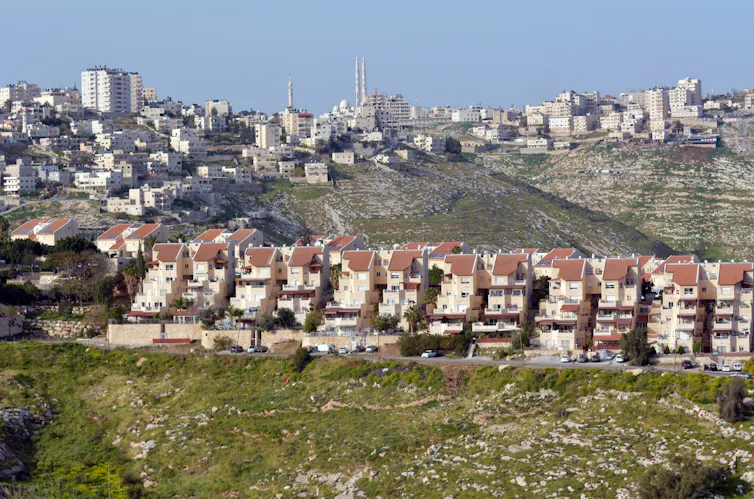
The Maale Adumim settlement next to the Palestinian town of al-Eizariya, pictured in 2015. ChameleonsEye / Shutterstock
Israeli government ministers have been explicit that E1 would suffocate any future Palestinian state. In September 2025, when announcing new progress on E1, Prime Minister Benjamin Netanyahu said: “We are going to fulfil our promise that there will be no Palestinian state.” His finance minister, Bezalel Smotrich, has also said E1 would “bury the idea of a Palestinian state”.
The E1 project has advanced considerably in recent times, after years of delay. In August 2025, final planning approval was given for more than 3,400 housing units on the site. Then, in August 2026, the first call for construction tenders was issued to build 1,200 residential units in the southern part of E1. The closing date for bidding is on October 19, just before Israeli elections on October 27.
The UK’s import ban, which seems intended to deter companies from taking part in building E1, has been backed by similar measures announced by countries including Canada, France, Ireland and Spain.
Mounting international concern
The ban on settlement goods demonstrates mounting international concern about Israel’s actions. More than 700,000 Israeli settlers now live on land captured in the 1967 six-day war, even though settlements on occupied land are illegal under international law.
Israeli rights group, Peace Now, reports that more than 102 new settlements have been approved since 2022, most deep inside the West Bank. The Israeli military often supports settlers building new outposts, and the Israeli government provides substantial financial backing to establish settlements.
The UN says that more than 6,400 Palestinians have been displaced in the West Bank due to settler attacks and access restrictions since January 2023, of which at least 2,500 were displaced in 2026 alone.
In addition, more than 30,000 Palestinians have been displaced from refugee camps during Israeli military operations in the northern West Bank since late 2024.
Israel’s expanded control over the West Bank is one element in a broader revisionist policy to push its borders outwards, which marks a step change from a previous strategy of conflict management.
The new moves come in the wake of the October 2023 attacks, when Hamas gunmen killed more than 1,200 Israelis and captured 250 hostages, and Israel’s subsequent war in Gaza, which has killed more than 70,000 Palestinians and devastated the strip.
Since the war began, Israel has seized territory as a buffer zone in southern Lebanon against Hezbollah. It has also advanced into Syria, following the fall of the Bashar al-Assad regime in late 2024. In Gaza, Israel has now taken control of at least 60% of the strip and is considering building three new military settlements there.
Israel’s far-right national security minister, Itamar Ben-Gvir, recently again raised the prospect that Israel may seek to expel the 2 million Palestinians in Gaza. Egypt, which has a border with Gaza, and Jordan, which shares a border with the West Bank, are gravely concerned about the risk of mass deportation of Palestinians across their borders.
The UK government’s action against settlement expansion, accompanied by similar measures introduced by countries elsewhere, signals a new effort to curb these expansionist ambitions.
This work by Middle East Monitor is licensed under a Creative Commons Attribution-NonCommercial-ShareAlike 4.0 International License.
Palestinians inspect the damage to a Palestinian memorial, which was smashed with a sledgehammer by far-right Israeli lawmaker Zvi Sukkot and those accompanying him, who entered the village of Madama near Nablus in the northern West Bank under the protection of Israeli soldiers, on August 25, 2026. [Nedal Eshtayah – Anadolu Agency]
Israeli Finance Minister Bezalel Smotrich has called on Prime Minister Benjamin Netanyahu to instruct the Israeli military to dismantle 40 Palestinian memorials across the occupied West Bank within 24 hours, according to Israeli media reports.
Smotrich made the request in an official letter to Netanyahu following controversy surrounding the demolition of a memorial that Israeli authorities said commemorated a Palestinian responsible for attacks against Israelis.
According to Israel’s Channel 14, Smotrich said the removal of such memorials was necessary as part of efforts to assert what he described as “state sovereignty” and combat what he called “infrastructure of terrorism and incitement.”
Smotrich reportedly attached a list identifying 40 memorials across the West Bank that he said commemorate Palestinians involved in attacks or other activities against Israel.
He called on Netanyahu to order the Israeli military to remove all of the listed memorials within 24 hours.
Donald Trump calls for help from NATO allies in securing the Strait of Hormuz despite saying on 7 March 2026 that they don’t need people to join wars after they’ve already won. He’s challenged with the claim that he lies as much as the IDF.Donald Trump explains why he established his Bored of Peace