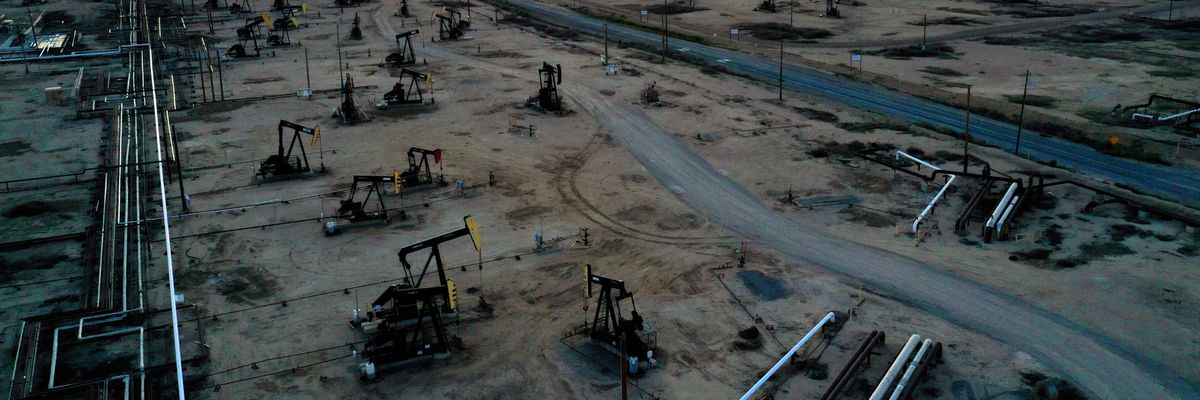
There are over 1,100 oil-producing wells in the McKittrick oil field, just north of the town of McKittrick, California. (Photo: Carolyn Cole/Los Angeles Times via Getty Images)
“The science is clear: No new oil and gas fields, or the planet gets pushed past what it can handle,” said one analyst.
Fossil fuel-producing countries late last year pledged to “transition away from fossil fuels,” but a report on new energy projects shows that with the United States leading the way in continuing to extract oil and gas, governments’ true views on renewable energy is closer to a statement by a Saudi oil executive Amin Nasser earlier this month.
“We should abandon the fantasy of phasing out oil and gas,” the CEO of Saudi Aramco, the world’s largest oil company, said at an energy conference in Houston.
A new report published Wednesday by Global Energy Monitor (GEM) suggests the U.S. in particular has abandoned any plans to adhere to warnings from climate scientists and the International Energy Agency (IEA), which said in 2021 that new oil and gas infrastructure has no place on a pathway to limiting planetary heating to 1.5°C.
Despite the stark warning, last year at least 20 oil and gas fields worldwide reached “final investment decision,” the point at which companies decide to move ahead with construction and development. Those approvals paved the way for the extraction of 8 billion barrels of oil equivalent (boe).
By the end of the decade, companies aim to sanction nearly four times that amount, producing 31.2 billion boe from 64 oil and gas fields.
The U.S. led the way in approving new oil and gas projects over the past two years, GEM’s analysis found.
The oil & gas industry persists in development of new fields, as top producing countries boost production.
Our latest report uncovers the regions driving the push for new fossil fuel reserves.
— Global Energy Monitor (@GlobalEnergyMon) March 28, 2024
An analysis by Carbon Brief of GEM’s findings shows that burning all the oil and gas from newly discovered fields and approved projects would emit at least 14.1 billion tonnes of carbon dioxide.
“This is equivalent to more than one-third of the CO2 emissions from global energy use in 2022, or all the emissions from burning oil that year,” said Carbon Brief.
GEM noted in its analysis that oil companies and the policymakers who continue to support their planet-heating activities have come up with numerous “extraction justifications” even as the IEA has been clear that new fossil fuel projects are incompatible with avoiding catastrophic planetary heating.
The report notes that U.S. Sen. Lisa Murkowski (R-Alaska) “supported ConocoPhillips’ Willow oil field, arguing that the Alaskan oil and gas industry has a ‘better environmental track record,’ and not approving the project ‘impoverish[es] Alaska Natives and blame[s] them for changes in the climate that they did not cause.’”
Carbon Brief reported that oil executives have claimed they are powerless to stop extracting fossil fuels since demand for oil and gas exists for people’s energy needs, with ExxonMobil CEO Darren Woods telling Fortune last month that members of the public “aren’t willing to spend the money” on renewable energy sources.
A poll by Pew Research Center last year found 67% of Americans supported the development of alternative energy sources. Another recent survey by Eligo Energy showed that 65% of U.S. consumers were willing to pay more for renewable energy.
“Oil and gas producers have given all kinds of reasons for continuing to discover and develop new fields, but none of these hold water,” said Scott Zimmerman, project manager for the Global Oil and Gas Extraction Tracker at GEM. “The science is clear: No new oil and gas fields, or the planet gets pushed past what it can handle.”
Climate scientist and writer Bill McGuire summarized the viewpoint of oil and gas executives and pro-fossil fuel lawmakers: “Climate emergency? What climate emergency?”
The continued development of new oil and gas fields, he added, amounts to “pure insanity.”
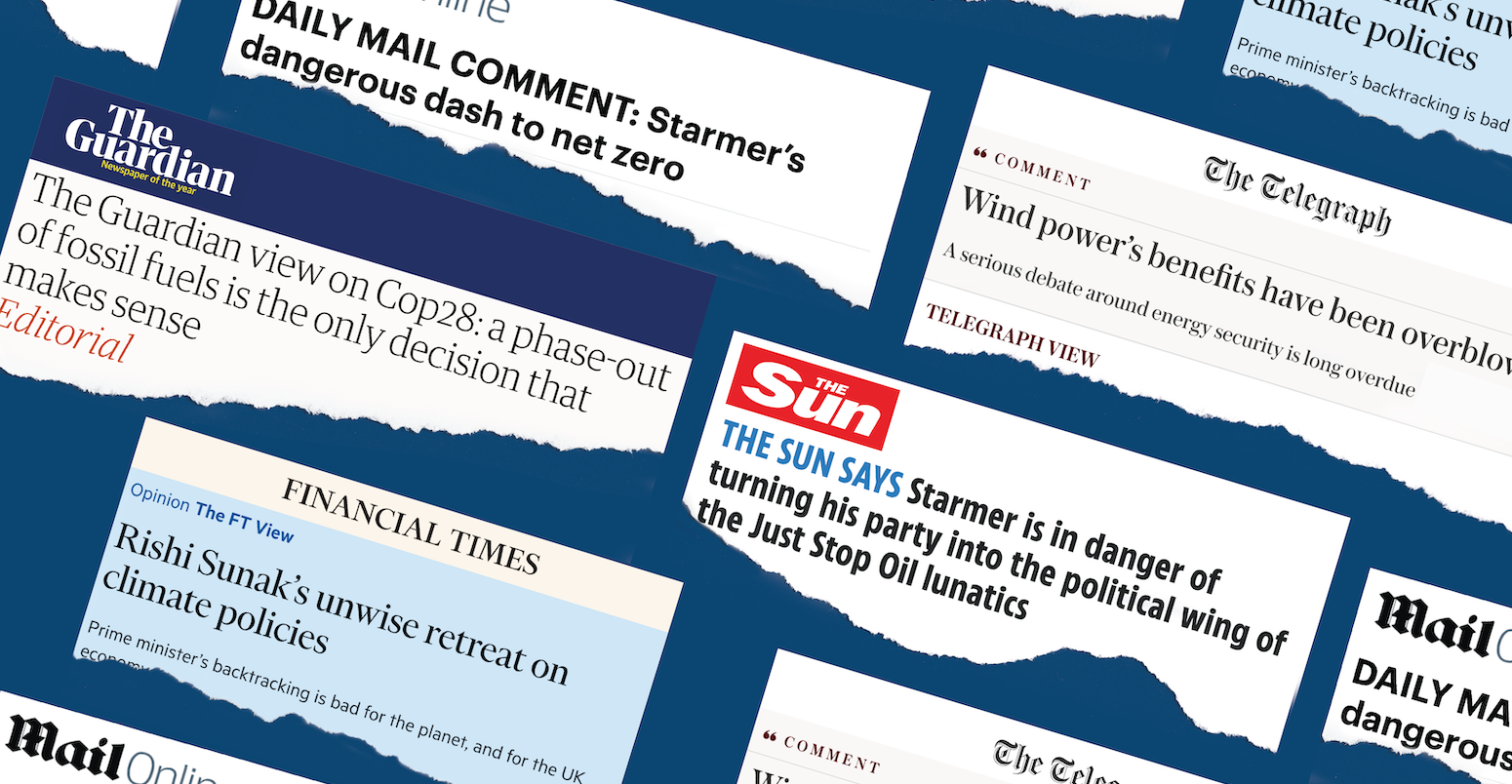
Graphic by Joe Goodman for Carbon Brief shows record opposition to climate action by UK’s right-leaning newspapers in 2023.
Last year saw a record number of UK newspaper editorials opposing climate action – almost exclusively from right-leaning titles – new Carbon Brief analysis shows.
The analysis is based on hundreds of UK national newspaper editorials, which are the formal “voice” of the publications.
The 354 editorials published in 2023 relating to energy and climate change add to thousands more collected in a long-running project started by Carbon Brief.
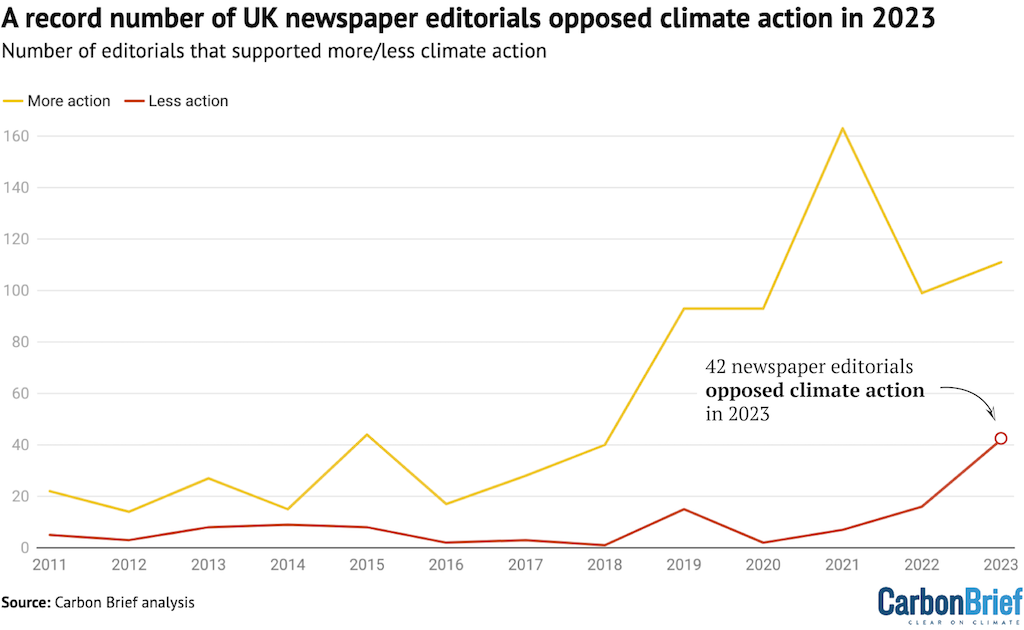
Newspapers such as the Sun and the Daily Mail published42 editorials in 2023 arguing against climate action – nearly three times more than they have printed before in a single year.
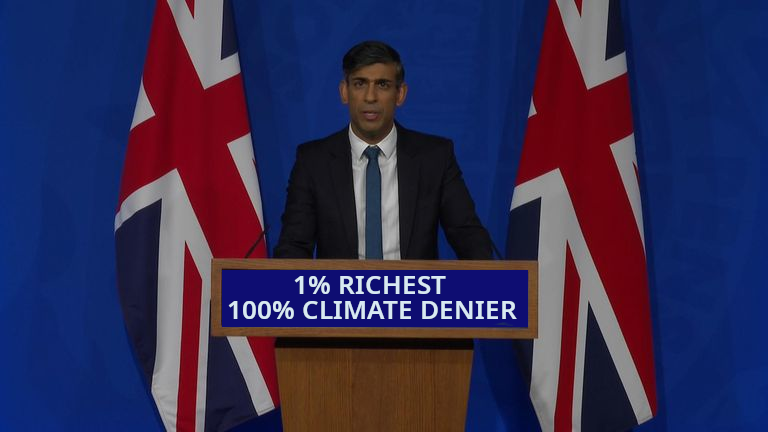
They called for delays to UK bans on the sale of fossil fuel-powered cars and boilers, as well as for more oil-and-gas production in the North Sea. In response to such demands, prime minister Rishi Sunak performed a “U-turn” in September on some of his government’s major net-zero policies.
Last year also saw a surge in hostility towards climate protesters, with editorial attacks doubling compared to recent years.
This analysis is part of a project assessing the attitudes of UK newspapers to climate change and energy since 2011. It shows that after a period of embracing climate action, right-leaning publications have largely returned to their historic stance of arguing against climate action.
Carbon Brief captured 354articles in its database of climate- and energy-related newspaper editorials last year, touching on topics ranging from UK energy bills to flooding in Libya.
Roughly half of these – 174in total – specifically called for either more or less climate action. The main focus of these editorials was the UK government’s net-zero target and the policies it is implementing, or failing to implement, in order to achieve this goal.
As the chart below shows, the 42 editorials arguing for less action last year marked a new record for the past 13 years of climate coverage.
Number of UK newspaper editorials arguing for more (yellow) and less (red) climate action, 2011-2023. Source: Carbon Brief analysis.
There was a clear partisan divide in attitudes towards climate action.
Nearly every editorial published in left-leaning and centrist titles that offered an opinion on climate action advocated for more to be taken. These made up around three-quarters of the articles calling for “more action” overall.
The Guardian, for example, published editorials calling for an end to oil exploration in the UK and for the world to get rid of fossil fuels “entirely”.
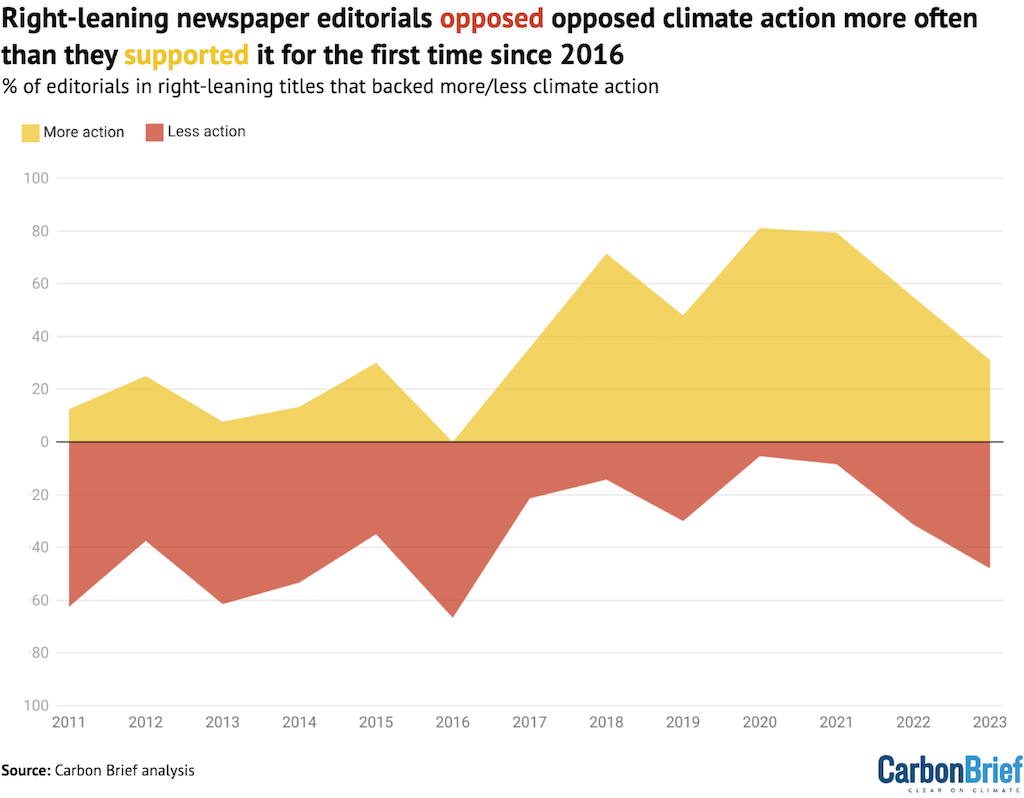
By contrast, around half of the climate-related editorials published in right-leaning titles, such as the Sun and the Daily Mail, actively opposed climate action. Only one-third of these editorials supported climate action and the remainder expressed a mix of views.
As the chart below shows, the past two years have seen a dramatic fall in the share of right-leaning newspaper editorials supporting climate action – and a rise in the share opposing it.
Prior to this downward trend, right-leaning titles with long histories of climate scepticism had been showing growing enthusiasm for climate action. The Daily Express and the Sun even launched special climate initiatives in 2021, as the UK prepared to host the COP26 summit.
The drop in support for climate action among right-leaning newspapers was followed by the government rolling back some of its climate policies in 2023. (See: Cost of net-zero.)
The share of right-leaning UK newspaper editorials arguing for more (yellow) and less (red) climate action, 2011-2023, %. Source: Carbon Brief analysis.
Carbon Brief also analysed a smaller set of 64 editorials from the 354 published in 2023 that discussed notable energy sources – specifically, renewables, nuclear power and fracking for shale gas.
Within this group, there were 14 editorials that were explicitly anti-renewable energy.
This is the highest number since 2013, when there was widespread opposition to wind energy within the right-leaning press.
Some of the criticism last year was reminiscent of that era. The Sun, for example, said solar and wind generation “will never reliably power a country this size and with such variable weather”.
(While other low-carbon energy sources would be needed, the Climate Change Committee has concluded that the UK could achieve a reliable decarbonised power system by 2035 in which wind and solar meet 70% of demand.)
A Sunday Telegraph editorial said that “supposed progress” in renewables had “only been achieved thanks to lavish subsidies”. (In fact, wind and solar remain the cheapest way to generate electricity in the UK.)
By far the most common anti-climate action narrative in newspaper editorials last year was the economic impact of what the Sun on Sunday called “bonkers net-zero policies that will just push prices up”. (Energy prices remain elevated thanks to expensive gas.)
The cost of net-zero, especially the up-front cost of buying electric vehicles and heat pumps, was consistently framed by right-leaning newspapers as something British people, in the words of the Sun, “just cannot afford”. (These papers invariably fail to mention the costs of inaction.)
This has been a popular topic among some right-wing and climate-sceptic commentators since the net-zero target was first proposed. This is in spite of analysis indicating that a net-zero transition would, ultimately, save UK households money.
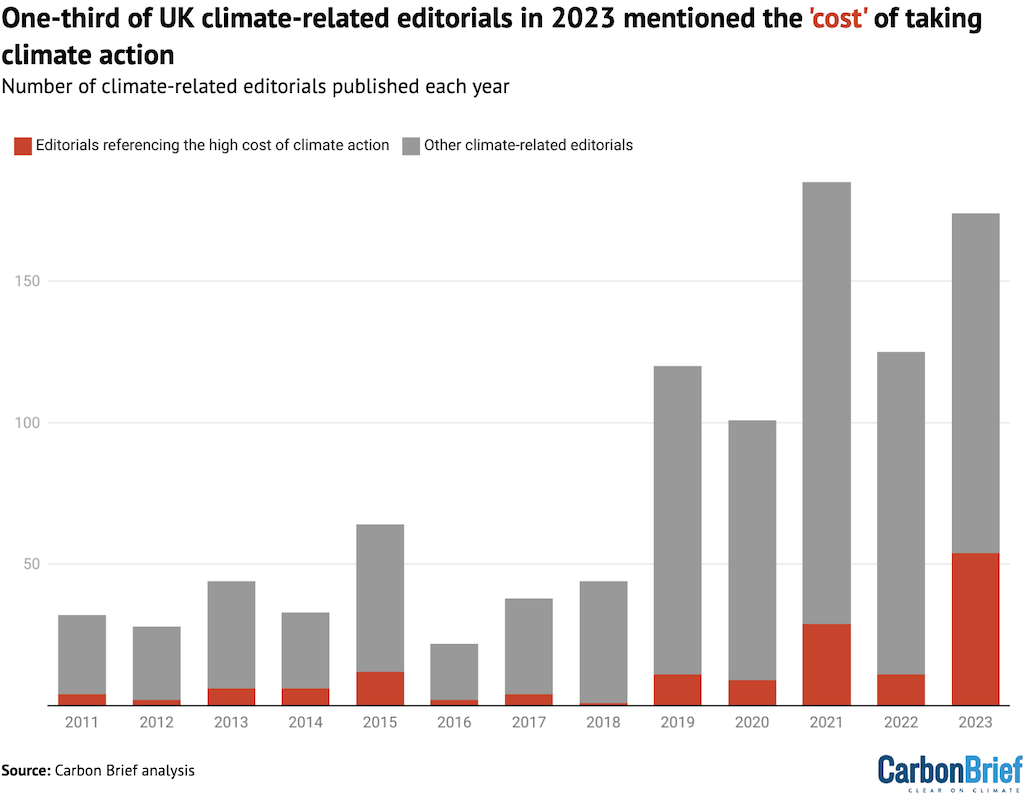
As the chart below shows, costs emerged as an even bigger talking point in 2023, with one-third of all climate-related editorials referencing the issue. There were twice as many editorials in the past year mentioning the high costs of action than there has ever been.
Annual number of climate-related editorials mentioning the economic costs of climate action (red), with remaining climate-related editorials published that year indicated in grey, 2011-2023. Source: Carbon Brief analysis.
Many, such as the Daily Mail, cited the wider economic situation in the UK as a reason not to act on climate change:
“When net-zero was made legally binding by 2050, Britain had not had Covid, the Ukraine war and rampant inflation. Now the country is skint and can’t afford it.”
(It is worth mentioning that publications such as the Daily Mail have been making similar arguments since long before any of these issues emerged. In 2017, it stated that climate action had only come at a “crippling cost to Western economies”.)
In light of what they argued were “unaffordable” costs, these publications argued that the best course of action would be to abandon “unrealistic” net-zero policies.
(The Office for Budget Responsibility has said that the costs of failing to act on climate change would be “much larger” than the costs of taking action.)
Right-leaning publications published numerous editorials calling for the government to delay or scrap plans to phase out gas boilers and internal combustion engine cars, introducedunder former Conservative prime minister Boris Johnson. One Daily Telegraph editorial said:
“There would surely be huge political benefits to scrapping all these pointlessly punitive measures.”
On 20 September, Conservative prime minister Rishi Sunak gave a speech in which he announced a series of rollbacks of net-zero policies that he said would protect “hard-working British people” from “unacceptable costs”. These included delays to the phase-out of fossil fuel-powered vehicles and boilers, as well as efficiency rules.
(Far from reducing costs, the rollbacks are expected to cost renters £2bn per year and drivers £6bn cumulatively, by leaving homes more draughty and cars more expensive to run.)
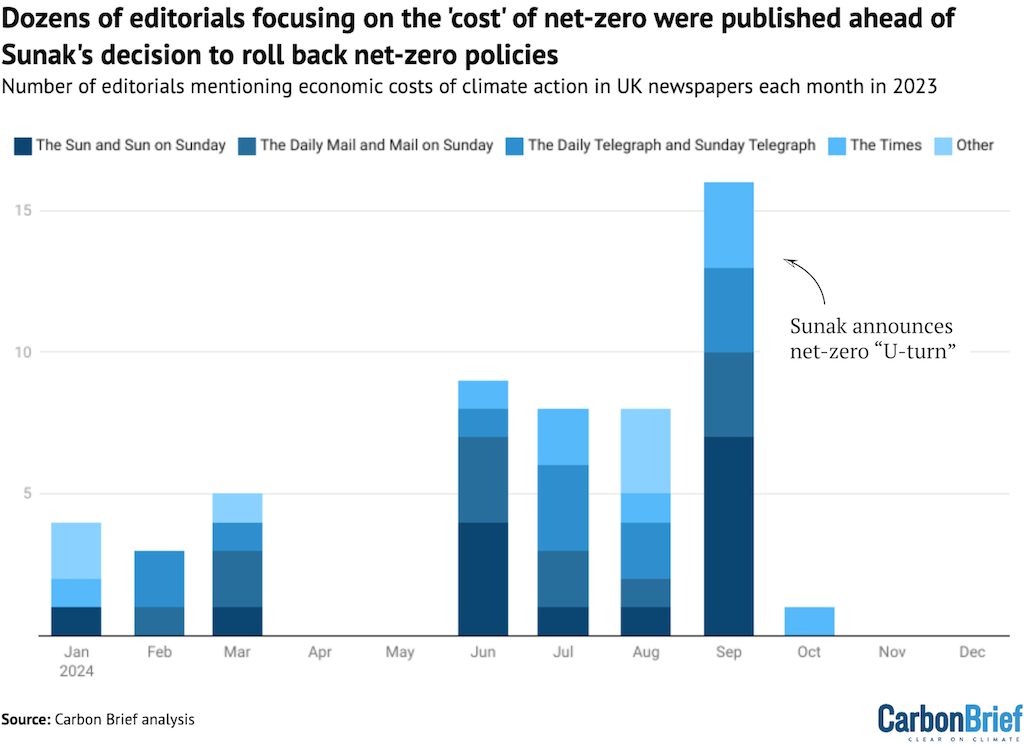
As the chart below shows, the speech followed a flurry of editorials warning of the costs of net-zero. After Sunak’s announcement, these editorials almost stopped entirely.
Monthly number of editorials mentioning the cost of climate action in UK newspapers in 2023. Source: Carbon Brief analysis.
Left-leaning and centrist publications rejected the notion that net-zero policies would inevitably place an economic burden on people in the UK.
The Guardian noted that, while “reaching net-zero will be costly and disruptive”, this just made it vital to have a “well-thought-out plan to share the cost equitably”. The Financial Times made the case for “green growth”, stating:
“True leadership…would involve finding ways to carry voters with [Sunak] through the challenges ahead and seizing on the green transition to rekindle growth and spur innovation.”
Sunak’s net-zero rollback was widely perceived by the UK press as an attempt to put “clear blue water” between himself and Keir Starmer, the leader of the opposition Labour party.
Meanwhile, there was a concerted effort in the right-leaning press to discredit Labour’s two flagship climate announcements – namely, pledges to spend £28bn each year on “green” investment and to stop issuing new oil-and-gas licences.
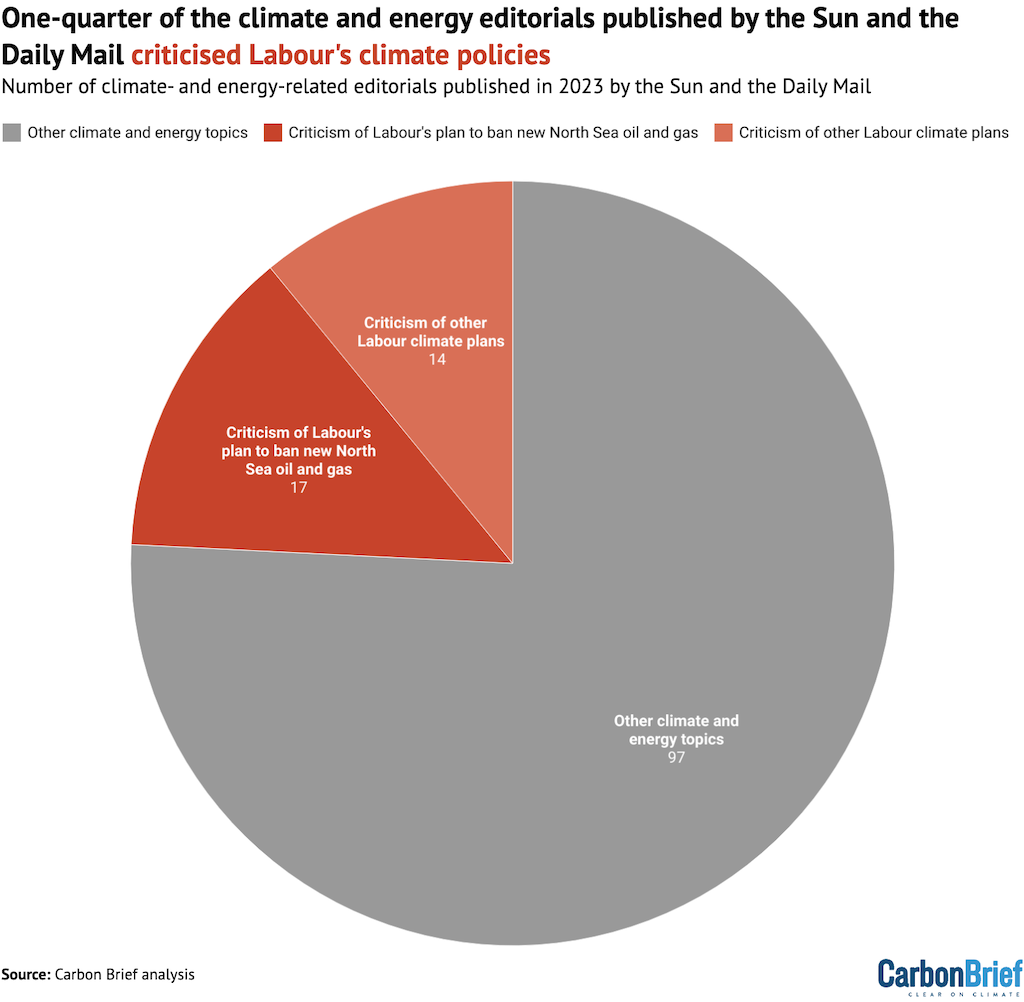
This was particularly evident in the Sun and the Daily Mail, the UK’s two most widely read national newspapers. Of the 128 climate- or energy-related editorials from these newspapers captured in Carbon Brief’s database last year, 31 took aim at Labour’s climate proposals.
Number of climate- and energy-related editorials published in the Sun and the Daily Mail in 2023 that focused on criticising Labour’s plans to end new North Sea oil and gas licensing (dark red) and other Labour climate policies (light red). The grey area represents other climate- and energy-related editorials in those newspapers that did not focus on Labour. Source: Carbon Brief analysis.
The debate around North Sea oil and gas was a major talking point last year, with many right-leaning editorials stating that new drilling licences would be vital for the UK’s energy security. (After a surge of interest in 2022, fracking was virtually forgotten last year, with just two editorials mentioning it in 2023.)
Labour officially announced in May that it planned to stop all new oil-and-gas developments.
Right-leaning newspapers responded by implying that environmental activist group Just Stop Oil and low-carbon energy tycoon Dale Vince were responsible for setting Labour’s policies. This claim was based on the fact that Vince, who had financially supported Just Stop Oil, had also given £1.5m to Labour.
In total, there were 16 editorials in the Sun, the Sun on Sunday and the Daily Mail about Vince’s support for Just Stop Oil and Labour. They described Vince as “bankrolling” Labour and helping to “dictate its green agenda”, framing Labour as “allies” of Just Stop Oil and “in their pocket”.
(Vince’s £1.5m in donations to Labour were spread over 10 years. The Labour Party has received donations totalling nearly £30m in the most recent 12 months for which official data is reported. The Conservatives have received £43m over the same period.)
These narratives were later picked up by then net-zero secretary Grant Shapps, who wrote a letter to Starmer in July concerning Vince’s support, and called Labour the “political wing of Just Stop Oil”.
(Responding to criticism, Starmer said in August that Labour would honour existing North Sea licences and maintain oil-and-gas fields “for decades to come”. He called Just Stop Oil’s more radical demands “contemptible”. Vince announced in October he would stop funding Just Stop Oil.)
More broadly, there was also an effort to frame Labour’s “green” policies as what the Sun called a “turn-off for much of the electorate”. This was particularly true following the Uxbridge by-election in July, where the Labour London mayor Sadiq Khan’s anti-air pollution policy, the ultra-low emissions zone (ULEZ), was viewed as significant in Labour narrowly missing out on winning the seat.
There were also many editorials throughout 2023 attacking shadow net-zero secretary Ed Miliband, with the Sun stating:
“Labour wanted to gamble a monstrous £28bn a year in borrowed money on a ‘green industrial revolution’ dreamed up by Ed Miliband, a man voters rejected in 2015 as incompetent.”
Climate activists have been a major target for right-leaning newspapers in recent years, especially since Extinction Rebellion’s mass protests in 2019.
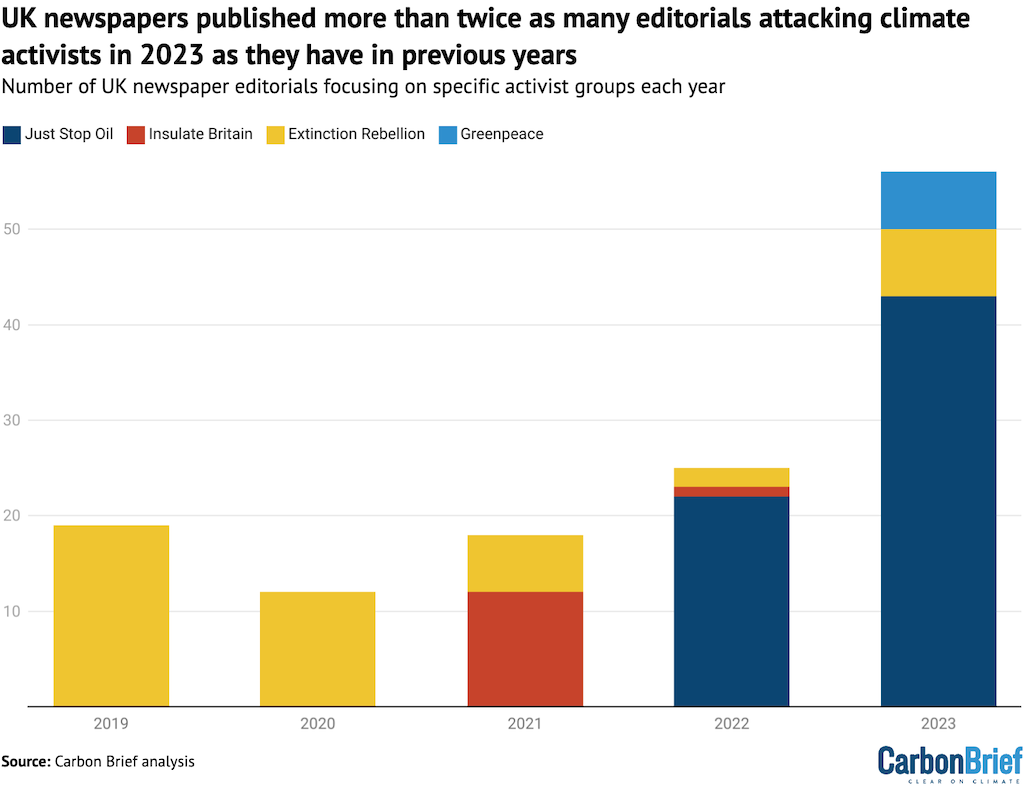
Yet their hostility towards climate activists reached new levels last year. There were 56 editorials taking aim at these groups, with 43 of these targeting Just Stop Oil. As the chart below shows, this is more than double the previous record of 25, set in 2022.
Editorials in the Sun and the Daily Mail described Just Stop Oil as a “criminal cult”, “eco-loons” and “deranged”. The Sun devoted entire editorials to targeting individual activists for taking flights or driving a car to the supermarket to buy fruit.
Number of editorials in right-leaning UK newspapers criticising climate activist groups between 2019 and 2023. Source: Carbon Brief analysis.
In a year that saw the government introduce strict and controversial new legislation to crack down on protests, UK newspapers were vocal in their support for tougher treatment of climate activists.
Prior to new penalties being introduced under the Public Order Act, a Times editorial about Just Stop Oil protests stated that “the law is as asinine as the tactics of those narcissists”.
The Sun, meanwhile, said the police were “too busy with fashionable woke causes and politely escorting Just Stop Oil protesters to bother with catching crooks”.
Methodology
This is a 2023 update of previous analysis conducted for the period 2011-2021 by Carbon Brief in association with Sylvia Hayes, a PhD researcher at the University of Exeter. The 2022 update can be found here.
The full methodology can be found in the original article, including the coding schema used to assess the language and themes used in editorials concerning climate change and energy technologies.
The analysis is based on Carbon Brief’s editorial database, which is regularly updated with leading articles from the UK’s major newspapers.
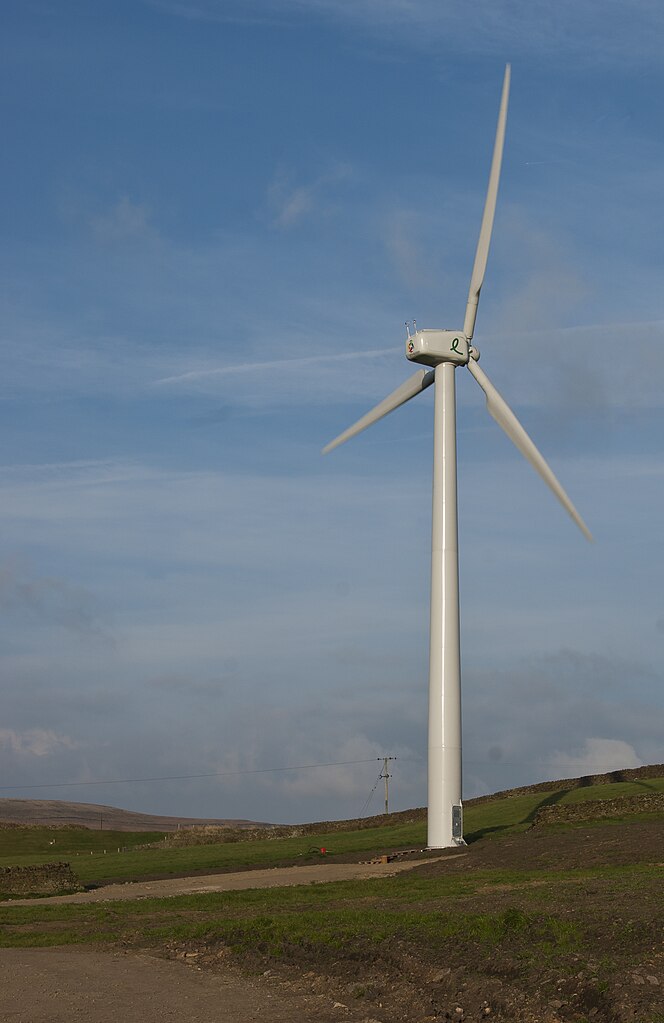
Analysis of the government’s renewable energy planning database shows that no applications for new onshore wind projects have been submitted since the prime minister, Rishi Sunak, claimed that the government would overturn the onshore wind ban in September 2023.
At the time, the National Infrastructure Commission advised the government to go further and restore onshore wind to the government’s Nationally Significant Infrastructure Projects process, which would encourage more applications.
The government rejected this recommendation and said the measures announced in September were enough.
Analysis by Carbon Brief estimates that if onshore wind had continued to be built at the same rate it was in 2017 – before the ban started to come into effect – 7GW of onshore wind would have been built. This would have knocked £5.1bn off energy bills, or £182 for each UK household, in the year from July 2022 to June 2023.
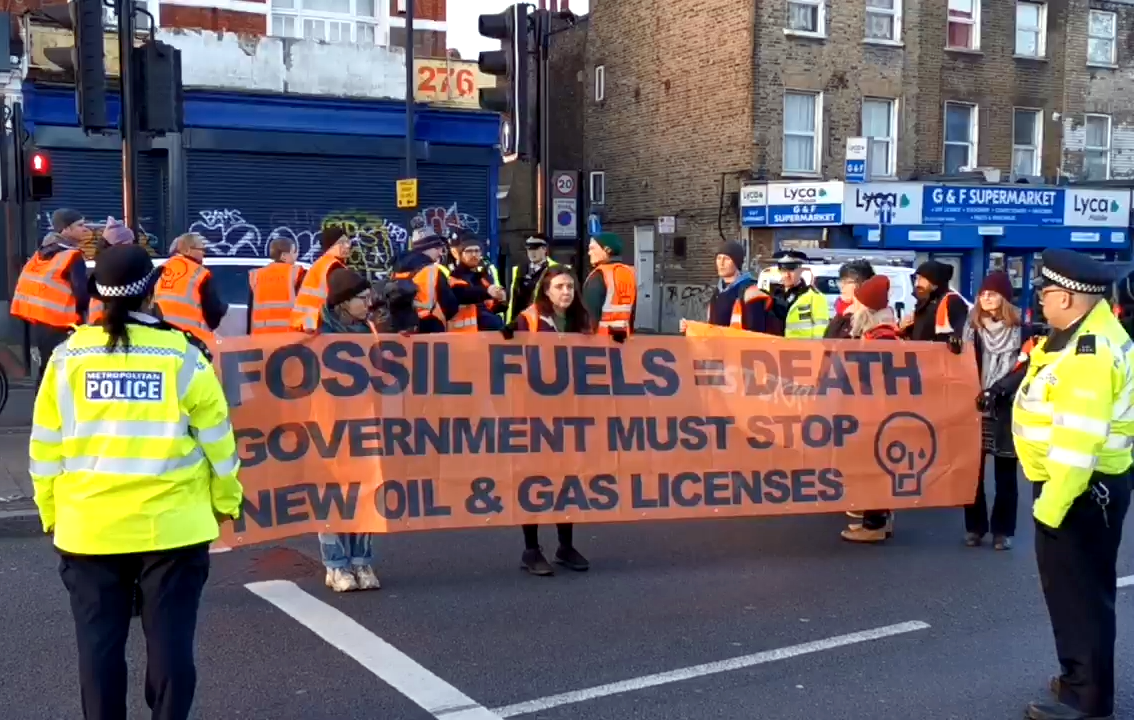
Just Stop Oil protesting in London 6 December 2022.
“It will always be profit over people and planet for polluters,” said one campaigner. “Shell simply cannot be trusted—with either their own meager targets or our futures.”
Shell announced Wednesday that it is raising payouts to wealthy shareholders and scrapping plans to cut oil production by up to 2% annually, a move that environmental groups said lays bare the futility of relying on fossil fuel corporations to voluntarily curb their climate-destroying activities.
The London-based company, which more than doubled its annual profits last year, said in a press release that it now intends to “achieve cash flow longevity” by keeping oil production stable until 2030 and boosting gas production, even as scientists say a rapid phaseout of fossil fuels is necessary to avert global climate destruction.
“It is unacceptable that Shell is betting on even more short-term returns to appease shareholders,” said Sjoukje van Oosterhout, Climate Case Shell’s lead researcher. “Shell is now throwing in the towel on reducing oil production and even scaling up gas production.”
Shell also announced Wednesday that it is hiking its dividend by 15%, a change that’s set to take effect this quarter. In an additional gift to shareholders, the company said it plans to buy back at least $5 billion of its own stock in the second half of 2023.
“Record profits, off the back of the energy crisis, should be boosting up green investment,” Jonathan Noronha-Gant, a senior campaigner at Global Witness, said in a statement Wednesday. “Instead it’s shareholder pay-outs and a doubling down on climate-wrecking fossil fuels.”
Shell had previously said its oil and gas production would fall by 1-2% each year through 2030. But as Bloombergreported, Shell justified the newly announced shift by claiming it “achieved its initial output-reduction plan—announced in 2021 amid a focus on cutting carbon emissions—faster than anticipated.”
Noronha-Gant called Shell’s announcement a “climate bombshell” that “exposes the hollowness behind the setting of such a target.”
“It will always be profit over people and planet for polluters,” Noronha-Gant said Wednesday. “Shell simply cannot be trusted—with either their own meager targets or our futures.”
Others responded with similar outrage. Climate scientist Bill McGuire wrote on Twitter that Shell CEO Wael Sawan “knows exactly what the consequences of this decision are.”
“People will die—are already dying,” McGuire tweeted. “I want to see him jailed—along with all the other CEOs who have been unequivocally complicit in crimes against humanity. And so should you.”
We can’t rely on oil companies that knowingly caused the #ClimateCrisis to do the right thing voluntarily…
If they have to decide between their economic bottom line and the survival of our communities, their greed will win out every time.https://t.co/3hm25DQugh
— Climate Justice Alliance (CJA) 🌻 (@CJAOurPower) June 14, 2023
Shell’s announcement comes weeks after Carbon Brief released an analysis highlighting the oil giant’s tacit admission that limiting warming to 1.5°C by the end of the century means an “immediate end to fossil fuel growth.”
“Shell had previously claimed that oil and gas production could rise for another decade, even as warming was limited to 1.5°C,” Carbon Brief observed. “The dramatic shift in its new ‘Energy Security Scenarios’ is not explicitly acknowledged, but… is hidden in plain sight.”
“The immediate end to fossil fuel growth in Shell’s new 1.5°C scenario marks a dramatic shift from its earlier work, which had squared the circle between limiting warming to 1.5°C and continuing to expand oil and gas production by invoking implausibly-large forest expansion,” Carbon Brief added.
Shell insisted Wednesday that it is “aiming to achieve near-zero methane emissions by 2030” and “net-zero emissions by 2050,” but research released earlier this week showed that such commitments are often meaningless because companies rarely outline specific steps they plan to take to achieve their stated targets.
Last month, Friends of the Earth Netherlands published a report accusing Shell of overstating its spending on renewable energy solutions by including “the sale of flowers and sandwiches at its gas stations” in the total, along with “biofuels with a high carbon footprint.”
“The company continues to contribute to catastrophic climate change,” the group concluded.