[Guardian] Exclusive: Document ‘falls far short’ of what is needed to safeguard lives and livelihoods from heat, drought and storms, say experts
The government’s plan to cope with the climate crisis has been condemned as “very weak” by experts, who say not enough is being done to protect lives and livelihoods.
Responding to the document, which was leaked to the Guardian, one highlighted its failure to adequately protect people in the UK from extreme heat. The heatwave in 2022, when temperatures surpassed 40C for the first time, led to the early deaths of more than 3,000 people, wildfires, buckled rail lines and farmers struggling with drought. Southern Europe is in the grip of a searing heatwave.
Another expert said there was a “yawning gap” in measures to restore nature, which is a vital part of adapting to climate change.
The National Adaptation Programme is expected to be published on Tuesday by the Department for Environment, Food and Rural Affairs (Defra), which is required by law to produce a plan every five years. In March, the government’s official advisers, the Climate Change Committee, said its publication would be a “make-or-break moment”.
Ministers have been criticised for years over the failure to make adequate plans for the impacts of global heating. The CCC said in March that the UK was “strikingly unprepared” and that there had been a “lost decade” in action on adaptation. It said heatwaves, droughts, floods and storms would intensify in the coming years until carbon emissions reached net zero.
…
Tag: Climate Change Committee
Leaked UK government plan to protect against climate heat ‘very weak’
UK should quit ‘climate-wrecking’ energy treaty, say official advisers
The UK should quit a controversial energy treaty to stop it delaying vital climate action and triggering huge taxpayer payouts to fossil fuel companies, according to the government’s official advisers.
The energy charter treaty (ECT) is a system of secret courts that enables companies to sue governments over policies that would cut their future profits. Companies have sued over phasing out coal-fired power stations, ending offshore oil drilling and banning fracking. The UK’s Climate Change Committee said Britain should withdraw from the ECT because recently proposed reforms did not go far enough.
The UK and Japan are the only major economies not to have committed to exiting the ECT. France, Germany, Spain and others have already said they will leave and the EU is set to pull out en masse after saying that staying would “clearly undermine” climate targets.
…
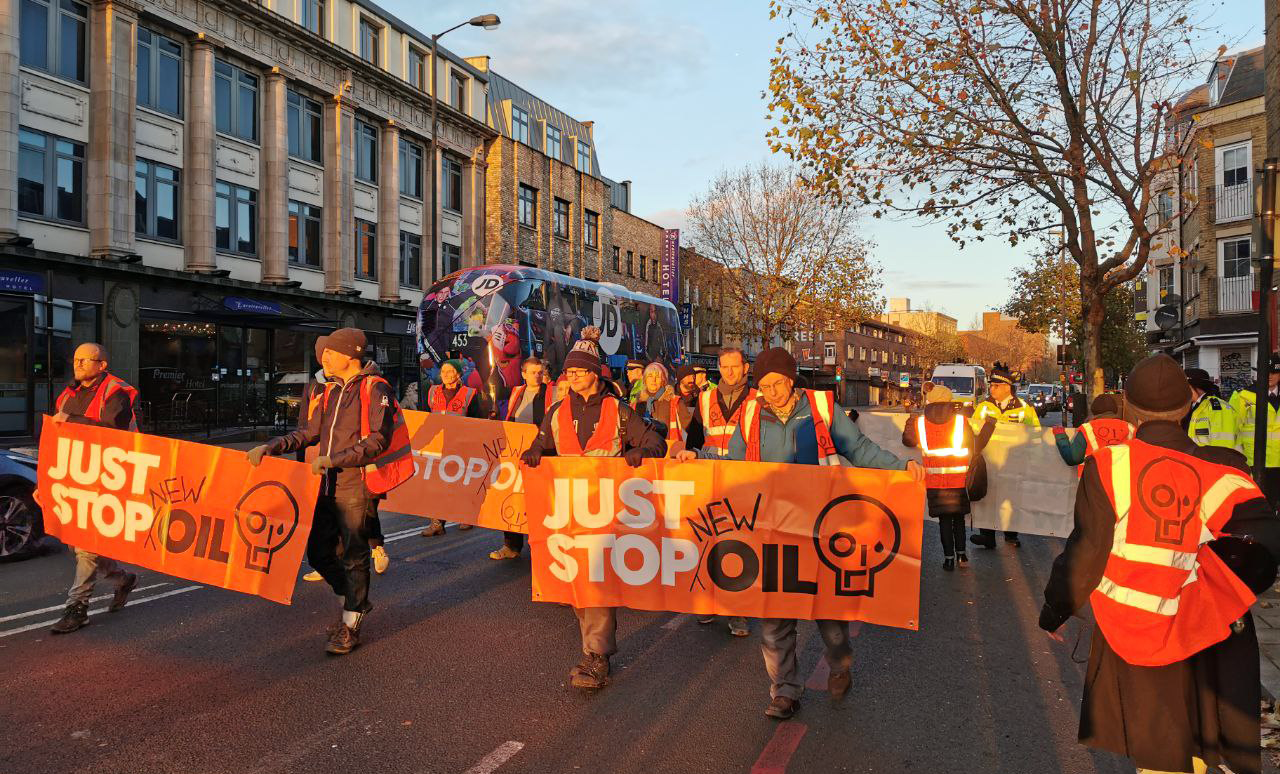
Just stop the need for Just Stop Oil, says climate adviser

Just Stop Oil protest A scathing report from the independent Climate Change Committee has condemned government’s slow progress.
Lord Deben, the outgoing chairman of the UK’s climate advisory board, is not a personal fan of the protest group Just Stop Oil. “I do not think it promotes the cause which we all have,” he said this week. But as his Climate Change Committee (CCC) released its new report, he called on the government to listen to the group’s demands and remove the need for protest in the first place.
“Governments and oppositions ought to recognise why it happens,” he said. “It happens because a very, very large number of people, many of them young, really do feel that their whole lives are threatened because governments are not leading, not taking up the challenge, not moving fast enough, not keeping [a 1.5C limit to global warming] within possibility, not, in other words, doing what they ought to do if they are to meet the needs of our population and the population of the world.”
Deben was speaking at a press briefing for the CCC’s latest progress report, released on Wednesday (28 June). The statutory document says that the current Conservative government is failing to make sufficient progress towards the UK’s legally binding net-zero goals. Energy and climate experts described its findings as “damning”.
…
NIC and CCC call for urgent action to protect infrastructure from climate risks
The two organisations have written jointly to ministers on the urgent need for action on climate adaptation
The National Infrastructure Commission and Climate Change Committee have written jointly to government urging ministers to take steps to improve the resilience of key infrastructure services to the effects of climate change.
Building on recent reports by both organisations, the advisory bodies set out five steps to accelerate national adaptation planning to protect key networks:
- Setting clear and measurable goals for resilience, and action plans to deliver them
- Ensuring these standards are developed in time to inform forthcoming regulatory price control periods (which set investment levels for operators)
- Giving explicit duties for resilience to all infrastructure regulators
- Cabinet-level oversight of interdependencies and whole-system resilience
- Embedding resilience in infrastructure planning as we move to an economy more reliant on electricity
The letter was sent to Oliver Dowden MP, Deputy Prime Minister and Chancellor of the Duchy of Lancaster, and Thérèse Coffey MP, Secretary of State for Environment, Food and Rural Affairs yesterday (26 April).
…
We must face up to neoliberalism’s flaws if we’re to halt climate breakdown
OPINION: Tackling the climate crisis effectively requires transition to a more fair and sustainable global economy
Original article by Paul Rogers republished from OpenDemocracy under a Creative Commons Attribution-NonCommercial 4.0 International licence.
The Climate Change Committee (CCC) delivered a report this week that is especially sobering in light of the fact that the committee is an independent, statutory body, established under the Climate Change Act 2008. The CCC is not just a think tank. Its function is “to advise the UK and devolved governments on emissions targets and to report to Parliament on progress made in reducing greenhouse gas emissions and preparing for and adapting to the impacts of climate change”.
Funded by the government, the committee is developing a reputation for being surprisingly blunt when it comes to government policy.
This was amply demonstrated in this week’s report, covered in some detail by the Environment Journal and neatly summed up by a single paragraph:
Simply put, the National Adaptation Programme (NAP) – which should respond to the scale of the challenge – falls well short. According to the CCC, it lacks a clear vision for the future, is not underpinned by tangible targets, and is not driving policy changes or steps towards implementation. If this does not improve then wider measures, including the net zero journey and restoration of biodiversity and ecosystems, will also fail.
Just a day later, the government delivered its revised plan to meet its climate change targets, with a heavy emphasis on carbon capture and nuclear power. It was received with relief by the oil and gas industry, but with a singularly large raspberry by environmental analysts.
By coincidence, the week also saw a study published following research by Australian climate scientists. As reported in The Guardian, it predicted: “Melting ice around Antarctica will cause a rapid slowdown of a major global deep ocean current by 2050 that could alter the world’s climate for centuries and accelerate sea level rise.”
This is just one of several reports on recent research showing that radical and rapid decarbonisation is now vital if climate breakdown and chaos are to be avoided. The reports raise two vital questions: What does rapid decarbonisation involve in practice? And what are the chances of success?
Back in 2020, the Intergovernmental Committee on Climate Change (IGCC) estimated that to limit global temperature rises to 1.5°C, a 7% decline in carbon dioxide output was needed every year for the whole decade. That has already failed for the first three years of the 2020s and a per annum decrease of about 10% is now needed, equivalent to a 60% decrease overall.
The likes of carbon capture and more nuclear power for the richer states are simply a non-starters
On the question of how to achieve this, Kevin Anderson, professor of energy and climate change at the universities of Manchester (UK), Uppsala (Sweden) and Bergen (Norway), and co-founder of the Climate Uncensored website, spells out what is required in the Scientists for Global Responsiblity’s journal, Responsible Science.
He writes that a starting point is that the world’s major emitters, the wealthier states, must get to zero carbon emissions by 2030 to 2035 to allow the poorer states extra time to follow suit. On this timescale, the likes of carbon capture and more nuclear power for the richer states are simply a non-starters. It would take far too long to reach net zero using these methods.
So what would this involve for a country such as the UK? Anderson sketches out a few examples, starting off with an immediate moratorium on airport expansion and an 80% cut in air travel by 2030. No new internal combustion engine cars would be built after 2025, and there would be a huge shift away from private cars in urban areas and towards public transport and active travel (such as walking and cycling). There would be a nationwide retrofit on all existing housing stock “rolling it out street by street at mass scale”, and new housing would be built to “passive house” standards.
Anderson underpins the whole process by a massive expansion of electrification across the entire energy system, with an obvious emphasis on wind, solar and other renewables, already cheaper than coal, oil or gas.
There is much more to Anderson’s article, so you should read it yourself, but three elements stand out. The first is that what is required is, in effect, a ‘Marshall Plan’ for a greened world. He uses the term to indicate the ambition necessary rather than, as in the original, the US helping Europe.
That brings us to the second element – the money to effect that change must come from the richer sectors of society right across the world. Although Anderson does not spell it out in detail, these cannot just be the super-rich, the ultra-high net worth individuals who now number close to 600,000 worldwide. It must also include the many millions more who are merely ‘high-net-worth’ people on a global scale.
This questions the very basis of the current economic model, but that won’t come as a surprise to anyone who has looked in any detail at what needs to be done. A frequent conclusion is that neoliberalism just isn’t fit for purpose when it comes to wealth distribution, and it is also not able to respond to climate breakdown at anything like the speed that is needed.
For his third point, Anderson points to some of the benefits that would follow in the wake of the changes. They include the elimination of fuel poverty; improved and warmer homes that are cheaper to run; better internal and external air quality; high-quality, reliable public transport; quieter urban spaces with more room for playing fields, parks and recreation; and plenty of skilled jobs supporting the green transition.
We might add that it also means finally facing up to the deep flaws in neoliberalism, especially those market fundamentalist dimensions that simply cannot, by their nature, respond to climate breakdown .
We might not meet Anderson’s timetable, but we will have no option over the next decade but to come very close to it, since the alternative of a chaotic global climate will be increasingly evident.
In any case, look at it this way. Not only will we get on top of climate breakdown, but we will start the transition to a fair and sustainable global economy. That really is something worth aiming for.
Original article by Paul Rogers republished from OpenDemocracy under a Creative Commons Attribution-NonCommercial 4.0 International licence.