Prime Minister Andy Burnham speaks to staff at the met office in Exeter, to discuss the UK’s ongoing response to extreme heat, wildfires and drought, August 14, 2026
Burnham urged to stand up to the fossil fuel giants and reject plans to drill Britain’s largest untapped oil fields
PRIME MINISTER Andy Burnham was urged to stand up to profiteering fossil fuel giants and reject plans to drill Britain’s largest untapped oil field as consultations on them drew to a close today.
Labour faces a key environmental test as the final decision over the future of the Rosebank oil field, which lies about 80 miles west of Shetland, is left with ministers.
Production at both Rosebank and Jackdaw had been approved by the previous Conservative government, but those decisions were quashed after a legal challenge from Greenpeace, leaving the government to decide whether or not drilling should go ahead.
The decision on the two projects comes after a summer that has seen soaring temperatures and devastating wildfires in both Britain and Europe.
Environmentalists warn that allowing the development of the Jackdaw gas field off the coast of Aberdeen, whose consultation ended last week, would produce more than 250 million tonnes of CO2 — equivalent to 70 per cent of Britain’s annual emissions.
Greenpeace campaigner Maja Darlington said: “The PM wants to be pragmatic, but there is nothing pragmatic about watching communities be battered by climate chaos while the Prime Minister flirts with expanding the very industry driving it.
“More drilling means more heatwaves, more droughts, more wildfires, and more suffering for the communities Burnham represents. The climate crisis is already hitting working people hardest — firefighters on the front line, bus drivers exposed to inhumane heat, nurses collapsing on the job.
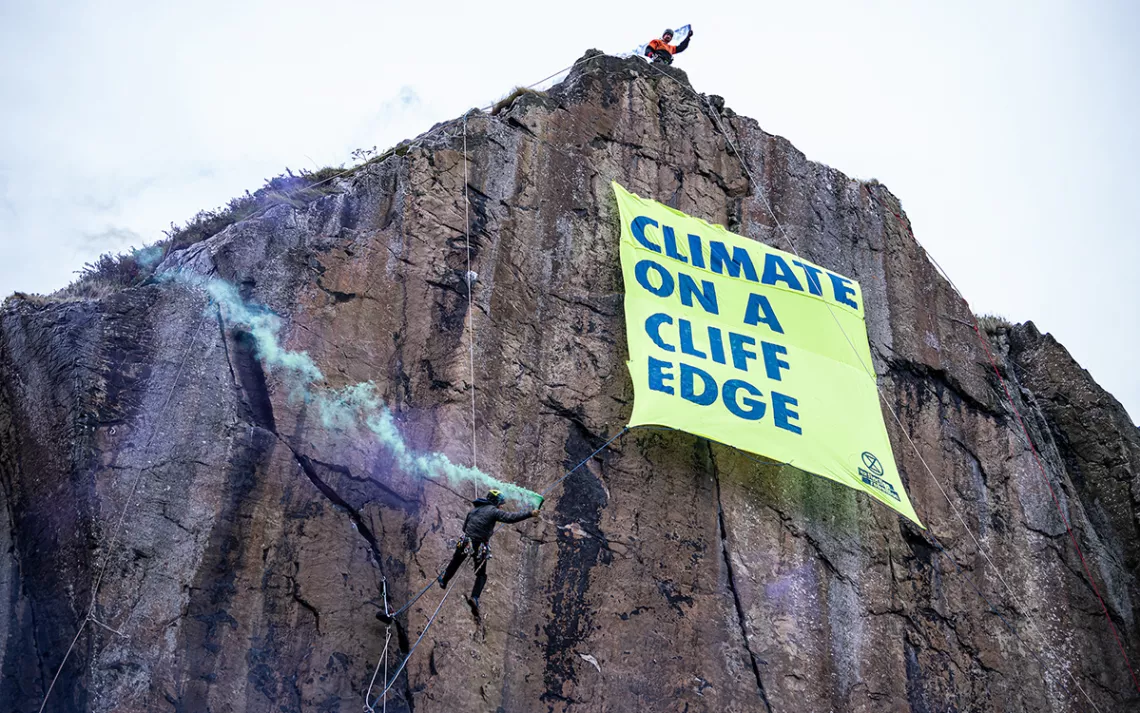
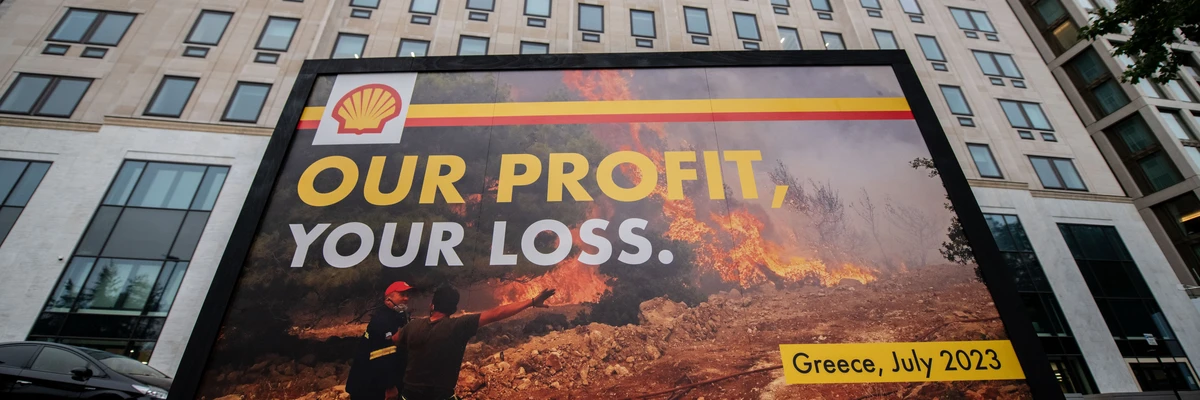
Experienced climbers scale a rock face near the historic Dumbarton castle in Glasgow, releasing a banner that reads “Climate on a Cliff Edge.” One activist, dressed as a globe, symbolically looms near the edge, while another plays the bagpipes on the shores below. | Photo courtesy of Extinction Rebellion and Mark RichardsGreenpeace activists display a billboard during a protest outside Shell headquarters on July 27, 2023 in London. (Photo: Handout/Chris J. Ratcliffe for Greenpeace via Getty Images)Orcas comment on killer apes destroying the planet by continuing to burn fossil fuels.
Climate activists from Greenpeace and Uplift during a demonstration outside the Scottish Court of Session, Edinburgh, on the first day of the Rosebank and Jackdaw judicial review hearing, November 12, 2024
STICK to the spirit of Labour’s manifesto commitments, climate campaigners told the Prime Minister as the public consultation on Rosebank closes on Monday.
Stop Climate Chaos Scotland (SCCS) demanded Andy Burnham block proposed new North Sea oil fields, claiming their lifetime carbon emissions could result in up to 65,495 excess heat deaths by the end of this century.
Made up of more than 70 organisations with a total of about one million supporters, SCCS wrote an open letter to Mr Burnham and his Energy Secretary Miatta Fahnbulleh ahead of the consultation closure for Rosebank, the largest untapped oil field in the North Sea which lies some 80 miles north-west of Shetland.
A similar exercise for the planned Jackdaw gas field, which lies in waters about 150 miles east of Aberdeen, finished on August 10.
Production for both fields had been approved by the previous Conservative government, but a legal challenge from Greenpeace has now left the current government to decide whether or not drilling should go ahead.
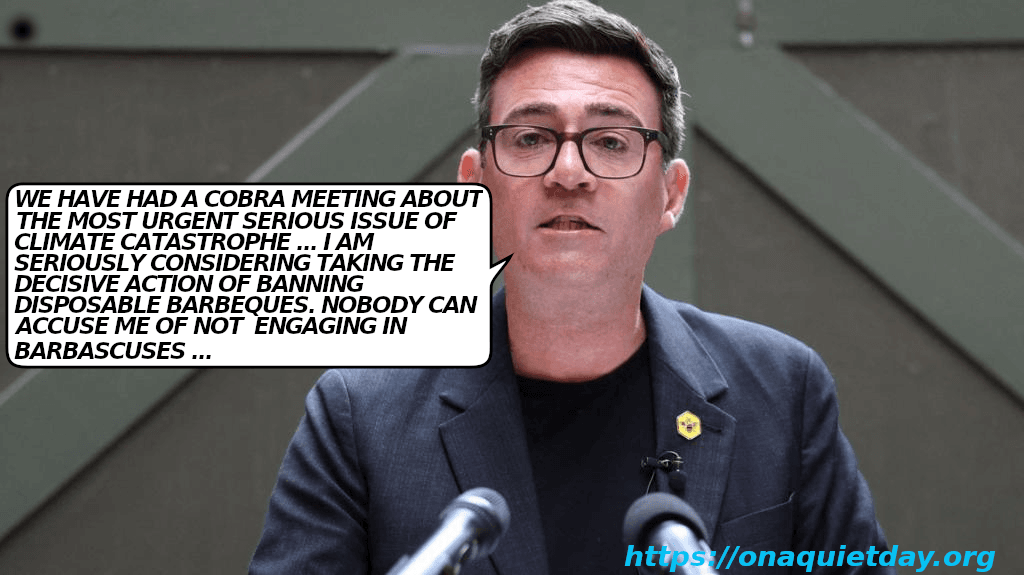
SCCS reminded the new PM, who recently issued a temporary ban on the sale of disposable barbecues and brought in the military to help deal with wildfires, that 2,700 excess deaths were linked to heatwaves in May and June alone.
Experienced climbers scale a rock face near the historic Dumbarton castle in Glasgow, releasing a banner that reads “Climate on a Cliff Edge.” One activist, dressed as a globe, symbolically looms near the edge, while another plays the bagpipes on the shores below. | Photo courtesy of Extinction Rebellion and Mark RichardsDonald Trump urges you to be a Climate Science denier like him. He says that he makes millions and millions for destroying the planet, Burn, Baby, Burn and Flood, Baby, Flood.Nigel Farage urges you to ignore facts and reality and be a climate science denier like him and his Deputy Richard Tice. He says that Reform UK has received £Millions and £Millions from the fossil fuel industry to promote climate denial and destroy the planet.
A burned field of wheat in Eton Wick, Windsor, in July. Experts say the UK should regenerative agriculture approaches to increase food resilience. Photograph: Maureen McLean/REX/Shutterstock
Rejecting North Sea drilling licences and protecting nature are just some measures Andy Burnham must implement to ready country
From record-smashing temperatures, wildfires, hosepipe bans and thousands of premature deaths, the climate crisis has left its mark across the summer of 2026.
Tackling the root cause – the burning of fossil fuels – and ending the crisis will take years. So will fixing the UK government’s calamitousfailure to protect lives and livelihoods against the long-predicted affects of global heating.
But the climate emergency is right here, right now, and here are 10 policies that Andy Burnham’s government should consider announcing urgently.
1. Reject drilling licences for the Jackdaw and Rosebank oil and gasfields
This would be a vital and confidence-boosting sign that the UK is committed to putting a rocket-booster under the clean, green and very fast-growing economy of the 21st century, not the fossil-fuelled one of the last. It would also give diplomatic weight to the UK as it works internationally to cut emissions and end the climate crisis.
The supposed benefits of approving the North Sea oil and gasfields are mostly fantasy. They will have no impact on UK energy prices – oil and gas are commodities whose price is set by international markets. As the UK Energy Research Council says: “Assertions that drilling the North Sea will provide energy resilience and affordability in the face of current fuel price shocks are a delusion.”
As for jobs, the licences would support very few – again, unlike the growing green economy. Some also argue North Sea production is less carbon intensive than imports, but that ignores the far cleaner record of our main gas importer, Norway, as well as the methane emissions from LNG, and in any case the differences are small compared with CO2 savings of using renewable energy and storage instead of gas.
2. Increase windfall tax on fossil fuel giants to pay for adaptation measures
…
3. Make grey water reuse mandatory in new buildings and incentivise rainwater harvesting
…
4. Bring the water industry under national control
…
5. Invest in proper equipment for firefighters
…
6. Implement a maximum workplace temperature
…
7. Fund cool spaces in every community
…
8. Launch a national retrofit programme
Homes in the UK are among the draughtiest and least energy-efficient in Europe. This means they are often too hot in summer and too cold in winter, leading to high bills and spiralling carbon emissions.
Efforts to persuade the private sector to take on the challenge of making homes fit for the changing climate have failed. But a report earlier this year suggested councils could take the lead on a retrofitting programme backed by national government. Under the plan, councils would train and employ their own retrofitting workforce and, starting with key public services such as hospitals and care homes, then work through council and social housing before moving on to privately owned homes. The report said it would not only make the country’s homes and public services more climate resilient, but it would also tackle the cost of living, create secure jobs and stimulate growth. They added it would also be a more efficient way of spending the public funds already allocated for insulation.
9. Plant more trees and protect existing nature
…
10. Encourage regenerative agriculture approaches to increase food resilience
Andy Burnham addresses the climate crisis by considering banning disposable barbecues.Nigel Farage urges you to ignore facts and reality and be a climate science denier like him and his Deputy Richard Tice. He says that Reform UK has received £Millions and £Millions from the fossil fuel industry to promote climate denial and destroy the planet.Orcas comment on killer apes destroying the planet by continuing to burn fossil fuels.
dizzy:
11. Make private jets and superyachts history
…
12. Tax the rich so much that they’re not able to destroy the planet
The rich hugely drive climate breakdown. Tax them out of existence.
13. Recognise Carbon Capture and Storage as a false solution and abandon it
…
14. End all fossil fuel subsidies
…
15/8/26 9.50pm
15. Abandon nuclear power
Nuclear is far too expensive, too centralised and takes far too long. Renewables is the way to go and will create far more employment for more people.
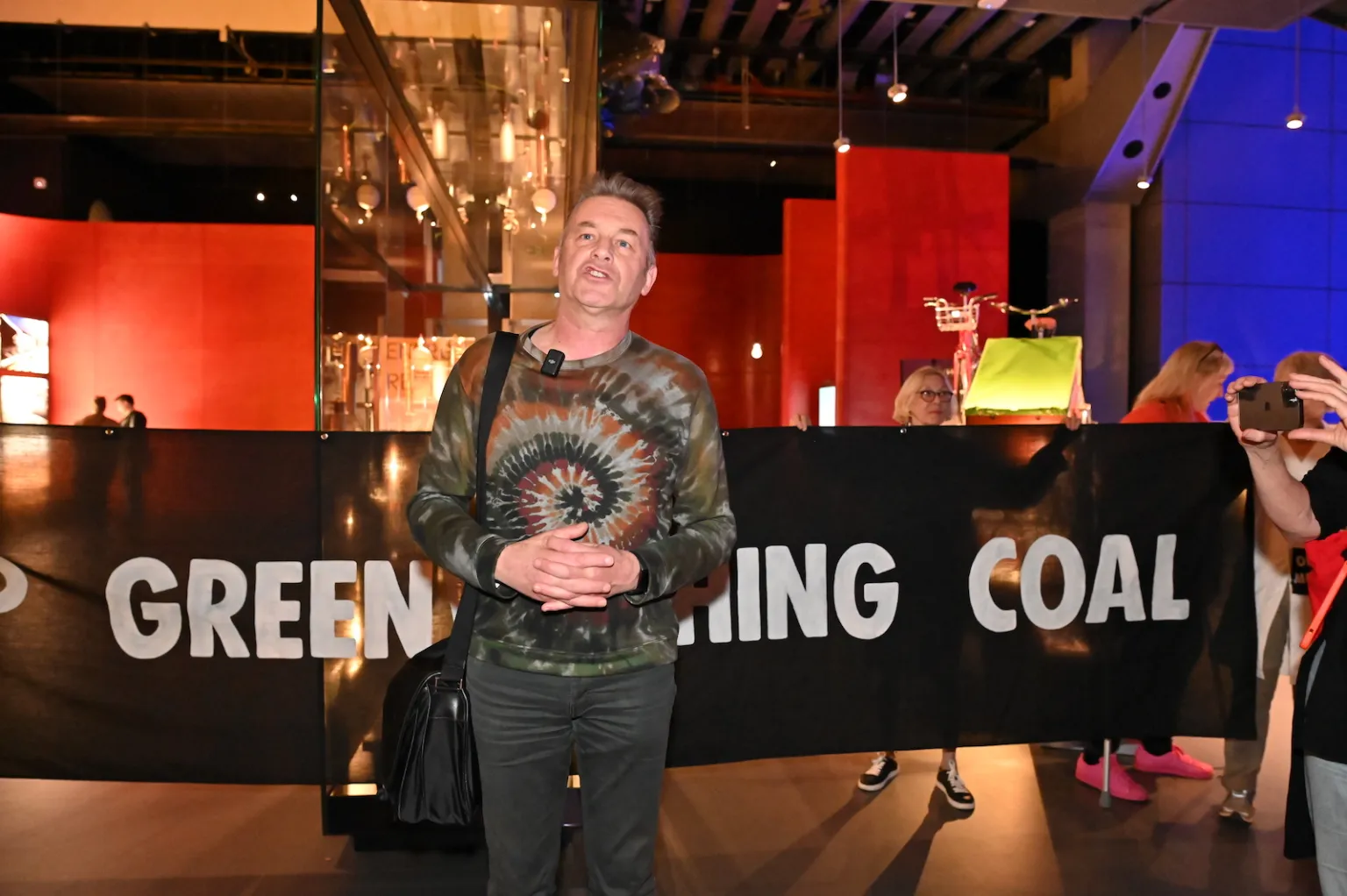
As I have already noted today, The Times has chosen to question whether Chris Packham is really autistic, despite the fact that he has a diagnosis saying that he is. I have already discussed some aspects of this issue. I also think it is worth asking why they have done this.
I stress that question because I cannot know the motivation of those involved. I have no access to the editorial discussions at The Times, and I am not suggesting that I do. But newspapers make choices. They decide whom to feature, what questions to ask, which doubts to amplify and what associations they want their readers to make. So asking why Chris Packham has become a target is entirely reasonable.
There are, I think, several possible explanations, and they obviously overlap, creating a credible explanation as a consequence.
The first is that Chris Packham is becoming an important figure in British public life. He is no longer simply a television presenter who talks about wildlife. Increasingly, he appears to be assuming the mantle that Sir David Attenborough wore for decades.
That matters. Attenborough acquired authority because millions of people trusted him. He could talk about the destruction of the natural world in a way that politicians could not because people did not think of him as a politician. They thought of him as someone who knew what he was talking about.
Packham has some of that authority, but there is an important difference. He is more explicitly political. He does not simply say that a species is disappearing or that an ecosystem is under threat. He asks why that is happening, who is responsible and what we should do about it. That makes him potentially threatening to some powerful interests.
Packham is a prominent advocate of action on climate change. He challenges the fossil fuel economy. He questions environmentally destructive forms of agriculture. He supports environmental protest. More broadly, he challenges the idea that the pursuit of profit should take priority over the survival of the ecosystems on which human beings depend.
…
Chris Packham’s diagnosis tells us nothing about whether he is right about climate change. The evidence on climate change stands or falls on its own merits. If The Times, or anyone else, disagrees with what Packham says about the climate, biodiversity, fossil fuels or the environment, there is an obvious response available to them. They should challenge his arguments. But what they should not do is challenge who he is, or seek to undermine him, and others, by doing so. That is not just unethical, it provokes prejudice to support profit at cost to many.
We should not be surprised that profit is promoted at cost to many. That is what extractive capitalism does. That is not a flaw in its design. It is what it is designed to do. The well-being of millions and maybe billions of people have been sacrificed to that false god over decades and maybe centuries. But should Chris Packham be added to that list, to be discarded by being discredited because he asks awkward questions? I think not. And that is why this case matters.
Green party leader Zack Polanski (Green Party of England and Wales). Image: Bristol Green Party Creative Commons CC0 1.0 Universal Public Domain Dedication.
As the consultation on Jackdaw, a major North sea oil and gas project ends, the Green Party leader calls out Prime Minister Burnham’s ‘weasel words’ on approval of more North Sea drilling and says it is a clear breach of Labour’s manifesto pledge.
Last week, the Green leader called an emergency press conference to urge Andy Burnham to act, and was joined by a firefighter, a GP and an ex soldier, all outlining the devastating impact the climate crisis is having in their areas of public service. Sky News have reported that the Government has rejected his call for COBR to be reconvened, with the Government ‘insisting supply chains are resilient’.
Zack Polanski said,
“We are now facing the fifth heatwave in months following the recent deaths of 3,000 people in our country from extreme weather conditions.”
“This is the greatest crisis this country has faced since the Second World War and to complacently dismiss the demands for immediate action by saying everything is under control is gross negligence, blatantly untrue and misses the severity of the crisis”
“Only days after dedicated public servants talked about the need for urgent action, backed up by indisputable science, to secure our food supplies and the health of the most vulnerable, the Labour government says it’s all in hand, and supply chains are resilient.”
On the ending of the consultation for Jackdaw, Zack Polanski says,
“In the midst of a heatwave fuelled by the climate crisis, the science is clear that more North Sea drilling would be a dereliction of duty by Labour. Whatever weasel words are used on drilling within new or existing licences, one of the new Prime Minister’s first significant decisions would be to break Labour’s manifesto pledge.
“In their own analysis, Jackdaw’s owners have themselves said that only 27 direct full time jobs would be created if given the go ahead.
“This has nothing to do with boosting the economy for the people of this country and far more to do with boosting obscene profits for fossil fuel companies and their shareholders. I made clear in my press conference last week, that’s why this needs to be treated for the serious crisis it is, with financial support for homes to keep cool and for fossil fuel giants to pay the costs of extreme weather adaptation.”
Donald Trump urges you to be a Climate Science denier like him. He says that he makes millions and millions for destroying the planet, Burn, Baby, Burn and Flood, Baby, Flood.Nigel Farage urges you to ignore facts and reality and be a climate science denier like him and his Deputy Richard Tice. He says that Reform UK has received £Millions and £Millions from the fossil fuel industry to promote climate denial and destroy the planet.Elon Musk urges you to be a Fascist like him, says that you can ignore facts and reality then.
Prime Minister Andy Burnham will chair a meeting of the government’s emergency Cobra committee on Wednesday to discuss the UK’s response to the extreme heat, as temperatures are set to soar again.
A No 10 spokesperson said the government understood firefighters, farmers and NHS staff were all facing challenges connected to the weather.
This week’s latest heatwave comes as more areas in England were placed under drought status on Monday and firefighters continue to battle a significant wildfire in the New Forest in Hampshire.
The Met Office has issued a rare amber extreme heat warning, external for Thursday, with temperatures peaking in the mid-to-high 30s across the Midlands and south-east of England, and a high of 38C possible
It comes as the record for the number of days reaching 30C in any year in the UK has been broken, according to the Met Office, with Sunday the 35th day of the year so far.

 Prime Minister Andy Burnham speaks to staff at the met office in Exeter, to discuss the UK’s ongoing response to extreme heat, wildfires and drought, August 14, 2026