Tag: CO2

  • We Must All Rise Together to Keep Fossil Fuels in the Ground

    Spread the love

    N.B. This is a strong statement from Scientist Rebellion. Original article by Scientist Rebellion at Common Dreams shared under Creative Commons (CC BY-NC-ND 3.0).

    Two scientists locked-on at the Museum of Sciences in Valencia, Spain on December 9, 2023 as the COP28 climate talks took place in Dubai, UAE. (Photo: Courtesy of Scientist Rebellion)

    This disastrous COP28 must be the end of vague political promises. The people of Earth are on to the lies.

    The United Nations climate summit, hijacked by the fossil fuel cartel, has gifted a blank check to rich countries and Big Oil to kill one billion people and force billions more to flee their homes by 2100. The so-called ‘historic’ outcome of COP28 fails to deliver the most basic and necessary measures which would have prevented societal and ‘earth systems’ collapse, as outlined by the IPCC: eliminate fossil fuel subsidies and halt all new gas and oil projects. Instead, the new resolution includes numerous loopholes which will allow polluters to greenwash emissions through fictional carbon capture, meaningless carbon credits, and the re-classification of methane (“natural gas”) as a transition fuel. But to remain under 2°C of warming, we cannot afford to burn the fossil fuels we already have in reserve, let alone drill for more. COP28 has taken a few tentative steps in the right direction, but only thanks to the blood and sweat of many people on the frontline of our climate crisis. The summit’s overall trend to support “business as usual” will result in further delays in meaningful climate action and condemn us to miss “the brief and rapidly closing window of opportunity to secure a livable and sustainable future for all.

    Wealthy countries have once again manipulated the climate summit in order to advance their ecocidal colonialism. Rich nations have been pillaging the natural resources of poorer ones for centuries and have used their fuels to emit far more than their share of CO2. They bear the lion’s share of responsibility to decarbonize first and fastest and provide much-needed funding to poorer nations, which are already heavily impacted by the escalating climate crisis. Instead, rich countries are racing in the opposite direction: the US, Canada, and just three other countries are responsible for more than half of planned oil and gas expansion. UN governance failure is also to blame here, however, and urgently needs addressing. Even if COP had succeeded in a commitment to phase out fossil fuels, it could not be implemented without a binding treaty and enforcement mechanisms. Additionally, COP must demand reporting of any conflicts of interest and ban fossil fuel executives and lobbyists from tainting any more climate summits.

    The Loss & Damage Fund could be an important first step, but without proper financing, it is condemned to fail. Loss and damage already costs more than $400 billion annually, but COP28 has only pledged $429 million in initial funding—a mere 0.1% of what is needed just for this year. By contrast, governments are using $7 trillion of our money every year to subsidize fossil fuels (despite the 1 in 5 deaths12 million people annually—caused by air pollution alone) while the oil industry rakes in obscene profits.

    That said, even a fully-financed Loss and Damage Fund can never fix a dysfunctional economic system which is fundamentally flawed, is based on endless growth, overconsumption, and extractivism, and is guaranteed to accelerate the global crisis. Studies have demonstrated that greenhouse gas emissions are firmly linked to resource exploitation and GDP growth. We have no choice but to create an economic system which aligns with the goals of a fair and equal transition, because the current one has failed both humans and all other 10 million life forms on this planet. Implementing a low-carbon economy is cheaper than sustaining the catastrophic costs of climate change, but the need to maintain and grow profit is preventing any progress. Profit will never fix what profit has created.

    1.5°C is dead, and 2°C will be dead by 2050, if not earlier, if we continue down this path. 2023 was the hottest year on record; we passed 2.0°C for the first time in history, and 2024 is projected to be even hotter. Human behaviors inflict massive planetary stress beyond the burning of fossil fuels. “20 of the 35 planetary vital signs are now showing record extremes.”

    We cannot entrust the fight for all life to the very politicians, companies, and markets that forced us into this existential crisis in the first place and who are right now brutally marching us off the cliff. This disastrous COP28 marks the end of vague political promises. The people of Earth are on to the lies. It is time to listen to the scientists, hundreds of whom have been driven out of their labs and into the streets to engage in civil disobedience: if we want to avoid condemning both this generation and all that follow to the worst outcomes of the climate crisis, we must all rise together in order to keep fossil fuels in the ground. The time is now.

    Original article by Scientist Rebellion at Common Dreams shared under Creative Commons (CC BY-NC-ND 3.0).

    • Scientist Rebellion Scientist Rebellion is a member-led organization of scientists from around the world advocating for action on the climate crisis. With no centralized leadership they have local groups in over 30 countries who perform advocacy, organize demonstrations, and take part in civil disobedience.
  • ‘Call to Action’: CO2 Now at Levels Not Seen in 14 Million Years

    Spread the love

    Original article by OLIVIA ROSANE republished from Common Dreams under Creative Commons (CC BY-NC-ND 3.0). 

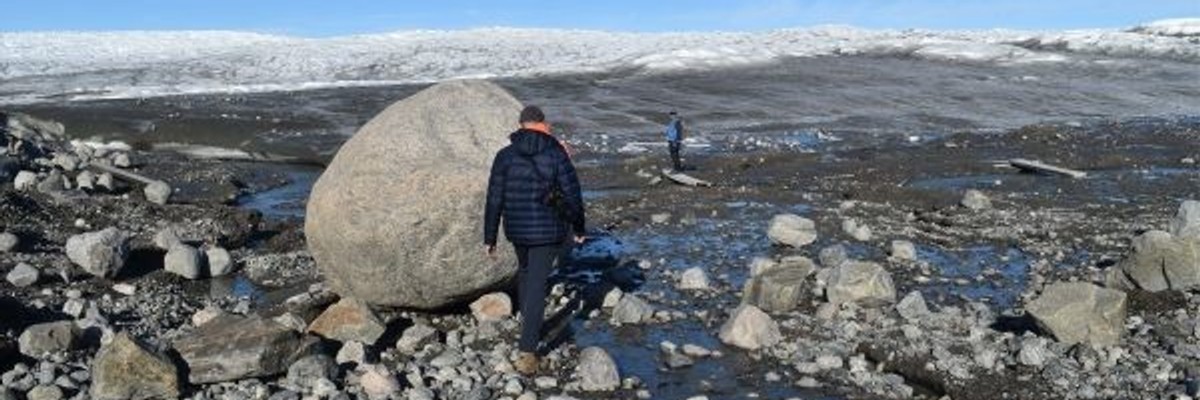
    An image shows the edge of the Greenland ice sheet, where recent melting has left bare ground.  (Photo: Kevin Krajick/Columbia University)

    “It really brings it home to us that what we are doing is very, very unusual in Earth’s history,” the lead author of a new study said.

    The last time that levels of atmospheric carbon dioxide were as high as they are today, Greenland was free of ice and the savanna and grassland ecosystems where humans evolved didn’t exist yet.

    That’s the conclusion of a study published in Science Friday, which researchers say compiles “the most reliable data available to date” on atmospheric carbon dioxide levels over the last 66 million years.

    “It really brings it home to us that what we are doing is very, very unusual in Earth’s history,” lead author Baerbel Hoenisch of the Columbia Climate School’s Lamont-Doherty Earth Observatory toldAgence France-Presse.

    “We’ve already pushed the atmosphere way beyond anything we’ve seen as a species.”

    By burning fossil fuels and clearing natural carbon sinks like forests, industrial capitalism has raised global carbon dioxide levels to 419 parts per million (ppm) today from around 280 ppm at the beginning of the industrial revolution.

    “Rising atmospheric CO2 is the most obvious and startling expressions of our impact on the global environment,” study corresponding author and University of Utah geologist Gabe Bowen wrote on social media. “The concentration has risen by ~50% in the past 100 years. Every year is now marked by the highest CO2 levels *ever observed* by humans!”

    https://twitter.com/bumbanian/status/1732897217558761726?ref_src=twsrc%5Etfw%7Ctwcamp%5Etweetembed%7Ctwterm%5E1732897217558761726%7Ctwgr%5E9d2adf4c509a751a46ba844c58d670922c80fba4%7Ctwcon%5Es1_c10&ref_url=https%3A%2F%2Fwww.commondreams.org%2Fnews%2Fc02-levels-14-million-years

    To understand how such a spike in carbon dioxide might impact Earth’s climate and ecosystems, it’s helpful to look at the pa st. This presents challenges, however, because the most reliable record of past carbon dioxide concentrations—gas bubbles preserved in ice cores—only goes back to around 800,000 years ago, when atmospheric concentrations of carbon dioxide were still at around preindustrial levels.

    “Once you lose the ice cores, you lose direct evidence. You no longer have samples of atmospheric gas that you can analyze,” Bowen said in a University of Utah press release. “So you have to rely on indirect evidence, what we call proxies. And those proxies are tough to work with because they are indirect.”

    Proxies are evidence in the geologic record that can stand in for carbon dioxide levels, such as mineral isotopes or the shape of fossilized leaves. Scientists have looked at these proxies before, but the current study represents the most comprehensive effort to date. A team of around 90 researchers from 16 countries spent seven years synthesizing and reviewing previous work under the banner of the Cenozoic CO2 Proxy Integration Project, according to the University of Utah and AFP.

    The new study represents the scientific consensus on the carbon dioxide record, and it concludes that the last time carbon dioxide levels were around 419 ppm was 14 million years ago. That’s much earlier than previous estimates of 3 to 5 million years ago.

    However, the record goes back further than that to the Cenozoic Era, when the dinosaurs died and mammals began to emerge.

    That record revealed a very clear pattern, Bowen tweeted: “CO2 goes up, the world warms. CO2 down, and things get icy.”

    https://twitter.com/bumbanian/status/1732897230368194885?ref_src=twsrc%5Etfw%7Ctwcamp%5Etweetembed%7Ctwterm%5E1732897230368194885%7Ctwgr%5E9d2adf4c509a751a46ba844c58d670922c80fba4%7Ctwcon%5Es1_c10&ref_url=https%3A%2F%2Fwww.commondreams.org%2Fnews%2Fc02-levels-14-million-years

    The record enabled the scientists to predict the consequences of current and projected carbon dioxide levels.

    “This is an incredibly important synthesis and has implications for future climate change as well, particularly the key processes and components of the Earth system that we need to understand to project the speed and magnitude of climate change,” University of Utah biology professor William Anderegg said in the press release.

    One of the report’s messages, Bowen tweeted is that “the future is now.”

    “We’ve already pushed the atmosphere way beyond anything we’ve seen as a species,” Bowen continued, “and if it stays this way we’re in for big changes in the environment we live in.”

    If policy-makers don’t restrict the burning of fossil fuels, atmospheric carbon dioxide could reach 600 to 800 ppm by 2100, AFP reported. According to the record, the last time levels were this high was 30 to 40 million years ago, when Antarctica was also ice-free and the Earth was home to giant insects.

    Even today’s concentrations are bound to have lasting consequences. For example, when carbon dioxide levels rapidly increased around 56 million years ago, it significantly altered ecosystems and took around 150,000 years to decrease again.

    “We are in this for a very long time,” Hoenisch told AFP, “unless we sequester carbon dioxide, take it out of the atmosphere, and we stop our emissions sometime soon.”

    However, the that doesn’t mean the most extreme changes are locked-in. Instead, Bowen tweeted that the report was a “call to action.”

    “The geological changes we studied lasted for thousands and millions of years,” Bowen said, “and if human-induced CO2 change is short-lived it won’t have as big an impact on the climate.”

    Original article by OLIVIA ROSANE republished from Common Dreams under Creative Commons (CC BY-NC-ND 3.0). 

  • Fossil CO₂ emissions hit record high yet again in 2023

    Spread the love

    Pep Canadell, CSIRO; Corinne Le Quéré, University of East Anglia; Glen Peters, Center for International Climate and Environment Research – Oslo; Judith Hauck, Universität Bremen; Julia Pongratz, Ludwig Maximilian University of Munich; Philippe Ciais, Commissariat à l’énergie atomique et aux énergies alternatives (CEA); Pierre Friedlingstein, University of Exeter; Robbie Andrew, Center for International Climate and Environment Research – Oslo, and Rob Jackson, Stanford University

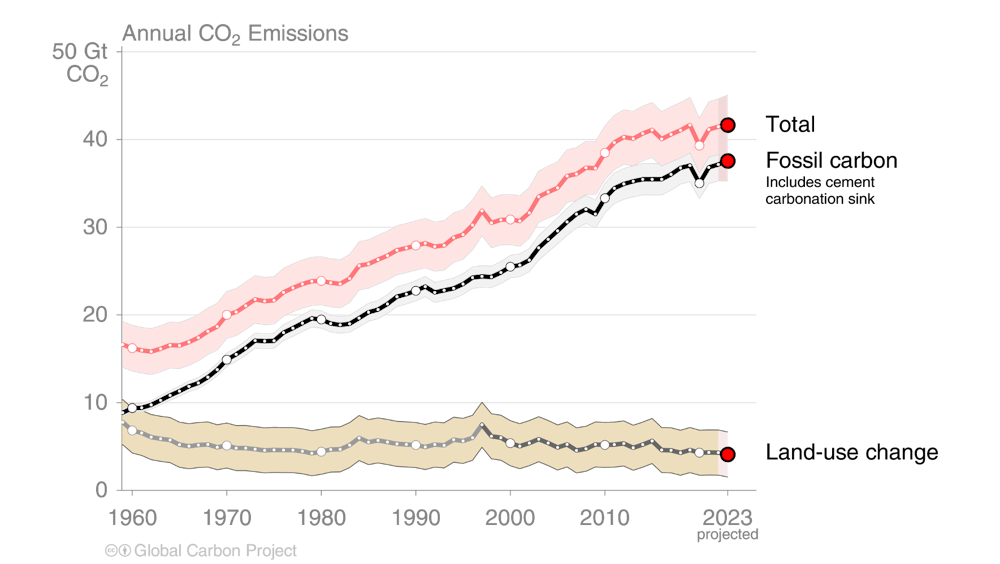
    Global emissions of fossil carbon dioxide (CO₂), in yet another year of growth, will increase by 1.1% in 2023. These emissions will hit a record 36.8 billion tonnes. That’s the finding of the Global Carbon Project’s 18th annual report card on the state of the global carbon budget, which we released today.

    Fossil CO₂ includes emissions from the combustion and use of fossil fuels (coal, oil and gas) and cement production. Adding CO₂ emissions and removals from land-use change, such as deforestation and reforestation, human activities are projected to emit 40.9 billion tonnes of CO₂ in 2023.

    The world’s vegetation and oceans continue to remove about half of all CO₂ emissions. The rest builds up in the atmosphere and is causing increasing warming of the planet.

    At current emission levels, the remaining carbon budget for a one-in-two chance to limit warming to 1.5°C will likely be exceeded in seven years, and in 15 years for 1.7°C. The need to cut emissions has never been so urgent.

    Emissions from every fossil source are up

    Fossil CO₂ emissions now account for about 90% of all CO₂ emissions from human activities. Emissions from every single fossil source increased this year compared to 2022:

    • coal (41% of global CO₂ emissions) up 1.1%
    • oil (32%) up 1.5%
    • natural gas (21%) up 0.5%
    • cement (4%) up 0.8%.
    Line graph showing emissions from fossil fuels, land-use changes and total emissions from 1960 to 2023
    All fossil fuel sources are driving the increase in total CO₂ emissions.
    Global Carbon Budget 2023/Global Carbon Project, CC BY

    Although global emissions have increased, the picture for individual countries is more diverse. There are some signs of progress towards decarbonisation.

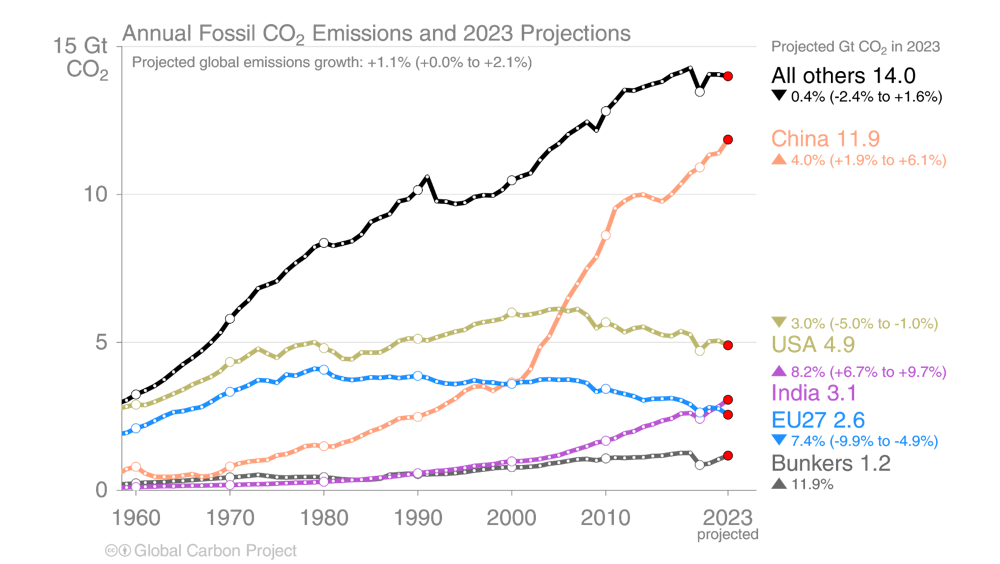
    China’s emissions (31% of the global total) increased by 4% with growth in all fossil fuel sources. The highest relative growth was from oil emissions. This was in part due to the transport sector’s recovery after COVID-19 pandemic shutdowns.

    The United States’ emissions (14% of global) are down by 3%. The rapid retirement of coal-fired power plants drove most of this decline. US coal emissions are the lowest since 1903.

    India’s emissions (8% of global) increased by 8.2%. Emissions for all fossil fuels grew by 5% or more, with coal the highest at 9.5%. India is now the world’s third-largest fossil CO₂ emitter.

    European Union emissions (7% of global) are down by 7.4%. This decline was due to both high renewable energy penetration and the impacts on energy supply of the war in Ukraine.

    During the decade of 2013-2022, 26 countries had declining fossil CO₂ emission trends while their economies continued to grow. The list includes Brazil, France, Germany, Italy, Japan, Portugal, Romania, South African, United Kingdom and USA.

    Emissions by individual countries from 1960 to 2023
    Individual country performances vary widely, but there are some signs of progress towards decarbonisation.
    Global Carbon Budget 2023/Global Carbon Project, CC BY

    Total CO₂ emissions are near a peak

    While fossil CO₂ emissions continue to increase, net emissions from land-use change, such as deforestation (CO₂ source), minus CO₂ removals, such as reforestation (CO₂ sink), appear to be falling. However, estimates of emissions from land-use change are highly uncertain and less accurate overall than for fossil fuel emissions.

    Our preliminary estimate shows net emissions from land-use change were 4.1 billion tonnes of CO₂ in 2023. These emissions follow a small but relatively uncertain decline over the past two decades.

    The declining trend was due to decreasing deforestation and a small increase in reforestation. The highest emitters are Brazil, Indonesia and the Democratic Republic of the Congo. These three countries contribute 55% of net global CO₂ emissions from land-use change.

    When we combine all CO₂ emissions from human activities (fossil and land use), we find very little trend in total emissions over the past decade. If confirmed, this would imply global CO₂ emissions from human activities are not growing further but remain at very high record levels.

    Stable CO₂ emissions, at about 41 billion tonnes per year, will lead to continuing rapid CO₂ accumulation in the atmosphere and climate warming. To stabilise the climate, CO₂ emissions from human activities must reach net zero. This means any residual CO₂ emissions must be balanced by an equivalent CO₂ removal.

    Nature’s a big help, with a little human help

    Terrestrial vegetation and ocean absorb about half of all CO₂ emissions. This fraction has remained remarkably stable for six decades.

    Besides the natural CO₂ sinks, humans are also removing CO₂ from the atmosphere through deliberate activities. We estimate permanent reforestation and afforestation over the past decade have removed about 1.9 billion tonnes of CO₂ per year.

    This is equivalent to 5% of fossil fuel emissions per year.

    Other non-vegetation strategies are in their infancy. They removed 0.01 million tonnes of CO₂.

    Machines (direct air carbon capture and storage) pulled 0.007 million tonnes of CO₂ out of the atmosphere. Enhanced weathering projects, which accelerate natural weathering processes to increase the CO₂ uptake by spreading certain minerals, accounted for the other 0.004 million tonnes. This is more than a million times smaller than current fossil fuel emissions.

    The remaining carbon budget

    From January 2024, the remaining carbon budget for a one-in-two chance to limit global warming to 1.5°C has been reduced to 275 billion tonnes of CO₂. This budget will used up in seven years at 2023 emission levels.

    The carbon budget for limiting warming to 1.7°C has been reduced to 625 billion tonnes of CO₂, with 15 years left at current emissions. The budget for staying below 2°C is 1,150 billion tonnes of CO₂ – 28 years at current emissions.

    Reaching net zero by 2050 requires total anthropogenic CO₂ emissions to decrease on average by 1.5 billion tonnes of CO₂ per year. That’s comparable to the fall in 2020 emissions resulting from COVID-19 measures (-2.0 billion tonnes of CO₂).

    Without additional negative emissions (CO₂ removal), a straight decreasing line of CO₂ emissions from today to 2050 (when many countries aspire to achieve net zero CO₂ or the more ambitious net zero for all greenhouse gases) would lead to a global mean surface temperature of 1.7°C, breaching the 1.5°C limit.

    Renewable energy production is at a record high and growing fast. To limit climate change fossil and land-use change, CO₂ emissions must be cut much more quickly and ultimately reach net zero.The Conversation

    Pep Canadell, Chief Research Scientist, CSIRO Environment; Executive Director, Global Carbon Project, CSIRO; Corinne Le Quéré, Royal Society Research Professor of Climate Change Science, University of East Anglia; Glen Peters, Senior Researcher, Center for International Climate and Environment Research – Oslo; Judith Hauck, Helmholtz Young Investigator group leader and deputy head, Marine Biogeosciences section a Alfred Wegener Institute, Universität Bremen; Julia Pongratz, Professor of Physical Geography and Land Use Systems, Department of Geography, Ludwig Maximilian University of Munich; Philippe Ciais, Directeur de recherche au Laboratoire des science du climat et de l’environnement, Institut Pierre-Simon Laplace, Commissariat à l’énergie atomique et aux énergies alternatives (CEA); Pierre Friedlingstein, Chair, Mathematical Modelling of Climate, University of Exeter; Robbie Andrew, Senior Researcher, Center for International Climate and Environment Research – Oslo, and Rob Jackson, Professor, Department of Earth System Science, and Chair of the Global Carbon Project, Stanford University

    This article is republished from The Conversation under a Creative Commons license. Read the original article.

  • Carbon Offsets 101: Why We Can’t Offset Our Way Out of the Climate Crisis

    Spread the love
    The buildings and steaming cooling towers of a coal-fired power plant behind a landscape park in Germany. Frank Bienewald / LightRocket via Getty Images

    https://www.ecowatch.com/carbon-offsets-climate-crisis.html

    … Carbon offsets are in theory a way to cancel out greenhouse gas emissions by funding an activity that will remove a supposedly equal amount of carbon dioxide from the atmosphere or prevent an equal amount of carbon pollution. They can be purchased by everyone from major companies pursuing net-zero emissions goals to individuals looking to compensate for high-carbon activities like flying. Typically, an institution or individual will purchase a certain amount of carbon credits, with one credit usually standing in for one metric ton of carbon dioxide — or what is typically emitted by driving 2,513 miles in a gas car — removed from the atmosphere. (That’s roughly the distance between San Francisco and Atlanta). Whoever buys the carbon credit is essentially buying the right to count the emissions reduction as theirs even if it’s being performed by a tree-planting or renewable energy project on the other side of the globe.

    Quick Facts

    • One carbon credit usually equals one metric ton of carbon dioxide supposedly removed from the atmosphere, or the equivalent of driving 2,513 miles in a gas-powered car.
    • The voluntary carbon market quadrupled in value between 2020 and 2021 to reach nearly $2 billion. 
    • The average tree absorbs 20 pounds of carbon dioxide each year during the first 20 years of its life.
    • Only four percent of carbon offset projects actively remove carbon dioxide from the atmosphere, as opposed to preventing additional emissions. 
    • More than 170 climate, environmental and Indigenous rights groups signed an open letter opposing carbon offsets. 
    • At least 52 percent of carbon-offset generating wind projects in India would have been built anyway.
    • California’s forest carbon offsets program likely overestimated its emissions reductions by at least 80 percent. 
    • A Ryanair program to offer passengers €1 carbon offsets only actually offset the company’s emissions by 0.01 percent. 
    • Sixty-six percent of highly-polluting companies studied relied on carbon offsets to meet their net zero targets.
    • There are only around 500 million hectares of land available for tree-planting carbon offset projects and Shell wants to claim 10 percent of it.

    They’re a Scam: One of the main criticisms of carbon offsets is that many projects don’t really do what they say they are going to do, namely, prevent additional emissions. A major ProPublica report published in 2019 reviewed 20 years of forest-preservation-based offset projects and found that “In case after case […] carbon credits hadn’t offset the amount of pollution they were supposed to, or they had brought gains that were quickly reversed or that couldn’t be accurately measured to begin with.” A 2021 study of wind farms in India found that at least 52 percent of the projects used to back offsets would have been constructed regardless and that therefore the selling of the offsets to polluting industries actually increased emissions. Two studies of California’s forest carbon offsets program found that it overestimated its emissions reductions by at least 80 percent. The dubious nature of many carbon-offset projects leads to charges of greenwashing, because fossil fuel or airline companies can use their purchasing of offsets to market themselves as being more sustainable than they really are. For example, a Ryanair program to charge its customers €1 to offset their flight only lowered the company’s emissions by 0.01 percent.

    They’re a Distraction From Reducing Emissions: Even if every carbon offset project worked exactly as advertised, however, it wouldn’t be an effective tool for fighting climate change. That’s because the climate crisis is caused by pumping greenhouse gas emissions into the atmosphere and will only be halted if emissions actually stop as well. Yet a 2021 study looking at net-zero pledges from the sectors responsible for 64 percent of greenhouse gas emissions found that 66 percent of them relied on carbon offsets. Oil, gas and mining companies were especially dependent on offsets for their net zero plans. 

    What everyone in the climate space can agree on is that the emphasis needs to move away from purchasing offsets and towards actually reducing fossil fuel emissions. At their best, offsets could be a stop-gap measure to fund beneficial projects and counteract emissions that there is not yet a technologically feasible way to reduce directly. At their worst, carbon offsets risk giving polluters an easy way to greenwash their image while continuing business as usual, actually increasing emissions through miscounting and reproducing the injustices underlying the climate crisis. Given that the current system tips more towards the latter than the former, it’s important for governments, companies and individuals to focus on not putting greenhouse gas emissions in the atmosphere in the first place. 

    Read the original article https://www.ecowatch.com/carbon-offsets-climate-crisis.html

  • Reform UK Party taken apart over inaccurate and bizarre climate science denial video

    Spread the love

    “Man catastrophically fails GCSE biology”

    The leader of Nigel Farage’s Reform UK Party has been rinsed over a video he posted on X in which he attempts to “challenge the climate change nonsense” by making a scientifically false claim which viewers have argued a primary school pupil could debunk.

    In what has been described as a bizarre and “eye-watering stupid” 41 second climate denial rant, leader of the right-wing populist political party, Richard Tice, attempts to claim that C02 is “plant food” and therefore “not a problem”.

     “C02, people make out that it’s some sort of poison,” says Tice in the video. “It’s not. It’s plant food. It’s responsible for photosynthesis, without which we get no plants, no food, we all die. You’ve got to challenge the mainstream narrative on this.”

    Scientists have proven how carbon dioxide in the atmosphere has increases by 50% due to human activities in less than 200 years, and that C02 in the atmosphere is responsible for warming the planet, therefore causing climate change.

    Viewers were quick to add a bit of context in the community notes under the video on X, which read: “CO2 is not regarded as a toxic pollutant and this has never been a part of the scientific case for reducing our emissions. Although the proportion of atmospheric CO2 is small, its effect on climate is well understood and backed up by an overwhelming scientific consensus.”

    Though Tice’s scientific illiteracy is also amusing, there is of course a huge danger in his spread of disinformation, as ‘Tice’s take’ on the climate attempts to legitimise further the continued drilling for new gas and oil.

    This is particularly revealing when you look at the funders to Nigel Farage’s Reform Party, which received a total of £135,000 from climate science deniers and fossil fuel interests in 2023.

    While all of Reform’s funders in 2023 were found to have oil and gas investments or ties to climate science denial, as revealed by the climate disinformation site DeSmog, helping to put Tice’s video into context.