Tag: CO2

  • ‘Time is Running Out,’ American Petroleum Institute Chief Said in 1965 Speech on Climate Change

    Spread the love

    BySharon Kelly on Nov 20, 2018 @ 15:48 PST

    Original article republished from DeSmog under their republishing agreement.
    The warning is clear and dire — and the source unexpected. “This report unquestionably will fan emotions, raise fears, and bring demand for action,” the president of the American Petroleum Institute (API) told an oil industry conference, as he described research into climate change caused by fossil fuels.

    “The substance of the report is that there is still time to save the world’s peoples from the catastrophic consequence of pollution, but time is running out.”

    The speaker wasn’t Mike Sommers, who was named to helm API this past May. Nor was it Jack Gerard, who served as API’s president for roughly a decade starting in 2008.

    The API president speaking those words was named Frank Ikard — and the year was 1965, over a half-century ago.

    It was the same year that Dr. Martin Luther King Jr. led a civil rights march from Selma to Montgomery, Muhammad Ali felled Sonny Liston in the first round, and Malcom X was fatally shot in New York. The first American ground combat troops arrived in Vietnam and President Lyndon B. Johnson signed the law establishing Medicaid and Medicare.

    It would be another four years before American astronaut Neil Armstrong first set foot on the moon — and another decade before the phrase “global warming” would appear for the first time in a peer-reviewed study.

    And 1965, according to a letter by Stanford historian Benjamin Franta published this week in the peer-reviewed journal Nature, was the year that President Johnson’s Science Advisory Committee published a report titled “Restoring the Quality of Our Environment,” whose findings Ikard described at that year’s annual API meeting.

    “One of the most important predictions of the report is that carbon dioxide is being added to the Earth’s atmosphere by the burning of coal, oil, and natural gas at such a rate that by the year 2000 the heat balance will be so modified as possibly to cause marked changes in climate beyond local or even national efforts,” Ikard presciently added, according to excerpts from his speech published in Nature.
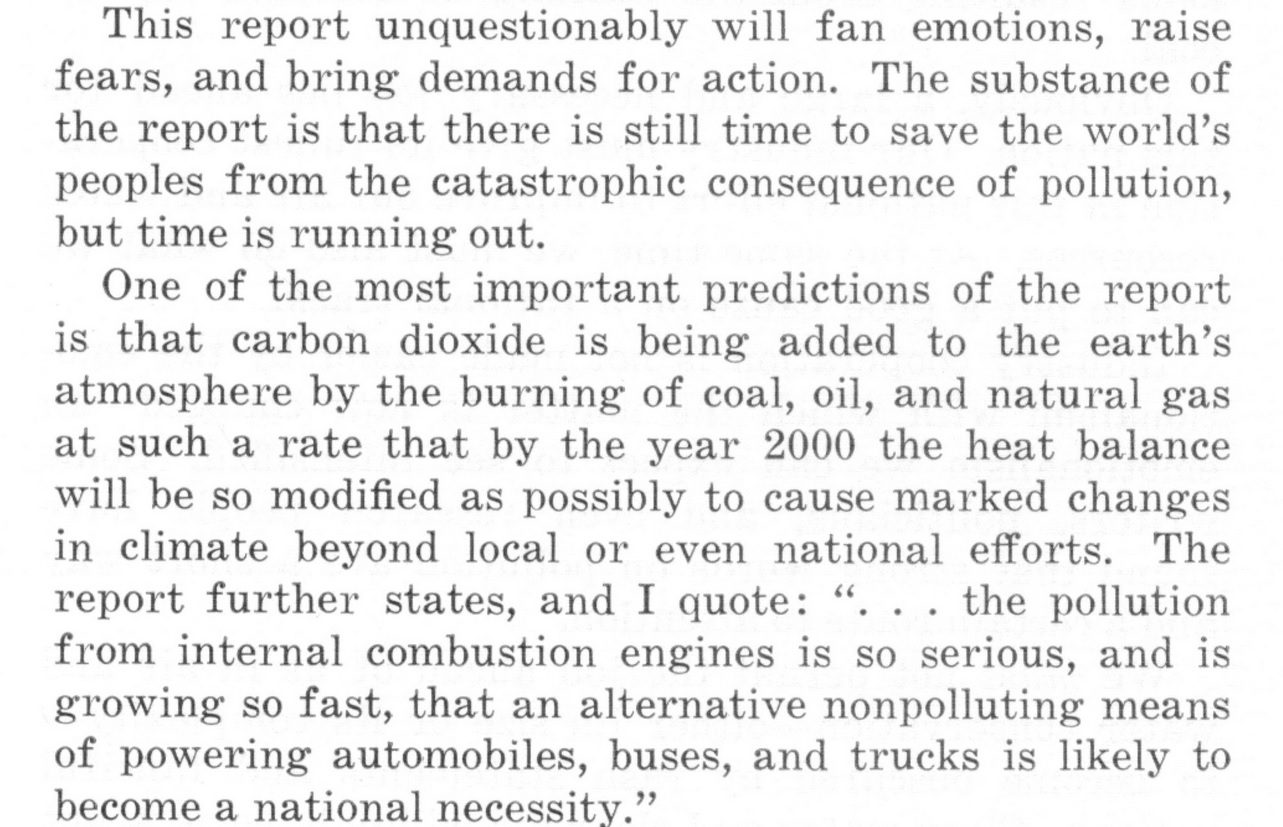
    Exerpt of API President Frank Ikard’s 1965 speech on climate change and fossil fuels.

    API Funded Early Research Linking CO2 and Fossil Fuels

    That prediction was based in part on information that was known to the oil industry trade group for over a decade — including research that was directly funded by the API, according to Nature.

    In 1954, a California Institute of Technology geochemist sent the API a research proposal in which they reported that fossil fuels had already caused carbon dioxide (CO2) levels to rise roughly five percent since 1854 — a finding that Nature notes has since proved to be accurate.

    API accepted the proposal and funded that Caltech research, giving the program the name Project 53. Project 53 collected thousands of CO2 measurements — but the results were never published.

    Meanwhile, other researchers were reaching similar conclusions. Nuclear physicist Edward Teller became known in 1951 as the “father of the hydrogen bomb” for designing a thermonuclear bomb that was even more powerful than the atomic bombs dropped in Hiroshima and Nagasaki. Teller warned the oil and gas industry in 1959 about global warming and sea level rise in a talk titled “Energy Patterns of the Future.”

    “Carbon dioxide has a strange property,” Teller said in excerpts published earlier this year by The Guardian. “It transmits visible light but it absorbs the infrared radiation which is emitted from the earth. Its presence in the atmosphere causes a greenhouse effect.”

    A researcher at Humble Oil Co. (now known as ExxonMobil) checked results from a study of carbon isotopes in tree rings against the unpublished Caltech results, and found that the two separate methods essentially agreed.
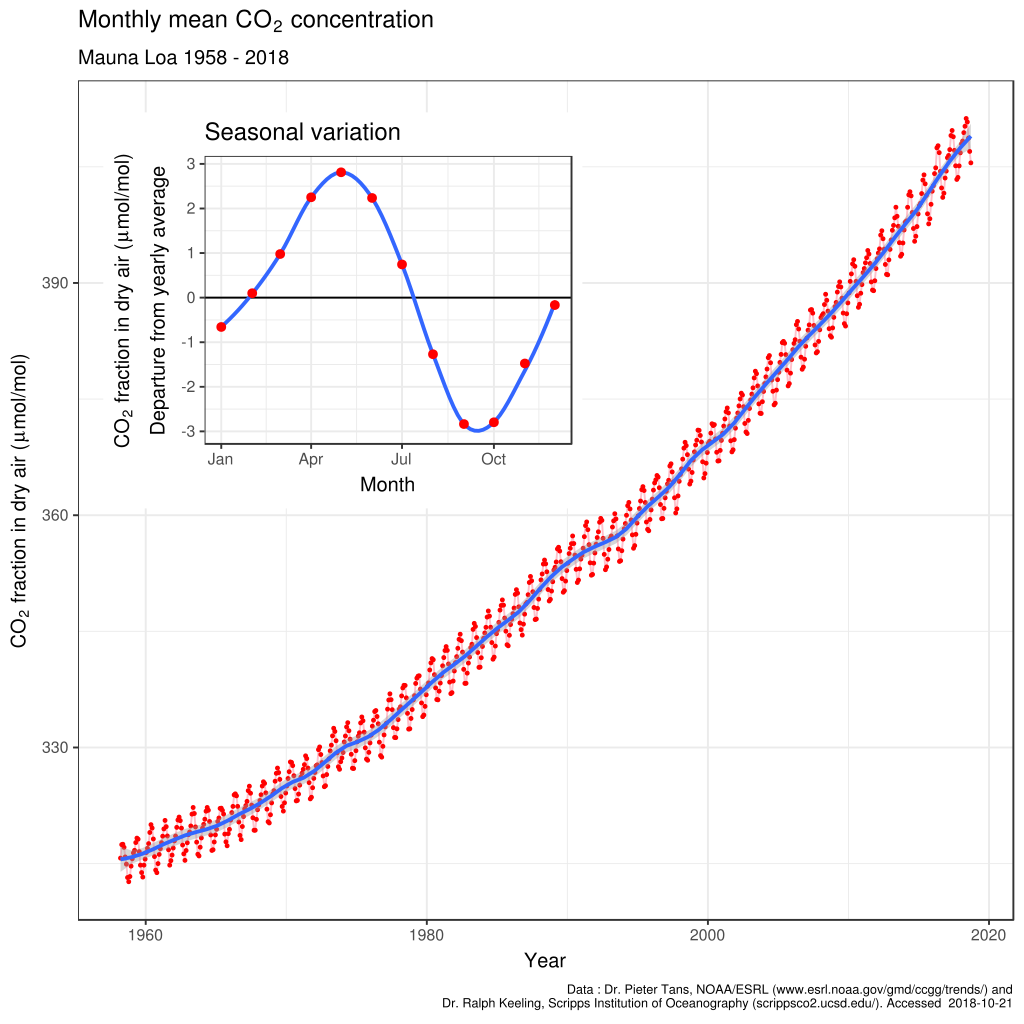
    This figure shows the history of atmospheric carbon dioxide concentrations as directly measured at Mauna Loa, Hawaii since 1958. This curve is known as the Keeling curve, and is an essential piece of evidence of the man-made increases in greenhouse gases that are believed to be the cause of global warming. Credit: Delorme, data from Dr. Pieter Tans, NOAA, and Dr. Ralph Keeling, Scripps, CC BY–SA 4.0

    And in 1960, Charles Keeling first published the measurements that became the famous “Keeling curve” — establishing one of the bedrock findings connecting climate change to fossil fuels. The CO2 measurements taken by Keeling back in the late 1950s showed levels of roughly 315 parts per million (ppm) at the Mauna Loa Observatory in Hawaii and rising.

    Those CO2 levels have since climbed upwards to 410.13 (ppm) on the day that the Nature letter was published — CO2 levels that scientists knew both then and now would be dangerously high, as carbon levels in the Earth’s atmosphere have not been over 410 ppm in millions of years.

    What the Oil Industry Knew, Then and Now

    In his 1965 talk, the API’s Ikard described the role of oil and gasoline specifically in causing climate change. “The report further states, and I quote: ‘… the pollution from internal combustion engines is so serious, and is growing so fast,’” he told the API conference, “‘that an alternative nonpolluting means of powering automobiles, buses, and trucks is likely to become a national necessity.’”

    Three decades later, the API urged a different approach to climate science. “It’s not known for sure whether (a) climate change actually is occurring, or (b) if it is, whether humans really have any influence on it,” the API wrote in a 1998 draft memo titled “Global Climate Science Communications Plan,” which was subsequently leaked.

    As of publication time, an API spokesperson had not replied to questions sent by DeSmog.

    It’s worth noting that since 1965, the science connecting climate change to fossil fuels has grown stronger and more robust. A scientific consensus around the hazards of climate change and the role that fossil fuels play in causing it has formed.

    “Rigorous analysis of all data and lines of evidence shows that most of the observed global warming over the past 50 years or so cannot be explained by natural causes and instead requires a significant role for the influence of human activities,” the Royal Society explains.

    Today, the API continues to call for further research on climate change — and expanding the use of fossil fuels in the meantime.

    “It is clear that climate change is a serious issue that requires research for solutions and effective policies that allow us to meet our energy needs while protecting the environment: that’s why oil and gas companies are working to reduce their greenhouse gas emissions,” the API’s webpage on climate change states.

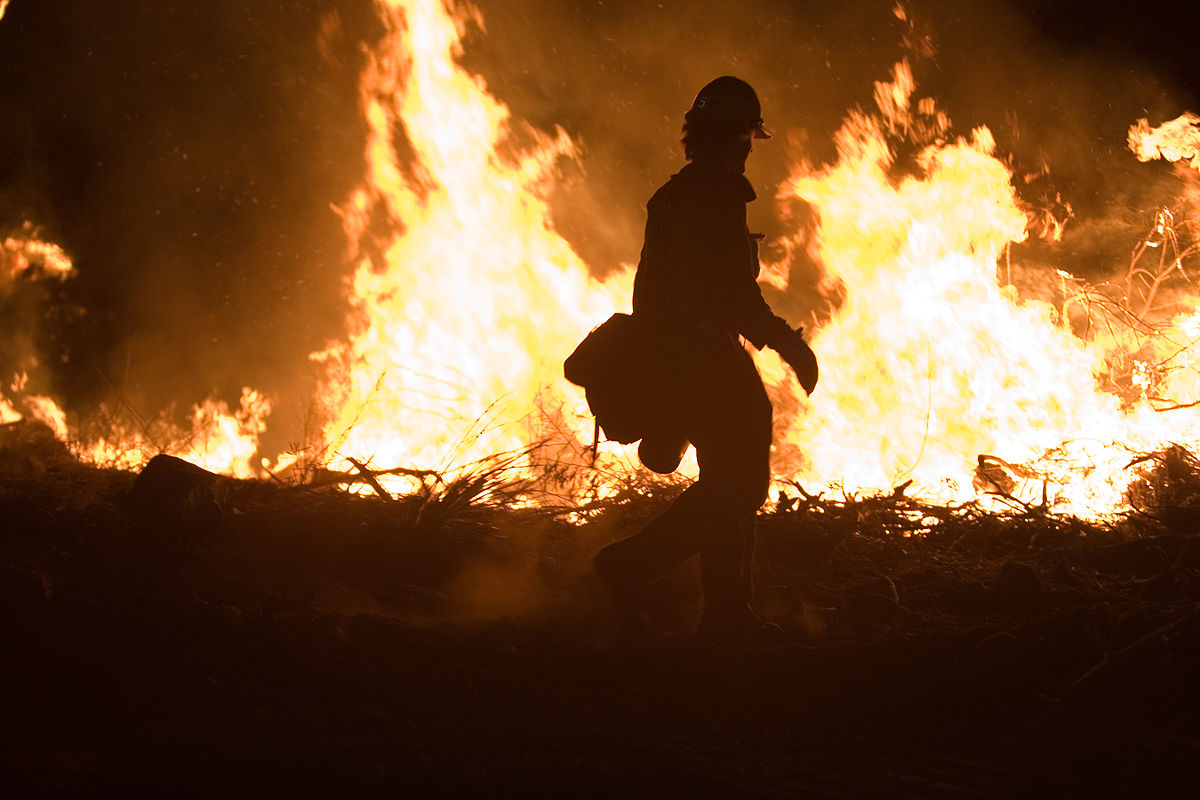
    “Yet archival documents show that even before Keeling published his measurements,” Franta’s letter published by Nature says, “oil industry leaders were aware that their products were causing CO2 pollution to accumulate in the planet’s atmosphere, in a potentially dangerous fashion.”Main image: San Diego, CA, October 26, 2007 – A Northern California fire crew works into the night clearing the fire line and monitoring the back burn that was set to stop the Poomacha fire from advancing westward. Credit: Andrea Booher, FEMA, public domain

    Original article republished from DeSmog under their republishing agreement.

  • ‘Deeply Depressing’ Study Shows Planet-Warming Emissions Continue to Rise

    Spread the love

    Wcmax1 20220717 20220723 Europe

    “If current emissions levels persist, there is now a 50% chance that global warming of 1.5°C will be exceeded in nine years.”

    Republished from Common Dreams under Creative Commons (CC BY-NC-ND 3.0). Feel free to republish and share widely.

    JAKE JOHNSONNovember 11, 2022

    Rapid and drastic cuts to global greenhouse gas emissions are necessary to curb warming and prevent the most dire climate scenarios from becoming reality.

    But a new study released Friday by the Global Carbon Project finds “no sign of the decrease that is urgently needed” as emissions remain at record levels this year, with fossil fuel giants and governments plowing ahead with new extraction efforts that could push critical climate targets out of reach.

    Scientists with the Global Carbon Project estimate that total CO2 emissions will reach 40.6 billion tonnes this year—driven by rising pollution from fossil fuels—and will likely continue to rise in 2023 without bold action from policymakers worldwide.

    “If current emissions levels persist, there is now a 50% chance that global warming of 1.5°C will be exceeded in nine years,” the researchers note. “Projected emissions from coal and oil are above their 2021 levels, with oil being the largest contributor to total emissions growth.”

    “The 2022 picture among major emitters is mixed: emissions are projected to fall in China (0.9%) and the E.U. (0.8%), and increase in the USA (1.5%) and India (6%), with a 1.7% rise in the rest of the world combined,” the report finds.

    Professor Pierre Friedlingstein of Exeter’s Global Systems Institute, the lead author of the new study, lamented in a statement that “we see yet another rise in global fossil CO2 emissions” in 2022 “when we need a rapid decline.”

    “There are some positive signs,” Friedlingstein added, pointing to the slowing growth of fossil fuel emissions over the long term, “but leaders meeting at COP27 will have to take meaningful action if we are to have any chance of limiting global warming close to 1.5°C.”

    That increasingly imperiled warming target remains a focus as world leaders gather in Sharm El-Sheikh, Egypt for the annual United Nations climate conference, a key opportunity for nations to commit to collective action against a climate emergency that is wreaking havoc worldwide.

    Climate campaigners warn the opportunity is at risk of being squandered as Big Oil lobbyists swarm the conference and gas producers use the event to push their dirty energy source as a “transition fuel.”

    Professor Corinne Le Quéré of the University of East Anglia, a co-author of the Global Carbon Project study, said that if governments respond to worsening climate chaos “by turbocharging clean energy investments and planting, not cutting, trees, global emissions could rapidly start to fall.”

    “We are at a turning point and must not allow world events to distract us from the urgent and sustained need to cut our emissions to stabilize the global climate and reduce cascading risks,” Le Quéré warned.

    Allowing planetary heating to exceed 1.5°C above preindustrial levels by the end of the century would spell disaster for large swaths of the planet as trends already seen around the world—from increasingly extreme weather events to species extinctions to rapidly melting sea ice—would accelerate, potentially locking in irreversible climate damage.

    Professor Mark Maslin of University College London told The Guardian that the Global Carbon Project study is “deeply depressing.”

    “It sends a clear message to the leaders at COP27—the world needs to have significant cuts in global emissions in 2023 if we are to have any chance to keep climate change to 1.5°C,” said Maslin.

    Republished from Common Dreams under Creative Commons (CC BY-NC-ND 3.0). Feel free to republish and share widely.

    Related

    A fire burns near an oil well in California

    Analysis Exposes Big Oil’s Plot to Unleash Climate-Killing ‘Carbon Bombs’ Worldwide

    Jake Johnson · May 11, 2022

    American Chestnut trees

    Climate Crisis Pushing Up to 1 in 6 US Tree Species Toward Extinction: Study

    Julia Conley · Aug 23, 2022

    "1.5 to survive" message at protest

    ‘Abdication of Responsibility’: Fury as COP27 Draft Omits Oil and Gas Phase-Out

    Julia Conley · Nov 17, 2022

    Icebergs near Ilulissat, Greenland

    ‘We Must Wake Up!’ Study Says Climate Tipping Points Loom—But Some Are Avoidable

    Brett Wilkins · Sep 8, 2022

  • Earth’s Atmospheric CO2 Hasn’t Been This High In Millions of Years

    Spread the love

    Republished from Common Dreams under Creative Commons Licence (CC BY-NC-ND 3.0).

    “Either we drive the fossil fuel industry into extinction—or the human race.”

    KENNY STANCILMay 17, 2022

    Climate scientists and concerned citizens are sounding the alarm as daily, weekly, and monthly records for atmospheric carbon dioxide levels continue to be shattered while the fossil fuel-powered capitalist economic system responsible for skyrocketing greenhouse gas pollution plows ahead.

    New data from the National Oceanic and Atmospheric Administration (NOAA) shows that the weekly average CO² concentration at the Mauna Loa Observatory in Hawaii reached 421.13 parts per million (ppm) from May 8 to May 14—the highest in recorded history and up from 418.34 ppm one year ago and 397.38 ppm one decade ago.

    “We simply do not know a planet like this,” meteorologist Eric Holthaus said Monday. “We are in a climate emergency.”

    https://twitter.com/EricHolthaus/status/1526384367987068928?ref_src=twsrc%5Etfw%7Ctwcamp%5Etweetembed%7Ctwterm%5E1526384367987068928%7Ctwgr%5E%7Ctwcon%5Es1_c10&ref_url=https%3A%2F%2Fwww.commondreams.org%2Fnews%2F2022%2F05%2F17%2Fearths-atmospheric-co2-hasnt-been-high-millions-years

    According to NOAA, the daily average CO² concentration at Mauna Loa hit 422.04 ppm on May 14, just slightly below the agency’s all-time record of 422.06 ppm observed on April 26. Researchers from the Scripps Institution of Oceanography at UC San Diego, meanwhile, measured 421.68 ppm of CO² at Mauna Loa on May 13, which they consider the daily record as of Monday.

    Those record-breaking daily and weekly measurements came after the monthly average CO² concentration at Mauna Loa surpassed 420 ppm for the first time in human history, with NOAA observing 420.23 ppm in April compared with Scripps at 420.02 ppm.

    Pieter Tans, a senior scientist at NOAA, recently told Axios that “it is likely May will be higher still.”

    “The window to act on climate change is closing,” American Clean Power warned recently on social media. “Accelerating the transition to clean energy will help reduce emissions and secure a healthier future for all.

    Twenty years ago, the highest monthly average CO² concentration was 375.93 ppm, according to NOAA. In 1958, the first year scientists began collecting data at Mauna Loa, it was 317.51 ppm.

    Climate scientist James Hansen, who alerted congressional lawmakers to the life-threatening dangers of the climate crisis in 1988, has long called for reducing atmospheric CO² to below 350 ppm, and there is now a scientific consensus that the livability of the planet decreases beyond such a concentration.

    Nevertheless, the annual rate of increase in CO² levels over the past six decades is now roughly 100 times faster than earlier increases that occurred naturally thousands of years ago.

    CO2 concentration over 10,000 years - Keeling Curve

    “The world effectively has made no serious progress compared to what is required,” Tans said earlier this month. “We really need to focus on decreasing emissions and we haven’t had much success globally because the rate of increase of CO² remains as high as it has been in the last decade.”

    “CO² has a longevity of hundreds to thousands of years,” he noted, “so we are really making a very long-term climate commitment.”

    Speaking with the Financial Times recently, Tans added that “we are going in the wrong direction, at maximum speed.”

    California-based activist Joe Sanberg put it even more bluntly last week.

    “It’s shocking that we’re staring down the barrel of the greatest existential crisis humanity has ever faced and we still haven’t passed a Green New Deal,” Sanberg tweeted. “Time is running out. Either we drive the fossil fuel industry into extinction—or the human race.”

    Republished from Common Dreams under Creative Commons Licence (CC BY-NC-ND 3.0).

  • COP26 News review day 12

    Spread the love

    The final day of the COP26 summit.

    Honest Government Ad | Net Zero by 2050 (feat. Greta Thunberg)

    Hundreds of global civil society representatives walk out of Cop26 in protest

    Carrying blood-red ribbons to represent the crucial red lines already crossed by Cop26 negotiations, hundreds of representatives of global civil society walked out of the convention centre in Glasgow on the final morning of the summit in protest.

    The audience at the People’s Plenary in the conference blue zone heard speakers condemn the legitimacy and ambition of the 12-day summit before walking out to join protesters gathered on the streets beyond the security fencing.

    “Cop26 is a performance,” the Indigenous activist Ta’Kaiya Blaney of the Tla A’min Nation told the meeting before the walkout. “It is an illusion constructed to save the capitalist economy rooted in resource extraction and colonialism. I didn’t come here to fix the agenda – I came here to disrupt it.”

    George Minbiot: Make extreme wealth extinct: it’s the only way to avoid climate breakdown

    A recent analysis of the lifestyles of 20 billionaires found that each produced an average of over 8,000 tonnes of carbon dioxide: 3,500 times their fair share in a world committed to no more than 1.5C of heating. The major causes are their jets and yachts. A superyacht alone, kept on permanent standby, as some billionaires’ boats are, generates around 7,000 tonnes of CO2 a year.

    I’ve come to believe that the most important of all environmental measures are wealth taxes. Preventing systemic environmental collapse means driving extreme wealth to extinction. It is not humanity as a whole that the planet cannot afford. It’s the ultra-rich.

    Fossil fuel industry gets subsidies of $11m a minute, IMF finds (An older article for context).

    The fossil fuel industry benefits from subsidies of $11m every minute, according to analysis by the International Monetary Fund.

    The IMF found the production and burning of coal, oil and gas was subsidised by $5.9tn in 2020, with not a single country pricing all its fuels sufficiently to reflect their full supply and environmental costs. Experts said the subsidies were “adding fuel to the fire” of the climate crisis, at a time when rapid reductions in carbon emissions were urgently needed.

    Extra video from thejuicemedia

  • COP26: CLIMATE ACTIVISTS TO TARGET 10 UK AIRPORTS THIS WEEKEND TO PROTEST EXPANSION

    Spread the love

    https://www.independent.co.uk/travel/news-and-advice/cop26-airport-expansion-protests-uk-b1950499.html

    Climate activists will target 10 UK airports this weekend to protest proposed expansion.

    Campaigners are planning to protest at Bristol, Doncaster-Sheffield, Gatwick, Glasgow, Leeds-Bradford, London-City, Luton, Liverpool, Manchester and Southampton airports from 11am on Saturday.

    [Hypocritical P]oliticians have consistently refused to endorse any reduction in flights, or any restraint on further aviation growth.

    Speaking ahead of a UN climate conference earlier this year, MP Rachel Maclean – the minister in charge of government policy on the future of transport and decarbonisation – said flying was one of the things that “make life worth living” and that the government would not place any restrictions on the aviation industry.

    Airlines are increasingly committing to becoming “greener” by using technology such as Sustainable Aviation Fuels (SAF) – however, these will account for 10 per cent of aviation fuel, at most, by 2030, and SAFs emit at least as much CO2 inflight as conventional kerosene.