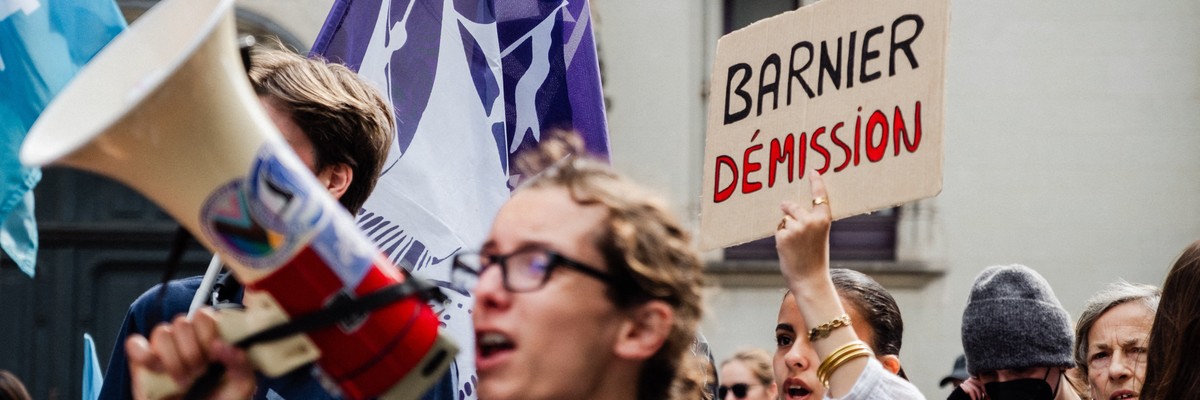
A protester carries a sign called on Michel Barnier, who was selected by French President Emmanuel Macron as the prime minister, to resign at a protest on September 7, 2024 in Nantes, France. (Photo: Maylis Rolland/Hans Lucas/AFP via Getty Images)
“Expressing one’s vote will be useless as long as Macron is in power,” said one demonstrator.
In cities and towns across France on Saturday, more than 100,000 people answered the call from the left-wing political party La France Insoumise for mass protests against President Emmanuel Macron’s selection of a right-wing prime minister.
The demonstrations came two months after the left coalition won more seats than Macron’s centrist coalition or the far-right Rassemblement National (RN) in the National Assembly and two days after the president announced that Michel Barnier, the right-wing former Brexit negotiator for the European Union, would lead the government.
The selection was made after negotiations between Macron and RN leader Marine Le Pen, leading protesters on Saturday to accuse the president of a “denial of democracy.”
“Expressing one’s vote will be useless as long as Macron is in power,” a protester named Manon Bonijol told Al Jazeera.
“Don't let democracy be humiliated.”
The Left saved France from the extreme right. Voters chose a left-wing coalition over LePen and over Macron’s corporate centrism.
A poll released on Friday by Elabe showed that 74% of French people believed Macron had disregarded the results of July’s snap parliamentary elections, and 55% said the election had been “stolen.”
Jean-Luc Mélenchon, the leader of La France Insoumise (LFI), or France Unbowed, also accused Macron of “stealing the election” in a speech at the demonstration in Paris on Saturday.
“Democracy is not just the art of accepting you have won but the humility to accept you have lost,” Mélenchon told protesters. “I call you for what will be a long battle.”
He added that “the French people are in rebellion. They have entered into revolution.”
Macron’s centrist coalition won about 160 assembly seats out of 577 in July, compared to the left coalition’s 180. The RN won about 140.
Barnier’s Les Républicains (LR) party won fewer than 50 parliamentary seats. French presidents have generally named prime ministers, who oversee domestic policy, from the party with the most seats in the National Assembly.
Barnier signaled on Friday that he would largely defend Macron’s pro-business policies and could unveil stricter anti-immigration reforms. Macron has enraged French workers and the left with policies including a retirement age hike last year.
Protests also took place in cities including Nantes, Nice, Montpellier, Marseilles, and Strasbourg.
All four left-wing parties within the Nouveau Front Populaire (NFP) coalition have announced plans to vote for a motion of no confidence against Barnier.
The RN has not committed to backing Barnier’s government yet and leaders have said they are waiting to see what policies he presents to the National Assembly before deciding how to proceed in a no confidence vote.
Until recently, Elon Musk was just a wildly successful electric car tycoon and space pioneer. Sure, he was erratic and outspoken, but his global influence was contained and seemingly under control.
But add the ownership of just one media platform, in the form of Twitter – now X – and the maverick has become a mogul, and the baton of the world’s biggest media bully has passed to a new player.
What we can gauge from watching Musk’s stewardship of X is that he’s unlike former media moguls, making him potentially even more dangerous. He operates under his own rules, often beyond the reach of regulators. He has demonstrated he has no regard for those who try to rein him in.
Under the old regime, press barons, from William Randolph Hearst to Rupert Murdoch, at least pretended they were committed to truth-telling journalism. Never mind that they were simultaneously deploying intimidation and bullying to achieve their commercial and political ends.
Musk has no need, or desire, for such pretence because he’s not required to cloak anything he says in even a wafer-thin veil of journalism. Instead, his driving rationale is free speech, which is often code for don’t dare get in my way.
This means we are in new territory, but it doesn’t mean what went before it is irrelevant.
A big bucket of the proverbial
If you want a comprehensive, up-to-date primer on the behaviour of media moguls over the past century-plus, Eric Beecher has just provided it in his book The Men Who Killed the News.
Alongside accounts of people like Hearst in the United States and Lord Northcliffe in the United Kingdom, Beecher quotes the notorious example of what happened to John Major, the UK prime minister between 1990 and 1997, who baulked at following Murdoch’s resistance to strengthening ties with the European Union.
In a conversation between Major and Kelvin MacKenzie, editor of Murdoch’s best-selling English tabloid newspaper, The Sun, the prime minister was bluntly told: “Well John, let me put it this way. I’ve got a large bucket of shit lying on my desk and tomorrow morning I’m going to pour it all over your head.”
MacKenzie might have thought he was speaking truth to power, but in reality he was doing Murdoch’s bidding, and actually using his master’s voice, as Beecher confirms by recounting an anecdote from early in Murdoch’s career in Australia.
In the 1960s, when Murdoch owned The Sunday Times in Perth, he met Lang Hancock (father of Gina Rinehart) to discuss potentially buying some mineral prospects together in Western Australia. The state government was opposed to the planned deal.
Beecher cites Hancock’s biographer, Robert Duffield, who claimed Murdoch asked the mining magnate, “If I can get a certain politician to negotiate, will you sell me a piece of the cake?” Hancock said yes. Later that night, Murdoch called again to say the deal had been done. How, asked an incredulous Hancock. Murdoch replied: “Simple […] I told him: look you can have a headline a day or a bucket of shit every day. What’s it to be?”
Between Murdoch in the 1960s and MacKenzie in the 1990s came Mario Puzo’s The Godfather with Don Corleone, aided by Luca Brasi holding a gun to a rival’s head, saying “either his brains or his signature would be on the contract”.
Former British Prime Minister John Major fell foul of Rupert Murdoch – and paid the price. Lynne Sladky/AP/AAP
Changing the rules of the game
Media moguls use metaphorical bullets. Those relatively few people who do resist them, like Major, get the proverbial poured over their government. Headlines in The Sun following the Conservatives’ win in the 1992 election included: “Pigmy PM”, “Not up to the job” and “1,001 reasons why you are such a plonker John”.
If media moguls since Hearst and Northcliffe have tap-danced between producing journalism and pursuing their commercial and political aims, they have at least done the former, and some of it has been very good.
The leaders of the social media behemoths, by contrast, don’t claim any fourth estate role. If anything, they seem to hold journalism with tongs as far from their face as possible.
They do possess enormous wealth though. Apple, Microsoft, Google and Meta, formerly known as Facebook, are in the top ten companies globally by market capitalisation. By comparison, News Corporation’s market capitalisation now ranks at 1,173 in the world.
Regulating the online environment may be difficult, as Australia discovered this year when it tried, and failed, to stop X hosting footage of the Wakeley Church stabbing attacks. But limiting transnational media platforms can be done, according to Robert Reich, a former Secretary of Labor in Bill Clinton’s government.
Despite some early wins through Australia’s News Media Bargaining Code, big tech companies habitually resist regulation. They have used their substantial influence to stymie it wherever and whenever nation-states have sought to introduce it.
Meta’s founder and chief executive, Mark Zuckerberg, has been known to go rogue, as he demonstrated in February 2021 when he protested against the bargaining code by unilaterally closing Facebook sites that carried news. Generally, though, his strategy has been to deploy standard public relations and lobbying methods.
But his rival Musk uses his social media platform, X, like a wrecking ball.
Musk is just about the first thing the average X user sees in their feed, whether they want to or not. He gives everyone the benefit of his thoughts, not to mention his thought bubbles. He proclaims himself a free-speech absolutist, but most of his pronouncements lean hard to the right, providing little space for alternative views.
Kamala wants to destroy your right to free speech under The Constitution https://t.co/oJN5T8nPLn
Some of his tweets have been inflammatory, such as him linking to an article promoting a conspiracy theory about the savage attack on Paul Pelosi, husband of the former US Speaker, Nancy Pelosi, or his tweet that “Civil war is inevitable” following riots that erupted recently in the UK.
As the BBC reported, the riots occurred after the fatal stabbing of three girls in Southport. “The subsequent unrest in towns and cities across England and in parts of Northern Ireland has been fuelled by misinformation online, the far-right and anti-immigration sentiment.”
Nor does Musk bother with niceties when people disagree with him. Late last year, advertisers considered boycotting X because they believed some of Musk’s posts were anti-Semitic. He told them during a live interview to “Go fuck yourself”.
He has welcomed Donald Trump, the Republican Party’s presidential nominee, back onto X after Trump’s account was frozen over his comments surrounding the January 6 2021 attack on the capitol. Since then both men have floated the idea of governing together if Trump wins a second term.
Is the world better off with tech bros like Musk who demand unlimited freedom and assert their influence brazenly, or old-style media moguls who spin fine-sounding rhetoric about freedom of the press and exert influence under the cover of journalism?
That’s a question for our times that we should probably begin grappling with.
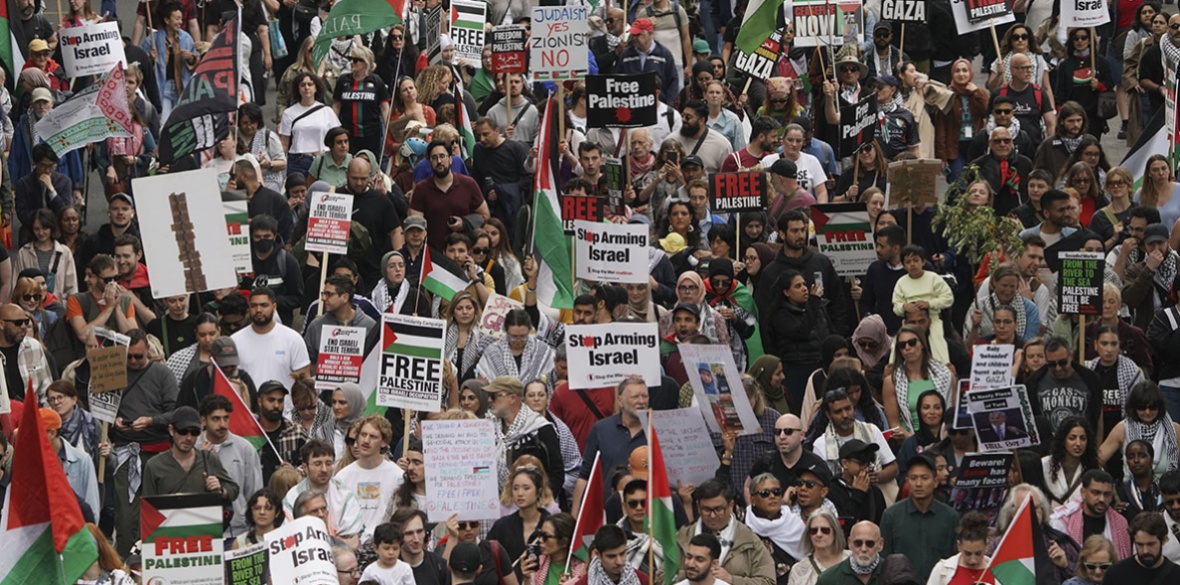
People take part in a national demonstration for Gaza from Russell Square to Whitehall in London, June 8, 2024
SCOTLAND YARD has been urged to abandon plans to impose new orders that would seriously disrupt Saturday’s March for Palestine demonstration in London.
Palestine Solidarity Campaign (PSC), union leaders, MPs, peers and coalition partners expressed concern over the force severely restricting the protest in an open letter today.
The Met was accused of employing tactics “to deter people from attending” the 18th national peaceful demonstration against the Gaza genocide since last October.
…
On Monday, the Met was accused of refusing to participate in negotiations in a “transparent and accountable” way with the march’s organisers.
Signatories of PSC’s letter raised concerns over the eleventh-hour announcement that the Met wanted the march delayed by nearly two hours “without explanation or rationale” and its refusal to allow Pall Mall as an assembly point.
They added: “We worry that these kind of delays, and late challenges and conditions to the plans of what are entirely peaceful demonstrations, are forming a pattern.”
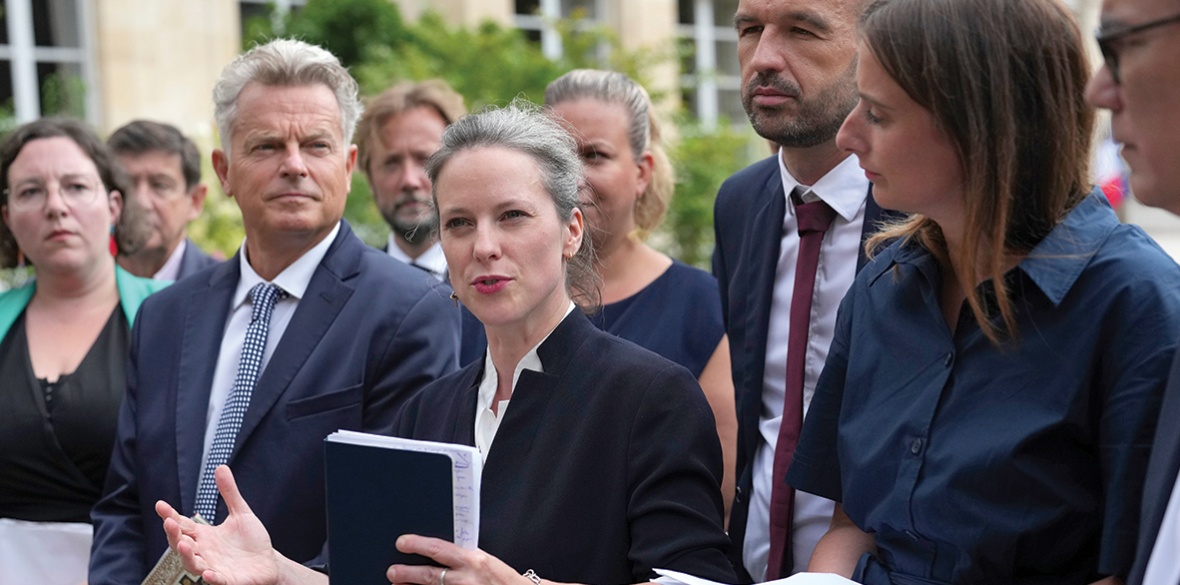
The Morning Star publishes the open letter to the French people from New Popular Front prime ministerial candidate Lucie Castets and leaders of its component parties, to inform British readers of the left’s case for government in France
LAST July, you mobilised massively at the polls to refuse the arrival of the extreme right in power and to break with the policies pursued for seven years. We thank you for this.
And since then? Nothing. The President of the Republic is procrastinating rather than drawing the consequences of these elections. How long are we going to continue as if nothing had happened at the beginning of the summer?
You have placed the New Popular Front at the top of the poll, without giving anyone an absolute majority. This result puts obligations on us all, and first and foremost obliges the one who caused it.
Unfair and imposed policies The inaction of the President of the Republic is serious and harmful. Because it highlights his desire to prolong the last seven years of unjust and authoritarian policies. Because it gives the impression that the vote would serve no purpose, that all this would be nothing more than a game of institutional chess.
We are measuring the extent of the distrust expressed today throughout the country, by you, citizens, leaders of unions, businesses, associations, collectives, local elected officials. Through renunciations, decisions imposed against the will of the people, such as the pension reform, many of you no longer believe in politics.
These feelings fuel the rise of the extreme right that we have fought and will continue to fight.
The choice of the next government will have very concrete consequences on the daily lives of each and every one, depending on whether it continues the austerity “cure” or decides to reinvest in our public services. Parents need to know if we will give ourselves the means to put a teacher in front of their child, and to straighten out the public school system; employees need to know when their salary will be revalued, after several years of inflation; residents need to know if their housing can be thermally renovated and if adaptation to climate change will be accelerated; patients need to know if they will be admitted to the emergency room if necessary and if the hospital will have the means to operate; our children need to know if we will offer them a habitable planet where they can grow and flourish.
Necessary break On all these issues, a break with past policies is necessary. It has been demanded by voters. This is what a New Popular Front government will undertake from the first hours of its nomination.
To the voters who have massively mobilised around the New Popular Front, we say: we are committed to building a fairer, more united society according to each person’s ability to contribute, in which work will be better paid, hardship better recognised, public services rehabilitated and to implementing immediately the ecological shift that is essential for our common future. A society in which everyone can have a dignified life.
To the voters who did not vote for us, on the right or the far right, as well as to those who did not vote at all, we say: yes, we want to break with the logic of one camp against another and will work together to build the future of the country and finance public services.
We are convinced that we will be able to improve the lives of French women and men in a concrete and rapid manner, and that the absence of an absolute majority will not prevent us from doing so. Who will refuse the increase in purchasing power that we are proposing with the revaluation of salaries and the remuneration of civil servants?
Who will accept seeing the catastrophic situation of public hospitals continue with emergency services closed in the middle of summer? Who will resign themselves to a new school year where so many teachers will be missing in front of our children in primary, secondary and high schools? On all these key issues, parliamentarians will report their votes and citizens will be witnesses.
A new way of governing We are aware of this: we must invent a new way of governing under the Fifth Republic. Parliament must, in a transparent manner, regain control of its calendar and calmly discuss the projects and Bills that will be submitted to it. Social partners must be listened to and respected. New forms of association of field actors, local elected officials, associations and all those who bring our democracy to life on a daily basis must be imagined.
We will also bring French diplomacy to the service of peace because we cannot accept that disputes are settled by force in Europe and in the world. We will thus work to thwart Vladimir Putin’s war of aggression, defend the sovereignty of the Ukrainian people and work towards a return to peace.
We will act to obtain an immediate ceasefire in Gaza and the release of the hostages. And since the President of the Republic himself had stated that the recognition of the state of Palestine was not a “taboo for France,” we will act for its immediate recognition, alongside the state of Israel, on the basis of UN resolutions to move towards a just and lasting peace.
Finally, we will bring civil peace to New Caledonia by returning to the reform of the electoral body and reopening a process of discussion, in the spirit of the Noumea and Matignon agreements.
We are convinced that France can still embody the values of justice, freedom and openness that have made its history. Hate speech damages it and does not resemble it.
You spoke out two months ago, now it is high time to take action: as in all parliamentary democracies, the coalition that comes out on top must be able to form a government, seek agreements within parliament and get to work. We’ve been working on it all summer. We’re ready.
Lucie Castets, candidate of the New Popular Front as Prime Minister Manuel Bompard, co-ordinator of France Insoumise Olivier Faure, first secretary of the Socialist Party Fabien Roussel, national secretary of the French Communist Party Marine Tondelier, national secretary of the Ecologists
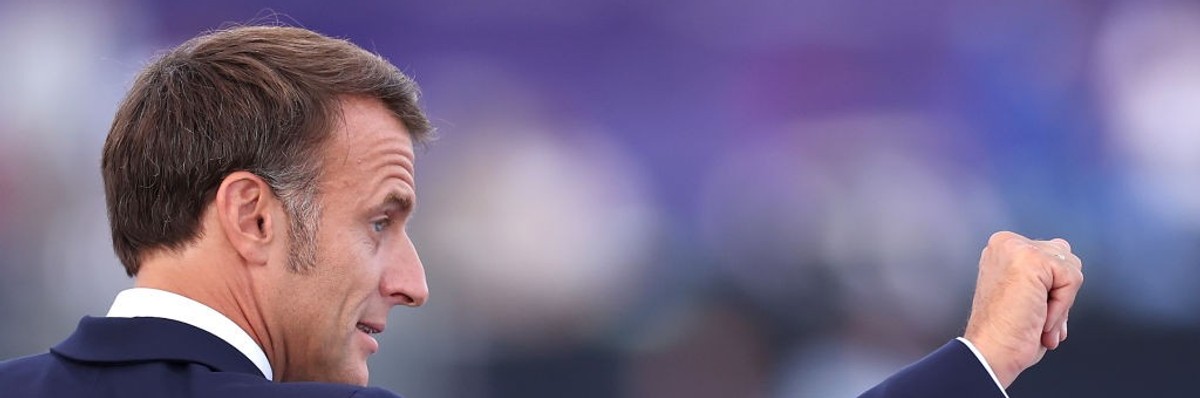
French President Emmanuel Macron gestures to the crowd before the opening ceremony of the 2024 Paralympic Games at Place de la Concorde on August 28, 2024 in Paris, France. (Photo: Alex Davidson/Getty Images)
The president’s rejection of a center-left coalition’s prime minister candidate “is not merely a political maneuver to hold onto power, but a direct attack on French progressive forces.”
Progressive International on Wednesday issued a scathing critique of French President Emmanuel Macron and backed calls for protests next month over his rejection of a leftist alliance’s candidate for prime minister following recent snap elections.
Nouveau Front Populaire (NFP), a coalition of left-of-center parties formed to counter the far-right in this summer’s elections, won the most seats, beating out Macron’s centrist alliance and Marine Le Pen’s right-wing Rassemblement National (RN), but lacks an absolute majority.
Macron has since refused to appoint NFP’s chosen candidate, Lucie Castets, as prime minister, which the Progressive International Observatory blasted as “blatant disregard of the election results and the precedent established throughout the French Fifth Republic.”
Progressive International launched in May 2020 to unite, organize, and mobilize progressive groups and individuals around the world, and since then it has built a global Observatory “with the legal expertise, data science, and parliamentary power to track the attacks on our democratic institutions and provide a real-time defense against them.”
“The attempt to stifle political competition and subvert the democratic process is a direct assault on these core values.”
France’s snap elections—which Macron called after his party performed poorly in European elections—were held on June 30 and July 7. Since then, the Observatory noted, “a caretaker government has led France, with Macron citing the Paris Olympics as a reason to delay the appointment.”
While the Olympic Games have concluded, Macron opened the Paralympic Games in the French capital Wednesday evening. They are set to run through September 8.
Macron—defending his refusal to appoint Castets—has argued that because centrist and right-wing parties would block any actions by NFP, “the institutional stability of our country therefore requires us not to choose this option.” His critics in France are now planning “a large demonstration against Macron’s coup on September 7.”
Echoing the French critics, the Observatory declared Wednesday that “Macron’s move is a direct challenge to the democratic will of the people and an affront to the foundational tenets of political pluralism.”
“This action is not merely a political maneuver to hold onto power, but a direct attack on French progressive forces,” the Observatory said, pointing to pledges by RN and centrist leaders to move a no-confidence motion against any prime minister nominated from the NFP.
The Observatory also highlighted Macron’s “sinister divide-and-rule move” to isolate the far-left La France Insoumise (LFI), led by Jean-Luc Mélenchon, by appealing to other NFP parties “to break the political paralysis.”
The other parties that make up NFP have rebuffed the French president and, according toFrance 24, “Mélenchon even threatened to start impeachment proceedings against Macron.”
Progressive International’s Observatory emphasized that “democracy thrives on the diversity of ideas and the peaceful transition of power. The attempt to stifle political competition and subvert the democratic process is a direct assault on these core values.”
The Observatory concluded with a “call to democratic forces worldwide to oppose Emmanuel Macron’s authoritarian efforts to repress the will of the French people—and join the call for the September 7 mobilization to defend it.”
;)