Tag: democracy

  • Watchdog of Far-Right GOP Issues ‘The Definitive Guide to Project 2025’

    Spread the love

    Original article by JAKE JOHNSON republished from Common Dreams under Creative Commons (CC BY-NC-ND 3.0). 

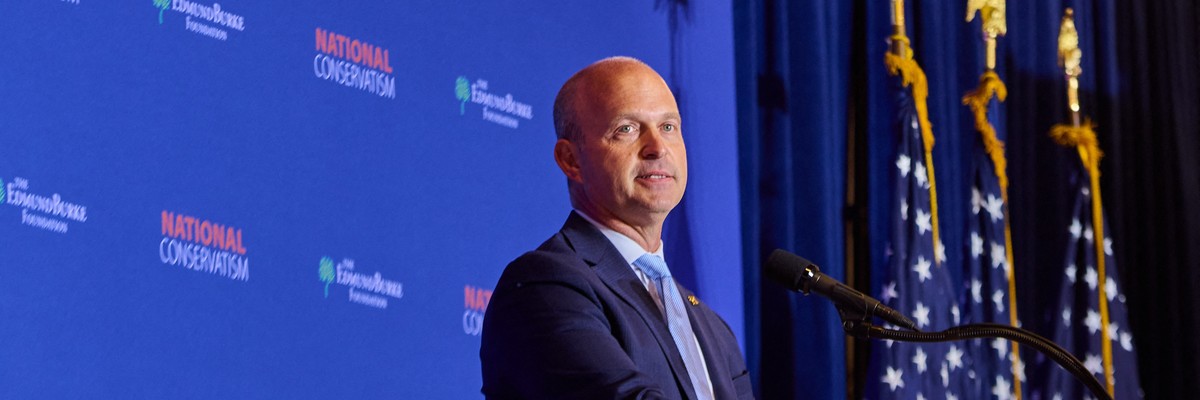
    Heritage Foundation president Kevin Roberts speaks at the National Conservative Conference in Washington D.C. on July 8, 2024. (Photo: Dominic Gwinn/Middle East Images via AFP)

    “It’s a clear threat to our democracy, as our government could be weaponized against us as part of a concerted effort to control how we live our live,” said the vice president of Media Matters for America.

    A watchdog organization that monitors the Republican Party and the far-right movement at its core released a document Thursday characterized as “the definitive guide to Project 2025,” a sweeping policy agenda crafted by more than 100 conservative groups and alumni of former President Donald Trump’s administration.

    The 67-page report published by Media Matters for America lays out in detail Trump’s close ties to Project 2025 and examines specific policy proposals included in the agenda, which—if implemented—would affect every area of American life, from the workplace to the environment to reproductive rights and other fundamental freedoms.

    “Project 2025 lays out an extreme far-right agenda that would impose draconian restrictions to the lives of everyday Americans,” Media Matters vice president Julie Millican said in a statement. “If enacted, not only would it gut the checks and balances that our country relies on, but it’s a clear threat to our democracy, as our government could be weaponized against us as part of a concerted effort to control how we live our lives.”

    “Project 2025’s extremist goals make clear what’s truly at stake,” Millican added.

    “Project 2025 looks like an albatross that Trump will find hard to get rid of.”

    Contrary to the Republican presidential nominee’s claim that he “knows nothing about” Project 2025 or who’s behind it, Media Matters noted that “Trump and his allies are deeply connected” to the initiative spearheaded by the Heritage Foundation.

    The new report points to Trump’s remarks at a 2022 Heritage event, where the former president declared that the group would “lay the groundwork and detail plans for exactly what our movement will do.” The Washington Post revealed Wednesday that Trump traveled to the event via private jet with Kevin Roberts, the president of the Heritage Foundation.

    “CNN reported that there are ‘nearly 240 people with ties to both Project 2025 and to Trump,’” Media Matters observed in its new analysis. “The Trump campaign and the Republican National Committee nominated Project 2025 author Russ Vought as the policy director of the RNC’s 2024 Committee on the Platform… John McEntee, a Project 2025 senior adviser, said in April he would ‘integrate a lot of our work’ with the Trump campaign later this year.”

    The report spotlights plans outlined by Project 2025 and the Trump campaign to purge the federal workforce and replace career civil servants with Trump loyalists dedicated to implementing the far-right movement’s assault on abortion rights, climate regulations, labor protections, and more. Trump allies have already begun screening “thousands of potential foot soldiers” to replace federal employees across the U.S. government.

    “This posture toward witch hunts against federal bureaucrats recalls the days of disgraced Sen. Joe McCarthy’s anti-communist crusade, which resulted in massive purges of left-wing federal employees as well as those perceived to be gay or gender-nonconforming,” Media Matters noted, adding that “MAGA media, including Project 2025 allies, have openly celebrated McCarthy’s destructive legacy.”

    The report also points with alarm to “a blog published to The American Conservative, a Project 2025 partner, [that] advocated for repealing the 22nd Amendment to allow Trump to serve a third term.”

    The Media Matters report came as the University of Massachusetts Amherst released new national survey data showing that Project 2025’s policy proposals are “deeply unpopular” with U.S. voters.

    Tatishe Nteta, provost professor of political science at UMass Amherst and director of the poll, said Thursday that “Project 2025 looks like an electoral liability” for Trump and the GOP, which has been accused of injecting Project 2025 policies into government funding proposals currently before Congress.

    Nteta said that given the results of the new survey—conducted between July 29 and August 1—”it is no surprise that the Democratic Party has sought to link” Project 2025 with Trump or that the GOP nominee has attempted to “move away from any and all association with the unpopular 900-page playbook.”

    “Large majorities of Americans oppose the key pillars of Project 2025, such as the replacement of career government officials with political appointees (68% opposed), restricting a woman’s right to contraception (72% opposed), and eliminating the Department of Education (64% opposed),” said Nteta. “While our politics are usually divided by class, generational, racial, gender, and partisan identities, among these groups we find strong opposition to many of the policies associated with Project 2025.”

    “Even former Trump voters exhibit opposition to many of these policies,” Nteta added, “a bad omen for the Republican Party and Trump campaign.”

    Just 8% of Trump 2020 voters support Project 2025’s proposal to strip emergency contraception access from tens of millions of women across the U.S., according to the new poll. Only 18% of Trump voters said they support “firing federal employees and replacing them with political appointees loyal to the president.”

    More than half of Americans say they have heard about Project 2025, the new survey shows—a finding that UMass Amherst professor Jesse Rhodes described as remarkable given that Heritage Foundation reports are “usually incredibly obscure.”

    “For the most part, Americans don’t like what they are hearing,” said Rhodes, a co-director of the new poll. “It’s no wonder Trump is trying to distance himself from Project 2025, but unfortunately for him, because dozens of his former administration officials worked on the report, this is going to be hard to do. Project 2025 looks like an albatross that Trump will find hard to get rid of.”

    Original article by JAKE JOHNSON republished from Common Dreams under Creative Commons (CC BY-NC-ND 3.0). 

  • Forget Wealth Tax. We Should Abolish Extreme Wealth Altogether

    Spread the love

    Original article by C.J. POLYCHRONIOU republished from Common Dreams under Creative Commons (CC BY-NC-ND 3.0). 

    “The idea that rich and poor are equal before government in democratic societies is ludicrous,” writes Polychroniou. “As disparities in wealth and income grow, so do the disparities in political influence.” (Photo: flickr/Creative Commons)

    Wealth taxation may sound like a good idea, but can it really address, let alone solve, the problem of inequality?

    Economic inequality is the scourge of the 21st century. The rich are getting richer and faster than any other time since the onset of neoliberalism, which calls for “free-market” capitalism, regressive taxation, fiscal austerity and the rejection of the social state. They get richer not only when the economy is on an upswing but even amid crises. Billionaires more than doubled their net worth during the pandemic, according to Bloomberg Billionaires Index.

    The latest analysis shows that the richest 1 percent gained $42 trillion in new wealth over the past decade, which amounts to “nearly 34 times more than the entire bottom 50 percent of the world’s population.” In the meantime, the very poor and low-income people across the globe, including the U.S., are actually getting poorer. So much for trickle-down economics which was popularized during the 1980s by the Reagan administration’s vast capital gains and income tax cuts and continues to persist to this day in spite of its major flaws. Cutting taxes on the rich not only increases economic inequality but has no effect on economic growth and unemployment.

    There must be something very rotten with an economic system that allows individuals to generate obscene amounts of wealth to the point they can hijack the political system and undermine democracy.

    However, inequality should not be examined purely from an economic perspective. Over the years, numerous studies have shown that economic inequality influences public attitudes toward democracy by generating political disillusion and low trust in government and other institutions, like Congress. Inequality also undermines social mobility, contributes to political polarization and fuels authoritarianism.

    Finally, inequality contributes to climate change. The richest 1 percent is responsible for more carbon emissions than the poorest 66 percent, according to a 2023 report by Oxfam. Of course, while the world’s wealthiest people make a huge contribution to climate change, they are also able to insulate themselves from the worst impacts of global warming.

    In sum, the super-rich can be blamed for many of the most serious ills confronting societies in the twentieth-first century. The only consequential question here is this: what can be done about it then?

    One of the most frequent responses to the problem of rising inequality is a call for the implementation of a wealth tax. Wealth taxation may sound like a good idea, but can it really address, let alone solve, the problem of inequality? The answer is an unqualified “no.” At least for the world’s advanced economies. Indeed, even if it’s possible to discover all the wealth that the very rich people own (much of which is hidden in companies or put in trusts) and then proceed with an accurate asset valuation, this will have very little impact, if any, on the daily lives of people who try to survive on minimum wages. Wealth taxation alone will have no impact on workers without social protection and no bargaining power at companies. It won’t protect workers at the “gig economy” and part-time workers.

    To effectively address economic inequality, we must identify the root cause of the problem, and one simple way to do this is by asking a rather simple question: How does one become superrich? Where does this immense wealth come from? Because as the renowned progressive economist James K. Boyce recently put it “nobody ‘earns’ a billion dollars.

    There must be something very rotten with an economic system that allows individuals to generate obscene amounts of wealth to the point they can hijack the political system and undermine democracy. Democracy cannot exist when we have wealth concentrated in the hands of a few. The idea that rich and poor are equal before government in democratic societies is ludicrous. As disparities in wealth and income grow, so do the disparities in political influence.

    Take corporations, for example, which exert enormous influence, thanks primarily to campaign donations and lobbying Their actions, which range from opposing labor laws and policies that benefit workers to restricting unionization, exacerbate inequalities at all levels of society and across the globe. Moreover, the surge in billionaire wealth and the surge in “corporate power and monopoly power” form a powerful connection. The very rich are not simply beneficiaries of the existing economic order. They are in control of the working arrangements of the global economic system. Yet despite the enormous power that corporations have on people’s lives and the communities in which they operate, there are very few policies and mechanisms at national or international level to curtail that power.

    Of course, we know that billionaires and big corporations pay very little in taxes, but we need much more than wealth and corporate taxation. We need ways to curb the power of big corporations and their drive to maximize shareholder value at the expense of everything else. We should also set a cap on extreme wealth. There is no social value for having billionaires. We should abolish the superrich, perhaps an easier task, politically speaking, than finding ways to tax them. Democratic societies could hold a referendum on whether we should abolish extreme wealth.

    In addition, we could create economic arrangements that provide a minimum income to ensure that everyone’s basic needs are met. This can be done either through universal basic income or guaranteed income programs.

    Last, but not least, we can challenge the rule of capital by advancing democratic forms of economic governance and economic planning. Participatory economics is one such alternative that would change the economy as we know it since it entails social ownership of production and self-managed workplaces. Worker cooperatives are established is various parts of Europe, particularly in Italy and Spain. The Mondragon Corporation in the Basque region of Spain is owned by its workers and represents the biggest and most successful case of worker cooperatives. Of course, for economic transformation to occur, breaking down hierarchical structures and putting workers in charge of business activities is not enough. What needs to happen is that the values of worker cooperatives spread across the economy and that power is wrested away from the capitalist class.In today’s world, we can tackle economic inequality only by shifting the conversation to its root causes and then coming up with blends of policies that work together to put an end to the driving forces behind inequality. Spending all political capital on something like a wealth tax will only help to prolong the life of an immensely cruel and dangerous economic system. An easier and far more effective way to end plutocracy is through the power of democracy via a binding referendum that calls on citizens to decide whether or not we should abolish altogether extreme wealth.

    Original article by C.J. POLYCHRONIOU republished from Common Dreams under Creative Commons (CC BY-NC-ND 3.0). 

  • ‘Disgusting’: Global 1% Captured $42 Trillion in New Wealth Over Past Decade

    Spread the love

    Original article by JAKE JOHNSON republished from Common Dreams under Creative Commons (CC BY-NC-ND 3.0).
    Demonstrators demand higher taxes on the rich in Paris, France on June 23, 2024.  (Photo: Laure Boyer/Hans Lucas/AFP via Getty Images)

    “The richest 1% of humanity continues to fill their pockets while the rest are left to scrap for crumbs.”

    The richest sliver of the global population hauled in more than $40 trillion in new wealth over the past decade as countries around the world cut taxes for those at the very top, supercharging inequality that poses a dire threat to democracy and the planet.

    An Oxfam analysis released Thursday ahead of a meeting of G20 finance ministers estimated that over the past 10 years, the global 1% has accumulated $42 trillion in new wealth. That’s “nearly 34 times more than the entire bottom 50% of the world’s population,” the group observed.

    “That is disgusting,” Michael Taylor, founder of the Australian Independent Media Network, wrote in response to the new figures.

    The analysis comes amid a growing push by current and former world leaders for rich countries to enact a global tax on billionaire wealth that would begin to reverse the damage done by decades of regressive policy. Oxfam found in a separate analysis released earlier this year that economic and political elites’ global “war on fair taxation” has slashed taxes for the rich by 32% since 1980.

    Oxfam said Thursday that global billionaires “have been paying a tax rate equivalent to less than 0.5% of their wealth.”

    “Inequality has reached obscene levels, and until now governments have failed to protect people and planet from its catastrophic effects,” Max Lawson, Oxfam’s head of inequality policy, said in a statement Thursday. “The richest 1% of humanity continues to fill their pockets while the rest are left to scrap for crumbs.”

    “Momentum to increase taxes on the super-rich is undeniable, and this week is the first real litmus test for G20 governments,” Lawson added. “Do they have the political will to strike a global standard that puts the needs of the many before the greed of an elite few?”

    A recent report by renowned economist Gabriel Zucman of the University of California, Berkeley outlined how nations could go about implementing a 2% minimum tax on the wealth of global billionaires—a policy change that he shows would raise up to $250 billion in annual revenue that could be used to support a range of priorities, from climate investments to education and healthcare programs.

    “Thanks to recent progress in international tax cooperation, a common taxation standard for billionaires has become technically possible,” said Zucman. “Implementing it is a question of political will.”

    The economist’s report was commissioned by the government of Brazilian President Luiz Inácio Lula da Silva, who has championed a global billionaire tax in the face of resistance from powerful nations, including the United States—which has more billionaires than any other country. In 2018, U.S. billionaires paid a lower effective tax rate than working-class Americans.

    But reporting indicates that the leaders of G20 nations—which are home to roughly 80% of the world’s billionaires—are likely to rebuff Lula’s push for billionaire wealth tax, opting instead to pursue what Bloombergdescribed as “research on taxation and inequality that could take years to deliver results.”

    Reuters similarly reported Wednesday that G20 finance ministers meeting in Brazil “are preparing a joint statement for Thursday in support of progressive taxation that will stop short of endorsing the hosts’ proposal for a global ‘billionaire tax.’”

    The global billionaire wealth surge comes in the context of growing misery for large swaths of the world’s population. A report released Wednesday by the United Nations’ Food and Agriculture Organization (FAO) estimated that one out of 11 people around the world—or up to 757 million people—”may have faced hunger” last year.

    “The world’s poorest people are paying the highest price of hunger,” Eric Munoz, Oxfam’s food policy expert, said in response to the FAO report. “We need deeper, structural policy and social change to address all of the drivers of hunger, including economic injustice, climate change, and conflict.”

    Original article by JAKE JOHNSON republished from Common Dreams under Creative Commons (CC BY-NC-ND 3.0).

  • Government urged to crack down on protest by ‘independent’ pro-Israel adviser

    Spread the love

    https://morningstaronline.co.uk/article/government-urged-crack-down-protest-independent-pro-israel-adviser

    People take part in a pro-Palestine march in central London organised by the Palestine Solidarity Campaign, July 6, 2024

    LABOUR Friends of Israel’s former chair Lord Walney called on ministers today probe candidate intimidation in the run-up to the general election.

    The government’s so-called independent adviser on political violence alleged that a series of events before July 4 were part of a “concerted campaign by extremists.”

    Aka John Woodcock, the former MP — who switched to Boris Johnson’s Tories in 2019 — has urged parliamentarians to to take a “zero-tolerance approach” with pro-Palestine groups and climate protesters, as well as accepted Israel lobby funding amid the Gaza genocide.

    In a letter shared with the BBC, he has called on Yvette Cooper and Security Minister Dan Jarvis to commission a short inquiry to find out if groups in different constituencies were working together and to document what he calls the “dark underbelly” of abuse.

    He wrote that evidence in the past few months suggested an intentional campaign “by extremists to create a hostile atmosphere for MPs” within their constituencies to pressure them to “cave in to political demands.”

    …

    It comes as pro-Israel Labour figures were accused of mischaracterising questioning by Palestine protesters in a bid to shirk political accountability for their support of the ongoing Gaza massacre.

    …

    https://morningstaronline.co.uk/article/government-urged-crack-down-protest-independent-pro-israel-adviser

  • To resist is democratic

    Spread the love
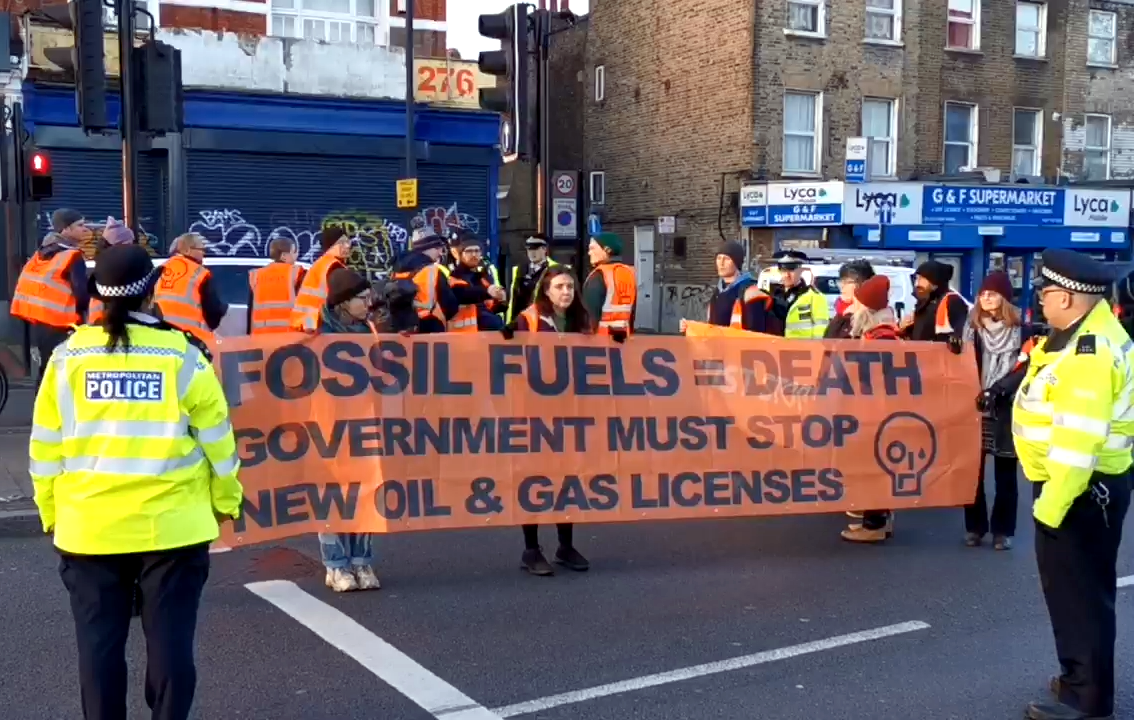
    Just Stop Oil protesting in London 6 December 2022.
    Just Stop Oil protesting in London 6 December 2022.

    Original article republished from Just Stop Oil under Attribution-NonCommercial 4.0 International Licence

    Blogs / October 6, 2022

    Democracy is a precious, and essential part of our society. Our leadership must always be accountable to the people, and if they are not, we risk oppression. We are, without a doubt, lucky to live in a liberal representational democracy, and when the time comes to vote, we should. So why then, are people acting politically, with civil resistance, outside of this mechanism?

    Over the last twelve months, thousands of people in the UK have engaged in peaceful resistance, and over a hundred (and counting) have been imprisoned. It’s not just in this country, in Canada ‘Save Old Growth’ are blocking motorways demanding no more felling of ancient trees. In France, Germany, Italy, Austria, Norway, the USA and Australia, ordinary people are resisting, disrupting transport and cultural activities – demanding that their states act to protect, not destroy, life. 

    They are ordinary people – coming together and acting out of love as much as fear and grief. Engaging in civil resistance, and defying a state, that while democratically elected, has proved deeply harmful. There’s no denying this harm – while the International Energy Agency has made it clear we can have no more new oil and gas development, the UK Government is ready to approve new oil fields and issue new exploration licenses, a death sentence for millions.

    Our politicians say they are ‘committed to reaching net zero’. What they are actually committed to is kicking the can down the road and round the corner. Gambling on unproven or non-existent technology to reverse our dumping of CO2 into the atmosphere.

    Instead of taking action, they’re making the problem worse for another 30 years, literally pouring fuel on the fire. The UK is the home of BP and Shell who are making eye-watering profits, and enjoying tax breaks to destroy life – because “pensions”, because “jobs”, because “economic growth”.

    A stable climate is not a competing policy demand to be set against pensions, transport, or public sector funding. One provides the basis for everything else, there simply isn’t a contest. Our predicament is almost comically simple – either we stop the destruction of the global systems that enable ordered civil society to work or we lose everything we value, our traditions, our cherished landscapes and, crucially, democracy. There are no free and fair elections on a burning earth. 

    In 2019 the MoD published a report outlining what is coming if we don’t immediately reduce carbon emissions – “increased conflict over diminishing natural resources”. That’s code for war. War over food and water – and we know what war looks like, flattened cities, dictator warlords, child traffickers waiting on borders, tortured grandfathers – it’s being documented once again in Europe.

    So what has happened in the UK to protect against this future? Traffic on the M25 has been disrupted, London bridges closed, oil terminals have been blockaded and occupied, football matches interrupted. Inept radio hosts have sparked viral memes about growing concrete and inspired themed stag nights. Just Stop Oil, Insulate Britain, XR and Stop HS2 have been painted on both the Left and Right as an eco-mob, eco-fascists, as selfish, naive and childish. But perhaps the most damaging criticism is that they are anti-democratic. 

    It’s as if every right and freedom we enjoy has been handed to us by a benign government. As if the Suffragettes never smashed windows, as if the race riots never happened, as if Stonewall simply wrote letters, as if those demanding disability rights didn’t chain themselves to railings and buses, as if the poll tax was scrapped due to reasonable debate and discussion or waiting politely for a chance to vote. Change requires citizens to stand up and resist harmful governments, it is part of democracy.

    Resistance has nothing to do with “protest”. Protest is when you express your disapproval. You do not express disapproval when murderous governments engage in an act condemning the world to go over 1.5C in the 2030s – a death sentence for small island states and millions in the global south.  Pakistan today demonstrates what we face – 33 million people impacted by floods and agriculture decimated.

    We know what to do. It’s what the Suffragettes did, it’s what the Civil Rights movements did, it’s what everyone does when the inalienable right to life and a livelihood are violated. We engage in non-violent civil resistance.

    What we must do now is block and disable the cogs of the machine. This is not a “tactic” – it is an act of self respect, an act of solidarity, an act of love and necessity. 

    We must resist now or we will look back with longing at all we have lost. The last 250 years of sacrifice and tears expended by generations to create decent societies is about to be snuffed out in the blink of an eye. The word betrayal does not cover the reality of what is going on. All our traditions, all our values, all that we claim to stand for is about to be lost.

    It’s not about winning. It’s about doing what has to be done. Those who fought fascism in the 20th century, those who are fighting the oil companies across the global south, those fighting the Russians in Ukraine, they act because they know someone has to stand up. 

    The next generations are watching us. Can you feel the weight of billions of children yet to take their first breath? They are saying “Are you mad? Get out there, and stop this – or you condemn us forever”.

    Original article republished from Just Stop Oil under Attribution-NonCommercial 4.0 International Licence

    dizzy: 1. I submit that we exist in a plutocracy rather than a democracy. 2. I couldn’t find the MoD article containing the quotation “increased conflict over diminishing natural resources”. I suspect that it existed but is no longer published openly. There are plenty of official reports making similar points and it is a reasonable statement. For example the WORLD DEVELOPMENT REPORT 2011, ‘Resource Scarcity, Climate Change and the Risk of Violent Conflict’ Alex Evans, Center on International Cooperation, New York University, September 9, 2010 makes similar claims. Edit: Despite that article being a very wooly academic paper, I think that it does make that claim

    Although the conflict risk posed by climate change and resource scarcity will almost always be better
    understood as a ‘threat multiplier’ than as a sole cause of violent conflict, a range of potential
    linkages between climate, scarcity and conflict risk can nonetheless be identified, whether through
    intensifying existing problems, or through creating new environmental problems that lead to
    instability.

    USAID (2009). Climate Change, Adaptation and Conflict: A preliminary review of the issues. CMD
    Discussion Paper no. 1, October 2009

    Later edit: Found the article: https://assets.publishing.service.gov.uk/government/uploads/system/uploads/attachment_data/file/930787/dcdc_report_changing_climate_gsp_RR-A487.pdf but I’ve not found the phrase “increased conflict over diminishing natural resources”. I would also attribute it to The Global Strategic Partnership (which supports the Ministry of Defence).