Tag: extreme weather events

  • Greenpeace Protests ‘Shock Doctrine’ by Blockading New TotalEnergies LNG Terminal

    Spread the love
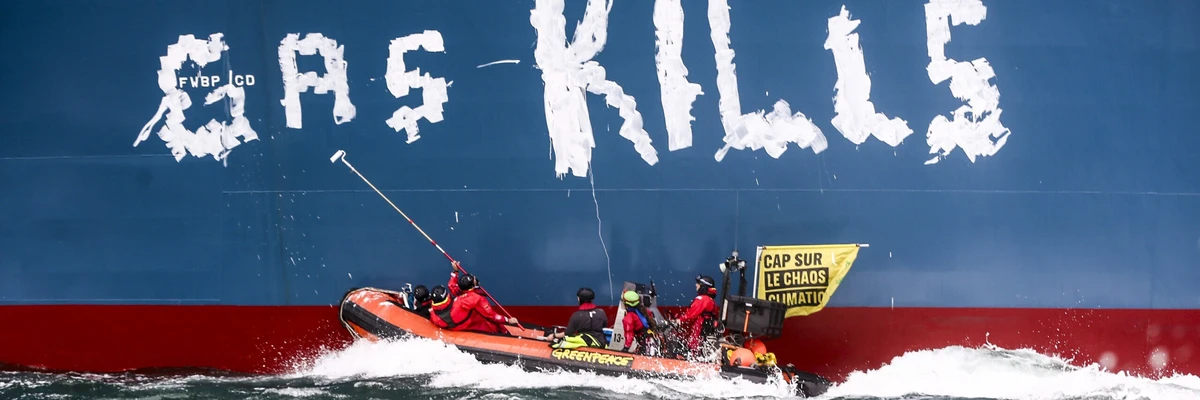
    Greenpeace activists paint "Gas kills" on the hull of the Cape Ann.
    Greenpeace activists paint, “Gas kills,” on the hull of the Cape Ann.
     (Photo: Jean Nicholas Guillo/Greenpeace)

    Original article by OLIVIA ROSANE republished from Common Dreams under Creative Commons (CC BY-NC-ND 3.0). 
    Gas companies “cynically used… the Russian invasion of Ukraine to frighten governments into massive, unneeded investment into and expansion of fossil gas imports and infrastructure,” one campaigner said.

    As part of the Global Fight to End Fossil Fuels, activists from Greenpeace France attempted to block a new TotalEnergies liquefied natural gas terminal [tanker] from entering the port of Le Havre Monday morning.

    Kayakers paddled between the port entrance and the tanker carrying the terminal—the Cape Ann—and wrote “Gas kills” in white paint along its side, Reuters reported.

    “This LNG terminal is yet another blatant example of ‘shock doctrine,’ where gas operators shifted their public messaging and lobbying from ‘energy transition’ to ‘energy security’ and cynically used the opportunity after the energy supply concerns triggered by the Russian invasion of Ukraine to frighten governments into massive, unneeded investment into and expansion of fossil gas imports and infrastructure,” Greenpeace France oil, transport, and ocean campaigner Hélène Bourges said in a statement.

    ation unit did arrive at the port in Western France Monday morning, TotalEnergies told Reuters.

    But the Greenpeace activists argue its arrival contradicts French President Emmanuel Macron’s 2022 promise to make France the first major nation to abandon the fossil fuels driving the climate emergency. What’s more, the gas is mostly U.S. shale gas, obtained by fracking—a method banned in France because of the harm it does to the global climate and the health and environment of local communities.

    The activists in kayaks carried banners reading “Total: shale dealer,” “Macron: shale dealer,” and “End Fossil Crimes.”

    Members of Scientists in Rebellion also came to Le Havre to support the action.

    “This LNG terminal is a sham that responds neither to the crisis nor to energy sovereignty and pushes us into a scenario of climate chaos,” the group wrote on X, formerly Twitter.

    https://twitter.com/SciRebFr/status/1703771689320870250?ref_src=twsrc%5Etfw%7Ctwcamp%5Etweetembed%7Ctwterm%5E1703771689320870250%7Ctwgr%5E54b9afa56d753f293067946d7e618ebd02439447%7Ctwcon%5Es1_c10&ref_url=https%3A%2F%2Fwww.commondreams.org%2Fnews%2Fgreenpeace-protests-totalenergies

    Greenpeace challenged the narrative that increased LNG is necessary to help France and the rest of Europe meet their energy needs in the wake of Russia’s invasion of Ukraine. In a report copublished in June with Disclose, Greenpeace France pointed out that the country’s existing LNG terminals did not use their maximum capacity in 2022 and were underutilized during the first half of 2023.

    “If France really suffered from a gas supply crisis in 2022 that was severe enough to justify the new floating terminal in Le Havre, it’s surprising that the capacities of existing terminals, particularly the ones at Dunkerque and Fos Tonkin, were underutilized,” the report authors wrote.

    “This summer’s extreme weather events have highlighted the urgency of moving away from fossil fuels.”

    Instead, they argued that the LNG increase was the result of lobbying from the oil and gas industry.

    “The only beneficiaries of the LNG gas infrastructure in Le Havre are TotalEnergies, the operator of the floating terminal, and its shareholders, whose private interests and gains prevail over climate action and people’s health, with the complicit support of the French government that granted an unprecedented legal preferential regime to set up this operation,” Bourges said in a statement.

    Greenpeace’s action followed a summer of deadly heatwaves, fires, and floods and a global mobilization to end fossil fuels from September 15-17.

    “This summer’s extreme weather events have highlighted the urgency of moving away from fossil fuels,” Greenpeace France wrote on social media.

    The group said it had two demands for Macron: to prevent the new terminal from being used and to kill any other fossil fuel projects under consideration.

    Original article by OLIVIA ROSANE republished from Common Dreams under Creative Commons (CC BY-NC-ND 3.0). 
  • Greece’s record rainfall and flash floods are part of a trend – across the Mediterranean, the weather is becoming more dangerous

    Spread the love


    Ioanna Stamataki, University of Greenwich

    Recent images of the devastating flash floods caused by Storm Daniel in Greece hit close to home literally and figuratively. As a Greek who has completed a PhD and worked for the past eight years on flash floods, the scenes unfolding across my homeland are painfully real: a stark reminder of the broader environmental challenges we face both on a local and a global scale.

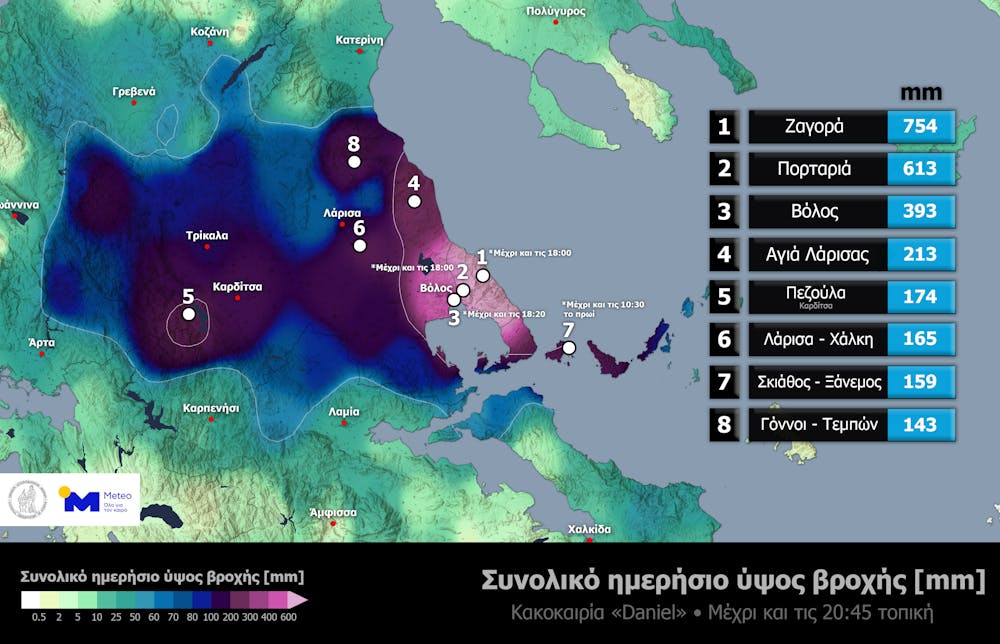
    These unprecedented flash floods were triggered by rainfall from the arrival of Storm Daniel on Monday September 4 which also affected Turkey and Bulgaria. The following day, in the village of Zagora, a record-breaking 754mm of rain fell in just 18 hours, leaving parts of the region of Thessaly in crisis and unable to respond.

    To put this in perspective, London gets about 585mm of rain over the course of a year while Thessaly gets 495mm, meaning that on Tuesday September 5, about 1.5 years’ worth of rain fell in 18 hours. Imagine the most torrential rain you have ever experienced, perhaps a cloudburst lasting 20 minutes or so. Now imagine it raining that hard but without pause for an entire day.

    Flash flooding is short in duration but extremely intense, and typically happens within six hours of heavy rainfall. Unlike regular floods, which develop more slowly and can be predicted in advance, flash floods catch people off guard due to their rapid onset and are rarely recorded in the field.

    Annotated map of central Greece
    Greece’s daily rainfall record was broken with 754 mm of rain in the village of Zagora – more than double the UK’s equivalent record.
    National Observatory of Athens/meteo.gr, CC BY-SA

    Catastrophic effects

    Across the three affected countries the floods have killed at least 18 people, with many others seeking refuge on their rooftops. There are ongoing power and water outages, infrastructure has been damaged, houses and even entire villages have been completely submerged.

    I asked Andrew Barnes, an academic at the University of Bath with expertise in using AI to analyse extreme events why this event was so exceptional. He told me that throughout Tuesday, a strong low-pressure centre formed across the south of Greece creating a large rotating weather system known as a cyclone.

    This cyclone carried large rain clouds from both the Mediterranean and Aegean Sea between Greece and Turkey. But it did not dissipate, and instead its low-pressure centre moved southwest and settled just south of Italy, with its bands of rain clouds also moving south and covering most of mainland Greece.

    Trending across the region

    It is crucial to emphasise that flash floods are not confined to Greece alone. They are in fact part of a broader pattern of extreme weather that has become more intense and frequent across the Mediterranean region.

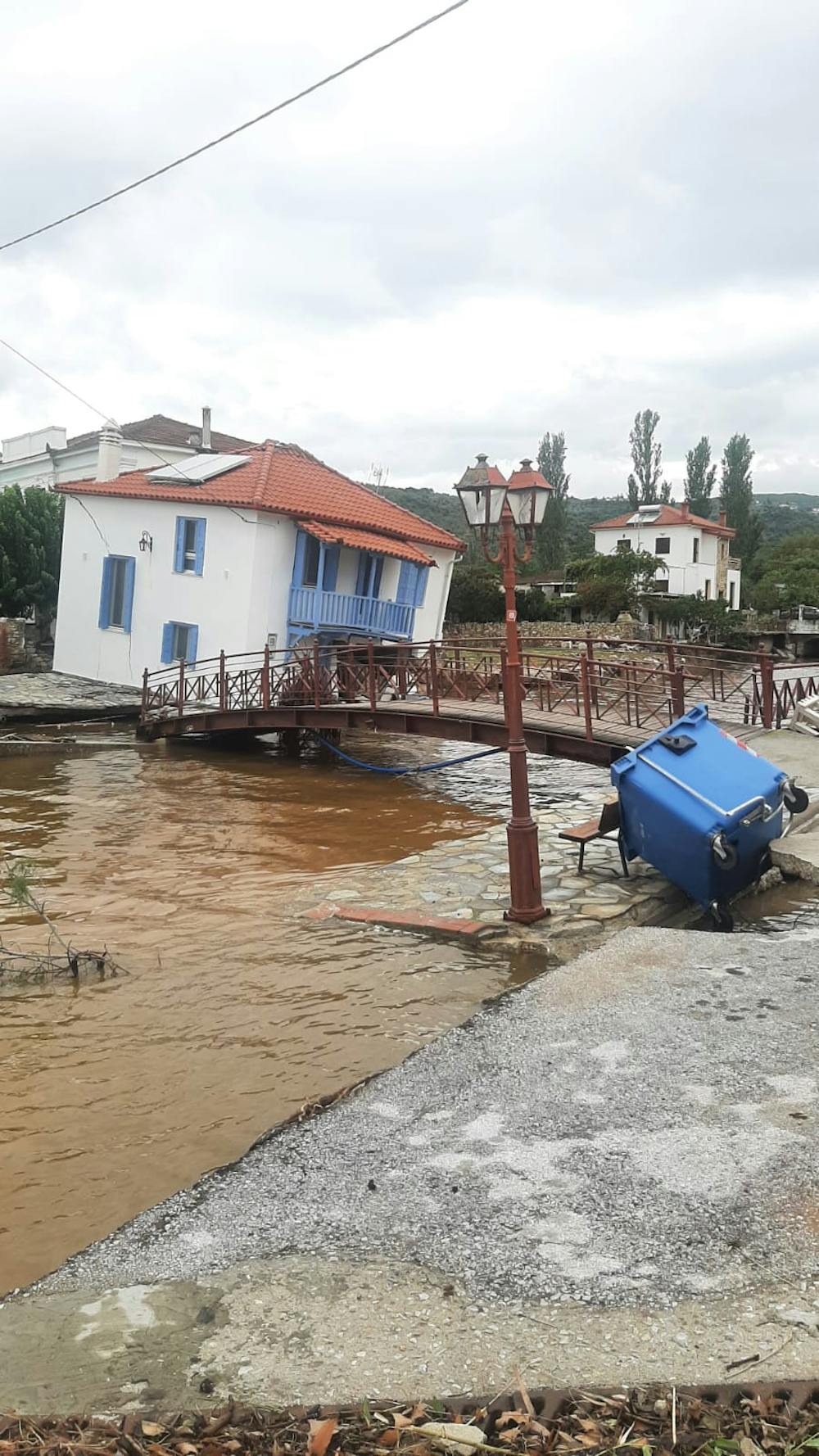
    The author’s friend saw this flooding in the village of Chorto.
    Irini Arabatzi

    Researchers who looked at 150 years of flood data in the Mediterranean found that most were flash floods, with their highest occurrence during the summer and autumn months. The region is particularly susceptible to these floods due to the combined effects of climate change and urbanisation. The latter has increased urban development in flood-prone areas and increased impervious surfaces (like roads and pavements), preventing the natural absorption of water into the ground.

    The Intergovernmental Panel on Climate Change’s chapter on the Mediterranean region issued a warning that extreme rainfall events are going to occur more often and be even more intense, elevating the risk of flash floods. This warning, in combination with records of flash floods in 2023 in Spain, Italy, Turkey, Bulgaria, France and Greece, underscores the urgent need for proactive measures to address these climate-related challenges.

    Research is advancing

    Flash floods might be rare, but they are severe enough to be a matter of significant concern. Fortunately, research has advanced considerably in recent years. We’re now better able to forecast when flash floods might happen, which areas might be susceptible, and to assess their impact in real-time.

    My colleagues and I are working on a project that combines historical documentary sources and modern hydraulic modelling. This way we can shed light on past floods and better understand the risks they pose, helping us design effective mitigation strategies for the future. Practically, in the case of a flash flood some basic but very important actions can be found on the poster below.

    infographic with important actions to take
    Tips from a flash floods expert.
    Ioanna Stamataki

    A complete eradication of flooding is neither technically feasible nor economically affordable. Instead on a larger scale it is key to start identifying flash-flood prone areas especially in catchments with historical flash floods. We should then focus on advocating for climate action and resilience measures, which can be anything from “hard” defences like new flood walls, through to policies and better public awareness of the risks. Only this will offer hope of a safer and more resilient future.


    Imagine weekly climate newsletter

    Don’t have time to read about climate change as much as you’d like?

    Get a weekly roundup in your inbox instead. Every Wednesday, The Conversation’s environment editor writes Imagine, a short email that goes a little deeper into just one climate issue. Join the 20,000+ readers who’ve subscribed so far. The Conversation


    Ioanna Stamataki, Lecturer in Hydraulics and Water Engineering, University of Greenwich

    This article is republished from The Conversation under a Creative Commons license. Read the original article.

    Related: Faster disaster: climate change fuels ‘flash droughts’, intense downpours and storms

  • Not convinced on the need for urgent climate action? Here’s what happens to our planet between 1.5°C and 2°C of global warming

    Spread the love

    Rachel Warren, University of East Anglia and Sally Brown, University of Southampton

    Many numbers are bandied around in climate emergency discussions. Of them, 1.5°C is perhaps the most important. At the Paris Agreement in 2015, governments agreed to limit global warming to well below 2°C and to aim for 1.5°C. By 2018, the Intergovernmental Panel on Climate Change – the UN body tasked with relaying the science of climate breakdown to the world – had made worryingly clear in a special report how much graver the consequences of the higher number would be.

    Together with the University of Queensland’s Ove Hoegh-Guldberg and colleagues around the world, we’ve explored in newly published work just how much sticking to 1.5°C matters.

    Climate breakdown is already harming livelihoods, cities and ecosystems. From heatwaves and droughts to cyclones and floods, devastating extreme weather events are more frequent, more intense and more unpredictable than they would be in the absence of global heating. Warming and acidifying oceans are causing severe coral bleaching to occur twice as often as in 1980, leaving many unable to recover.

    Shrinking habitats are increasingly forcing wildlife into conflict with human settlements. Increasing wildfires are damaging vital carbon stores in North America and Siberia, while the advance of spring is throwing species who depend on each other out of sync.

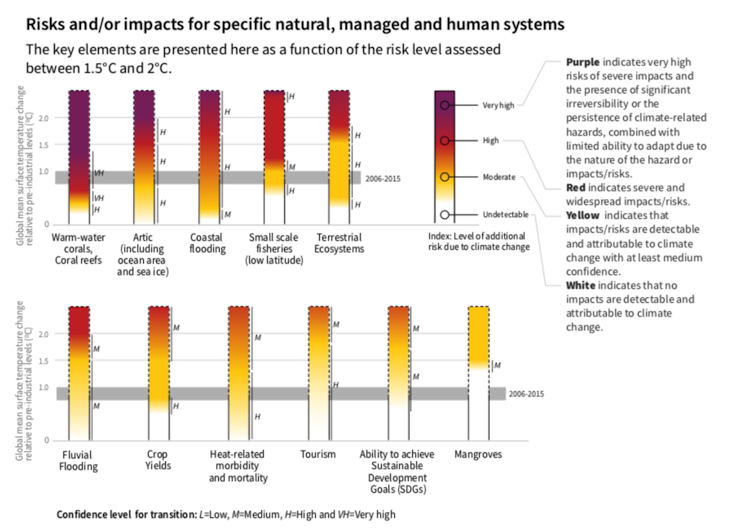
    The more we destabilise our climate, the greater the risk to human societies and ecosystems. Even at 1.5°C of global heating, tough times are in store for the living planet. But the space between 1.5°C and 2°C of heating is a crucial battleground, within which risks to humanity and ecosystems amplify rapidly.

    Climate battleground

    At 1.5°C of warming, about one in twenty insect and vertebrate species will disappear from half of the area they currently inhabit, as will around one in ten plants. At 2°C, this proportion doubles for plants and vertebrates. For insects, it triples.

    A great many risks amplify between 1.5 and 2 degrees of warming.
    Hoegh-Guldberg, Jacob, Taylor/IPCC

    Such high levels of species loss will put many ecosystems across the world at risk of collapse. We rely on healthy ecosystems to pollinate crops, maintain fertile soil, prevent floods, purify water, and much more. Conserving them is essential for human survival and prosperity.

    Between 1.5°C and 2°C, the number of extremely hot days increases exponentially. Some parts of the world can also expect less rain and more consecutive dry days, while others will receive more extreme floods. Collectively, this will place agriculture, water levels and human health under severe stress – especially in southern African nations, where temperatures will increase faster than the global average. The Mediterranean is another key area at particular risk above 1.5°C of heating, where increased drought will alter flora and fauna in a way without precedent in ten millennia.

    At 1.5°C of warming, we could expect to lose between 70% and 90% of our coral reefs. While this would be catastrophic for the millions of ocean creatures and human livelihoods these beautiful ecosystems support, there would still be a chance of recovery in the long term if oceans warm slowly. But at 2°C of warming, we could kill 99% of reefs. To be clear, this is a line that once crossed cannot be easily uncrossed. It could mean the extinction of thousands of species.

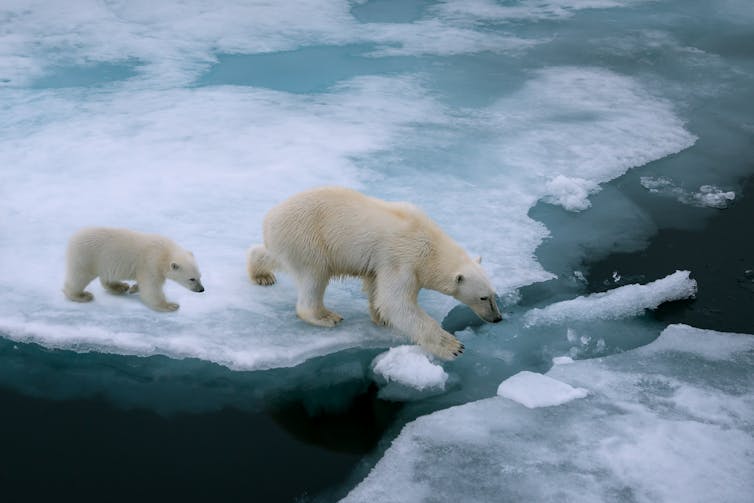
    Arctic sea ice has been a constant on our planet for hundreds of thousands, perhaps millions of years. If we limit global heating to 1.5°C, there’s a 70% chance of it remaining that way. But at 2°C, some Arctic summers will be ice-free. Polar bears and other species who depend on frozen sea ice to eat and breed will be left homeless and struggling to survive.

    Studies show that at 1.5°C, we could expect one metre of sea-level rise in 2300, with an extra 26cm at 2°C. However, between these two levels of global heating, the risk of the Greenland and West Antarctic Ice Sheets starting a slow process of decline dramatically increases. For the Greenland sheet, this is likeliest to happen at 1.6°C, with the Antarctic ice sheet’s tipping point hovering not far above this mark.

    Polar bears depend on Arctic sea ice.
    FloridaStock/Shutterstock

    If these ice sheets melt, seas could rise by up to two metres over the next two centuries. These rises could lead to millions more people being exposed to flooding each year. Many of those living in coastal cities, deltas, or small islands will be faced with little option but to build upwards or relocate.

    Way off track

    The impacts of climate breakdown are accelerating. The planet has warmed by 1.1°C since 1850-79, but 0.2°C of this warming happened between 2011 and 2015 alone. The last four years were the warmest in the global temperature record.

    Despite knowing all the above, many country-level commitments and action are nowhere near enough to limit warming to 2°C, let alone 1.5°C. We’re heading for 2.9°C to 3.4°C of warming. By this point, many dangerous tipping points could be crossed, leading to rainforest die-back, deadly heatwaves, and significant sea-level rise. Half of all insect and plant species are projected to disappear from more than half of the area they currently inhabit, potentially causing widespread ecosystem collapse and threatening organised human civilisation itself.

    Limiting warming to 1.5°C will save the global economy trillions of dollars in the long run, even accounting for the seemingly gargantuan cost of transitioning our energy systems. But this is more than just an economic or academic issue – its a matter of life and death for millions of humans and animal species, and a severe threat to the well-being of billions.

    Tackling climate breakdown is perhaps the tallest order humanity has ever faced, and there is no simple solution. The only way forward is accepting that we must fundamentally change the way we live our lives. It won’t be an easy transition, but there is no alternative if we are to preserve the well-being of humans, wildlife, and ecosystems. The coming year is vital, and there’s too much at stake not to act now.


    Click here to subscribe to our climate action newsletter. Climate change is inevitable. Our response to it isn’t. The Conversation

    Rachel Warren, Professor of Global Change, University of East Anglia and Sally Brown, Senior Research Fellow, University of Southampton

    This article is republished from The Conversation under a Creative Commons license. Read the original article.

  • Faster disaster: climate change fuels ‘flash droughts’, intense downpours and storms

    Spread the love

    Andrew King, The University of Melbourne and Andrew Dowdy, The University of Melbourne

    The run of extreme weather events around the world seems to be never-ending. After the northern summer of extreme heat and disastrous fires, we’ve seen more exceptional autumn weather over Europe with record-breaking heat in the UK.

    Meanwhile, record-breaking rain and intense flash floods struck Greece before the same storm devastated Libya, with thousands dead.

    Almost 20% of Africa is estimated to be in drought, and drought conditions are returning to parts of Australia. To top it off, we’ve seen several hurricanes intensify unusually quickly in the Atlantic.

    We know climate change underpins some of the more extreme weather we’re seeing. But is it also pushing these extreme events to happen faster?

    The answer? Generally, yes. Here’s how.

    Flash droughts

    We usually think of droughts as slowly evolving extreme events which take months to form.

    But that’s no longer a given. We’ve seen some recent droughts develop unexpectedly quickly, giving rise to the phrase “flash drought”.

    How does this happen? It’s when a lack of rainfall in a region combines with high temperatures and sunny conditions with low humidity. When these conditions are in place, it increases how much moisture the atmosphere is trying to pull from the land through evaporation. The end result: faster drying-out of the ground.

    Flash droughts tend to be short, so they don’t tend to cause the major water shortages or dry river beds we’ve seen during long droughts in parts of Australia and South Africa, for example. But they can cause real problems for farmers. Farmers in parts of eastern Australia are already grappling with the sudden return of drought after three years of rainy La Niña conditions.

    As we continue to warm the planet, we’ll see more flash droughts and more intense ones. That’s because dry conditions will more often coincide with higher temperatures as relative humidity falls across many land regions.

    Flash floods and extreme rainfall

    Climate change can cause increased rainfall variability. Some parts of the world will get a lot wetter, on average, while others will get drier, increasing the variation in rainfall between different regions. For Australia, most locations are generally expected to have intensified downpours of rain, as well as intensified droughts. So we might be saying more often “it doesn’t rain, it pours!”.

    We’re seeing exceptionally extreme rainfall in many recent events. The recent floods that submerged villages in Greece came from a sudden downpour of over 500 millimetres in a single day. Hong Kong was hit last week by the heaviest rains in 140 years, flooding subway stations and turning streets into rivers.

    But why does it happen so quickly?

    Sudden extreme rains fall when we have very moist air coupled with a weather system that forces air to rise.

    We’ve long known human-caused climate change is increasing how much moisture the air can hold generally, rising by about 7% per degree of global warming. That means storms now have the potential to hold and dump more water.

    Notably, the impact of climate change on rain-bearing weather systems can vary by region, which makes the picture more complicated. That means, for instance, climate change may lead to more extreme rain in some places, while other places may only see an intensification in really short extreme rain events and not for longer timescales.

    We can safely say, though, that in most parts of the world, we’re seeing more intense storms and sudden extreme rainfall. Sudden dumps of rain drive flash floods.

    More moisture in the air helps fuel more intense convection, where warm air masses rise and form clouds. In turn, this can trigger efficient, quick and intense dumps of rain from thunderstorms.

    These short-duration rain events can be much larger than you’d expect from the 7% increase in moisture per degree of warming.

    Flash cyclones? Hurricanes are intensifying faster

    Last month, Hurricane Idalia caused major flooding in Florida. As we write, Hurricane Lee is approaching the US.

    Both tropical storms had something odd about them – unusually rapid intensification. That is, they got much stronger in a short period of time.

    Usually, this process might increase wind speeds by about 50 kilometres per hour over a 24-hour period for a hurricane – also known as tropical cyclones and typhoons. But Lee’s wind speeds increased by 129km/h over that period. US meteorological expert Marshall Shepherd has dubbed the phenomenon “hyperintensification”, which could put major population centres at risk.

    Rapidly intensifying tropical cyclones are strong and can be very hazardous, but they aren’t very common. To trigger them, you need a combination of very high sea surface temperatures, moist air and wind speeds that don’t change much with height.

    While still uncommon, rapid intensification is potentially getting more frequent as we heat the planet. This is because oceans have taken up so much of the heat and there’s more moisture in the air. There’s much more still to learn here.

    Australia’s El Niño summer in a warming world

    Spring and summer in Australia are likely to be warmer and drier than usual. This is due to the El Niño climate cycle predicted for the Pacific Ocean. If, as predicted, we also get a positive Indian Ocean Dipole event, this can heighten the hotter, drier weather brought by El Niño. After three wet La Niña years, this is likely to be a marked shift.

    If it arrives as expected, El Niño would lower the risk of tropical cyclones for northern Australia and reduce chances of heavy rain across most of the continent.

    But for farmers, it may help trigger flash droughts. Prevailing warm and dry conditions may rapidly dry the land and reduce crop yields and slow livestock growth.

    Drier surfaces coupled with grass growth from the wet years could worsen fire risk. Grass can dry out much faster than shrubs or trees, and grass fires can start and spread very rapidly.

    Climate change loads the dice for extreme weather. And as we’re now seeing, these extremes aren’t just more intense – they can happen remarkably fast. The Conversation

    Andrew King, Senior Lecturer in Climate Science, The University of Melbourne and Andrew Dowdy, Principal Research Scientist, The University of Melbourne

    This article is republished from The Conversation under a Creative Commons license. Read the original article.

  • Summer 2023 was the hottest on record – yes, it’s climate change, but don’t call it ‘the new normal’

    Spread the love

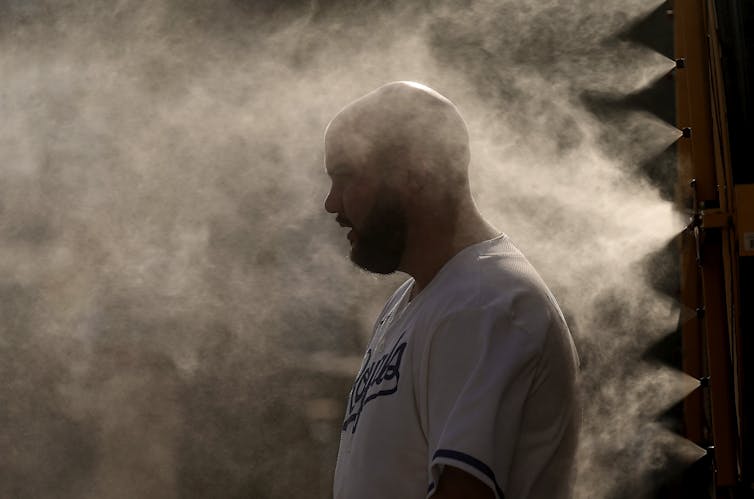
    Kansas City’s baseball stadium ran misters to cool people off in heat near 100 degrees on June 28, 2023.
    AP Photo/Charlie Riedel

    Scott Denning, Colorado State University

    Summer 2023 has been the hottest on record by a huge margin. Hundreds of millions of people suffered as heat waves cooked Europe, Japan, Texas and the Southwestern U.S. Phoenix hit 110 degrees Fahrenheit (43 degrees Celsius) for a record 54 days, including a 31-day streak in July. Large parts of Canada were on fire. Lahaina, Hawaii, burned to the ground.

    As an atmospheric scientist, I get asked at least once a week if the wild weather we’ve been having is “caused” by climate change. This question reflects a misunderstanding of the difference between weather and climate.

    Consider this analogy from the world of sports: Suppose a baseball player is having a great season, and his batting average is twice what it was last year. If he hits a ball out of the park on Tuesday, we don’t ask whether he got that hit because his batting average has risen. His average has gone up because of the hits, not the other way around. Perhaps the Tuesday homer resulted from a fat pitch, or the wind breaking just right, or because he was well rested that day. But if his batting average has doubled since last season, we might reasonably ask if he’s on steroids.

    Unprecedented heat and downpours and drought and wildfires aren’t “caused by climate change” – they are climate change.

    The rise in frequency and intensity of extreme events is by definition a change in the climate, just as an increase in the frequency of base hits causes a better’s average to rise.

    And as in the baseball analogy, we should ask tough questions about the underlying cause. While El Niño is a contributor to the extreme heat this year, that warm event has only just begun. The steroids fueling extreme weather are the heat-trapping gases from burning coal, oil and gas for energy around the world.

    Nothing ‘normal’ about it

    A lot of commentary uses the framing of a “new normal,” as if our climate has undergone a step change to a new state. This is deeply misleading and downplays the danger. The unspoken implication of “new normal” is that the change is past and we can adjust to it as we did to the “old normal.”

    Unfortunately, warming won’t stop this year or next. The changes will get worse until we stop putting more carbon dioxide and other greenhouse gases into the atmosphere than the planet can remove.

    The excess carbon dioxide humans have put into the atmosphere raises the temperature – permanently, as far as human history is concerned. Carbon dioxide lingers in the atmosphere for a long time, so long that the carbon dioxide from a gallon of gasoline I burn today will still be warming the climate in thousands of years.

    That warming increases evaporation from the planet’s surface, putting more moisture into the atmosphere to fall as rain and snow. Locally intense rainfall has more water vapor to work with in a warmer world, so big storms drop more rain, causing dangerous floods and mudslides like the ones we saw in Vermont, California, India and other places around the world this year.

    By the same token, anybody who’s ever watered the lawn or a garden knows that in hot weather, plants and soils need more water. A hotter world also has more droughts and drying that can lead to wildfires.

    So, what can we do about it?

    Not every kind of bad weather is associated with burning carbon. There’s scant evidence that hailstorms or tornadoes or blizzards are on the increase, for example. But if summer 2023 shows us anything, it’s that the extremes that are caused by fossil fuels are uncomfortable at best and often dangerous.

    Without drastic emission cuts, the direct cost of flooding has been projected to rise to more than US$14 trillion per year by the end of the century and sea-level rise to produce billions of refugees. By one estimate, unmitigated climate change could reduce per capita income by nearly a quarter by the end of the century globally and even more in the Global South if future adaptation is similar to what it’s been in the past. The potential social and political consequences of economic collapse on such a scale are incalculable.

    Fortunately, it’s quite clear how to stop making the problem worse: Re-engineer the world economy so that it no longer runs on carbon combustion. This is a big ask, for sure, but there are affordable alternatives.

    Clean energy is already cheaper than old-fashioned combustion in most of the world. Solar and wind power are now about half the price of coal- and gas-fired power. New methods for transmitting and storing power and balancing supply and demand to eliminate the need for fossil fuel electricity generation are coming online around the world.

    In 2022, taxpayers spent about $7 trillion subsidizing oil and gas purchases and paying for damage they caused. All that money can go to better uses. For example, the International Energy Agency has estimated the world would need to spend about $4 trillion a year by 2030 on clean energy to cut global emissions to net zero by midcentury, considered necessary to keep global warming in check.

    Just as the summer of 2023 was among the hottest in thousands of years, 2024 will likely be hotter still. El Niño is strengthening, and this weather phenomenon has a history of heating up the planet. We will probably look back at recent years as among the coolest of the 21st century. The Conversation

    Scott Denning, Professor of Atmospheric Science, Colorado State University

    This article is republished from The Conversation under a Creative Commons license. Read the original article.