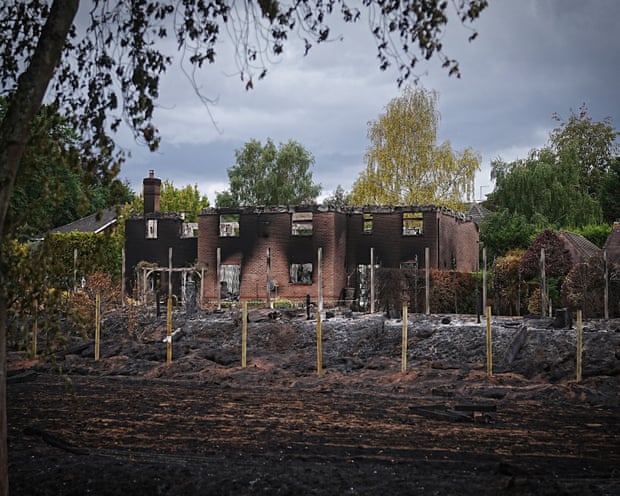
The fire-gutted remains of homes on Quarry Park Road on 17 August in Stourbridge, England after a wildfire that broke out across the West Midlands. Photograph: Christopher Furlong/Getty
Government resilience campaign aims to ensure people can cope in a national disaster, in order to free resources for most vulnerable
UK citizens will be told to stock up on tinned food and take steps to ensure they are prepared for national emergencies as part of a new government campaign to improve the nation’s resilience.
The new campaign from the Cabinet Office will set out ways people can prepare for and potential attacks from hostile states, including stocking up on bottled water, sources told the Guardian.
The aim will be to ensure most households have basic supplies and knowledge about how to cope in a crisis, in order to free up immediate government resources for the most vulnerable.
Translation by dizzy: The government wants you to stock up for when the shelves are empty caused by climate change – the long dry summer has decimated agricultural produce.
Donald Trump urges you to be a Climate Science denier like him. He says that he makes millions and millions for destroying the planet, Burn, Baby, Burn and Flood, Baby, Flood.Nigel Farage urges you to ignore facts and reality and be a climate science denier like him and his Deputy Richard Tice. He says that Reform UK has received £Millions and £Millions from the fossil fuel industry to promote climate denial and destroy the planet.Orcas comment on killer apes destroying the planet by continuing to burn fossil fuels.
Search and rescue workers dig through debris looking for any survivors or remains of people swept up in the flash flooding on July 6, 2025 in Hunt, Texas.(Photo: Jim Vondruska/Getty Images)
“It’s not a question of whether climate change played a role—it’s only a question of how much,” said one expert.
As the death toll from catastrophic flooding in Texas continued to rise, climate scientists this weekend underscored the link between more frequent and severe extreme weather events and the worsening climate emergency caused primarily by humans burning fossil fuels.
Officials said Sunday that at least 69 people died in the floods, 59 of them in Kerr County. Of the 27 missing girls from Camp Mystic—some of whom were sleeping just 225 feet from the Guadalupe River when its waters surged during flash flooding Friday—11 are still missing.
While some local officials blamed what they said were faulty forecasts from the National Weather Service—which has been hit hard by staffing cuts ordered by the Trump administration’s Department of Government Efficiencyin line with Project 2025—meteorologists and climate scientists including Daniel Swain of the University of California, Los Angeles have refuted such allegations, citing multiple NWS warnings of potentially deadly flooding.
However, some experts asserted that vacancies at key NWS posts raise questions about forecasters’ ability to coordinate emergency response with local officials.
Climate scientists do concur that human-caused global heating is causing stronger and more frequent extreme weather events including flooding.
“This kind of record-shattering rain (caused by slow-moving torrential thunderstorms) event is *precisely* that which is increasing the fastest in a warming climate,” Swain wrote in a statement. “So it’s not a question of whether climate change played a role—it’s only a question of how much.”
As Jeff Masters and Bob Henson wrote Saturday for Yale Climate Connections:
Many studies have confirmed that human-caused climate change is making the heaviest short-term rainfall events more intense, largely by warming the world’s oceans and thus sending more water vapor into the atmosphere that can fuel heavy rain events. Sea surface temperatures this week have been as much as 1°F below the 1981-2010 average for early July in the western Gulf [of Mexico] and Caribbean, but up to 1°F above average in the central Gulf. Long-term human-caused warming made the latter up to 10 times more likely, according to the Climate Shift Index from Climate Central.
“The tragic events in Texas are exactly what we would expect in our hotter, climate-changed, world,” Bill McGuire, professor emeritus of geophysics and climate hazards at University College London, said Saturday. “There has been an explosion in extreme weather in recent years, including more devastating flash floods caused by slow-moving, wetter, storms, that dump exceptional amounts of rain over small areas across a short time.”
It’s hard to make the Texas flood tragedy worse, except to know that on the same day Trump signed a bill to stop our efforts to defeat the climate change that is causing increased frequency of disastrous floods. And giving us more expensive electricity. www.nytimes.com/2025/07/05/c…
Instead of taking action to combat the planetary emergency, the Trump administration is ramping up fossil fuel production while waging war on clean energy and climate initiatives. The so-called One Big Beautiful Bill Act signed into law by Trump on Friday slashes the tax credits for electric vehicles and other renewable technologies including wind and solar energy that were a cornerstone of the Biden-era Inflation Reduction Act.
Donald Trump urges you to be a Climate Science denier like him. He says that he makes millions and millions for destroying the planet, Burn, Baby, Burn and Flood, Baby, Flood.
Is climate action a lost cause? The United States is withdrawing from the Paris Agreement for the second time, while heat records over land and sea have toppled and extreme weather events have multiplied.
In late 2015, nations agreed through the Paris Agreement to try to hold warming well under 2°C and ideally to 1.5°C. Almost ten years later, cutting emissions to the point of meeting the 1.5°C goal looks very difficult.
But humanity has shifted track enough to avert the worst climate future. Renewables, energy efficiency and other measures have shifted the dial. The worst case scenario of expanded coal use, soaring emissions and a much hotter world is vanishingly unlikely.
Instead, Earth is tracking towards around 2.7°C average warming by 2100. That level of warming would represent “unprecedented peril” for life on this planet. But it shows progress is being made.
How did we get here?
Global greenhouse gas emissions have risen since industrialisation began around 1850. Carbon dioxide (CO₂) is far and away the most common greenhouse gas we emit, while methane and nitrous oxide also play a role. These gases trap the sun’s heat in the atmosphere, preventing it from radiating back out to space.
In 2023, 41% of the world’s energy-related CO₂ emissions came from coal, mainly for electricity generation. Some 32% came from burning oil in road vehicles, and 21% from natural gas used for heating buildings and industrial processes.
The world is certainly feeling the effects. The World Meteorological Organization confirmed 2024 was the hottest year on record, temporarily hitting 1.5°C over the pre-industrial era. In turn, the world suffered lethal heatwaves, devastating floods and intense cyclones.
Extreme weather hit hard in 2024. Pictured: Flooded houses after Cyclone Debby hit Florida. Bilanol/Shutterstock
How are we tracking?
In 2014, the world’s peak body for assessing climate science – the Intergovernmental Panel on Climate Change – began using four scenarios called Representative Concentration Pathways (RCPs). These four big picture climate scenarios are based on what actions humanity does or doesn’t take. They comprise:
rapid climate action, low emissions (RCP 2.6)
two scenarios of some action and medium emissions (RCP 4.5 and 6.0)
no action, high emissions (RCP 8.5).
The numbers refer to how many more watts of heat strike each square metre of the planet.
Of these four, only the RCP 2.6 scenario is compatible with the Paris Agreement’s goal of holding climate change well under 2˚C.
But Earth is tracking towards somewhere between RCP 2.6 and 4.5, which would translate to about 2.7°C of warming by 2100.
IPCC experts also developed five pathways of possible social, economic and political futures to complement the four scenarios.
Of these pathways, we are tracking closest to a middle of the road scenario where development remains uneven, the intensity of resource and energy use declines, and population growth levels off.
While effective, these scenarios are now more than a decade old and need to be updated. In response, my colleagues and I produced the One Earth Climate Model to outline rapid pathways to decarbonise. We set an ambitious carbon budget of 450 gigatonnes of CO₂ before reaching net zero – a pathway even more ambitious than the RCP 2.6.
The US, European Union and China together represent about 28% of the global population, but are responsible for 56% of historic emissions (926 gigatonnes) . The pathways compatible with 1.5°C give them a remaining carbon budget of 243 Gt CO₂. China would require the largest carbon budget to reach decarbonisation.
For this to happen, by 2050, the world would have to be 100% powered by clean sources and phase out fossil fuel use. This would limit global warming to around 1.5°C, with a certainty of just over 50%. We would also have to end deforestation within the same timeframe.
Emissions peak – are we there yet?
Emissions of carbon dioxide and other greenhouse gases have still not plateaued, despite sharply increasing renewable electricity generation, battery storage and lower-cost electric vehicles.
But there has been real progress. The EU says its emissions fell by 8.3% in 2023 compared to 2022. Europe’s net emissions are now 37% below 1990 levels, while the region’s GDP grew 68% over the same period. The EU remains on track to reach its goal of reducing emissions by at least 55% by 2030.
Australia’s emissions fell by 0.6% last year. The country is now 28.2% below June 2005 levels, which is the baseline set for its Paris Agreement goal of a 43% reduction by 2030.
In the US, emissions are still below pre-pandemic levels and remain about 20% below 2005 levels. Since peaking in 2004, US emissions have trended downward.
The world’s largest emitter, China, is finally cutting its emissions. Huge growth in renewables has now led to the first emissions drop on record, despite surging demand for power. This is good news. For years, China’s domestic emissions remained high despite its leading role in solar, wind, EVs and battery technology.
China produces almost one-third (31%) of the world’s energy-related carbon emissions – not least because it is the workshop of the world. Every cut China makes will have a major global effect.
According to the IPCC, limiting warming to around 1.5°C requires global emissions to peak before 2025 at the latest. It now looks like the peak may occur this year.
Despite daily negative news, the decarbonisation train has left the station. In 2024, renewables accounted for more than 90% of growth in electricity production globally. Electric vehicles became cost competitive, while heat pumps are developing fast and solar is on a winning streak.
So, is it too late to save the climate? No. The technologies we need are finally cheap enough. The sooner we stop climate change from worsening, the more disasters, famine and death we avert. We might not manage 1.5°C or even 2°C, but every tenth of a degree counts. The faster we make the shift, the better our climate future.
Orcas discuss Donald Trump and the killer apes’ concept of democracy. Front Orca warns that Trump is crashing his country’s economy and that everything he does he does for the fantastically wealthy.Neo-Fascist Climate Science Denier Donald Trump says Burn, Baby, Burn.Elon Musk urges you to be a Fascist like him, says that you can ignore facts and reality then.
Children born in 2020 will face “unprecedented exposure” to extreme weather events, including heatwaves, droughts and wildfires, even if warming is limited to 1.5C above pre-industrial temperatures.
That is according to a new study, published in Nature, which calculates the number of unprecedented extreme events that people born in different decades and countries might live through.
Using a case study focused on Brussels, the researchers find that people born in 2020 will experience an “unprecedented” 11 heatwaves in their lifetime – even if global warming is limited to 1.5C by the end of the century.
In contrast, in a pre-industrial climate, a person living in the Belgian capital would likely experience just three such heatwaves, according to the study.
More than half of children born in 2020 – around 62 million people – will experience “unprecedented lifetime exposure” to heatwaves, even if warming is limited to 1.5C, the study finds.
However, this number nearly doubles to 111 million under a scenario where warming hits 3.5C.
The study also analyses crop failures, river floods, tropical cyclones, wildfires and droughts.
The research “helps the climate community build new narratives that better clarify the impacts [of climate change] on younger generations and vulnerable populations”, one expert who was not involved in the study tells Carbon Brief.
Intergenerational justice
As the planet warms, extreme weather events such as heatwaves, floods and droughts are becoming more intense, more frequent and lasting longer.
A popular 2021 study found that children born in the 21st century will be exposed to more extreme weather events in their lifetimes than their parents and grandparents.
The paper found that in a scenario of 3C of warming above pre-industrial levels, a child who turns six in 2020 will experience twice as many wildfires and tropical cyclones, three times more river floods, four times more crop failures, five times more droughts and 36 times more heatwaves over their lifetime than a six-year-old living in a pre-industrial climate.
The authors also found a “particularly strong increase” in children’s future exposure to extremes in the Middle East and North Africa.
The lead author of the study – Prof Wim Thiery from Vrije Universiteit Brussel – told Carbon Brief at the time that today’s youth will live “an unprecedented life”, in which they will “face conditions which older generations have never experienced”.
Four years later, Dr Luke Grant – a researcher in Thiery’s team – has led a new study building on the ideas of the 2021 paper.
Grant tells Carbon Brief that rather than counting the number of extreme events that an individual might experience, his new study counts the number of people that reach an “unprecedented state” of exposure to extremes.
Prof Kaveh Madani is the director of the UN University Institute for Water, Environment and Health and was not involved in the study. He tells Carbon Brief that the paper “helps the climate community build new narratives that better clarify the impacts [of climate change] on younger generations and vulnerable populations”.
The authors define “exposure” as the number of extreme events that a person experiences in their lifetime, relative to the number they would have experienced in a pre-industrial climate.
“Unprecedented lifetime exposure” is defined as exposure so high that it has only a one-in-10,000 chance of happening in a world without any greenhouse gas emissions.
‘Unprecedented lifetime exposure’
The authors present a case study of extreme heat in Brussels, Belgium, to explain their method.
They define a heatwave as a three-day extreme heat event, which reaches average temperatures that would be expected once per century in a pre-industrial climate.
Using models from the Inter-Sectoral Impact Model Intercomparison Project (ISIMIP), the authors calculate heatwave frequency in a world without climate change. They also assess scenarios in which warming is limited to 1.5C, 2.5C and 3.5C by the end of the century.
They combine this data with demographic information, including how many people are born in the country each year and their average life expectancy, using data from sources including the ISIMIP database and UN population estimates and projections.
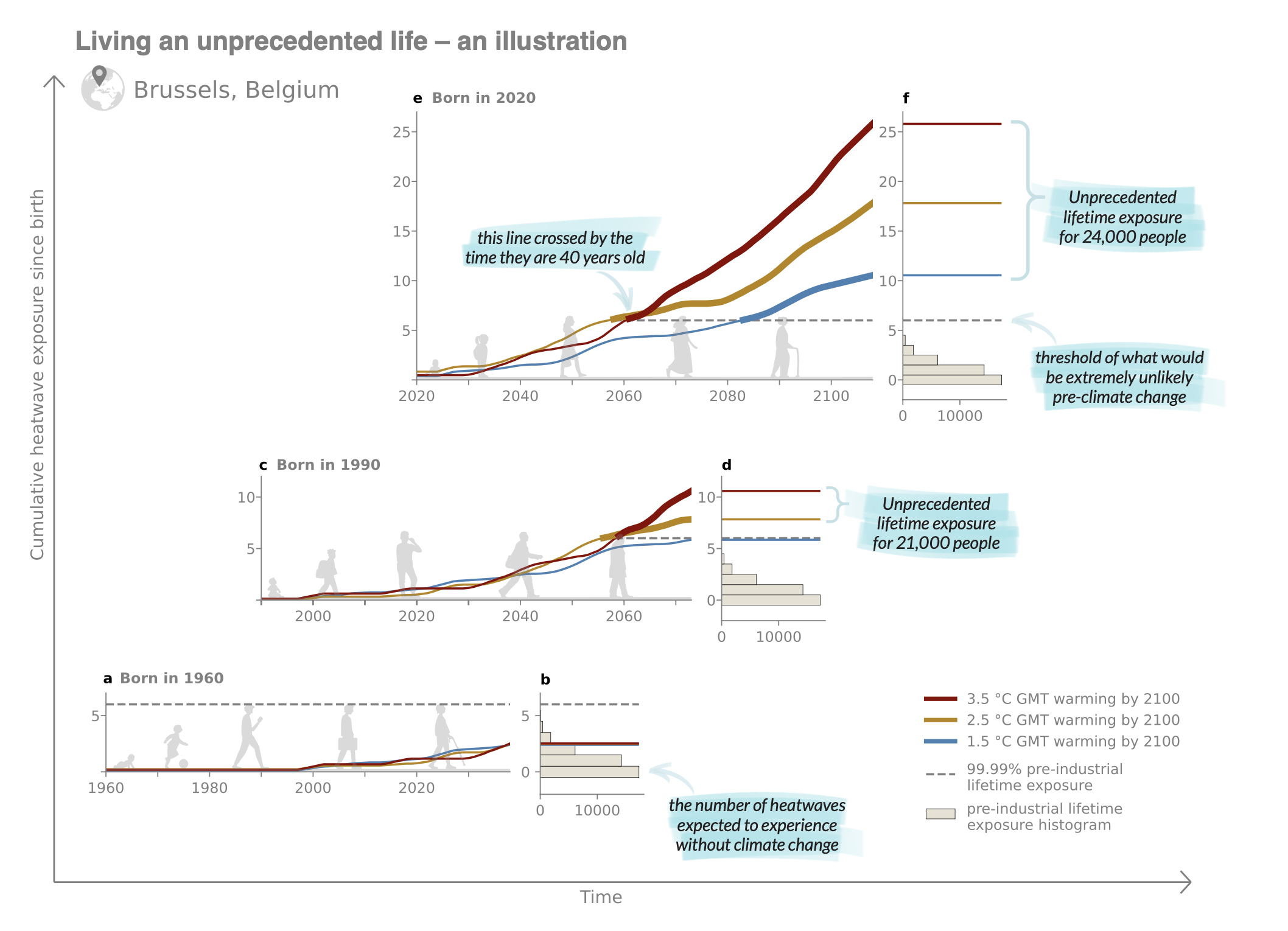
In a world without climate change, the study finds that a person born in 1960 in Brussels would have a one-in-10,000 chance of experiencing six of the pre-defined heatwaves in their lifetime. Any member of this “birth cohort” who experiences more than six heatwaves in their lifetime has therefore faced “unprecedented lifetime exposure” to extreme heat, according to the study.
The authors find that a person born in Brussels in 1960 is likely to experience three heatwaves on average during their lives under all of the three future warming pathways– meaning that they are unlikely to face “unprecedented lifetime exposure” to heat.
By contrast, the researchers find that many younger age cohorts will experience unprecedented heatwave exposure. For many younger age cohorts, lifetime exposure to heatwaves is greater for higher warming pathways.
For example, people born in Brussels in 2020 will experience 11 heatwaves in their lifetime if global warming is limited to 1.5C by the end of the century. If warming rises to 2.5C or 3.5C, they could experience 18 or 26 heatwaves, respectively.
The graphic below shows heat exposure since birth in Brussels for three “birth cohorts” of 1960 (bottom row), 1990 (middle row) and 2020 (top row). It presents three future scenarios, in which warming is limited to 1.5C (blue), 2.5C (yellow) and 3.5C (red) by 2100. The dotted line shows the threshold for an “unprecedented” lifetime exposure to extreme heat.
Lifetime exposure to unprecedented heat for people born in Brussels in 1960 (bottom row), 1990 (middle row) and 2020 (top row), under scenarios that limit warming to 1.5C (blue), 2.5C (yellow) and 3.5C (red) by the year 2100. The dotted line shows the threshold for an “unprecedented” lifetime exposure to extreme heat. Source: Grant et al (2025).
Heat exposure
The authors repeat their analysis across the Earth’s entire land surface, by dividing it into grid cells and using location-specific temperature and demographic data.
Of the 81 million people born in 1960, they find that 13 million are likely to face unprecedented exposure to heatwaves in their lifetimes. They add that for this age cohort, lifetime exposure to unprecedented extremes does not vary depending on the warming scenario.
However, 21st century warming has a significant effect on exposure for younger generations. Under a 1.5C warming pathway, 52% of people born in 2020 will face unprecedented exposure to heatwaves. This rises to 92% under a 3.5C warming scenario.
The study adds:
“This implies that 111 million children born in 2020 will live an unprecedented life in terms of heatwave exposure in a world that warms to 3.5C versus 62 million in a 1.5C pathway.”
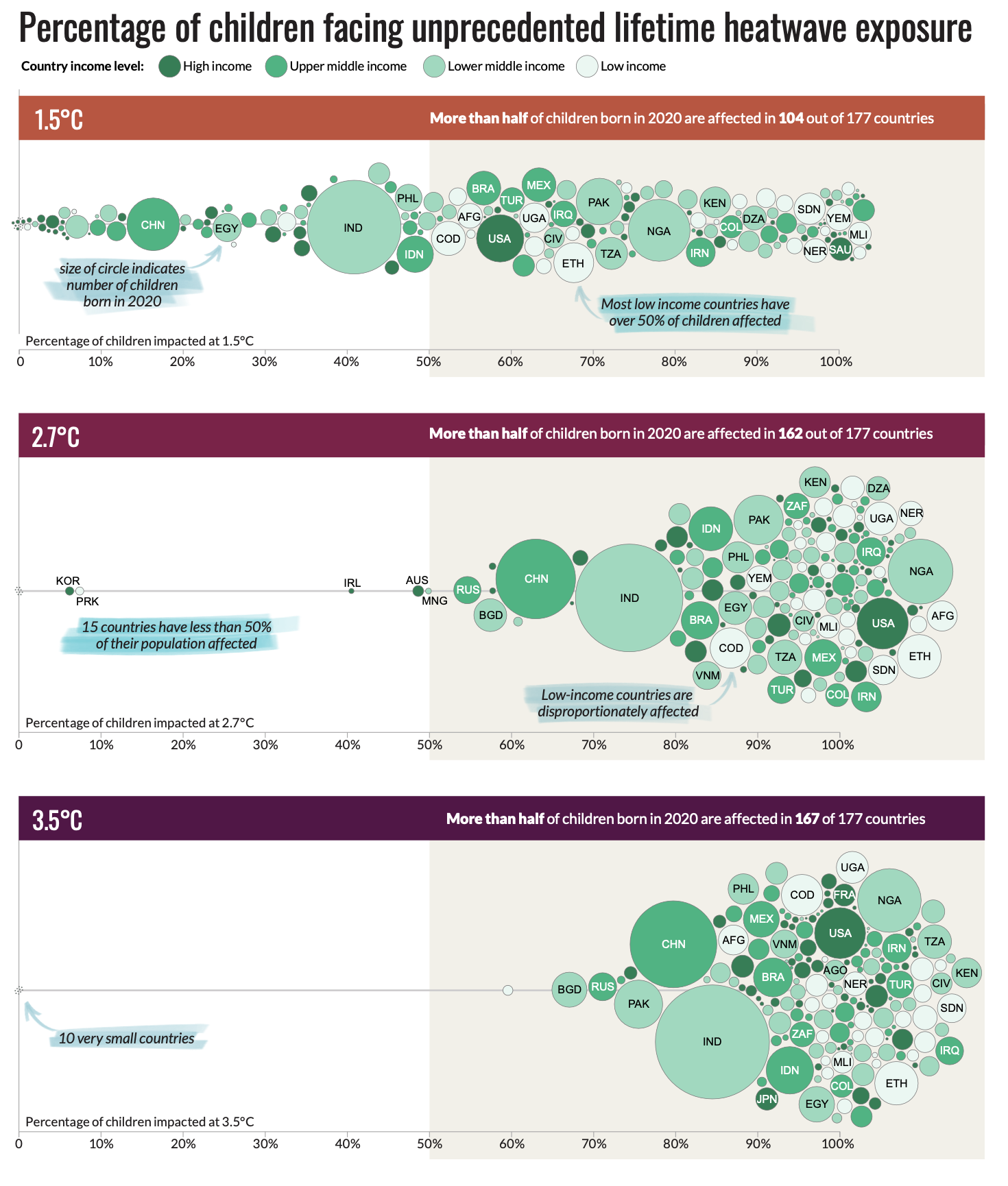
The charity Save the Children has published a report which unpacks the findings of the study. The graphic below, from the report, shows the percentage of people from different countries born in 2020 who will face unprecedented lifetime exposure to heatwaves under the 1.5C (top), 2.5C (middle) and 3.5C (bottom) warming scenarios.
Each circle shows a country, indicated by its three-letter countries code. The size of the circle indicates the number of people in the country. Darker circles indicate higher-income countries.
Circles on the right hand side of the graphic indicate that more than half of the country’s 2020 cohort will be exposed to unprecedented heatwaves in their lifetime.
The percentage of people born in 2020 who will face unprecedented lifetime exposure to heatwaves under the 1.5C (top), 2.5C (middle) and 3.5C (bottom) warming scenarios. Each circle indicates a country, indicated by its three-letter countries code. The size of the circle indicates the number of people in the country. Darker circles indicate higher-income countries. Source: Save the Children
“The evidence is now inescapable that heatwaves impact every community around the world,” Dr Luke Harrington, a senior lecturer in environmental science at the University of Waikato, who was not involved in the study, tells Carbon Brief. He adds:
“This paper offers the clearest view that climate change is verifiably unfair: those who have done the least to contribute to rising global temperatures will experience the most extreme impacts.”
From floods to fires
The authors apply the same method to five other climate extremes – crop failure, wildfires, droughts, floods and tropical cyclones.
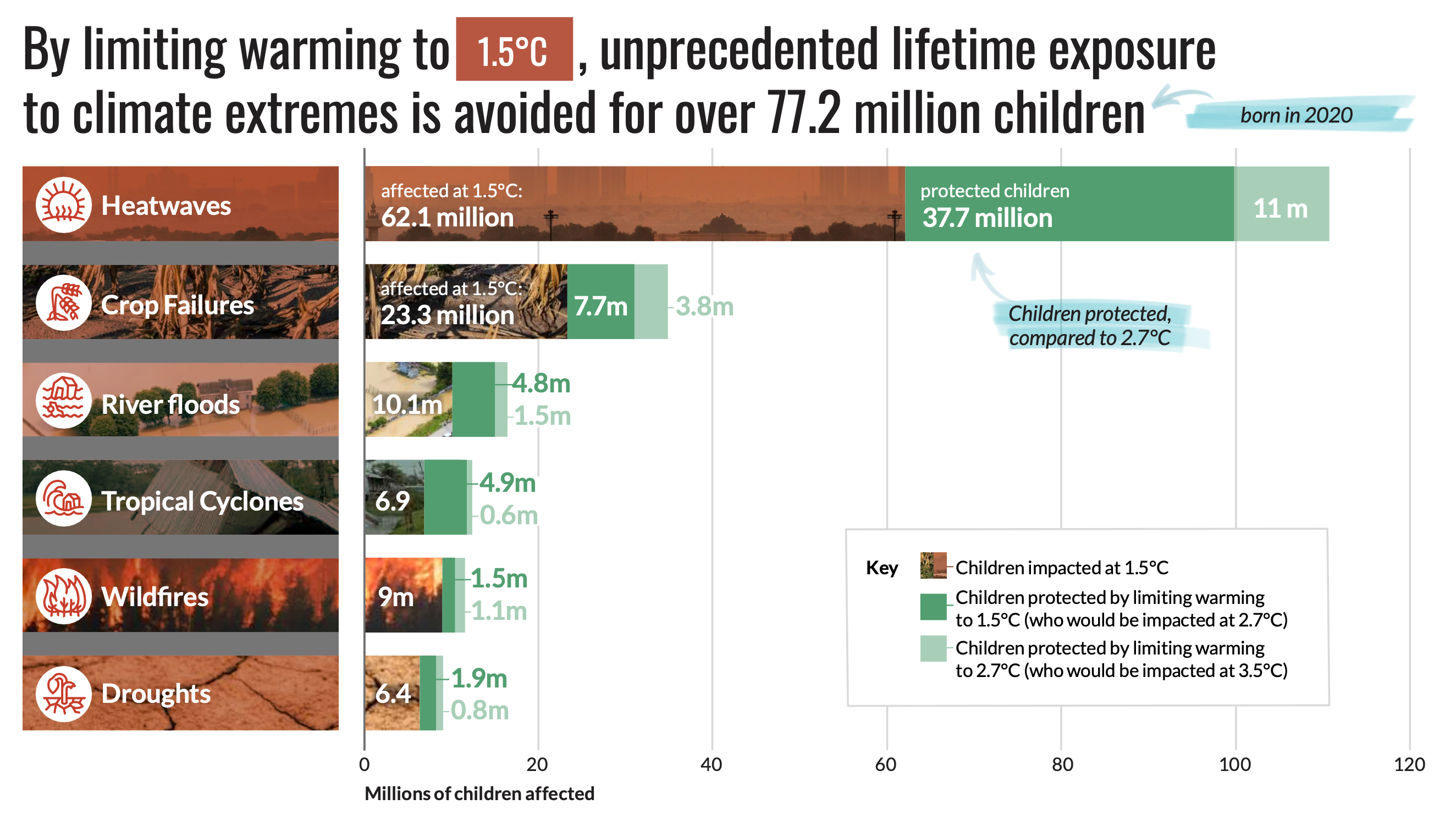
The graphic below shows the key findings. The coloured portion of the bar shows the number of people born in 2020 who will face unprecedented exposure to each extreme under a 1.5C warming pathway. The dark green and light green bars show the additional exposure under 2.7C and 3.5C warming.
Number of people born in 2020 who will face “unprecedented lifetime exposure” to heatwaves, crop failures, river floods, tropical cyclones, wildfires and droughts under 1.5C 2.7C and 3.5C warming. Source: Save the Children
The authors find that unprecedented lifetime exposure to heatwaves will affect the most people, with 62 million people born in 2020 likely to face unprecedented exposure to heat in their lifetimes if warming is limited to 1.5C.
This is followed by crop failures and river floods, which will impact 23 million and 10 million people from the 2020 birth cohort under the 1.5C warming pathway, respectively.
Lead author Grant tells Carbon Brief that he is “most confident” about his heatwave findings because temperature is a “basic” metric for climate models to “get right”.
Meanwhile, extremes such as crop failure depend on a range of factors including soil moisture, land-atmosphere interactions and rainfall, which can make it harder for the models to accurately capture changes, Grant explains.
Vulnerability
The authors also assess how “socioeconomic vulnerability” affects their findings using a global deprivation index – a tool which measures the level of disadvantage and hardship experienced by individuals or communities in a particular geographic area.
The authors use the index to identify the 20% most and least vulnerable people in each age cohort. They find that the most vulnerable groups are overwhelmingly from African countries.
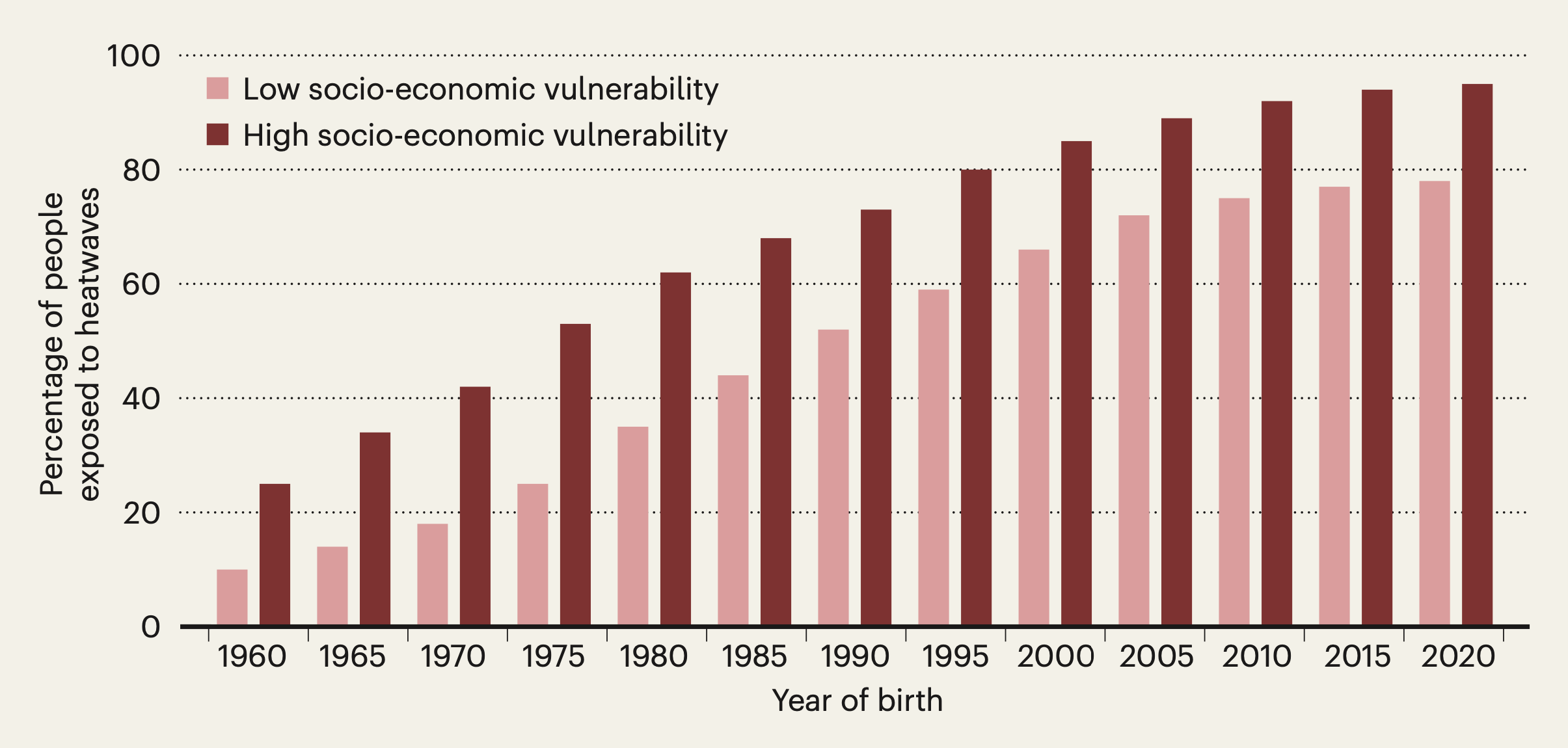
The authors also conclude that “socioeconomically vulnerable people have a consistently higher chance of facing unprecedented lifetime heatwave exposure compared to the least vulnerable members of their generation”.
The graph below, taken from a news and views article about the study, shows the percentage of high vulnerability (red) and low vulnerability (pink) people in each age cohort who would be exposed to unprecedented heat, under a 2.7C warming scenario.
The percentage of high vulnerability (red) and low vulnerability (pink) people in each age cohort who would be exposed to unprecedented heat, under a 2.7C warming scenario. Source: Gualdi and Muttarak (2025).
Dr Marina Romanello, a research fellow at the University College London and research director of the Lancet Countdown on Health and Climate Change who was not involved in the study, tells Carbon Brief that the paper “is an important addition to the scientific literature, showing how our delays in tackling climate change are putting the future of our children at risk”.
She adds:
“The authors have used well-established models to project future health threats, framing them around what matters the most: the wellbeing, health and survival of present and future generations.”
Grant, L. et al. (2025) Global emergence of unprecedented lifetime exposure to climate extremes, Nature, doi:10.1038/s41586-025-08907-1
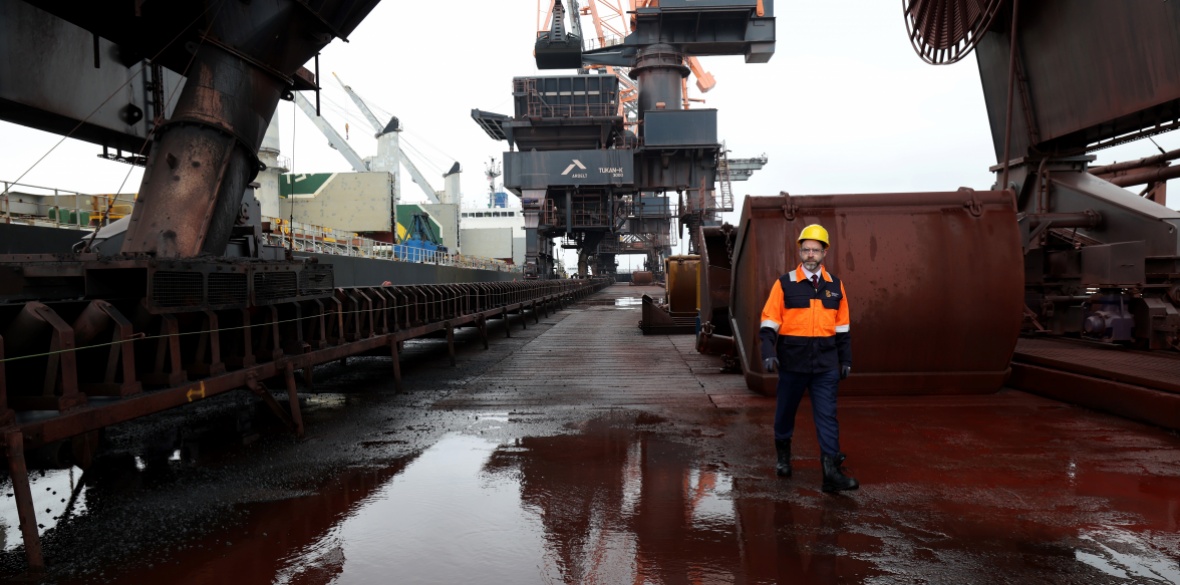
Business Secretary Jonathan Reynolds arrives as coking coal is unloaded at Immingham Port, northern England, as he visits the site in Lincolnshire to view raw materials destined for British Steel at Scunthorpe, being off-loaded, April 15, 2025
THE CRISIS at Scunthorpe steelworks, rightly if belatedly being addressed in the immediate term by state intervention, is the consequence of privatising critical national infrastructure so decisions on its future rest on the profit-and-loss calculations of private companies.
Right-wing media and parliamentarians, who are pro-privatisation and pro-war, want to avoid this conclusion. So we are seeing a propaganda campaign to blame it on other causes, each of which advances the right’s agenda.
One is that it is the result of pursuing “net zero” policies aimed at reducing greenhouse gas emissions. In fact, a planned and publicly directed green transition is essential to Britain’s industrial future: it is leaving it to the market which places jobs and industry at risk.
Turning our backs on the climate crisis cannot be an option as extreme weather events and crop failures grow more serious with each passing year. Labour should face pressure not to drop its already much reduced climate commitments, but to invest in measures that directly help people — restoring its original ambitious plans to insulate 19 million homes in a decade, cutting emissions and lowering household energy bills, for example — to stop the climate-denialist right claiming green policies lower living standards.
The other is to turn Jingye’s record at British Steel into a “security risk” because the company is Chinese, scaremongering over other Chinese investments in Britain and calling for trade decoupling in line with the new cold war being pushed from Washington.
Here, socialists must take a clear position that distinguishes our opposition to any company not accountable to the British people controlling assets of strategic importance from a China-bashing narrative that raises international tensions and risks advancing the US-led war drive.
That doesn’t mean defending the behaviour of a firm like Jingye, which seemed designed to force the closure of the Scunthorpe blast furnaces and whose negotiations with government involved demanding huge sums of money while offering little in return.
But it does mean identifying the parallels between its conduct and, say, that of the Indian conglomerate Tata, which has also taken hundreds of millions in public money while refusing to save the blast furnaces at Port Talbot, a move set to cost thousands of jobs. The common factor is not the country of origin, but the lack of democratic accountability of companies not owned by the British public.