Tag: floods
Unprecedented rains cause floods and landslides in Nepal, killing nearly 200 people
Original article by Abdul Rahman republished from peoples dispatch under a Creative Commons Attribution-ShareAlike 4.0 (CC BY-SA) license.

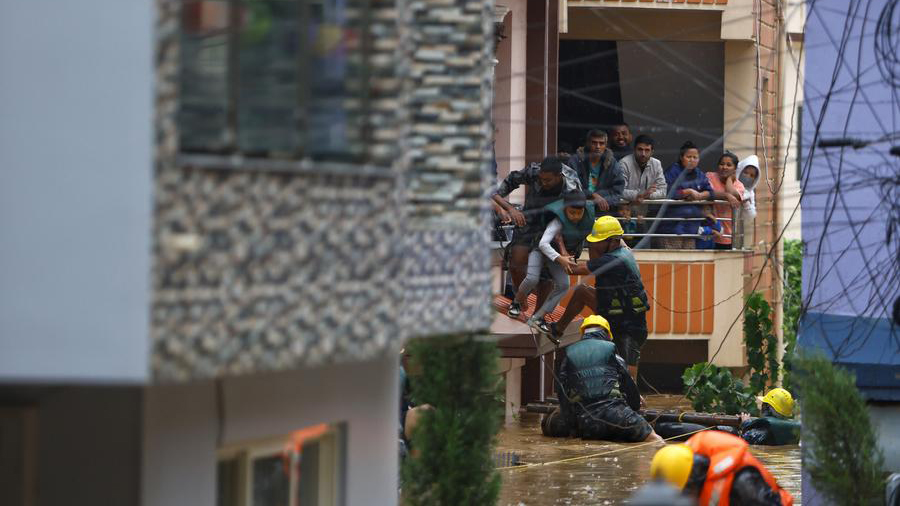
Rescuers evacuate flood victims in Lalitpur, Nepal ((Photo: Sulav Shrestha/Xinhua) Meteorologists in the Himalayan nation have observed a pattern of change in the local climate in the last few years, with monsoon season lasting longer than usual and erratic rains affecting millions
Over 200 people have been killed or missing in the floods and landslides caused by unprecedented rains lashing Nepal for the last five days. Thousands have been displaced in different parts of the mountainous country.
On Monday, authorities announced the shutting down of all educational institutions. Several school and university buildings have also been damaged after facing the brunt of the torrential rains.
The capital Kathmandu has been one of the most affected regions in the country with a large number of neighborhoods flooded or covered with the mud due to rain water, which has also caused the water levels in the Bagmati river to rise. The flood and landslides have destroyed numerous homes, bridges, roads, and vehicles, leaving a large number of people stranded.
Many flooded areas are localities where poor and working class people live. Their houses have been inundated with water and mud, which may take longer to clear, raising the risk of the breakout of epidemics after the water recedes.
According to Nepal’s Ministry of Transport, 47 out of 80 highways in the country have been affected by the rains and landslides, greatly impacting transportation. Over one hundred flights were canceled due to heavy rains, and the Kathmandu airport stopped operating on Friday and Saturday for several-hour-long periods. It re-started operations again on Sunday morning.
Several power plants have also been damaged due to the flooding and landslides, disrupting the power supply to different parts of the country.
The Communist Party of Nepal (UML) issued a statement earlier asking the government to increase its efforts to relief and rescue work. The party also asked cadres to participate in flood relief efforts.
The heavy rains in Nepal could also have a significant impact in India. In Indian states like Bihar, the flooding was already worsening in the last couple of weeks. Thousands of people have been displaced in several bordering regions in Bihar in the last couple of days, with most of the rivers in the region flowing far above the danger mark.
According to official data, at least 1.6 million people on the Indian side of the border are already severely affected due to the floods. Several schools and other public services have been affected. Local power grids are also shutting down due to flooding, leaving thousands without electricity.
Effects of climate change
Heavy rains during the monsoon season in South Asia are normal. However, in the last few years, local meteorological officials have claimed the severity of rains has increased and the monsoon has been significantly prolonged. The monsoon has shifted its usual duration. Its withdrawal, stretching until the month of October, is quite unusual, resulting in larger repercussions on the region’s agriculture.
From Thursday to Saturday, Kathmandu received 322 mm rainfall against an annual average of around 2,700 mm, causing a sudden rise in the water levels in the region’s rivers. On Saturday alone, some parts of the city received 240 mm rainfall within 24 hours, a record in over two decades.
Several studies indicate that Nepal has emerged as one of the most vulnerable countries in the context of climate change. The rise in the country’s average temperature is much higher than that of the global average (0.056 degrees Celsius against the global average of 0.03 degree Celsius), for example. The rise in temperature has caused the melting of several glaciers in the country, again endangering the local climate as well as the livelihoods of millions of people.
Despite the seriousness of the climate situation in Nepal, most of the developed world has largely been indifferent to its concerns in the climate negotiations so far. Raising the issue, Prime Minister KP Sharma Oli, while speaking during the ongoing UN General Assembly’s 79th session on Thursday said that the world needs to pay attention to the possible effects of climate change in a country such as Nepal which is a “natural climate stabilizer” vital for maintaining balance in the global environment.
Given its significance for global climate concerns, “it is essential that the mountain agenda receive due attention in climate negotiations,” Oli said.
Original article by Abdul Rahman republished from peoples dispatch under a Creative Commons Attribution-ShareAlike 4.0 (CC BY-SA) license.
Global Cooperation Key to Preventing ‘Runaway’ Climate and AI Chaos: UN Chief
Original article by JULIA CONLEY republished from Common Dreams under Creative Commons (CC BY-NC-ND 3.0).

United Nations Secretary-General António Guterres speaks at the U.N. headquarters on February 22, 2023. (Photo: Lev Radin/Pacific Press/LightRocket via Getty Images) “Geopolitical divides are preventing us from coming together around global solutions for global challenges,” said United Nations Secretary-General António Guterres.
At the World Economic Forum in Davos, Switzerland on Wednesday, United Nations Secretary-General António Guterres warned that multilateralism that includes often overlooked governments in the Global South is the only solution to the rapidly developing crises posed by the climate emergency and artificial intelligence—both of which are worsening “the global crisis in trust.”
“In the face of the serious, even existential threats posed by runaway climate chaos,” said Guterres, “and the runaway development of artificial intelligence without guardrails, we seem powerless to act together.”
While “droughts, storms, fires, and floods are pummeling countries and communities,” particularly in nations that have contributed the least planet-heating fossil fuel pollution, Guterres told the political and business elite assembled in Davos, “countries remain hellbent on raising emissions.”
He reserved particular scorn for the United States fossil fuel industry, which—amid the Biden administration’s approval of pollution-causing infrastructure including the Willow oil project and the Mountain Valley Pipeline—deceives the public with false climate solutions, misinformation, and greenwashing campaigns “to kneecap progress and keep the oil and gas flowing indefinitely.”
As suffering intensifies in communities that are most vulnerable to drought, damage from extreme weather, and other climate catastrophes, Guterres said, fossil fuel giants and powerful governments are risking lives to only delay an “inevitable” shift to renewable energy.
“The phaseout of fossil fuels is essential,” said the secretary-general. “No amount of spin or scare tactics will change that. Let’s hope it doesn’t come too late.”
As trust between the Global South and wealthy governments is frayed by fossil fuel-producing countries’ refusal to leave oil, gas, and coal behind, Guterres warned that the separate threat of “unintended consequences” of artificial intelligence evolution also looms—for people in rich economies as well as developing countries.
“This technology has enormous potential for sustainable development,” said the U.N. chief, while noting that “some powerful tech companies are already pursuing profits with a clear disregard for human rights, personal privacy, and social impact.”
Guterres’ comments came days after the International Monetary Fund (IMF) released a new analysis of AI’s expected impact on the global economy and workers, with nearly 40% of the labor market expected to be “exposed” to AI.
In wealthy countries, about 60% of jobs are projected to be impacted by AI, and about half of those workers are likely to see at least some of their primary tasks being completed by AI tools like ChatGPT or similar technology, “which could lower labor demand, leading to lower wages, and reduced hiring,” according to the IMF. “In the most extreme cases, some of these jobs may disappear.”
The analysis released Sunday noted that the rapidly changing field could worsen inequality within countries, as some higher earners may be able to “harness AI” and leverage its use for increases in their productivity and pay while those who can’t fall behind.
“In most scenarios, AI will likely worsen overall inequality, a troubling trend that policymakers must proactively address to prevent the technology from further stoking social tensions,” said the IMF. “It is crucial for countries to establish comprehensive social safety nets and offer retraining programs for vulnerable workers.”
Guterres called on policymakers to work closely with the private sector—currently “in the lead on AI expertise and resources”—to “develop a governance model” for AI that is focused on “monitoring and mitigating future harms.”
A systematic effort is also needed, said the secretary-general, “to increase access to AI so that developing economies can benefit from its enormous potential.”
Along with the IMF and Guterres, global human rights group Amnesty International this week raised alarm about AI and the “urgent but difficult task” of regulating the technology, noting that in addition to changing how people and companies work, AI has the potential to be “used as a means of societal control, mass surveillance, and discrimination.”
Police agencies in several countries have begun using AI for so-called “predictive policing,” attempting to prevent crimes before they’re committed, while officials have also deployed automated systems to detect fraud, determine who can and can’t access healthcare and social assistance, as well as to monitor migrants’ and refugees’ movement.
Amnesty credited the European Union with making headway in regulating AI in 2023, closing out the year by reaching a landmark agreement on the AI Act, which would take steps to protect Europeans from the automation of jobs, the spread of misinformation, and national security threats.
The AI Act, however, has been criticized by rights groups over its failure to ban mass surveillance via live facial recognition tools.
“Others must learn from the E.U. process and ensure there are not loopholes for public and private sector players to circumvent regulatory obligations, and removing any exemptions for AI used within national security or law enforcement is critical to achieving this,” said Amnesty.
In Davos on Wednesday, Guterres expressed hope that policymakers will agree on climate, AI, and other solutions that center human rights in the coming year, including at the U.N.’s Summit of the Future, planned for September.
“These two issues—climate and AI—are exhaustively discussed by governments, by the media, and by leaders here in Davos,” said Guterres. “And yet, we have not yet an effective global strategy to deal with either. And the reason is simple. Geopolitical divides are preventing us from coming together around global solutions for global challenges.”
“The only way to manage this complexity and avoid a slide into chaos,” he said, “is through a reformed, inclusive, networked multilateralism.”
Original article by JULIA CONLEY republished from Common Dreams under Creative Commons (CC BY-NC-ND 3.0).
‘It’s high time government woke up to the climate emergency’

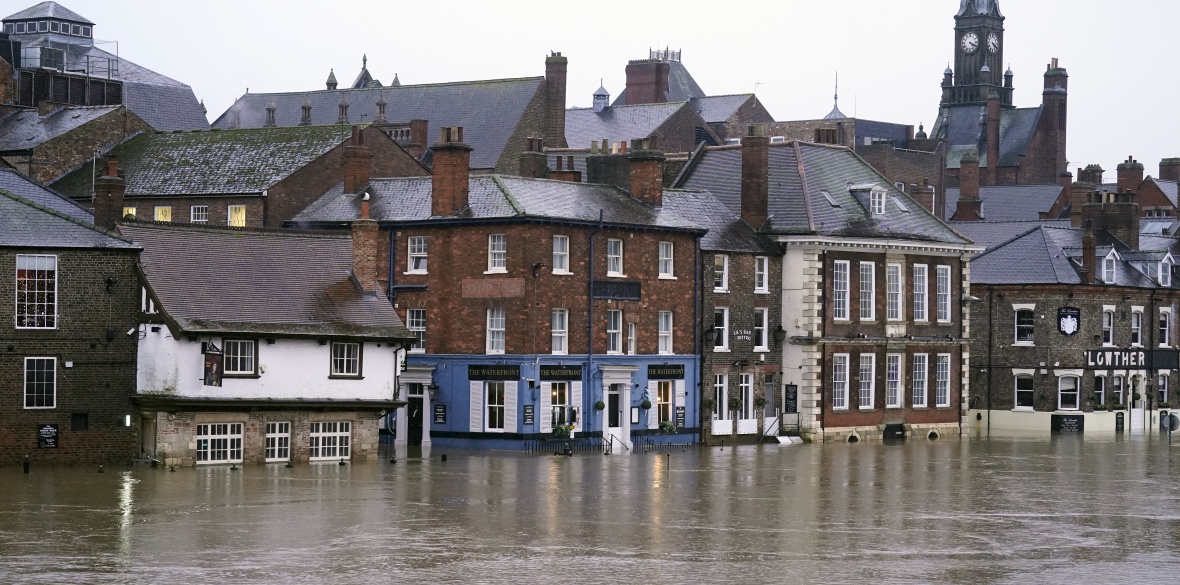
Flood water in York, Yorkshire, January 2, 2024 Firefighters demand emergency funding as thousands evacuated across Britain
FIREFIGHTERS have demanded emergency funding to tackle widespread flooding after thousands of residents were evacuated from their homes and transport links ground to a halt in the wake of Storm Henk.
…
Since 2010 funding for the Environment Agency has been axed by two-thirds, including funding for flood defences and resilience. More than 2,000 jobs have been axed.
In the call for emergency funding, Fire Brigades Union (FBU) general secretary Matt Wrack said: “When floods threaten people’s homes, lives and livelihoods, it’s firefighters who step in to protect communities.
“Storm Henk follows a winter of storm after devastating storm and more is to come.
“It’s high time that the government woke up to the realities of the climate emergency.
…
Greenpeace UK climate campaigner Georgia Whitaker said: “While the prime minister is on a tour to kick off the election year, thousands of people are seeing their homes, businesses and fields wrecked by rising water.
“We’ve known for decades that the climate crisis would bring more rainfall and flooding and yet the government completely failed to prepare for it.
“Thousands of flood defences are in a state of disrepair and ministers are still allowing developers to build in high-risk areas, while also pushing for more oil and gas drilling that will only make the problem worse. It’s a double failure.
“(Prime Minister Rishi) Sunak should take a break from his glad-handing tour and see for himself what the real consequences of climate inaction look like.
“He might learn how voters waist-deep in flood water feel about his plans to slow down climate action ahead of the election.”
…

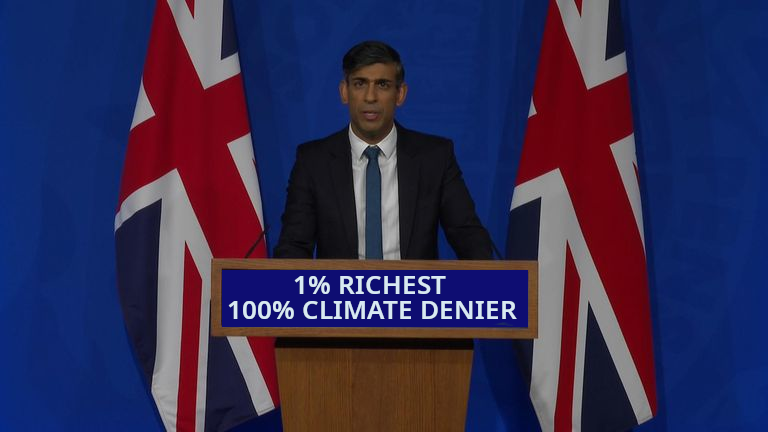
Image of UK Prime Minister Rishi Sunak reads 1% RICHEST 100% CLIMATE DENIER Fires, Floods, and All-Time Record Heat Batter Brazil
Original article by JON QUEALLY republished from Common Dreams under Creative Commons (CC BY-NC-ND 3.0).

A woman cools off with a hose as fans of singer Taylor Swift queue outside the Nilton Santos Olympic Stadium before Taylor Swift’s concert amid a heat wave in Rio de Janeiro on November 18, 2023. (Photo by Tercio Teixeira/AFP via Getty Images) The heat index—which combines air temperature and humidity—hit an astounding 58.5ºC (137ºF), the highest index ever recorded, in Rio de Janeiro on Tuesday.
Amid a stifling heatwave this week Brazil is experiencing its highest temperatures ever recorded—a milestone that comes alongside global trends and fresh scientific data showing the world is far from meeting stated ambitions to reduce greenhouse gas emissions to curb the climate emergency.
According to the National Institute of Meteorology, temperatures in the southeastern city of Araçuaí hit 44.8ºC (112.6ºF) on Sunday, breaking the previous record set in 2005.
It was so hot over the weekend that international pop star Taylor Swift was forced to reschedule concerts nationwide.
Meanwhile, the heat index—which combines air temperature and humidity—hit an astounding 58.5ºC (137ºF), the highest index ever recorded, Tuesday morning in the country’s second-most populous city of Rio de Janeiro.
The extreme heat is having a severe and negative impact on people’s ability to work and live comfortably and putting a crush on the nation’s power grid. As the Associated Pressreports:
Brazilians turned to fans, air conditioners and dehumidifiers to cool down, with utilities reporting record energy demand. Power outages were reported in Sao Paulo and Rio de Janeiro.
Amid the high heat, wildfires are burning widely in the Pantanal biome, the world’s biggest tropical wetlands spanning parts of Mato Grosso and Mato Grosso do Sul states. The fires have ravaged an area about the size of Cyprus, or more than 947,000 hectares (about 3,600 square miles), according to the Environmental Satellite Applications Laboratory of the Federal University of Rio de Janeiro.
The wildfires are arriving earlier in some places and with much more intensity. With summer not even at its height, fears are growing of what’s to come:
“The Pantanal is a region that’s used to fires,” biologist Gustavo Figueiroa, head of the environmental group SOS Pantanal, toldAl-Jazeera on Monday. “Normally, it regenerates naturally. But this many fires isn’t normal.”
Attributed in part to the El Niño effect, the historic temperatures in South America’s largest country mirror the trend happening worldwide, with 2023 on track to be the hottest in 125,000 years, the result of burning fossil fuels and release of other heat-trapping gasses since the Industrial Revolution.
In addition to the heatwave and fires, heavy rains and damaging storms have brought severe flooding to other regions of the country, some resulting in the death of local residents and tens of thousands displaced.
Despite global efforts to reduce emissions and transition away from coal, oil, and gas, the latest figures from the United Nations in its 2023 Emissions Gap Report, released Monday, show that humanity is expanding its use of fossil fuels instead.
“The report shows that the emissions gap is more like an emissions canyon,” U.N. Secretary-General António Guterres said in a statement. “A canyon littered with broken promises, broken lives, and broken records. All of this is a failure of leadership, a betrayal of the vulnerable, and a massive missed opportunity.”
Original article by JON QUEALLY republished from Common Dreams under Creative Commons (CC BY-NC-ND 3.0).