Earth Hurtling Toward ‘Hothouse Trajectory,’ Scientists Warn in Tipping Points Analysis

Spread the love

Original article by Jessica Corbett republished from Common Dreams under Creative Commons (CC BY-NC-ND 3.0). 

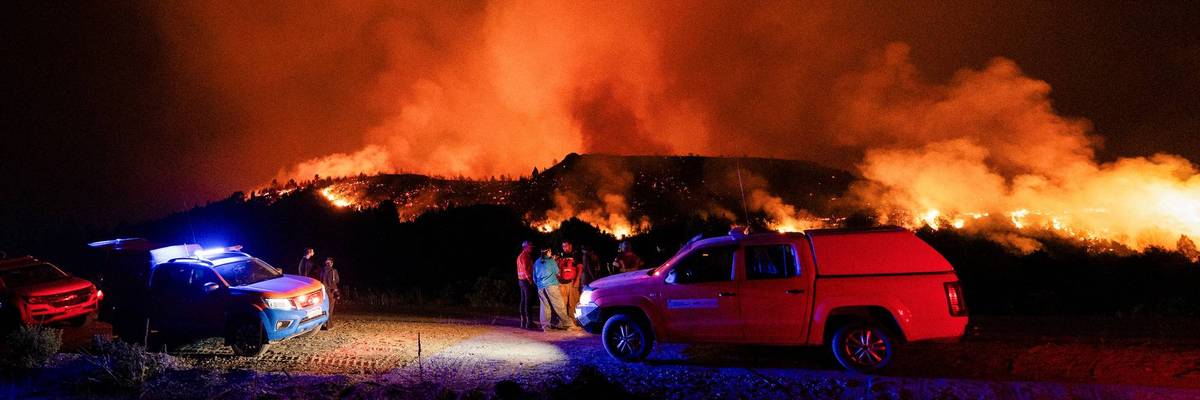
Volunteers and firefighters work to extinguish a forest fire burning in the Patagonian region of Chubut province, Argentina, on February 1, 2026. (Photo by Gonzalo Keogan/AFP via Getty Images)

“Existing climate mitigation approaches, including scaling up renewable energy and protecting carbon-storing ecosystems, are critical to limit the increase in global temperatures,” said the lead author.

In the lead-up to the Trump administration effectively destroying the US Environmental Protection Agency’s ability to combat the fossil fuel-driven climate emergency, an international team of scientists warned Wednesday that “Earth’s climate is now departing from the stable conditions that supported human civilization for millennia.”

Various institutions, including in the United States, have confirmed that 2025 was among the hottest years on record, and January continued that trend. Meanwhile, governments and polluting industries have repeatedly refused to impose policies that adequately heed experts’ calls for action.

RECOMMENDED…

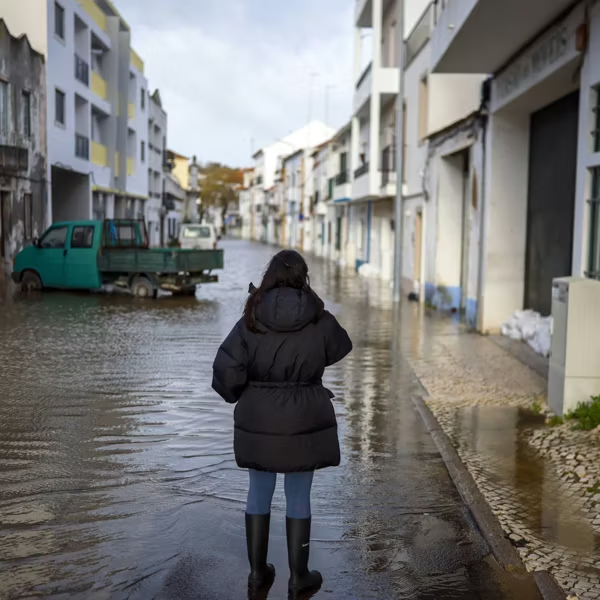
PORTUGAL-WEATHER-CLIMATE-FLOOD-EMERGENCY

Scientists Warn ‘Garbage’ Models Underestimate Risk of Economic Collapse From Climate Crisis

Immigration Detainees Held At Texas Facility

US Military Helping Trump to Build Massive Network of ‘Concentration Camps,’ Navy Contract Reveals

“In an effort to mitigate dangerous levels of warming, the Paris Agreement formalized the aim of limiting warming to 1.5°C above preindustrial levels, yet global temperatures have recently breached this limit for 12 consecutive months, coinciding with record-breaking heat, wildfires, floods, and other extremes,” the scientists noted Wednesday in the journal One Earth.

They wrote that “crossing critical temperature thresholds may trigger self-reinforcing feedbacks and tipping dynamics that amplify warming and destabilize distant Earth system components. Uncertain tipping thresholds make precaution essential, as crossing them could commit the planet to a hothouse trajectory with long-lasting and potentially irreversible consequences.”

A “hothouse trajectory,” they wrote, is “a pathway in which self-reinforcing feedbacks push the climate system past a point of no return, committing the planet to substantially higher long-term temperatures, even if emissions are later reduced.”

“Sixteen major tipping elements have been identified, 10 of which could add to global temperature if triggered,” the experts detailed. “Tipping may already be underway or could occur soon for the Greenland and West Antarctic ice sheets, boreal permafrost, mountain glaciers, and parts of the Amazon rainforest.”

As an example, they pointed to ice melt in the Arctic, explaining that the resulting water “could perturb the Atlantic Meridional Overturning Circulation (AMOC), which is already showing signs of weakening. A weakened AMOC could alter global atmospheric circulation, shifting tropical rain belts and drying parts of the Amazon. This cascade of events could trigger large-scale Amazon forest dieback, with major consequences for the region’s carbon storage and biodiversity.”

Concerned about the Point of No Return? Today we published a paper on the risk of a hothouse Earth trajectory. You can read it here: authors.elsevier.com/c/1mbW49C~Iu…

Prof William Ripple (@williamripple.bsky.social) 2026-02-11T19:43:39.167Z

The team of eight was led by William Ripple, who has previously emphasized alongside other experts that “we are on the brink of an irreversible climate disaster” and “fossil fuels—and the fossil fuel industry and its enablers—are driving a multitude of interlinked crises that jeopardize the breadth and stability of life on Earth.”

Ripple, distinguished professor of ecology at Oregon State University (OSU), said in a Wednesday statement that “after a million years of oscillating between ice ages separated by warmer periods, the Earth’s climate stabilized more than 11,000 years ago, enabling agriculture and complex societies.”

“We’re now moving away from that stability and could be entering a period of unprecedented climate change,” he stressed. “Existing climate mitigation approaches, including scaling up renewable energy and protecting carbon-storing ecosystems, are critical to limit the increase in global temperatures.”

Study co-author Christopher Wolf, a former OSU postdoctoral researcher who is now a scientist with Terrestrial Ecosystems Research Associates (TERA), noted that already, “climate model simulations suggest the recent 12-month breach indicates the long-term average temperature increase is at or near 1.5°C.”

“It’s likely that global temperatures are as warm as, or warmer than, at any point in the last 125,000 years and that climate change is advancing faster than many scientists predicted,” he said.

“Policymakers and the public remain largely unaware of the risks posed by what would effectively be a point-of-no-return transition,” Wolf added. “And while averting the hothouse trajectory won’t be easy, it’s much more achievable than trying to backtrack once we’re on it.”

🆕 Several Earth system components may be closer to destabilisation than previously thought. Crossing key temperature thresholds could trigger feedback loops, pushing the planet toward a “Hothouse Earth” trajectory. Study by @oregonstate.edu, @iiasa.ac.at & PIK: www.sciencedirect.com/science/arti…

PIK_climate (@pik-potsdam.bsky.social) 2026-02-11T16:52:15.896Z

The team’s warnings came in the wake of Big Oil-backed President Donald Trump claiming in a United Nations speech last year that climate change is “the greatest con job ever perpetrated on the world,” and ditching dozens of relevant organizations and treaties, including the Paris Agreement.

On Thursday, the Trump administration continued its war on the climate, revoking the “endangerment finding” that allowed the EPA to pass regulations fighting the global emergency—which was forcefully condemned by scientists and activists.

“In case there was any remaining doubt, the truth is very clear: Trump cares nothing for the health and well-being of our communities or our climate,” said Erin Doran, senior staff attorney at the advocacy group Food & Water Watch. “He is concerned only with making more money for the billionaire fossil fuel polluters that help to fund his dangerous political agenda.”

“The notion that the EPA shouldn’t regulate climate emissions is inconsistent with the law, the science, and the realities of the climate crisis,” Doran added. “EPA is charged with protecting human health and the environment, yet this rule does neither, benefiting only the fossil fuel industry at our expense. It’s absurd, and we’ll be fighting back.”

Original article by Jessica Corbett republished from Common Dreams under Creative Commons (CC BY-NC-ND 3.0). 

Power-mad orange gasbag Donald Trump says Burn, Baby, Burn.
Nigel Farage urges you to ignore facts and reality and be a climate science denier like him and his Deputy Richard Tice. He says that Reform UK has received £Millions and £Millions from the fossil fuel industry to promote climate denial and destroy the planet.
Orcas comment on killer apes destroying the planet by continuing to burn fossil fuels.
Orcas comment on killer apes destroying the planet by continuing to burn fossil fuels. [This was the first appearance of the Orcas.]

Continue ReadingEarth Hurtling Toward ‘Hothouse Trajectory,’ Scientists Warn in Tipping Points Analysis

Heavy rain and floods affect millions in Pakistan, over 650 killed since late June

Spread the love

Original article by Abdul Rahman republished from peoples dispatch under a Creative Commons Attribution-ShareAlike 4.0 (CC BY-SA) license.

The Lower Swat Forest Division team of the Forest Department is engaged in rescue and relief activities in the flood-affected areas of Mingora, KP. Photo: Pir MusavirPTI/X

Pakistan has witnessed frequent heavy rains and floods in recent times causing massive human and material loss claimed to be the result of human-induced global changes in the climate

Pakistan is yet again facing heavy casualties and massive destruction due to unusual heavy rains and floods across the country this year. According to the country’s National Disaster Management Authority (NDMA), more than 650 people have been killed and over 900 others have been injured in rain-related incidents across the country since June 26.

The flash floods in mostly the northeastern parts of the country have also displaced hundreds of thousands with scores still reported missing.

It is estimated that Pakistan has already received 50% more rain this year in comparison to last year. The country’s meteorological department has warned that the current spell of heavy rains is expected to last until August 19 with three more spells of heavy rains through September after that.

The upcoming spells may cause massive flooding in the areas along the Indus river in the coming days, Pakistani authorities have warned.

Though death and destruction from the floods have been recorded across all the provinces of Pakistan, including the capital Islamabad, the northeastern Khyber Pukhtunkhwa (KP), and Gilgit-Baltistan have been hit the hardest.

Last week, huge flash floods washed away villages and communication networks at various places in the hilly region of KP and Gilgit-Baltistan. Heavy rains and cloud bursts have destroyed roads, railway lines, schools, hospitals, and other essential civilian infrastructure in KP, Gilgit-Baltistan, and other parts of Pakistan.

Buner in KP, which witnessed a cloud burst last week, has been the hardest-hit district, amassing more than half of all deaths recorded in the province with scores of people still missing.

According to the NDMA, KP recorded the highest number of people killed at 390, followed by Punjab, Pakistan’s largest province, which has recorded 164 deaths. Even the drier regions such as Balochistan have recorded over a dozen deaths due to the heavy rain and flash flooding.

Fresh heavy rains on Monday have made the relief and rescue operations difficult, particularly in the most affected regions in the hills.

Effects of climate change

Residents in Pakistan’s hilly areas who lost their houses in the flash floods say there were no early warnings of the heavy rains which multiplied the loss of lives and property.

Inam Haider Malik, head of the NDMA, claimed in a press conference in Islamabad on Sunday that it is difficult to predict cloud bursts and flash floods and warned that at least three more spells of heavy rain in the coming days may cause flooding in the lower areas in Pakistan. He emphasized that the “scale of loss is part of the climate change impacts”.

Pakistan’s chief meteorologist Zaheer Babar also claimed that the unusually heavy rains are a result of climate change. However, he also underlined that the impact of erratic rain is multiplied due to haphazard construction near the river valleys and unscientific disposal of waste in the river beds, Geo Tv quoted Babar saying.

“The situation in Khyber Pukhtunkhwa and Gilgit Baltistan is devastating. We are in the midst of a climate emergency,” claimed Ammar Ali Jan, leader of the Haqooq-e-Khalq Party (HKP). In his posts on X, Ammar also demanded “Pakistan should receive climate reparations, including debt relief” as it is a victim of “fossil-fuel driven model of Western development.”

Taimur Rahman, leader of the Mazdoor Kisan Party (MKP), underlined the failure of the Pakistani state to treat all its citizens equally, resulting in disproportionate losses to the poor during such floods.

Taimur claimed that the government in the country uses most of its resources on developing flood preventive mechanisms around richer localities while ignoring the needs of the majority of people.

Pakistan has faced repeated floods in the last few years with an increase in the overall rainfall during the monsoon season in particular. In 2022, in a similar situation, floods killed over 1,700 across Pakistan and affected over 33 million people, badly impacting the peoples livelihoods and the overall economy of the country as it tried to recover from the effects of COVID-19. The floods also destroyed crops, intensifying the overall food insecurity in the country.

Original article by Abdul Rahman republished from peoples dispatch under a Creative Commons Attribution-ShareAlike 4.0 (CC BY-SA) license.

Donald Trump urges you to be a Climate Science denier like him. He says that he makes millions and millions for destroying the planet, Burn, Baby, Burn and Flood, Baby, Flood.
Nigel Farage urges you to ignore facts and reality and be a climate science denier like him. He says that Reform UK has received millions and millions from the fossil fuel industry to promote climate denial and destroy the planet.
Continue ReadingHeavy rain and floods affect millions in Pakistan, over 650 killed since late June

Actuaries and Scientists Warn Climate Shocks Risk ‘Planetary Insolvency’

Spread the love

Original article by Jessica Corbett republished from Common Dreams under Creative Commons (CC BY-NC-ND 3.0). Published Jan 16, 2025

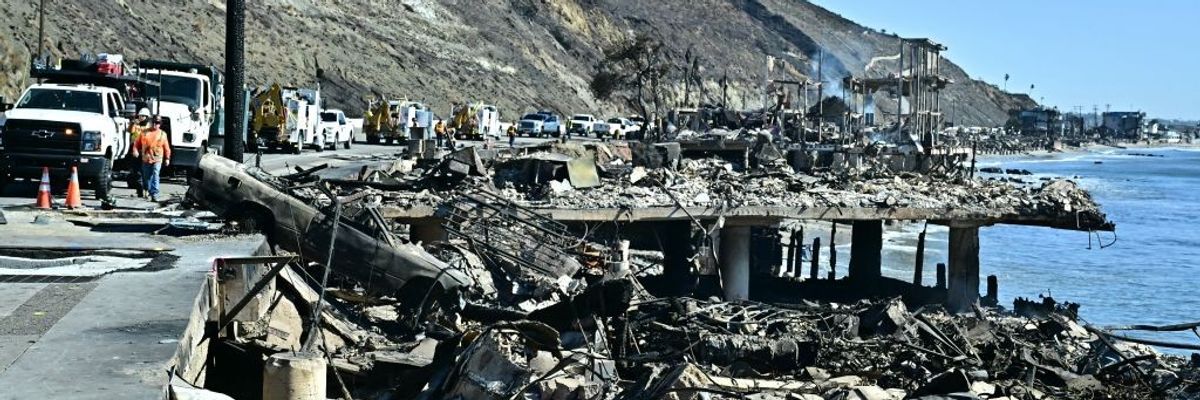
Gas company employees work in Malibu, California, after the Palisades Fire destroyed beach homes on January 12, 2025. (Photo: Frederic J. Brown/AFP via Getty Images)

A new report “shows a 50% GDP contraction between 2070 and 2090 unless an alternative course is chartered,” said the lead author.

U.K. actuaries and University of Exeter climate scientists on Thursday warned that “the risk of planetary insolvency looms unless we act decisively” and urged policymakers to “implement realistic and effective approaches to global risk management.”

Actuaries have developed techniques that “underpin the functioning of the global pension market with $55 trillion of assets, and the global insurance market, collecting $8 trillion of premiums annually, to help us manage risk,” Tim Lenton, University of Exeter’s climate change and Earth system science chair, noted in the foreword of a report released Thursday.

Planetary Solvency—Finding Our Balance With Nature is the fourth report for which the Institute and Faculty of Actuaries (IFoA) has collaborated with climate scientists. In financial terms, solvency is the ability of people or companies to pay their long-term debts. Co-authors of one of the previous publications coined the phrase planetary solvency, “setting out the idea that financial risk management techniques could be adapted to help society manage climate change and other risks.”

Three IFoA leaders—Kalpana Shah, Paul Sweeting, and Kartina Tahir Thomson—explained in their introduction to the latest report how “planetary solvency applies these techniques to the Earth system,” writing:

The essentials that support our society and economy all flow from the Earth system, commodities such as food, water, energy, and raw materials. The Earth system regulates the climate and provides a breathable atmosphere, it is the foundation that underpins our society and economy. Planetary solvency assesses the Earth system’s ability to continue supporting us, informed by planetary boundaries, tipping points in the Earth system, and other scientific discoveries to assess risks to this foundation—and thus to our society and the economy.

Our illustrative assessment of planetary solvency in this report shows a more fundamental, policy-led change of direction is required. Our current market-led approach to mitigating climate and nature risks is not delivering. There is an increasing risk of severe societal disruption (planetary insolvency), as our economic system drives further global warming and nature degradation.

“Impacts are already severe with unprecedented fires, floods, heatwaves, storms, and droughts,” the document points out, emphasizing that human activity—particularly burning fossil fuels—drives climate change and biodiversity loss. “If unchecked they could become catastrophic, including loss of capacity to grow major staple crops, multimeter sea-level rise, altered climate patterns, and a further acceleration of global warming.”

The report was released as wildfires ravage California and shortly after scientific bodies around the world concluded that 2024 was the hottest year on record and the first in which the average global temperature exceeded a key goal of the Paris agreement: 1.5°C above preindustrial levels. In the United States, experts identified 27 disasters with losses exceeding $1 billion.

“We risk triggering tipping points such as Greenland ice sheet melt, coral reef loss, Amazon forest dieback, and major ocean current disruption,” the new publication warns, adding that “tipping points can trigger each other,” and if multiple are triggered, “there may be a point of no return, after which it may be impossible to stabilize the climate.”

Food system shocks and more frequent and devastating disasters increase the risk of mass mortality for humanity—including due to hunger and infectious diseases—along with mass migration and conflict, the report highlights.

“Climate change risk assessment methodologies understate economic impact, as they often exclude many of the most severe risks that are expected and do not recognize there is a risk of ruin,” the document stresses. “They are precisely wrong, rather than being roughly right.”

Specifically, lead author and IFoA council member Sandy Trust said in a statement, “widely used but deeply flawed assessments of the economic impact of climate change show a negligible impact” on gross domestic product (GDP).

However, Trust continued, “the risk-led methodology, set out in the report, shows a 50% GDP contraction between 2070 and 2090 unless an alternative course is chartered.”

To mitigate the risk of planetary insolvency, the co-authors called on policymakers around the world to implement independent, annual assessments; set limits and thresholds that respect the planet’s boundaries; enhance governance structures to support planetary solvency; and “enhance policymaker understanding of ecological interdependencies, tipping points, and systemic risks so they understand why these changes are needed.”

They also underscored the need to limit global warming and avoid triggering tipping points with actions such as accelerating decarbonization, removing greenhouse gases from the atmosphere, restoring damaged ecosystems, and building resilience.

“You can’t have an economy without a society, and a society needs somewhere to live,” said Trust. “Nature is our foundation… Threats to the stability of this foundation are risks to future human prosperity which we must take action to avoid.”

Original article by Jessica Corbett republished from Common Dreams under Creative Commons (CC BY-NC-ND 3.0).

Orcas discuss Donald Trump and the killer apes' concept of democracy. Front Orca warns that Trump is crashing his country's economy and that everything he does he does for the fantastically wealthy.
Orcas discuss Donald Trump and the killer apes’ concept of democracy. Front Orca warns that Trump is crashing his country’s economy and that everything he does he does for the fantastically wealthy.
Neo-Fascist Climate Science Denier Donald Trump says Burn, Baby, Burn.
Elon Musk urges you to be a Fascist like him, says that you can ignore facts and reality then.

Continue ReadingActuaries and Scientists Warn Climate Shocks Risk ‘Planetary Insolvency’

Revealed: Forecasts of greenhouse gas emissions from fossil fuels soar in Trump’s first 100 days

Spread the love

https://www.theguardian.com/us-news/2025/may/02/trump-drill-baby-drill-tariffs

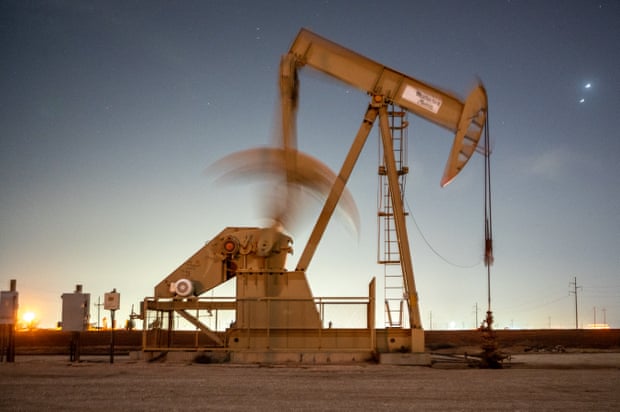
Expected greenhouse gas emissions from US oil and gas fields has jumped under Trump, after previously dropping under Biden, forecasts show. Photograph: Bloomberg/Getty Images

Tariff chaos hampers Trump’s pledge to ‘drill, baby, drill’, but analysis still shows surge in planet-heating emissions

Donald Trump’s ambitions for the US to “drill, baby, drill” for more fossil fuels have ironically been hampered by the economic chaos unleashed by his own tariffs, but the US is still on track to increase oil and gas extraction, causing a surge in planet-heating emissions, a new analysis shows.

The US was already the world’s leading oil and gas power, producing more of the fossil fuels than any country in history during Joe Biden’s administration. But Trump has sought to escalate this further, declaring an “energy emergency” to open up more land and ocean for drilling and launching an unprecedented assault on environmental regulations in his first 100 days back in the White House.

This new political climate means that the expected amount of greenhouse gas emissions from active and planned projects in US oil and gas fields has jumped under Trump, after previously dropping under Biden, forecasts shared with the Guardian show.

Despite awarding more drilling leases than Trump in his first 100 days, Biden also pursued policies to combat the climate crisis that saw oil and gas companies revise down their production estimates. That situation has now reversed, threatening a pulse of new pollution that will further add to the fever of a planet already suffering from heatwaves, floods, droughts and other disasters accelerated by global heating.

“The uptick in embodied emissions from forecast US oil and gas production is worrying,” said Olivier Bois von Kursk, policy adviser at the International Institute for Sustainable Development, which tracks emissions projections from the lifetime of projects, based on data from research consultancy Rystad Energy. “The world can’t afford more climate chaos.”

The International Energy Agency, which has forecast that global oil and gas demand will peak by 2030, has said that no new major fossil fuel projects can occur if the world is to stay within agreed temperature limits and avoid catastrophic climate impacts. Last year was the hottest, worldwide, ever recorded and governments are collectively failing to meet targets to avert escalating disasters.

Tariffs on solar panels from Vietnam, Cambodia and Malaysia have been ratcheted up to as much as 3,521%. “We don’t want windmills in this country,” the president said shortly after his inauguration in January. “We don’t want windmills. You know what else people don’t like? Those massive solar fields.”

https://www.theguardian.com/us-news/2025/may/02/trump-drill-baby-drill-tariffs

Neo-Fascist Climate Science Denier Donald Trump says Burn, Baby, Burn.
Elon Musk urges you to be a Fascist like him, says that you can ignore facts and reality then.
Orcas discuss Donald Trump and the killer apes' concept of democracy. Front Orca warns that Trump is crashing his country's economy and that everything he does he does for the fantastically wealthy.
Orcas discuss Donald Trump and the killer apes’ concept of democracy. Front Orca warns that Trump is crashing his country’s economy and that everything he does he does for the fantastically wealthy.

‘A ruthless agenda’: charting 100 days of Trump’s onslaught on the environment

Continue ReadingRevealed: Forecasts of greenhouse gas emissions from fossil fuels soar in Trump’s first 100 days

More than 150 ‘unprecedented’ climate disasters struck world in 2024, says UN

Spread the love

https://www.theguardian.com/environment/2025/mar/19/unprecedented-climate-disasters-extreme-weather-un-report

A destroyed mechanic’s shop in downtown Swannanoa, North Carolina, US, December 2024, nearly three months after Hurricane Helene in late September. Photograph: Mike Belleme/The Guardian

Floods, heatwaves and supercharged hurricanes occurred in hottest climate human society has ever experienced

The world is already deep into the climate crisis, with the WMO report saying that for the first time, the 10 hottest years on record all occurred in the last decade. However, global carbon emissions have continued to rise, which will bring even worse impacts. Experts were particularly critical of the purge of climate scientists and programmes by the US president, Donald Trump, saying that ignoring reality left ordinary people paying the price.

“Leaders must step up – seizing the benefits of cheap, clean renewables for their people and economies – with new national climate plans due this year,” said the UN secretary general, António Guterres.

Dr Luke Parsons, of the Nature Conservancy, said: “Every year, we venture further into uncharted territory, with 2024 the hottest year modern human society has ever experienced. Yet the coming decade is expected to be even hotter, pushing us deeper into this unprecedented climate.”

Previous research determining the role of the climate crisis in what are now unnatural disasters has shown that at least 550 heatwaves, floods, storms, droughts and wildfires had been made significantly more severe or more frequent by global heating.

Original article by The Guardian at https://www.theguardian.com/environment/2025/mar/19/unprecedented-climate-disasters-extreme-weather-un-report

Neo-Fascist Climate Science Denier Donald Trump says Burn, Baby, Burn.
Elon Musk urges you to be a Fascist like him, says that you can ignore facts and reality then.
Orcas comment on killer apes destroying the planet by continuing to burn fossil fuels.
Continue ReadingMore than 150 ‘unprecedented’ climate disasters struck world in 2024, says UN