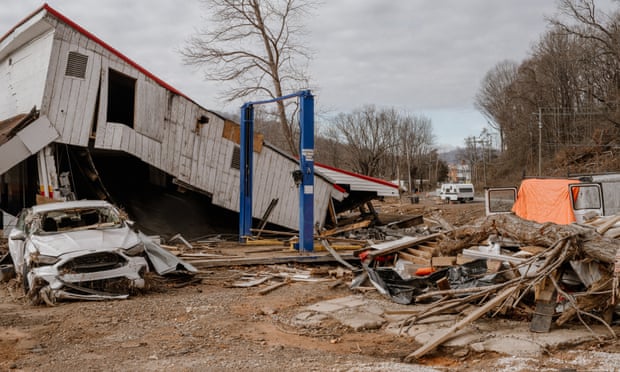
A destroyed mechanic’s shop in downtown Swannanoa, North Carolina, US, December 2024, nearly three months after Hurricane Helene in late September. Photograph: Mike Belleme/The Guardian
Floods, heatwaves and supercharged hurricanes occurred in hottest climate human society has ever experienced
…
The world is already deep into the climate crisis, with the WMO report saying that for the first time, the 10 hottest years on record all occurred in the last decade. However, global carbon emissions have continued to rise, which will bring even worse impacts. Experts were particularly critical of the purge of climate scientists and programmes by the US president, Donald Trump, saying that ignoring reality left ordinary people paying the price.
“Leaders must step up – seizing the benefits of cheap, clean renewables for their people and economies – with new national climate plans due this year,” said the UN secretary general, António Guterres.
Dr Luke Parsons, of the Nature Conservancy, said: “Every year, we venture further into uncharted territory, with 2024 the hottest year modern human society has ever experienced. Yet the coming decade is expected to be even hotter, pushing us deeper into this unprecedented climate.”
Previous research determining the role of the climate crisis in what are now unnatural disasters has shown that at least 550 heatwaves, floods, storms, droughts and wildfires had been made significantly more severe or more frequent by global heating.
Neo-Fascist Climate Science Denier Donald Trump says Burn, Baby, Burn.Elon Musk urges you to be a Fascist like him, says that you can ignore facts and reality then.Orcas comment on killer apes destroying the planet by continuing to burn fossil fuels.
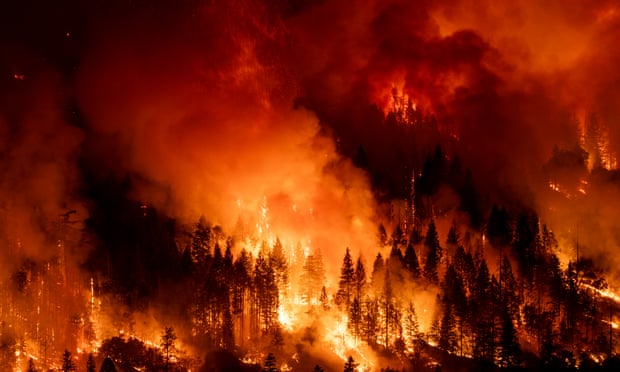
A wildfire in California this year. Fires driven by severe droughts have affected the western US, Canada, the Amazon forest and particularly the Pantanal wetlands. Photograph: David McNew/Getty Images
Average global temperature in November was 1.62C above preindustrial levels, bringing average for the year to 1.60C
This year is now almost certain to be the hottest year on record, data shows. It will also be the first to have an average temperature of more than 1.5C above preindustrial levels, marking a further escalation of the climate crisis.
Data for November from the EU’s Copernicus Climate Change Service (C3S) found the average global surface temperature for the month was 1.62C above the level before the mass burning of fossil fuels drove up global heating. With data for 11 months of 2024 now available, scientists said the average for the year is expected to be 1.60C, exceeding the record set in 2023 of 1.48C.
…
Fossil fuel emissions must fall by 45% by 2030 to have a chance of limiting heating to 1.5C. The recent Cop29 climate summit failed to reach an agreement on how to push ahead on the transition away from coal, oil and gas. The C3S data showed that November 2024 was the 16th month in a 17-month period for which the average temperature exceeded 1.5C.
The supercharging of extreme weather by the climate crisis is already clear, with heatwaves of previously impossible intensity and frequency now striking around the world, along with fiercer storms and worse floods.
After a disappointing COP29, we should prepare for more extreme weather events like the floods that hit Valencia last month | David Ramos/Getty Images
Summit proves change won’t come until floods and wildfires are killing tens of thousands in rich Global North cities
While COP29 in Baku narrowly avoided collapsing, its results were bitterly disappointing for delegations from across the Global South, who ended up with barely a quarter of the annual $1.3trn of support they were seeking by 2035 to respond to climate breakdown.
Quite apart from other factors, more than 1,500 pro-carbon lobbyists worked hard to limit progress and ensure that burning oil, gas and coal at profit continues for as long as possible whatever the global consequences. After all, the world’s fossil fuel industries rake in around a trillion dollars in profits a year.
Meanwhile, more and more examples are emerging of accelerating climate breakdown. The flooding in Valencia is just one, but scarcely noticed in Europe is the thoroughly weird weather being experienced in the eastern United States.
This autumn there have been over five hundred wildfires in New Jersey alone, a 5,000-acre fire has been burning for a week on the New York-New Jersey border prompting a voluntary evacuation, and New York City’s Fire Department was called out to deal with 271 brush fires in the first two weeks of November alone.
As if timed for that and certainly released with COP29 in mind, Carbon Brief, a website covering the latest developments in climate science, climate policy and energy policy, has mapped every published study on ‘impossible’ weather events – record heatwaves or storms that would not have happened without the overall global climate changes.
The first such study came in 2004, the year after weeks of extreme heat hit Europe and killed 70,000 people across the continent over several months. That early example of an ‘impossible’ weather event kick-started a new field of research known as ‘extreme event attribution’, which looks at how climate change has influenced extreme weather.
There are now 600 studies of 750 such extreme events spanning the past 20 years – a tiny fraction of the total number of these kinds of events. Of these 750, Carbon Brief found that scientists and researchers had concluded that 74% were made more likely or more severe because of climate change.
This has added to the growing sense of urgency right across the climate science community coupled with a highly critical view of the whole COP process. Even before the dismaying summit in the Azerbaijani capital, both last year’s COP in Abu Dhabi and the year before in Egypt were notable for their lack of progress even as the urgency of preventing climate breakdown was becoming more and more obvious.
There are other risks to global security including nuclear weapons, pandemics, cyber warfare, AI misuse and the progressive destruction of biodiversity, but climate breakdown is different from all of these. It is not a future risk, it is a current happening, it is accelerating, and we now have very few years left to get on top of it. If we don’t then a worldwide catastrophe with many hundreds of millions dying and societal collapse will become increasingly likely.
Does it have to be like that?
As things stand, in terms of changing attitudes, developments in renewables, resistance of the fossil carbon industries and, of course, Donald Trump’s looming presidency in the US, a reasonable prognosis for the next decade has three elements.
First, the use of renewable energy resources does continue to increase but not at anything like the rate required, so net carbon emissions will continue to rise, not fall, for most of the next ten years. Second, resistance to decarbonisation will continue from many quarters, no doubt now including the White House. Finally, severe weather events will become both more common and more destructive.
Eventually, and it might take more than a decade, the disasters will be so great, including sudden weather events in rich cities in the Global North killing many tens of thousands of people, that public pressure across the world will force governments to respond. There will be no alternative to engage in truly transformative change.
But what that means is that the task ahead by then will be hugely greater than if the transformation starts much sooner, so timescales become crucial, especially what can speed up the process.
There is, though, one thing to remember at a time of widespread pessimism. If nations had got their act together 25 years ago after the Kyoto Protocols, were signed we would be in a far more favourable position worldwide than we are now. We are acting more than two decades late.
But climate breakdown is not happening as a slow, steady process of change, creeping up almost unawares. If that had been the case then with all the reasons not to act, especially the global fossil carbon lobby, we would have been in an even worse position now. Instead, it is happening at variable rates in two respects, some parts of the world – such as the polar regions – are warming up much faster than others and extreme weather events are happening much more often.
We are therefore getting a foretaste of what will affect everyone a few years before it does, and this gives us just a little more time to act. It means that the next ten years, and perhaps even the five years to 2030, will be the key time for us to come to terms with the transformation in society that is essential for global well-being. That is possible, just.
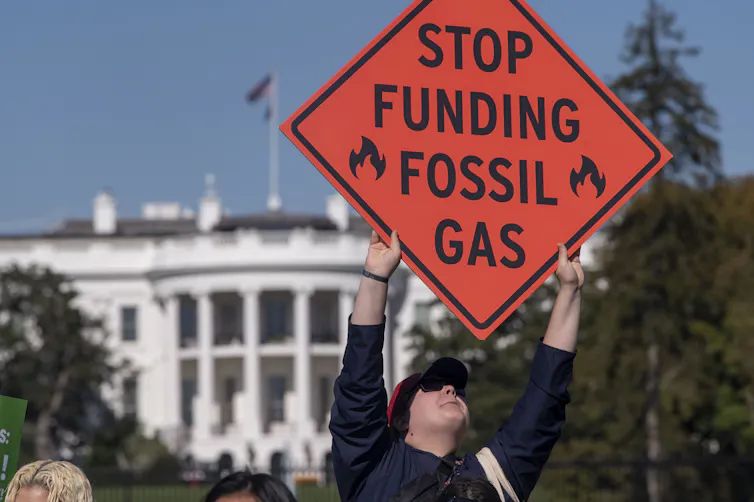
If you care about saving Earth from catastrophe, you might be feeling a little down about the re-election of Donald Trump as United States president. Undeniably, his return to the White House is a real setback for climate action.
But beyond Trump and his circle, there remains deep concern about climate change, especially among younger people. Support for climate policy remains high in the US and around the world. And studies based on data from 60,000 people in more than 60 countries suggest individuals’ concern about climate change is widely underestimated.
So now is a good time to remember that efforts to tackle the climate crisis – both in Australia and globally – are much bigger than one man. Here are ten reasons to remain hopeful.
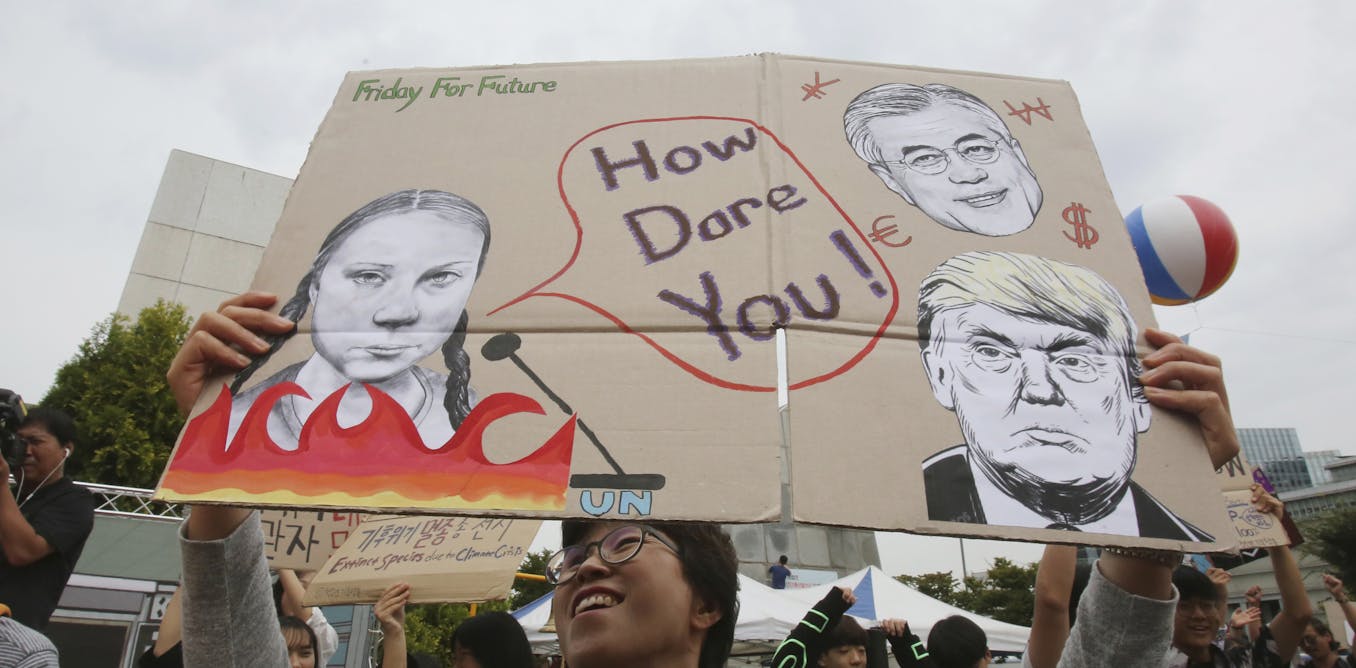
Beyond Trump and his circle, there remains deep concern about climate change around the world. HAYOUNG JEON/EPA
1. The global clean energy transition can’t be halted
4. The federal government is not everything in the US
When Trump was last in power, he withdrew the US from some climate commitments, such as the Paris Agreement. But many state and local governments powered ahead with climate policy, and that will happen this time around, too. For example, California – the world’s fifth largest economy – plans to eliminate its greenhouse gas footprint by 2045. Even Texas, a Republican heartland, is leading a shift toward wind and solar power.
5. The US climate movement will be more energised than ever
During Trump’s first presidency, the US climate movement developed policy proposals for a “Green New Deal”. Many of these proposals were later implemented by the Biden administration. Initial reactions to Trump’s re-election suggest we can expect similar policy advocacy this time around.
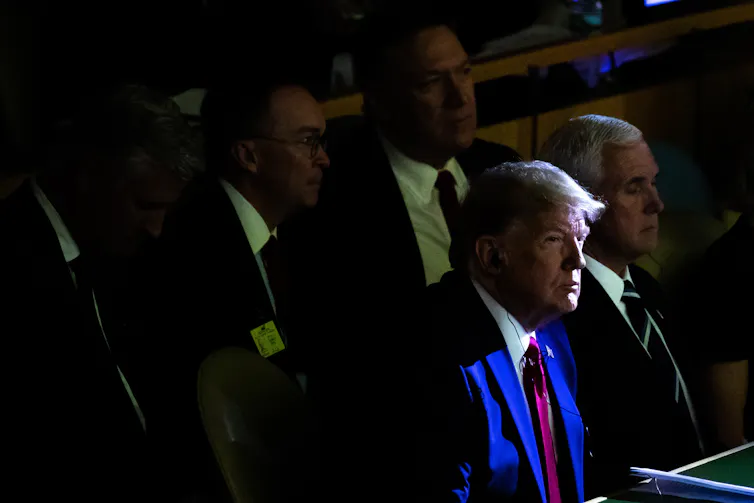
Efforts to tackle the climate crisis are much bigger than one man in the White House. Kevin Wolf/AP
6. Global climate cooperation is bigger than Trump
If Trump makes good on his promise to leave the Paris Agreement (again), he will only be leaving the room where the world’s future is being shaped. The US has walked away from global climate agreements before – for example, refusing to join the Kyoto Protocol in 2001. But other nations rallied for global action, and will do so again.
7. The rules-based global order will remain
When a nation walks away from rules that have been agreed after decades of negotiation, responsible countries must work together to bolster global cooperation. This applies to trade and security – and climate is no different.
As our Foreign Minister Penny Wong recently explained, Australia, as a middle power on the world stage, wants:
a world where disputes are resolved by engagement, negotiation and by reference to rules [and] norms […] We don’t want a world in which disputes are resolved by power alone.
8. Australian diplomacy matters
Australia is seeking to co-host the United Nations climate talks with Pacific island countries in 2026, and is emerging as the favourite. Hosting the conference, known as COP31, would be a chance for Australia to help broker a new era of international climate action, even if the US opts out under Trump.
Hosting the talks would also help cement Australia’s place in the Pacific and assist our Pacific neighbours to deal with the climate threat.
Co-hosting COP31 would help assist our Pacific neighbours to deal with the climate threat. Mick Tsikas/AAP
9. Australia’s clean energy shift is accelerating
About 40% of Australia’s main national electricity grid is poweredby renewables and this is set to rise to 80% by 2030. Some states are surging ahead – for example, South Australia is aiming for 100% renewables by 2027.
Australians love clean energy at home, too. One in three households have rooftop solar installed, making us a world-leader in the technology’s uptake. Trump’s occupation of the Oval Office cannot stop this momentum.
10. Trump cannot change the science of climate change
The science is clear – burning coal, oil and gas fuels climate change and increases the risk of disasters that are harming communities right now. In Australia, we need look no further than the Black Summer bushfires in 2019-20 and unprecedented Lismore floods in 2022.
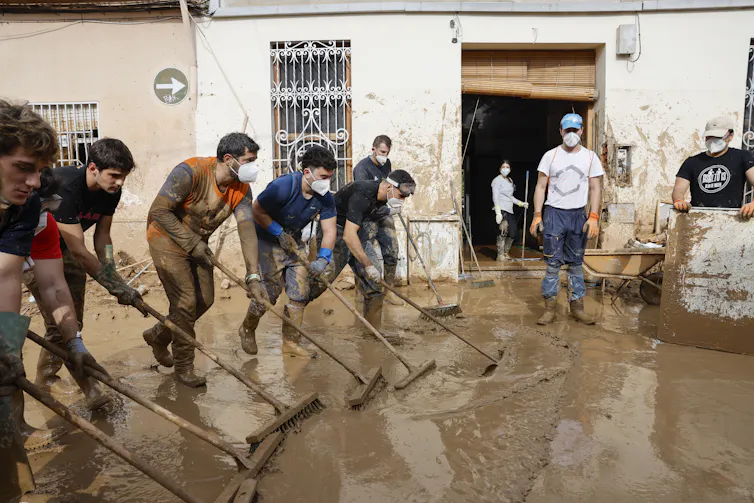
The devastating floods in Spain remind us that climate change has arrived. ANA ESCOBAR/EPA
On gloomy days – like, say, the election of a climate denier to the White House – it might feel humanity won’t rise to Earth’s biggest existential challenge. But there are many reasons for hope. The vast majority of us support policies to tackle climate change, and in many cases, the momentum is virtually unstoppable.
Wesley Morgan, Research Associate, Institute for Climate Risk and Response, UNSW Sydney and Ben Newell, Professor of Cognitive Psychology and Director of the UNSW Institute for Climate Risk and Response, UNSW Sydney
Reassuring report based on long-debunked climate contrarian
The Washington Post (10/24/24) claims that “the rise in billion-dollar disasters, while alarming, is not so much an indicator of climate change as a reflection of societal growth and risky development.”
As the country begins to vote in an election that will be hugely consequential for the climate crisis, the central task of news outlets’ climate beats should be informing potential voters of those consequences. Instead, the Washington Post‘s “Climate Lab” seems to be working hard to cast doubt on whether climate change is really causing weather disasters to be more expensive.
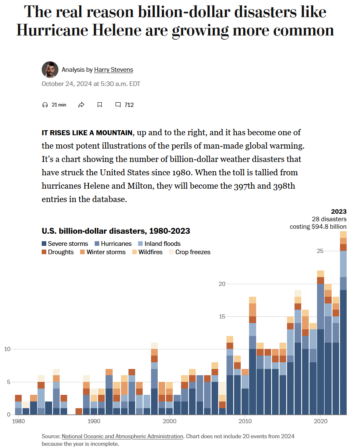
In a lengthy piece (10/24/24) headlined “The Real Reason Billion-Dollar Disasters Like Hurricane Helene Are Growing More Common,” Post Climate Lab columnist Harry Stevens highlighted a NOAA chart depicting a notable increase in billion-dollar weather disasters hitting the US that he says is widely used by government reports and officials “to help make the case for climate policies.” But, in fact, Stevens tells readers:
The truth lies elsewhere: Over time, migration to hazard-prone areas has increased, putting more people and property in harm’s way. Disasters are more expensive because there is more to destroy.
The takeaway is clear: The (Democratic) government is lying to you about the supposedly devastating impacts of climate change.
Distorting with cherry-picked data
The problem is, it’s Stevens’ story that’s doing the misleading. It relies heavily on the work of one source, Roger Pielke Jr., a longtime climate contrarian beloved by climate denial right-wingers, who cherry-picks data to distort the truth.
What’s worse, from a media critic’s perspective, is that it’s not even a new story; it’s been debunked multiple times over the years. Pielke—a political scientist, not a climate scientist, which Stevens never makes clear—has been promoting this tale since 1998, when he first published a journal article that purported to show that, as Stevens describes, “after adjusting damage to account for the growth in people and property, the trend [of increasing economic costs from weather disasters] disappears.”
A review of Roger Pielke’s book The Climate Fix in the journal Science (11/26/10) accused him of writing “a diatribe against the IPCC and other scientists that is based on highly selective and distorted figures and his own studies.”
When Pielke published the argument in his 2010 book, the journal Science (11/26/10) published a withering response, describing the chapter as “a diatribe against the IPCC and other scientists that is based on highly selective and distorted figures and his own studies.” It detailed the multiple methodological problems with Pielke’s argument:
He makes “corrections” for some things (notably, more people putting themselves in harm’s way) but not others. Some adjustments, such as for hurricane losses for the early 20th century, in which the dollar value goes up several hundred–fold, are highly flawed. But he then uses this record to suggest that the resulting absence of trends in damage costs represents the lack of evidence of a climate component. His record fails to consider all tropical storms and instead focuses only on the rare land-falling ones, which cause highly variable damage depending on where they hit. He completely ignores the benefits from improvements in hurricane warning times, changes in building codes, and other factors that have been important in reducing losses. Nor does he give any consideration to our understanding of the physics of hurricanes and evidence for changes such as the 2005 season, which broke records in so many ways.
Similarly, in discussing floods, Pielke fails to acknowledge that many governing bodies (especially local councils) and government agencies (such as the US Army Corps of Engineers) have tackled the mission of preventing floods by building infrastructure. Thus even though heavy rains have increased disproportionately in many places around the world (thereby increasing the risk of floods), the inundations may have been avoided. In developing countries, however, such flooding has been realized, as seen for instance this year in Pakistan, China and India. Other tenuous claims abound, and Pielke cherry-picks points to fit his arguments.
That year, climate expert Joe Romm (Climate Progress, 2/28/10) called Pielke “the single most disputed and debunked person in the entire realm of people who publish regularly on disasters and climate change.”
Debunked a decade ago
In response to Pielke, climate scientist Kerry Emanuel (538, 3/31/14) pointed out that it’s not necessarily appropriate to normalize damages by gross domestic product (GDP) if the intent is to detect an underlying climate trend,” since “GDP increase does not translate in any obvious way to damage increase,” as “wealthier countries can better afford to build stronger structures and to protect assets.”
Pielke peddled the story in 538 (3/19/14) four years later—and lost his briefly held job as a contributor for it, after the scientific community spokeoutagainst it in droves, as not being supported by the evidence.
The backlash led 538 to give MIT climate scientist Kerry Emanuel (3/31/14) a column to rebut Pielke, in which she explained that while it’s of course true that “changing demographics” have impacted the economic costs of weather disasters, Pielke’s data didn’t support his assertion “that climate change has played no role in the observed increase in damages.” She pointed to the same kinds of methodological flaws that Science did, noting that her own research with Yale economist Robert Mendelsohn projected that through the year 2100, “global hurricane damage will about double owing to demographic trends, and double again because of climate change.”
That all happened ten years ago. So why is Pielke’s same old ax-grinding getting a platform at the Washington Post shortly before Election Day?
Stevens does tell readers—quite far down in the article—that Pielke has “clashed with other scientists, journalists and government officials” over his research—though Stevens doesn’t give any details about those clashes, or about Pielke’s reputation among climate scientists more generally.
Stevens also briefly notes that Pielke was recently hired by the American Enterprise Institute, which Stevens characterizes as “center-right,” but more helpfully might have characterized as “taking millions from ExxonMobil since 1998.” But in the same paragraph, Stevens also takes pains to point out that Pielke says he’s planning to vote for Harris, as if to burnish Pielke’s climate-believer bonafides.
Pielke agrees with Pielke
Roger Pielke “agrees with studies that agree with Pielke” (Environmental Hazards, 10/12/20).
Stevens tells Post readers that the science is firmly on Pielke’s side:
Similar studies have failed to find global warming’s fingerprint in economic damage from hurricanes, floods, tornadoes and crop losses. Of 53 peer-reviewed studies that assess economic damage from weather events, 52 could not attribute damage trends to global warming, according to Pielke’s 2020 review of the literature, the most recent and comprehensive.
You’ll notice Stevens just used Pielke’s own review to bolster Pielke’s argument. But the journal that published that review (Environmental Hazards, 8/5/20) immediately followed up with the publication of a critique (10/12/20) from researchers who came to the opposite conclusion in their study on US hurricanes. They explained that there are “fundamental shortcomings in this literature,” which comes from a disaster research “field that is currently dominated by a small group of authors” who mostly use the same methodology—adjusting historical economic losses based strictly on “growth in wealth and population”—that Pielke does.
The authors, who wrote a study that actually accounted for this problem and did find that economic losses from hurricanes increased over time after accounting for increases in wealth and population, point out that Pielke dismissed their study and two others that didn’t agree with his own results essentially because they didn’t come to the same conclusions. As the authors of the critique write drily: “Pielke agrees with studies that agree with Pielke.”
A phony ‘consensus’
Stevens includes in his article an obligatory line that experts say
disputing whether global warming’s influence can be found in the disaster data is not the same as questioning whether climate change is real or whether society should switch from fossil fuels.
He also adds that
many scientists say that global warming has intensified hurricanes, wildfires, droughts and other extreme weather, which must be leading to greater economic losses.
Note that he frames it as only “many,” and suggests they are only using (faulty, simplistic) logic, not science. But of course, climate change is intensifying extreme weather, as even Stevens has reported as fact recently (in the link he provides in that passage). In contrast, Stevens writes that
the consensus among disaster researchers is that the rise in billion-dollar disasters, while alarming, is not so much an indicator of climate change as a reflection of societal growth and risky development.
But in fact, as mentioned above, there’s not consensus even among disaster researchers (who are primarily economists). And the “many scientists” who disagree with Pielke aren’t the scientists the Post chooses to focus on. While Stevens quotes a number of different experts, including some who disagree with Pielke, they are not given anywhere near the space—or credence—Pielke and his arguments are. (Pielke’s name appears 15 times across the article and its captions.)
When he does get around to quoting some of the scientists, like MIT’s Emanuel, whose research shows that extreme weather events are intensifying, Stevens presents the conflicting conclusions as a back-and-forth of claims and counterclaims, giving the last word in that debate to a disaster researcher whose goal is to refocus blame for disasters on political decisions—like supporting building in vulnerable locations—rather than climate change.
Changes in our built environment, and governments’ impact on those changes, are certainly an important subject when it comes to accounting for and preventing billion-dollar disasters—which virtually no one disputes. (Indeed, the four government reports Stevens links to in his second paragraph as supposedly misusing the NOAA data explicitly name some variation of “increased building and population growth” as a contributing factor to growing costs.) It’s simply not an either/or question, as the Post‘s teaser framed it: “Many blame global warming. Others say disasters are more expensive because there is more to destroy.” So it’s bizarre and frankly dangerous that ten years after climate scientists debunked Pielke’s claim that there’s no evidence climate change is increasing extreme weather costs, Stevens would take, as the “urgent” question of the moment, “Is global warming to blame” for the growing billion-dollar disaster tally?
By giving the impression that the whole thing is basically a government scam to justify climate policies, Stevens’ direct implication is that even if climate change is indisputable, it doesn’t really matter. And it feeds into climate deniers’ claims that the climate change-believing government is lying about climate change and its impacts, at a time when a large number of those deniers are seeking office.