Tag: fossil fuel industry

  • Gas Executive ‘Lobbying to Slow Climate Action’ At Labour Party Conference

    Spread the love

    Original article by Phoebe Cooke republished from DeSmog.

    Tony Ballance from Cadent told the Labour conference to ignore scientific studies that show the limitations of hydrogen for heating.

    LIVERPOOL – A senior executive at the UK’s largest gas distributor has been accused of lobbying to slow down climate action after pushing for the use of hydrogen in heating at a Labour Party conference panel on net zero.

    Tony Ballance, Cadent’s chief strategy and regulation officer, told a packed event on Monday to ignore a growing body of scientific evidence that finds the fuel to be expensive, resource intensive and inefficient at heating homes.

    Emails previously revealed by DeSmog show how the hydrogen lobby is now targeting Labour – which has been hosting its annual conference in Liverpool since Sunday – as the party most likely to win the next general election.

    Cadent, the sponsor of the New Statesman event that hosted Ballance, distributes gas to 11 million homes and businesses in the UK. Gas boilers are used to heat around 85 percent of UK homes, which together produce 14 percent of the UK’s greenhouse gas emissions. 

    The rapid roll-out of electricity-powered heat pumps to replace gas heating is seen as essential for the UK to reach net zero targets by 2050. Hydrogen, while widely seen as important for decarbonising industrial processes such as steel and concrete manufacture, is not seen by the vast majority of scientists to have a major future role in heating homes.

    The gas industry has championed hydrogen as a replacement for gas in heating, arguing that it can easily replace existing methane gas and can use existing pipelines to transport and store the fuel. 

    However, a study published this year found heat pumps to be two to three times more efficient than oil and gas based fossil heating systems, even in cold and sub-zero temperatures. It is one of over 40 studies that find hydrogen should only ever play a “limited and complementary role” in heating.

    Addressing a question from DeSmog about whether Cadent had taken these studies into account, Ballance claimed that the evidence was “limited”, and encouraged policymakers to consult “more authoritative sources” – such as gas boiler manufacturers.

    DeSmog previously revealed that a major gas industry group had paid a PR firm to drum up opposition to heat pumps in the UK press – and promote hydrogen instead. 

    In response to Ballance’s claim at the Labour Party conference, Richard Lowes, a heating specialist at the Regulatory Assistance Project (RAP), accused Cadent of lobbying “to protect their investment and slow down climate action”.

    “This is all about lobbying MPs to try and convince them that gas has a future, when the evidence shows it doesn’t,” Lowes told DeSmog.

    “The more we learn about using hydrogen for heating, the worse the evidence gets: it is more expensive, extremely inefficient and unsustainable. Together these make it seem very unlikely it will come to anything.”

    ‘Twee’ Argument

    Cadent was one of two gas networks to win a government contract to trial hydrogen for home heating ahead of the government’s decision on the policy, expected in 2026. But plans for the village of Whitby in Cheshire were scrapped in July after a sustained local campaign, which raised concerns over the safety of hydrogen in homes.

    In response, then Energy Secretary Grant Shapps indicated that the government was poised to drop plans to replace home gas boilers with hydrogen alternatives.

    However, the gas industry is still pushing for a role for hydrogen. Ballance said: “Now as many of you know, there was considerable opposition to the [Whitby] trial… not helped by an anti-hydrogen lobby coming to town, whipping up the anti-hydrogen campaign.”

    Despite the considerable and sustained concerns over the safety and environmental impact of hydrogen, Ballance said there “wasn’t opposition” to hydrogen in Whitby – rather, “it was opposition to being forced” into the trial.

    In answer to DeSmog’s question about scientific studies showing the inefficiency of hydrogen for heating, Ballance said: “Frankly.. When you scratch the surface.. Frankly it doesn’t pass.”

    He said: “You [should] talk to the boiler manufacturers who have the technology and they’re looking at this. You have to scratch below the surface rather than someone just counting up studies and wanting to see things in studies that are actually sometimes misrepresented. It’s about not seeing this [hydrogen versus heat pumps debate] as some kind of twee argument and being really serious about this.”

    An investigation by DeSmog found that the Energy and Utilities Alliance (EUA), which represents the vast majority of the UK’s gas boiler manufacturers and distributors – including Cadent – had paid for an extensive negative PR campaign to “spark outrage” against heat pumps in the British press.

    Along with other regional gas distributors, Cadent has been advocating for hydrogen via a campaign called Hello Hydrogen, which was launched in October 2022 to “raise awareness of hydrogen gas for heating our homes and calling on the government to commit to a hydrogen future”.

    At the event on Monday, Ballance also argued that some of the scientific studies “were in Brazil and California, where it’s not surprising – gas is not going to be the preferred source of heating in much hotter, different countries”.

    Richard Lowes told DeSmog that while not all of the studies covered by the academic analysis referred to the UK, many of them do.

    “The same outcomes from around the world show that hydrogen will have a limited role in heating and that should reinforce what a terrible idea it is,” he said.

    “To my knowledge, no UK study [which is] based on hitting the UK’s net zero climate targets, has ever shown anything more than a marginal role for hydrogen.”

    Original article by Phoebe Cooke republished from DeSmog.
  • After ‘Mind-Blowing’ September, 2023 Set to Be Hottest Year on Record: EU Climate Agency

    Spread the love

    Original article by JAKE JOHNSON republished from Common Dreams under Creative Commons (CC BY-NC-ND 3.0). 

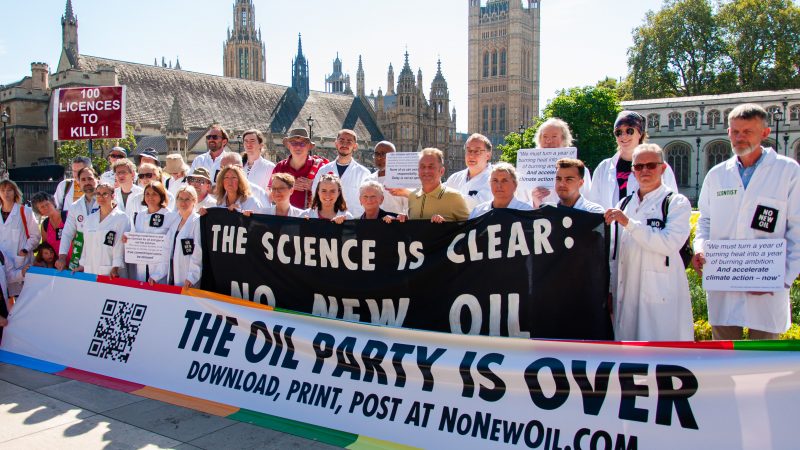
    Scientists protest at UK Parliament 5 September 2023.
    Scientists protest at UK Parliament 5 September 2023.

    “The unprecedented temperatures for the time of year observed in September—following a record summer—have broken records by an extraordinary amount.”

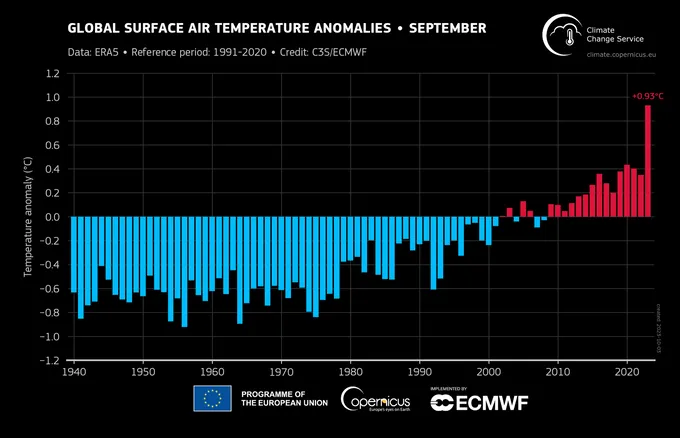
    Europe’s Copernicus Climate Change Service said Thursday that 2023 is on track to be the hottest year ever recorded following a string of scorching months, including an unusually warm September that stunned scientists.

    Copernicus director Carlo Buontempo toldThe Associated Press that September was “just mindblowing” and that he has “never seen anything like that in any month in our records,” echoing the sentiments of other experts.

    The European climate agency said Thursday that last month was the warmest September on record globally and “the most anomalous warm month of any year” in its dataset going back to 1940.

    “The month as a whole was around 1.75°C warmer than the September average for 1850-1900, the preindustrial reference period,” the agency noted. “The global temperature for January-September 2023 was 0.52°C higher than average, and 0.05°C higher than the equivalent period in the warmest calendar year (2016).”

    Samantha Burgess, Copernicus’ deputy director, said in a statement that “the unprecedented temperatures for the time of year observed in September—following a record summer—have broken records by an extraordinary amount.”

    “This extreme month has pushed 2023 into the dubious honor of first place—on track to be the warmest year and around 1.4°C above preindustrial average temperatures,” Burgess added. “Two months out from COP28—the sense of urgency for ambitious climate action has never been more critical.”

    (Credit: Copernicus Climate Change Service/ECMWF)
    (Credit: Copernicus Climate Change Service/ECMWF)

    The new Copernicus data came hours after the release of a United Nations report that called on nations worldwide to end fossil fuel exploration by 2030, warning that countries are not acting with sufficient urgency to rein in planet-heating pollution.

    Simon Stiell, the U.N. climate chief, said the report “puts the cards on the table—except this is not a game.”

    “We know that we as the global community are not on track towards achieving the long-term goals of the Paris Agreement and that there is a rapidly closing window of opportunity to secure a livable and sustainable future,” said Stiell.

    Original article by JAKE JOHNSON republished from Common Dreams under Creative Commons (CC BY-NC-ND 3.0). 

  • Extinction Rebellion NL pauses daily A12 highway blockades awaiting a decision on government fossil fuel subsidies

    Spread the love
    Extinction Rebellion NL image reads STOP FOSSIELE SUBSIDIES
    Extinction Rebellion NL image reads STOP FOSSIELE SUBSIDIES

    Extinction Rebellion pauses daily A12 highway blockades; Hague mayor relieved

    Extinction Rebellion (XR) is suspending the blockades on the Utrechtsebaan (A12) in The Hague. The group of activists will await a vote in parliament on Tuesday on a motion in which Suzanne Kroger (GroenLInks) and Raoul Boucke (D66) asked for a phase-out plan for fossil fuel subsidies. The Hague mayor, Jan van Zanen, called it a relief.

    Fossil subsidies are schemes like tax discounts and excise duty exemptions for the fossil fuel industry. If the motion is not adopted, the daily blockades will resume, XR said. The climate activists consider the motion “recognition that politicians also see that 39.7 to 46.4 billion euros in fossil subsidies annually cannot be defended.”

    In the motion, the two parliamentarians ask the government to draw up scenarios before the Christmas recess for ending the subsidies “in the term of 2, 5, and 7 years.” For each scheme, the government must also indicate how many negative consequences can be mitigated and which “national measures” can be taken if subsidies are fixed in a European context. Kroger and Boucke called fossil subsidies an “obstacle in the transition to a climate-neutral society.”

    XR blocked the A12 highway in The Hague for the 27th day in a row on Thursday. Dozens of demonstrators were again arrested. 

  • Cop28 president-designate hits back at critics even as his company increases oil drilling investments

    Spread the love

    https://morningstaronline.co.uk/article/cop28-president-designate-hits-back-at-critics-even-as-his-company-increases-oil-drilling-investments

    THE Emirati president-designate for the upcoming United Nations Cop28 climate conference hit back on Saturday at critics of his appointment, even as the firm he leads increases investment in fossil fuel extraction.

    Climate activists have roundly criticised Sultan al-Jaber’s appointment as the president-designate of the talks because he serves as the CEO of the Abu Dhabi National Oil Company.

    But Mr Jaber dismissed the critics as people who “just go on the attack without knowing anything, without knowing who we are.”

    Speaking to an audience in the UAE capital Abu Dhabi, Mr Jaber pointed to his 20 years of work on renewable energy as a sign that he and the Emirates represent the best chance to reach a consensus to address climate change worldwide.

    Although Mr Jaber, a trusted confidant of UAE leader Sheikh Mohammed bin Zayed al-Nahyan, has been behind tens of billions of dollars spent or pledged toward renewable energy, he also leads an oil company that extracts some four million barrels of crude every day.

    https://morningstaronline.co.uk/article/cop28-president-designate-hits-back-at-critics-even-as-his-company-increases-oil-drilling-investments

  • Major Polluters In ‘Ludicrous’ Push For Carbon Capture at Party Conferences

    Spread the love

    Original article by Adam Barnett and Rachel Sherrington republished from DeSmog.

    The technology could provide cover for fossil fuel companies to explore more oil and gas drilling, campaigners say.

    By Adam Barnett and Rachel Sherrington on Sep 29, 2023 @ 05:14 PDT

    Prime Minister Rishi Sunak and Labour leader Keir Starmer. Credit: DeSmog via UK Parliament (CC BY 3.0)
    Prime Minister Rishi Sunak and Labour leader Keir Starmer. Credit: DeSmog via UK Parliament (CC BY 3.0)

    A trade group for contested carbon capture with close ties to major oil and gas companies is sponsoring over a dozen events at the Conservative and Labour conferences over the next fortnight. 

    Fossil fuel companies are using the technology as “a fig leaf” to pursue oil and gas drilling, campaigners have warned, as industry lobbyists across the energy sector seek to win over policymakers.

    The Carbon Capture and Storage Association (CCSA), a trade body promoting carbon capture utilisation and storage (CCUS), is due to host 15 events across the Conservative and Labour gatherings, which begin on Sunday in Manchester.

    The London-based CCSA describes itself as the “lead” European organisation for CCUS, promoting the “rapid” and “commercial” deployment of the technology. The process involves capturing CO2 emissions from industrial production and storing it underground. Some technologies allow the captured CO2 to be re-used by converting it into plastics, concrete or biofuel. 

    The group says that its members are “companies across the CCUS industry” including “support services in the energy sector” such as law, banking and consultancy.  

    Nearly a fifth of the CCSA’s 100 members are oil and gas companies, including BP, Exxon, Shell and Equinor. Fossil fuels are the largest contributor to climate change, producing 75 percent of global greenhouse gas emissions and nearly 90 percent of all carbon dioxide emissions.

    The CCSA board is also dominated by key figures at oil and gas companies, including BP, Equinor, TotalEnergies and Shell. 

    Lorne Stockman, research co-director at the campaign group Oil Change International, told DeSmog: “It’s very clear what carbon capture serves and who it’s a solution for, and that’s the fossil fuel industry. 

    “This isn’t about the best way of addressing the climate crisis, it’s about keeping the industry in business.”

    He said the companies were trying to hedge their bets by winning over both the Conservatives and Labour, in the hope of continued government funding to support the high infrastructure costs.

    “They pay both parties as much as they can,” said Stockman. “They’ve got the resources, they’ve got the money, they’ve got the influence, and of course they’re showing up to ensure that the fossil fuel industry continues to get public support even while we try to confront the climate emergency.”

    Carbon capture and storage, and the extension of the technology, CCUS, has been touted by major polluters as a way to cut their production emissions to meet climate targets. 

    But the role of carbon capture in the energy transition is hotly contested. Climate scientists point to the failure of CCS to remove significant amounts of CO2 emissions while campaigners warn of the high costs compared to renewable energy. The vast majority of companies use the captured CO2 to extract more oil through a process called “enhanced oil recovery”.

    A DeSmog analysis published this week found the majority of large-scale global CCS projects have spectacularly failed to deliver what they promised, overran budgets and targets, and resulted in a net increase in emissions.

    A CCSA spokesperson told DeSmog: “We are proud to bring a wide variety of our members to party conferences this year to engage with politicians, delegates and the media on the vital role carbon capture and storage technology will play in the net zero transition. 

    “This technology will ensure industry can continue to support jobs making critical products such as steel and cement in the UK, rather than importing them from abroad, as well as creating 70,000 new jobs in green industries. 

    “Carbon capture technology will be an important part of the solution, alongside reducing energy use and rolling out renewable electricity as we all work together to reach net zero.”

    Fossil Fuel Presence

    The UK government has committed £20 billion of investment for carbon capture and storage over the next 20 years, and aims to capture and store 20-30 million tonnes of CO2 per year by 2030 and over 50 million by 2035. 

    The “CCUS Investor Roadmap”, updated this year, sets out plans to deliver four CCUS “low-carbon” industrial clusters by 2030, and capture and store nine million tonnes of CO2 from industrial CCS by 2035.

    Despite well-documented concerns over carbon capture, industry executives will look to increase the government’s commitments further and showcase its “key role in decarbonising industry”, when they join the Conservatives in Manchester next week, and Labour in Liverpool later in the month. 

    Experts and MPs – yet to be named – have been invited to the group’s ticketed drinks receptions, while a number of talks are dedicated to promoting the technology as a crucial part of the UK’s “green industrial revolution”.

    “Our politics are shot through with oil and gas lobbyists, it’s just at party conferences they come into the light a little bit more,” Tessa Khan, executive director of fossil fuel campaign group Uplift, told DeSmog.

    “This is a ludicrous amount of special pleading for a technology, carbon capture and storage, that, on the current trajectory, will play a marginal role in reducing industrial emissions and at worst is a fig leaf for more oil and gas drilling.”

    The CCSA reception in Liverpool at the Labour Party conference will feature food, drinks and speeches from industry leaders, with members of the shadow cabinet expected to attend.

    Doug Parr, chief scientist and policy director at Greenpeace, told DeSmog that CCS “has been used and continues to be used as a cover for fossil fuel exploitation”. 

    “If the CCS crew are out and about at party conferences, one has to have a suspicion, given the number of fossil fuel industries that continue to be involved with them, that that’s what’s being attempted in the UK”, he said. 

    Board Members and Political Influence

    Individuals from the fossil fuel industries are well represented on the CCSA board, as well as the group’s membership. 

    Oil and gas companies TotalEnergies, Wintershall Dea, Uniper, Phillips 66 UK, Neptune Energy and Eni are also members of the CCSA, alongside Drax, the UK’s single largest emitter of CO2. Drax is seeking an estimated £31.7 billion in subsidies for its proposed biomass energy carbon capture and storage (BECCS) plant, which is being trialled in its CCUS “incubation area” in North Yorkshire.

    The CCSA board is also dominated by career oil and gas executives who have spent decades working in the industry.

    Chair of the CCSA, Jonathan Briggs, is director of a CCS project run by Vitol, a Dutch multinational energy and commodity company which trades oil, gas and coal. Briggs works on the “Humber Zero” project to decarbonise VPI Power’s Combined Cycle Gas Turbine in Immingham, North Lincolnshire.

    The board includes Rowaa Ahmar, group head of public affairs, policy and bioenergy with carbon capture and storage (BECCS) at biomass company Drax, the UK’s largest single emitter of CO2. 

    Other board members include Graeme Davies, a project director at Harbour Energy; Shirley Oliveira, vice president for hydrogen and CCUS advisory services at BP; Dan Sadler, UK vice president for low carbon solutions at Equinor; Gaël Le Parc, UK CCS director for TotalEnergies; and Steve Schofield, head of climate and carbon policy and advocacy at the corporate relations department of Shell. 

    The CCSA also has political connections. CCSA president, Baroness Liddell, was a Labour minister under former prime ministers Tony Blair and Gordon Brown. Joe Butler-Trewin, CCSA’s Public Affairs and Communications Officer in London, worked on Keir Starmer’s 2020 campaign for the Labour leadership. 

    The Conservative and Labour parties did not respond when contacted for comment. 

    Original article by Adam Barnett and Rachel Sherrington republished from DeSmog.