Image of Al Gore by JD Lasica Creative Commons Attribution 2.0 Generic license.
At an event coinciding with the U.N. General Assembly in New York, Gore said he used to believe the sector sincerely wanted to be part of the solution to the climate crisis, but now he thinks it’s clear they are not.
Former U.S. Vice President Al Gore, a long-time climate activist, had harsh words for the fossil fuel industry on Thursday.
“Many of the largest companies have engaged in massive fraud,” he said at The New York Times’ Climate Forward event, as the Independent reported. “For some decades now, they’ve followed the playbook of the tobacco industry, using these very sophisticated, lavishly financed strategies for deceiving people.”
Gore, who won the Nobel Peace Prize in 2007, criticized the industry for using their influence to lobby against effective climate action.
“The climate crisis is a fossil fuel crisis.”
“The fossil fuel companies, given their record today, are far more effective at capturing politicians than they are at capturing emissions,” he said.
Now, he warned, the sector had set its sights on the United Nations COP28 climate change conference in the United Arab Emirates with the appointment of the UAE’s state oil company CEO Sultan Ahmed Al Jaber to lead the talks.
“That’s just, like, taking the disguise off,” Gore said, as The New York Times reported. “They’ve been trying to capture this process for a long time.”
Gore’s remarks reflect a recent shift in the tone of his climate advocacy. In a TED Talk filmed in July and released in August, Gore made many of the same arguments about fossil fuel lobbying and Al Jaber’s appointment.
“The climate crisis is a fossil fuel crisis,” he said. “The solutions are going to come from a discussion and collaboration about phasing out fossil fuels.”
After listening to the talk, journalist Emily Atkin wrote in her newsletter Heated:
With this new talk, it’s become clear that the man who made An Inconvenient Truth famous is no longer primarily focused on convincing people that the climate crisis is real or dangerous. He’s turned a corner, and is now focused on convincing people that if they truly care about solving the climate crisis, they must turn their ire toward the fossil fuel industry—and boot them from the negotiating table before it’s too late.
Gore acknowledged the shift in his thinking himself on Thursday.
“I was one of many who felt for a long time that the fossil fuel companies, or at least many of them, were sincere in saying that they wanted to be a meaningful part of bringing solutions to this crisis,” Gore said, as The Independent reported. “But I think that it’s now clear they are not. Fossil fuel industry speaks with forked tongue.”
While he acknowledged that it was not fair to expect the industry to solve a crisis its business model encouraged it to perpetuate, “it’s more than fair to ask them to get out of the way, and stop blocking the efforts of everybody else to solve this crisis,” he said. “I think it’s time to call them out.”
Gore’s remarks came as world leaders and climate activists and experts gathered in New York for the U.N. General Assembly and Secretary-General António Guterres’ Climate Ambition Summit, held the day before.
He is also not the only prominent mainstream climate voice to have turned on the fossil fuel sector.
Former Executive Secretary of the U.N. Framework Convention on Climate Change Christiana Figueres, who helped negotiate the Paris agreement, said that she did not think the industry should be invited to COP28.
“If they are going to be there only to be obstructors, and only to put spanners into the system, they should not be there,” she said at a conference Thursday organized by Covering Climate Now, as The Guardian reported.
Her remarks echoed an opinion piece she wrote for Al Jazeera in July, in which she said she was wrong to believe that the sector could be part of the solution.
“My patience ran out, and I say this with sadness,” she said Thursday.
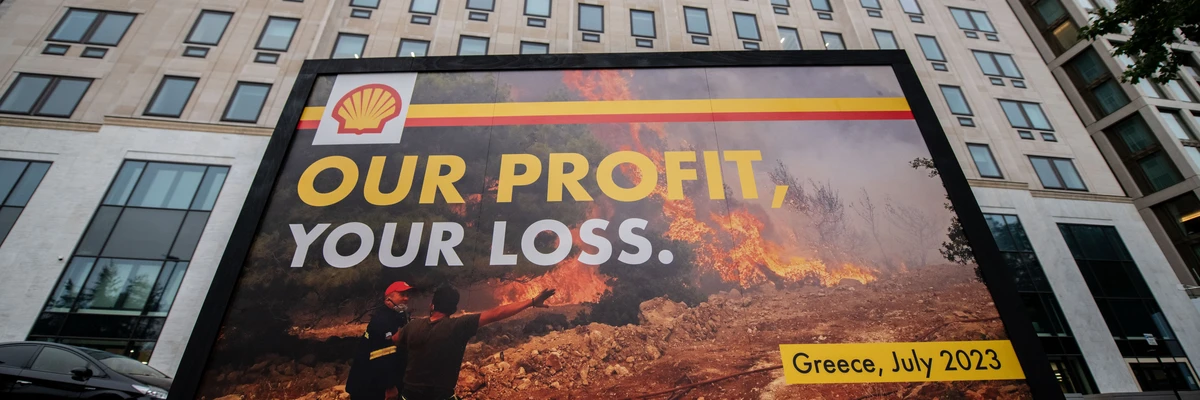
Greenpeace activists display a billboard during a protest outside Shell headquarters on July 27, 2023 in London. (Photo: Handout/Chris J. Ratcliffe for Greenpeace via Getty Images)
In February this year, the UK’s Climate Change Committee (CCC) wrote a letter to government in which it claimed that more domestic oil and gas extraction would have “at most, a marginal effect on prices”, recommending instead that the best way of reducing exposure to volatile energy markets is “cut[ting] fossil fuel consumption, improving energy efficiency, [and] shifting to a renewables-based power system”.
Meanwhile, research from campaign group Uplift reveals that gas from undeveloped UK oil and gas fields in the North Sea, including Rosebank, will deliver at most three weeks of energy to the UK per year, while oil would provide up to five years of oil demand, even if none of it were exported. In reality, most production from North Sea fields, along with Rosebank, which is joint-owned by Norwegian state oil major Equinor (40%), Canadian Suncor Energy (20%) and Israeli-owned Ithaca Energy (20%), is likely to be exported abroad, as is currently the case with 60% and 80% of North Sea gas and oil, respectively.
Further analysis of data from GlobalData reveals just how far burning oil and gas from Rosebank would threaten the UK’s climate targets. According to GlobalData, Rosebank contains the largest untapped oil and gas reserves of all proposed North Sea fields, with 370 million barrels of oil equivalent.
Using US Environmental Protection Agency (EPA) conversion figures – according to which one barrel of oil emits 0.43 tonnes (t) of CO₂ when burnt and 1,000 cubic feet of gas emit 0.0551t of CO₂ when burnt – Rosebank is likely to release 155 million tonnes of carbon dioxide (mtCO₂) into the atmosphere over its lifetime.
However, in a “balanced” net-zero pathway, as per the CCC’s sixth carbon budget, emissions from fossil fuels fall 75% by 2035 from 2018 levels. In total, emissions from “fuel supply” – predominantly made up of fossil fuels – amount to 298mtCO₂-equivalent (mtCO₂e) between 2023 and 2050, meaning lifetime emissions from Rosebank are equivalent to more than half of the UK’s remaining carbon budget for total fuel supply.
…
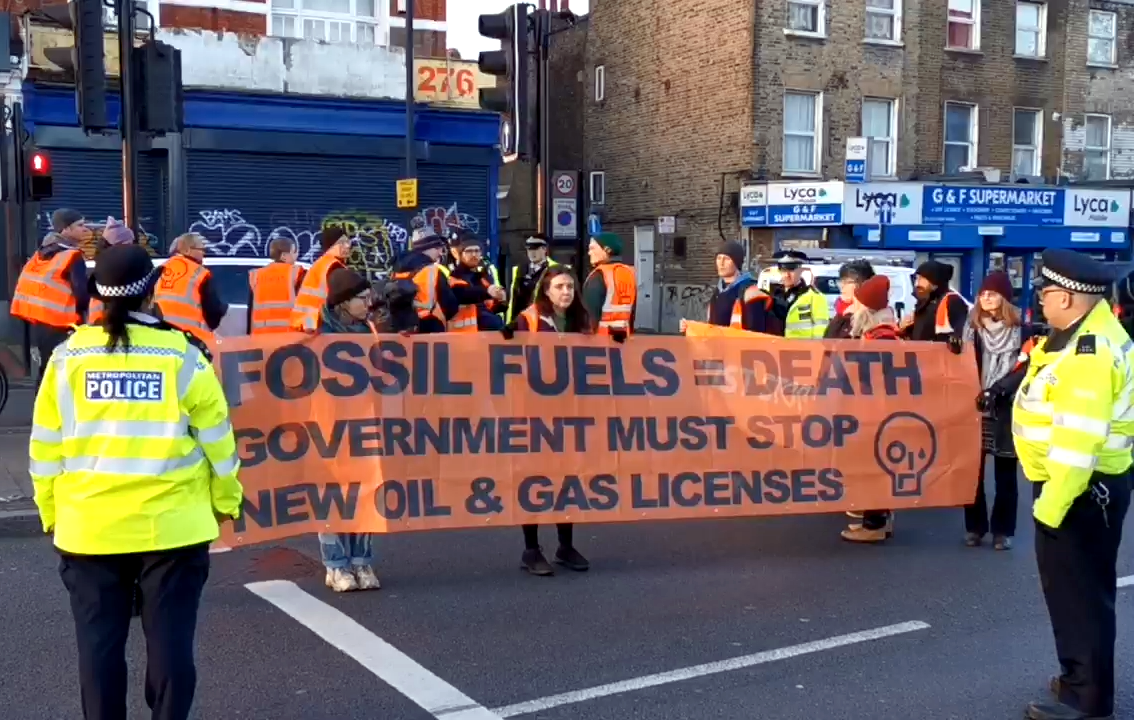
Just Stop Oil protesting in London 6 December 2022.
The oil industry’s push to portray carbon capture as a climate solution at COP28 obscures how the technology is really being used.
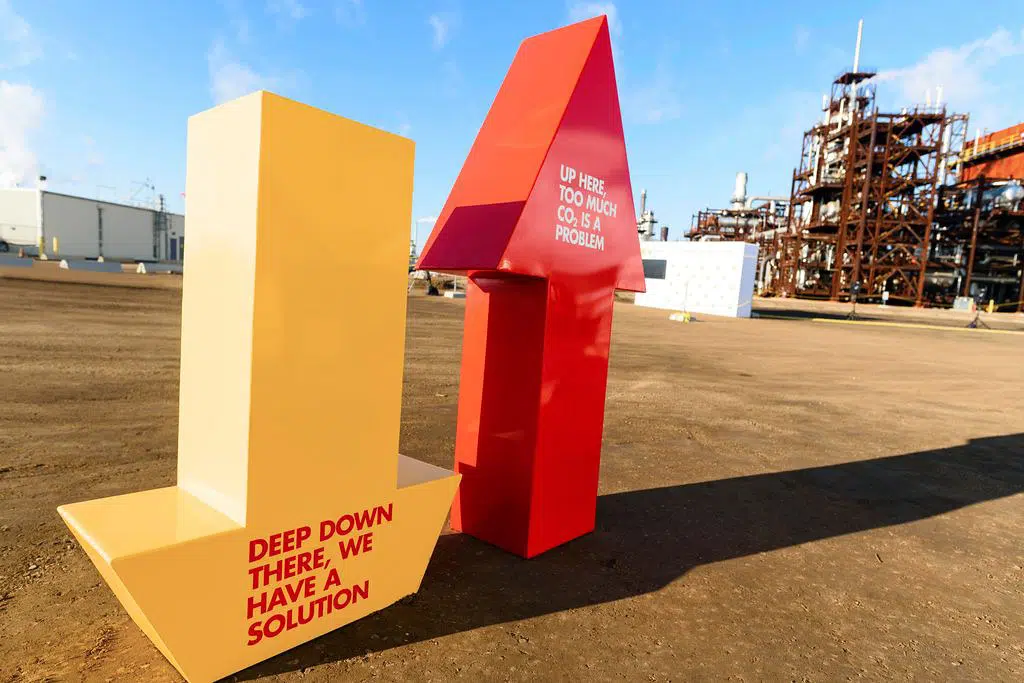
Shell and its joint venture partners have a Quest carbon capture and storage (CCS) project at its Scotford Complex near Fort Saskatchewan, Canada. Credit: Government of Alberta, CC BY-NC-ND 2.0
When Sultan Ahmed Al Jaber opens the 28th annual UN climate conference in Dubai in November, he will be juggling two roles – convincing the world of the United Arab Emirates’ leadership in reducing greenhouse gas emissions, while preserving the very industry that’s causing them.
In addition to his job as summit president, Al Jaber heads the Abu Dhabi National Oil Company (ADNOC), which plans to increase its oil and gas output by 11 percent by 2027. The company says that more oil will mean less emissions, however — provided the industry builds enough facilities to capture carbon dioxide (CO2), the main gas causing the climate crisis.
“We must be laser-focused on phasing out fossil fuel emissions, while phasing up viable, affordable zero carbon alternatives,” Al-Jaber said at a pre-COP 28 event in Bonn in June. The statement was widely interpreted as a pitch for carbon capture.
On September 6, ADNOC finalized a deal to build a carbon capture and storage (CCS) project in the UAE’s Habshan oil and gas field, extending the company’s existing CCS operations at a steel plant. Now projected to become one of the largest carbon capture plants in the Middle East, ADNOC says the facility will have the equivalent climate impact of removing 500,000 cars from the road.
In fact, the project will be used to squeeze even more oil from the ground. Most of the CO2 ADNOC already captures is pumped into existing oil wells, forcing residual crude to the surface in a process known as “enhanced oil recovery” or “EOR”.
It is a trend reflected across the sector: Of the 32 commercial CCS facilities operating worldwide, 22 use most, or all, of their captured CO2 to push more oil out of already tapped reservoirs. This fleet accounts for approximately 31 million tonnes of the world’s roughly 42 million tonnes of operational carbon capture capacity, according to figures published by the industry-backed Global CCS Institute, U.S. Energy Information Administration and other sources.
But the fact that existing carbon capture projects are mostly used to bring more oil to the surface has not stopped oil and gas companies championing the technology as a climate solution in the run-up to COP28.
In January, ExxonMobil Tweeted a video interview with a safety and environment supervisor at its LaBarge CCS project in Wyoming.
“Welcome to La Barge — the industrial facility that has captured the most CO2 emissions on earth to date,” says a caption at the start of the clip.
Nowhere does the video mention that most of the CO2 captured from the LaBarge gas processing plant is being injected underground to extract more oil. Research by the Institute for Energy Economics and Financial Analysis, a nonprofit energy think tank, shows that 97 percent of CO2 captured by the La Barge facility has been sold for EOR since the plant began operations in 1986. In times when EOR was not profitable, CO2 was simply vented into the atmosphere.
While CCS is proving a boon for the fossil fuel industry, a DeSmog review of 12 of the world’s biggest projects has found a litany of missed carbon capture targets; cost overruns; and multi-billion-dollar bills to taxpayers in the form of subsidies.
DeSmog’s research also raises questions over an oft-cited claim that industry captures 41 million tonnes of CO2 annually — or 0.1 percent of the world’s approximately 37 billion tonnes of energy-related CO2 emissions.
Beyond the consistent underperformance of many CCS projects, DeSmog found that most either strip out CO2 in the process of refining fossil fuels, or use their captured CO2 to push more oil out of the ground — or both. The result: existing CCS projects are enabling the release of a much greater amount of overall CO2 emissions into the atmosphere than they are storing underground.
For examples, see a summary of the 12 projects DeSmog analysed here.
From Oilman’s Dream to “Climate Solution”
The process of using carbon dioxide to produce more oil, now known industry-wide as enhanced oil recovery, or “CO2-EOR”, was born in the oil fields of Texas in the early 1970s.
Petroleum engineers from leading oil producers such as Shell, Exxon, and Chevron had discovered that injecting CO2 at high pressure into “mature” or “previously developed” oil reservoirs helped increase the flow of otherwise stubborn hydrocarbons — in essence squeezing more volume out of aging wells.
Though initial tests found that each ton of injected CO2 could push out an additional two or more barrels of oil, the lack of readily available CO2 made the technique expensive. That changed when companies began siphoning off CO2 emitted from several Texas gas processing plants, and piping it to an oil field to boost productivity. To ensure a steady supply, industry agents scoured the region and purchased the rights to mine naturally occurring CO2 deposits in Colorado, New Mexico, and Arizona — eventually building hundreds of miles of dedicated pipelines to transport the gas to oil-field injection points.
By the late 1970s, amid growing concerns over what was then known as the “greenhouse effect,” industry executives began to propose that capturing CO2 and burying it underground could allow the world to continue generating power from fossil fuels far into the future. In 1992, the Paris-based International Energy Agency (IEA) and other energy organizations established a research program to support developers seeking to prove CCS at scale.
By the time of the first U.N. climate conferences in the mid-1990s, the oil industry had begun marketing carbon capture as a technological “silver bullet” capable of making coal “clean,” and rendering oil and gas as “low carbon” — a strategy employed by oil majors to this day.
However, capturing CO2 is not the same as avoiding its climate impacts. If that CO2 is then used to directly produce more oil, or if CCS “abatement” is used to suggest that additional oil and gas production is climate-friendly — or in some cases both — then those CCS projects are invariably acting as a net harm to the climate, by actually increasing overall CO2 pollution.
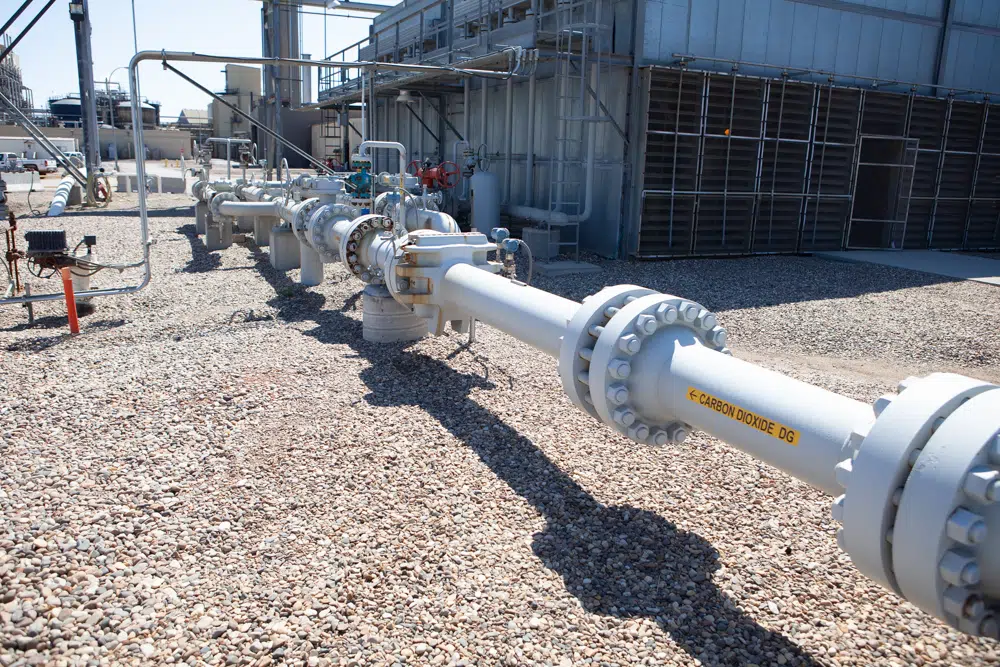
Carbon dioxide runs through pipes at a North Dakota CCS plant. Credit: Buchsbaum Media.
For example, the fossil fuel industry often points to Norway’s pioneering Sleipner CCS facility — which has captured and buried approximately one million tons of CO2 per year under the North Sea since 1996 — as proof that carbon capture works. But that figure does not account for all the additional CO2 that’s emitted when fossil gas produced by the plant is burned by end-users.
Energy expert Michael Barnard, estimates that even though Sleipner has stored about 23 million tons of CO2 from 1996-2019, burning the gas refined by the plant over that time has released some 581 million tons of CO2 into the atmosphere — or more than 25 times the amount that was sequestered. (For more details on Sleipner, see DeSmog’s review of 12 CCS facilities).
Profit Driver
Now an established technique worldwide, producers generally use CO2-EOR to recover oil from older “depleted” fields, where less sophisticated recovery methods have left up to two-thirds of the original oil behind. If the geology and economics are favorable, using EOR techniques can extend the productive life of developed oil fields for several more decades.
To put the significance of this approach to the oil industry into perspective, according to the U.S. National Energy Technology Laboratory, of the 600 billion barrels of oil that have been discovered in the U.S., approximately 400 billion are unrecoverable by conventional means. But half of that unrecoverable oil — or 200 billion barrels — could be squeezed to the surface through CO2-EOR.
Today, the oil industry pumps some 80 million tonnes of CO2 underground each year to extract more oil, much of it in the U.S. — the world’s leading oil and gas producer, and biggest user of CCS-EOR, which drives six percent of the country’s daily output. In some cases, the technique can squeeze up to four or five additional barrels from otherwise declining fields for every ton of injected CO2. Though geology plays a role, one of the main factors inhibiting even greater EOR volume is the lack of cheaply available CO2.
Despite many EOR projects simply being intended to extend oil production, companies often label them as climate-friendly “carbon capture” facilities since about half the CO2 injected underground remains there, depending on local geological conditions.
However, climate claims made on the basis of CCS projects also often ignore the fact that much of the CO2 the industry “captures” for EOR purposes is mined from naturally occurring underground deposits, and reburying this gas in an oil field does nothing to reduce the amount of emissions humans are releasing into the atmosphere by burning fossil fuels.
Government Backing
While costs for proven zero-carbon emitting renewable energy technologies are plummeting, CCS projects have remained dependent on subsidies and tax breaks that often incentivise some of the world’s richest and most polluting companies to capture CO2 to produce more oil.
Governments worldwide have awarded at least $19 billion in subsidies to CCS projects over the last 20 years, according to data compiled by Oil Change International, a research and advocacy organization. This number includes more than $4 billion in failed projects, including the troubled Kemper Facility, a now-abandoned “clean coal” and EOR scheme. (For details, please see DeSmog’s review of 12 CCS projects).
Carbon capture technology used at a coal mine in 2014. Credit: Peabody Energy, Wikimedia Commons (CC BY-2.0)”>Wikimedia Commons Wikimedia Commons (CC BY-2.0)”>CC BY-2.0
By far and away, the United States has extended the most government support for CCS, estimated at $15 billion since 2010. Canada, Australia, and the European Union have also poured billions into the technology. Norway’s state-owned Statoil, now Equinor, was also an early CCS adopter, and the government continues to pour billions into new, more sophisticated projects. Likewise, state-owned companies in China, as well as Brazil’s Petrobras, Saudi Arabia’s Aramco, and the United Arab Emirates’ ADNOC are receiving support to develop and expand their existing CCS operations.
U.S. Doubles Down
Despite the fact that almost three-quarters of existing CCS projects are used to pump more oil, new climate policies on both sides of the Atlantic are driving more government support.
In August last year, U.S. President Joe Biden’s Inflation Reduction Act (IRA) – which contained sweeping climate provisions — significantly expanded tax credits for investments in CCS beyond an existing $12 billion in government support. Under the revised “45Q” credits section, companies can now claim $60 per ton of CO2 captured for EOR — up from $35 before the Act was passed — and $85 per ton of CO2 captured for geological storage, up from $50.
Additionally, the IRA reduces the requirements for eligible CCS projects while locking in a seven-year extension to qualify for the tax credit, meaning that developers have until January 2033 to begin construction.
The industry-backed Global CCS Institute reckons these tax breaks and other enhancements could increase CCS deployment in the U.S. 13-fold to more than 110 million tonnes per year by 2030.
Since there has been no cap set as to how much the U.S. government can pay through new carbon capture credits, Bloomberg New Energy Finance and Credit Suisse caution these subsidies could balloon to a vast $50 to $100 billion in CCS giveaways over the next decade.
Flurry of Deals
More than 50 new CCS projects were announced within months of the passage of the IRA — spurred on by even more support from the Biden administration.
In July, ExxonMobil, which boasts more CCS experience than any other company, spent over $5 billion to acquire independent oil and gas producer Denbury Resources and its 1,300 miles of CO2 pipeline infrastructure. In projects almost entirely devoted to EOR, Denbury has been injecting over four million tonnes a year of carbon captured from industrial and natural sources into various oil fields in 10 onshore sequestration sites across the Gulf region of the U.S.
Buying Denbury allows ExxonMobil to not only advance its various carbon capture deals, but also gives it a great potential revenue source as polluting companies increasingly resort to buying carbon credits to meet climate targets. With an expanding CO2 pipeline network already in place, ExxonMobil can now offer itself up as an emissions disposal company and cash in on the associated tax credits.
Looking ahead, ExxonMobil says that CCS and other “carbon management” schemes could develop into a $4 trillion global market by 2050.
‘Preserve our Industry’
The deal-making continued in August, when the White House and the Emirati government endorsed a new partnership between ADNOC and Texas-based Occidental Petroleum to “supercharge and accelerate decarbonization solutions” in the UAE, the United States, and around the world. Both partners are currently running large-scale carbon capture projects specifically aimed at producing “low carbon” oil.
One of the technologies the partnership will explore is “direct air capture,” which involves sucking air through giant fans and filtering out CO2 with a chemical-lined filter. The CO2 can then be stored underground or piped to petroleum wells to help extract oil. Bonus funds in Biden’s IRA are now available to prove this experimental technology is viable.
Currently the world’s first large-scale direct air capture plant in Iceland stores about 4,000 tonnes of CO2 a year, about 0.001 percent, of global carbon capture capacity, according to data from the Global CCS Institute. That’s less than four second’s worth of global emissions. However, these modest beginnings have not tempered oil industry enthusiasm for the technique.
“We believe that our direct capture technology is going to be the technology that helps to preserve our industry over time,” Occidental Petroleum Chief Executive Vicki Hollub told a major fossil fuel conference in Houston in March. The company is already the U.S. leader in carbon capture operations, and Hollub says new advances could serve as a lifeline for the oil industry, extending operations “60, 70, or 80 years in the future,” she noted.
Direct air capture plants could soon be used to trap CO2 for enhanced oil recovery operations in the US, the UAE and beyond. In 2021, ADNOC announced plans to produce “low carbon” petroleum, and last year Occidental signed its first contract for “net-zero oil”.
European Commission President Ursula von der Leyen requested a Dutch foreign official to examine CCS as a climate solution. Credit: WikiMedia Commons, CC BY-NC-ND 2.0“>WikiMedia Commons
Europeans Follow Suit
Aggressive support for CCS from the Biden administration has found echoes across the Atlantic. In March, the European Commission proposed that the EU should target 50 million tonnes per year of CO2 capture capacity by 2030, from almost zero today. The target forms part of the draft Net-Zero Industry Act, a key piece of climate legislation aiming to drive the clean energy transition.
European Commission president Ursula von der Leyen has since instructed Wopke Hoekstra, a former Dutch foreign minister who has worked for Shell, to examine CCS as a climate solution before he takes over as climate commissioner in October.
Against this backdrop of positive policy signals, the oil industry has announced a spate of ambitious carbon capture plans in Europe, a continent with little existing CCS infrastructure outside of Norway – almost all of which plan to store CO2 under the North Sea.
In the UK, the North Sea Transition Authority, which regulates the country’s oil and gas industry, this month awarded 21 licenses to 14 companies to store captured CO2 into blocks for formerly productive oil and gas fields under the seabed. The combined CCS plan aims to store 30 million tonnes of CO2 annually by 2030.
Around the world, hundreds of new carbon “abatement” projects reliant on CCS to clean up fossil-fueled electrical generation, steel and cement output, as well as hydrogen production, are now scheduled to come online by the end of the decade.
This, in turn, has triggered a scramble by companies seeking to enter the rapidly emerging CO2 logistics, handling, shipping and disposal markets.
Despite all this activity, announced global schemes to capture and bury CO2 constitute only a tiny fraction of what would be needed to slow climate change, critics say. Based on the current project pipeline, the International Energy Agency predicts that by 2030, the world’s annual carbon capture capacity from both new construction and retrofits could amount to a total of 205 million tonnes of CO2, only about 0.5 percent of current global energy-related emissions.
Moreover, the core of the IEA’s Net Zero scenario, as well as similar roadmaps for avoiding the worst impacts of climate change, rests on rapidly accelerating the shift to renewables from fossil fuels, regardless of whether a portion of CO2 emissions are “abated” through capture and storage.
Aware of the risks of the oil industry presenting CCS as a catch-all climate solution at COP28, some governments are pushing back. In July, ministers from Germany, France, Denmark, the Netherlands and more than a dozen other nations published a joint letter warning that CCS and “abatement technologies must not be used to green-light continued fossil fuel expansion.” Instead, such technologies “must be considered in the context of steps to phase out fossil fuel use, and should be recognised as having a minimal role to play in decarbonization.”
With the Emirati hosts seemingly determined to champion carbon capture, and the oil industry planning to market ever more barrels of “net-zero” oil, the battle over the future of a 50-year-old technology may have only just begun.
Click here for case studies from a DeSmog review of 12 of the world’s leading CCS projects, and their impact on the climate.
A 1970 report by Eni’s Isvet research centre warned of “catastrophic” climate risk from the build-up of CO2 caused by burning fossil fuels. Flickr via PRP Channel (CC BY-2.0)
Italian oil major Eni knew of the climate impacts of fossil fuel extraction since 1970, according to a report by Greenpeace Italy and advocacy group ReCommon shared with DeSmog.
The report comes four months after the two organizations announced a lawsuit against the company alleging Eni used “lobbying and greenwashing” to push for more oil and gas production, despite having known about the risks fossil fuels posed over the past 53 years.
The two groups had previously unearthed a 1970 report by Eni’s Isvet research centre that warned of the “catastrophic” climate risk from the build-up of carbon dioxide (CO2) caused by burning fossil fuels. They also found a 1978 report produced by Eni’s Tecneco company that included a projection of how much atmospheric CO2 levels would rise by the turn of the 21st century.
But, until now, compared to other oil majors, relatively little evidence was uncovered that Eni had longstanding knowledge of the damage its fossil fuel products would cause.
“Our investigation shows how Eni joins the long list of fossil fuel companies that, as emerged from numerous international investigations conducted in the recent years, were aware at least since the early 1970s of the destabilizing effect of coal, gas, and oil exploitation on global climate balances, due to greenhouse gas emissions,” said Felice Moramarco, a communications strategist with Greenpeace Italy, who coordinated the research for this report.
“If we find ourselves today in the midst of a climate crisis that threatens the lives of each and every one of us,” he added, “the responsibility falls mainly on companies like Eni, which have continued for decades to exploit fossil fuels, ignoring the alarming and growing warnings from the global scientific community.”
The report aims to build on evidence in Eni’s 1970 and 1978 report, and is the result of months of research within public and private archives in Italy, including the company’s own archive.
The findings add to the existing body of research that fossil fuel companies have been aware of the climate risks of burning fossil fuels since at least the 1970s and 80s, but still chose to expand oil and gas production and obstruct climate action.
‘They’ve Been Playing Us All for Fools’
Last week, California filed what may be the most consequential climate lawsuit yet against a range of Carbon Majors, including Exxon, Shell, Chevron, and BP for covering up what they knew about emissions and misleading the public for decades about the climate crisis. Speaking about the fossil fuel defendants, California Governor Gavin Newsom charged, “They’ve been playing all of us for fools,” and noted that the legal action could “illuminate their deception and their lies over 50, 60, 70 years.”
The report in the Italian case shows that Eni also foresaw damages from its products going back more than 50 years.
In 1971, Eni set up a new company in Rome to study pollution problems called Tecneco. In a 1973 report, Tecneco predicted that human activities could cause permanent changes to the atmosphere, including changes that could “gradually cause the disappearance of all life on earth.” Among the atmospheric changes listed was “climatic modifications.” Another section of the report stated that the increase of carbon dioxide “in the atmosphere is considered a potential cause of climate change.”
Another 1978 Tecneco report was even clearer, stating, “Carbon dioxide (CO2) is the ultimate oxidation product of fossil fuels … it exists in air in concentrations of about 300 ppm [parts per million] and only human activity increases this value by interfering with natural processes, so that above a certain threshold it becomes a pollutant.”
The report warned that continued production and use of fossil fuels would “alter the heat balance of the atmosphere, leading to climatic change with serious consequences for the biosphere.” Another section predicted that “climatic changes may occur on a regional scale due to the continued, increasing consumption of fossil fuels, and this may become a major problem by the end of the century … the best available data indicate that the CO2 content of the atmosphere will reach 375–400 ppm in the year 2000; this would increase the temperature of the atmosphere by 0.5 °C.” Eni’s prediction was quite accurate: Global warming in the year 2000 was exactly 0.5 °C and CO2 concentrations were around 370 ppm.
Eni also understood the need to limit fossil fuel pollution decades ago, according to the report. A 1988 issue of the company’s corporate magazine Ecos – widely read by employees and executives – warned that continued use of “fossil sources” of energy would produce a “greenhouse effect that could lead to climate change with devastating effects on the entire earth’s ecosystem.” Another issue of the magazine from the same year stated that as research on global warming continued, “it is incumbent on us to work as of now, as far as possible, to contain the phenomenon of carbon dioxide emissions. … It is generally agreed that it is very important to ‘buy time’ so as to refine the complex prediction models and identify the most appropriate solutions. Buying time means limiting the increase in CO2 as far as possible.”
The same issue also includes an article detailing the link between “greenhouse effect” and fossil fuel “combustion processes,” and contains information on CO2 concentration: “From samples of air trapped in glaciers, data on the concentration of carbon dioxide in the air in past times can be obtained. It has been estimated by this route that the concentration of CO2 in the air has increased by about 25% in the last 200 years, from a level of 275 parts per million by volume to a current level of around 330-340 ppm (volume).”
In 1992, Eni claimed it needed more research before taking action on climate change. Credit: Petar Milošević Wikimedia Commons (CC BY-2.0)
Earlier this year, a DeSmog investigation also found that Eni has misleadingly promoted fossil gas since the 1980s as the “clean energy of the future,” despite its damaging effects on the climate.
Eni also continued to be a member of IPIECA – the International Petroleum Industry Environmental Conservation Association. Starting in the late 1980s, the organization coordinated Big Oil’s efforts to delay fossil fuel controls around the world (and weaken the foundational UN Framework Convention on Climate Change) by emphasizing scientific uncertainty and misleading the public about the industry’s own knowledge.
The report reveals that at a 1992 IPIECA symposium in Rome co-hosted by Eni, for example, the company’s manager of Safety, Quality and Environmental Protection department insisted that “before taking political decisions, such as adopting a carbon tax, which could lead to dire and unexpected economic consequences, it is necessary to obtain more data … on several controversial points such as the role of the oceans and clouds in climate change, as well as data on their behaviour in various countries and economic and geographic areas.”
Experts say Big Tobacco and other polluters used the “we need more research” refrainas a delay tactic. The Eni manager at the 1992 symposium added that “Eni feels that its objectives are very similar to those of IPIECA and strongly supports this important international association founded by oil companies.”
“In due course [Eni] will make the respective pleadings and arguments public so that anyone can get a full, correct, accurate (and free from misleading ideologies) idea of the very significant issues and complexities associated, as well as the correctness of both the company’s behavior and its energy transition strategies,” said the company in a recent statement to Italian newspaper Domani.
And added that “following the logic described by the NGOs, which is devoid of any foundation and knowledge of the industrial and technological history of energy systems, as well as the evolution of economic and industrial systems and the energy mix required for their operation, anyone who has been using fossil energy or fuel for the past 50 years would have ignored these ‘alarms’ and would be similarly responsible for the emissions generated through their use.”
On July 25, Greenpeace Italy and ReCommon received a “request for mediation” from Eni in response to their lawsuit. This is a mandatory prerequisite for filing a defamation lawsuit under Italian law. The company also stated it may seek at least 50,000 euros in damages from each group.
“We intend to resist this attempt at intimidation by Eni and call for the support of all people and public and private entities who care about the cause of climate justice, starting with those who live and work in the territories that are suffering the catastrophic consequences of the crisis themselves,” said Antonio Tricarico, program director at ReCommon.
Influential right-wing groups are set to host events featuring major polluters, days after Prime Minister Rishi Sunak watered down green targets.
Image of InBedWithBigOil by Not Here To Be Liked + Hex Prints from Just Stop Oil’s You May Find Yourself… art auction. Featuring Rishi Sunak, Fossil Fuels and Rupert Murdoch.
A number of oil and gas firms have been announced as the hosts of stands and events at this year’s Conservative Party conference.
The conference, which is being held from 1 to 4 October in Manchester, will play host to the likes of BP, British Gas’ parent company Centrica, petrochemical giant Valero, and Drax – the UK’s largest CO2 emitter.
Events hosted by the companies will cover a range of energy and climate issues, and will feature senior Conservative MPs and ministers.
A range of influential right-wing organisations will co-host the panels. They include the Spectator magazine and groups based in and around Westminster’s Tufton Street, home to a network of opaquely funded, free market think tanks with a history of criticising climate action and pushing for more fossil fuel exploration.
This news comes as Prime Minister Rishi Sunak this week announced several delays to the government’s net zero policies. Sunak announced on Wednesday that a ban on the sale of new petrol and diesel vehicles will be pushed back from 2030 to 2035, while he also watered down schemes to phase out gas boilers and scrapped new energy efficiency regulations on rented homes.
Dozens of organisations will be running stalls at the Tory conference, including a number of fossil fuel firms and major polluters. These include oil giant BP, petrochemical manufacturer INEOS, and Drax, which operates the UK’s single most polluting power station and has actively attempted to influence government energy policy in its favour.
A “Hydrogen Zone” stand which “showcases what the hydrogen economy could deliver for the UK by 2030” will also exhibit projects from a number of gas extraction and distribution companies including RWE, Centrica, Cadent, Northern Gas Networks, National Gas, SGN, and Wales and West Utilities.
DeSmog has previously revealed that the Conservative Party received £3.5 million in donations from fossil fuel interests and climate science deniers in 2022, while two-thirds of the directors in charge of the party’s multi-million-pound endowment fund have a financial interest in oil, gas, and highly polluting industries.
The CPS
The Centre for Policy Studies (CPS), a Tufton Street think tank, is hosting two separate events at the conference in partnership with gas companies.
Valero, the US-based downstream petroleum company which operates an oil refinery in Pembroke, Wales, is hosting an event with the CPS entitled “How do we decarbonise and remain competitive?” featuring Conservative MPs Gareth Davies and John Penrose.
French gas giant EDF and German-owned energy firm E.ON will also be co-hosting a CPS event asking how energy can be made cheaper. The panel will include Exchequer Secretary to the Treasury Gareth Davies.
The CPS has supported the expansion of fossil fuel exploration. In response to the release of the government’s new “energy security” strategy in April 2022, the think tank included ending the ban on fracking for shale gas in a list of “significant missed opportunities” by the government, along with onshore wind and home insulation.
This followed years of lobbying from the CPS on the subject, including a report in December 2013 entitled, “Why every serious environmentalist should favour fracking”.
In an economic bulletin issued by the CPS in March 2022, the think tank also stated that “we need to continue to support offshore exploration and production activity in the North Sea. As part of this, the government should look at accelerating regulatory approval for upcoming oil and gas projects such as Rosebank… Clair South, Glengorm, Cambo and Bentley”.
The International Energy Agency has stated that new oil and gas exploration is incompatible with net zero.
A DeSmog investigation published earlier this year revealed that three CPS board members have donated £610,000 to the Conservative Party since Rishi Sunak became prime minister.
CPS runs the online publication CapX, which has published a number of articles recently attacking net zero policies. One set of “positive” policy prescriptions featured in a piece by Andrew Hunt included pushes, in place of the “obsession” over net zero, to “force developers to build more beautiful buildings” and “replace ugly road bollards and railings with ‘green street furniture’”.
Vocal climate crisis denier Ross Clark also argued on CapX in February that net zero carries a “perverse incentive to destroy UK jobs”, and that Britain was “highly unlikely” to “get anywhere net zero by 2050”. In another CapX piece, Clark said it would be “impossible” for Britain to electrify its power grid by 2030.
The CPS told DeSmog that, in recent years, it has been “one of the most prominent champions of free-market environmentalism, with a dedicated workstream on net zero.
“Our director, Robert Colvile, has been one of the country’s most prominent advocates of onshore wind and solar, as well as co-authoring the 2019 Conservative Party manifesto, which contained a prominent commitment to net zero.
“Our CapX site offers a platform for robust debate on the policy issues of the day. The most cursory glance at our output would show that this includes publishing many pieces that are strongly supportive of net zero”.
A Spectator Sport
The Spectator magazine will be hosting a Conservative conference event in association with Cadent Gas, discussing public consent for net zero. The event will feature two outspoken climate crisis deniers: Conservative MP Jacob Rees-Mogg who is also a GB News host, and Sherelle Jacobs, a columnist at the Telegraph.
Rees-Mogg is well-known for his anti-net zero views, and was a leading proponent of further fossil fuel extraction during Liz Truss’s short tenure as prime minister.
In August, Rees-Mogg argued that the government should “revisit its approach to net zero” and “cancel the ban” on oil-fired boilers from 2026, points which Sunak mirrored in his recent net zero announcement.
Jacobs has previously argued that climate science is “being manipulated into alarmist fake news,” and more recently claimed that net zero was a “damp squib”.
An Spectator editorial published in reaction to Sunak’s climbdown on net zero measures claimed that the plan to phase-out the sale of new fossil-powered engines was a “always was a conspiracy against the public, justified on very thin environmental arguments,” and that Sunak’s announcement was “an important step”.
The editorial argued for further climate inaction on the basis that Britain contributes less than 1 percent of total annual greenhouse gas emissions. (This argument has been identified as a common example of the key climate delay tactic of “Whataboutism”, in an influential academic paper published by Cambridge University Press).
The Spectator is also hosting a drinks reception with newly formed UK gas infrastructure operator National Gas.
National Gas is also set to host an event at the Conservative conference on the UK’s “need” for hydrogen entitled “Gassed up”. The event is being co-hosted with the influential centre-right think tank Onward. Several of Onward’s former staff members are now working in Sunak’s government.
German fossil fuel giant RWE, which owns and operates Europe’s second most polluting power plant, will also host an event in association with the Conservative Environment Network (CEN). The event will ask whether wind and solar energy are “energy saviours or a blight on our communities?”. The event will feature Lee Rowley, a minister at the Department for Levelling Up, Housing and Communities.
RWE also claims to be the world’s second largest offshore wind company and Europe’s third-largest renewable energy company.
Centrica is co-hosting an event with the CEN asking whether Britain is “winning or losing” at the “green industrial revolution”.
Liquefied Natural Gas supplier Liquid Gas will also host an event on decarbonising rural areas.
The Spectator, the CEN, Onward and the Conservative Party have been approached for comment.
Greenpeace activists display a billboard during a protest outside Shell headquarters on July 27, 2023 in London. (Photo: Handout/Chris J. Ratcliffe for Greenpeace via Getty Images)