Tag: fossil fuel industry

  • Italian Oil Giant Eni Knew About Climate Change More Than 50 Years Ago, Report Reveals

    Spread the love

    Original article by Stella Levantesi and Benjamin Franta republished from DeSmog.

    A 1970 report by Eni’s Isvet research centre warned of “catastrophic” climate risk from the build-up of CO2 caused by burning fossil fuels. Flickr via PRP Channel (CC BY-2.0)
    A 1970 report by Eni’s Isvet research centre warned of “catastrophic” climate risk from the build-up of CO2 caused by burning fossil fuels. Flickr via PRP Channel (CC BY-2.0)

    Italian oil major Eni knew of the climate impacts of fossil fuel extraction since 1970, according to a report by Greenpeace Italy and advocacy group ReCommon shared with DeSmog. 

    The report comes four months after the two organizations announced a lawsuit against the company alleging Eni used “lobbying and greenwashing” to push for more oil and gas production, despite having known about the risks fossil fuels posed over the past 53 years.

    The two groups had previously unearthed a 1970 report by Eni’s Isvet research centre that warned of the “catastrophic” climate risk from the build-up of carbon dioxide (CO2) caused by burning fossil fuels. They also found a 1978 report produced by Eni’s Tecneco company that included a projection of how much atmospheric CO2 levels would rise by the turn of the 21st century.

    But, until now, compared to other oil majors, relatively little evidence was uncovered that Eni had longstanding knowledge of the damage its fossil fuel products would cause. 

    “Our investigation shows how Eni joins the long list of fossil fuel companies that, as emerged from numerous international investigations conducted in the recent years, were aware at least since the early 1970s of the destabilizing effect of coal, gas, and oil exploitation on global climate balances, due to greenhouse gas emissions,” said Felice Moramarco, a communications strategist with Greenpeace Italy, who coordinated the research for this report.

    “If we find ourselves today in the midst of a climate crisis that threatens the lives of each and every one of us,” he added, “the responsibility falls mainly on companies like Eni, which have continued for decades to exploit fossil fuels, ignoring the alarming and growing warnings from the global scientific community.”

    The report aims to build on evidence in Eni’s 1970 and 1978 report, and is the result of months of research within public and private archives in Italy, including the company’s own archive.

    The findings add to the existing body of research that fossil fuel companies have been aware of the climate risks of burning fossil fuels since at least the 1970s and 80s, but still chose to expand oil and gas production and obstruct climate action. 

    ‘They’ve Been Playing Us All for Fools’

    Last week, California filed what may be the most consequential climate lawsuit yet against a range of Carbon Majors, including Exxon, Shell, Chevron, and BP for covering up what they knew about emissions and misleading the public for decades about the climate crisis. Speaking about the fossil fuel defendants, California Governor Gavin Newsom charged, “They’ve been playing all of us for fools,” and noted that the legal action could “illuminate their deception and their lies over 50, 60, 70 years.”

    The report in the Italian case shows that Eni also foresaw damages from its products going back more than 50 years. 

    In 1971, Eni set up a new company in Rome to study pollution problems called Tecneco. In a 1973 report, Tecneco predicted that human activities could cause permanent changes to the atmosphere, including changes that could “gradually cause the disappearance of all life on earth.” Among the atmospheric changes listed was “climatic modifications.” Another section of the report stated that the increase of carbon dioxide “in the atmosphere is considered a potential cause of climate change.”

    Another 1978 Tecneco report was even clearer, stating, “Carbon dioxide (CO2) is the ultimate oxidation product of fossil fuels … it exists in air in concentrations of about 300 ppm [parts per million] and only human activity increases this value by interfering with natural processes, so that above a certain threshold it becomes a pollutant.” 

    The report warned that continued production and use of fossil fuels would “alter the heat balance of the atmosphere, leading to climatic change with serious consequences for the biosphere.” Another section predicted that “climatic changes may occur on a regional scale due to the continued, increasing consumption of fossil fuels, and this may become a major problem by the end of the century … the best available data indicate that the CO2 content of the atmosphere will reach 375–400 ppm in the year 2000; this would increase the temperature of the atmosphere by 0.5 °C.” Eni’s prediction was quite accurate: Global warming in the year 2000 was exactly 0.5 °C and CO2 concentrations were around 370 ppm.

    Eni also understood the need to limit fossil fuel pollution decades ago, according to the report. A 1988 issue of the company’s corporate magazine Ecos – widely read by employees and executives – warned that continued use of “fossil sources” of energy would produce a “greenhouse effect that could lead to climate change with devastating effects on the entire earth’s ecosystem.” Another issue of the magazine from the same year stated that as research on global warming continued, “it is incumbent on us to work as of now, as far as possible, to contain the phenomenon of carbon dioxide emissions. … It is generally agreed that it is very important to ‘buy time’ so as to refine the complex prediction models and identify the most appropriate solutions. Buying time means limiting the increase in CO2 as far as possible.”

    The same issue also includes an article detailing the link between “greenhouse effect” and fossil fuel “combustion processes,” and contains information on CO2 concentration: “From samples of air trapped in glaciers, data on the concentration of carbon dioxide in the air in past times can be obtained. It has been estimated by this route that the concentration of CO2 in the air has increased by about 25% in the last 200 years, from a level of 275 parts per million by volume to a current level of around 330-340 ppm (volume).”
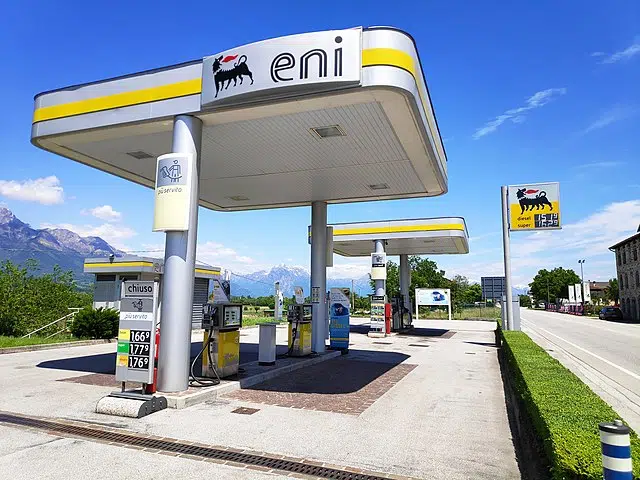
    In 1992, Eni claimed it needed more research before taking action on climate change. Credit: Petar Milošević Wikimedia Commons (CC BY-2.0)
    In 1992, Eni claimed it needed more research before taking action on climate change. Credit: Petar Milošević Wikimedia Commons (CC BY-2.0)

    Earlier this year, a DeSmog investigation also found that Eni has misleadingly promoted fossil gas since the 1980s as the “clean energy of the future,” despite its damaging effects on the climate. 

    Eni also continued to be a member of IPIECA – the International Petroleum Industry Environmental Conservation Association. Starting in the late 1980s, the organization  coordinated Big Oil’s efforts to delay fossil fuel controls around the world (and weaken the foundational UN Framework Convention on Climate Change) by emphasizing scientific uncertainty and misleading the public about the industry’s own knowledge.

    The report reveals that at a 1992 IPIECA symposium in Rome co-hosted by Eni, for example, the company’s manager of Safety, Quality and Environmental Protection department insisted that “before taking political decisions, such as adopting a carbon tax, which could lead to dire and unexpected economic consequences, it is necessary to obtain more data … on several controversial points such as the role of the oceans and clouds in climate change, as well as data on their behaviour in various countries and economic and geographic areas.” 

    Experts say Big Tobacco and other polluters used the “we need more research” refrain as a delay tactic. The Eni manager at the 1992 symposium added that “Eni feels that its objectives are very similar to those of IPIECA and strongly supports this important international association founded by oil companies.”

    “In due course [Eni] will make the respective pleadings and arguments public so that anyone can get a full, correct, accurate (and free from misleading ideologies) idea of the very significant issues and complexities associated, as well as the correctness of both the company’s behavior and its energy transition strategies,” said the company in a recent statement to Italian newspaper Domani. 

    And added that “following the logic described by the NGOs, which is devoid of any foundation and knowledge of the industrial and technological history of energy systems, as well as the evolution of economic and industrial systems and the energy mix required for their operation, anyone who has been using fossil energy or fuel for the past 50 years would have ignored these ‘alarms’ and would be similarly responsible for the emissions generated through their use.”

    On July 25, Greenpeace Italy and ReCommon received a “request for mediation” from Eni in response to their lawsuit. This is a mandatory prerequisite for filing a defamation lawsuit under Italian law. The company also stated it may seek at least 50,000 euros in damages from each group.

    “We intend to resist this attempt at intimidation by Eni and call for the support of all people and public and private entities who care about the cause of climate justice, starting with those who live and work in the territories that are suffering the catastrophic consequences of the crisis themselves,” said Antonio Tricarico,  program director at ReCommon.

    Original article by Stella Levantesi and Benjamin Franta republished from DeSmog.

  • Fossil Fuel Firms Flock to Conservative Party Conference

    Spread the love

    Original article by Joey Grostern and Sam Bright republished from DeSmog.

    Influential right-wing groups are set to host events featuring major polluters, days after Prime Minister Rishi Sunak watered down green targets.

    Image of InBedWithBigOil by Not Here To Be Liked + Hex Prints from Just Stop Oil's You May Find Yourself... art auction. Featuring Rishi Sunak, Fossil Fuels and Rupert Murdoch.
    Image of InBedWithBigOil by Not Here To Be Liked + Hex Prints from Just Stop Oil’s You May Find Yourself… art auction. Featuring Rishi Sunak, Fossil Fuels and Rupert Murdoch.

    A number of oil and gas firms have been announced as the hosts of stands and events at this year’s Conservative Party conference. 

    The conference, which is being held from 1 to 4 October in Manchester, will play host to the likes of BP, British Gas’ parent company Centrica, petrochemical giant Valero, and Drax – the UK’s largest CO2 emitter. 

    Events hosted by the companies will cover a range of energy and climate issues, and will feature senior Conservative MPs and ministers.

    A range of influential right-wing organisations will co-host the panels. They include the Spectator magazine and groups based in and around Westminster’s Tufton Street, home to a network of opaquely funded, free market think tanks with a history of criticising climate action and pushing for more fossil fuel exploration.

    This news comes as Prime Minister Rishi Sunak this week announced several delays to the government’s net zero policies. Sunak announced on Wednesday that a ban on the sale of new petrol and diesel vehicles will be pushed back from 2030 to 2035, while he also watered down schemes to phase out gas boilers and scrapped new energy efficiency regulations on rented homes. 

    Dozens of organisations will be running stalls at the Tory conference, including a number of fossil fuel firms and major polluters. These include oil giant BP, petrochemical manufacturer INEOS, and Drax, which operates the UK’s single most polluting power station and has actively attempted to influence government energy policy in its favour. 

    A “Hydrogen Zone” stand which “showcases what the hydrogen economy could deliver for the UK by 2030” will also exhibit projects from a number of gas extraction and distribution companies including RWE, Centrica, Cadent, Northern Gas Networks, National Gas, SGN, and Wales and West Utilities.

    DeSmog has previously revealed that the Conservative Party received £3.5 million in donations from fossil fuel interests and climate science deniers in 2022, while two-thirds of the directors in charge of the party’s multi-million-pound endowment fund have a financial interest in oil, gas, and highly polluting industries.

    The CPS

    The Centre for Policy Studies (CPS), a Tufton Street think tank, is hosting two separate events at the conference in partnership with gas companies. 

    Valero, the US-based downstream petroleum company which operates an oil refinery in Pembroke, Wales, is hosting an event with the CPS entitled “How do we decarbonise and remain competitive?” featuring Conservative MPs Gareth Davies and John Penrose. 

    French gas giant EDF and German-owned energy firm E.ON will also be co-hosting a CPS event asking how energy can be made cheaper. The panel will include Exchequer Secretary to the Treasury Gareth Davies. 

    The CPS has supported the expansion of fossil fuel exploration. In response to the release of the government’s new “energy security” strategy in April 2022, the think tank included ending the ban on fracking for shale gas in a list of “significant missed opportunities” by the government, along with onshore wind and home insulation.

    This followed years of lobbying from the CPS on the subject, including a report in December 2013 entitled, “Why every serious environmentalist should favour fracking”. 

    In an economic bulletin issued by the CPS in March 2022, the think tank also stated that “we need to continue to support offshore exploration and production activity in the North Sea. As part of this, the government should look at accelerating regulatory approval for upcoming oil and gas projects such as Rosebank… Clair South, Glengorm, Cambo and Bentley”.

    The International Energy Agency has stated that new oil and gas exploration is incompatible with net zero.

    A DeSmog investigation published earlier this year revealed that three CPS board members have donated £610,000 to the Conservative Party since Rishi Sunak became prime minister. 

    CPS runs the online publication CapX, which has published a number of articles recently attacking net zero policies. One set of “positive” policy prescriptions featured in a piece by Andrew Hunt included pushes, in place of the “obsession” over net zero, to “force developers to build more beautiful buildings” and “replace ugly road bollards and railings with ‘green street furniture’”.

    Vocal climate crisis denier Ross Clark also argued on CapX in February that net zero carries a “perverse incentive to destroy UK jobs”, and that Britain was “highly unlikely” to “get anywhere net zero by 2050”. In another CapX piece, Clark said it would be “impossible” for Britain to electrify its power grid by 2030.

    The CPS told DeSmog that, in recent years, it has been “one of the most prominent champions of free-market environmentalism, with a dedicated workstream on net zero.

    “Our director, Robert Colvile, has been one of the country’s most prominent advocates of onshore wind and solar, as well as co-authoring the 2019 Conservative Party manifesto, which contained a prominent commitment to net zero. 

    “Our CapX site offers a platform for robust debate on the policy issues of the day. The most cursory glance at our output would show that this includes publishing many pieces that are strongly supportive of net zero”.

    A Spectator Sport 

    The Spectator magazine will be hosting a Conservative conference event in association with Cadent Gas, discussing public consent for net zero. The event will feature two outspoken climate crisis deniers: Conservative MP Jacob Rees-Mogg who is also a GB News host, and Sherelle Jacobs, a columnist at the Telegraph.

    Rees-Mogg is well-known for his anti-net zero views, and was a leading proponent of further fossil fuel extraction during Liz Truss’s short tenure as prime minister.

    In August, Rees-Mogg argued that the government should “revisit its approach to net zero” and “cancel the ban” on oil-fired boilers from 2026, points which Sunak mirrored in his recent net zero announcement.

    Jacobs has previously argued that climate science is “being manipulated into alarmist fake news,” and more recently claimed that net zero was a “damp squib”. 

    The Spectator regularly publishes articles attacking net zero and questioning climate science. It  hosts the work of notorious climate crisis deniers such as Toby Young, Ross Clark, Brendan O’Neill, Charles Moore, Dominic Lawson, Rod Liddle, Matt Ridley and Rupert Darwall, among others.

    An Spectator editorial published in reaction to Sunak’s climbdown on net zero measures claimed that the plan to phase-out the sale of new fossil-powered engines was a “always was a conspiracy against the public, justified on very thin environmental arguments,” and that Sunak’s announcement was “an important step”. 

    The editorial argued for further climate inaction on the basis that Britain contributes less than 1 percent of total annual greenhouse gas emissions. (This argument has been identified as a common example of the key climate delay tactic of “Whataboutism”, in an influential academic paper published by Cambridge University Press).

    The Spectator is also hosting a drinks reception with newly formed UK gas infrastructure operator National Gas. 

    National Gas is also set to host an event at the Conservative conference on the UK’s “need” for hydrogen entitled “Gassed up”. The event is being co-hosted with the influential centre-right think tank Onward.  Several of Onward’s former staff members are now working in Sunak’s government. 

    German fossil fuel giant RWE, which owns and operates Europe’s second most polluting power plant, will also host an event in association with the Conservative Environment Network (CEN). The event will ask whether wind and solar energy are “energy saviours or a blight on our communities?”. The event will feature Lee Rowley, a minister at the Department for Levelling Up, Housing and Communities.

    RWE also claims to be the world’s second largest offshore wind company and Europe’s third-largest renewable energy company.

    Centrica is co-hosting an event with the CEN asking whether Britain is “winning or losing” at the “green industrial revolution”.

    Liquefied Natural Gas supplier Liquid Gas will also host an event on decarbonising rural areas. 

    The Spectator, the CEN, Onward and the Conservative Party have been approached for comment.

    Original article by Joey Grostern and Sam Bright republished from DeSmog.

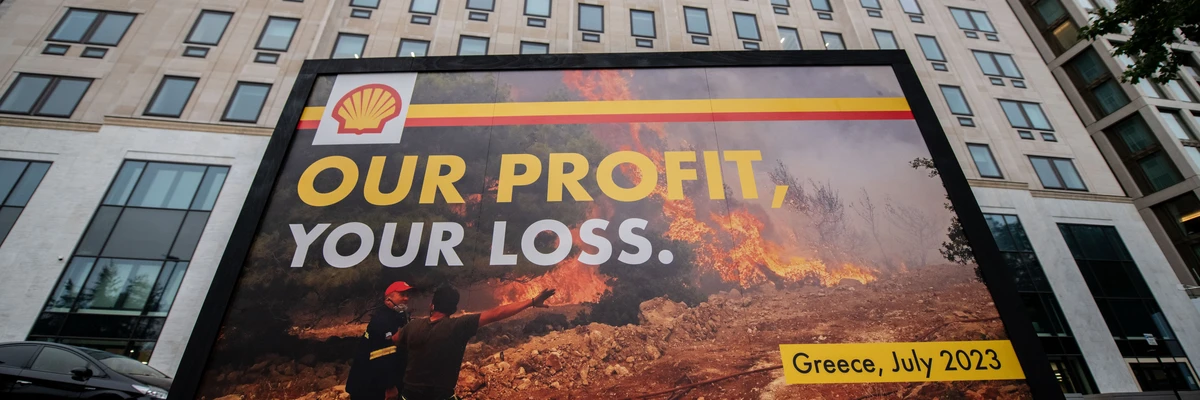
    Greenpeace activists display a billboard during a protest outside Shell headquarters on July 27, 2023 in London.
    Greenpeace activists display a billboard during a protest outside Shell headquarters on July 27, 2023 in London. (Photo: Handout/Chris J. Ratcliffe for Greenpeace via Getty Images)
  • FFS: Huge Fossil Fuel Subsidies in UK and globally

    Spread the love
    Image of InBedWithBigOil by Not Here To Be Liked + Hex Prints from Just Stop Oil's You May Find Yourself... art auction. Featuring Rishi Sunak, Fossil Fuels and Rupert Murdoch.
    Image of InBedWithBigOil by Not Here To Be Liked + Hex Prints from Just Stop Oil’s You May Find Yourself… art auction. Featuring Rishi Sunak, Fossil Fuels and Rupert Murdoch.

    FFS Fossil Fuel Subsidies continue to be huge in UK and globally despite the urgent need to move away from the use of fossil fuels since they are the main cause of the climate crisis. Current estimates of FFS are 4% of GDP globally and 2% of GDP in UK. FFS that’s huge FFS. We only have estimates of FFS because FFS are not specifically acknowledged with governments disguising FFS by selecting definitions that hide their FFS FFS. Please publish your own article if you know FFS better than me FFS.

    FFS? FOSSIL FUELS SUPPORT IN THE UK TAX SYSTEM

    … the UK continues to offer a number of tax reliefs for both domestic production and consumption of fossil fuels. In the last 5 years, the value of UK support to fossil fuels mounted to approximately £12bn annually on average.

    …

    In the face of the climate and environmental crises, and the short timeframe left to avert breakdown, it is increasingly clear that the current rate and scale of action will not deliver a safe future. In place of this we need a deep transformation of design and operation of the economy. This will require structural policy shifts, as well as a step-change in public investment. Tax revenues can play an important role in sustainably servicing this increased borrowing. Crucially though, by bringing together the twin goals of a Green New Deal – securing economic and climate justice — a reimagined UK tax system can play a central role in driving a more equitable distribution of wealth while reorienting economic activity away from high-carbon production and consumption. Phasing out UK fossil fuel support needs to be part of a coherent strategy to ensure an orderly, just, and rapid transition.

    …

    https://www.edie.net/rishi-sunak-announces-5bn-windfall-tax-on-fossil-fuel-giants-to-help-households-deal-with-energy-price-crisis/

    …

    Under a new plan, oil and gas firms can access a “super-deduction” investment allowance which means for £1 spent in “UK extraction” up to 91% of the costs will be covered by the tax saving.

    This deduction is covered from the point of investment, rather than at the point the project starts producing. Many green experts have noted that “UK extraction” is a vague term, but one that points to major tax reliefs for energy giants that invest in the extraction of more UK-based oil and gas fields.

    …

    That’s a huge incentive for fossil fuel companies to extract from previous Chancellor and current Prime Minister Rishi Sunak FFS: It will cost them only 9p for a £ of investment.

    FFS: Energy crisis: Governments spent more than €900 billion on fossil fuel subsidies in 2022

    These calculations show how a renewable energy transition would save everyone money FFS

    The last drop: Why it is not economic to extract more oil and gas from the North Sea FFS

  • Dutch Climate and Energy Minister estimates NL’s fossil fuel subsidies at up to €46.4 billion a year, more than 4% of the Netherlands’ GDP. Campaigners call for phase-out plan

    Spread the love

    Today the outgoing Dutch Minister for Climate and Energy Policy, Rob Jetten, published an analysis of the Netherlands’ fossil fuel subsidies, estimating these at between €39.7 and €46.4 billion a year, more than 4% of the Netherlands’ GDP. According to campaigners the analysis underlines the importance of an urgent phase-out plan, in line with the Dutch government’s long-standing promise to end these subsidies by 2025. 

    Recent research by Dutch research and environmental organizations shows that this would allow the Netherlands to reduce its CO2 emissions by up to 20% by 2030, while creating space for innovative and sustainable businesses and freeing up billions that can be reinvested in climate justice and social protection measures. The conclusions of the impact analysis for companies of subsidy removal that were also covered in today’s government publication mainly emphasize the short-term impacts for a select group of large energy-intensive companies that run on cheap fossil energy. Researchers and campaigners say this is too limited a perspective and should not stand in the way of an urgent phase-out plan.

  • 400+ Actions to End Fossil Fuels Planned Around the World for Sept. 15-17

    Spread the love
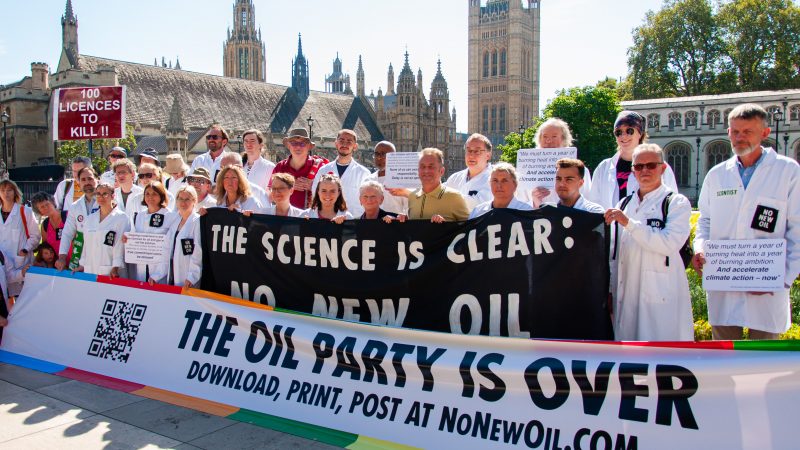
    Scientists protest at UK Parliament 5 September 2023.
    Scientists protest at UK Parliament 5 September 2023.

    Original article by JULIA CONLEY republished from Common Dreams under Creative Commons (CC BY-NC-ND 3.0). 

    “When we the people use our collective power we can win,” said one campaigner.

    “September 15-17, 2023. Everywhere.”

    Those are the dates and location of the international mobilization against fossil fuels set to take place this coming weekend, and the last word is hardly an exaggeration as organizers with the Global Fight to End Fossil Fuels report that more than 400 actions, marches, rallies, and other events have already been registered around the world.

    More than 780 organizations have endorsed the day of action—up from 500 less than a week ago—and millions of participants are expected to rally from Cape Town, South Africa to Manila, Philippines and Lahore, Pakistan, as well as in dozens of cities and towns across the United States, the largest emitter of greenhouse gases in history.

    The protests are scheduled just before the United Nations Climate Ambition Summit, taking place on September 20 in New York, where groups including the NAACP, Sierra Club, and Sunrise Movement are supporting the March to End Fossil Fuels on September 17.

    More than 10,000 people are expected to march in New York to demand that U.S. President Joe Biden end federal approvals for new fossil fuel projects like the Willow drilling project in Alaska and phase out oil and gas drilling in federal lands and waters; declare a climate emergency to unlock resources to accelerate the transition to renewable energy; and provide a just transition that creates millions of green jobs while supporting people who have worked in the fossil fuel industry.

    “President Biden is in an unparalleled position to lead the world toward cleaner, less polluting energy options and eliminate the dependence on dangerous fossil fuels,” said organizers of the New York march. “If he takes action, he will protect our health, boost our economy, and tackle the climate crisis head-on.”

    The March to End Fossil Fuels is backed by advocates including author Naomi Klein, 350.org co-founder Bill McKibben, actor and Third Act leader Jane Fonda, and lawmakers including U.S. Sen. Ed Markey (D-Mass.) and Rep. Rashida Tlaib (D-Mich.).

    On Monday, scientists including Lucky Tran of the March for Science and biologist Sandra Steingraber announced that 300 climate experts had signed their letter to Biden reminding him that “a broad scientific consensus exists” that fossil fuel extraction must be drawn down immediately to keep global heating below 1.5°C.

    https://twitter.com/Prof_FSultana/status/1701287399345561724?ref_src=twsrc%5Etfw%7Ctwcamp%5Etweetembed%7Ctwterm%5E1701287399345561724%7Ctwgr%5E38e8876908f1a885f6f8c9d1f348cd78264d5ea6%7Ctwcon%5Es1_c10&ref_url=https%3A%2F%2Fwww.commondreams.org%2Fnews%2F400-actions-march-climate

    The scientists plan to release the letter with all signatures ahead of Sunday’s march.

    The global mobilization—and the Climate Ambition Summit, where leaders of countries that emit the most heat-trapping gases will be expected to present updated plans to reduce their emissions and phase out fossil fuels—comes after a summer in the Northern Hemisphere in which numerous temperature records were broken.

    As Common Dreams reported last week, U.N. Secretary-General António Guterres warned that “climate breakdown has begun” when U.S. scientists found the summer was the hottest on record. Scientists have said that extreme weather events such as wildfires in Canada and heatwaves in the U.S. and Europe in recent months would not have happened without human-caused planetary heating.

    Tasneem Essop, executive director of Climate Action Network, emphasized that popular uprisings against the fossil fuel industry and the politicians that continue to support it have found success, such as the campaign that pushed Ecuadorians to vote against drilling in the Yasuní National Park in the Amazon last month.

    “July 2023 was the hottest month in recorded climate history,” said Essop. “The unparalleled, deadly climate disasters sweeping the world seem to leave polluters unfazed. Historical emitters like Norway, the U.K., and the USA are announcing new fossil fuel projects even as floods, fires, and heatwaves take over our lives. We take inspiration from recent victories in the Yasuní region with the referendum to stop oil drilling.”

    “When we the people use our collective power we can win,” Essop added. “Let our resistance against fossil fuels in September send a loud message to the fossil fuel industry and their supporters that their time is up.”

    Outside of the U.S., more than 3,000 people are expected to join the Pakistan Climate March in the southern Sidh province; 100,000 are expected to join a march in Abuja, Nigeria; and 3,000 are expected to march near Malacañang Palace in Manila.

    “We demand a phaseout of fossil fuels now,” said Farooq Tariq, secretary-general of Kissan Rabita Committee in Pakistan. “The fossil fuel industry and its supporters bear responsibility for the climate crisis and perpetuate a predatory and destructive economic system that harms both people and the planet.”

    Original article by JULIA CONLEY republished from Common Dreams under Creative Commons (CC BY-NC-ND 3.0).