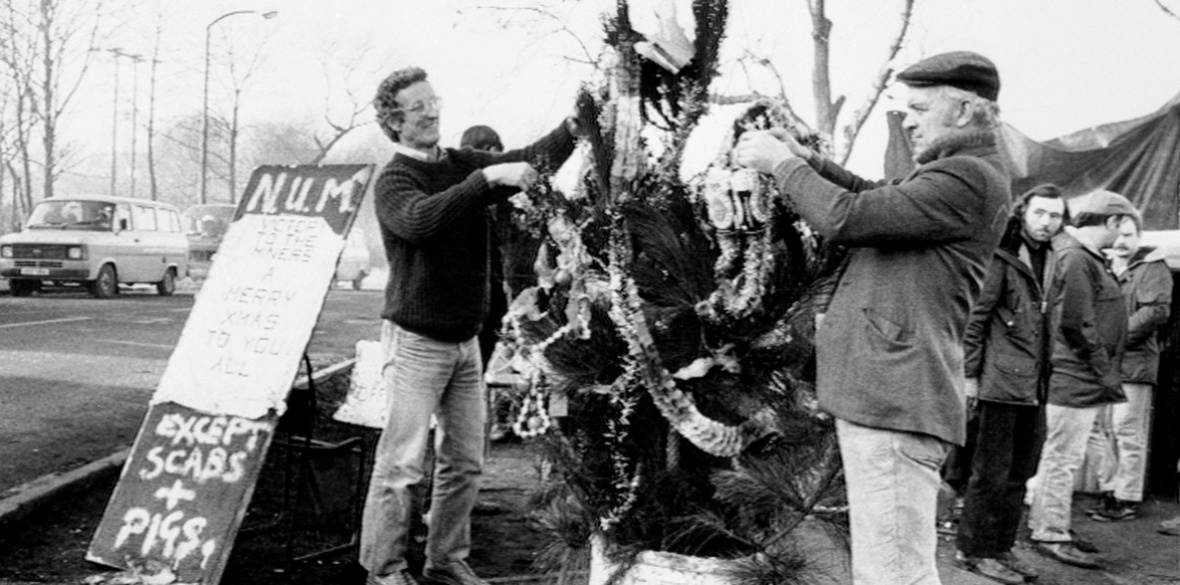
Picketers decorate a Christmas tree outside Rossington Colliery, while police transit vans line the roadway, December 11, 1984
CHRISTMAS 1984 was potentially a desperate time for the families of miners who had been on strike against pit closures for nine months. It turned out to be the opposite for many striking mining communities.
France’s communist-led union group CGT sent a convoy of 30 lorries, driven by volunteers and packed with food and toys, across the Channel. The union had mounted a “toy drive” among its members, and thousands had flooded in.
The convoy arrived at Dover, and the lorries journeyed to struggling mining communities in Wales and northern England.
Hundreds of miners’ support groups across the country redoubled their solidarity efforts — and the public responded generously.
The result for many striking miners and their families was the best Christmas they had ever had. And the solidarity is remembered today across the former coalfields.
In the north-east, Ian Lavery, now Labour MP for Blyth and Ashington, was a 20-year-old miner at Ellington Colliery in Northumberland. He lived with his parents and siblings. His father was a striking miner, as were two of his three brothers.
He told the Morning Star: “It was one of the best times of my life.
“At Christmas time 1984, none of us had a ha’penny — no money at all. But one thing about miners and working-class people is that they will do anything to make sure the kids have a good Christmas. Whatever the situation — on strike for seven or eight months — we would not let the kids down.
“It was fabulous to see the juggernauts arriving from France. They provided every striking miner’s kid with a toy at Christmas. Honestly, there was juggernaut after juggernaut come all the way from France. Absolutely amazing. Then there were the chickens and the turkeys. They were on the Christmas table of every striking miner. It was just fabulous.
“There were Christmas parties in every village and community.
A photo taken on December 15, 2024 shows residents sitting among piles of debris of metal sheets and wood after homes were destroyed by the cyclone Chido that hit France’s Indian Ocean territory of Mayotte. (Photo: Kwezi/AFP via Getty Images)
“You feel like you are in the aftermath of a nuclear war,” said one resident. “I saw an entire neighborhood disappear.”
Undocumented migrants living in informal settlements in the French territory of Mayotte were among those whose lives and livelihoods were most devastated by Cyclone Chido, a tropical cyclone that slammed into the impoverished group of islands in the Indian Ocean over the weekend.
Authorities reported a death toll of at least 20 on Monday, but the territory’s prefect, François-Xavier Bieuville, told a local news station that the widespread devastation indicated there were likely “some several hundred dead.”
“Maybe we’ll get close to a thousand,” said Bieuville. “Even thousands… given the violence of this event.”
Mayotte, which includes two densely populated main islands, Grande-Terre and Petite-Terre, as well as smaller islands with few residents, is home to about 300,000 people.
The territory is one of the European Union’s poorest, with three-quarters of residents living below the poverty line, but roughly 100,000 people have come to Mayotte from the nearby African island nations of Madagascar and Comoros in recent decades, seeking better economic conditions.
Many of those people live in informal neighborhoods and shacks across the islands that were hardest hit by Chido, with aerial footage showing collections of houses “reduced to rubble,” according toCNN.
“What we are experiencing is a tragedy, you feel like you are in the aftermath of a nuclear war,” Mohamed Ishmael, a resident of the capital city, Mamoudzou, told Reuters. “I saw an entire neighborhood disappear.”
Bruno Garcia, owner of a hotel in Mamoudzou, echoed Ishmael’s comments, telling French CNN affiliate BFMTV: “It’s as if an atomic bomb fell on Mayotte.”
“The situation is catastrophic, apocalyptic,” said Garcia. “We lost everything. The entire hotel is completely destroyed.”
Residents of the migrant settlements in recent years have faced crackdowns from French police who have been tasked with rounding up people for deportation and dismantling shacks.
The aggressive response to migration reportedly led some families to stay in their homes rather than evacuate, for fear of being apprehended by police.
Now, some of those families’ homes have been razed entirely or stripped of their roofs and “engulfed by mud and sheet metal,” according to Estelle Youssouffa, who represents Mayotte in France’s National Assembly.
People in Mayotte’s most vulnerable neighborhoods are now without food or safe drinking water as hundreds of rescuers from France and the nearby French territory of Reunion struggle to reach victims amid widespread power outages.
“It’s the hunger that worries me most. There are people who have had nothing to eat or drink” since Saturday, French Sen. Salama Ramia, who represents Mayotte, told the BBC.
The Washington Postreported that Cyclone Chido became increasingly powerful and intense—falling just short of becoming a Category 5 hurricane with winds over 155 miles per hour—because of unusually warm water in the Indian Ocean. The ocean temperature ranged from 81-86°F along Chido’s path. Tropical cyclones typically form when ocean temperatures rise above 80°F.
“The intensity of tropical cyclones in the Southwest Indian Ocean has been increasing, [and] this is consistent with what scientists expect in a changing climate—warmer oceans fuel more powerful storms,” Liz Stephens, a professor of climate risks and resilience at the University of Reading in the United Kingdom, told the Post.
People living on islands like Mayotte are especially vulnerable to climate disasters both because there’s little shielding them from powerful storms and because their economic conditions leave them with few options to flee to safety as a cyclone approaches.
“Even though the path of Cyclone Chido was well forecast several days ahead, communities on small islands like Mayotte don’t have the option to evacuate,” Stephens said. “There’s nowhere to go.”
A protester carries a sign called on Michel Barnier, who was selected by French President Emmanuel Macron as the prime minister, to resign at a protest on September 7, 2024 in Nantes, France. (Photo: Maylis Rolland/Hans Lucas/AFP via Getty Images)
“Expressing one’s vote will be useless as long as Macron is in power,” said one demonstrator.
In cities and towns across France on Saturday, more than 100,000 people answered the call from the left-wing political party La France Insoumise for mass protests against President Emmanuel Macron’s selection of a right-wing prime minister.
The demonstrations came two months after the left coalition won more seats than Macron’s centrist coalition or the far-right Rassemblement National (RN) in the National Assembly and two days after the president announced that Michel Barnier, the right-wing former Brexit negotiator for the European Union, would lead the government.
The selection was made after negotiations between Macron and RN leader Marine Le Pen, leading protesters on Saturday to accuse the president of a “denial of democracy.”
“Expressing one’s vote will be useless as long as Macron is in power,” a protester named Manon Bonijol told Al Jazeera.
“Don't let democracy be humiliated.”
The Left saved France from the extreme right. Voters chose a left-wing coalition over LePen and over Macron’s corporate centrism.
A poll released on Friday by Elabe showed that 74% of French people believed Macron had disregarded the results of July’s snap parliamentary elections, and 55% said the election had been “stolen.”
Jean-Luc Mélenchon, the leader of La France Insoumise (LFI), or France Unbowed, also accused Macron of “stealing the election” in a speech at the demonstration in Paris on Saturday.
“Democracy is not just the art of accepting you have won but the humility to accept you have lost,” Mélenchon told protesters. “I call you for what will be a long battle.”
He added that “the French people are in rebellion. They have entered into revolution.”
Macron’s centrist coalition won about 160 assembly seats out of 577 in July, compared to the left coalition’s 180. The RN won about 140.
Barnier’s Les Républicains (LR) party won fewer than 50 parliamentary seats. French presidents have generally named prime ministers, who oversee domestic policy, from the party with the most seats in the National Assembly.
Barnier signaled on Friday that he would largely defend Macron’s pro-business policies and could unveil stricter anti-immigration reforms. Macron has enraged French workers and the left with policies including a retirement age hike last year.
Protests also took place in cities including Nantes, Nice, Montpellier, Marseilles, and Strasbourg.
All four left-wing parties within the Nouveau Front Populaire (NFP) coalition have announced plans to vote for a motion of no confidence against Barnier.
The RN has not committed to backing Barnier’s government yet and leaders have said they are waiting to see what policies he presents to the National Assembly before deciding how to proceed in a no confidence vote.
A group of people thought to be migrants are brought in to Dover, Kent, onboard the RNLI Dungeness Lifeboat following a small boat incident in the Channel, September 3, 2024
AT LEAST 12 people trying to cross into Britain from France have died after their boat sank in the English Channel.
The deaths were confirmed today by the French coastguard after a rescue operation near the coast of Cap Gris-Nez, off Wimereux, took place.
Up to 65 people were rescued and two were still missing as the Morning Star went to print.
According to the mayor of Le Portel – where the surviving refugees were being treated – the bottom of the boat “ripped open.”
The people on board the dinghy ended up in the water and several of them needed emergency medical care, the French coastguard said.
…
The International Organisation for Migration, which records Channel crossing deaths as part of its Missing Migrant Project, estimates 226 people including 35 children are missing or have died after attempting the crossing as of January this year.
According to the French coastguard, there have been at least 19 deaths in 2024 prior to Tuesday’s incident, including nine since the start of July.
Last week, France and Britain agreed to deepen co-operation on so-called illegal migration in the Channel.
At least 2,109 people have tried to cross since – the highest number of the year.
The Morning Star publishes the open letter to the French people from New Popular Front prime ministerial candidate Lucie Castets and leaders of its component parties, to inform British readers of the left’s case for government in France
LAST July, you mobilised massively at the polls to refuse the arrival of the extreme right in power and to break with the policies pursued for seven years. We thank you for this.
And since then? Nothing. The President of the Republic is procrastinating rather than drawing the consequences of these elections. How long are we going to continue as if nothing had happened at the beginning of the summer?
You have placed the New Popular Front at the top of the poll, without giving anyone an absolute majority. This result puts obligations on us all, and first and foremost obliges the one who caused it.
Unfair and imposed policies The inaction of the President of the Republic is serious and harmful. Because it highlights his desire to prolong the last seven years of unjust and authoritarian policies. Because it gives the impression that the vote would serve no purpose, that all this would be nothing more than a game of institutional chess.
We are measuring the extent of the distrust expressed today throughout the country, by you, citizens, leaders of unions, businesses, associations, collectives, local elected officials. Through renunciations, decisions imposed against the will of the people, such as the pension reform, many of you no longer believe in politics.
These feelings fuel the rise of the extreme right that we have fought and will continue to fight.
The choice of the next government will have very concrete consequences on the daily lives of each and every one, depending on whether it continues the austerity “cure” or decides to reinvest in our public services. Parents need to know if we will give ourselves the means to put a teacher in front of their child, and to straighten out the public school system; employees need to know when their salary will be revalued, after several years of inflation; residents need to know if their housing can be thermally renovated and if adaptation to climate change will be accelerated; patients need to know if they will be admitted to the emergency room if necessary and if the hospital will have the means to operate; our children need to know if we will offer them a habitable planet where they can grow and flourish.
Necessary break On all these issues, a break with past policies is necessary. It has been demanded by voters. This is what a New Popular Front government will undertake from the first hours of its nomination.
To the voters who have massively mobilised around the New Popular Front, we say: we are committed to building a fairer, more united society according to each person’s ability to contribute, in which work will be better paid, hardship better recognised, public services rehabilitated and to implementing immediately the ecological shift that is essential for our common future. A society in which everyone can have a dignified life.
To the voters who did not vote for us, on the right or the far right, as well as to those who did not vote at all, we say: yes, we want to break with the logic of one camp against another and will work together to build the future of the country and finance public services.
We are convinced that we will be able to improve the lives of French women and men in a concrete and rapid manner, and that the absence of an absolute majority will not prevent us from doing so. Who will refuse the increase in purchasing power that we are proposing with the revaluation of salaries and the remuneration of civil servants?
Who will accept seeing the catastrophic situation of public hospitals continue with emergency services closed in the middle of summer? Who will resign themselves to a new school year where so many teachers will be missing in front of our children in primary, secondary and high schools? On all these key issues, parliamentarians will report their votes and citizens will be witnesses.
A new way of governing We are aware of this: we must invent a new way of governing under the Fifth Republic. Parliament must, in a transparent manner, regain control of its calendar and calmly discuss the projects and Bills that will be submitted to it. Social partners must be listened to and respected. New forms of association of field actors, local elected officials, associations and all those who bring our democracy to life on a daily basis must be imagined.
We will also bring French diplomacy to the service of peace because we cannot accept that disputes are settled by force in Europe and in the world. We will thus work to thwart Vladimir Putin’s war of aggression, defend the sovereignty of the Ukrainian people and work towards a return to peace.
We will act to obtain an immediate ceasefire in Gaza and the release of the hostages. And since the President of the Republic himself had stated that the recognition of the state of Palestine was not a “taboo for France,” we will act for its immediate recognition, alongside the state of Israel, on the basis of UN resolutions to move towards a just and lasting peace.
Finally, we will bring civil peace to New Caledonia by returning to the reform of the electoral body and reopening a process of discussion, in the spirit of the Noumea and Matignon agreements.
We are convinced that France can still embody the values of justice, freedom and openness that have made its history. Hate speech damages it and does not resemble it.
You spoke out two months ago, now it is high time to take action: as in all parliamentary democracies, the coalition that comes out on top must be able to form a government, seek agreements within parliament and get to work. We’ve been working on it all summer. We’re ready.
Lucie Castets, candidate of the New Popular Front as Prime Minister Manuel Bompard, co-ordinator of France Insoumise Olivier Faure, first secretary of the Socialist Party Fabien Roussel, national secretary of the French Communist Party Marine Tondelier, national secretary of the Ecologists