This work by Middle East Monitor is licensed under a Creative Commons Attribution-NonCommercial-ShareAlike 4.0 International License.
Palestinian residents flee the conflict zones by car, on donkey carts, and on foot, carrying their belongings to safer areas following intense Israeli military attacks on the Jabalia Refugee Camp in northern Gaza on May 21, 2025. [Saeed M. M. T. Jaras – Anadolu Agency
The Israeli army controls over 77% of the Gaza Strip, local authorities said on Sunday, Anadolu reports.
“Field data and verified analysis indicate that the Israeli occupation forces now effectively control approximately 77% of Gaza’s total geographic area,” Gaza’s government media office said in a statement.
The Israeli army gained control through “direct ground offensives, the deployment of its forces in residential and civilian areas, or preventing Palestinians from accessing their areas, lands, and properties via intensified fire, or forced evacuation,” it added.
The office strongly condemned the Israeli plans of mass displacement, ethnic cleansing, systematic genocide, and settler colonialism by force, “under the cover of a siege and an open war targeting both people and infrastructure.”
It held Israel and its supporters, including the US, UK, Germany, and France, fully responsible for the crime of genocide in Gaza.
On Thursday, Israel Hayom newspaper said that the army plans to control 70-75% of Gaza within nearly three months as part of an expanded military campaign in the enclave.
Rejecting international calls for a ceasefire, the Israeli army has pursued a brutal offensive against Gaza since October 2023, killing more than 53,900 Palestinians, most of them women and children.
Last November, the International Criminal Court issued arrest warrants for Israeli Prime Minister Benjamin Netanyahu and his former Defense Minister Yoav Gallant for war crimes and crimes against humanity in Gaza.
Israel also faces a genocide case at the International Court of Justice for its war crimes against defenseless civilians in the enclave.
This work by Middle East Monitor is licensed under a Creative Commons Attribution-NonCommercial-ShareAlike 4.0 International License.
UK Labour Party government ministers Keir Starmer, Angela Rayner and Rachel Reeves explain that they are partners complicit in Israel’s Gaza genocide. The UK has provided Israel with arms, military and air force support. They explain that they don’t do gas chambers but do do forced marches, starvation, destroy hospitals, mass-murders of journalists and healthcare workers.UK Conservative Party leader Kemi ‘‘not a genocide’‘ Badenoch explains her reality that the Earth is flat, the Moon is made of cheese and that she was born from Unicorn horn dust
Two Youth Demand activists protest ouside a house which according to the activists belongs to the Foreign Secretary David Lammy demanding that he stops arming Israel on April 8, 2025, London, United Kingdom. (Photo: Kristian Buus/In Pictures via Getty Images)
Lammy called Israel’s escalation of the genocide “morally unjustifiable.” But what is beyond unjustifiable is for Lammy to say this while directly arming and providing surveillance information for the genocide.
On Tuesday, after releasing a joint statement with France and Canada threatening “concrete actions” if Israel did not allow aid into Gaza, the U.K. government suspended talks on its upgraded free trade deal, summoned the Israeli ambassador, and imposed new sanctions on settlers in the occupied West Bank. While this might appear substantial for the goal of isolating the Zionist state, it amounts to little more than face-saving measures.
In his speech announcing these measures, U.K. Foreign Secretary David Lammy couldn’t even bear to say these words without condemning the October 7 operation and maintaining Israel’s right to commit genocide. We can’t fall for these empty measures, even if they appear to be a positive push toward some justice. In reality, they are a distraction and feign action from a government supporting Israel as it accelerates its genocidal attacks. Each day, as Israel commits new massacres with American weapons, it is using the Royal Air Force Akrotiri, a British military base on Cyprus, to conduct surveillance flights and facilitate weapons transfers.
The government’s suspension of negotiations on its free-trade agreement is misleading. This is not the existing free-trade agreement in place between Britain and Israel, but a future plan to deepen relations. Known as the 2030 Roadmap, this was initiated under the previous Conservative government in 2022, and the Labour government continued negotiations immediately after entering government in July 2024. Stopping these negotiations is a good first step, but they must end their current free-trade agreement if Lammy’s words are worth their salt.
Israeli Prime Minister Benjamin Netanyahu says the world “won’t stop us.” Our leaders bought by Zionism will certainly not, but the people will.
The sanctions on a handful of people and companies in the occupied West Bank might be a generally positive step. But at a closer look, these measures are only on three people, two outposts, and two organisations. All of the 700,000 settlers occupying the West Bank in their 150 settlements and 128 outposts are illegal under international law. These very narrow sanctions then give wider justification for the illegal occupation of the West Bank, scapegoating a handful of “extreme” characters but not contending with the occupation itself. Last year, the International Court of Justice ruled that Israel’s occupation of Palestine is illegal. Once again, Britain is ignoring international law, just as it does in refusing to hand over surveillance data on Gaza to the International Criminal Court.
Britain’s recent moves should rightly be compared with the United States, which has formed the Gaza Humanitarian Foundation, a private company of U.S. military veteran mercenaries to run an aid distribution operation, better described as a trojan horse to occupy Gaza. As Israel accelerates its genocide in Gaza, the U.S. and Britain are attempting to conceal their role in the violence. We might see these as necessary measures for Israel to be committing what many are referring to as the final stage in the genocide.
Over the past few days, the Starmer government’s statements have given us the illusion of a change in course toward Israel. Yet in five of the six days leading up to May 20, Britain has flown a surveillance flight over Gaza for Israel.
Britain has made no material change in its policy of arming Israel, providing surveillance information, and using its military base on Cyprus for weapons shipments. Therefore, not only are these statements hollow and vacuous, but they are a pernicious and sly attempt to divert attention from Britain’s role as it directly participates in Israel’s genocide against the Palestinian people.
On Sunday (May 18th), Britain sent an A400M Atlas plane to Israel from RAF Akrotiri. This aircraft can carry up to 37 metric tons of cargo, including weapons and soldiers. Two hours later, it sent a surveillance flight over Gaza. These operations have been purposefully concealed from public knowledge, but this is clearly shifting. The only reason we know about these flights is because of the work of Matt Kennard, Declassified U.K., and Genocide-Free Cyprus, among other groups. There clearly is mounting pressure as a result of the revelations of Britain’s direct role in Israel’s genocide, and perhaps we must recognize it has a role in Lammy’s face-saving attempts.
Last week, the U.K. government defended its continued provision of F-35 fighter jet parts to Israel, pointing to the need for “national security.” In court, they claimed “no genocide has occurred or is occurring,” that Israel is not “deliberately targeting civilian women or children.” Britain is defending Israel legally, diplomatically, and militarily. No statement can change that fact.
Israel stopped all aid trucks from entering Gaza on March 2. It has taken more than 11 weeks for the government to take any action at all. Every day, the Israeli occupation commits heinous massacres. They are even bragging that the world “won’t stop us.” And so far, they’re right.
In the face of this, we cannot despair. Palestinians in Gaza remain steadfast each day, for the 18 months of this escalation in the genocide that has been ongoing for more than 77 years. Israeli Prime Minister Benjamin Netanyahu says the world “won’t stop us.” Our leaders bought by Zionism will certainly not, but the people will. We must continue our demands for a full arms embargo, an end to British surveillance flights, and the total liberation of Palestine.
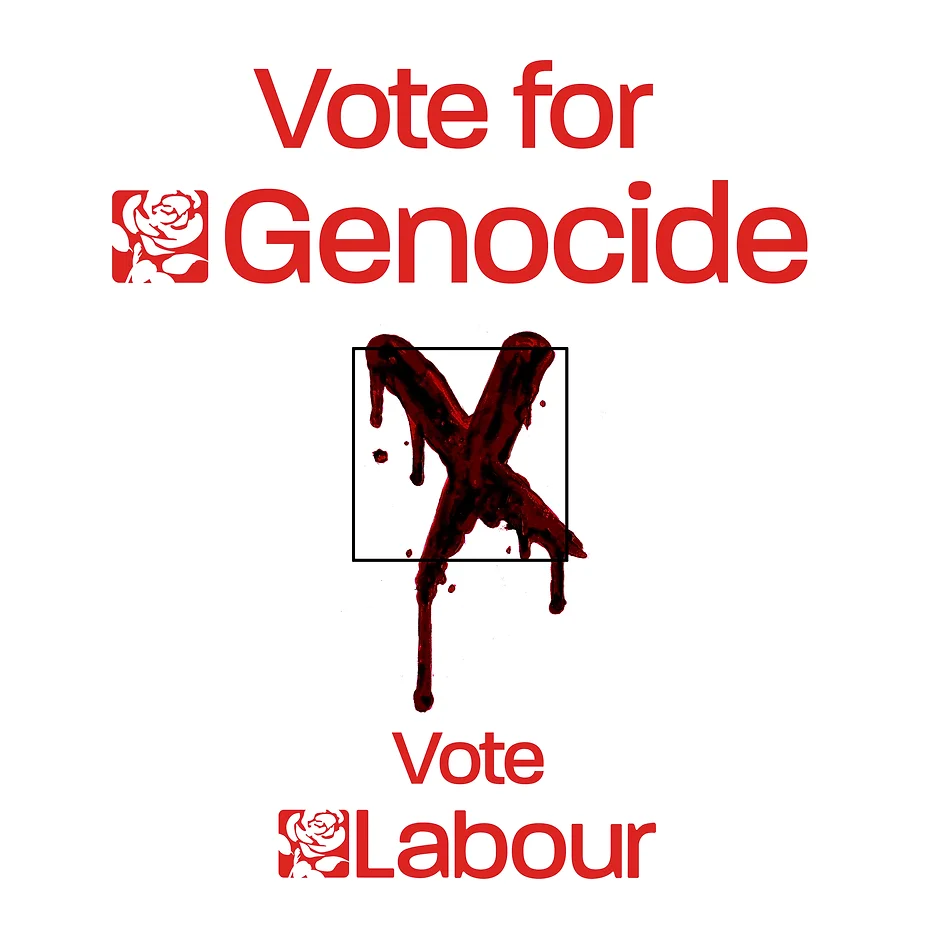
UK Foreign Minister David Lammy confirms that UK government and military are active participants in Israel’s genocides and that the F-35 parts that they suspended from supplying to Israel are instead simply diverted via the United States. He says see https://youtu.be/QILgUHrdWREUK Labour Party government ministers Keir Starmer, Angela Rayner and Rachel Reeves explain that they are partners complicit in Israel’s Gaza genocide. The UK has provided Israel with arms, military and air force support. They explain that they don’t do gas chambers but do do forced marches, starvation, destroy hospitals, mass-murders of journalists and healthcare workers.Vote For Genocide Vote Labour.
Members of an international diplomatic delegation scramble for cover after coming under Israeli fire during a May 21, 2025 visit to the besieged Jenin refugee camp in the illegally occupied West Bank of Palestine. (Photo: Mohammad Ateeq/AFPTV/AFP via Getty Images)
Among those shot at were representatives of three nations that threatened “concrete actions” if Israel doesn’t end its assault and siege on Gaza and others that support a genocide case against the country.
Israeli occupation forces fired what they called “warning shots” at a large delegation of international diplomats visiting the besieged Jenin refugee camp in the West Bank on Wednesday, an incident many critics said was an attempt to intimidate countries that just two days earlier issued an ultimatum to stop annihilating Gaza and others that have joined a genocide case against Israel.
Palestinian officials were briefing a group of more than 20 diplomats about the crisis in the illegally occupied West Bank—where Israeli soldiers and settlers have killed and wounded thousands of Palestinians including hundreds of children since October 2023 while pushing ahead with massive land theft and colonization—when they came under fire.
According to the Israeli Foreign Ministry, the delegation “deviated” from the route approved by Israeli occupation authorities “and entered an area where they were not authorized to be,” prompting Israel Defense Forces (IDF) soldiers to fire “warning shots to distance them away.”
“The IDF regrets the inconvenience caused,” the ministry added.
Israeli soldiers intentionally fired at a delegation of about 30 Arab & EU diplomats, ambassadors and consuls, visiting Jenin refugee camp, in the West Bank. Israel claims “it was an accident” and that they fired “warning shots” because they “felt in danger”. Israel was trying to intimidate them.
Israeli media reported IDF troops fired shots in the air. However, video footage of the incident appears to show soldiers aiming their guns and firing straight ahead in the direction of the diplomats as they scrambled for cover. Israeli officials have often been caught lying about the actions of IDF troops in Palestine.
The delegation included diplomats from the European Union and countries including Austria, Brazil, Bulgaria, Canada, Chile, China, Egypt, France, India, Japan, Jordan, Lithuania, Mexico, Morocco, Poland, Portugal, Romania, Russia, Spain, Sri Lanka, Turkey, and the United Kingdom.
Another video documenting the moment the diplomats and representatives from over 24 countries and the EU were intimidated by Israeli soldiers as they gathered in front of the besieged Jenin Camp. pic.twitter.com/5uJTOE9pRi
On Monday, three of those countries—France, the United Kingdom, and Canada—issued a rare joint statement condemning Operation Gideon’s Chariots, the ongoing Israeli campaign to conquer and indefinitely occupy all of Gaza and ethnically cleanse much of its population.
On Tuesday, the U.K. announced it is suspending negotiations with Israel on a free trade agreement, explaining that “it is not possible to advance discussions on a new, upgraded FTA” with a government “that is pursuing egregious policies in the West Bank and Gaza.”
Israeli Prime Minister Benjamin Netanyahu and Yoav Gallant, his former defense minister, are wanted by the International Criminal Court for alleged war crimes and crimes against humanity in Gaza including extermination and forced starvation.
The U.K. additionally sanctioned three far-right Israeli extremists, including settler leader Daniella Weiss, as well as three illegal settlement outposts and two groups “that have supported, incited, and promoted violence against Palestinian communities in the West Bank.”
Also on Tuesday, European Commission Vice President Kaja Kallas—who is the E.U.’s foreign policy chief—said the 27-nation bloc would review its political and economic agreement with Israel in light of the “catastrophic” situation in Gaza.
Brazil, Chile, China, Egypt, Jordan, Mexico, Spain, and Turkey have either joined or expressed support for the South Africa-led genocide case against Israel currently before the International Court of Justice—which last year found that Israel’s 58-year occupation of the West Bank, including East Jerusalem, and Gaza is an illegal form of apartheid that must be ended as soon as possible.
France's Foreign Minister confirms that Israeli soldiers shot at EU ambassadors and diplomats in Jenin.
Had any other country done this, it would have been considered an act of war. Imagine if Russia had done this?
Israel’s 592-day assault and siege on Gaza has left more than 189,000 Palestinians dead, maimed, or missing and over 2 million others forcibly displaced, starved, or sickened, according to the Gaza Health Ministry.
The Palestinian Authority Ministry of Foreign Affairs condemned what it called Wednesday’s “heinous crime” against the diplomats.
“The delegation was undertaking an official mission to observe and assess the humanitarian situation and document the ongoing violations perpetrated by the occupying forces against the Palestinian people,” the ministry said. “This deliberate and unlawful act constitutes a blatant and grave breach of international law and of the fundamental principles of diplomatic relations as enshrined in the 1961 Vienna Convention on Diplomatic Relations.”
Kallas said Wednesday that “any threats on diplomats’ lives are unacceptable.”
“Israel is also a signatory to the Vienna Convention, I mean the obligation to guarantee the security of all foreign diplomats,” Kallas noted. “We definitely call on Israel to investigate this incident and also hold accountable [those] who are responsible for this.”
The governments of other countries whose diplomats were targeted on Wednesday condemned the incident, with some, including France and Italy, summoning their Israeli ambassadors.
Genocide denier and Current UK Prime Minister Keir Starmer is quoted that he supports Zionism without qualification. He also confirms that UK air force support has been essential in Israel’s mass-murdering genocide. Includes URLs https://www.declassifieduk.org/keir-starmers-100-spy-flights-over-gaza-in-support-of-israel/ and https://youtu.be/O74hZCKKdpAUK Labour Party government ministers Keir Starmer, Angela Rayner and Rachel Reeves explain that they are partners complicit in Israel’s Gaza genocide. The UK has provided Israel with arms, military and air force support. They explain that they don’t do gas chambers but do do forced marches, starvation, destroy hospitals, mass-murders of journalists and healthcare workers.
The BBC has stopped Evan Davis, one of its senior presenters, from hosting a personal podcast informing the public about heat pumps, a flagship clean heating solution.
Speaking on the final episode of the show, launched in January, Davis said that the BBC had become “concerned” that the podcast was “somehow treading on areas of public controversy”.
He added: “I take their shilling; they dictate the rules. They know they have to try and keep their presenters out of areas of public controversy and they have decided heat pumps can be controversial so they’ve asked me not to be involved.”
Heat pumps, powered by electricity, are currently set to play a key role in decarbonising heating and replacing gas boilers, which heat around 85 percent of Britain’s homes and account for 15 percent of greenhouse gas emissions nationwide. The government has set a target of 600,000 heat pump installations every year by 2028, up from just 55,000 in 2022.
The Happy Heat Pump podcast co-hosted by Davis attempted to educate listeners about how to use a heat pump, how much they cost, and which properties are best suited to a heat pump.
Heat pumps can be more expensive to install than alternatives, though experts have blamed the government for not matching the incentives offered by its European counterparts. Heat pump uptake in the UK is among the lowest in Europe, with more than 500,000 heat pumps sold in France last year, and more than 400,000 in both Italy and Germany.
However, gas industry lobbyists and sections of the right-wing media have attempted to stoke a “culture war” around the uptake of heat pumps in the UK. DeSmog revealed in July 2023 that a barrage of negative press about heat pumps had been funded by a gas lobby group.
Davis’s podcast co-host, Bean Beanland, criticised the BBC’s decision. Beanland, the director for growth and external affairs for the Heat Pump Federation, said the corporation’s judgement was “extraordinary”.
“It does seem to me that somehow the technologies we espouse have fallen victim to some sort of culture war,” he added.
Davis said that he believes the BBC’s decision was “more about net zero than this particular form of heating”. The legally-binding target of reaching net zero emissions by 2050 has also been weaponised by campaigners and conservative media outlets, despite a broad public consensus for reducing emissions and building new green infrastructure.
“Cars are controversial, they kill and maim thousands every year, but that hasn’t stopped the BBC glamorising car use in its decades broadcasting hundreds of episodes of Top Gear,” said Andrew Simms, co-director of the New Weather Institute.
“Heat pumps, on the other hand, don’t kill or maim, they just cheaply and safely warm homes. It’s been estimated that swapping all 23 million gas boilers in the UK to heat pumps could save roughly £11 billion in wholesale gas costs.
“The technology is already hugely successful in some of the coldest countries in Europe. In those with the longest, harshest winters like Norway, Finland and Sweden, heat pumps dominate. Already by 2022 around 41 percent of Finnish households had a heat pump installed, with two-thirds in Norway and nearly half in Sweden. Try telling them that their heating systems are controversial.”
A number of commentators have expressed their dismay on social media at the BBC’s decision. Financial Times associate editor Stephen Bush accused the BBC of “muzzling one of its best presenters from making an excellent, wholly factual programme”. Bush added that the broadcaster was an “organisation badly in need of new leadership.”
A BBC spokesperson told DeSmog: “The BBC editorial guidelines are clear that anyone working for the BBC who does an external public speaking or writing engagement should not compromise the impartiality or integrity of the BBC or its content, or suggest that any part of the BBC endorses a third-party organisation, product, service or campaign.”
As previously revealed by DeSmog, the BBC’s commercial content arm, BBC StoryWorks, has been paid to promote oil and gas companies, agricultural giants, fossil fuel states, and high-emission transport firms.
Experts have also highlighted that Davis’s podcast was simply reflecting basic facts about heat pumps.
Energy policy expert Jan Rosenow said: “Heat pumps are a mature technology that has been around for more than 100 years. All authoritative analyses indicate that we need to deploy millions of them to reach net zero. Public controversy stems from poor reporting – Evan tried to change that.”
These sentiments were reflected by fellow climate expert Andrew Sissons, who said: “I’ve said this before but… heat pumps are really quite boring, and it says quite a lot about the state of debate in Britain that we’ve managed to make them controversial. Credit to Evan for trying to make them not controversial.”