Interior Secretary Doug Burgum told an AI conference that data centers should be powered by coal, gas, and nuclear. Ruth Porat said his “comments were fantastic.”
This article is being co-published with The Lever, an investigative newsroom. Click here to get The Lever’s free newsletter.
At a recent artificial intelligence conference in Washington, D.C., Google’s president cheered on Trump’s interior secretary after he slammed Silicon Valley’s support of the so-called “climate extremist agenda” and pushed to expand the use of “incredibly clean” coal plants and other fossil fuels to power data centers, according to a previously unreported recording.
Following the speech by Interior Secretary Doug Burgum, Ruth Porat, president and chief investment officer of Google and Alphabet, told conference attendees that “I thought Secretary Burgum’s comments were fantastic… [B]ecause I think it is very clear that to realize the potential of AI, you have to have the power to deliver it. And we have underinvested in this country, and to stay ahead, we need to actually address it head-on.”
Porat was speaking on a panel about how AI is “rewriting America’s future,” alongside Big Tech leaders including venture capitalist Delian Asparouhov and Kevin Weil, the chief product officer for OpenAI, maker of ChatGPT. During the panel, Porat also discussed a Google white paper advocating for U.S. investments in natural gas and nuclear to power the industry’s energy-hungry data centers.
Google and other major tech companies as recently as a few years ago led the corporate world in acknowledging the seriousness of the climate emergency and proposing concrete actions to limit Silicon Valley’s carbon emissions. Porat’s company has for years positioned itself as a climate leader in the tech industry. Among its many promises? An ambitious 2020 pledge to power all its operations with carbon-free energy by 2030.
Yet Porat’s comments at the Hill & Valley Forum, and her subsequent praise in July for the Trump administration’s “energy abundance” agenda — which supports oil, gas, and coal while severely penalizing renewables such as wind and solar — signal that, at a time when climate action is under serious threat from Republicans, the country’s largest tech companies are wavering in their support for the cheapest, cleanest, and lowest-carbon energy sources.
That’s reflected in Google’s carbon emissions, which soared nearly 50 percent between 2019 and 2024, according to a company environmental report. An independent study from the NewClimate Institute, a German nonprofit, warned in August of a “crisis” for the tech giant’s ability to meet its climate targets, stating that “data centre expansion and higher artificial intelligence (AI) usage have rapidly increased Google’s electricity demand and absolute [greenhouse gas] emissions.”
Google didn’t respond to a media request about Porat’s comments.
“Climate Extremist Agenda”
Founded in 2021, the Hill & Valley Forum is an organization that brings together prominent tech executives and venture capitalists with federal policymakers. This year’s event, which took place in late April, featured the likes of Palantir CEO Alex Carp and billionaire venture capitalist Vinod Khosla, alongside politicians including Republican House Speaker Mike Johnson.
The opening remarks were delivered by Burgum, a former North Dakota governor with close ties to the fossil fuel industry. As interior secretary, Burgum oversees management and conservation of federal land. Previous reporting showed that in 2024, months prior to being nominated by Trump for the position, Burgum hosted a private dinner for oil, gas, and coal executives.
Burgum, a Republican, used his speech to criticize Silicon Valley for having supported “the climate extremist agenda,” which he defined as the idea that “a degree of temperature change in the year 2100 is the thing that we should drive every policy in America.” Burgum added: “I’ve always been a little offended by that.”
Echoing common climate-denier talking points about the inability of climate models to predict future temperature rise, Burgum questioned “how a group could take a spreadsheet and extrapolate [climate] data for 90 years, 80 years, now 75 years and say ‘this is absolutely what’s going to happen.’”
He then positioned coal as an energy source that can power Big Tech’s data centers. “Any coal plant running in America today is incredibly clean,” he claimed without evidence.
Burgum concluded by stating that accelerating production of American oil, gas, coal, and potentially some nuclear would be key to realizing Silicon Valley’s AI agenda.
“That’s the Trump plan, and that’s what we’re doing right now,” he said.
Google Leader On Burgum’s Vision for AI: “Fantastic”
Porat, the Google president, expressed no qualms with Burgum’s speech when she was asked about it on a panel later that day, instead stating that his “comments were fantastic.” Porat then elaborated that Google and the Trump administration were in agreement about needing to scale up nuclear production and modernize the electrical grid.
Five years ago, Google CEO Sundar Pichai warned that “we have until 2030 to chart a sustainable cause for our planet or face the worst consequences of climate change.” He outlined a plan to power its data centers by doing “things like pairing wind and solar power sources together, and increasing our use of battery storage.”
But at the Hill & Valley Forum, Porat outlined an energy agenda much more favorable to fossil fuels. During the panel, she touted a recent Google white paper that didn’t once mention wind or solar, even though they generally remain the cheapest form of power generation worldwide. The document instead called for federal investment in “affordable, reliable, and secure energy technologies, including geothermal, advanced nuclear, and natural gas generation with carbon capture (among other sources).”
Others at the conference voiced direct skepticism of renewable energy, including David Friedberg, co-host of the popular pro-Trump tech podcast All-In. “To scale up energy, it’s not about solar, it’s not about wind, those might have been nice from a narrative perspective, but scalable energy production requires these next-gen systems and we have to unlock that,” he claimed during a panel about reindustrializing America.
In reality, last year, nearly 93 percent of new power additions worldwide came from renewable sources.
Trump’s AI Action Plan
When the Trump administration unveiled its AI Action Plan in Washington, D.C., in late July, the event was presented in the form of a live podcast hosted by Friedberg and his other All-In co-hosts, as well as the founders of Hill & Valley.
“We need to build and maintain vast AI infrastructure and the energy to power it,” the plan reads. “To do that, we will continue to reject radical climate dogma and bureaucratic red tape, as the Administration has done since Inauguration Day.”
The plan claims that it will ensure free speech in AI systems by eliminating “references to misinformation, Diversity, Equity, and Inclusion, and climate change.” It further constricts federal spending to developers of the type of AI models, such as ChatGPT or Elon Musk’s Grok, “who ensure that their systems are objective and free from top-down ideological bias.”
Some climate groups were quick to condemn the proposal. “This U.S. AI Action Plan doesn’t just open the door for Big Tech and Big Oil to team up, it unhinges and removes any and all doors,” KD Chavez, executive director of the national advocacy group Climate Justice Alliance, said in a statement.
But if Google has any concerns about the anti-climate AI policies being pursued by the White House, the company isn’t showing it. At a mid-July AI event in Pennsylvania, Porat heaped more praise on the Trump administration.
“Mr. President, thank you for your leadership and for your clear and urgent direction that our nation invest in AI infrastructure, technology and the energy to unlock its benefits so that America can continue to lead,” she said.
Donald Trump urges you to be a Climate Science denier like him. He says that he makes millions and millions for destroying the planet, Burn, Baby, Burn and Flood, Baby, Flood.Nigel Farage urges you to ignore facts and reality and be a climate science denier like him. He says that Reform UK has received millions and millions from the fossil fuel industry to promote climate denial and destroy the planet.Elon Musk urges you to be a Fascist like him, says that you can ignore facts and reality then.
The UK’s high electricity prices have become intensely political, with competing claims over the cause of rocketing bills and how best to get them down.
Prices spiked after Russia cut off gas exports to Europe, precipitating a global energy crisis alongside its invasion of Ukraine in 2022.
The UK has been particularly exposed, as gas sets its wholesale power prices 98% of the time – and gas remains three times more expensive than before the crisis.
Nevertheless, some have sought instead to misleadingly blame the UK’s high electricity prices on “green levies” that support the expansion of clean power, as well as on the target for net-zero emissions by 2050.
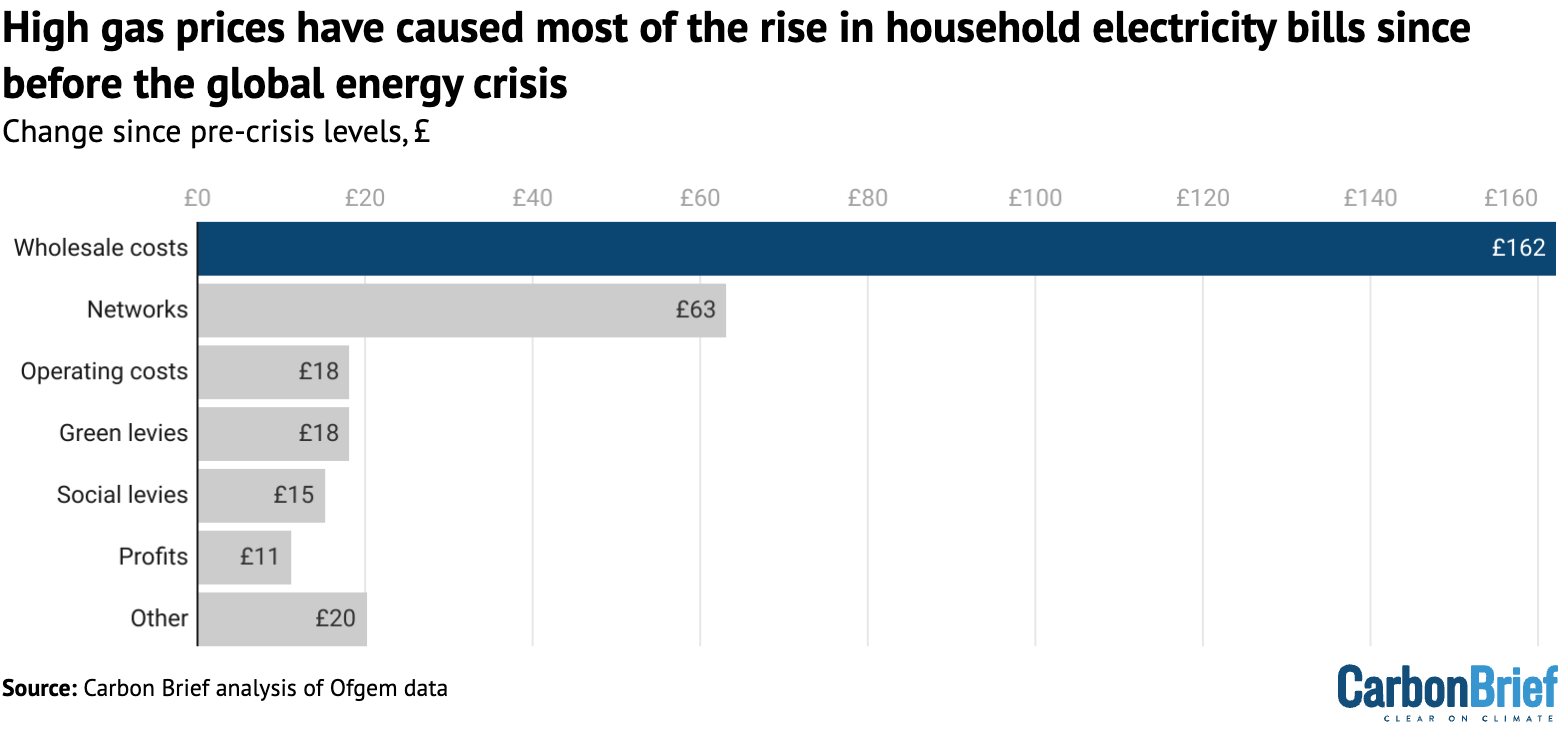
While the UK is making significant investments in new clean-power capacity and in upgrading its electricity grid, “green levies” and network charges account for just 6% and 20% of the rise in bills since before the energy crisis, respectively, against 53% due to wholesale prices driven by gas.
Moreover, part of the rise in network charges is also down to gas, resulting from utility firms going out of business during the energy crisis, as well as high gas-related costs for managing the electricity grid.
Dhara Vyas, chief executive of industry body Energy UK tells Carbon Brief that it is “crystal clear what has driven electricity bills up in the UK…it’s the wholesale costs, driven by the price of gas”.
This article looks at how electricity prices could be reduced in the short- to medium term and why the transition to clean power is, ultimately, expected to result in lower energy bills overall.
(This article refers to the UK throughout, but strictly relates to the island of Great Britain made up of England, Scotland and Wales. Northern Ireland is part of the separate all-Ireland electricity system.)
Why are UK electricity prices so high?
In the months before Russia’s invasion of Ukraine in early 2022, global gas prices had already started to rise as the global economy bounced back from the Covid pandemic and Russian president Vladimir Putin began restricting energy supplies to Europe.
In the wake of its invasion of Ukraine in February 2022, Russia then cut off the bulk of gas deliveries to Europe, having previously been the continent’s biggest source of the fuel.
While gas prices have subsided from their historic highs in 2022, as of May 2025, they remain three times higher than they were before the global energy crisis.
As such, despite all of the mediacommentary and politicians’speeches arguing the contrary, the UK’s exposure to high gas prices is still, by far, the biggest reason for the country’s high electricity prices.
(In 2022, International Energy Agency (IEA) chief Dr Fatih Birol wrote in the Financial Times that it was “absurd” to blame high prices on clean energy. He added: “When people misleadingly blame clean energy and climate policies for today’s energy crisis they are, intentionally or not, moving the spotlight away from the real culprits – the gas supply crunch and Russia.”)
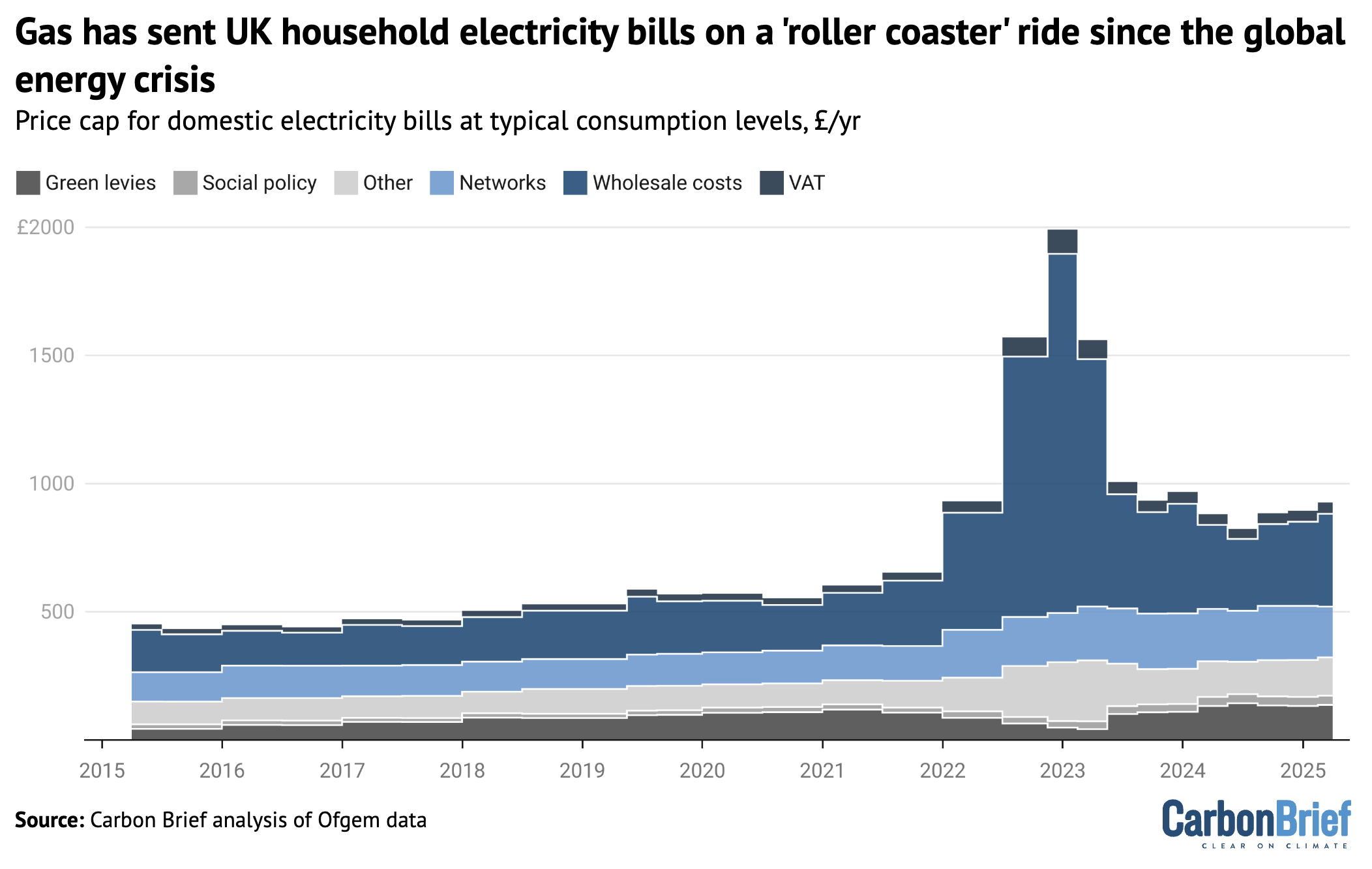
The figure below shows the price cap for household electricity bills set by energy regulator Ofgem, breaking down the different elements of average household costs over the past decade.
The biggest driver of recent increases in electricity bills is the wholesale price of electricity, which is set in the UK almost exclusively by wholesale gas prices (see below).
Consequently, the spike in electricity bills shown by the dark blue area in the figure below is a reflection of the spike in gas prices following Russia’s invasion of Ukraine in 2022.
In contrast, “green levies” – costs added to bills in order to pay for government climate policies – actually fell during the height of the gas price spike, as the dark grey area of the chart shows. They are currently only marginally above pre-crisis levels.
Ofgem price cap for domestic electricity bills at typical consumption levels, £ per household per year, broken down by source of charges. Source: Carbon Brief analysis of Ofgem.
In recognition of these basic facts, the UK’s prime minister Keir Starmer has reiterated the link between high energy bills and the country’s exposure to fossil-fuel prices.
The UK’s households and businesses have “paid the price” for “our over-exposure” to fossil fuels, he told an energy security summit in London at the end of April 2025, attended by Carbon Brief and jointly hosted by the UK government and the IEA.
Starmer told the summit that half the UK’s recessions since the 1970s had been caused by “fossil-fuel shocks” and that his government was “determined” to get the country off the “roller-coaster of international fossil-fuel markets” by shifting to clean energy:
“When it comes to energy, we’re also paying the price for our over-exposure, over many years, to the roller-coaster of international fossil-fuel markets, leaving the economy and therefore peoples’ household budgets vulnerable to the whims of dictators like [Russian president Vladimir] Putin, to price hikes, and to volatility that is beyond our control.”
Under the latest price cap from Ofgem, the average household now faces an electricity bill of £926 per year, up from £603 before the energy crisis – a rise of 54%.
Two-fifths of the current cap is made up of wholesale costs (38%), one-fifth from network charges (22%), plus another one-fifth from green levies (15%) and social policies (4%). The final fifth of the bill is made up of operating costs (14%), profits (2%) and other items.
The biggest change in these costs has come from the spike in wholesale energy costs.
However, the gradual rises in these other costs have been overwhelmed in recent years by the huge spike in wholesale power prices driven by expensive gas.
One common objection to these facts is that gas prices have been equally eye-watering in other European countries, but their electricity prices have not been quite so affected as the UK’s.
Whereas the UK once had middling power prices relative to other European countries, it has risen up the ranks to post some of the continent’s costliest electricity per unit.
(Figures comparing electricity prices in European capital cities in April 2025 put the UK fourth, whereas France is close to the continental average.)
The biggest reason for this rise in the UK’s relative prices is the fact that its power system is far more exposed to gas-fired generation than other countries.
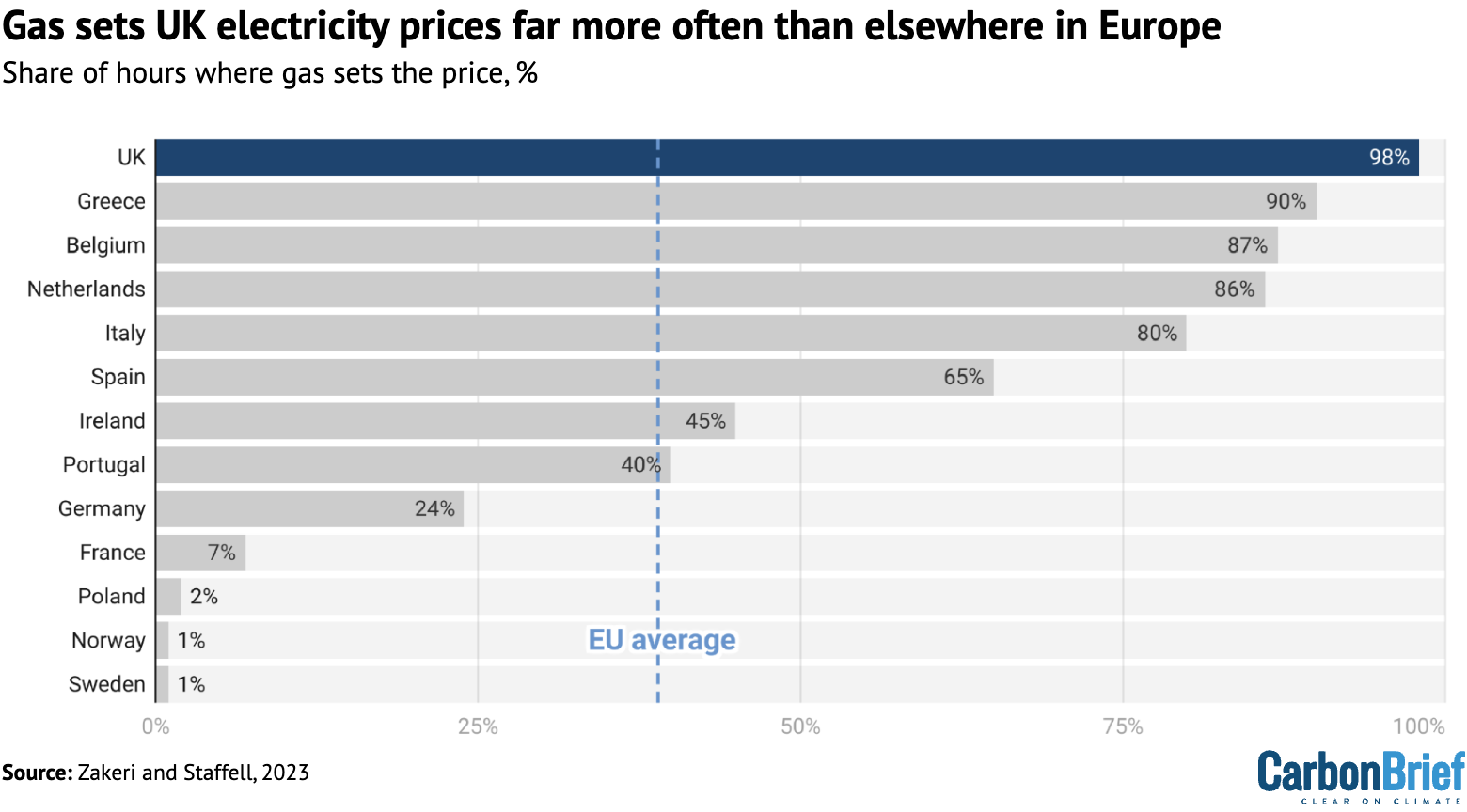
Specifically, gas sets the wholesale price of electricity in the UK 98% of the time, according to academic research published in 2023. This is far more often than in other European countries, including France (7%) or Germany (24%), as shown in the figure below.
Share of hours where gas sets the wholesale price of electricity in selected European countries, %. Source: Zakeri and Staffell 2023.
The UK’s electricity market operates using a system known as “marginal pricing”. This means that all of the power plants running in each half-hour period are paid the same price, set by the final generator that has to switch on to meet demand, which is known as the “marginal” unit.
While this is unfamiliar to many people, marginal pricing is far from unique to the UK’s electricity market. It is used in most electricity markets in Europe and around the world, as well as being widely used in commodity markets in general.
Still, the UK’s current electricity mix means that gas is almost always the marginal fuel, even though it only accounts for a third of generation overall.
(In contrast, the marginal fuel in many other European countries is hydro. In France, it tends to be nuclear, while in Germany it is split between coal, gas and hydro.)
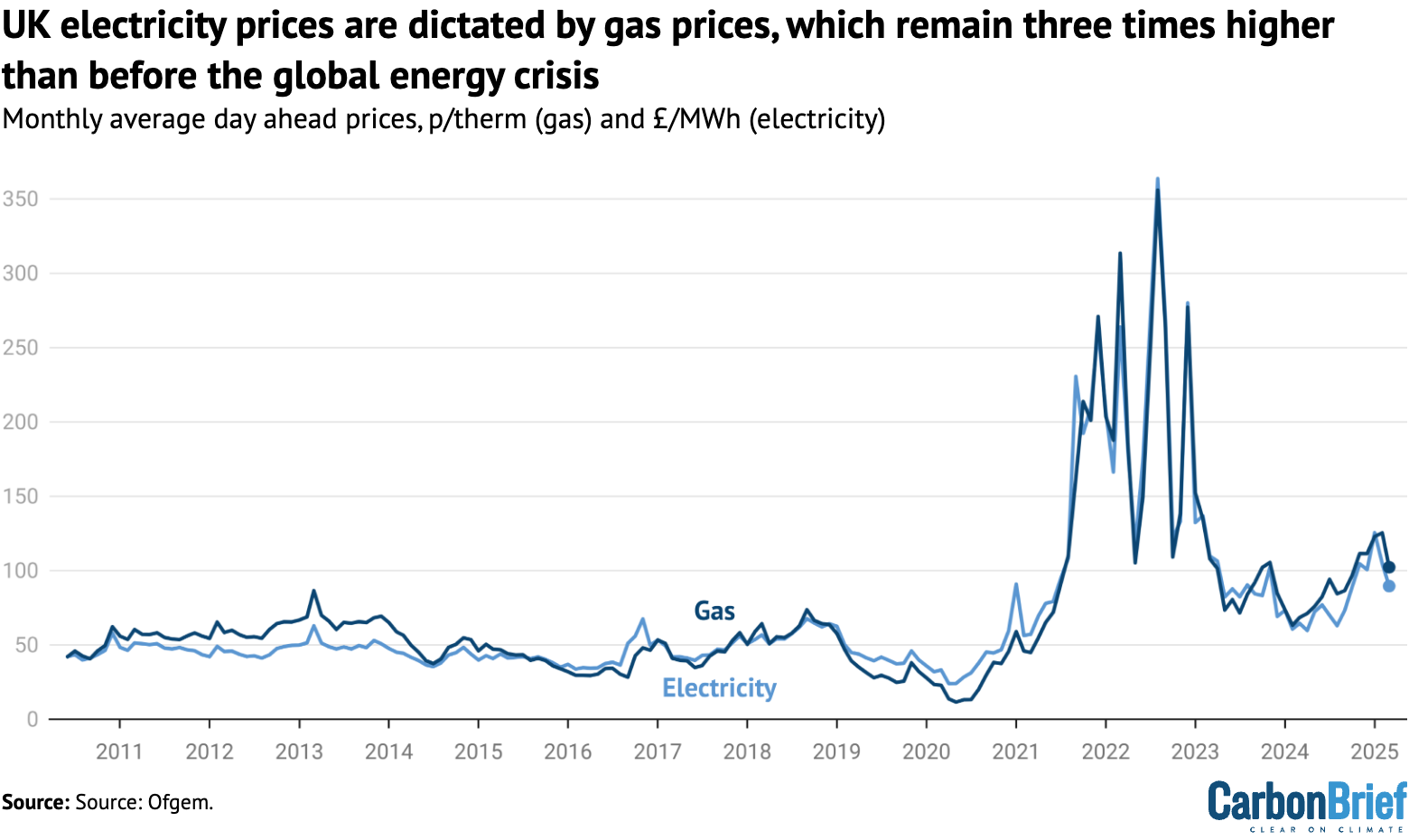
The result is that the UK’s wholesale electricity prices track wholesale gas prices almost perfectly, as shown in the figure below.
Monthly average day ahead prices for wholesale gas (pence per therm) and electricity (£ per megawatt hour) in the UK. Source: Ofgem.
In summary, the UK electricity system is far more heavily exposed to gas prices than those of other European countries and, consequently, its power prices have been hit harder by the energy crisis.
“I think the bottom line on it all is that we are particularly exposed to gas prices…That’s the principal driver of our [electricity] prices.”
Energy UK chief Vyas said in a recent statement that “it’s the volatile cost of fossil fuels and our dependence on them that have driven up energy bills for customers”.
In comments to Carbon Brief for this article, Vyas expands on the point, explaining how the UK’s exposure to imported fossil fuels has left it worse off than its neighbours:
“Our electricity prices are high largely because our energy system depends on imported gas – and because of the extent to which that gas sets the price for electricity. This is what has driven UK bills to record levels in recent years – and why, despite falling from that peak, they remain high compared to three years ago. It’s also largely why our energy costs are higher than our European counterparts.”
What has driven the rise in UK household electricity bills?
Since 2021, the household electricity price cap set by regulator Ofgem has risen from £603 per year for average households to £926 per year – an increase of £324, or 54%.
Some £162 of the increase is due to wholesale costs, which have roughly doubled over the period.
“It’s crystal clear what has driven bills up in the UK. If you look at any data about our energy bills over the last 5 years – every single time it’s the wholesale costs, driven by the price of gas, that pushes bills up or down. The policy costs on bills (sometimes referred to as green levies) hardly shift.”
Underneath the large spike in wholesale power costs due to the “roller coaster” of international gas markets, there have also been steady increases in policy and network charges in recent years. This includes the “green levies” that support the expansion of the UK’s clean energy supplies.
Specifically, some £63 has been added to bills since 2021 as a result of rising network charges, another £18 from “green levies” and £65 from other sources.
(Notably, as explained below, part of the rise in network charges is also due to high gas prices.)
This means that network charges and “green levies” account for 20% and 6% of the rise since pre-crisis levels, respectively, compared with 54% due to higher wholesale prices.
These contributions to the increase in electricity bills since 2021 are shown in the figure below.
Changes in domestic electricity price cap components between summer 2021 and the second quarter of 2025, £. Source: Carbon Brief analysis of Ofgem data.
As explained above, the driver of higher wholesale electricity costs is high gas prices, with the fuel remaining three times more expensive than before the global energy crisis.
In contrast, “green levies” have gone from £118 per year in summer 2021 to £137 today. As bills rose dramatically in this period, the share due to green levies has dropped from 20% to just 15%.
The small rise in green levies is due to a £22 inflationary increase in the cost of the “renewables obligation” (RO) scheme, which closed to new projects in 2017. The RO currently adds £89 per year to average household electricity bills, some 10% of the total.
Ironically, this means that the cost of renewable support has risen, at least in part, because of high gas prices, which have contributed to higher-than-expected inflationary pressures.
The RO still supports around 30% of UK electricity supplies, but the first tranche of 15-year contracts will come to an end from 2027, meaning the cost will fall over time.
In 2023, the then-Conservative government sought views on changing the measure of inflation used to calculate the RO each year from the “technically deficient” index known as “RPI”, to the lower “CPI”. However, this shift was not pursued.
The cost of renewables that hold newer “contracts for difference” (CfDs) has actually fallen by £5 per household per year since before the energy crisis – from £32 to £27 – despite supporting more capacity than four years ago.
This is because CfDs offer a fixed price for each unit of electricity generated. As wholesale prices have climbed, the top-up needed to meet this fixed price has fallen. CfDs currently account for less than 3% of average electricity bills, down from 5% before the crisis.
In total, the RO and CfDs currently add around £10bn a year to end-user electricity bills, of which households account for around a third. This amounts to £116 per household per year.
The Office for Budget Responsibility (OBR) forecasts that the combined cost of the RO and CfDs will rise by 3% between now and the end of the decade, from £9.6bn to £9.9bn.
Current electricity bills also include £20 to pay for “feed-in tariffs” (FiTs), which were offered to small-scale renewable schemes until 2019. This is up by £2 per year since before the crisis.
FiTs also rise with inflation, but, as with the RO, the scheme is closed to new projects. This means costs will fall over time as the oldest installations see their contracts coming to an end.
The cost of government social policies adds another £36 to average electricity bills, up £18 since summer 2021 due to higher spending on insulating the homes of families on low incomes.
This type of spending had been falling until 2019, after the then-Conservative government tried to lower energy bills from 2013 by “cutting the green crap”. Although these efforts reduced bills in the short term, they ended up adding £22bn to bills in the long term, previous Carbon Brief analysis found, because they left homes more exposed to the spike in gas prices during the energy crisis.
Vyas tells Carbon Brief:
“For well over a decade, investors have been telling us they want to see ambition and certainty from government. Taking a ‘boom and bust’ approach, where policy and direction of travel keep changing, adds costs to everyone’s bills. For example, the infamous move to ‘cut the green crap’ cost customers in this country billions of pounds, as Carbon Brief has demonstrated.”
Why network charges on electricity bills are going up
Alongside wholesale prices, network charges have also seen significant increases since before the global energy crisis, as noted above. These charges have risen by £63 from £136 a year in summer 2021 to £198 today, up by nearly 50%.
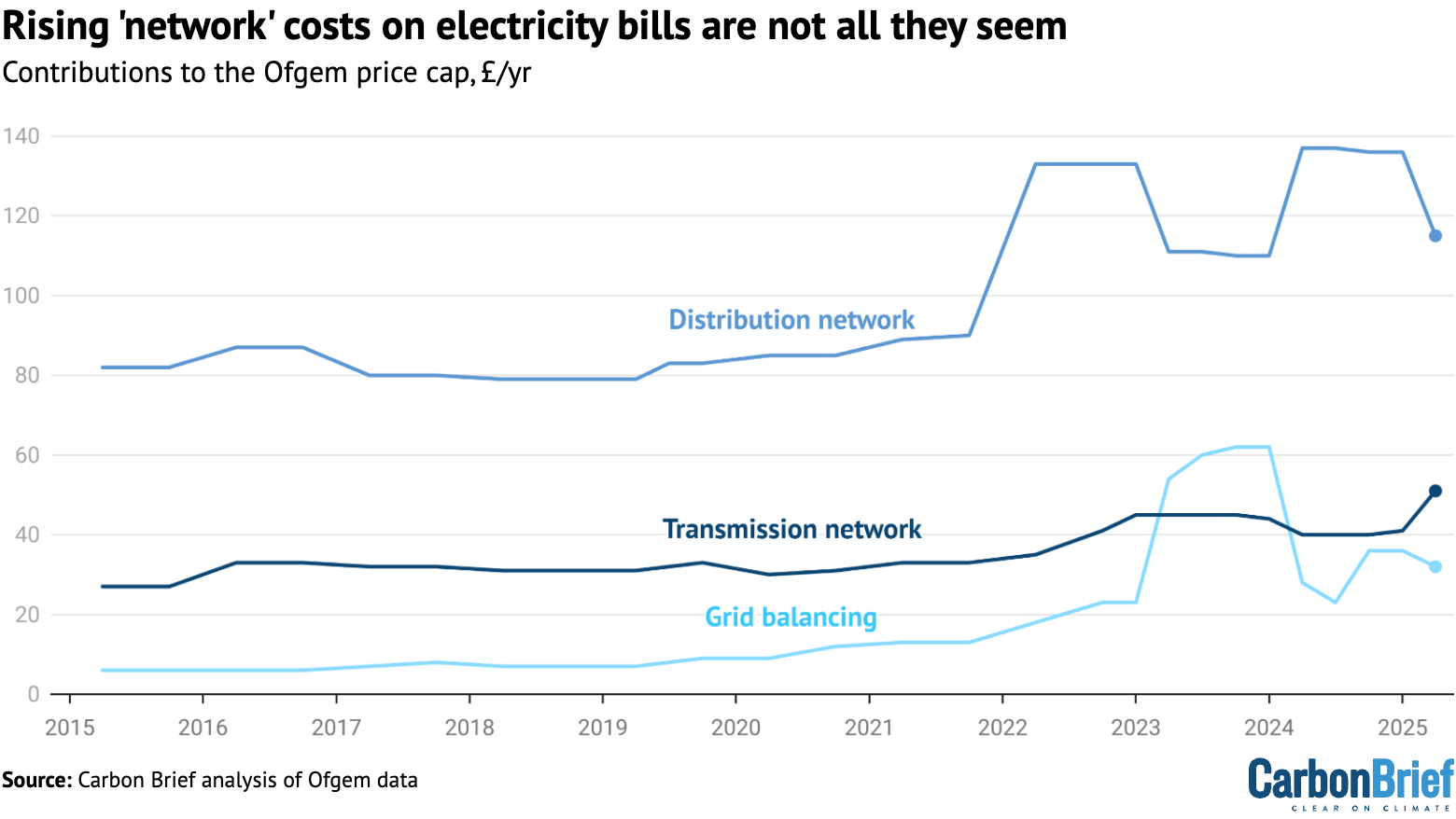
The figure below breaks down the £200 cost of network charges per household per year.
Some £115 of this – 13% of bills – is earmarked for “distribution” networks, which deliver electricity to households and businesses at lower voltages. This segment has seen the largest increase of all network charges, adding £25 per year.
Next is the national “transmission” network, at £51, which moves electricity around the country on towering pylons carrying high-voltage lines – sometimes referred to as the “motorways of the grid”. While these costs have risen by more than half since 2021, this still only added an extra £18 to bills each year.
The third component is grid balancing, which reflects the costs of making sure that supply and demand are perfectly matched at all times. This has soared from £12 a year in 2021 to £32 today.
Network cost contributions to the Ofgem price cap for domestic electricity bills at typical consumption levels, £ per household per year. Source: Carbon Brief analysis of Ofgem.
Manyarticles on the UK’s high electricity bills have said that rising network charges are due to the cost of managing and expanding the grid to cope with new, variable wind and solar generation.
While major investments are being made in the grid, the rise in network charges is not all it seems. Indeed, parts of these increases are also due to high gas prices.
For example, the cost of bailing out the dozens of electricity retailers that went out of business during the energy crisis – ultimately, as a result of high gas prices – is being paid for by households and is included within distribution network charges under the Ofgem price cap.
The amounts being added to bills to pay for these bailouts, within each of the price-cap periods shown in the figure above, is not routinely disclosed by Ofgem.
However, in 2022, Ofgem said that £66 was being added to household bills to pay for these failures under a scheme known as the “supplier of last resort” (SoLR). This aligns with the first hump in the figure above – and the second hump likely relates to further SoLR costs.
For grid balancing costs, there is a similar story, because high gas prices make it more expensive to manage the electricity system.
National Grid Electricity System Operator (NESO) sometimes pays gas power plants to switch on – and these “redispatch” instructions are more expensive as a result of high gas prices.
NESO explains that balancing costs are “strongly in correlation to the wholesale spot electricity markets and [therefore] dependent on the natural gas market”.
A gas-related bump in balancing costs is clearly evident in the figure above.
There have been two other important drivers of rising balancing costs. First, an increase in the number of balancing actions that NESO needs to take, mainly relating to “constraints” on the network that result in wind projects being paid to switch off – known as curtailment.
Constraint costs have risen because grid capacity has not kept pace with the number of new wind power projects being built, particularly in Scotland.
A series of new grid connections are being built between Scotland and England, which will add to transmission charges while cutting balancing costs.
The second additional factor for balancing charges is that, since 2023, consumers have paid for 100% of these costs, whereas they were previously shared equally with electricity generators.
Despite their rapid recent rise, balancing charges still only add £32 a year to average household electricity bills, including the much–publicisedcost of wind constraint payments.
One analyst tells Carbon Brief:
“I know people make a great fuss about constraint payments…it sounds like a big number. It’s actually not, in terms of its impact on bills.”
A final important factor in rising network charges is that the UK’s electricity networks are ageing and require significant ongoing investment in order to replace old equipment before it fails.
(For example, the substation fire that closed Heathrow airport earlier this year started in a transformer that had been commissioned in 1968, making it 57 years old.)
Moreover, grid operators have been allowed to increase their investments in recent years, partly in order to make up for previous periods of what a select committee report called “under-investment”.
The 2003 report, on the resilience of the electricity network, said that customers at the time had been “living off the investment made by [their] predecessors” and that there was “insufficient investment” to replace old equipment “in a planned and orderly way”.
Similarly, a 2009 Ofgem report on energy network price controls found that distribution network operators “may not have been carrying out the investment required to maintain” the grid.
Gross tells Carbon Brief:
“My suspicion is that the investment to facilitate renewables being connected to the grid is a pretty small fraction of that increase [in network charges]…I think [a lot of it is] the legacy of maybe…squeezing and minimising expenditures in the immediate post-privatisation period.”
To be clear, it remains the case that major investments are being made in expanding the grid – and that these investments will, ultimately, be paid for via consumer electricity bills.
The relatively low annual cost increase to households is despite these investments totalling as much as £50bn, according to NIC. (This is a good illustration of the way that “scary-sounding numbers” can be used to mislead people about the “cost” of the transition to net-zero.)
Moreover, NIC expects household energy bills to drop significantly overall by 2035, even as electricity network charges rise. (It sees the average dual-fuel bill for electricity and gas falling from just shy of £2,000 a year in 2019 to around £1,300 by 2035 and to less than £1,200 by 2050.)
In broader terms, rising levies and network charges illustrate the changing nature of electricity bills – and energy bills more broadly – as the UK shifts towards net-zero.
Historically, fuel costs have accounted for the bulk of energy bills, including not only household gas and electricity, but also the cost of motoring.
In a net-zero future, fuel costs would be massively reduced, as gas for heat and power, as well as petrol in cars, are progressively replaced with more efficient electrifiedalternatives.
Notably, this means that part of the cost of upgrading, decarbonising and expanding the UK’s electricity system would translate into major savings in the cost of UK transport.
This transition carries upfront capital costs to build new clean power sources, as well as the infrastructure needed to connect them to consumers and to manage their variable output.
The UK’s industrial electricity prices have also been a prominent fixture in the debate over why energy costs have become so high, particularly following the latest crisis in steelmaking.
In November 2024, the Financial Times had published a chart showing that industrial electricity prices in the UK in 2023 were far higher than in any other country listed.
Yet this discourse frequently ignores the dominant role of gas in driving high prices.
In her March 2025 speech abandoning Conservative support for the UK’s net-zero by 2050 target, opposition leader Kemi Badenoch misleadingly blamed high power prices on climate policies in general and “environmental levies” in particular.
The debate around industrial power prices was supercharged at the end of March with the news that the owner of the Scunthorpe steelworks, British Steel, planned to shut it down.
After the closure was averted by a government takeover, an April editorial in the Daily Telegraph illustrated the tenor of much of the commentary in right-leaning, climate-sceptic newspapers by confidently blaming the crisis on “sky-high energy costs imposed by successive governments in the name of net-zero”.
Like so many others debating the UK’s high industrial electricity prices, the editorial failed to even mention the word “gas”, let alone acknowledge its role in driving up costs.
In reality, the UK steel industry is completely exempt from “environmental levies” and – under the government’s “supercharger” scheme – it also gets relief from the majority of network costs.
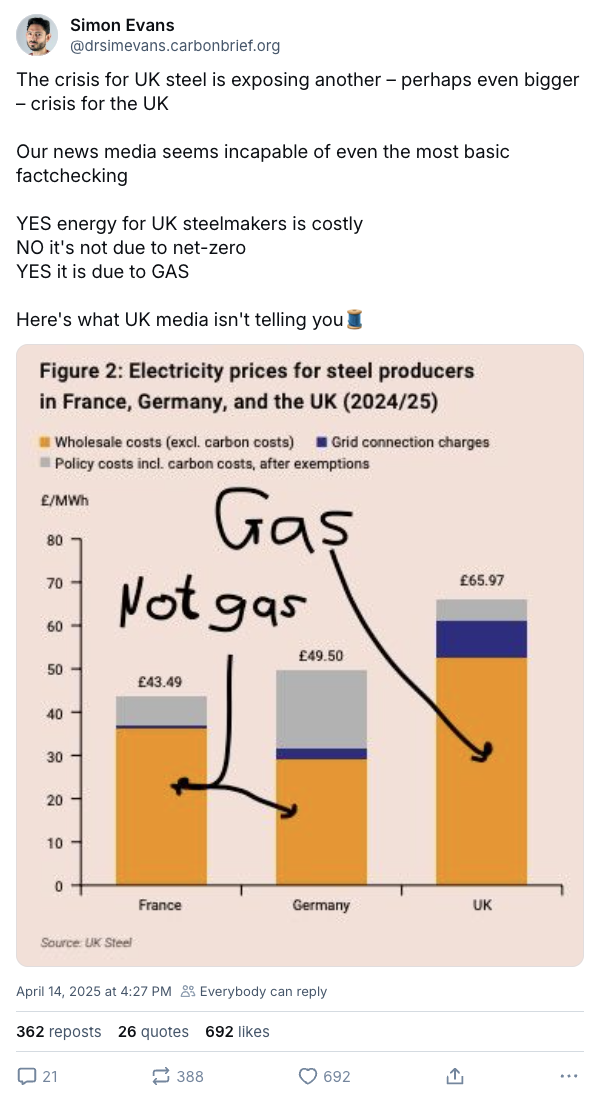
While the UK steel industry still faces higher electricity prices than its counterparts in the likes of France or Germany, this is almost entirely down to expensive gas driving up UK wholesale prices.
Indeed, as UK Steel explained in a recent report, environmental levies have a smaller impact on steel industry electricity bills in the UK than in neighbouring countries.
Frank Aaskov, director, energy and climate change policy at UK Steel, tells Carbon Brief that the debate around industrial energy costs since the start of the global energy crisis has been “poorly informed”, adding that that is “probably a bit of an understatement”.
Some actors have been “willingly misinforming others” by blaming net-zero for the problems in the steel industry, says Aaskov, adding that other factors are “much more important”. He says:
“Net-zero, in itself, is not the cause of the decline in the steel industry. There are much more important factors, such as global overcapacity, [as well as] inflexible and unambitious trade policies.”
While Aaskov identifies high industrial electricity prices as a “key factor” for the sector, he says that “today, it’s not net-zero policies” that are causing those prices to be high. He says:
“Today, [net-zero policies] are not the driver of high industrial electricity prices in the UK. It is higher network charges – because we have lower exemptions than there are in Germany and France – and it’s the cost of natural gas, which is driving the higher wholesale price.”
Aaskov says attempts to blame net-zero are “unhelpful to the steel industry, especially because we as a sector have committed to decarbonising, our members are making huge investments in reducing emissions and Port Talbot is the key example of that”.
The spike in gas prices put the spotlight on its role in setting wholesale power prices via marginal pricing, leading some people to call for electricity market reform.
Although the review was much broader in scope, it was presented as a way to tackle high electricity prices and – potentially – to decouple them from the high price of gas.
In the foreword of the first REMA consultation, then-energy secretary Kwasi Kwarteng said that the electricity markets will be the “backbone” of the future electricity system, so it is “critical” to get the design right. He added:
“The last major programme of electricity market reform was 10 years ago and left some key parts of our market structure unchanged from the time when fossil fuels were the dominant source of energy; it is time to look again at whether they are fit for purpose, or whether reform is needed to deliver a clean, secure and low-cost energy system for consumers.”
The consultation explained that, while the use of marginal pricing left UK wholesale power prices “closely track[ing] gas prices”, the impact of this would “naturally diminish over time” as the share of generation coming from gas declined and that of clean power increased.
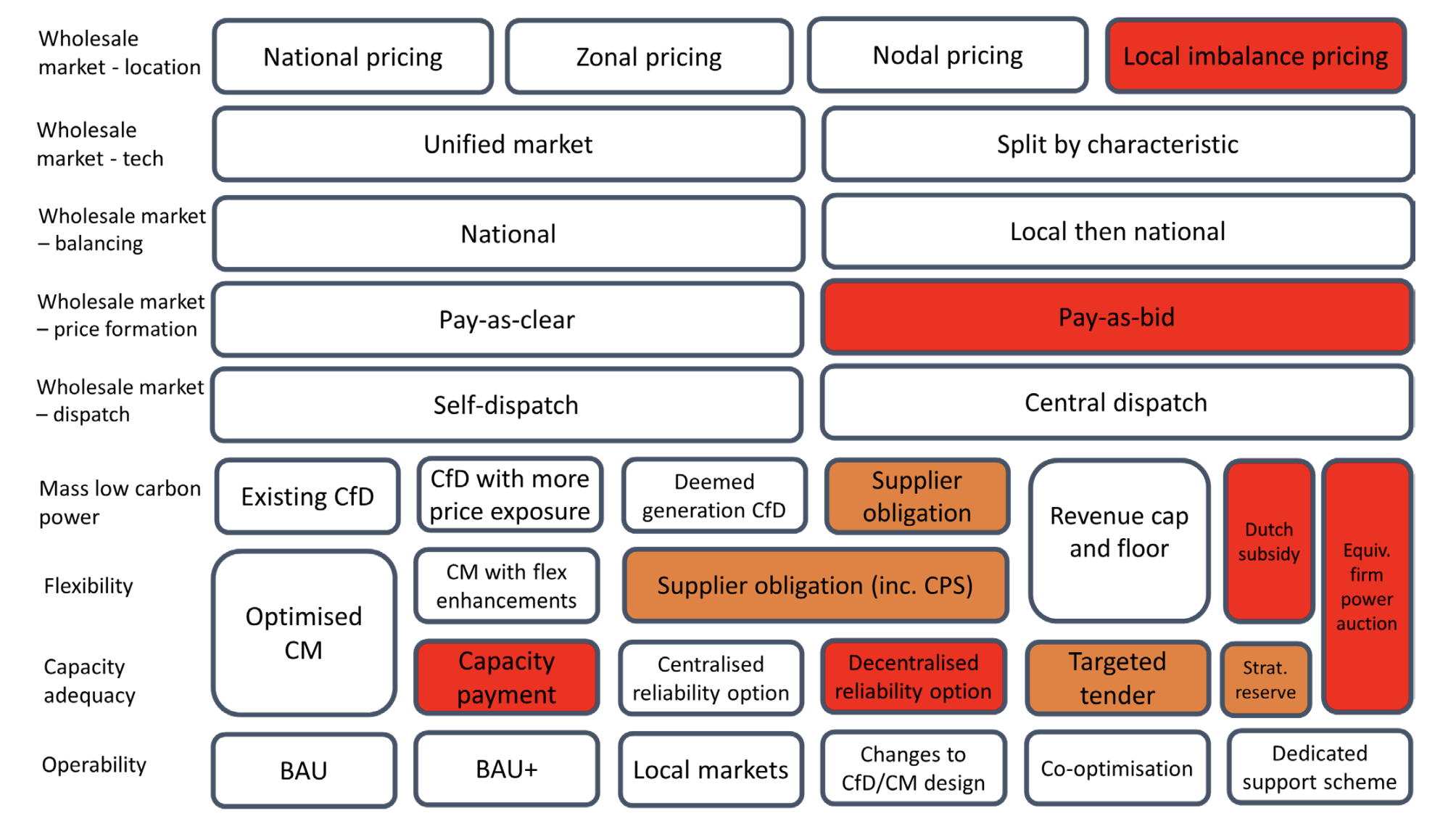
Still, it set out a number of options for explicitly breaking the link between wholesale power prices and the price of gas, such as a market that was “split by characteristic”, or that offered generators a price reflecting their own costs, rather than that of the marginal unit (“pay-as-bid”).
A summary of the responses to this consultation was published in March 2023, with the government deciding to rule out a number of options – including “pay-as-bid” – shown in the figure below.
A second consultation followed in March 2024, with the results published alongside the REMA autumn update in December 2024.
This narrowed the options still further, including ruling out both the “green power pool” and split market options, both of which would have created a separate market for renewables.
This means that, while there are numerous options within REMA that are still being considered, breaking the link between wholesale power prices and the price of gas is no longer on the table.
The core final decision within REMA is now between reforming the current national wholesale market, where this is a single price for wholesale electricity across the country, or switching to a regional market split into a number of zones with their own prices.
Both options would continue to use marginal pricing, whether at national or regional level. The switch to “zonal” pricing has been made in numerous markets in recent years, including Ontario, Italy, Denmark and Australia. It is also being considered in Germany.
In the UK, the “bruising” question around whether to adopt zonal prices is seen as the “most hotly contested aspect” of REMA and has become an “energy death-match”.
As such, despite the role of gas in wholesale power prices continuing to be the biggest driver of high electricity bills, it has come to dominate the discussion around market reform.
Those who support zonal prices have claimed it would more closely reflect local supply and demand conditions, ultimately leading to a more efficient electricity system, as well as helping to cut network costs.
Analysis by the Energy Systems Catapult suggests that it would save £30bn by 2035, while a study by FTI Consulting for Octopus Energy found that it could save consumers between £55bn and £74bn by 2050.
Octopus Energy and its CEO, Greg Jackson, are some of the most vocal proponents of zonal pricing. Jackson and supporters argue that while it is true that wholesale prices and CfD payments would increase under a zonal system – by £35bn and £15bn, respectively, over 25 years – these would be more than offset by a drop in constraint costs and “congestion rents” of £40bn and £65bn.
The impact on constraint costs is a core pillar of the argument for zonal. However, grid balancing costs overall – including constraints – currently only make up 4% of electricity bills. (See: Why are UK electricity prices so high?)
The shift to zonal pricing is also supported by key organisations such as Ofgem, NESO and Citizens Advice.
A consultation response from Energy UK says that while a “minority” of its members favour zonal pricing, “the majority prefer further exploration of alternatives”.
These organisations have mustered numerous studies of their own, which they say show that zonal pricing could dent investment and could, as a result, even raise costs for consumers.
In the public realm, the main criticisms of zonal prices focus on the potential for it to create a “postcode lottery” for consumers and to create uncertainty – and higher costs – for investors in the clean power capacity needed to hit UK targets.
For example, a report prepared by consultants LCP Delta for energy company SSE found that zonal pricing could increase wholesale prices across 97% of the country. Its research suggested a drop in wholesale costs would only be seen in Northern Scotland.
(Advocates for zonal argue that these higher wholesale costs would be outweighed by lower costs for building and managing the electricity network.)
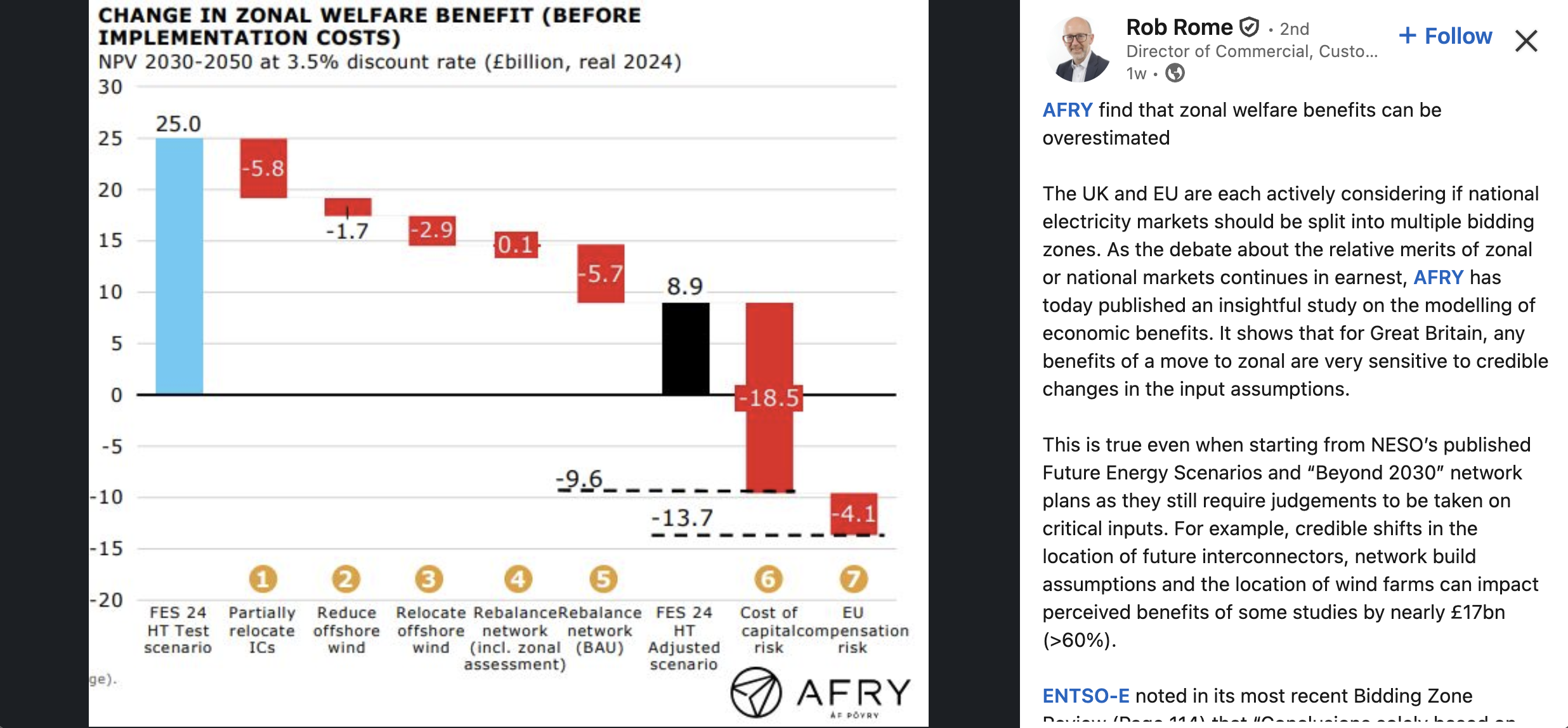
Recent research by consultancy Afry, summarised in the screenshot below, suggests that the savings from a shift to zonal pricing are “overestimated” and that risks, such as higher borrowing costs, could mean it translated into an increase in energy bills overall.
Jane Cooper, deputy CEO at trade body RenewableUK, said in a statement that people in England and Wales are “rightly worried” about zonal pricing creating a postcode lottery, adding:
“This scheme would create so much uncertainty in our electricity market that it could disrupt investment in vital new clean-energy projects and push up their costs, at the very time when we need to start building at pace to deliver the government’s target of clean power by 2030. We’re urging ministers to rule out zonal pricing as soon as possible and to focus on policy decisions which do not undermine the confidence of investors.”
(Analysis by Cornwall Insight highlights that there is already a “postcode lottery” of sorts, with households in London paying £120 less than those in north Wales and Merseyside over the coming year. This is to do with the variation in the regional distribution network charges added to bills. The figures in the sections above are national averages.)
Modelling from UKERC found that zonal pricing could increase strike prices in the next CfD auction by up to £20 per megawatt hour (MWh), as investors seek to factor in the associated risk. It found that higher prices in the CfD auctions could increase consumer costs by £3bn a year.
Non-profit Regen highlighted that the £55bn savings over 20 years, as suggested by FTI, only equates to around £31 per household per year, if applied evenly across current demand.
Ultimately, the debate around the benefits of zonal prices continues, with many aspects of the exact design of such a system – for example, how many zones there would be – still undecided.
The government is expected to make a decision on whether to switch to zonal power pricing ahead of the seventh CfD allocation round in summer 2025, to minimise the impact on renewable energy investment by providing greater certainty.
Zonal was chosen over nodal in part because it would be simpler to implement, with the government estimating in 2023 that this would take about 18 months. (It is not clear if this 18-month timeline includes consultation, such as on the number of zones.)
Subsequently, the government has told industry that a shift to zonal pricing would not be put in place until 2032, according to RenewableUK.
This is supported by recent analysis from consultants Cornwall Insight, which suggests that a shift to zonal would take closer to five years, until the mid-2030s.
In a statement, Kate Mulvany, principal consultant at Cornwall Insight, said:
“The government’s commitment to a decision by mid-2025 is welcome. But we must be realistic: this is the start of a long road, not the finish line. Clear, early communication and a credible delivery timeline will be essential to retain market confidence, keep renewables investment and avoid unintended consequences, which could have substantial impacts on government targets.
“Zonal pricing may still form part of the long-term vision for electricity market reform. But, for now, its delivery sits firmly in the next decade.”
With zonal pricing – and any associated changes in the costs of the electricity system – unlikely to kick in before the next election in 2029, the hunt for options to cut bills more quickly continues.
However, there are currently no mechanisms in place that would guarantee a reduction in energy bills in the short term, according to Energy UK, meaning potential reductions would only be possible if the gas wholesale market tumbles.
Gross says: “We could all cross our fingers and hope that the global price of gas will collapse over the next few years…[But] it’s definitely not a great energy-security strategy for the long term.”
In a recent report, Energy UK identified a number of ways the government could lower electricity bills during the current parliament, listed in the table below.
These can be categorised into optimising the energy system, investing public money in a “strategic and targeted way” and capitalising on the benefits of a smarter, more flexible host of technologies in the energy sector.
For example, Energy UK says that households with equipment such as a battery, a heat pump or an electric vehicle (EV), could save £115 per year if changes are made to maximise flexibility. This might mean charging the EV at night or warming the house in advance of periods with high electricity prices.
Additionally, it says flexibility could be used to reduce the need to build out networks and power stations to meet peak demand, potentially reducing the need for investment by £3.5bn.
Option
Cost
Savings
Maximising flexibility
None
At least £115 per year for households with flexibility equipment
Closer UK-EU cooperation on energy
None
Up to £370m reduction in overall energy costs. Total savings for the economy are likely to be around £10bn this parliament
Modernising system operation
Small investment in NESO systems
Full savings are hard to quantify. Likely billions of pounds in efficiency savings this parliament.
Rebalancing policy levies for domestic users
£1.5bn per year (reducing from 2027 as RO & FiT taper off)
Up to £400 a year to households using electric heating, while guaranteeing that no households see an increase in cost.
Targeted consumer support
£1.5bn per year
£400 per year for the 3.17m households currently in fuel poverty, closing the fuel poverty gap completely.
Invest in energy efficiency
£13.2bn already committed in Labour manifesto
£140 per year is the average saving to a household from schemes such as ECO and GBIS. A Warm Homes Plan targeted at measures such as clean heat and solar is likely to achieve larger bill reductions.
Make the most of Contracts for Difference
Negligible
Up to £20 per year for the typical household.
Optimise network investment
Negligible
Almost £100 per year.
Electrify non-domestic demand
£1-4bn to be covered by hypothecated ETS/CBAMM revenues and general taxation
Level of bill savings depends on the nature of the business. UK supermarkets could save up to 15% on their energy costs.
Unlock private investment
Negligible (credit guarantees)
Full savings are hard to quantify. Likely to enable a minimum reduction of £150m in CfD costs.
Source: Energy UK. Energy UK’s table of options to reduce electricity bills in the UK in the short term. Source: Energy UK.
(Following Energy UK releasing this advice, the UK and EU have signed a new energy cooperation deal. This includes exploring UK participation in the EU’s electricity trading platforms, because, “since we left the EU, we have traded electricity inefficiently, adding costs and friction”.)
The single-biggest way the government could reduce electricity bills would be to remove some or all of the policy costs they currently include – a total of £173 for the average household.
These costs could be paid for via general taxation, which is split more fairly between households on different incomes, or the government could “rebalance” bills by shifting levies onto gas.
At present, gas faces an implicit subsidy because resulting CO2 emissions do not face a carbon price. However, raising gas bills could have implications for fuel poverty, even if power prices drop.
Many otherorganisations have looked at how bills could be “rebalanced”, given that the UK’s net-zero target relies heavily on increased use of electricity and reduced reliance on gas. Many of these analyses examine options to ensure fuel-poor households are not disadvantaged.
Further options for cutting bills, beyond those considered by Energy UK, have been proposed by a number of other groups.
A recent report by thinktank Common Wealth, for example, suggested that gas power plants should be nationalised, in order to prevent owners holding the electricity market “to ransom”.
One final possibility is that bills could drop as a result of falling gas prices. The latest forecast from Cornwall Insight suggests that there will already be a small 7% drop in the Ofgem price cap from 1 July, as a result of slightly cheaper gas.
EU gas use is set to fall in the coming years, meaning that available supply could exceed demand by 43% by 2030 and 42% by 2040, according to projections from the European Commission.
At the same time, the IEA’s latest World Energy Outlook noted that analysts are expecting a glut of liquified natural gas (LNG) on the global market, as projects in the pipeline come on stream.
On top of this, US president Donald Trump is pushing for an even faster expansion of LNG exports, which could see European gas prices going down by up to 9% by 2030, according to November 2024 analysis from Aurora.
Cornwall Insight forecasts power prices will fall between 2024 and 2030, predominantly due to ample gas storage levels in Europe for the winter, alleviating previous supply security concerns – although they expect prices to remain higher than the pre-crisis 2021 levels.
“We mustn’t get ahead of ourselves. While prices are falling, recent patterns show the impact that wholesale market volatility can have on bills in the space of just a few days. The UK’s heavy reliance on energy imports – particularly gas – combined with ongoing geopolitical tensions, ensure household bills remain highly vulnerable to sudden shocks.
“To secure the UK’s energy future and drive down costs for good, we must break free from volatile international markets and fast-track the transition to renewables.”
Paul Drummond, climate and environment research lead at asset manager Redwheel, tells Carbon Brief that sticking with gas would leave the UK exposed. He says:
“We wouldn’t be solving any of the problems we have now. We’re still going to be significantly reliant on the gas price setting the power price – and as we’ve seen in the last few years, that has been highly volatile. That volatility in itself is a cost. It’s uncertain. So we wouldn’t change the situation we’re in now, which is not a great position to be in.”
Beyond household energy bills, Energy UK has produced a list of recommendations for reducing electricity prices for non-domestic users. This includes shifting legacy policy costs and Climate Change Levy payments away from electricity bills, among other actions.
Additionally, the government is reportedly looking at plans to help shield industry from “sky-high energy costs in what is expected to be the centrepiece of Keir Starmer’s vaunted new industrial strategy”, according to the Financial Times.
The industrial strategy is set to be published in June.
A coalition of manufacturers, investors and climate groups recently called on chancellor Rachel Reeves to move policy costs, which would include green levies, off electricity prices and into general taxation. They argued that this would cut business energy costs by up to 15% and household bills by up to £370 per year.
What will the UK’s climate goals mean for bills in the future?
At the heart of debates over the causes of high electricity prices are different views on the future path of the UK’s energy system.
The UK’s Labour government is targeting a “fully decarbonised” power system by 2030, setting a goal for clean sources to meet 100% of domestic demand and account for at least 95% of electricity generation in the country.
To reach these targets, it has laid out plans for a massive expansion of wind and solar power, along with steep increases in energy storage capacity and flexible low-carbon generation.
The government’s 2024 plan suggests it would require a programme of investment in clean power and associated infrastructure worth around £40bn per year until the end of the decade.
During campaigning and after being elected last summer, the Labour party had stated that this transition to clean electricity would save “up to £300” on household energy bills.
More recently, however, the party has gone quiet on this specific number. Speaking at an event run by the UK government and the IEA in April, energy secretary Ed Miliband said:
“Our vision of low-carbon power goes well beyond the climate imperative – important as that is. Homegrown low-carbon power is our nationally chosen route to energy security. Solar power, wind power, tidal, geothermal, nuclear power – also an essential part of the low carbon opportunity. These are often unlimited, low-cost power supplies which we can exploit for the benefit of our citizens.”
While the short-term picture is relatively uncertain, there is credible analysis to suggest that the government’s push for clean power will leave bills lower than or consistent with their current levels.
In its Clean Power 2030 report on reaching clean power by 2030, system operator NESO highlights that the overall cost to consumers “would not increase as a result of the move to a clean power system”.
Instead, it says that the much-reduced role for gas in a clean power system would be responsible for an increasingly small percentage of the wholesale costs protecting the country from price swings, the operator notes.
In one of the scenarios set out by NESO, gas would set the price in just 15% of hours by 2030, insulating consumers from “volatile international gas prices”.
It states that without accelerated action towards clean power, a repeat of the sort of gas price spike seen in 2022 would add around £22bn to electricity costs in 2030.
If the clean power mission is successful, it says, this cost would be cut in half and price spikes would be less likely.
(NESO does note that “how costs flow through to prices and, ultimately, bills, will depend on policy design”.)
As highlighted by research by Ember and E3G, deploying renewables “at speed” helps lower bills and increase energy security.
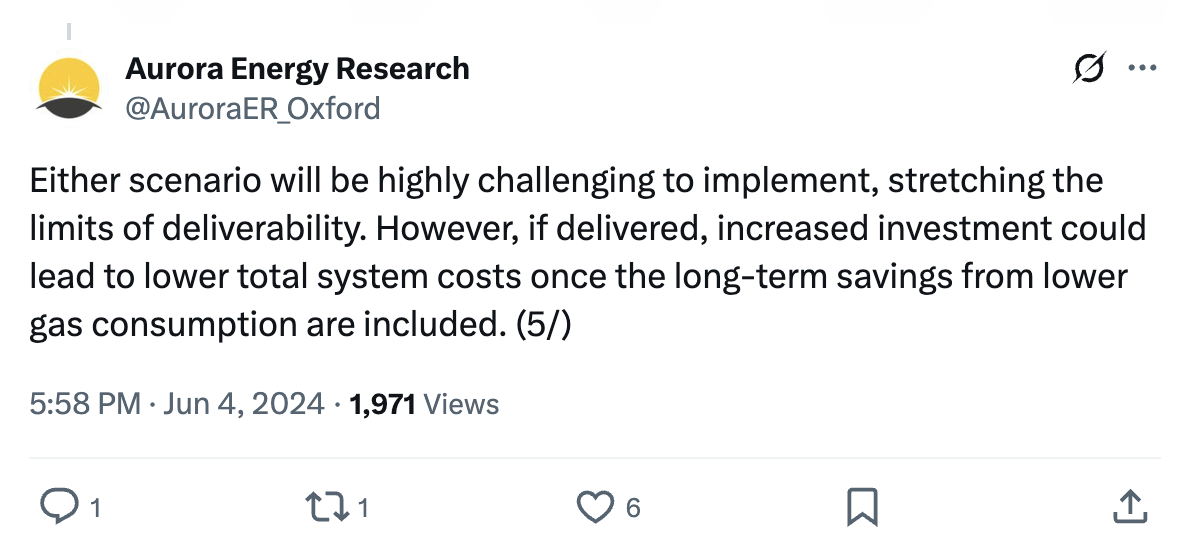
According to consultancy Aurora, a total of £116bn will need to be invested between 2025-35 to reach Labour’s 2030 clean power target, or around £10.6bn per year.
Despite criticism of the impact of bringing forward the target date, Aurora’s analysis suggests that it would require just an extra £1bn of investment a year to achieve the target five years earlier.
Aurora found that consumer energy bills will be lower under Labour’s 2030 target than under a 2035 goal.
In the longer term, there is more widespread agreement that a clean energy system – predominantly using electricity for heat, power and transport – would reduce overall energy costs for the UK.
For example, thinktank E3G suggests that the UK’s clean power “mission” could cut bills could fall by £200 by 2030, while consultancy DNVGL expects bills to fall 40% by 2050.
In contrast, the Conservative party has recently ended cross-party support for the UK’s net-zero-by-2050 target, launching an intensifying attack on clean energy.
Party leader Kemi Badenoch falsely claimed in a recent speech that the UK’s current climate policies are “driving up the cost of energy”.
Similarly, Reform UK has argued that net-zero policies are to blame for higher energy bills and that it would scrap the 2050 target if elected. In its manifesto in June 2024, it claimed, without evidence, that scrapping net-zero would save “over £30bn per year for the next 25 years.”
In contrast, asked if rowing back on climate action would reduce bills, Energy UK’s Vyas tells Carbon Brief: “No – not least because we’re only part way through the job and haven’t realised the full benefits yet.” She adds:
“Investing in clean power is crucial if we are to make progress on tackling climate change and achieving energy security. People across the country are clear that they want cheaper bills – and they want to see action when it comes to tackling the climate crisis. Of course, we need to go at a pace we can manage in practical terms and make sure that the costs of the transition are paid fairly.”
In a post on LinkedIn, Vyas’s colleague Adam Berman, director of policy and advocacy at Energy UK, writes that the “mental gymnastics” needed to believe it would be cheaper to stick with gas for electricity, instead of shifting to clean power, is “truly remarkable”. He says:
“If you genuinely believe gas is cheaper than clean power over an extended period of time, how do you reconcile that with the £100bn the UK government spent supporting homes and businesses during the energy crisis? The mental gymnastics required to ignore this are truly remarkable.”
In the longer term, electrification is key to net-zero, helping the UK to decarbonise not just its electricity system, but sectors including transport and heating at pace and in the most economical way.
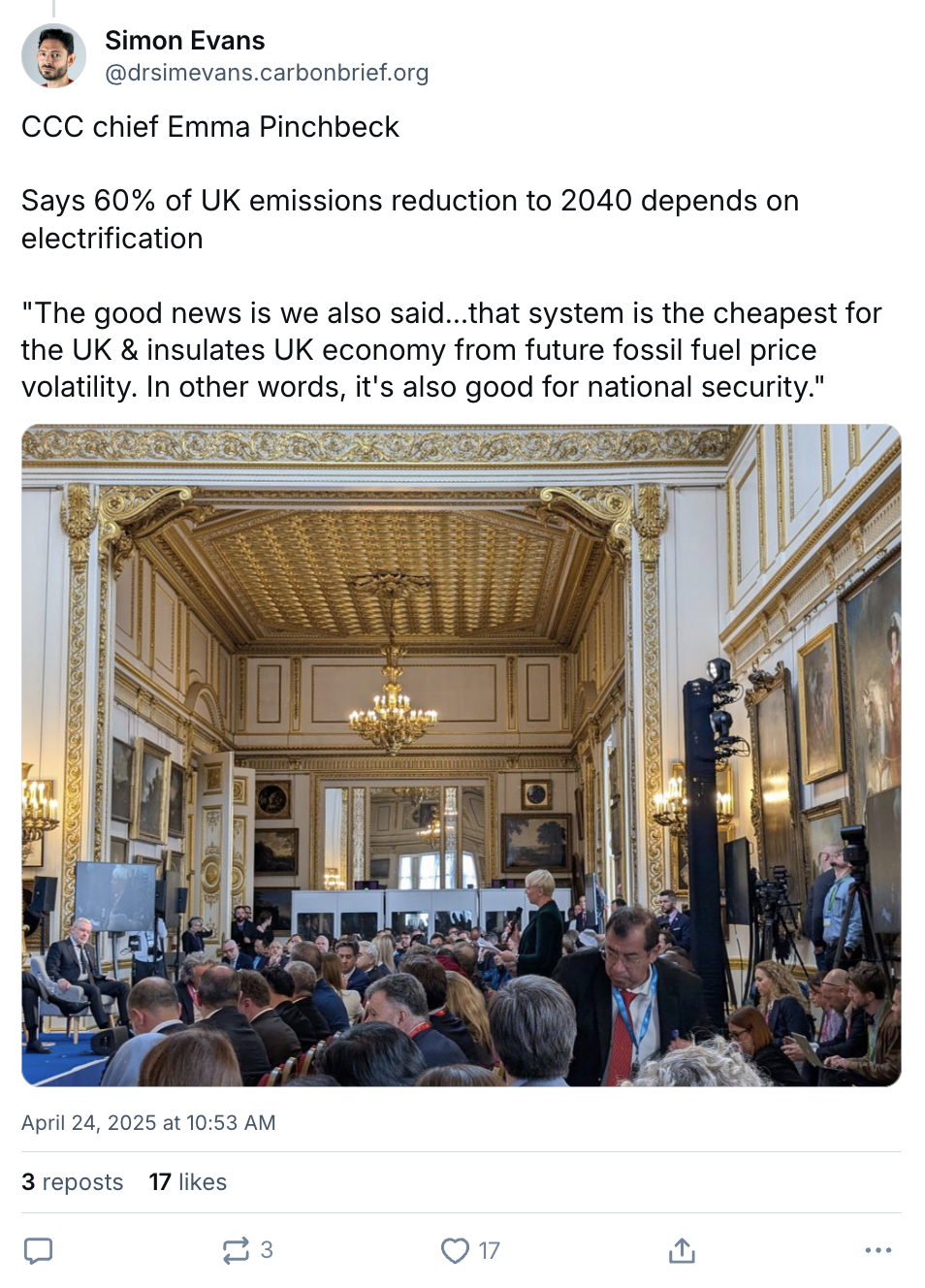
Speaking at the UK government and IEA event in April, Emma Pinchbeck, the chief executive of the Climate Change Committee (CCC), said that electrification with clean power was vital to the UK’s climate targets and energy security, but was also the cheapest option to pursue.
The impact of clean power on lowering household bills is supported by the CCC’s recent advice to the government, which suggested the transition to net-zero would cut average household energy bills to £700 below today’s levels by 2050.
Additionally, the CCC said it would cut household motoring costs by a similar amount, thanks to EVs being much cheaper to run than petrol or diesel alternatives.
Vyas tells Carbon Brief that the best way to lower bills in the long-term will be to decarbonise the power system and to electrify energy end use, such as heat and transport. She says:
“The focus has to be on taking action that will make it quicker and easier to do two things. The first is to decarbonise our power system, encouraging investment in generation, storage, infrastructure and other technologies, tackling barriers that cause delays, such as planning and consents. And the second is to electrify – with a big focus on decarbonising the way we heat homes and buildings, as well as the way we power our transport.”
Much of this impact comes from reducing the UK’s need for fossil fuel imports, as well as improving energy efficiency. Analysis by ECIU highlights that renewables have already cut the UK’s dependence on foreign fuels for electricity generation from 65% in 2014 to under 50% today.
A report from the IEA last year similarly concluded that accelerating climate action towards net-zero “could lead to major reductions in household energy bills” around the world.
Matthew Chattle/Future Publishing via Getty Images
The UK’s broken justice system is locking young activists like me away – and we’ll all suffer the consequences
My name’s Ella. I am a fairly average 22-year-old from Birmingham, central England. I have friends, a supportive family, and hopes and dreams for after graduation. I’m also facing up to ten years in prison.
On 5 August last year, I was arrested along with three others on a side street in Gatley, near Manchester, just after 4am. We had been planning to enter Manchester Airport’s airfield – provided it was safe to do so – to block the taxiway by glueing our hands to the tarmac.
We didn’t get near the airport, but I have been held in HMP Styal, a women’s prison just outside Manchester, ever since. I was charged with conspiracy to cause a public nuisance and spent six months in prison awaiting trial. I was found guilty in February and will have served three months by the time I am sentenced at the end of this month.
So what drives a young person like me to take nonviolent action as drastic as this? You may have realised that I am a member of Just Stop Oil. At the time of my arrest, I was carrying boltcutters, glue, a hi-vis jacket, and a banner reading ‘sign the treaty’ in all caps.
It was the summer of 2024, the hottest year ever recorded. We were trying to send a message to the British government: it must sign the Fossil Fuel Non-Proliferation Treaty and make an immediate plan to transition away from oil, gas and coal to prevent further global heating, climate breakdown, and eventual societal collapse.
We wanted to go to an airport – a symbol of the carbon economy – to make clear that the UK’s ‘business as usual’ approach is sending humanity over a cliff edge into destruction, displacement, and massive loss of life.
Our protest may have seemed drastic, but as I tried to explain to the judge and the jury, it was proportionate to the scale of the crisis we are facing. We all stand to lose everything.
Until my arrest, I was a final-year environmental science student at the University of Leeds. As I told the court, the science is clear: burning and extracting fossil fuels is heating the planet and leading to mass crop failure, with food insecurity and starvation for large parts of the world and drastic price hikes on staples for the rest of us. Crop failure on this scale will kill millions and displace many more. A billion people could be on the move within 25 years. The impacts will be felt everywhere, by everyone.
I spoke about my university lecturers, who are prominent climate scientists and are fearful for their children’s lives. They feel they aren’t being listened to, that the government is implementing policies contrary to science. I said that the knowledge I had gained from studying gave me a responsibility to act.
Court trials like mine are remarkably technical – you must submit a legal defence if you want the judge to allow jurors to consider your motivation, or the context of your actions. I did not have a lawyer and, like my co-defendants, put forward a defence of ‘self-defence’ and ‘necessity’.
I argued that I acted not only to protect the lives of the millions already living on the frontline of climate breakdown, but in defence of myself and young people globally. I told the court how I am afraid for my own future, the future of my brother, my friends, my cousins, and all young people everywhere.
The judge dismissed this, saying the climate crisis does not pose an ‘immediate threat to life’. He told jurors to ignore the context around our actions and focus only on whether we had planned to commit a ‘crime’, saying that anything they’d heard about climate change during the hearing was irrelevant as it was a political or philosophical belief.
But the climate crisis is not a belief, it is science, and science doesn’t care about legal defences, judges’ rulings or prison sentences. It will continue to worsen and take more lives until governments work together to stop burning fossil fuels.
Conservative ministers loudly championed free speech – right up until they outlawed it. Now, we’re all at risk
Over the past six months in prison, this truth has become clearer and clearer. Climate breakdown is no longer something I read about in textbooks, study in lectures, or write about in exams. I’m seeing it through the bars of my cell window.
On New Year’s Day, a state of emergency was declared as Greater Manchester was hit by heavy rains. Over a thousand people were evacuated from flooded homes – HMP Styal’s prison officers among them – their possessions ruined, and huge disruption caused.
The rising waters cut off the roads leading to the prison, causing a staffing crisis that compromised our safety, with no one allowed to leave their wings or houses. The prison’s library and workplaces were flooded, ruining books and leaving some prisoners with no work or activities even after the regime returned to normal.
Such extreme weather is being seen everywhere. On the penultimate day of my hearing, 14 people were killed in floods in the US state of Kentucky, including a seven-year-old girl and her mother, who were washed away in their car. I used my closing speech to tell jurors about this, about how upset it made me. How many people will die before we open our eyes?
The judge ruled it irrelevant.
Having been barred from considering almost everything we’d said, the jury had little choice but to find us guilty. I am grateful to all twelve of them, though, for listening to what we had to say for three weeks and making the only decision they could within the constraints given.
Despite the guilty verdict, being in prison and my impending sentencing, I am at peace. I should have had my whole life ahead of me, and my future now hangs in the balance, but I know that I acted in line with my conscience and moral convictions and, above all, nonviolently: without violence and actively against violence.
Being on trial at a crown court in my early twenties was the scariest thing I’ve ever done. But what choice did I have? At university, I studied the truth, and now I have to act on it.
Orcas discuss Donald Trump and the killer apes’ concept of democracy. Front Orca warns that Trump is crashing his country’s economy and that everything he does he does for the fantastically wealthy.Neo-Fascist Climate Science Denier Donald Trump says Burn, Baby, Burn.Elon Musk urges you to be a Fascist like him, says that you can ignore facts and reality then.
The UK government is about to host a summit with the International Energy Agency (IEA) on the future of energy security. It does so as the world grapples with war, geopolitical realignments and trade barriers, against a backdrop of accelerating climate upheavals. One of the expected outcomes of this summit is a new, agreed definition of what constitutes energy security in the 21st century.
Common understandings of energy security have focused on making supplies reliable and affordable, with less attention paid to ensuring sources of energy are sustainable and less volatile over the medium- and long-term. This neglect compromises our collective security.
The IEA’s 31 member countries and 13 associates include most of the world’s most powerful states. Its influence means that this new definition of energy security will be used to inform government policies and investment decisions around the world. Given the cost of energy infrastructure, and the lengthy time it takes to build these projects, this definition is set to shape our future, economically and climatically.
But there is a very real risk that this definition will open the door to further investments into fossil fuel production under the guise of energy security.
International Energy Agency (IEA) member and ‘association member’ countries. IEA, CC BY-SA
After Russia invaded Ukraine, governments rushed to cut their reliance on Russian fossil fuels. This caused major disruptions as prices spiked and millions were pushed into energy poverty.
Europe alone spent an extra €517–€831 billion (£444–£713 billion) on energy in 2021 and 2022, even though some imports from Russia continued through so-called “shadow fleets”. Some argued that high fossil fuel prices only embolden leaders like Putin and help fund their conflicts.
Governments responded with “energy nativism”, as they sought to secure as much energy as possible for their citizens at whatever cost. This typically meant boosting renewables and bulk buying oil and gas. In the UK’s case, it also meant the previous government issuing hundreds of new licenses to drill for oil and gas to “increase energy security” – licenses the current government says it will honour).
Shipments of liquified natural gas (LNG) were also redirected from poorer countries like Pakistan and Bangladesh towards the highest bidders in Europe and Asia. This raises the question of who exactly is becoming more energy secure and at what cost.
Meanwhile, large fossil fuel exporters like Qatar, the US and Australia ramped up production. A US official even referred to its gas exports as “molecules of freedom”. Australia has exported so much natural gas it may have to buy its own gas back from Japan at market price.
The sheer volume of investment in new oil and gas infrastructure like offshore rigs or LNG terminals, combined with long build times, has locked in higher fossil fuel production and pushed emissions to record levels. This poses significant risks for both exporters and importers, especially as future demand is uncertain and energy markets remain volatile.
Fossil fuels remain dominant
More fundamentally, continued reliance on fossil fuels is making humanity less secure. The vast majority of emissions still come from burning coal, oil or gas. Preventing climate catastrophe therefore requires us to phase out fossil fuels as fast as possible – with wealthy nations leading the charge. In their place, we’ll have to generate energy from renewable sources that do not replicate the volatility of globally traded fossil fuels.
Yet despite some progressive policies, fossil fuels remain dominant across the global economy. Investment in oil and gas today is almost double the level it must fall below if the world is to reach net zero by 2050, according to the IEA’s own modelling.
The pursuit of energy security has boosted renewables, but adding additional clean energy isn’t enough – it must ultimately displace fossil fuels entirely. This will require a whole-economy shift. That means cutting production of fossil fuels while also reducing demand, stabilising prices and building out clean energy fast enough to support the electrification of transport, industry and heating.
But supply chains for batteries, solar panels and other key technologies are vulnerable. Delays and shortages could mean electricity prices spike, sparking social unrest. This is yet another risk of getting energy security wrong: if inflationary pressures drive the immiseration of the general public, governments and their energy plans will be short lived.
The definition of energy security that comes out of the IEA summit should reflect the fact we’re now in a world of constant crises. True energy security means charting a path towards a world that is more socially, economically and environmentally secure. This means developing a well-managed global plan to phase out fossil fuels.
Federal subsidies to the oil and gas sector totalled $74.6 billion over five years, Environmental Defence found. Credit: David Niddrie / Flickr (CC BY NC 2.0)
Amid trade war talk of expanding Canadian energy infrastructure, a new report reveals that direct Canadian subsidies to the fossil fuel and petrochemical sectors reached nearly $30 billion in 2024.
For comparison’s sake, Canada spent between $38 billion and $39 billion on defense in 2024.
“Oil and gas companies – emboldened by their influence over President Trump – are exploiting the current economic uncertainty to call on governments to double down on fossil fuels,” Julia Levin, associate director of national climate with nonprofit group Environmental Defence, which put out the report, said in a statement.
Levin notes that oil and gas companies have been vocal in their demand that politicians work to expand pipelines and related projects, and seek new export markets for Canadian fossil fuels. Meanwhile, Canadian taxpayers, who fund the companies’ subsidies, face the expensive consequences of climate change and related disasters.
In recent weeks, the chief executives of Canada’s major oil and gas companies — including Suncor, Cenovus, Enbridge, and Imperial — signed an open letter to the leaders of four of Canada’s major political parties. In it, they demand federal party leaders to eliminate regulations, emissions caps, tanker bans on the West Coast, and carbon levees on major emitters.
The open letter was endorsed by prominent Canadian conservatives, including Conservative Party leader Pierre Poilievre. Alberta Premier Danielle Smith recently repeated many of the same industry talking points in defending her taxpayer-funded trip to attend a controversial PragerU fundraiser where she shared a stage with far-right influencer Ben Shapiro.
Last month, Liberal leader Mark Carney indicated his interest in building new east-west pipelines, ostensibly to reduce dependence on foreign imports and develop new trade opportunities.
“This push ignores the fact that fossil fuels come at a high price — not just at the pump, but through rising costs of groceries, worsening health outcomes, damage to property and huge government handouts,” said Levin in the statement.
“It also ignores the rapid energy transition towards renewable energy that is happening globally.”
Among Environmental Defence’s principal findings is that the Canadian government spent $29.6 billion on the fossil fuel sector in 2024, which is nearly $6 billion more than what it would cost to build interprovincial grid connection infrastructure. Recent research from the International Institute for Sustainable Development suggests that a national electrical grid could lower electricity costs nationwide, create hundreds of thousands of new clean tech jobs, stabilize electricity costs, improve Canadians’ health, and provide Canada with the energy security currently threatened by the Trump trade war.
The Trans Mountain project has received $21 billion in government financing. Credit: Sally T. Buck / Flickr (CC BC NC ND 2.0)
Canada’s direct subsidies includes approximately $21 billion in financing for the Trans Mountain Pipeline, $7.5 billion from Export Development Canada (which included money for LNG and carbon capture, and financing for Canadian companies and companies and governments seeking to buy Canadian products), and another $700 million for LNG infrastructure.
Big Oil regularly promotes LNG and carbon capture as potential solutions for the climate crisis, though these arguments have been thoroughly debunked. LNG advocates in Canada often characterize it as a “bridge fuel” that could be used to help developing nations transition away from coal. Recent research indicates that the world’s two largest coal users — India and China — are in fact transitioning directly to renewable energy systems like solar and wind.
Moreover, LNG is a deadly fossil fuel that also happens to be resource intensive to produce, and often results in large volumes of methane emissions. Methane is estimated to be 80 times more potent a greenhouse gas than carbon dioxide. As for carbon capture, recent research from the Institute for Energy Economics and Financial Analysis poured cold water on Canada’s premier industry-driven carbon capture project — Pathways Alliance — determining that it is not financially viable and is unlikely to provide any environmental benefit. This determination is consistent with expert analyses of other carbon capture projects, both in Canada and globally.
Canada Has Given Away $74.6 Billion in Subsidies
Environmental Defence estimates Canada spent $2.4 billion on carbon capture projects in 2024, more than in previous years.
The group’s report also determined that federal subsidies to the oil and gas sector over the last five years amounted to $74.6 billion. Their analysis of what constitutes federal fossil fuel funding includes direct grants, tax breaks, loans, and loan guarantees from the government of Canada and some federal agencies (such as Export Development Canada).
Despite oil industry claims that fossil fuel companies are investing in climate solutions (claims that have led the federal government to introduce anti-greenwashing legislation), Environmental Defence found that none of Canada’s four largest industry companies reported investments in climate initiatives or emissions reductions as part of their capital spending.
The report has also reveals that pollution created by oil and gas companies reached an estimated $53 billion in 2024. This includes increased health costs, property damage from extreme weather events, as well as decreased agricultural productivity, a consequence of changing weather patterns.
“The calls for a new oil pipeline pose real risks to Canadian taxpayers,” said Levin in an email to DeSmog, noting not only that global demand for oil is set to peak in the next four years and then significantly decline, but that oil demand is already showing signs of plateauing in major energy markets like China.
“No company is willing to bet its own money on what is guaranteed to quickly become a massive stranded asset,” said Levin. “Instead, oil and gas companies want taxpayers to pay the price for new fossil fuel infrastructure as their wealthy shareholders reap the rewards.”
Levin is particularly critical of the under reported fact that federal subsidies to the fossil fuel sector have deepened Canada’s economic vulnerability.
“The Canadian public is already on the hook for the new Trans Mountain Pipeline — to the tune of somewhere around $30 to $40 billion and rising. And the project has done nothing to reduce our dependence on the United States, with nearly half its oil still flowing south of the border,” she said.