Group That Calls CO2 ‘Essential’ Praises Trump Energy Secretary Pick Chris Wright

Spread the love

Original article by Geoff Dembicki republished from DeSmog

Climate denier Gregory Wrightstone (left) has nothing but praise for Trump’s energy secretary pick, Chris Wright (right). Credit: DeSmog

The head of the CO2 Coalition tells DeSmog that Wright agrees carbon dioxide is “not the demon molecule, it’s the miracle molecule.”

Donald Trump’s pick to lead the Department of Energy, Chris Wright, is receiving enthusiastic approval from a climate obstruction organization that argues global carbon dioxide emissions should be increasing because the gas is “essential for life.” 

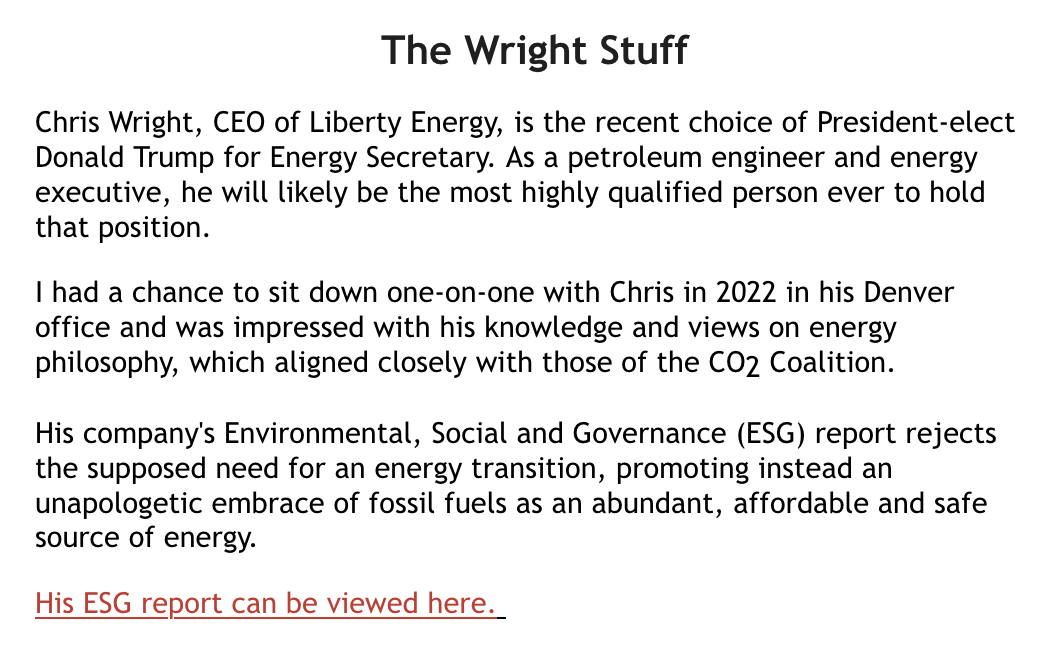
“I had a chance to sit down one-on-one with Chris in 2022 in his Denver office,” claimed Gregory Wrightstone, executive director of a group called the CO2 Coalition. For nearly a decade, the organization has publicly disputed the fundamentals of climate science while receiving donations from foundations linked to corporate backers, including the oil and gas billionaire Charles Koch

Wrightstone, who detailed the encounter with Wright in a recent newsletter, “was impressed with his knowledge and views on energy philosophy, which aligned closely with those of the CO2 Coalition.”

In a phone interview with DeSmog, Wrightstone elaborated on that alignment, explaining that “the main thing that he and I and the CO2 Coalition agree on is that increasing CO2 is a net benefit, it’s not the demon molecule, it’s the miracle molecule.”

Wright is currently the CEO of the fracking services company Liberty Energy and would bring no political or government experience to the role of energy secretary. Yet Wrightstone concluded that because Wright is “a petroleum engineer and energy executive, he will likely be the most highly qualified person ever to hold that position.” 

After Trump announced the nomination last week, some industry observers hailed the appointment as a sign of political moderation within the Republican cabinet, with the head of the Colorado Oil and Gas Association arguing that Wright is “a pragmatic problem solver” and “not a climate denier.”

Yet the full-throated praise that Wright is receiving from the likes of Wrightstone raises serious questions about whether the future energy secretary even thinks climate change is a problem worth addressing, said Connor Gibson, an independent research specialist who’s spent years tracking the CO2 Coalition and other groups that obstruct climate action including for Greenpeace USA. 

“The CO2 Coalition has been a persistent voice undermining the ABCs of climate change — that it’s happening, that it’s caused by human fossil fuel use, and that it’s going to be dangerous,” he told DeSmog. 

Wright didn’t respond to questions via his company Liberty Energy nor via the Trump-Vance transition team. 

Screenshot from CO2 Coalition emailed newsletter. Credit: CO2 Coalition

Backed by Koch

In email correspondence with DeSmog, Wrightstone explained how his meeting with the future nominee for energy secretary came about several years ago: “I was speaking at an event in Denver and set up a meeting in his office,” he wrote.

“We had a wide-ranging conversation, but I can’t recall any particular details,” he added during a phone interview. Yet Wright made a positive impression on the executive director of the CO2 Coalition. “The key takeaway is that he’s a big supporter of the continuing use of fossil fuels, including coal, oil, and natural gas,” Wrightstone said. 

According to Wrightstone, he and Wright’s views align on other key points, including the factually incorrect or dubious claims that “there is no man-made climate crisis,” “science is not consensus and consensus is not science,” “fossil fuels cannot be replaced by intermittent and unreliable solar and wind power,” and “history tells us that warmer periods have been beneficial, while cold periods have been horrific to humanity.”

These talking points have for years been disseminated by the CO2 Coalition, which was recently cited by Alberta’s United Conservative Party in a resolution that abandoned the oil-producing Canadian province’s net-zero targets and officially recognized “that CO2 is a foundational nutrient for all life on Earth.”

Gibson referred to the CO2 Coalition in a recent report he co-wrote along with Robert Brulle of Brown University as an “organization solely focused on disputing climate change science.”

During the first Trump administration, William Happer of the CO2 Coalition was appointed to the National Security Council but exited after only a year. White House advisors reportedly feared that his extreme views were a liability to Trump’s reelection. In 2017, Happer argued that the “demonization” of carbon dioxide “really differs little from the Nazi persecution of the Jews, the Soviet extermination of class enemies, or ISIL slaughter of infidels.”  

Nevertheless, the CO2 Coalition received more than $76,000 from foundations linked to the oil and gas billionaires Charles and David Koch during Trump’s first term, according to Gibson’s report. Greenpeace calculations show the group got $620,000 in Koch-related contributions between 2004 and 2015. 

“We have not received Koch Industries money since I’ve been here,” Wrightstone, who took over in 2021, said when asked about Koch contributions. 

Gibson argues that Wright, as a fossil fuel executive, is slightly more nuanced in expressing his views on climate change than his supporters at the CO2 Coalition. Wright acknowledges that human-caused global heating is real and potentially a problem while saying in a video posted to his LinkedIn last year that “there is no climate crisis.”

“It seems to me to be the calculated words of a CEO who recognizes that there is a potential liability of telling an outright lie to the public,” Gibson said. “Yet the effect of his comments is to leave people with the impression that climate change is not happening.”

Original article by Geoff Dembicki republished from DeSmog

Continue ReadingGroup That Calls CO2 ‘Essential’ Praises Trump Energy Secretary Pick Chris Wright

COP29 puts world on course for more extreme weather – and more deaths

Spread the love

Original article by Paul Rogers republished from Open Democracy under a Creative Commons Attribution-NonCommercial 4.0 International licence.

After a disappointing COP29, we should prepare for more extreme weather events like the floods that hit Valencia last month
 | David Ramos/Getty Images

Summit proves change won’t come until floods and wildfires are killing tens of thousands in rich Global North cities

While COP29 in Baku narrowly avoided collapsing, its results were bitterly disappointing for delegations from across the Global South, who ended up with barely a quarter of the annual $1.3trn of support they were seeking by 2035 to respond to climate breakdown.

Quite apart from other factors, more than 1,500 pro-carbon lobbyists worked hard to limit progress and ensure that burning oil, gas and coal at profit continues for as long as possible whatever the global consequences. After all, the world’s fossil fuel industries rake in around a trillion dollars in profits a year.

Meanwhile, more and more examples are emerging of accelerating climate breakdown. The flooding in Valencia is just one, but scarcely noticed in Europe is the thoroughly weird weather being experienced in the eastern United States.

This autumn there have been over five hundred wildfires in New Jersey alone, a 5,000-acre fire has been burning for a week on the New York-New Jersey border prompting a voluntary evacuation, and New York City’s Fire Department was called out to deal with 271 brush fires in the first two weeks of November alone.

As if timed for that and certainly released with COP29 in mind, Carbon Brief, a website covering the latest developments in climate science, climate policy and energy policy, has mapped every published study on ‘impossible’ weather events – record heatwaves or storms that would not have happened without the overall global climate changes.

The first such study came in 2004, the year after weeks of extreme heat hit Europe and killed 70,000 people across the continent over several months. That early example of an ‘impossible’ weather event kick-started a new field of research known as ‘extreme event attribution’, which looks at how climate change has influenced extreme weather.

There are now 600 studies of 750 such extreme events spanning the past 20 years – a tiny fraction of the total number of these kinds of events. Of these 750, Carbon Brief found that scientists and researchers had concluded that 74% were made more likely or more severe because of climate change.

This has added to the growing sense of urgency right across the climate science community coupled with a highly critical view of the whole COP process. Even before the dismaying summit in the Azerbaijani capital, both last year’s COP in Abu Dhabi and the year before in Egypt were notable for their lack of progress even as the urgency of preventing climate breakdown was becoming more and more obvious.

There are other risks to global security including nuclear weapons, pandemics, cyber warfare, AI misuse and the progressive destruction of biodiversity, but climate breakdown is different from all of these. It is not a future risk, it is a current happening, it is accelerating, and we now have very few years left to get on top of it. If we don’t then a worldwide catastrophe with many hundreds of millions dying and societal collapse will become increasingly likely.

Does it have to be like that?

As things stand, in terms of changing attitudes, developments in renewables, resistance of the fossil carbon industries and, of course, Donald Trump’s looming presidency in the US, a reasonable prognosis for the next decade has three elements.

First, the use of renewable energy resources does continue to increase but not at anything like the rate required, so net carbon emissions will continue to rise, not fall, for most of the next ten years. Second, resistance to decarbonisation will continue from many quarters, no doubt now including the White House. Finally, severe weather events will become both more common and more destructive.

Eventually, and it might take more than a decade, the disasters will be so great, including sudden weather events in rich cities in the Global North killing many tens of thousands of people, that public pressure across the world will force governments to respond. There will be no alternative to engage in truly transformative change.

But what that means is that the task ahead by then will be hugely greater than if the transformation starts much sooner, so timescales become crucial, especially what can speed up the process.

There is, though, one thing to remember at a time of widespread pessimism. If nations had got their act together 25 years ago after the Kyoto Protocols, were signed we would be in a far more favourable position worldwide than we are now. We are acting more than two decades late.

But climate breakdown is not happening as a slow, steady process of change, creeping up almost unawares. If that had been the case then with all the reasons not to act, especially the global fossil carbon lobby, we would have been in an even worse position now. Instead, it is happening at variable rates in two respects, some parts of the world – such as the polar regions – are warming up much faster than others and extreme weather events are happening much more often.

We are therefore getting a foretaste of what will affect everyone a few years before it does, and this gives us just a little more time to act. It means that the next ten years, and perhaps even the five years to 2030, will be the key time for us to come to terms with the transformation in society that is essential for global well-being. That is possible, just.

Original article by Paul Rogers republished from Open Democracy under a Creative Commons Attribution-NonCommercial 4.0 International licence.

Continue ReadingCOP29 puts world on course for more extreme weather – and more deaths

For decades, governments have subsidised fossil fuels. But why?

Spread the love
Sobrevolando Patagonia/Shutterstock

Bernard Njindan Iyke, La Trobe University

Even now, decades after we first began trying to avert the worst of global warming, more than 80% of the world’s total energy comes from fossil fuels.

You might think this would make fossil fuel production extremely profitable. But it’s not always the case. Much of the most accessible oil has already been extracted and burned. Many countries want to shore up domestic sources of fossil fuels to boost energy security. Energy price fluctuations and competition from new energy sources such as solar, wind and fossil gas have made it harder for some fossil fuel companies to make money, especially in coal.

This is where fossil fuel subsidies come in. Australia gave A$14.5 billion in subsidies to major fossil fuel producers and consumers in 2023–24 alone.

You might have wondered – why would some of the largest companies on Earth need subsidies? Here’s why.

LNG tanker
Australia’s surging liquefied natural gas industry has been boosted by government funding. KDS Photographics/Shutterstock

Private companies, public money

Globally, private companies dominate fossil fuel production, though fossil fuel-rich nations often have state-owned companies, such as Saudi Arabia’s Aramco and Russia’s Rosneft.

Why would governments give fossil fuel companies money? Many reasons. But the most important is that wealthy countries have historically needed huge volumes of fossil fuels for manufacturing, transport and power. Many countries have some sources of fossil fuels inside their borders, but only a few are self-sufficient. This has enabled fossil fuel giants such as Saudi Arabia to become wealthy beyond belief.

Many governments have used subsidies to boost their energy security and encourage local producers to seek out new sources of coal, gas and oil. These subsidies can make all the difference in making fossil fuel companies competitive internationally. For instance, Canada spent billions on subsidies to boost its oil sands and fracking projects.

Subsidies were essential in the United States’ fracking revolution. Novel approaches to extracting fossil gas and oil – boosted by major tax incentives – turned the US from a major importer of oil and gas into a net exporter by 2019.

You can see why the US did this. At a stroke, it went from being dependent on energy provided by foreign nations to being independent.

Once subsidies are in place, they become very hard to remove. Indonesia’s lavish fuel subsidies now account for 2% of the nation’s GDP. When the national government tried to walk these back, there were riots.

And there’s another reason, too. Fossil fuels are still playing an important role in boosting the economy in most nations. Subsidising them has long been seen as a way to maintain economic growth and stability.

Globally, these subsidies are estimated at a staggering $10.5 trillion each year.

This figure has grown sharply in recent years, after Russia’s invasion of Ukraine. As European nations tried to wean themselves off Russia’s gas, energy prices surged worldwide. In response, some countries introduced new subsidies to support businesses and consumers.

The top-line figure of $10.5 trillion includes two types of subsidy – explicit (meaning real dollars change hands) and implicit (for example, governments building roads and railways to encourage crude oil transport).

Explicit subsidies

Explicit fossil fuel subsidies are direct financial incentives from governments to fossil fuel producers and consumers. These incentives come in different forms, such as tax breaks, direct payments, grants and price controls. All of them aim to reduce the financial burden associated with fossil fuel production and use.

In Australia, explicit subsidies include fuel tax credits and exploration tax reductions. Fossil fuel companies can get subsidies to offset the losses they make during the years it takes to find and begin extracting new fossil fuels.

In the US, oil and gas companies benefit from the oil depletion allowance, which permits them to deduct a percentage of their gross income from oil and gas sales as an expense. They can also claim tax deductions for intangible drilling costs, such as the wages of workers and material needed to find new sources of oil and gas.

China, too, uses direct subsidies, discounted land-use fees, and preferential loans as explicit subsidies to boost coal production and consumption. The national government also supports fossil fuel consumption through direct payments to consumers.

coal miners China
China has used subsidies to encourage exploitation of its large coal resources. zhaoliang70/Shutterstock

Implicit subsidies

Implicit subsidies are often described as “imaginary”. That doesn’t mean they don’t exist, just that they’re not a direct transfer to directly paid to fossil fuel producers.

For instance, the cost of burning fossil fuels is borne by the global community and the natural world, in the form of climate change, damage to human health and other harms. Most fossil fuel companies don’t have to pay a cent for the pollution their products cause – so in effect, they are being granted an indirect subsidy.

Implicit incentives also include government investment in facilities such as transport networks, pipelines, oil refineries and port infrastructure, which will accelerate fossil fuel production and delivery. Think of the Middle Arm development in Darwin, funded by both the federal and territory government.

Why are these subsidies still being paid?

As the world grapples with a worsening climate crisis, fossil fuel subsidies are under great scrutiny.

It’s politically difficult to withdraw subsidies once given. This is why governments around the world have instead begun to give subsidies and tax incentives to green energy developers, including the enormous $500 billion Inflation Reduction Act in the US, the European Union’s Green Deal, and China’s massive subsidies of green technologies such as electric vehicles and solar panels.

The goal here is to make renewable energy and electrified transport steadily more affordable and competitive – just as fossil fuel subsidies did for oil, gas and coal.

Bernard Njindan Iyke, Lecturer in Finance, La Trobe University

This article is republished from The Conversation under a Creative Commons license. Read the original article.

Continue ReadingFor decades, governments have subsidised fossil fuels. But why?

Milei’s unfinished promises: Argentina has the highest inflation in the world

Spread the love

Original article by Pablo Meriguet republished from peoples dispatch under a Creative Commons Attribution-ShareAlike 4.0 (CC BY-SA) license.

Photo: World Economic Forum

Javier Milei’s right-wing government promised to stop inflation in Argentina, and has thus far failed

The neoliberal economic measures of Javier Milei’s government are not improving the economic situation they promised to eradicate. During the election campaign, Milei made several promises that thus far he has been unable to keep. For example, he stated that the price of gas would not increase under his government, but from April to May rates rose by 450%. He also promised that public transportation fares would not increase, but the price of the subway went from 125 to 757 pesos.

The government has not been able to stimulate the growth of the Argentine economy either. According to the IMF itself, which bases a good part of its analysis and recommendations on neoliberal economic theory, the GDP of the Argentine economy will fall by 3.5% in 2024. In this sense, the recession the country is enduring does not seem to have a clear way out. Initially, the IMF thought that the economic contraction would be 2.8% of the GDP, but given the incontestable evidence, it had to adjust its forecast.

However, the IMF maintains that there will be a rebound effect, and that, therefore, in 2025 Argentina will grow by 5%. In addition, the agency praised the economic measures of the Milei government to curb the inflationary process, fiscal adjustment, and liberalization of the economy. Petya Koeva Brooks, deputy director of the Research Department, said that “looking ahead, even in the coming quarters, we expect growth to rebound because we see the effects of fiscal adjustment, the return of confidence and rising wages.”

However, several Argentine economists have stated that such expectations are not based on the reality of the national economy, as the problems caused by high inflation have worsened, as well as the evident decrease in employment in the country. According to data for the first half of 2024, Argentina has the highest cumulative inflation worldwide, 79.8%, and a peak year-on-year inflation of 271.5%.

Another unfulfilled promise of Milei was the increase of employment in the country thanks, according to the libertarian government, to the radical liberalization of the economy. However, despite the set of neoliberal economic measures, there has been a 7.7% increase in unemployment during the first quarter of 2024.

Milei’s administration celebrates the fact that the inflationary process decreased a little compared to previous years, claiming that this is thanks to certain public policies of his administration. This is even though Milei’s brutal fiscal adjustment, the contraction of the State, and the loss of thousands of jobs, which Milei stated would have a very positive impact on inflation, have not had the expected results. For example, food prices in Argentina have risen 260% (40 times more than Mexico), one of many figures which confirms that the neoliberal “shock” measures of Milei are not likely to benefit workers in the long run.

Original article by Pablo Meriguet republished from peoples dispatch under a Creative Commons Attribution-ShareAlike 4.0 (CC BY-SA) license.

Continue ReadingMilei’s unfinished promises: Argentina has the highest inflation in the world

Green MP Carla Denyer calls on Ed Miliband to ban new drilling in the North Sea

Spread the love
Green Party's co-leader and Bristol Central MP Carla Denyer on BBC Question Time.
Green Party’s co-leader and Bristol Central MP Carla Denyer on BBC Question Time.

In the wake of unfounded reports that Ed Miliband will announce a ban on new drilling in the North Sea, Green Party co-leader and MP for Bristol Central, Carla Denyer, has urged the energy secretary to do just that, and “send a clear signal to the fossil fuel industry that they have no future in the UK.” Denyer said:  

“It didn’t take long for the right wing press to come out waving the banner for the fossil fuel industry together with the usual round of scare stories about a dent to the economy and tax revenues if we don’t continue to burn oil and gas. Those cheerleading for oil and gas corporations must not be allowed to derail us from the path towards a green transition. That is where our future prosperity and thousands of good new jobs lies. We need to seize the opportunities that greening the economy will bring. 

“This is a test to see how brave and bold Labour will be and whether they will send a clear signal to the fossil fuel industry that they have no future in the UK. Ed Miliband certainly should ban all future licences for new North Sea oil and gas fields, and do so immediately.  

“The Green Party would like to see him go further by revoking the licence for Rosebank which has the potential for producing around 500 million climate-wrecking barrels of oil. We would also like to see a carbon tax on polluters to help drive the transition to cleaner and cheaper renewable sources of energy.” 

Continue ReadingGreen MP Carla Denyer calls on Ed Miliband to ban new drilling in the North Sea