The Koch Network Is Pushing Trump to Accelerate AI, Documents Show

Spread the love

Article by Geoff Dembicki republished from DeSmog.
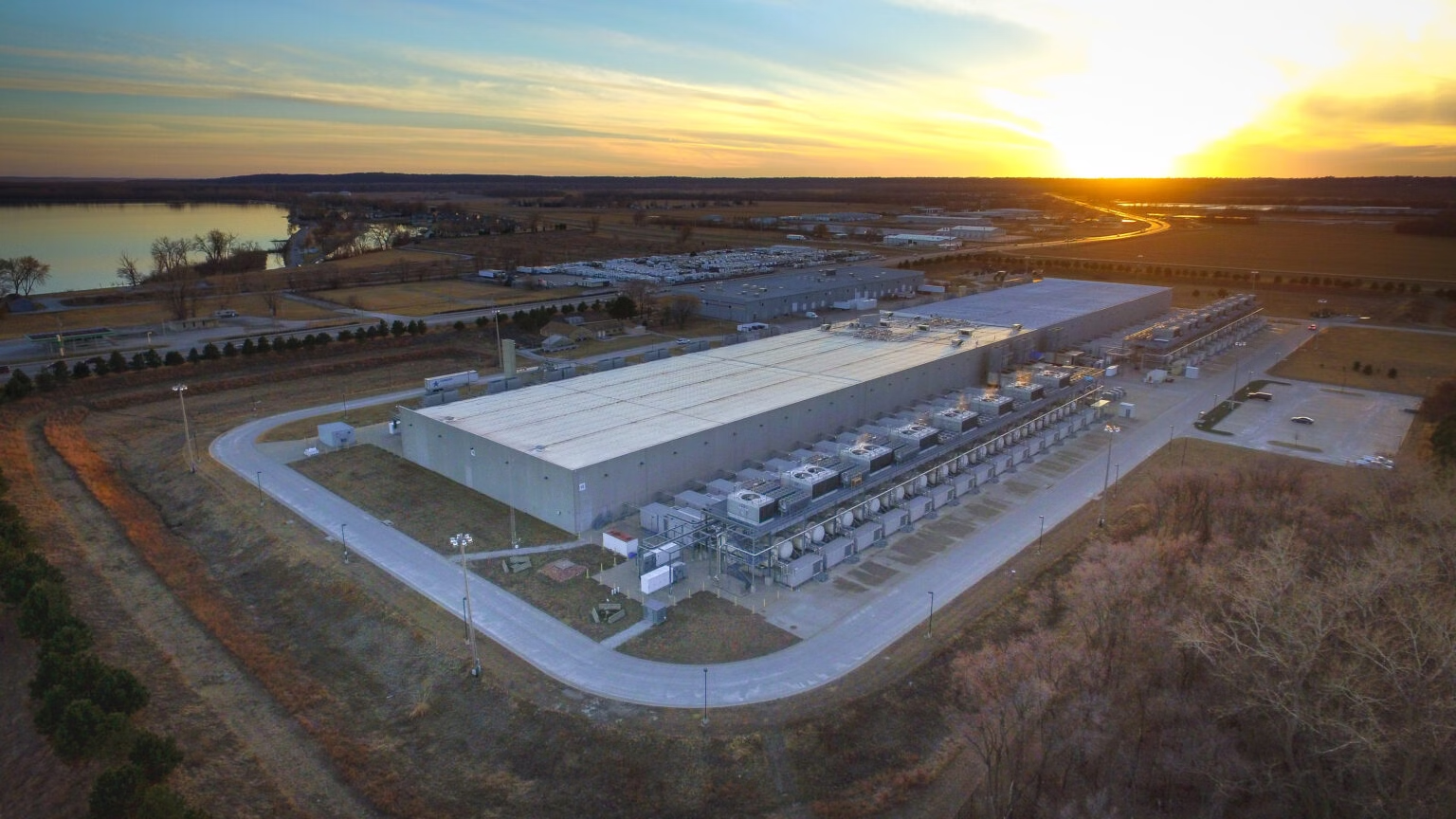
Koch, Inc., said in October that its real estate arm has been getting into the business of building data centers like this one in Council Bluffs, Iowa. Credit: Chad Davis/Wikimedia Commons (CC BY-NC-ND 2.0)

Right-wing political group Americans for Prosperity, backed by oil and gas billionaire Charles Koch, sees data centers as part of a larger pro-fossil fuel agenda.

A political group created by oil and gas billionaire Charles Koch earlier this year wrote to a branch of the U.S. government making requests about artificial intelligence.

“To seize the moment and ensure that AI can meet its true promise and potential,” it argued in March to the National Coordination Office, a federal body tasked by Donald Trump at the time with developing an AI Action Plan, the administration should “clear the red tape” preventing “energy innovators” from supplying the massive amounts of electricity required to power new AI data centers across the country.

The comments were written by analysts with Americans for Prosperity (AFP), a Koch-bankrolled activist organization that supports right-wing causes and political candidates and spent more than $157 million to sway voters during the 2024 elections.

Strategy plans, policy documents, corporate communications and comments to the federal government reviewed by DeSmog show that Koch’s political operation is attempting to shape and help implement a U.S. AI technology agenda, which could ultimately profit Koch’s traditional oil and gas business.

Despite the Koch network’s ongoing disagreements with Trump on issues including tariffs, the vast political operation appears to have found common cause with the administration on ensuring that fossil fuels, and not renewable energy sources, are central to AI development, even as wind and solar remain cheaper and faster to build.

“Practical solutions can be identified that move our nation forward,” Americans for Prosperity wrote to the government’s AI and Energy Working Group in May. “We look forward to working with you and the Congress to assist in the identification of those solutions.”

Neither AFP nor Koch, Inc. responded to a request for comment.

‘Couched in Fear’

Charles Koch became one of America’s richest people through owning and overseeing an industrial empire with his late brother, David, that includes oil refineries, pipelines, petrochemicals and natural gas. Koch, Inc., formerly known as Koch Industries, is now embracing AI across its vast operations, which it has predicted will create “substantial economic value” for the company.

Koch, Inc., in 2020 announced a partnership with the AI software provider C3 AI, with the goal of improving “operating performance” across its products “ranging from refined oil, chemicals, and biofuels to polymers, automotive components, and forest products.”

Also around that time, the company led a $125 million investment in the San Francisco cloud computing startup Mesosphere, alongside the likes of Microsoft and Khosla Ventures. Other backers included Andreessen Horowitz, the venture capital firm whose founders became prominent Trump supporters during the 2024 election.

Koch, Inc., said in October that its real estate arm has been getting into the business of building data centers in cities like Chicago, Kansas City, and Atlanta. The company argued in a news release that it “can provide the expertise and capabilities that major tech companies either don’t have or don’t think would be worth the time or effort to build on their own from the ground up.”

As Koch’s industrial empire invests in AI and partners with Big Tech, AFP is pushing the Trump administration to remove regulatory barriers on the technology.

Last March, AFP analysts Faith Burns and James Czerniawski disapprovingly noted there were over 800 state-level proposals to regulate AI. These efforts “are couched in fear of the technology,” they argued in comments to the National Coordination Office, and said the correct approach for government is “keeping itself out of the way to drive innovation.”

This is part of a larger political project that would also be beneficial to the Koch companies involved with producing, transporting and selling fossil fuels.

AFP argued in its March comments that the administration and Congress could make progress on accelerating AI by deregulating the power sector “to get abundant and affordable energy to Americans and leading AI companies.” 

‘Radical Climate Dogma’ 

The quickest and most economic way to power all the data centers now being built is through renewable sources, industry data shows. That’s in part because nearly 80 percent of planned electricity projects in the U.S. are currently tied to solar and wind farms.

But Americans for Prosperity has thrown its political weight behind legislation that hobbles renewables in favor of oil, gas and coal.

It cited as a major victory the passage this summer of the Trump administration’s Big Beautiful Bill, a massive tax cut bill predominately benefiting America’s wealthiest citizens that included deep cuts to clean energy tax credits brought in under President Joe Biden.

The Koch political group ran a $20 million advertising and political campaign that it claimed “helped make this win possible through over 1,500 meetings with lawmakers, nearly 500,000 doors knocked, more than 475,000 phone calls, 725+ community events [and] over 100,000 letters sent to Congress.”

AFP presented the bill as a victory for fossil fuels. “It provides for a minimum of 30 offshore oil and gas lease sales,” its analyst Burns said in an advertisement posted on the group’s Facebook page. “And it makes available for lease four million acres of recoverable coal resources on federal land.”

As it worked to help pass the Big Beautiful Bill, Americans for Prosperity was supporting the administration’s efforts on AI.

In late July, the Trump administration unveiled an AI Action Plan, which promised “to reject radical climate dogma and bureaucratic red tape” to ensure that the U.S. can “build and maintain vast AI infrastructure and the energy to power it.”

In a statement that was posted on the White House website, Americans for Prosperity’s Brent Gardner said the plan “will ensure America leads the world” on AI. That statement was included along with praise from the likes of Chevron, Palantir, Meta, IBM and the Heritage Foundation

The plan itself had input from Dean Ball, who was recently an AI advisor at the White House Office of Science and Technology Policy, and earlier a fellow at the Mercatus Center, a conservative think tank that’s received millions of dollars in funding from the Charles G. Koch Charitable Foundation. Ball was “intimately involved in the drafting” of the plan, according to a recent webinar on AI policy hosted by National Journal.

Ball said during the event that the build-out of data centers will likely mean that there’s “more gas, natural gas in particular, used in the United States than there otherwise might have been.”

Ball is now a senior fellow at the Foundation for American Innovation, a national non-profit whose supporters include the Koch-backed Stand Together Trust.

The Next AI Battle

The fallout of Trump’s Big Beautiful Bill is already being felt across the renewables industry. Power “developers have canceled 1,891 power projects this year with a combined capacity of 266 GW, with clean energy accounting for 93% of cancellations,” according to analysis by the climate newsletter Distilled.

That’s not necessarily good news for AI, given that new natural gas and nuclear facilities can  take much longer to build than renewables.

And there is now a growing backlash to the technology, with a coalition of over 200 environmental groups this month demanding a halt to new U.S. data centers, arguing they are “rapidly increasing demand for energy, driving more fossil fuel pollution, straining water resources and raising electricity prices across the country.”

But Americans for Prosperity has now made one of its political priorities getting federal “permitting reform” legislation passed, which would streamline or eliminate many environmental and other reviews on new energy projects such as data centers.

In a recent petition form sent out to its members, AFP claimed that permitting reform can help “ensure 24/7 reliable power as demand increases, particularly in regions experiencing surging data center growth and electrification trends.” It envisions such legislation as hastening “new pipelines, export terminals and delivery systems” along with expanding “LNG and crude oil exports.”

The Koch network is joined by a coalition of fossil fuel industry groups including the American Petroleum Institute and the American Gas Association, which in early December released a letter calling for passage of “a broader permitting package” around new energy infrastructure projects.

And the effort is also attracting interest from Big Tech.

Sponsors for a mid-December conference in Washington, D.C., that includes U.S. Energy Secretary Chris Wright and features panels on “permitting reform,” “energy for AI,” and “American energy dominance” include the Koch nonprofit organization Stand Together.

Also listed as a sponsor: the tech giant Amazon.

Article by Geoff Dembicki republished from DeSmog.

Donald Trump urges you to be a Climate Science denier like him. He says that he makes millions and millions for destroying the planet, Burn, Baby, Burn and Flood, Baby, Flood.
Nigel Farage urges you to ignore facts and reality and be a climate science denier like him and his Deputy Richard Tice. He says that Reform UK has received £Millions and £Millions from the fossil fuel industry to promote climate denial and destroy the planet.
Elon Musk urges you to be a Fascist like him, says that you can ignore facts and reality then.
Continue ReadingThe Koch Network Is Pushing Trump to Accelerate AI, Documents Show

‘Green’ UK pensions are bankrolling US fossil fuels

Spread the love

Article by Josephine Moulds and Simon Lock republished from The Bureau of Investigative Journalism under a Creative Commons Attribution-NonCommercial-NoDerivs 3.0 Unported License.

Public sector pensions have ploughed billions into opaque investment funds which are financing ruinous gas projects on the US Gulf Coast

In brief

  • UK public sector pension schemes are bankrolling rapid expansion of liquefied natural gas production in the US South, posing a major climate threat
  • US gas projects are reaping rewards from price shocks caused by Trump’s war in Iran
  • Gas terminals are frequently built in poor neighbourhoods, causing health problems in nearby communities

Trump’s war in Iran has boosted the fortunes of US gas companies – and UK savers are unwittingly bankrolling their expansion.

Sixty local government pension funds have invested a total of £8bn into funds paying for the rapid construction of gas infrastructure on the Gulf Coast of the US. Residents say these terminals are already causing health problems in their communities. Experts say they represent one of the biggest threats to the future of the planet.

Over 7 million school staff, civil servants and other public sector workers either save with, or receive their pension from, local government pension schemes. Our revelations have sparked concerns among local councillors, who have urged fund managers to divest from fossil fuels.

While the companies behind these projects are enjoying a boost from the war in Iran, they could tumble in value as the world switches to renewable forms of energy. Councillor Andrew Scopes, who sits on an advisory panel for West Yorkshire Pension Fund, said: “We will still be paying benefits out in 60 years’ time. We need to be looking beyond the possible short-term gains, at the long-term risk.”

Recommended Articles

Members of the scheme were dismayed to find what they were bankrolling. “The UK could be funding a safer, healthier future for all via renewable energy generated in the UK that is cheap, safe, clean and owned by us,” said Jane Thewlis, a retired social worker.

The news comes as the government is making changes to the law governing pension schemes. During a debate in the House of Lords, peers from several parties raised the issue of pension fund investments in climate-wrecking companies.

Baroness Hayman, a crossbench peer, told us: “Many UK pension funds are already reducing their exposure to fossil fuels, recognising the risks these investments pose. But with £3 trillion held in UK pensions, and the climate and nature challenge growing, there is a clear opportunity to better protect savers from rising financial and environmental risks.”

A gas explosion

The giant white orbs containing liquefied natural gas (LNG) look almost alien. Scores of these terminals are popping up along the 1,200km Louisiana and Texas coastline, a building frenzy turbo-charged by Trump’s second term. If all the planned terminals are built, the LNG produced in the US would generate the same amount of greenhouse gases each year as every EU country combined, says Jeremy Symons, a former official at the US environmental regulator.

UK pension funds have supported this expansion for years. In 2019, a little-known infrastructure fund called Stonepeak put up $1.3bn to complete the construction of the Calcasieu Pass gas terminal in the south-west corner of Louisiana. Twenty miles inland, building has started on another terminal also funded by Stonepeak.

Calcasieu Pass LNG terminalVenture Global

UK savers in 12 local government pension schemes, including West Yorkshire, South Yorkshire and Worcestershire, have invested over £360m in Stonepeak funds that financed these plants, according to figures from council records and data provider Pitchbook.

Since starting operations, Calcasieu Pass has reported hundreds of emissions violations and paid authorities a $245,000 settlement. That’s unlikely to make much difference to its owner, Venture Global, a major Trump donor. Its shares rocketed by more than 80% after the US and Israel started bombing targets in Iran.

Roishetta Ozane, a resident turned activist, lives near both terminals. She told us that pollution from the nearby gas, petrochemicals and oil infrastructure has caused asthma and an increase of cancer in the area – an account borne out by academic research.

“We’re seeing more women develop health issues that are living near these facilities, having pre-term babies or having miscarriages,” she said. “We’re seeing our air quality deteriorate. We have a drinking water crisis.” She said residents had to deal with noise pollution from construction and the flaring of excess gas from the terminals.

Roishetta Ozane (second left)

Two of her children have asthma. She told us the doctor said pollution may have exacerbated the seizures suffered by her son, who died last year. “When my son passed away, I was like, what are we doing this for?” she said. “We’re fighting for our children, for our future, for our community, but yet they’re dying.”

Further down the coast, a huge fireball at Freeport LNG in June 2022 made the risks of these installations vividly clear. IFM Global Infrastructure Fund – which counts among its investors more than 20 UK pension funds, including Avon, East Sussex and Aberdeen – paid $1.3bn to help build Freeport LNG in 2013. It continues to hold a stake in the project.

Travelling south, the construction boom continues. Right next to the Mexican border, Rio Grande LNG is building a sprawling complex that the NGO Sierra Club estimates will match the emissions of 50 coal-fired power plants every year. Campaigners say the project is already contributing to habitat loss in an area critical for endangered animals such as ocelots, falcons and sea turtles.

French bank Société Générale backed out of funding the controversial project. But it was able to proceed thanks to a $5bn commitment from BlackRock’s Global Infrastructure Partners Fund V – which is supported by nearly £200m of UK savers’ pensions, from Waltham Forest to Greater Manchester.

In total, we found eight US-based LNG terminals backed by UK pension money. Taken together, those terminals would give rise to more CO₂ every year than the entire UK several times over, according to Sierra Club data.

https://flo.uri.sh/visualisation/28573619/embed?auto=1 [“Sorry, this content could not be embedded.”]

A spokesperson for IFM Investors told us that the fund publicly discloses its infrastructure equity assets. They added: “Natural gas is increasingly utilised as a transition fuel for decarbonisation globally … These assets benefit from investment from long-term, trusted capital partners like pension funds, who can reinvest in them and pave the way for carbon emissions reduction.”

LNG is often promoted as a cleaner alternative to traditional fossil fuels. However, a peer-reviewed study found it is 33% worse in terms of planet-heating emissions over a 20-year period compared with coal.

Worcestershire Pension Fund said it invests through structures that mean “exposure to any single asset is indirect, limited, and a very small component of a broader portfolio.” It said the Stonepeak fund in question “publishes detailed annual reports and complies fully with statutory disclosure requirements”.

A greener pension

When it comes to curbing carbon emissions, council pension funds and campaigners have tended to focus on selling their shares in companies like BP and Shell. But a growing portion of pension funds are invested in so-called “private markets”. Typically this involves putting money into a number of big funds, which in turn invest in everything from private equity to property to company loans.

Private markets can offer healthy returns. They’re also something of a black hole for information, which makes following the money much more difficult. And they’re often excluded from the scope of council climate commitments.

The upshot is that even pension schemes that have promised not to invest in fossil fuels have ploughed money into funds that are paying for major gas projects.

Take Waltham Forest Pension Fund, which in 2016 became the first local authority to make such a commitment. Simon Miller, a former councillor who chaired the pension fund committee, said the council already had a number of green goals to improve the lives of residents. “[But] we had a pension fund that was merrily invested in fossil fuels that was absolutely out of lockstep with the political direction and philosophy of the borough.”

The council’s pension fund proceeded to sell its investments in fossil fuel companies over the following five years.

According to its latest report, however, Waltham Forest is still invested in funds managed by Global Infrastructure Partners that have financed Rio Grande LNG and Allete, which owns an 18,000-acre coal mine in North Dakota.

https://frontend.poool.fr/engage/56TXL-DGRM7-IPY34-9YVAW/67b3726b9f79a3dc6ea9504c [“Sorry, this content could not be embedded.”]

Lewisham Pension Fund has also brought down the emissions associated with its investments after committing to sell its holdings in fossil fuel companies. But it remains invested in a huge infrastructure fund operated by JP Morgan Asset Management. While this fund has substantial investments in renewable energy, it continues to hold a 50% stake in Third Coast, which spilled over 1 million gallons of oil into the Gulf of Mexico in 2023.

In February 2024, West Yorkshire Pension Fund said it would no longer lend to the oil, gas and coal sector. According to the new standards set by the authority, councillor Andrew Scopes said, the decision to invest in a Stonepeak fund that bankrolled an LNG plant on Ozane’s doorstep would be “very difficult to justify”.

Jane Thewlis, a campaigner and member of the scheme, said: “We are particularly concerned if [West Yorkshire Pension Fund] is funding LNG infrastructure in the US, which is not compatible with a livable climate. We expect our elected representatives to use our money to fund a safe future – not to hasten the end of humanity.”

West Yorkshire Pension Fund said its environmental, social and governance policy “takes account of the current status and role of gas and oil within the energy transition, particularly with regard to reliability, affordability and coal displacement”. It said LNG is seen as “a bridge between today’s fossil‑fuel‑dominated energy system and a future low or zero‑carbon one”.

JP Morgan, Stonepeak and Waltham Forest council declined to comment on the record. Lewisham council said it cannot comment in a pre-election period. Third Coast, the LNG port operators, Global Infrastructure Partners and other local councils did not respond to requests for comment.

What next?

  • We are providing our research to campaigners and pension fund advisory panels so they can challenge decision makers on investments in infrastructure funds
  • New rules mean that council pension funds will be combined into pension fund pools, limiting councillors’ power over investment decisions. We will investigate what that means for funds that have committed to invest responsibly
  • Parliament is discussing the first of a number of pension reforms, where campaigners are pushing for greater recognition of climate risk

Article by Josephine Moulds and Simon Lock republished from The Bureau of Investigative Journalism under a Creative Commons Attribution-NonCommercial-NoDerivs 3.0 Unported License.

Neo-Fascist Climate Science Denier Donald Trump says Burn, Baby, Burn.
Elon Musk urges you to be a Fascist like him, says that you can ignore facts and reality then.
Continue Reading‘Green’ UK pensions are bankrolling US fossil fuels

Analysis: Record wind and solar saved UK from gas imports worth £1bn in March 2026

Spread the love

Original article by Simon Evans and Ho Woo Nam republished from Carbon Brief under a CC license

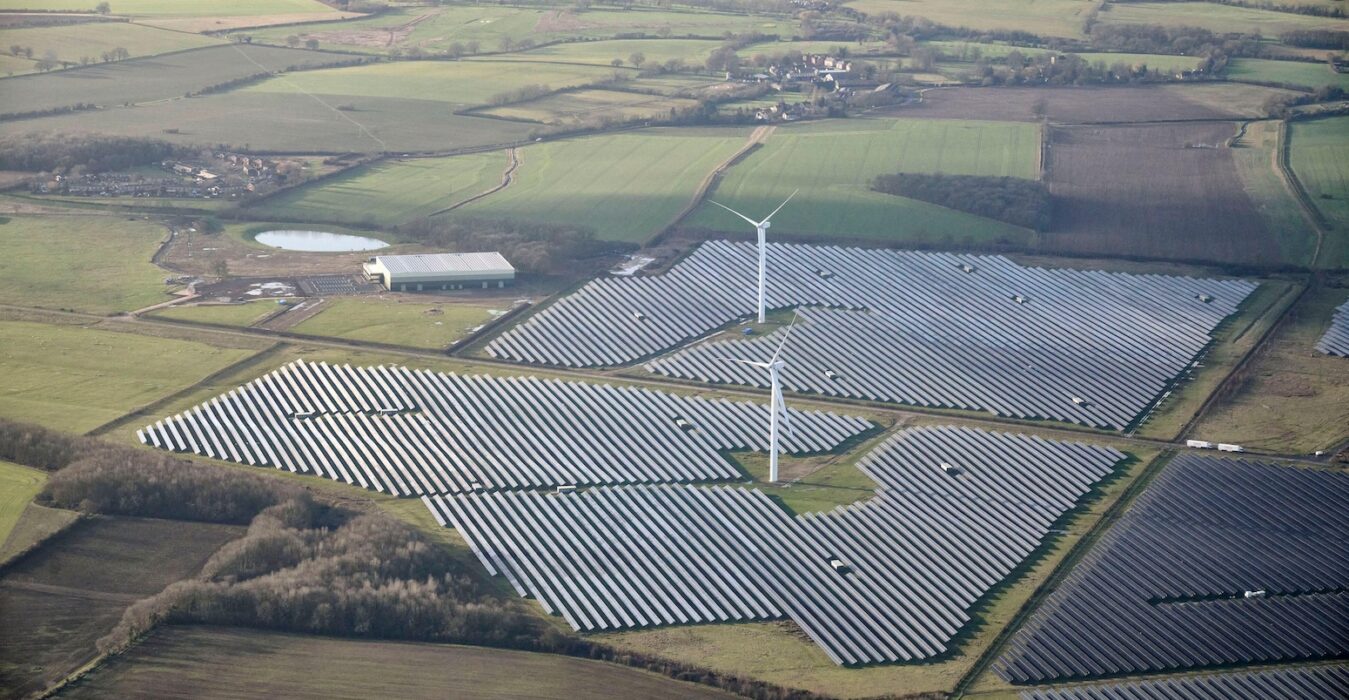
Aerial view of a solar farm and wind turbines, in the East Midlands, UK. Credit: Paul White – UK Industries / Alamy Stock Photo

The UK avoided the need for gas imports worth £1bn in March 2026 thanks to record electricity generation from wind and solar, reveals Carbon Brief analysis.

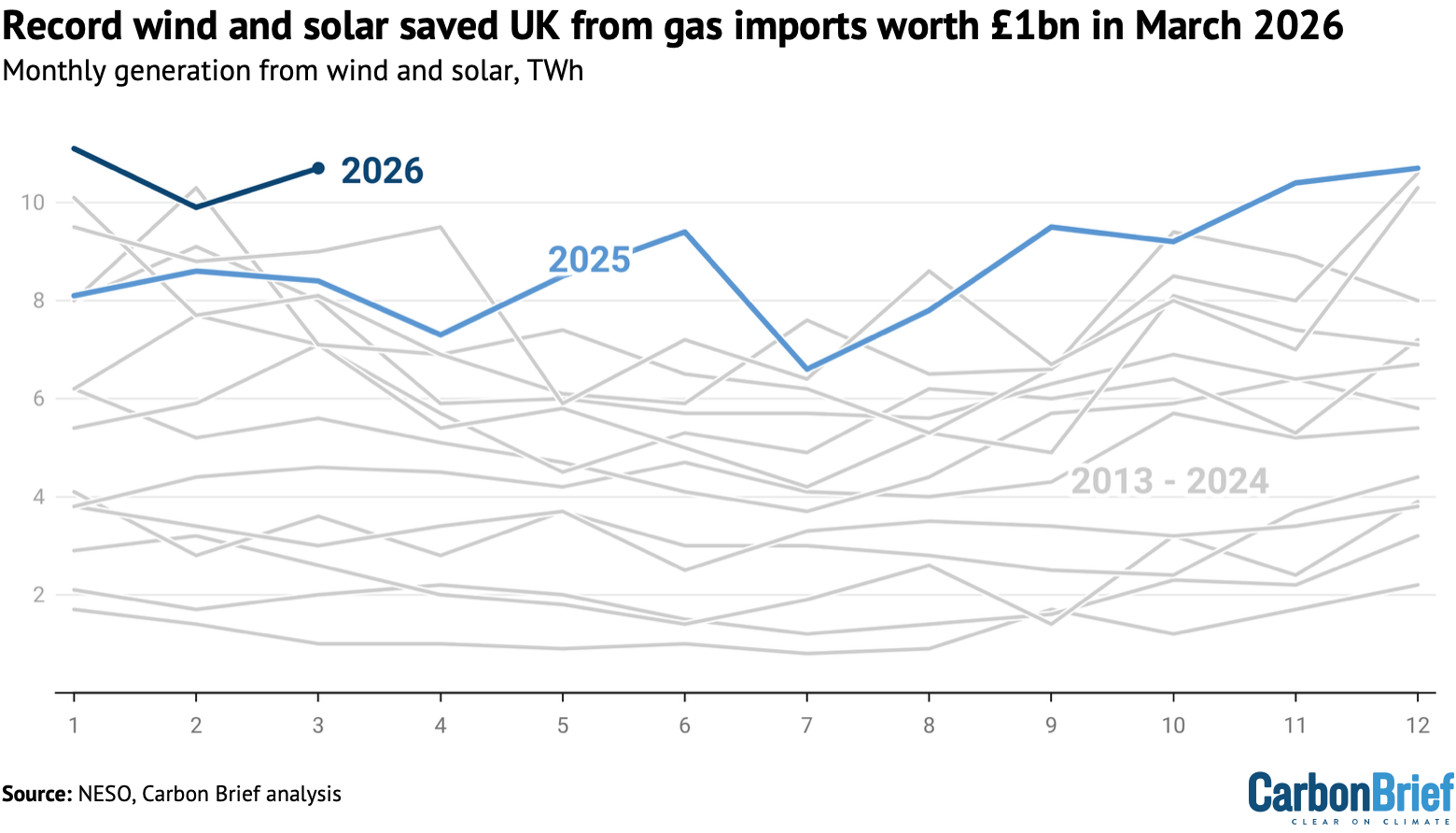
Wind generation hit a new record for the month of March on the island of Great Britain, up 38% year-on-year, while solar nearly matched the output of last year’s exceptionally sunny spring.

Together, wind and solar generated 11 terawatt hours (TWh) of electricity in March 2026, up a combined 28% and setting a new record for the month, as shown in the figure below.

Chart showing that record wind and solar saved UK from gas imports worth £1bn in March 2026
Monthly generation from wind and solar in terawatt hours on the island of Great Britain (England, Scotland and Wales), which has a separate electricity system from the island of Ireland, which includes Northern Ireland. Source: National Energy System Operator (NESO) and Carbon Brief analysis.

This record wind and solar output avoided the need to import 21TWh of gas – roughly 18 fully loaded tankers of liquified natural gas (LNG) – which would have cost around £1bn at current high prices due to the Iran war.

(This is based on gas costing 130p per therm, or £44 per megawatt hour, compared with the range of 120-170p per therm seen over the past month.)

At the same time, the record output from wind and solar saw electricity generation from gas falling 25% year-on-year in March 2026 to the lowest level ever recorded for the month.

This meant that gas was setting the price of electricity roughly 25% less often in March 2026 than in the same month in 2022, when fossil-fuel prices spiked after Russia’s invasion of Ukraine.

Original article by Simon Evans and Ho Woo Nam republished from Carbon Brief under a CC license

Nigel Farage urges you to ignore facts and reality and be a climate science denier like him and his Deputy Richard Tice. He says that Reform UK has received £Millions and £Millions from the fossil fuel industry to promote climate denial and destroy the planet.
Donald Trump urges you to be a Climate Science denier like him. He says that he makes millions and millions for destroying the planet, Burn, Baby, Burn and Flood, Baby, Flood.
Elon Musk urges you to be a Fascist like him, says that you can ignore facts and reality then.
Continue ReadingAnalysis: Record wind and solar saved UK from gas imports worth £1bn in March 2026

Analysis: CO2 from UK data centres could be ‘hundreds of times’ higher than thought

Spread the love

Original article by Josh Gabbatiss republished from Carbon Brief.

Aerial view of the Google AI data centre in Waltham Cross, UK. Credit: Amazing Aerial.

Emissions from the new data centres set to drive the UK’s AI “revolution” could be hundreds of times higher than government estimates, according to analysis by Carbon Brief.

There are dozens of data centres being developed across the country, potentially driving a surge in electricity demand.

Amid uncertainty about the scale and pace of this expansion, there are mounting concerns that new data centres could pose a threat to the nation’s climate goals.

UK government analysis concluded that the emissions from data centres would be negligible, even if they expand rapidly – a finding one campaigner tells Carbon Brief is “nonsense”.

In contrast, Carbon Brief analysis finds that emissions from powering data centres could be far higher than the government figures suggest, if at least a small amount of the electricity they need is generated by burning gas.

Data centres could run entirely on low-carbon electricity, but some in the sector have argued that the government’s AI ambitions require the UK to use more gas power.

If new data centres source a large amount of their power from gas, it could cause carbon dioxide (CO2) emissions equivalent to at least Denmark’s annual total.

‘AI superpower’

Data centres are energy-intensive computing facilities that are required to train and run complex AI models, among many other things.

The UK is one of the top-ranking nations for data-centre capacity, with roughly 1.8 gigawatts (GW) of facilities consuming more than 2% of national electricity. This could grow rapidly in the coming years as the government aims to make the UK an “AI superpower”.

Companies have already “achieved financial commitment” to invest in 71 new data centres that, if built, would require around 20GW of electricity, according to energy regulator Ofgem.

(For reference, the UK’s average electricity demand in 2025 stood at around 37GW.)

This potential increase in electricity demand has raised concerns from campaigners and some MPs about the impact of data centres on the UK’s climate targets. 

Last year, the government’s plan for meeting its 2035 climate target noted that AI growth was “not factored into” emissions projections, although energy secretary Ed Miliband has said new data centres are captured in modelling of “overall electricity demand growth”.

The government is targeting a “clean power system” by 2030, with just a small amount of gas generation remaining. Extra demand from new data centres could require a rollout of clean power that is even faster than the growth already underway.

If clean-power growth does not keep pace, data centres could, therefore, prolong the use of gas power, either by requiring more gas to remain on the grid or by facilities building their own on-site gas generation.

There is significant uncertainty around future emissions from UK data centres, which will depend on the number of centres built, how clean their power is and when they come online.

The government published an analysis of its AI strategy’s climate impact last year, alongside a data-centre “roadmap”. 

The analysis, released by the Department for Science, Innovation and Technology (DSIT) suggests emissions from future data centres will be minimal – reaching a maximum of 0.142m tonnes of CO2 (MtCO2) from 11.2GW of AI-related computing power by 2035. 

(There is an additional 2.4GW of data-centre demand in this scenario that is not associated with AI, for which emissions are not calculated.)

This figure is based on what DSIT describes as a high-emissions, high-AI growth scenario. Yet it implies that each unit (kilowatt hour, kWh) of electricity supplied to the 11.2GW of AI data centres would be associated with less than 2g of CO2. In other words, their electricity supply would need to be almost completely decarbonised. The government aim is for 50gCO2/kWh by 2030.

In addition, the DSIT figure – for emissions associated with the entire UK data centre fleet in 2035 – is much lower than the emissions estimates reported in planning applications for individual UK data centres made by Google and other companies.

Gas power

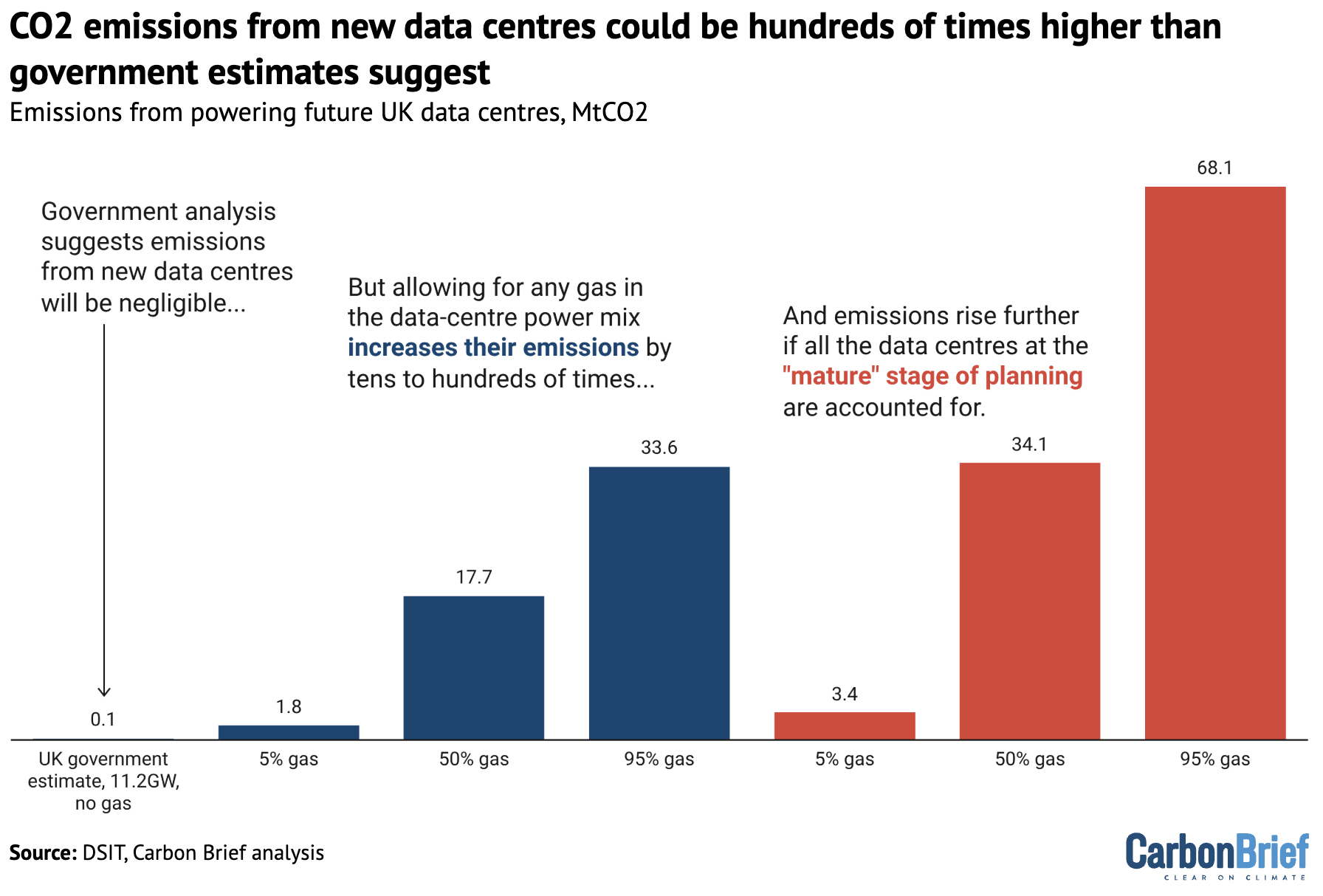
The chart below, based on Carbon Brief analysis, shows how data-centre emissions could be far higher than the government’s figures suggest. 

Even if gas-fired electricity only accounts for 5% of their supply – indicated by the smallest blue column below – emissions from 11.2GW of data centres would be around 2MtCO2. This is more than 10 times higher than the government’s top estimate for 2035. 

If the same data centres rely more heavily on gas, emissions could be hundreds of times higher, exceeding 30MtCO2. This is roughly equivalent to the annual emissions of Denmark. Emissions could rise even higher if capacity increases in line with the extra 20GW of data-centre demand that Ofgem says is in the pipeline, as indicated by the red columns

Emissions from powering future UK data centres, MtCO2, under different scenarios. The UK government figure is based on a modelled estimate for total AI-related data-centre computing power in 2035. The blue bars combine the government capacity figure of 11.2GW with increasing shares of gas power. The red bars use the Ofgem estimate of 20GW of “mature” projects that may be built in the future, combined with existing capacity of 1.8GW, to reach a figure of 21.8GW. Source: DSIT, Carbon Brief analysis.

If data-centre expansion reaches 20GW and those centres rely heavily on gas power, then the figure could be as high as 70MtCO2, the annual emissions of Sweden. This would also be nearly 500 times higher than the government’s upper estimate, which it says is based on a “pessimistic decarbonisation” scenario.

(The numbers are not directly comparable as, unlike the AI-specific 11.2GW figure, it is unclear how much of this 20GW would be for AI, specifically.)

The government’s modelling states that AI emissions in 2035 would be “equivalent to below 0.05% of the UK’s projected total emissions”. It also says “this could be equivalent to the annual emissions of approximately 5,000 to 23,600 UK households”.

On the contrary, Carbon Brief’s analysis suggests data centres could, in fact, be equivalent to as much as 20% of the UK’s projected total emissions in 2035.

As for the number of households, Carbon Brief estimates that future data centres could result in emissions equivalent to as many as 11.4m homes, roughly a third of all UK households.

Dr Tim Squirrel, head of strategy at Foxglove – part of an NGO group calling for more government scrutiny of data-centre emissions – tells Carbon Brief the DSIT figures are “nonsense and threaten to derail our carbon budgets”. He says:

“The figures that DSIT projects here wildly downplay data-centre emissions, even by the standards of the most optimistic energy transition scenario. There is no way that the amount of compute they anticipate can be built and produce the miniscule emissions they’re calculating.”

In its analysis, the government attributes the low emissions figures to “more efficient models and hardware” and “the UK’s ambitious targets for electricity grid decarbonisation”.

When asked by Carbon Brief, DSIT declined to provide any more information about its analysis. 

Clean growth

While the UK is prioritising data centres for AI, there is mounting industry pressure to allow gas-power expansion for this “critical” infrastructure, as is happening in, for example, the US and Ireland.

Developers in the UK have reportedly already “turned to gas” via private electricity supplies, due to struggles securing a connection to the public network.

Yet, new data centres could be completely emissions-free if they are powered entirely with on-site clean energy or using electricity from a decarbonised grid.

As it stands, most data centres are connected to the electricity grid. Some enter power purchase agreements (PPAs) in which they financially support renewable-energy operators, allowing them to describe their electricity as clean.

Katie Davies, head of energy and infrastructure policy at techUK, a trade association representing the technology sector, highlights this expansion of PPAs as important for driving the growth of wind and solar power:

“In doing so, data centres actively contribute to additionality by unlocking extra carbon-free capacity that might not otherwise come online.”

report last year by Aurora Energy Research found that data centres could provide a “route-to-market” worth up to £35bn for 19GW of UK renewables. However, it added:

“If renewables capacity and networks don’t keep pace, additional data centre demand will likely be met by carbon-intensive sources of generation.”

The UK’s “AI opportunities action plan” includes the establishment of “AI growth zones“, which the government says will be in areas with “available clean energy”. It is also overhauling the grid connection queue, which Davies says is important:

“Reducing this queue through strategic alignment and the removal of speculative applications will be vital to ensuring [data-centre] operators do not have to turn to higher-carbon energy sources as a last resort.”

Responding to Carbon Brief’s analysis, a government spokesperson said:

“We want the UK to be at the forefront of AI, but we are clear this must be done sustainably. That is why our AI growth zones are supporting development in areas with access to clean power, while the AI Energy Council is exploring how AI can be powered by responsible, clean-energy sources.”

Update: After Carbon Brief contacted DSIT about this analysis, it deleted its emissions assessment and replaced it with text stating: “We keep analysis under routine review, and are updating this modelling to ensure it reflects the most up to date assumptions and analysis.”

Methodology

There is considerable uncertainty around data-centre power demand and emissions, with much of the relevant information not in the public domain. Carbon Brief has performed some rough calculations based on available data.

The government figure comes from an annex to DSIT’s UK compute roadmap. DSIT analyses the emissions impact of expanding the UK’s data-centre capacity to between 7.4GW in a “low compute-demand scenario” and 13.6GW in a “high compute-demand scenario” by 2035. (The majority of the demand in each scenario is from AI.)

DSIT also uses an “AI environmental impacts model” to estimate the greenhouse gas emissions from AI compute, only covering the 11.2GW AI component of data-centre capacity. It concludes that AI emissions in 2035 could range from 0.025MtCO2 to 0.142MtCO2. This includes both “direct” and “indirect” emissions, indicating that it covers more than just emissions from the electricity used to power the data centres.

widely reported consultation by the energy regulator, Ofgem, found that there are proposals for around 140 new data centres in the UK, which would require 50GW of electricity if they were all built.

In reality, it is highly unlikely that all of these data centres will be completed, with a “significant number” expected to fail when trying to secure funding or planning permission. 

The 20GW figure used in this analysis is based on the 71 “mature” projects that have “achieved financial commitment with final investment decision”, according to Ofgem.

Carbon Brief used the top government figure of 0.142MtCO2, even though it represents a “pessimistic grid decarbonisation” and “high compute demand” scenario. 

To calculate the emissions from powering data centres in the future, Carbon Brief assumes a data-centre “load factor” of 90%, which is in line with other analyses. The analysis uses different shares of gas in the centres’ power supplies to indicate a range of future possibilities, assuming emissions from gas power are 0.4MtCO2 per terawatt hour.

Original article by Josh Gabbatiss republished from Carbon Brief.

Continue ReadingAnalysis: CO2 from UK data centres could be ‘hundreds of times’ higher than thought

Iranian gas supply to Iraq stops after South Pars gas facilities attack

Spread the love

This work by Middle East Monitor is licensed under a Creative Commons Attribution-NonCommercial-ShareAlike 4.0 International License.

A view of the South Pars gas field facilities near the southern Iranian town of Kangan on the shore of the Gulf on January 22, 2014. [BEHROUZ MEHRI / AFP via Getty Images.

Iraq’s Electricity Ministry said Wednesday that Iranian gas flows have stopped following developments in the region, significantly reducing power generation and taking about 3,100 megawatts offline, Anadolu reports.

The disruption came after Iranian media reported that several facilities linked to the South Pars gas field in the Assaluyeh energy zone on Iran’s southern Gulf coast were targeted Wednesday with missile attacks.

Iran holds 43 gas fields, with South Pars the most significant. It is the world’s largest natural gas field, and it is shared with Qatar, where it is known as the North Field.

The development comes amid global concerns that Iranian energy infrastructure could be targeted by US or Israeli strikes during the war, now in its third week, potentially causing major economic and environmental damage across the region.

The Iraqi News Agency (INA) quoted Electricity Ministry spokesperson Ahmad Moussa, who said that “as a result of developments in the region, Iranian gas flows to Iraq stopped completely about an hour ago, causing roughly 3,100 megawatts to go offline.”

Moussa said authorities had directed increased coordination with the Oil Ministry to compensate for the lost gas using alternative fuels and domestic gas supplies.

READ: Trump suggests ‘finishing off what’s left’ of Iran

“The loss of 3,100 megawatts will certainly affect the power system. We had been preparing well to ensure our stations were ready ahead of peak (summer) demand,” he added.

Iraq relies heavily on Iranian gas to operate power plants, particularly in the south, leaving the country vulnerable to disruptions in supply.

Iran supplies Iraq with 50 million cubic meters of gas per day, covering roughly one-third of the country’s needs and generating 6,000 megawatts of electricity daily.

The US and Israel have continued a joint offensive on Iran since Feb. 28, killing so far around 1,300 people, including then-Supreme Leader Ali Khamenei.

Iran has retaliated with drone and missile strikes targeting Israel, Jordan, Iraq and Gulf countries hosting US military assets, causing casualties and damage to infrastructure while disrupting global markets and aviation.

Climate science denier Donald Trump confirms that he knows nothing about democracy and that more liquid gold is being secured according to his policy of global privateering.
Donald Trump sings and dances, says that it's fun to kill everyone ...
Donald Trump sings and dances, says that it’s fun to kill everyone … https://www.youtube.com/shorts/cNKBW5LLMls
Donald Trump calls for help from NATO allies in securing the Straight of Hormuz despite saying only 9 days ago that they don't need people to join wars after they've already won.
Donald Trump calls for help from NATO allies in securing the Straight of Hormuz despite saying only 9 days ago that they don’t need people to join wars after they’ve already won. https://www.bbc.com/news/articles/c9dn3j04lydo

Continue ReadingIranian gas supply to Iraq stops after South Pars gas facilities attack