Protesters gather outside Number 10 North in Manchester demanding the government puts an end to spy tech firm Palantir’s role in the NHS, October 1, 2026
Patients and health workers unite at demos across England demanding the government cut ties with the spy tech firm
PATIENTS, health workers, and members of the public gathered in more than 40 protests across England today to demand an end to spy tech firm Palantir’s role in the NHS.
In London, protesters converged on Palantir’s headquarters to hand in a giant “contract terminated” poster as part of a global week of action against the company’s involvement in public services.
The protests in Manchester, Exeter, Liverpool, Bristol, Norwich, Newcastle, Birmingham and Brighton were organised by campaign groups, including Medact, Global Justice Now, Keep Our NHS Public, Palestine Solidarity Campaign, and We Own It.
Campaigners condemned Palantir’s role in managing the country’s health data, citing its track record of surveillance, human rights abuses and complicity in the genocide in Gaza.
Speaking at the London rally, Dr Omar Abdel-Mannan, a paediatric neurologist in the NHS who has volunteered in Gaza, said: “Everything that I stand for as a doctor, every principle of the NHS committed to providing equitable healthcare for all, is directly contradicted by the core values and repeated actions of Palantir.
This work by Middle East Monitor is licensed under a Creative Commons Attribution-NonCommercial-ShareAlike 4.0 International License.
People gather at the Sheikh Radwan cemetery in Gaza City, Gaza, Palestine on October 01, 2026, to conduct mass funeral prayers and burial for more than 100 Palestinians whose bodies retrieved from the rubble of destroyed residential buildings in the southern Yarmouk neighborhood. [Abdalhkem Abu Riash – Anadolu Agency]
Israel continues to kill Palestinians, attack healthcare facilities and block vital supplies nearly a year after the Gaza ceasefire was announced, Medical Aid for Palestinians (MAP) has warned.
The charity said Israeli forces had killed more than 1,400 Palestinians and injured over 5,000 since the agreement announced on 10 October 2025, citing Gaza’s Ministry of Health. Hospitals remain short of medicines, fuel and essential supplies, leaving the health system struggling to recover.
“A year ago, Palestinians were told that the killing would stop and they would have a chance to rebuild their lives. Instead, they have spent the past year living with continued death, displacement and destruction,” said MAP’s Gaza Director, Fikr Shalltoot.
“Palestinians should not have to spend another year simply striving to stay alive as this genocide continues with impunity,” Shalltoot added.
MAP said Israeli forces had advanced beyond the “Yellow Line”, established under the agreement as the line behind which they were to withdraw, and now control around 70 per cent of Gaza. More than two million Palestinians are confined to the remaining areas.
The advances have displaced families and cut off access to homes, healthcare and sanitation facilities.
MAP communications assistant Mona Ramadan said the line had moved beyond her destroyed family home in Beit Lahia, where her father and brother remain buried beneath the rubble.
“Killing them was not enough. Their graves have been erased, too,” Ramadan said.
Now displaced in Deir al-Balah, Ramadan fears she may never return home. “We see homes and neighbourhoods disappearing, totally effaced. We see what is being destroyed, and we know that erasing the evidence does not erase what happened. We are still here. We witnessed it. We remember.”
Haitham Al Saqqa, MAP’s Nutrition Programme Officer, lives around 700–800 metres from the line. He described daily gunfire, bullets striking his home and restrictions on which rooms his children can enter because of the danger.
“Almost every day, my family asks whether we should stay or look for somewhere else. But where would we go? We have already lost and left so much,” Al Saqqa said.
MAP cited World Health Organisation figures recording 56 attacks on healthcare between January and August 2026, killing ten people and injuring 49. Only 35 of Gaza’s 57 hospitals and field hospitals remain partially functional, with none fully functioning.
On 15 September, a 65-year-old patient was killed when an Israeli military quadcopter fired at a MAP-supported medical point in Jabalia, the charity said. The following week, another medical point in central Gaza was evacuated after Israeli gunfire seriously injured a woman and child nearby.
Israeli advances have also forced the suspension of MAP’s neonatal project at Kamal Adwan Hospital. Its rehabilitation project at the European Gaza Hospital was relocated to Nasser Hospital after the former became inaccessible and was taken out of service.
MAP urged world leaders to enforce a permanent ceasefire, ensure unrestricted humanitarian access and support international investigations into attacks on healthcare.
It called for an immediate suspension of arms sales to Israel, including F-35 components, an end to military cooperation and the suspension of the UK-Israel trade agreement until Israel’s widespread violations of international law end.
This work by Middle East Monitor is licensed under a Creative Commons Attribution-NonCommercial-ShareAlike 4.0 International License.
Orcas discuss Donald Trump and the killer apes’ concept of democracy. Front Orca warns that Trump is crashing his country’s economy and that everything he does he does for the fantastically wealthy.
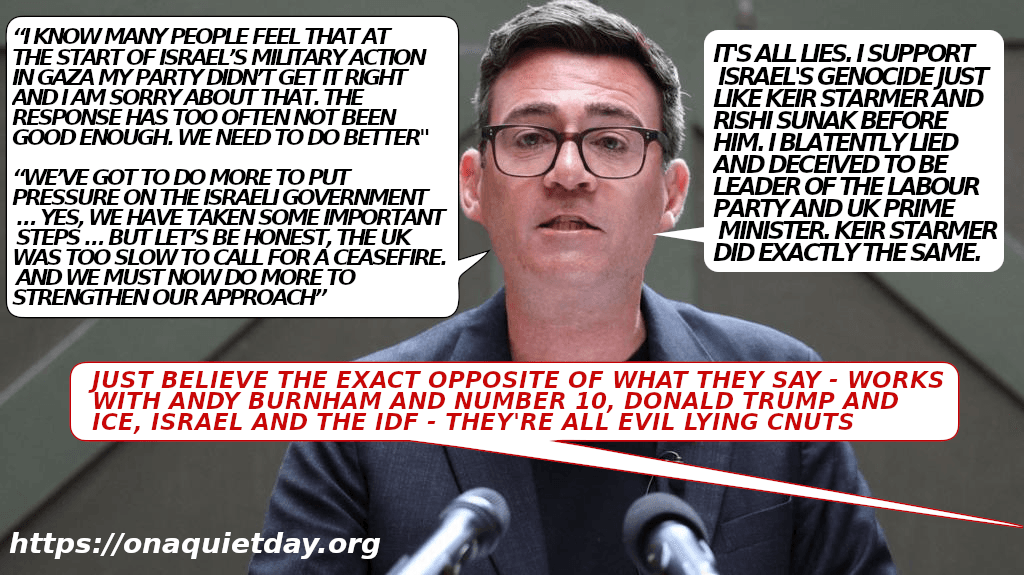
Ed Miliband says that he and the Labour Party are full of shit criminalising people holding signs as terrorists despite anything he says.UK Prime Minister Andy Burnham admits to blatently lying and engaging in deception to become leader of the UK Labour Party and Prime Minister.
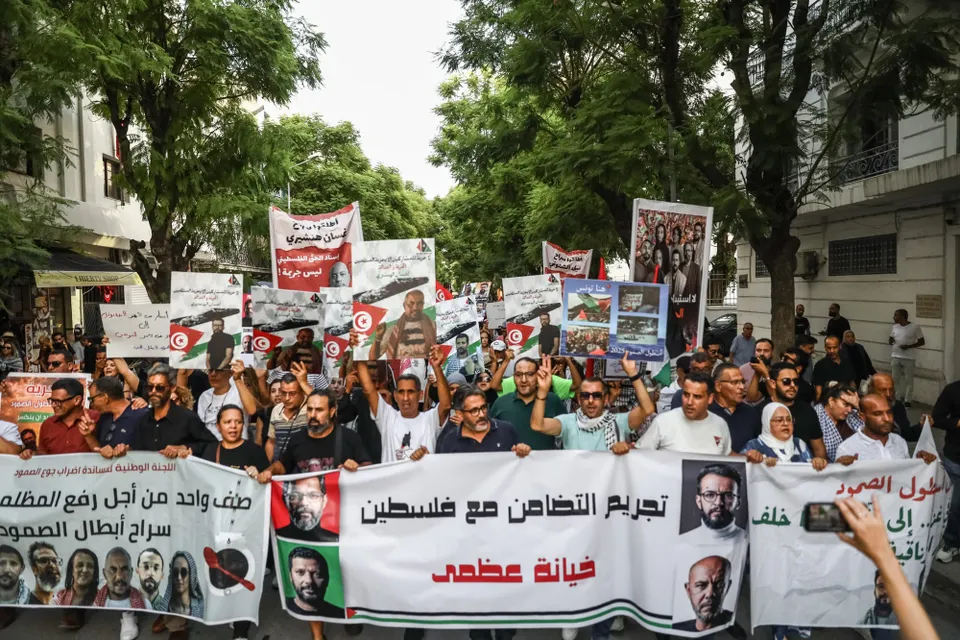
Demonstrators at the ”National March” in Tunis, Tunisia, on September 19, 2026 | Chedly Ben Ibrahim/NurPhoto/Getty Images
Wael Naouar has been refusing food since 16 August this year. More than five weeks into his hunger strike, supporters say the Palestinian rights activist imprisoned in Tunis, in a semi-conscious state and on the brink of death: Naour, who is Tunisian, has lost more than 20kg, is struggling to breathe, is fainting repeatedly and suffering from hallucinations.
Naouar is not alone, Nabil Channoufi, Ghassan Henchiri and Ghassan Boughdiri — three other activists imprisoned alongside Naouar — have also joined his hunger strike.
Their alleged crime?
Helping organise the 2025 Global Sumud Flotilla, a Palestine solidarity mobilisation in which hundreds of activists from around the world gathered in Tunisia, before setting sail for Gaza in an attempt to break Israel’s illegal siege blockade of the embattled region to provide vital supplies of food and medicine to an embattled population.
The flotilla — which comprised over 40 ships — never made it to Gaza, but succeeded in refocusing the world’s attention on the UN-designated genocide perpetrated on the Palestinian people by the Israeli state.
The story of Naouar’s arrest, his subsequent hunger strike, and the support he and his comrades have received from a wide cross-section of Tunisian society including the Tunisian League for the Defence of Human Rights, the Tunisian General Labour Union and the Tunisian National Bar Association, reveals how the global grassroots movement to demand justice and freedom for Palestinians shows no sign of abating even as many national governments in across the world either chosen silence, or have bowed to pressure from the United States and Israel to crackdown on their own citizens.
Around the world, including here in the UK, citizens urging their governments to take action face torture, arrest, prosecution and lengthy prison sentences.
Earlier this month, Bassem Trifi, president of the Tunisian League for the Defence of Human Rights, visited Naouar in prison with an appeal signed by the Tunisian League for the Defence of Human Rights, the Tunisian General Labour Union and the Tunisian National Bar Association, urging him to stop the hunger strike and preserve his life.
“His health has deteriorated dramatically and his condition is extremely alarming,” Trifi said at the time, adding that Naouar thanked the organisations and activists supporting him but said his hunger strike would continue until “the injustice imposed upon him and his comrades is lifted.”
When Solidarity is a Crime
In Tunisia, the preparations for the 2025 Sumud Flotilla were far from clandestine. Local activists reached out to the relevant Tunisian authorities to seek permission to charter ships and purchase medicines, baby formula and other humanitarian supplies for Gaza, Ghassan Bouazzi, a member of the National Committee for the Defense of the Sumud Flotilla Activists and the Palestinian Cause, told openDemocracy.
The authorities neither approved nor rejected the application, Bouazzi said, and so the organisers proceeded.
In September 2025, hundreds of activists descended on Tunisia to prepare the flotilla, organisers spoke to journalists, held public gatherings and coordinated with police and security officials around Sidi Bou Said port, where the boats assembled.
“The collection of donations, the organisation of the flotilla and, before that, the organisation of a land-based aid convoy… all took place openly and in full view of the Tunisian authorities,” Bouazzi said, adding that the organising headquarters was barely 500 metres from the interior ministry.
The state did more than simply know about the mobilisation, he continued, “The Tunisian state was, in some sense, a party to the flotilla’s departure, and was fully aware of the entire process through which it was organised.”
Ships from the global flotilla began departing for Gaza from Italy and Spain in late August 2025, and were joined by vessels from Greece and Tunisia in early September that year. On the night of September 24, several vessels were attacked by drones and the Israeli crackdown swung into full force.
Back in Tunisia, the mood of the authorities had begun to shift as well.
In January 2026, Naouar and other organisers in Tunis began publicly discussing preparations for a second flotilla. The following month, organisers submitted an application to the authorities, Bouazzi said. This time, permission was denied.
Weeks later, the arrests began.
The authorities claimed those organising Sumud 2025 had committed fraud, falsification of documents and money laundering. Investigators have since scrutinised the detainees’ bank accounts, assets and financial transactions, as well as those of some relatives, according to Bouazzi. He said that, to his knowledge, the investigation had established no unexplained enrichment or links to money-laundering networks thus far.
Seven organisers were initially detained in March. Three have since been released. Naouar, Channoufi, Henchiri and Boughdiri remain in Mornaguia prison.
Within 48 hours of their arrests, supporters established the National Committee for the Defense of the Sumud Flotilla Activists and the Palestinian Cause. Since then, campaigners have organised repeated protests calling for their release.
Last week, protesters marched through central Tunis from the headquarters of the Tunisian National Journalists’ Union to Avenue Habib Bourguiba, carrying pictures of the four detainees and calling for an end to the case.
Then some of the protesters were arrested too.
From the following night, police detained people who had participated in the demonstration, some from their homes and others from the street. Lawyers said at least 11 had been arrested, while activists put the number at 13 or more.
A judge subsequently authorised an additional 48 hours of detention for some of those arrested, whose lawyers said they had been questioned about slogans chanted during the protest. Tunisian authorities had not publicly confirmed the arrests at the time of writing.
openDemocracy contacted the Tunisian authorities for comment but had received no response by the time of publication.
Activists such as Bouazzai, have been trying to understand what is driving this recent crackdown.
“The Tunisian authorities regard any independent movement with significant popular support and mobilisation as a threat to their power,” he said, “even when that movement is devoted to supporting the Palestinian people.”
Naouar has a history of political organising beyond Palestine solidarity. He was imprisoned as a student under former dictator Zine El Abidine Ben Ali, later became secretary-general of the General Union of Tunisian Students and, shortly before his arrest this year, publicly criticised President Kais Saied.
Human rights organisations have also raised wider concerns about pressure on Tunisia’s civil society, including the use of financial investigations, lengthy pre-trial detention and prosecutions of activists and NGO workers. Saied’s government has rejected accusations that the judiciary is being used against political opponents and says judicial proceedings are independent.
That tension is particularly striking in Tunisia, where Palestine has historically commanded broad public support and Saied himself has repeatedly expressed support for the Palestinian cause.
Bouazzi argues there is a growing gap between that rhetoric and the state’s treatment of independent organising around Palestine.
He also believes external pressure and the wider geopolitical situation in the region may have played a role in the government’s changing approach, although he did not provide evidence of specific foreign intervention.
For the movement campaigning outside the prison, the immediate demand remains straightforward: the four organisers should be released.
“What we ask of our friends and of supporters of the Palestinian people around the world is to shed light on this injustice,” Bouazzi said. “International attention could create embarrassment and pressure on the Tunisian authorities and help secure the release of our detained comrades.”
Orcas discuss Donald Trump and the killer apes’ concept of democracy. Front Orca warns that Trump is crashing his country’s economy and that everything he does he does for the fantastically wealthy.Ed Miliband says that he and the Labour Party are full of shit criminalising people holding signs as terrorists despite anything he says.UK Prime Minister Andy Burnham admits to blatently lying and engaging in deception to become leader of the UK Labour Party and Prime Minister.
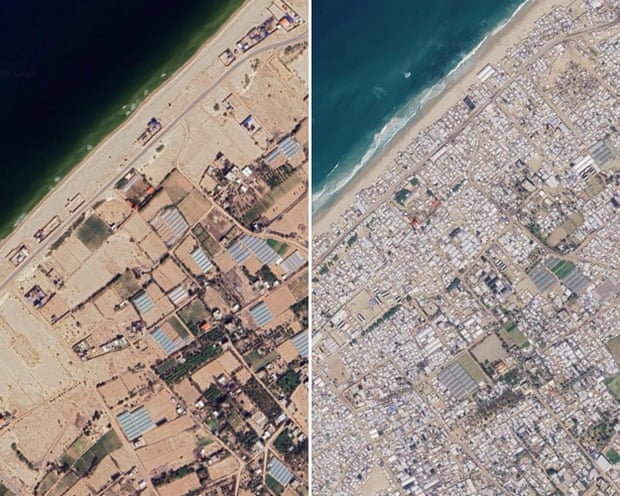
Al-Mawasi in Rafah in 2023 (left) and 2026, with huge tented camps lining much of the shoreline. Composite: Google
Satellite imagery shows further destruction of homes, businesses and places of worship since fragile ceasefire
An update to Google Maps has revealed the extent of devastation during the three-year Gaza war and the severity of the continuing humanitarian crisis faced by the territory’s 2.3 million inhabitants.
The images were taken in June this year and show further destruction of homes, businesses, places of worship and infrastructure since a fragile ceasefire came into effect almost 12 months ago.
They show huge tented camps lining much of the shoreline, often within a few metres of the sea. Gaza’s once busy main port, now badly damaged and empty of fishing boats, is surrounded by makeshift accommodation. Any available open space in Gaza City is packed with shacks, tents and huts.
…
More than 2.1 million displaced people are living in tents and temporary shelters in Gaza, where about 82% of structures – roughly 200,000 buildings – have been damaged, with about two-thirds of those destroyed, according to the UN agency for Palestinian refugees, Unrwa.
A recent UN assessment estimated that the number of destroyed structures across Gaza had increased by 9% since the declaration of a ceasefire in October 2025.
Donald Trump sings and dances, says that it’s fun to kill everyone … unless he gets distracted or falls asleep.Ed Miliband says that he and the Labour Party are full of shit criminalising people holding signs as terrorists despite anything he says.UK Prime Minister Andy Burnham admits to blatently lying and engaging in deception to become leader of the UK Labour Party and Prime Minister.
A large group of Jewish and Muslim demonstrators carrying banners and Palestinian flags march from Bryant Park toward the United Nations headquarters to protest the policies of Israeli Prime Minister Benjamin Netanyahu and US President Donald Trump regarding the war in Gaza in New York, United States, on September 24, 2026. [Waleed Zein – Anadolu Agency]
To claim that Israel’s genocidal war in Gaza has fundamentally changed the internal politics of the United States and the wider world might be an overstatement. But what cannot be overstated is a simple fact: Israel and its policies no longer enjoy the virtually unlimited approval and support in the US that they once taken for granted. At both the local and national levels, support for Israel has weakened significantly, while across Europe, too, political attitudes toward Israel have changed in ways that would have been difficult to imagine just three years ago.
To see that change in Europe just consider the new position taken by the United Kingdom toward Israel, particularly over the occupied West Bank. In earlier September, Foreign Secretary Ed Miliband accused Israeli settler terrorists of perpetrating ethnic cleansing against Palestinians and announced new measures targeting Israel’s settlement enterprise, including sanctions and a ban on imports. Prime Minister Andy Burnham, who just two months before taking office, apologized for Labour’s initial response to the war on Gaza for being too slow to respond to Israel’s genocide. He has said Britain must put more pressure on the Israeli government and consider further sanctions. These are not the positions Britain was taking just a few years ago.
In America it is even more evident that Israel is losing the support it once enjoyed. It would have been unthinkable just three years ago that large sections of the American public would challenge their government’s traditionally unconditional support for Israel.
Opinion polls are showing a trend of negative opinion toward Israel. Last July, an Economist/YouGov poll found that 47 percent of Americans believed Israeli Prime Minister Benjamin Netanyahu was guilty of war crimes in Gaza, while 43 percent said Israel was committing genocide against Palestinians. Nearly half, 49 percent, said the US should arrest Netanyahu if he entered the country. Even more strikingly, a February 2026 Gallup poll found that 41 percent of Americans sympathized more with Palestinians in the Middle East conflict. From 2001 through 2025, Israelis had consistently enjoyed a double-digit advantage on this measure. In 2026, for the first time in Gallup’s long-running series, Palestinians moved ahead of Israelis in Americans’ sympathies.
The change is visible beyond polling booths and political rallies.
On September 24, Oscar-winning actress Susan Sarandon and Emmy-winning actress Hannah Einbinder were among more than 100 people arrested in New York during a protest against Netanyahu outside the United Nations, where demonstrators demanded an end to U.S. arms supplies to Israel.
Hollywood star Mark Ruffalo was among more than 1,800 actors, entertainers and producers, including Nicolas Gage and Emma Stone, who signed a pledge to boycott Israeli film institutions over the war. What was once largely confined to the margins of American political debate has consequently become part of mainstream public discourse.
Politically speaking, the shift is becoming increasingly visible at the grassroots level and in electoral contests across the US. One of the clearest examples is the rise of Zohran Mamdani, who defeated former New York Governor Andrew Cuomo in the Democratic mayoral primary before going on to win the general election. Cuomo had made support for Israel one of the central issues of his campaign, while Mamdani was an outspoken critic of Israel’s conduct in Gaza and a supporter of Palestinian rights, going as far as to threaten to have Israeli Prime Minister Benjamin Netanyahu arrested if he came to New York. The ability of a candidate with such positions to win in New York — home to the largest Jewish population outside Israel — was itself politically significant. It indicates even Jewish people are not supporting Israeli actions.
The same shift is visible in the growing difficulty faced by AIPAC, the most powerful pro-Israel lobby in the United States, and its affiliated groups in some Democratic primaries.
In Michigan, AIPAC and its affiliated groups spent nearly $30 million backing pro Israel Representative, Haley Stevens, against progressive candidate Abdul El-Sayed, a vocal critic of U.S. military aid to Israel. El-Sayed nevertheless won the Democratic Senate primary on August 4 by about 48.5% of the vote.
The November midterm elections will provide a much broader test of whether this change in public opinion is beginning to translate into electoral politics.
Furthermore, the shift has also begun to show itself inside Congress in ways that would have been extremely difficult to imagine only a few years ago. On July 15, the House of Representatives voted on an amendment that would have cut $3.3 billion in military aid to Israel from a broader national security spending bill. True the amendment failed but 103 Democrats and one Republican voted in favour of the cut. In other words, more than half of all House Democrats backed an effort to cut military aid to Israel — an extraordinary departure from the traditionally strong bipartisan support for Israel in Congress. The vote is significant because of the number of lawmakers prepared to break with the established position on U.S. military support for Israel. With the November midterm elections approaching, such a vote provides another indication that the political debate over Israel and U.S. support for it is no longer confined to the margins of American politics.
What has changed in the US is not simply the intensity of criticism of Israel, but the political space in which it now operates. What was once largely treated as a settled pro-Israel bipartisan consensus is increasingly being challenged by voters, activists, candidates and members of Congress. The shift is visible in opinion polls, in the streets, in Democratic primaries and even on the floor of the House of Representatives. None of this means that support for Israel has disappeared from American politics; it plainly has not. But the political consensus surrounding it is no longer what it was. The November midterm elections will show whether this change in public opinion and political activism has become a lasting force in American electoral politics or just a temporary shift.
Whatever the outcome of the midterms, however, it will be difficult for Israel to return to the position it once occupied in American public life — as a state that could count on being treated by much of American public opinion and the political establishment as virtually beyond criticism.
It will be interesting to watch whether Democrats on the left who make it into the next Congress will use foreign policy, including U.S. support for Israel, as an issue in their dealings with pro-Israel Democrats and Republicans, including the president himself.
The views expressed in this article belong to the author and do not necessarily reflect the editorial policy of Middle East Monitor.
This work by Middle East Monitor is licensed under a Creative Commons Attribution-NonCommercial-ShareAlike 4.0 International License
Climate science denier Donald Trump confirms that he knows nothing about democracy and that more liquid gold is being secured according to his policy of global privateering.Orcas discuss Donald Trump and the killer apes’ concept of democracy. Front Orca warns that Trump is crashing his country’s economy and that everything he does he does for the fantastically wealthy.
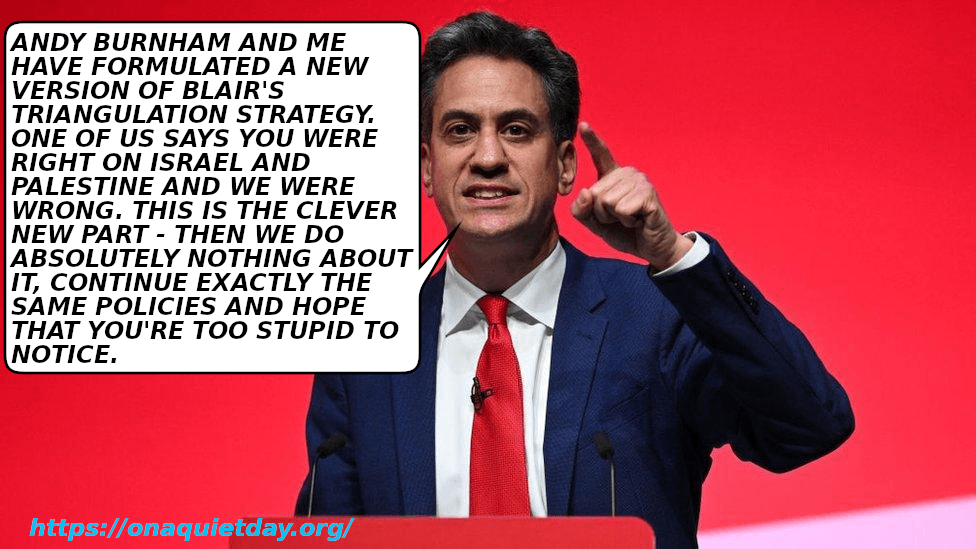
Ed Miliband claims that he and Andy Burnham have reformulated Blair’s triangulation strategy. Their new formulation entails acknowledging that they were wrong on Israel and Palestine but entails doing absolutely nothing about it and continuing exactly the same policies hoping that you’re too stupid to notice.UK Prime Minister Andy Burnham admits to blatently lying and engaging in deception to become leader of the UK Labour Party and Prime Minister.

 Protesters gather outside Number 10 North in Manchester demanding the government puts an end to spy tech firm Palantir’s role in the NHS, October 1, 2026