Tag: Germany

  • ‘North Sea Fossil Free’: Activists in 6 Countries Protest ‘Unhinged’ Oil and Gas Development

    Spread the love

    Original article by OLIVIA ROSANE republished from Common Dreams under Creative Commons (CC BY-NC-ND 3.0). 

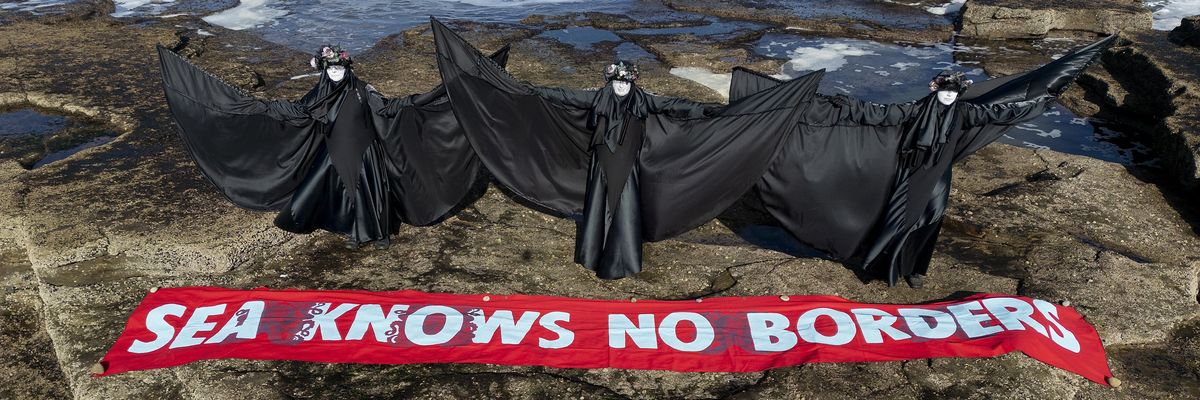
    The “oil slicks” performance artist group demonstrates the impacts of a potential oil spill on Scotland’s Moray Firth as part of a North Sea-wide day of action on March 16, 2024.  (Photo: XR Forres)

    “Going full steam ahead with new North Sea oil and gas is a sure fire route to the worst climate scenarios,” one campaigner said.

    Climate activists in six North Sea countries came together on Saturday to carry out acts of civil disobedience in protest of their governments’ continued fossil fuel development.

    Demonstrators in the United KingdomNorway, Sweden, Denmark, Germany, and the Netherlands blockaded roads, ports, and refineries; dropped banners; and held solidarity concerts as part of the North Sea Fossil Free campaign to demand that their governments align their plans for the shared body of water with the Paris agreement goal of limiting global heating to 1.5°C above preindustrial levels.

    “For too long, the U.K., Norway, and other North Sea countries have avoided scrutiny for their oil drilling plans as the emissions are not included in their national inventories,” a spokesperson for Extinction Rebellion U.K. told Common Dreams. “Going full steam ahead with new North Sea oil and gas is a sure fire route to the worst climate scenarios.”

    “The only serious response we can make is for citizens to unite, but we need to see many many more people doing this work.”

    The day of action, which was organized by Extinction Rebellion (XR), came days after a new report from Oil Change International revealed that none of five North Sea countries—Norway, the U.K., the Netherlands, Germany, and Denmark—have plans consistent either with limiting warming to 1.5°C or with the agreement to transition away from fossil fuels reached at last year’s United Nations COP28 climate conference. If the five countries were counted as one, they would be the seventh biggest producer of oil and gas in the world.

    In particular, these governments continue to issue permits to explore for and develop oil and gas fields, despite the fact that the International Energy Agency has said that no new fossil fuel development is compatible with limiting global temperature rise to 1.5°C. In one high-profile example, the U.K. approved the undeveloped Rosebank oil field in September 2023. Taken together, these permits could lead to more than 10 billion metric tons of greenhouse gas emissions.

    The worst offenders were Norway and the U.K., which could be among the top 20 developers of oil and gas fields through mid-century if they do not change course.

    “The five major North Sea countries are at a crossroads: One path leads toward global leadership in climate action and green industries, where they take bold action to phase out oil and gas production that creates sustainable jobs and communities. The other path leads to catastrophic climate change, economic crisis, and the loss of status as climate leaders globally, as they cling to outdated practices while the world moves forward,” Silje Ask Lundberg, North Sea campaign manager at Oil Change International, said when the report was released.

    Extinction Rebellion co-founder Clare Farrell said that the North Sea governments’ policies were a betrayal of their citizens and the world following the hottest year on record.

    “Temperatures have tracked 1.5°C above average recently, almost 2°C,” Farrell said. “Our global commitments, such that they are, are being flushed away with no regard for what the public really want. Where’s the consent for that here in our democracies? No government has a mandate to do that. So people deserve to know that our governments are willfully destroying everything. The people of these North Sea nations have not consented to destroying civilization, but that’s what is going to happen. Their governments are unhinged and unchecked.”

    Saturday’s protests, Farrell continued, were a way for the people in these countries to make their voices heard.

    “The only serious response we can make is for citizens to unite, but we need to see many many more people doing this work,” Farrell said. “Direct action like this should shake us awake; our governments will destroy democracy and society if we let them continue, that’s the course we are on, and they are redoubling their efforts despite the facts and knowing how much suffering they are already causing all over the world as climate breaks down.”

    The demands of Saturday’s protests were threefold: An end to new oil and gas infrastructure in the North Sea, for governments to tell the truth about the realities of the climate crisis, and for the countries to pursue a just transition to renewable energy. In addition, many activists made additional demands specific to their nations’ policies.

    The Netherlands

    In the Netherlands, activists with Extinction Rebellion and Scientist Rebellion blocked all roads and railways leading to the largest oil refinery in Europe: Shell’s Pernis refinery. They targeted Shell because the oil major has received new permits to drill in the Victory Gas Field and has also restarted its drilling in the Pierce Field. What’s more, the company has refused to clean up its aging equipment in the North Sea, leaving old pipelines and drilling platforms to rust and pollute the sea with mercury, polonium, and radioactive lead. While there are 75 aging Shell oil and gas platforms in the Dutch North Sea that should be removed by 2035, current efforts are not on track to meet this deadline.

    “Like the rest of the fossil industry, Shell is only interested in profits and shareholder returns,” said Bram Kroezen of XR Netherlands, adding that Shell’s appeal of a landmark court ruling ordering it to reduce emissions showed that the company “completely lacks a moral compass.”

    Germany

    Activists with Ende Gelände blocked off access to a floating liquefied natural gas (LNG) terminal in the port of Brunsbüttel, Germany, beginning at 9:00 am local time. The activists are calling for an end to LNG imports, as new science reveals the so-called “bridge” fuel may in fact be at least as damaging to the climate as coal due to previously unaccounted for methane leaks.

    “LNG is a double climate killer,” Rita Tesch, spokesperson for Ende Gelände, said in a statement. “Because it consists of methane. Methane is even more harmful to the climate than carbon dioxide. It escapes into the atmosphere during transportation by LNG ships and at terminals such as here in Brunsbüttel, and heats it up rapidly. The carbon dioxide from burning it is on top of that. It’s clear: LNG imports are a climate crime!”

    Norway

    Activists with XR Norway targeted Rafnes Petroleum Refinery, with some blockading access on land while another group entered the security area by boat.

    “I’m ashamed to be a Norwegian,” XR Norway spokesperson Jonas Kittelsen said in a statement. “Norway profits massively from aggressively expanding our oil and gas sector, causing mass suffering and death globally. My government portrays us as better than the rest of the world, which we are not.”

    Denmark

    Performance collective Becoming Species and Extinction Rebellion Denmark worked together to stage a creative protest targeting the oil company Total Energies, which is the leading oil and gas producer in the Danish North Sea and currently has plans to reopen “Tyra Feltet,” Denmark’s largest gas field. Four members of the band Octopussy Riot climbed a Total-owned container and staged a punk concert in Denmark’s Esbjerg Harbor.

    “We octopuses have formed the band Octopussy Riot and have arrived here to play our song, a demand for you two-legs to stop oil and gas extraction,” performer Linh Le, said. “The sea is dying, our climate collapsing. We will not accept that the most rich and powerful destroy our home. We do not want to go extinct.”

    Sweden

    Members of XR Sweden blocked the road to Gothenburg’s Oil Harbor, where the group has been protesting since May of 2022. The activists called on Sweden to stop investing in the harbor and on city officials to develop a plan to dismantle the harbor and refineries.

    “Twenty-two million tons of oil enter Gothenburg’s port every year, which is owned by the city,” one activist said. “There is no plan for decommissioning. This does not go together with the climate goals.”

    Scotland

    Finally, protesters across Scotland stood in solidarity with the other actions with performances and banner drops. In Aberdeen, activists unfurled banners outside the offices of Equinor, which owns 80% of Rosebank, and Ithaca, which owns the remaining 20%. The banners read, “North Sea Fossil Free,” “Stop Rosebank,” and “Sea knows no borders.” In Dundee, protesters targeted the Valaris 123 oil platform off the coast with banners. Shetland Stop Rosebank also brought signs to Lerwick Harbor, from where the first stage of Rosebank’s development is launching. XR Forres organized a performance of the group the “oil slicks” along the Moray Firth, to demonstrate what an oil spill would do to its unique coastal landscape.

    “All countries should align their drilling plans with the Paris agreement now,” the XR U.K. spokesperson said. “We thank everyone who has taken action today in defense of a livable planet.”

    Original article by OLIVIA ROSANE republished from Common Dreams under Creative Commons (CC BY-NC-ND 3.0). 

  • UN Experts Say Arms Exports to Israel ‘Must Cease Immediately’

    Spread the love

    Original article by JAKE JOHNSON republished from Common Dreams under Creative Commons (CC BY-NC-ND 3.0). 

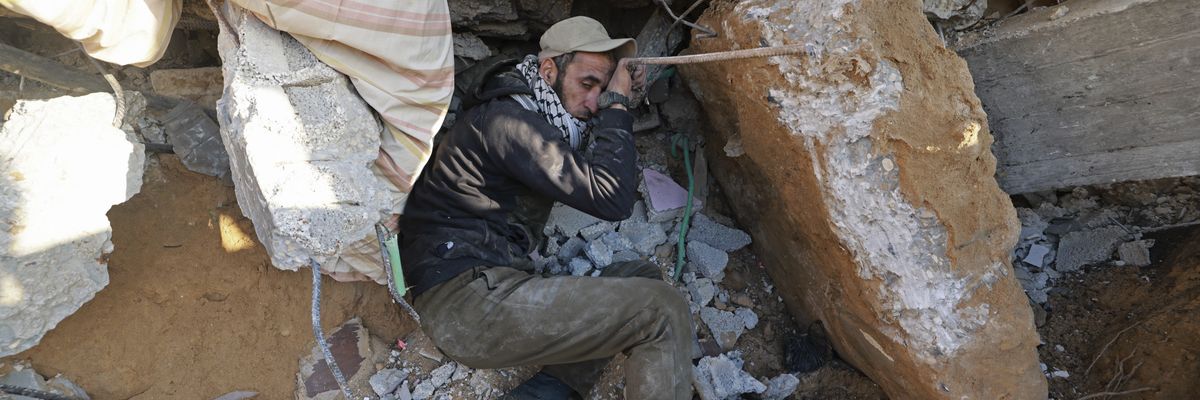
    A man looks for survivors amid the debris of destroyed houses in the aftermath of Israeli airstrikes in Rafah in the southern Gaza Strip on February 22, 2024.  (Photo: Mohammed Abed/AFP via Getty Images)

    “State officials involved in arms exports may be individually criminally liable for aiding and abetting any war crimes, crimes against humanity, or acts of genocide.”

    Dozens of United Nations experts on Friday called for an immediate arms embargo on Israel and warned that countries and private companies still sending weapons to the Israeli military during its assault on Gaza could be complicit in crimes against humanity.

    The experts—including special rapporteurs on education and the rights of displaced people—said in a joint statement that “any transfer of weapons or ammunition to Israel that would be used in Gaza is likely to violate international humanitarian law and must cease immediately.”

    “Such transfers are prohibited even if the exporting state does not intend the arms to be used in violation of the law—or does not know with certainty that they would be used in such a way—as long as there is a clear risk,” they said. “State officials involved in arms exports may be individually criminally liable for aiding and abetting any war crimes, crimes against humanity, or acts of genocide.”

    The U.N. experts noted that the United States and Germany are “by far” Israel’s largest arms suppliers, though France, the United Kingdom, Canada, and Australia also export weapons to the Israeli government, which the International Court of Justice (ICJ) ruled is plausibly committing genocide in the Gaza Strip.

    The ICJ’s interim ruling, which Israel has disregarded, has “heightened” the need for an arms embargo, the experts said, noting that compliance with the Genocide Convention of 1948 “requires states parties to employ all means reasonably available to them to prevent genocide in another state as far as possible.”

    The experts also said that “arms companies contributing to the production and transfer of arms to Israel and businesses investing in those companies bear their own responsibility to respect human rights, international humanitarian law and international criminal law.”

    “They have not publicly demonstrated the heightened human rights due diligence required of them and accordingly risk complicity in violations,” they said.

    “All states must not be complicit in international crimes through arms transfers. They must do their part to urgently end the unrelenting humanitarian catastrophe in Gaza.”

    The statement comes two weeks after a Dutch court ordered the Netherlands’ government to stop exporting jet parts to Israel, citing the “clear risk” that the aircraft might be used to “commit serious violations of international humanitarian law.” The government is appealing the ruling.

    Other countries, including Italy and Spain, have said they have suspended arms sales to Israel since its latest assault on Gaza began—though a Spanish newspaper reported earlier this month that the country exported $1.1 million worth of ammunition to Israel in November.

    The U.S., meanwhile, is reportedly planning to send additional weaponry to Israel and has refused to attach conditions to its arms exports even as top officials—including President Joe Biden—publicly voice concerns about the rising death toll in Gaza and Israel’s looming ground invasion of Rafah, where more than half of the enclave’s population is currently sheltering.

    According to The Wall Street Journal, the latest proposed arms shipment “includes roughly a thousand each of MK-82 bombs, KMU-572 Joint Direct Attack Munitions that add precision guidance to bombs, and FMU-139 bomb fuses.”

    “The arms are estimated to be worth tens of millions of dollars,” the Journal added. “The proposed delivery is still being reviewed internally by the administration, a U.S. official said, and the details of the proposal could change before the Biden administration notifies congressional committee leaders who would need to approve the transfer.”

    Israel has used U.S. weaponry to commit atrocities in the Gaza Strip, including airstrikes on homes full of children. An Amnesty International investigation released earlier this month found that a January 9 Israeli airstrike on a residential building in southern Gaza killed 18 civilians, including 10 children.

    Based on ordnance fragments recovered from the rubble, the weapon used in the attack was identified as a GBU-39 Small Diameter Bomb—made by the U.S. company Boeing.

    On Friday, Gaza’s health ministry said that Israeli airstrikes killed more than 100 people over the past 24 hours and injured at least 160 more. Israeli strikes on the severely overcrowded city of Rafah on Thursday destroyed a mosque and several homes, killing or wounding many people and leaving others trapped under the rubble.

    “International law does not enforce itself,” the U.N. experts said Friday. “All states must not be complicit in international crimes through arms transfers. They must do their part to urgently end the unrelenting humanitarian catastrophe in Gaza.”

    Original article by JAKE JOHNSON republished from Common Dreams under Creative Commons (CC BY-NC-ND 3.0). 

    Jewish-Led NYC Rally Targets AIPAC, Dem Allies Who Oppose Gaza Cease-Fire

    “AIPAC uses money and racist bullying to ensure congressional complicity in the genocide of Gaza,” said Jewish Voice for Peace.

    ‘People of Gaza Need a Cease-Fire,’ Medical Aid Leader Tells UN Security Council

    “This body has failed to effectively address this conflict. We have watched members of this council deliberate and delay while civilians die.”

    All of Us Must ‘Confront the Current Siege in Gaza’

    As the Nuremberg Tribunal and U.S. law make clear, it is the responsibility of the people to halt crimes that the courts have proved impotent to prevent.

  • South Africa to file legal action with ICJ against UK, US, for war crime complicity

    Spread the love

    Article republished from the Skwawkbox

    South Africa’s legal team at the ICJ last month

    Nation whose case put Israel formally on trial for genocide joins Nicaragua in turning its sights on accomplices in genocide

    A team of almost fifty South African lawyers is preparing a legal case to bring to the International Court of Justice (ICJ), the United Nations’ top court, against the US and UK, for their complicity in Israel’s array of war crimes in Gaza and the occupied West Bank.

    South Africa’s successful ICJ case against Israel last month led to Israel being put formally on trial for genocide and resulted in a string of binding orders on Israel to stop its slaughter of Gazans and even to protect Palestinians from harm, as well as to ensure adequate aid reaches the strip’s 2.5 million people, many of whom are now starving and homeless.

    Israel has flouted the rulings, continuing and even intensifying the mass murder and blockade, and is being supported in its flagrant disregard for international law by the UK and US, who are providing both material and financial aid, and giving political cover by refusing to condemn Israel’s actions or to call its crimes what they are, instead casting doubt on the mass deaths and brutality and denigrating the Court’s ruling.

    South Africa joins Nicaragua in taking action against the UK and US. The Central American nation has also filed a case against Germany, Canada and the Netherlands.

    The team of lawyers, which already numbers around fifty, is likely to grow further as more lawyers are set to join from other nations. Wikus van Rensburg, who is leading the action, said that it was time for the US and other complicit nations to “be held responsible for [their] crimes”.

    Article republished from the Skwawkbox

  • Protesters March on NYC Transit Hubs Demanding Gaza Cease-Fire

    Spread the love

    Original article by BRETT WILKINS republished from Common Dreams under Creative Commons (CC BY-NC-ND 3.0). 

    Demonstrators demanding a Gaza cease-fire protest outside Penn Station in New York City on December 18, 2023. (Photo: caren/X)

    “We must stand up and not be silent to this injustice,” said one rabbi taking part in the demonstration.

    A coordinated wave of demonstrations against what activists called Israel’s genocidal war on Gaza targeted New York City transit hubs Monday afternoon, with protesters demanding an immediate cease-fire as heavy Israeli bombardment of the besieged strip pushed the death toll from 73 days of attacks to nearly 20,000.

    Protesters marched from Grand Central Station to the Port Authority Bus Terminal and then on to Penn Station, where at least hundreds of activists gave police the slip and occupied Moynihan Hall. Many participants prayed for peace before leaving the station.

    “We must stand up and not be silent to this injustice,” Rabbi Yisroel Dovid Weiss toldamNewYork Metro outside Grand Central Station. “We hurt and cry with the people who are dying and suffering under the stranglehold of the Zionist occupation. We want the world to know that we hurt because we are Jews, we will not be silent because we are Jews.”

    Independent photojournalist Katie Smith followed the entire demonstration—which was coordinated by the group Within Our Lifetime—documenting incidents including police “violently engaging with protesters” and a confrontation between the actor Alec Baldwin and activists.

    According to Smith, activists later marched to a building in Greenwich Village where a fundraiser for the Israel Defense Forces was reportedly being held.

    Monday’s actions followed recent protests in New York, including a Manhattan march led by artists remembering the life and work of Refaat Alareer—a Gaza poet and professor killed last week in an Israeli airstrike—and calling on Israel to free political prisoners including the members of Freedom Theater recently arrested in Jenin in the illegally occupied West Bank.

    In recent days, large protests for Gaza have also taken place in U.S. cities including HoustonLos Angeles, and Washington, D.C., as well as in cities in countries including the U.K., Canada, France, Belgium, Norway, and Germany.

    In California, workers at Google and allies held a Thursday die-in at the tech giant’s San Francisco office “to demand the company stop powering Israel’s genocide of Palestinians in Gaza” through the $1.2 billion Project Nimbus cloud computing contract.

    More protests are planned for this week, including a nationwide action by Mennonites on Tuesday and a rally by over 80 groups on Capitol Hill in Washington, D.C. that same day.

    Sponsored by the Action Center on Race and Economy, Adalah Justice Project, Grassroots Global Justice Alliance, and the U.S. Campaign for Palestinian Rights, Tuesday’s D.C. event is being held to “demand a permanent cease-fire in Gaza and oppose the Biden administration’s proposed military aid package sending billions of taxpayer dollars to Israel, U.S. southern border militarization, and immigration enforcement.”

    Original article by BRETT WILKINS republished from Common Dreams under Creative Commons (CC BY-NC-ND 3.0). 

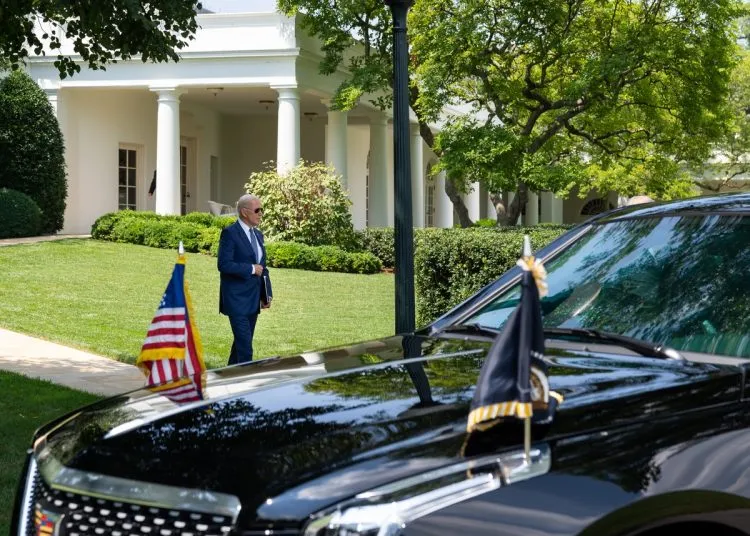
    Zionist president Joe Biden. 27 July 2021 image by Official White House Photo by Adam Schultz. Original public domain image from Flickr
    Zionist president Joe Biden. 27 July 2021 image by Official White House Photo by Adam Schultz. Original public domain image from Flickr
  • Germany bans public grieving and solidarity with Palestine

    Spread the love

    Original article republished from peoples dispatch under a Creative Commons Attribution-ShareAlike 4.0 (CC BY-SA) license.
    Demonstrators in Berlin take the streets in solidarity with Palestine (Photo: Montecruz Foto)

    Germany is home to Europe’s largest Palestinian community, with roughly 80,000 Palestinians living in the country. For years, German authorities have tried to stifle Palestinian activism in the country, viewing it as a nuisance to its explicit policy of “unconditional support for Israel.” Demonstrations, such as one earlier this year to mark the 75th anniversary of the Nakba, have been sporadically banned in recent years and organizations, like the Palestinian prisoner solidarity network Samidoun, have also come under increasing scrutiny.

    Yet the criminalization of solidarity with Palestine on a national level has taken on entirely new dimensions since October 7. After a small demonstration on Berlin’s busy Sonnenallee street on the evening of October 7, the German media and body politic have been up in arms about Palestinians supposedly celebrating terrorism and antisemitism on German streets.

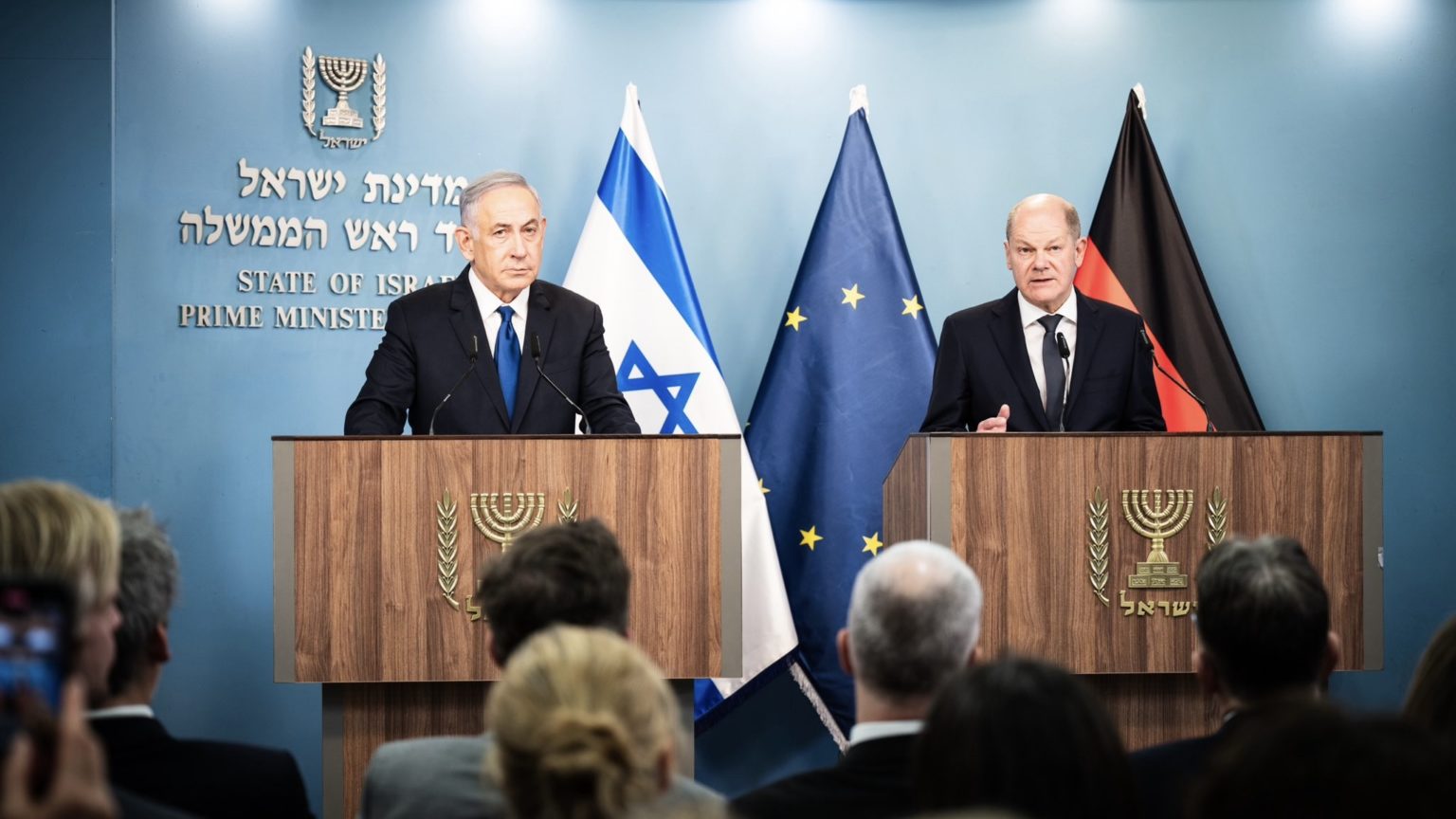
    Talking points that were two weeks ago only uttered by far-right AfD politicians are now being openly expressed by politicians from all parliamentary parties in Germany. Playing off the idea of “imported antisemitism,” the social democratic Chancellor Olaf Scholz is now arguing that “we must finally deport on a large scale” residents who do not hold German citizenship and openly protest against Israel. The Christian Democrats (CDU) are even demanding that the recognition of Israel’s right to exist must become a precondition for German citizenship.

    Samidoun has been made into public enemy number one, as the media presents the group as a bastion for “sympathizers of terror” that poses “a particular danger, because as a secular organization, they are building bridges between Islamists and radical leftists.” In a speech before parliament on October 12, Chancellor Scholz personally announced a ban on Samidoun along with a ban on the activities of Hamas in Germany. 

    In Berlin specifically, which is home to one of the largest Palestinian diaspora communities outside the Arab world, the authorities have been particularly hostile towards any signs of solidarity with Palestine. Since October 7, every demonstration explicitly or implicitly referring to Palestine has been banned, leaving the roughly 30,000 Palestinians living in Berlin with no means of expressing their anguish at the siege and bombardment of Gaza.

    Solidarity groups have been trying to bypass this censorship by avoiding political statements and focusing on humanitarian campaigning, yet even demonstrations and slogans such as “Children in Gaza need help” and “Solidarity with the civilian population in the Gaza Strip” were banned. On October 13, the police went so far as to ban a demonstration registered by the group “Jewish Voice for a Just Peace in the Middle East” entitled “Jewish Berliners against violence in the Middle East.” 

    Sonnenallee, a busy street in the district in which many Arab migrants live, has become a focal point of dissent against Israel’s attack on Gaza. The police patrol Sonnenallee every evening with tight controls on the public squares. Racial profiling and brutal arrests are commonplace and often recorded and posted to social media. One particular video shows police officers stomping out a candle-lit vigil with their boots.

    In a letter to all Berlin schools, the city’s Department for Education, Youth and Family set out strict guidelines on how to discuss the situation in Palestine with students. “Any demonstrative action or expression of opinion that can be understood as advocating or approving of the attacks against Israel or support for the terrorist organizations carrying them out, such as Hamas or Hezbollah, constitutes a threat to school peace in the current situation and is prohibited.” According to the letter, these may include the following: “visibly wearing relevant clothing (for example, the kuffiyeh known as the Palestinian scarf), displaying stickers and patches with inscriptions such as ‘free Palestine’ or a map of Israel in the colors of Palestine (white, red, black, green), and shouting ‘free Palestine!’ and demonstrating verbal support for Hamas and its terrorism.”

    At one high school on Sonnenallee, a 61-year-old teacher attempted to confiscate a Palestinian flag from a 14-year-old student and ended up in a physical altercation with a second 15-year-old student. The parents’ association of the school tried to organize a demonstration under the slogan “No place for racism, no place for violence” as a reaction to the incident, yet it was promptly banned by the police, ostensibly as a “a precautionary measure”. The Central Council of Palestinians in Germany has since sent a letter in response to Berlin’s Department for Education, expressing their “great concern about the psychological and educational development [of their children]” in Berlin schools.

    As other European states are witnessing mass protests in solidarity with Palestine, the German state has been able to use force and violence to prevent such scenes on German streets. Yet it is unlikely that the government will be able to ban these sentiments of solidarity indefinitely, especially as the images of Israel’s brutal attack on Gaza continue to circulate around the world.

    Original article republished from peoples dispatch under a Creative Commons Attribution-ShareAlike 4.0 (CC BY-SA) license.