Article by Julia Conley republished from Common Dreams under Creative Commons (CC BY-NC-ND 3.0).
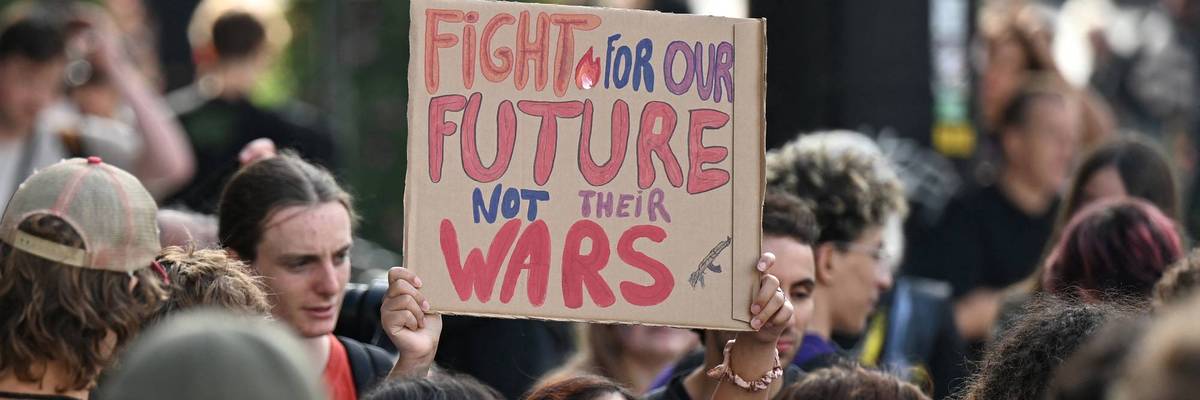
Protests across Europe have focused on education cuts, while a Gen Z-led movement has spearheaded demonstrations over voting rights in India.
“We are going to sweep away the old world,” said the deputy of the French National Assembly on Thursday, highlighting a rapidly growing global protest movement, largely led by students and young people, against austerity measures.
Clémence Guetté, a member of the left-wing French party La France Insoumise, or France Unbowed, added that “the youth wants to change everything,” posting on social media a video of a massive demonstration in Paris—just one of several cities across France where students have led more than 250,000 people in protests demanding education funding and decrying cuts in the proposed 2027 national budget.
RECOMMENDED…

‘Savagery’: Horrific Injuries as French Police Crack Down on Nationwide Student Protests

‘Should Concern All Americans’: Records Show ICE Has Gathered 50 Million Voter Records Ahead of Midterms
But Guetté noted that while France’s growing protests—and the violent response of the police—have captured international attention, with thousands of people demanding the resignation of President Emmanuel Macron in Place de la Bastille, Paris on Thursday, the movement against austerity and corrupt governance has spread across Europe and is also gaining traction across Latin America and South Asia.
“The youth of the world are rising up,” said Guetté.
The protests against education cuts, dilapidated school buildings, and crowded classrooms in France began in mid-September in lower-income Parisian suburbs before spreading nationwide.
As they have shown no sign of slowing down, thousands of miles away in India, the Generation Z-led Cockroach Janta Party (CJP)—so named because the chief justice of the Supreme Court derided unemployed young people as “cockroaches” this year—has spearheaded calls for the resignation of the country’s top Election Commission official.
The Election Commission has been accused of an illegal purge of voters over its “special intensive revision” of voter rolls, which has included removing more than 130 million names.
The CJP initially took to the streets over the summer to demand the resignation of the Indian education minister, due to leaks of the country’s medical school entrance exam, which had delayed university admissions for millions of students and forced them to retake the intense exams. CJP organizers said the scandal has led to the suicides of more than 20 students.
Those protests were ultimately successful in forcing Education Minister Dharmendra Pradhan out of office.
Thousands of supporters joined a demonstration in Bengaluru on Thursday as the CJP condemned the detention on Wednesday of politician Rahul Gandhi, a leader of the opposition against Prime Minister Narendra Modi, as well as other protesters.
Leaders of the mass protest movement on Thursday rejected allegations that the protests, which have also been met with violence from police, are “destabilizing the country.”
“When you declare living people as dead [on voter rolls] for your political gains, that is destabilizing the country,” said one organizer.
As Common Dreams reported Wednesday, Spain residents have also been inspired in recent days to take to the streets by the tens of thousands following the eviction of María del Carmen Abascal Martín, an 87-year-old woman who died this week before she was able to return home, as the demonstrations over housing justice were underway.
After Maricarmen’s eviction on September 23, the Spanish Socialist Workers’ Party, led by Prime Minister Pedro Sánchez, announced new rental regulations and protections for vulnerable tenants, but lawmakers rejected the package. Sánchez responded by dissolving the legislature and calling for snap elections in November.
Meanwhile, tens of thousands of people have marched in Madrid, Valencia, and other cities to demand a general strike and affordable housing across Spain, where the average rent has doubled over the last 10 years.
More than 1,000 people have set up encampments at Puerta del Sol in Madrid and Plaza Catalunya in Barcelona, saying they will not leave until the government takes concrete steps to protect tenants.
In Chile, student unions led protests last week against proposed education cuts in the country’s 2027 budget, put forward by conservative President Jose Antonio Kast. Chilean national police blocked people from marching through Santiago last Thursday toward La Moneda presidential palace, with officers firing water cannons and tear gas at the crowd.
According to the undersecretary of the interior, at least 17 people were arrested, and Kast condemned the protests.
One commentator on the social media platform X called on the public to connect “the dots on these Gen Z protests.”
Across the globe, they said, “young people can’t get hired. Can’t afford rent. Can’t afford a house. Can’t see a future.”
“The streets are the only place left,” they added. “This is going global.”
Another recent entry into the international protest movement came last week in Belgium, where students in Liège were reportedly directly inspired by the France protests to speak out against rising education costs and overcrowding in schools.
The city’s main train station was temporarily closed on Thursday and traffic was disrupted, and more than 100 protesters were arrested.
“We support each other because we’re facing pretty much the same issues,” Alfred, a 19-year-old student, told Reuters of the connection between the Belgian and French unrest.
Students in Italy, Ireland, and Germany have also called for protests over soaring university costs and government disinvestment in education, particularly as worldwide energy costs have gone up due to the US-Israeli war on Iran.
In Rome and Turin, high school students began occupying their schools on Monday under the slogan, “Let’s do as in France.”
Article by Julia Conley republished from Common Dreams under Creative Commons (CC BY-NC-ND 3.0).