Tag: Germany

  • Right to Asylum Must Be Protected in EU, Says Human Rights Coalition

    Spread the love

    Original article by Jessica Corbett republished from Common Dreams under Creative Commons (CC BY-NC-ND 3.0).

    The Doctors Without Borders vessel Geo Barents intercepted two small boats full of migrants navigating toward Europe
    in the Central Mediterranean on March 16, 2024. (Photo by Simone Boccaccio/SOPA Images/LightRocket via Getty Images)

    “As this legislative cycle starts, the E.U. can and must do better than abandon its commitment to the global refugee protection regime,” said an Amnesty campaigner.

    Nearly 100 human rights organizations came together Tuesday to emphasize that members of the European Union “must guarantee the right to seek and enjoy asylum and uphold their commitments to the international refugee protection system.”

    The joint statement from groups including Amnesty International, Human Rights Watch, and Oxfam came as members of the European Parliament prepare for the July 16 plenary sitting, the first meeting scheduled since the bloc’s June elections, which resulted in the far-right “Patriots for Europe” becoming the third-largest alliance in the legislative body.

    The human rights coalition underscored obligations under Article 18 of the E.U. Charter of Fundamental Rights and expressed concern about “the recent and increasing attempts by the E.U. and its member states to evade their asylum responsibilities by outsourcing asylum processing and refugee protection risk undermining the international protection system.”

    As the groups detailed:

    Italy, for instance, is currently seeking to process asylum applications of certain groups of asylum-seekers outside of its territory, from detention in Albania—which risks leading to prolonged, automatic detention, a denial of access to fair asylum procedures with necessary procedural guarantees, and delayed disembarkation for people rescued or intercepted at sea. Others, such as Denmark and Germany, are assessing the feasibility of this type of arrangement. Fifteen E.U. member states and some political groups have endorsed similar shortsighted measures to shift asylum processing outside E.U. territory and encouraged the European Commission to explore ways to facilitate this through further legislative reform, including through a watered-down ‘safe third country’ concept.

    These attempts must be seen in the context of parallel containment efforts that seek to stem departures and prevent the arrival of asylum-seekers to E.U. territory through partnership agreements with third countries, with little to no attention to the human rights records of those authorities.

    The coalition stressed that “as the extensive track record of human rights violations in partner countries such as Libya demonstrates, the E.U. and Member States have no adequate tools and competencies to effectively monitor or enforce human rights standards outside of E.U. territory.”

    A report published in November by Doctors Without Borders features stories of violence that migrants endured in nations including Libya and Tunisia while trying to get to the E.U. That publication also points out that 2023 was the deadliest year for migration in the Central Mediterranean since 2017, due in part to E.U. countries failing to assist those at risk of drowning.

    In addition to sounding the alarm about current E.U. policies and practices, the coalition on Tuesday cited examples including Australia’s offshore detention scheme, which “demonstrates how these models have created prolonged confinement and restricted freedom of movement, deeply harming both the mental and physical health of people seeking protection.”

    The organizations also pointed to an asylum scheme attempted by the United Kingdom—which left the E.U. in 2020 following the 2016 Brexit vote—and Rwanda, which the statement notes “is not yet in effect following the U.K. Supreme Court declaring it unlawful and in any event is unlikely to be operationalized at any significant scale.”

    The U.K.’s failed attempt to forcibly remove people to the African country was “projected to cost a staggering £1.8 million per asylum-seeker returned,” which is equal to €2.13 million or $2.3 million. The coalition called such schemes “not only an unjustifiable waste of public money, but also a lost opportunity to spend it in ways that would truly aid people seeking asylum by investing in fair and humane asylum systems and the communities that welcome them.”

    Olivia Sundberg Diez, Amnesty’s E.U. advocate on migration and asylum, said in a statement Tuesday that “attempts by states to outsource their asylum responsibilities to other countries are not new—but have long been criticized, condemned, and rejected for good reason.”

    “Just as the U.K.-Rwanda scheme is, rightly, collapsing, the E.U. and its member states should pay attention, stop making false promises, and wasting time and money on expensive, inhumane, and unworkable proposals,” she continued. “As this legislative cycle starts, the E.U. can and must do better than abandon its commitment to the global refugee protection regime.”

    The meeting scheduled for next week will follow the Pact on Migration and Asylum that the European Parliament passed in April and the Council of the E.U. adopted in May. The coalition highlighted that “civil society organizations have been clear about their serious concerns” regarding the reforms while also explaining that “the transfer of asylum-seekers outside of E.U. territory for asylum processing and refugee protection is not provided for in the pact, nor within current E.U. law.”

    “After the E.U. and member states have spent close to a decade attempting to reform the E.U.’s asylum system, they should now focus on implementing it with a human rights-centered approach that prioritizes the right to asylum per E.U. law and fundamental principles of international refugee law to which they remain bound,” the coalition concluded. “They should not, mere weeks after the reform has passed, waste further time and resources on proposals that are incompatible with European and international law.”

    Original article by Jessica Corbett republished from Common Dreams under Creative Commons (CC BY-NC-ND 3.0).

  • 93 Countries Back ICC Probe Into Israeli War Crimes in Gaza

    Spread the love

    Original article by JON QUEALLY republished from Common Dreams under Creative Commons (CC BY-NC-ND 3.0). 
    Palestinian child, injured in the Israeli attack on Abu Aisha family house is taken to Al-Aqsa Martyrs Hospital in Deir al-Balah, Gaza on June 14, 2024.
     (Photo by Ashraf Amra/Anadolu via Getty Images)

    A joint statement calls on “all States to ensure full co-operation with the Court for it to carry out its important mandate of ensuring equal justice for all victims of genocide, war crimes, [and] crimes against humanity.”

    Ninety-three nations on Friday, all them state parties to the Rome Statute that created the International Criminal Court, reiterated their support for the ICC as it assesses an application for arrest warrants of high level Israeli government officials accused of perpetrating war crimes in Gaza.

    The 93 countries—including Canada, Bangladesh, Belgium, Ireland, Afghanistan, Costa Rica, Chile, Germany, France, Mongolia, Mexico, New Zealand, and scores of other—cited separate ICC statements defending its mandate for independence and upheld in their joint statement “that the Court, its officials and staff shall carry out their professional duties as international civil servants without intimidation.”

    Though neither nation is named in the joint statement, both the United States and Israel have publicly condemned ICC chief prosecutor Karim Khan for his May 20 arrest warrant applications for Israeli Prime Minister Benjamin Netanyahu and Defense Minister Yoav Gallant over alleged “war crimes” and “crimes against humanity” in the Gaza Strip.

    Khan also submitted arrest warrants for Hamas leaders Yahya Sinwar, Mohammed Diab Ibrahim Al-Masri, and Ismail Haniyeh for their alleged roles in the October 7 attack on southern Israel. Following Khan’s announcement in May, U.S. President Joe Biden said, “Whatever this prosecutor might imply, there is no equivalence—none—between Israel and Hamas. We will always stand with Israel against threats to its security.”

    In April it was reported that the U.S. government was working behind the scenes to block the ICC from issuing any arrest warrants targeting Israel officials. Neither Israel nor the U.S. is party to the Rome Statute, though the United Nations has recognized the ICC’s jurisdiction over the Occupied Palestinian Territories (OPT), where the alleged war crimes by the occupying power, Israel, took place.

    After Khan made his application for warrants, White House spokesperson Karine Jean-Pierre said, “We’ve been really clear about the ICC investigation. We do not support it.” On June 4, Republicans in the U.S. House of Representatives, along with 42 Democrats, passed a measure that would sanction ICC officials if the arrest warrants for any Israeli officials were approved or carried out.

    Balakrishnan Rajagopal, the United Nations Special Rapporteur on the right to adequate housing, was among those who applauded Friday’s public statement.

    Rajagapol thanked the signatory nations “for defending the ICC and standing up against the bullies, including the relics from the U.S. Senate whose idea of engaging with the world is to use threats,” a possible reference to Sen. Lindsay Graham (R-S.C.) who denounced Khan’s applications as “outrageous,” applauded the House approval of sanctions, and vowed further punishment for the ICC.

    Such punitive measures and high-profile threats directed at the ICC appeared to be the exact kind of intimidation Friday’s joint pledge of support is responding to.

    “The ICC, as the world’s first and only permanent international criminal court, is an essential component of the international peace and security architecture,” the statement reads. “We therefore call on all States to ensure full co-operation with the Court for it to carry out its important mandate of ensuring equal justice for all victims of genocide, war crimes, crimes against humanity and the crime of aggression, grave crimes that threaten the peace, security and well-being of the world.”

    With their show of unified support for the ICC and its mandate, the countries said they aim to “contribute to ending impunity for such crimes and preventing their recurrence while defending the progress we have made together to guarantee lasting respect for international humanitarian law, human rights, the of law and the enforcement of international criminal justice.”

    Original article by JON QUEALLY republished from Common Dreams under Creative Commons (CC BY-NC-ND 3.0). 
    America Crawls Further Into Global Isolation by Backing Gaza Genocide

    Why the Senate Must Reject the Dangerous Antisemitism Awareness Act

    Despite Mainstream Headlines, Israel’s Tents Massacre Was Not a ‘Tragic Mistake’

    The Nuseirat Massacre Shows How Israel and the West Devalue Palestinian Lives

  • Pro-Trump Platform Promotes Climate Science Denial Ads to Millions Across Europe

    Spread the love

    Original article by Joey Grostern republished from DeSmog.

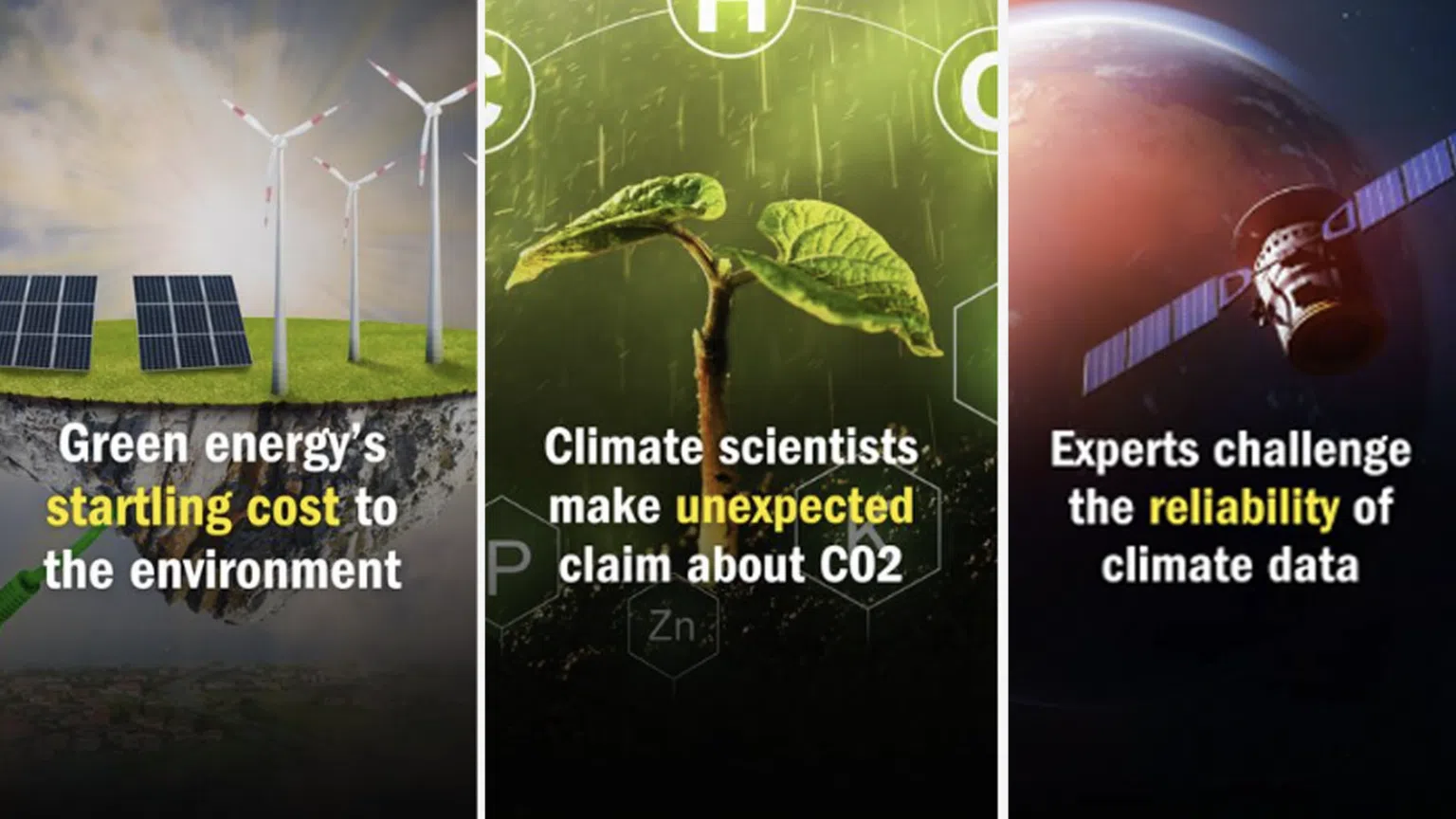
    A mashup of three Epoch Times adverts posted on Meta. Credit: The Epoch Times / Meta

    Campaigners have referred the Epoch Times to the UK advertising regulator for “stoking the climate culture war” on social media.

    The pro-Trump Epoch Times has run hundreds of anti-climate social media adverts in Europe since the beginning of 2024 that have been seen millions of times, DeSmog can reveal. 

    Epoch Times accounts in Europe have run 425 adverts on Facebook, Instagram, and X (formerly Twitter) that have attacked or undermined climate science, green energy, or climate action since the start of the year. These adverts have been run in the UK, Germany, Slovakia, and Bulgaria, appearing on social media feeds at least 2.3 million times across Facebook and Instagram, and 3.1 million times on X. 

    These anti-climate ads were active for 22 days on average on Meta platforms (Facebook and Instagram), while they were displayed for 9.5 days on average on X.

    Four of the adverts posted by Epoch Times on Meta have now been referred to the Advertising Standards Agency (ASA), a UK watchdog, by the campaign group Global Witness. The group is calling for the ASA to open an investigation into whether the Epoch Times breached the Committee of Advertising Practice (CAP) Code and, if so, to ban these adverts.

    The Epoch Times claims to be the fastest growing independent news outlet in the United States. It claims to host websites across 22 languages in 35 countries, publishing online and in print. The publication has gained a substantial online following in recent years, amassing more than 10 million followers across its various Facebook accounts.

    Based in New York, the Epoch Times is affiliated with the Falun Gong new religious movement in China and is staunchly anti-communist. Though the source of its income isn’t publicly declared, former employees told the New York Times that the publication was financed “by a combination of subscriptions, ads and donations from wealthy Falun Gong practitioners.”

    The publication has propelled itself on Facebook by filling its feeds with viral, feel-good videos alongside its often partisan news coverage. 

    According to NewsGuard, an independent company that rates the credibility of news sites, Epoch Times articles “frequently include distorted, misleading, or unsubstantiated claims.” The Epoch Times claims on its website that its reporters are “guided by the highest code of conduct and ethics”.

    The Epoch Times spent at least $1.5 million on adverts in support of then Republican President Donald Trump from 2018 to 2019 – more than any group other than the Trump campaign. 

    The publication was banned from advertising by Meta following these revelations, and the social media company told DeSmog that it ”continues to enforce this ban”. However, a number of Epoch Times offshoots have been allowed to promote climate science denial across Europe this year. 

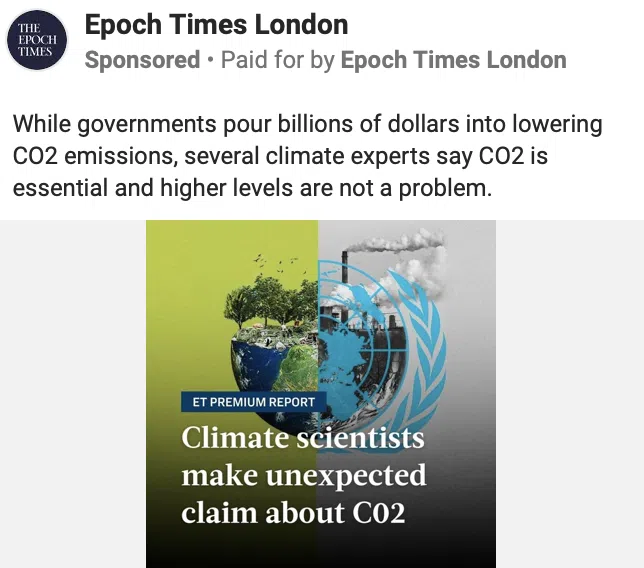
    Many of these adverts have explicitly questioned the contribution of carbon dioxide (CO2) to climate change. The adverts have featured statements including “Several climate scientists say CO2 is essential and higher levels are not a problem”, and “What if more CO2 is actually good for the environment?”

    The UN’s Intergovernmental Panel on Climate Change (IPCC), the world’s foremost climate science body, has stated that carbon dioxide “is responsible for most of global warming” since the late 19th century, which has increased the “severity and frequency of weather and climate extremes, like heat waves, heavy rains, and drought”.

    The adverts ran for months, and reached millions of people, despite Meta’s pledge to tackle climate misinformation. Ten were removed prior to DeSmog contacting Meta, of which six were removed over a failure to include an appropriate advertising disclaimer.

    “After sowing division and disinformation in the U.S., everyone in the UK should be alarmed that the Epoch Times is using the same playbook here,” said Nienke Palstra, campaign strategy lead at Global Witness. “We have already seen politicians trying to stoke a climate culture war and the Epoch Times is spending big to tap into this sentiment. We cannot allow the future of our planet to be put at threat for the political gain of extremists and populists.”

    A spokesperson for the Epoch Times told Global Witness that scientists have always differed in their opinion on climate change and that “To ban different opinions does not help a civilised open society and erodes freedom of speech.”

    Climate Denial Content

    The bulk of the anti-climate adverts seen by DeSmog were posted by Epoch Times London, a Facebook page created in October 2023 that has fewer than 600 followers. 

    Many of the adverts posted by Epoch Times London questioned climate science, for example claiming that “the greenhouse effect is real but irrelevant”, and that “new studies undercut the ‘scientifically empty’ global warming narrative.”

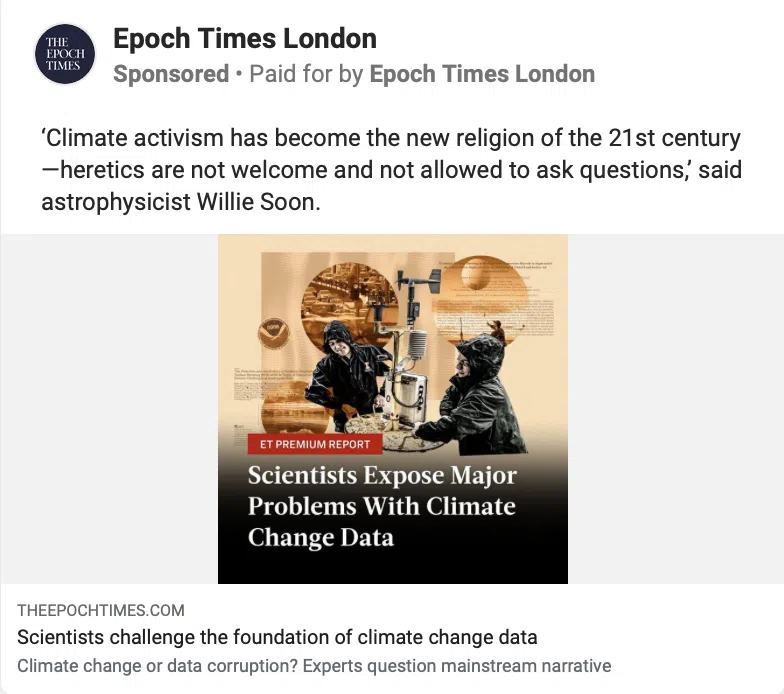
    One advert entitled “Scientists Expose Major Problems With Climate Change Data” was linked to an Epoch Times article that claimed climate change can be best explained by “natural variation”. The article also said that attempts to create a scientific consensus around human-caused climate change are the product of “deliberate fraud” according to “some experts.”

    The same article quoted Willie Soon, a scientist who has cast doubt on climate science and who has openly admitted accepting research funding from fossil fuel interests.

    A number of the Epoch Times London adverts suggested that the consensus on climate change is based on a wilful misinterpretation of evidence by the scientific community, asking questions such as “Climate change or data corruption? Experts question mainstream narrative.”

    DeSmog’s analysis found that Epoch Times London ran at least 392 unique adverts on Meta since the start of the year that attacked or attempted to undermine climate science, green energy, or climate action.

    Of those adverts, 146 were still active prior to DeSmog contacting Meta. According to an analysis of Meta’s ad archive, Epoch Times London has spent between £12,600 and £51,715 on its anti-climate advertising since the start of the year, with those adverts having been seen between 1.9 million and 2.5 million times. Meta has now blocked Epoch Times London’s ability to post adverts.

    According to Companies House, Epoch Times London was incorporated in 2014. The publication drew criticism in the UK in 2020 for posting free editions of its paper to Brighton and Hove residents, the front page of which included claims that the Chinese Communist Party had deliberately covered up evidence of COVID-19’s existence. 

    Following complaints from constituents, Lloyd Russell-Moyle, the Labour MP for Kemptown in Brighton, publicly criticised the Epoch Times in the House of Commons and called on Royal Mail to stop posting its print edition.

    Epoch’s European Operations

    Elsewhere in Europe, DeSmog has seen evidence of anti-climate advertising from Epoch Times-affiliated accounts. 

    The most prolific source of these adverts has been the German Epoch Times account on X, which has run 61 anti-climate adverts since the beginning of the year, reaching at least 1.5 million people and appearing 3.2 million times on X feeds across the German-speaking world. 

    Of the adverts that made a funding declaration, all stated that they were paid for Epoch Times Europe Gmbh, a company that has existed in Germany since at least 2009 according to the country’s company register. 

    A number of these adverts directly questioned the role of CO2 on climate change, saying that “CO2, especially anthropogenic emissions, hardly play a role”, “Climate change: CO2 not to blame”, “Climate change is too complex to blame on CO2”, and “CO2 is the most expensive fraud in history.”

    While there were fewer ads run on Meta in Germany than in the UK, they still generated at least 100,000 impressions, representing an ad spend of between €1,500 and €3,777. 

    An account run by German Epoch Times journalist Erik Rusch has also run at least 24 anti-climate adverts since its creation in January – though the adverts state that they were paid for by Rusch. 

    Some of the adverts run by Epoch Times Germany suggested that wind turbines produce nefarious health effects, including claims such as, “Don’t ignore the health effects: Doctor warns against wind turbines”, and “Wind energy under scrutiny: Dr Bellut-Staeck on the low-frequency risks to humans and animals.”

    One of the German adverts quoted Fritz Vahrenholt, who is a scientific advisor to the UK’s leading climate science denial group, the Global Warming Policy Foundation (GWPF).

    Other adverts promoted by the German Epoch Times, as well as Epoch Times London, quoted fellow GWPF advisor Richard Lindzen. In one of these adverts, Lindzen was quoted as saying: “If we could get rid of 60 percent of CO2, we would all be dead.” 

    Germany Epoch Times adverts also linked back to articles on its website, directing readers to the claim by climate science denier John F. Clauser that the perceived climate threat is a “dangerous corruption of science.” 

    Another advert quoted Lindzen as asking, “Is climate change the existential threat we’ve been led to believe?” and linked to an Epoch Times interview with Lindzen on its YouTube series “American Thought Leaders”. 

    Former UK Prime Minister Liz Truss was recently interviewed on this series, while a parallel series, “British Thought Leaders”, has interviewed a number of climate science deniers. Since the beginning of March, this series has featured Martin Durkin, Rupert Darwall, and GWPF advisor Gwythian Prins. These interviews were headlined: “The Science Simply Does Not Support the Ridiculous Hysteria Around Climate At All”, “This Obsession With Carbon Dioxide Emissions Has Led to Tragedy”, and “The World Is at War – The West’s Green Policies Are Playing Into Our Enemy’s Hands”.

    Epoch Times Bulgaria has posted three anti-climate ads since the beginning of the year, one of which was entitled “scientists alarmed that there is no real evidence that CO2 is causing climate change”.

    Meta has pledged to take action against false narratives on climate change, and the platform has committing to using a “suite of tools, such as fact checking and labels, to help combat climate misinformation.”

    In May 2021, Facebook said that it would begin attaching informational labels to posts about climate change, directing users to the platform’s new “Climate Science Information Center”.

    However, research conducted in 2022 by the Center for Countering Digital Hate found that Facebook is failing to flag at least half of climate misinformation content.

    “Despite claiming to take climate misinformation seriously, Meta has a history of allowing climate disinformation posts with high-engagement to go unchecked,” said Ilana Berger, senior climate and energy disinformation researcher at the misinformation watchdog Media Matters. “If Meta is committed to combating climate disinformation on its platform, it must at the very least consistently enforce its existing policies.”

    Meanwhile, following his takeover of Twitter in 2022, Elon Musk has slashed the number of staff who identify harmful content and misinformation. X did not respond to DeSmog’s request for comment.

    “Climate misinformation threatens all of our futures – and with elections pending across Europe, the stakes could not be higher,” said Richard Wilson, director of the campaign group Stop Funding Heat. “But the same money that is fuelling this problem could also be the key to a solution. If enough advertisers speak out, and urge Facebook and Twitter to stop climate lies being promoted through their platforms, they will have to clean up their act.”

    Original article by Joey Grostern republished from DeSmog.

  • Morning Star: The Tories have wrecked the NHS – but that doesn’t mean Labour will rescue it

    Spread the love

    https://morningstaronline.co.uk/article/tories-have-wrecked-nhs-doesnt-mean-labour-will-rescue-it

    The NHS overtook the economy as voters’ biggest concern in February, according to polling by Ipsos. Small wonder when waiting lists have hit 7.5 million: there can hardly be a person in the country who doesn’t have a friend or relative who has been affected.

    And the Conservatives bear a heavy responsibility.

    In the decade up to the pandemic, real-terms healthcare spending per head rose on average by just 0.4 per cent a year — in four years it actually fell, despite rising pressures on the service.

    That compares very poorly to the record of the last Labour government, which raised spending by 5.7 per cent a year on average from 1997-2010. It even compares badly to that of the Thatcher and Major Conservative governments, which averaged a 2.1 per cent annual increase.

    But we should be more cautious than Poulter about endorsing Keir Starmer’s solution.

    Starmer and shadow health secretary Wes Streeting have pointedly refused to offer the increases in NHS budgets that the Tony Blair and Gordon Brown governments delivered. Streeting is emphatic that he will not “pour money into a 20th-century model,” instead demanding reforms which, in increasing reliance on the private sector, both mimic existing Conservative policy and are unlikely to make a difference to waiting lists (because private healthcare in Britain recruits from the NHS, so overall capacity will not grow).

    …

    Britain’s public services are collapsing under the strain of decades of neoliberal policy. In the NHS, hospitals have been undermined through outsourcing services to the private sector as well as by the cost of PFI debt — both issues with their origins in the Blair years.

    To restore our NHS to health, we need a reversal of privatisation and outsourcing and a forced end to all PFI contracts, as well as a significant increase in overall funding to bring us closer to healthcare spending levels in France or Germany.

    …

    https://morningstaronline.co.uk/article/tories-have-wrecked-nhs-doesnt-mean-labour-will-rescue-it

  • Why Germany ditched nuclear before coal – and why it won’t go back

    Spread the love
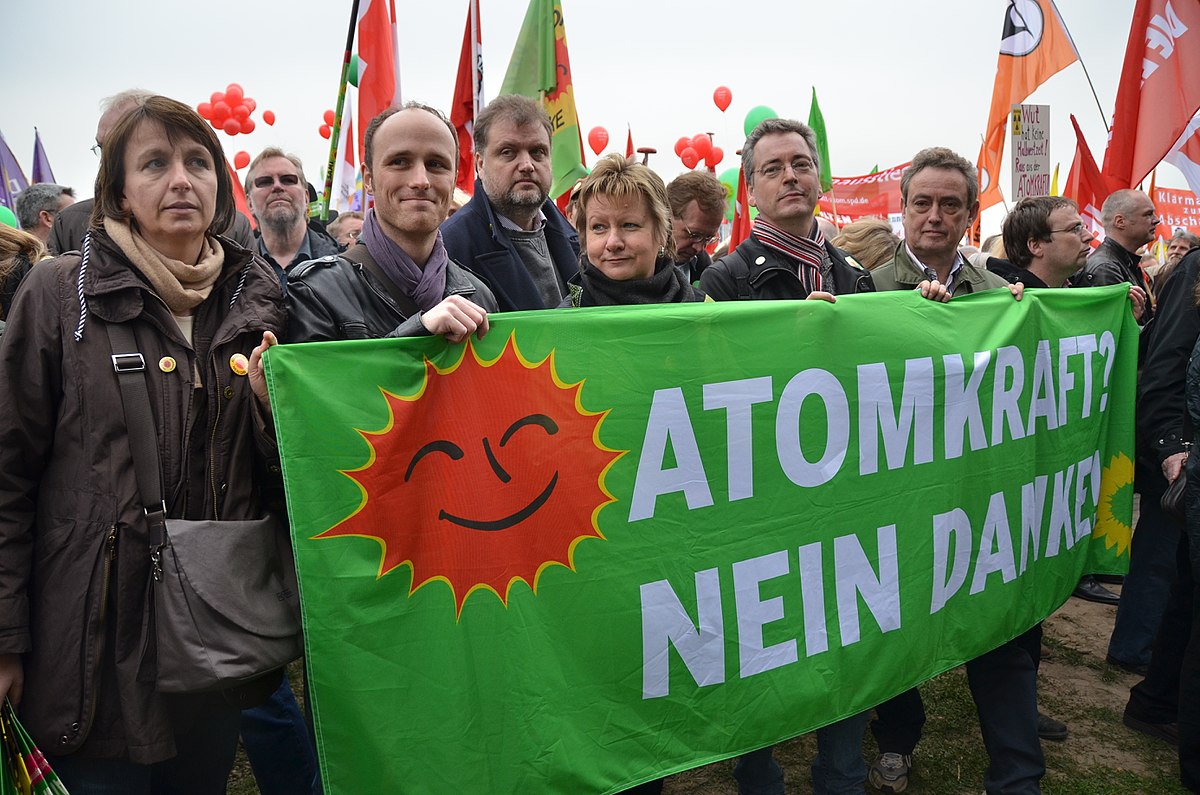
    Atomkraft Nein Danke - Nuclear Power No Thanks. Wikimedia Image Flickr: Atomkraft? Nein Danke!
Author	Bündnis 90/Die Grünen Nordrhein-Westfalen licensed under the Creative Commons Attribution-Share Alike 2.0 Generic license.
    Author Bündnis 90/Die Grünen Nordrhein-Westfalen licensed under the Creative Commons Attribution-Share Alike 2.0 Generic license.

    Why Germany ditched nuclear before coal – and why it won’t go back

    Trevelyan Wing, University of Cambridge

    One year ago, Germany took its last three nuclear power stations offline. When it comes to energy, few events have baffled outsiders more.

    In the face of climate change, calls to expedite the transition away from fossil fuels, and an energy crisis precipitated by Russia’s 2022 invasion of Ukraine, Berlin’s move to quit nuclear before carbon-intensive energy sources like coal has attracted significant criticism. (Greta Thunberg prominently labelled it “a mistake”.)

    This decision can only be understood in the context of post-war socio-political developments in Germany, where anti-nuclearism predated the public climate discourse.

    From a 1971 West German bestseller evocatively titled Peaceably into Catastrophe: A Documentation of Nuclear Power Plants, to huge protests of hundreds of thousands – including the largest-ever demonstration seen in the West German capital Bonn – the anti-nuclear movement attracted national attention and widespread sympathy. It became a major political force well before even the Chernobyl disaster of 1986.

    Its motivations included: a distrust of technocracy; ecological, environmental and safety fears; suspicions that nuclear energy could engender nuclear proliferation; and general opposition to concentrated power (especially after its extreme consolidation under the Nazi dictatorship).

    Instead, activists championed what they regarded as safer, greener, and more accessible renewable alternatives like solar and wind, embracing their promise of greater self-sufficiency, community participation, and citizen empowerment (“energy democracy”).

    This support for renewables was less about CO₂ and more aimed at resetting power relations (through decentralised, bottom-up generation rather than top-down production and distribution), protecting local ecosystems, and promoting peace in the context of the cold war.

    Germany’s Energiewende

    The contrast here with Thunberg’s latter-day Fridays for Future movement and its “listen to the experts” slogan is striking. The older activist generation deliberately rejected the mainstream expertise of the time, which then regarded centralised nuclear power as the future and mass deployment of distributed renewables as a pipe dream.

    This earlier movement was instrumental in creating Germany’s Green Party – today the world’s most influential – which emerged in 1980 and first entered national government from 1998 to 2005 as junior partner to the Social Democrats. This “red-green” coalition banned new reactors, announced a shutdown of existing ones by 2022, and passed a raft of legislation supporting renewable energy.

    That, in turn, turbocharged the national deployment of renewables, which ballooned from 6.3% of gross domestic electricity consumption in 2000 to 51.8% in 2023.

    These figures are all the more remarkable given the contributions of ordinary citizens. In 2019, they owned fully 40.4% (and over 50% in the early 2010s) of Germany’s total installed renewable power generation capacity, whether through community wind energy cooperatives, farm-based biogas installations, or household rooftop solar.

    Most other countries’ more recent energy transitions have been attempts to achieve net-zero targets using whatever low-carbon technologies are available. Germany’s now-famous “Energiewende” (translated as “energy transition” or even “energy revolution”), however, has from its earlier inception sought to shift away from both carbon-intensive as well as nuclear energy to predominantly renewable alternatives.

    Indeed, the very book credited with coining the term Energiewende in 1980 was, significantly, titled Energie-Wende: Growth and Prosperity Without Oil and Uranium and published by a think tank founded by anti-nuclear activists.

    Consecutive German governments have, over the past two and a half decades, more or less hewed to this line. Angela Merkel’s pro-nuclear second cabinet (2009-13) was an initial exception.

    That lasted until the 2011 Fukushima disaster, after which mass protests of 250,000 and a shock state election loss to the Greens forced that administration, too, to revert to the 2022 phaseout plan. Small wonder that so many politicians today are reluctant to reopen that particular Pandora’s box.

    Another ongoing political headache is where to store the country’s nuclear waste, an issue Germany has never managed to solve. No community has consented to host such a facility, and those designated for this purpose have seen large-scale protests.

    Instead, radioactive waste has been stored in temporary facilities close to existing reactors – no long-term solution.

    Nuclear remains unpopular

    National polls underscore the Teutonic aversion to nuclear. Even in 2022, at the height of the recent energy crisis, a survey found that 52% opposed constructing new reactors, though 78% supported a temporary extension of existing plants until summer 2023. The three-way Social Democratic-Green-Liberal coalition government ultimately compromised on mid-April 2023.

    Today, 51.6% of Germans believe this was premature. However, a further deferral was deemed politically unfeasible given the trenchant anti-nuclearism of the Greens and sizeable cross sections of the population.

    Despite some public protestations to the contrary (the main opposition CDU party declared in January that Germany “cannot do without the nuclear power option at present”), in private few political leaders think the country will, or even realistically can, reverse course.

    As an industry insider told me, talk of reintroducing nuclear to Germany is “delusional” because investors were “burnt … too many times” in the past and now “would rather put their money into safer investments”. Moreover, “it would take decades to build new [nuclear] power stations” and electricity is no longer the sector of concern, given the rapid buildout of renewables, with attention having shifted to heating and transport.

    Chart of power production in Germany by source
    German nuclear power (purple) has largely been replaced by renewables (yellow), not coal (black and brown).
    Clean Energy Wire, CC BY-SA

    Predictions that the nuclear exit would leave Germany forced to use more coal and facing rising prices and supply problems, meanwhile, have not transpired. In March 2023 – the month before the phaseout – the distribution of German electricity generation was 53% renewable, 25% coal, 17% gas, and 5% nuclear. In March 2024, it was 60% renewable, 24% coal, and 16% gas.

    Overall, the past year has seen record renewable power production nationwide, a 60-year low in coal use, sizeable emissions cuts, and decreasing energy prices.

    The country’s energy sector, it seems, has already moved on. In the words of one industry observer: “Once you switch off these nuclear power stations, they’re out.” And there’s no easy way back.

    For better or worse, this technology – in its present form at least – is dead in the water here. For many Germans, it will not be missed.The Conversation

    Trevelyan Wing, Fellow of the Cambridge Centre for Geopolitics and Centre Researcher at the Cambridge Centre for Environment, Energy and Natural Resource Governance (CEENRG), University of Cambridge

    This article is republished from The Conversation under a Creative Commons license. Read the original article.