It literally sounds like the plot of a dystopian science fiction movie: The richest man in the world befriends—and helps finance—another rich man who becomes president of the United States, who then gives his plutocratic benefactor carte blanche access to the operations of the federal government. The bedlamite billionaire instantly zeroes in on the obscure little office that oversees the writing of all the government’s checks, thus ensuring that he has the power to bring down the U.S. and global economy and even, if he so wishes, topple said president.
Oh, and—he’s also a right-wing extremist who recently spoke to the far-right German political party whose leaders say things like “Hitler and the Nazis are just a speck of bird poop in more than 1,000 years of successful German history.” He told them—with a wink-wink-nudge-nudge—that Germans placed “too much focus on past guilt, and we need to move beyond that.” And then there’s the matter of that salute, which of course, he denies was what many people—even or especially among those who delighted in it—thought it was.
What does Elon Musk want with control of the Bureau of the Fiscal Service and its computers that write the federal government’s checks? Maybe it’s benign. Maybe he and his team just want to scrutinize the hundreds of millions of payments the government makes to individuals, businesses, other governments, nonprofits, and so on and root out inefficiency.
It seems awfully unlikely that it’s benign. Musk tweeted over the weekend that the U.S. Agency for International Development, which has existed for six decades and spends billions on poverty relief, disaster aid, economic development, and more, is a “criminal organization.” But Musk’s motives aren’t even the main point here. The main point is that even if it is benign, it’s unprecedented and antidemocratic.
…
Will Musk do to the federal government what he did to Twitter? The plundering of that platform was a crime, metaphorically, but at least it was (more or less) victimless. Here, there will be victims—immigrants, refugees, poor people, sick people, and many others who interfere with the schemes of the world’s richest man, who believes Germany should stop apologizing.
With only a few weeks until Germany’s election, Elon Musk has unambiguously thrown his support behind the far-right Alternative for Germany (AfD) party. In a video address to a party rally last week, he appeared to urge Germans to “move on” from any “past guilt” related to the Holocaust.
It’s good to be proud of German culture, German values, and not to lose that in some sort of multiculturalism that dilutes everything.
Troublingly, the AfD is now firmly entrenched as Germany’s second-most popular political party, behind the centre-right Christian Democratic Union (CDU). Like all parties in German elections, however, it cannot win an outright majority. It is also unlikely to be invited to join any ruling coalition that emerges from the February 23 election.
But the AfD’s anti-migrant, anti-government sloganeering has already seriously distorted Germany’s public debate and democratic culture, leaving many to ask whether it even needs to win elections to see its policies implemented.
This was evident following a dramatic week in Germany’s Bundestag.
First, in a radical break with Germany’s political norms, opposition leader Friedrich Merz deliberately drew on the votes of the AfD on Wednesday to ram a radical anti-asylum seeker motion through the parliament.
It was the first time in the history of the Bundestag that a parliamentary majority was reached with the help of the far right. Merz’s action was widely condemned as a “taboo-breaking” step towards legitimising the AfD.
The so-called ‘firewall’ was broken this week between mainstream German political parties and the far right. Clemens Bilan/EPA
Merz tried to take this a step further with a far-reaching bill to tighten immigration controls on Friday. Although the bill narrowly failed, all of the AfD voted with Merz. Twelve members of his own CDU party refused to back him.
Merz’s courting of the far right is widely seen as politically unnecessary, given his conservative CDU is already leading the national polls, making him the favourite to succeed the Social Democratic Party (SDP)‘s Olaf Scholz as chancellor.
This raises a couple crucial questions heading into the election. Is it insiders or outsiders that are playing the biggest role in bringing the far right into the mainstream? And just how big a role will the AfD play after the election?
The Musk effect
Musk’s embrace of the AfD should come as no surprise, given the integral part he played in Donald Trump’s election victory in the United States. In the German context, however, his behaviour and statements have taken on darker hues.
Germans know only too well what is at stake when democracy is eroded by those who abuse its freedoms to attack it. Had Musk’s now notorious Nazi salutes following Trump’s inauguration been performed in Berlin, for example, he might have faced up to three years in prison.
The catchphrase “never again” has underpinned German politics since the second world war. Yet, the response to Musk’s recent provocations was oddly muted in some sections of the German media.
With a few notable exceptions, it was left to activists to remind Germans of the severity of this gesture – projecting an image of Musk’s salute on a German Tesla plant, alongside the word “heil”.
Given the seriousness with which Germany patrols representations of its Nazi past, it was surprising just how few journalists were prepared to state without equivocation that “a Hitler salute is a Hitler salute is a Hitler salute”.
Merz’s embrace of the far right
Initially, there were some signs Germany’s main political leaders would decry Musk’s attempts to normalise far-right politics in the country.
Scholz has continued to label Musk’s blatant attempts to influence German politics as “unacceptable” and “disgusting”.
Merz claims to be keeping his distance from Musk. But it appears his strategy for winning the election is not far from what Musk is suggesting – mimicking AfD policies and collaborating with the party on anti-immigration votes.
In his most radical break with the centrism that characterised the CDU under former Chancellor Angela Merkel, Merz cracked the “firewall” against working with the far-right this week. Knowing just what it meant, he used the AfD’s support to pass the starkly worded nationalist border protection motion in the Bundestag.
Democratic party leaders, meanwhile, registered their shock and dismay. Merkel herself spoke out against Merz, saying it was “wrong” to “knowingly” work with the AfD.
Her intervention appears to have been critical to the immigration bill failing on Friday, with many of her former supporters in the CDU withholding their votes.
A defaced election poster for the Christian Democratic Union (CDU) showing leader Friedrich Merz smeared with a Hitler moustache. Martin Meissner/AP
What AfD’s rise could mean
Given the two votes in the past week and Musk’s high-profile intervention, many in Germany now fear a CDU victory in the election could signal more collaboration with the AfD.
The Greens’ Robert Habeck, Germany’s vice chancellor, has said Merz’s nationalist coalition would “destroy Europe”. He has also warned Musk to keep his “hands off our democracy”, prompting Musk to label Habeck “a traitor to the German people”.
People attend the election campaign launch of the Alternative for Germany (AfD) party on Jan. 25. Hannibal Hanschke/EPA
Musk is by no means the cause of the AfD’s popularity, but his embrace of the extremist party has given it a global profile and credibility in circles that might not have otherwise considered supporting it.
As some commentators have suggested, it is probably not coincidental the AfD’s plans for the German economy would benefit Musk’s business interests. Economic self-interest alone seems insufficient, however, to explain why Musk has gravitated to the extreme right.
The same might be said of Merz. Electoral calculations alone cannot explain his risky courting of the far right. He has long been the frontrunner to win the next election. Cosying up to the AfD will only make it harder to form a coalition with either Scholz’s Social Democratic Party or the Greens.
If these two parties refuse to deal with Merz, the only other bloc large enough to deliver his party control of the government would be the AfD. Would he go so far?
Whether it is formally part of the next government or not, the AfD and its camp followers (such as Musk) could be set to have a much bigger influence on German politics. How this will change Germany in the long term remains to be seen.
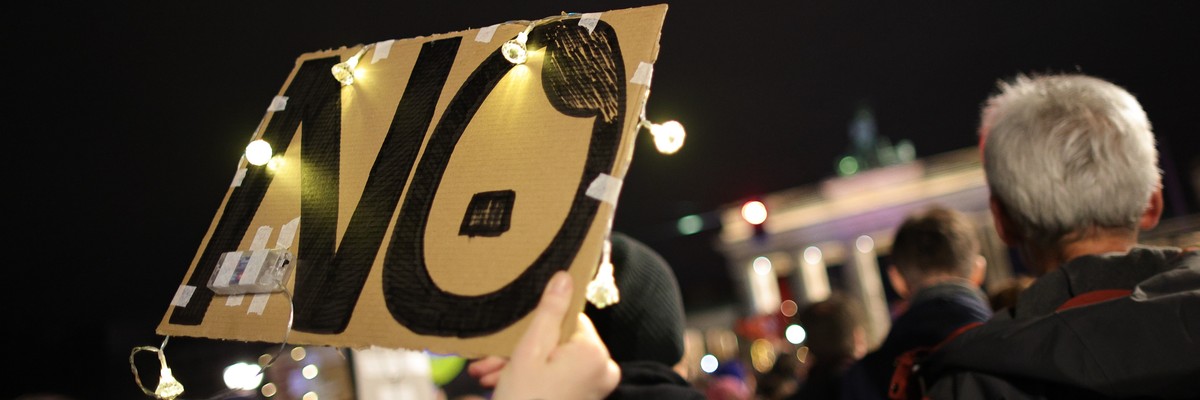
Protesters hold up a banner reading “NO” with the O shaped like an Adolf Hitler caricature during a demonstration against right-wing extremism, U.S. President Donald Trump, and right-wing billionaire Elon Musk on January 25, 2025 in Berlin, Germany. (Photo: Omer Messinger/Getty Images)
“We must not forget the tragic lesson of our past,” said Polish Prime Minister Donald Tusk. “Evil, violence and contempt cannot triumph anew.”
Billionaire enterpreneur Elon Muskinsisted at a far-right rally in Germany over the weekend that the European country must move “beyond the past” and leave behind the memory of one of the deadliest genocides in history—but as leaders on the continent marked the 80th anniversary of the Auschwitz concentration camp liberation on Monday, several made clear that Musk’s advice was not welcome.
Musk’s comments on “‘the need to forget German guilt for Nazi crimes’ sounded all too familiar and ominous,” said Polish Prime Minister Donald Tusk on Sunday. “Especially only hours before the anniversary of the liberation of Auschwitz.”
German Chancellor Olaf Scholz said on the social media platform X, “I couldn’t agree more.”
The country’s ambassador to Israel said that while Musk claimed German children are treated as “guilty of the sins” of the Nazis during World War II, the government simply wants “them to grow up informed and responsible and to apply the lessons of Germany’s past.”
As Common Dreams reported, the Tesla CEO and key adviser to U.S. President Donald Trump made the remarks at a rally for Alternative for Germany (AfD) on Saturday, five weeks before Germans are set to vote in federal elections.
AfD is currently polling at 19%, trailing the center-right Christian Democratic Union (CDU), which is in first place at 28%. But leaders across Europe, including Spanish Prime Minister Pedro Sánchez, French President Emmanuel Macron, and Scholz have warned that Musk appears to be angling for the spread of far-right ideologies—including neo-Nazism—in European countries.
The AfD has been designated a “suspected extremist” group by Germany’s domestic intelligence agency, and one of its candidates for public office last year said that “not all” Nazis who worked for Adolf Hitler’s government were criminals.
The party has been ostracized in Germany, with other political groups including the CDU ruling out the formation of a coalition government with the AfD, but last week CDU leader Friedrich Merz said he would push for tougher anti-immigration proposals even if they were submitted by the AfD.
Scholz, who represents the Social Democrats, toldStuttgarter Zeitung in response to Merz’s comments that “the firewall to the AfD must not crumble.”
As Tusk oversaw the liberation of Auschwitz anniversary on Monday, International Holocaust Remembrance Day, he alluded to Musk’s comments at the AfD rally.
“We must not forget the tragic lesson of our past,” he said on X, which is owned by Musk. “Evil, violence, and contempt cannot triumph anew.”
Musk’s comments came days after he appeared to flash a Nazi salute twice at an event for Trump’s inauguration.
In the U.S. on Sunday, Illinois Gov. JB Pritzker addressed Musk’s remarks at the AfD rally on CNN, asking why Trump hadn’t spoken out against them.
“President Trump ought to be calling that out,” said the Democratic governor. “If he doesn’t agree with Elon Musk, if he doesn’t agree with two Sieg Heils at his own rally, and backing a party that backs Nazis, then he ought to say so. Why isn’t Donald Trump speaking out?”
A Palestinian girl is in shock after surviving an Israeli bombing of an UNRWA school in the Nuseirat refugee camp in Gaza, Palestine on July 14, 2024. (Photo: Salama Nabeel Eaid Younes/Anadolu via Getty Images)
“The world’s failure to protect Gaza’s children is a moral failing on a monumental scale,” said one advocate.
Amid a relentless Israeli onslaught that has wrought monumental physical and psychological destruction in Gaza, a report published this week revealed that nearly all children in the embattled Palestinian enclave believe their death is imminent—and nearly half of them want to die.
The Gaza-based Community Training Center for Crisis Management, supported by War Child Alliance, surveyed more than 500 Palestinian children in Gaza last June and found that 96% of them fear imminent death, 92% are not accepting of reality, 79% suffer from nightmares, 77% avoid discussing traumatic events, 73% display signs of aggression, 49% wish to die because of the war, and many more “show signs of withdrawal and severe anxiety, alongside a pervasive sense of hopelessness.”
“This report lays bare that Gaza is one of the most horrifying places in the world to be a child,” War Child U.K. CEO Helen Pattinson said in a statement. “Alongside the leveling of hospitals, schools, and homes, a trail of psychological destruction has caused wounds unseen but no less destructive on children who hold no responsibility for this war.”
In a first of its kind report, our Gaza based partner Community Training Centre for Crisis Management asked injured, separated and disabled children and their caregivers about the toll of the ongoing war on their lives. Their answers are devastating but sadly not a surprise.1/5
Israel’s 434-day assault on Gaza—which is the subject of an International Court of Justice genocide case—has left tens of thousands of children dead, maimed, missing, or orphaned and hundreds of thousands more forcibly displaced, starved, or sickened. Doctors and others including volunteers from the United States have documented many cases in which they’ve concluded Israeli snipers and other troops have deliberately shot children in the head and chest.
“The harm caused to Gaza’s children goes beyond statistics. Behind every number is a name, a life, and a future that is being extinguished before it can even begin,” Iain Overton, executive director of the U.K.-based group Action on Armed Violence, said in response to the new report.
“The world’s failure to protect Gaza’s children is a moral failing on a monumental scale,” he added. “We must act decisively and compassionately to ensure that these children’s voices are heard and their futures protected.”
In October, the U.K.-based charity Oxfam International said that Israel’s yearlong assault on Gaza has been the deadliest year of conflict for women and children anywhere in the world over the past two decades. A year ago, the United Nations Children’s Fund called Gaza “the world’s most dangerous place to be a child.” Earlier this year, U.N. Secretary-General António Guterres for the first time added Israel to his so-called “List of Shame” of countries that kill and injure children during wars and other armed conflicts.
“The international community must act now before the child mental health catastrophe we are witnessing embeds itself into multi-generational trauma, the consequences of which the region will be dealing with for decades to come,” Pattinson stressed. “A cease-fire must be the immediate first step to allow War Child and other agencies to effectively respond to the intense psychological damage children are experiencing.”
Addressing the complicity of allies like the United States, Germany, and Britain, who provide weapons and diplomatic cover for Israel, progressive U.K. parliamentarian Jeremy Corbyn wrote on social media in response to the new report, “Every single supplier of arms to Israel has blood on its hands—and the world will never forgive them.”
Secretary general of Amnesty International Agnes Callamard holding a press conference, in London, 23 April 2023 (AFP)
Agnes Callamard says it’s time for ICC to charge Israeli leaders with the crime of committing genocide in Gaza
The secretary general of Amnesty International, Agnes Callamard, has urged British politicians to revise their denial that genocide is being committed in Gaza, following a major report by the group concluding that Israel is guilty of genocide.
The world’s leading human rights group on Thursday declared that Israel has committed and continues to commit genocide against Palestinians in Gaza, based on extensive legal and field research covering the period between 7 October 2023 and early July 2024.
“I hope that Prime Minister Keir Starmer and his foreign minister will read through the 300 pages of evidence that we have provided,” Agnes Callamard told Middle East Eye following the release of Amnesty’s report
“Genocide is not a matter of belief. Genocide is not a matter of desire. Genocide is a matter of law. Genocide is a matter of fact.”
Callamard also said the UK, US and German governments may be found complicit in genocide, as a result of their support for the Israeli army.
…
“For the last 14 months, we’ve had a few governments that have supported Israel: the United States, Germany, and the UK.
“They have supported them and they have sold weapons. Therefore, they are facing the real risk of being complicit in the crime of genocide,” she told MEE.
UK Foreign Minister David Lammy confirms that UK government and military are active participants in Israel’s genocides and that the F-35 parts that they suspended from supplying to Israel are instead simply diverted via the United States. He says see https://youtu.be/QILgUHrdWREGenocide denier and Current UK Prime Minister Keir Starmer is quoted that he supports Zionism without qualification. He also confirms that UK air force support has been essential in Israel’s mass-murdering genocide. Includes URLs https://www.declassifieduk.org/keir-starmers-100-spy-flights-over-gaza-in-support-of-israel/ and https://youtu.be/O74hZCKKdpA