Pressure on Germany is mounting from multiple fronts: the resilience of Gaza’s people and fighters, the global solidarity movement, and even Nicaragua’s lawsuit against the German government.
Exactly 22 months after the start of the genocide against the people of Gaza, German Chancellor Friedrich Merz announced on August 8 that Germany would “no longer approve any exports of military equipment to Israel that could be used in the Gaza Strip” – at least for now.
But many left-wing, pro-Palestinian, and peace activists in Germany remain skeptical.
What weapons are we talking about?
It quickly became clear this was not a blanket halt to German arms shipments to Israel. Weapons intended for military operations in the illegally occupied West Bank, southern Lebanon, and Syria are unaffected. So are arms for aggression against neighboring Arab states, Yemen, and Iran.
Ammunition and air-defense technology are also exempt. While officially labeled “defensive”, these systems are used to intercept rockets and drones from the resistance in Gaza, Iran, Yemen’s Ansar Allah movement, and, until late last year, Hezbollah in Lebanon. So in fact they serve not just defense but also to sustain Israel’s broader policy of aggression and genocide.
The ban likely doesn’t apply to equipment for Israel’s navy either – despite its central role in enforcing the illegal blockade of Gaza’s coast. According to a 2024 study by the research group Forensis, German-built ships have also shelled Gaza from the sea. In a move that appeared to underscore this, ThyssenKrupp Marine Systems announced on August 8, that it had just secured an export license for more warships and another submarine for Israel. Between 1999 and 2016, Germany delivered five nuclear-capable submarines to the Israeli government.
Arms supplier under pressure
Despite the justified criticism and inconsistency in Germany’s announcement, this partial suspension marks a significant political shift. Immediately after the Gaza genocide began, Germany quickly became Israel’s second-largest arms supplier, behind only the United States. Recently, one-third of Israel’s weapons imports came from Germany – earning the German arms sector hundreds of billions of euros in less than two years.
Merz, a staunch pro-Zionist known for hardline conservative views, open racism, and unabashed neoliberalism, previously sat on the supervisory board of BlackRock and represents the right wing of Germany’s main conservative party, the Christian Democratic Union (CDU). His decision drew angry reactions not only from the Netanyahu government, Zionist lobby organizations, and the right-wing press in Germany, but also from high-ranking politicians in his own party.
All that shows the mounting pressure Merz and the German government face. That pressure comes from multiple fronts: the resilience of Gaza’s people and fighters, the global solidarity movement – including in Germany – and international actions such as Nicaragua’s lawsuit against the German government.
Leon Wystrychowski is a former member of the Palästina Solidarität Duisburg (Palestine Solidarity Duisburg, PSDU).
Genocide denier and Current UK Prime Minister Keir Starmer is quoted that he supports Zionism without qualification. He also confirms that UK air force support has been essential in Israel’s mass-murdering genocide. Includes URLs https://www.declassifieduk.org/keir-starmers-100-spy-flights-over-gaza-in-support-of-israel/ and https://youtu.be/O74hZCKKdpAKeir Starmer objects to criticism of the IDF. He asks how could anyone object to them starving people to death, forced marches like the Nazis did, bombing Gaza’s hospitals and universities,mass-murdering journalists, healthworkers and starving people queuing for food, killing and raping prisoners and murdering children. He calls for people to stop obstructing his genocide for Israel.
Britain faces pressure to suspend arms sales to Israel following international outcry against plans to take over Gaza City
Palestinians rush to collect humanitarian aid airdropped by parachutes into Gaza City, northern Gaza Strip, August 7, 2025
PRESSURE mounted on Britain yesterday to follow Germany’s lead in suspending arms sales to Israel, amid international outcry against Israeli ministers’ plans to take over Gaza City.
Prime Minister Sir Keir Starmer said Israel’s decision to further escalate its offensive in Gaza is wrong and urged the Israeli government to reconsider.
His failure to respond with action, however, despite warnings of more destruction and suffering, was branded “unconscionable” by the Palestine Solidarity Campaign (PSC).
PSC director Ben Jamal said a full occupation would “mean the slaughter of thousands of Palestinians and ethnic cleansing of hundreds of thousands from their land.
“Those already facing starvation, due to Israel’s blocking of aid, will now be pushed further to the brink by the full siege of the city.
“It is unconscionable that in the face of such an egregious announcement of a planned crime against humanity, UK Prime Minister Keir Starmer can only muster the words that this plan is ‘wrong,’ while taking no action to stop it.
“Our government must stop arming Israel, end all military co-operation, end all trade with Israel and introduce a full body of sanctions on this genocidal state.”
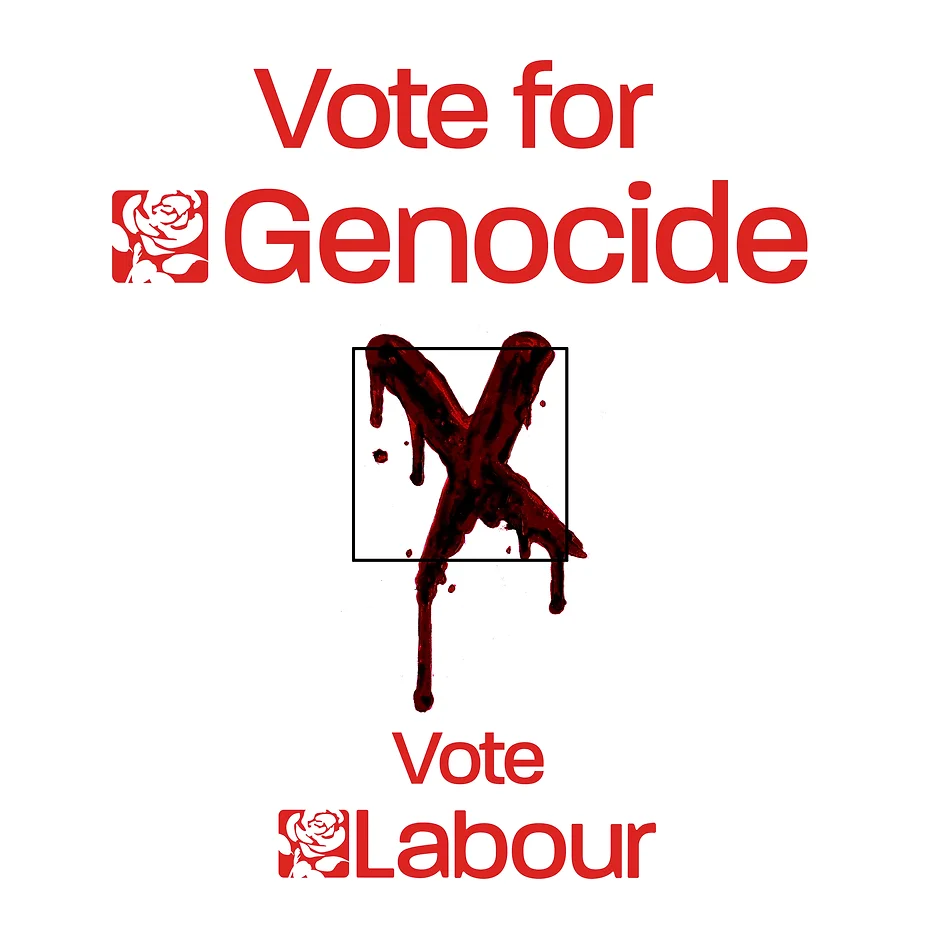
Keir Starmer objects to criticism of the IDF. He asks how could anyone object to them starving people to death, forced marches like the Nazis did, bombing Gaza’s hospitals and universities,mass-murdering journalists, healthworkers and starving people queuing for food, killing and raping prisoners and murdering children. He calls for people to stop obstructing his genocide for Israel.Genocide denier and Current UK Prime Minister Keir Starmer is quoted that he supports Zionism without qualification. He also confirms that UK air force support has been essential in Israel’s mass-murdering genocide. Includes URLs https://www.declassifieduk.org/keir-starmers-100-spy-flights-over-gaza-in-support-of-israel/ and https://youtu.be/O74hZCKKdpAVote Labour for Genocide.
Ghassan Abu-Sittah and other health workers hold press conference after Israeli attacks on Gaza’s hospitals, October 2023. Source: Ghassan Abu-Sittah/X
A judge in a German court ruled that the ban on activity imposed on renowned Dr. Ghassan Abu-Sittah was unlawful.
The Palestine Congress in Berlin, which was organized in mid-April of last year, was violently shut down by the police on its first day, just minutes after it began. The pretext for this action, which was deemed unlawful by attorneys, was a live-stream of Palestinian historian Dr. Salman Abu Sitta.
His nephew, the doctor Ghassan Abu-Sittah, was banned from entering Germany on the morning of April 12, 2024. He had arrived on a flight from the UK, was detained and questioned for hours at Berlin airport, and then deported. He was also told that he was banned from practicing any political activities in Germany for the month of April, even from abroad. The organizers of the conference are taking legal action against the dissolution of the event, the trial of which is ongoing.
Witness to the genocide wins in Berlin
But Ghassan Abu-Sittah won a victory on Tuesday, July 15, at Berlin’s Administrative Court (Verwaltungsgericht). From the UK, the doctor had filed a lawsuit against the actions of the German authorities. The surgeon and rector of the University of Glasgow has worked as a doctor in a dozen war and crisis zones over the course of his life, including the Gaza Strip. Shortly after the genocide began in October 2023, he went there again as part of a “Doctors Without Borders” mission to provide aid at Al-Shifa Hospital. The hospital was repeatedly attacked and ultimately destroyed by the Israeli army in November 2023 and again in March/April 2024. Israeli forces massacred hundreds of doctors, patients, and refugees.
The court’s judge ruled that the ban on activity imposed on Abu-Sittah was unlawful. According to a spokeswoman for the court, there was no sufficient evidence that Abu-Sittah’s statements posed a threat to Germany’s constitutional order or public safety. In particular, the authorities were unable to produce any statements by the renowned doctor that referred positively to the Palestinian resistance’s “Al-Aqsa Flood” operation or even to possible war crimes committed by the Palestinian resistance. Even if such a danger had existed, a preventive ban on the doctor’s activities would have been disproportionate.
The spokesperson also pointed out that Abu-Sittah was heard as an eyewitness to the genocide in the International Criminal Court proceedings against Israeli government politicians, and was also announced as such at the Palestine Congress.
Racist repression
His lawyer, Alexander Gorki, explained on request: “The hearing showed that the ban on activities was unlawful from start to finish. What was to be sanctioned via the residency rights were opinions expressed by my client, who knew the situation on the ground in Gaza very well as a Palestinian and a doctor.” The court “put a stop to the abuse of immigration law”. However, the ruling will not prevent the immigration authorities from abusing their power in the future, warns the migration law expert. To counter this, “political pressure is needed”.
In fact, the repressive authorities in Germany have been using all kinds of tricks and legal means for years to bypass the courts and exert pressure on the Palestinian solidarity movement and Palestinians in Germany: from expulsions and deportations, to bans on organizing, employment bans and the cancellation of welfare benefits. Migrants and refugees with a precarious status are particularly affected. Just two weeks ago, on the orders of a court, Musaab Abu Atta, a Palestinian refugee and political activist, was released from four months of custody. The public prosecutor’s office is trying to lock him up again because of an alleged “flight risk”, even though he has a fiancée and a job in Berlin. At the same time, there are indications that they want to deport him to Syria.
Leon Wystrychowski is a former member of the Palästina Solidarität Duisburg (Palestine Solidarity Duisburg, PSDU).
This work by Middle East Monitor is licensed under a Creative Commons Attribution-NonCommercial-ShareAlike 4.0 International License.
Aid trucks sent by the United Nations under Israeli attacks enter the Zakim border crossing under the protection of Palestinians and reached the warehouses in the north of in Gaza City, Gaza, on June 25, 2025. [Ahmed Jihad Ibrahim Al-arini – Anadolu Agency]
Germany on Monday called for the United Nations to take the lead in coordinating aid distribution in Gaza, as concerns mount over civilian deaths at food distribution points, Anadolu reports.
“There is an established and functioning humanitarian aid system, supported by major aid organizations, NGOs and the United Nations. It works. In our view, it must be able to deliver the necessary aid to the people,” said Foreign Ministry spokesperson Kathrin Deschauer at a press conference.
The remarks follow reports that Israeli forces have killed more than 400 Palestinians gathering at US-backed food distribution centers in recent weeks.
“It is shocking and unacceptable that the distribution of aid to people in need is resulting in deaths and also many injuries,” Deschauer added, calling for an investigation into the reports.
Many civilians seeking help and food are being “put in danger,” she said, expressing deep concern about the “dramatic humanitarian situation in Gaza.”
On June 27, the head of the UN agency for Palestinian refugees (UNRWA) issued a scathing condemnation of the current aid distribution system in Gaza.
“The new aid distribution system has become a killing field,” UNRWA Commissioner-General Philippe Lazzarini wrote in a post on X. “Over 400 starving people reported killed since it started operating just a month ago. They were shot at while trying to access food for themselves and their families.”
Keir Starmer and David Lammy’s remarkable attempts to publicly realign their government’s support for Israel’s genocidal war on Gaza reflect similar shifts recently performed by political leaders in France, Canada, the US and Germany.
On 20 May, Starmer told MPs that innocent children’s suffering in Gaza was “intolerable”, while Lammy called it “abominable”. Lammy condemned Israeli Finance Minister, Bezalel Smotrich’s call to “purify Gaza” by ethnic cleansing as “dangerous, repellent and monstrous”[1].
By 26 May even the GermanChancellor, Friedrich Merz admitted that Israel’s actions in Gaza “can no longer be justified”.
Given such politicians’ unstinting support for Israel’s assault on Gaza, we may be forgiven for questioning whether their latest pronouncements indicate a shift in policy, a rhetorical attempt to placate public opposition to state collusion in genocide, or an insurance policy against being named in future legal proceedings.
In fact, Lammy’s suspension of UK-Israel free trade talks on 20 May in response to Israel’s block on aid to Gaza was swiftly followed on 26 May by an official visit to the port of Haifa by UK Trade Envoy, Lord Ian Austin, who as the UK Embassy to Israel triumphantly tweeted was “witnessing cooperation at every stop”[2].
While President Trump’s recent decision not to visit Israel was a signal to US allies to adjust their foreign policy stance, UK arms exports to Israel have been a consistent focus of sustained, pro-Palestine mass protests in Britain since October 2023.
Alongside an unparalleled mass movement on the streets of British towns and cities a quiet but effective legal challenge was launched against the UK government’s policy of arms exports to Israel. Campaigners took the UK government to court, accusing it of failing to uphold domestic and international legal obligations by supplying weapons and components used in Israel’s genocidal war on Gaza.
Starmer and Lammy’s performed their volte-face in the House of Commons just four days after a landmark High Court challenge by Global Legal Action Network (GLAN)[3] and Palestinian human rights organisation Al-Haq[4] against the UK government’s decision on 2 September 2024 to continue licensing export of F-35 fighter jet components to Israel, while suspending other arms exports due to risk of violations of international law.
The High Court case displays a web of contradictions and the hypocrisy of ministers’ public statements on arms sales to Israel. According to GLAN and Al-Haq, it exposed “structural flaws in accountability” in the UK arms export control regime, which “renders it unfit to ensure respect for fundamental legal and humanitarian obligations”.
Al-Haq points out, “In Parliament, the government maintains it is for the courts to decide whether Britain is complying with its legal obligations. Yet in court, their lawyers argued the opposite — they say that such matters are not for the judiciary to examine.”
Charlotte Andrews-Briscoe, representing GLAN points out, “The government has been telling Parliament that it is unable to answer questions regarding its decision to indirectly arm Israel because that decision is being tested in the courts, and at the same time telling the judiciary that it cannot examine that decision because that is the role of Parliament.”
In the High Court, UK government lawyers rejected Al-Haq’s assertion that there is at least a serious risk that Israel is committing genocide in Gaza and said there is “a tenable view that no genocide has occurred or is occurring”.
Internationally accepted arguments relating to breaches of the Genocide Convention, in the context of the enormous harms suffered by civilians in Gaza, were dismissed by UK government lawyers as “touchy feely”.
The UK government also claimed it had seen “no deliberate targeting of women and children”, and therefore “no serious risk of genocide”. In its own evidence, the government included a report entitled “Research Report: Long-Range Shootings or Shootings of Minors.” This was withheld from GLAN and Al-Haq, despite a duty to disclose and an explicit request for its disclosure.
The UK government also claimed in the High Court that Israel’s targeting policies were as good as the UK’s. Is that even a defence?
That this happened days before Lammy’s statement to MPs on the situation in Israel and the Occupied Palestinian Territories will lead many to suspect that Lammy’s latest windy denunciations of Israeli politicians and a few settlers is a red herring intended to shield UK government ministers from charges of arms exports to Israel in breach of domestic and international law.
Lammy in his statement to MPs on 20 May referred to “a new, extensive ground operation throughout Gaza”, “renewed bombardment, new displacement and new suffering”, and said “we are now entering a dark new phase in this conflict”.
The emphasis on the new level of Israeli atrocities in Gaza is intended create a bogus political and legal distinction between the ‘normal conduct’ of Israel’s war on Gaza, impossible to conduct without arms exports, military intelligence and diplomatic support from Britain, and the latest ‘unacceptable conduct’ of the siege of Gaza by Israel, the starvation and mass displacement of Palestinians, which David Lammy and Keir Starmer condemn so robustly before TV cameras in the House of Commons.
Given the sustained horror of Israel’s genocide of the Palestinians over a period of 20 months and the growing evidence of UK government complicity in immoral and illegal arms sales, it will be a difficult political trick for Starmer and Lammy to pull off.
As Gearóid Ó Cuinn, Director of the Global Legal Action Network says, “The government has now been exposed as being disingenuous in Parliament and in court; this merry-go-round of delay and inaction is facilitating genocide and needs to stop. A decision in our case will come far too late for the people of Gaza who are being starved to death – the government must immediately end arms sales and other forms of military support to Israel and apply sanctions.”
[4] UK’s ‘flawed’ assessment of genocide in Gaza revealed in court that contradicts claims made in Parliament, 20 May 2025 https://www.alhaq.org/advocacy/26458.html
UK Labour Party government ministers Keir Starmer, Angela Rayner and Rachel Reeves explain that they are partners complicit in Israel’s Gaza genocide. The UK has provided Israel with arms, military and air force support. They explain that they don’t do gas chambers but do do forced marches, starvation, destroy hospitals, mass-murders of journalists and healthcare workers.Vote For Genocide Vote Labour.UK Conservative Party leader Kemi ‘not a genocide’ Badenoch explains her reality that the Earth is flat, the Moon is made of cheese and that she was born from Unicorn horn dust


 Palestinians rush to collect humanitarian aid airdropped by parachutes into Gaza City, northern Gaza Strip, August 7, 2025