Tag: Germany

  • Germany leads the charge in persecuting Palestine solidarity movement

    Spread the love

    Original article by Leon Wystrychowski republished from peoples dispatch under a Creative Commons Attribution-ShareAlike 4.0 (CC BY-SA) license.
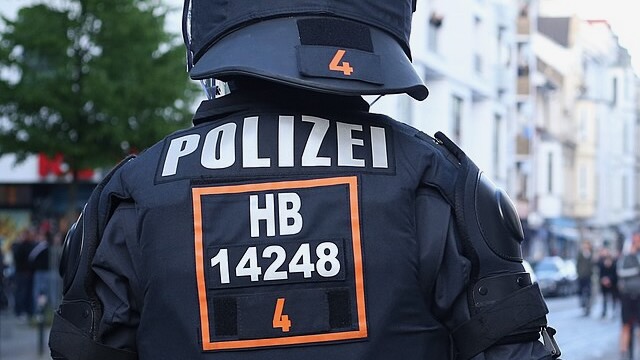
    Armed state policeman in Bremen, Germany. Photo: Wikicommons

    The German state has unleashed a fierce and sweeping crackdown on the Palestine solidarity movement in the country.

    Germany’s policy of harsh repression of any expression of solidarity with Palestine and the struggle of the Palestinian people has continued unabated. In their attempt to silence all mentions of Palestine, German authorities have canceled events, censored activists and academics, violently repressed protests, and passed new legislation to further undermine support for Palestine solidarity. 

    However, despite their best efforts, people in Germany continue to defy what they see as illegitimate bans on speech and activity, and continue to express support for the Palestinian cause.

    2024 ends with new attacks

    In November 2024, the German parliament had passed a so-called “antisemitism resolution,” which though non-binding, sought to stifle any domestic activity to discourage participation in pro-Palestine movements. 

    At the beginning of December, Ramsis Kilani was expelled from the Left Party (Die Linke). The young Palestinian, who lost his father, stepmother and five siblings–ages four through twelve–in an Israeli attack in the Gaza Strip in 2014, was accused of “relativizing Hamas terror, selectively criticizing violence against women as a weapon of war, and rejecting Israel’s right to exist.” 

    Two weeks later, an “anti-colonial and peace Christmas market” in the west German city of Darmstadt provided the opportunity for several well-known politicians, the media, the local chapter of the “Central Council of Jews in Germany” and “concerned” evangelicals to file criminal charges and even make death threats towards the local Palestine group and church congregation that were jointly responsible for the Christmas market.

    Read more: What’s really behind Germany’s unshakeable support of Israel?

    No place for social science at Goethe University, Frankfurt

    The academic conference entitled “Talking about (the silencing of) Palestine,” which took place on January 16 and 17 in Frankfurt am Main, had to move to private rooms after Goethe University withdrew the previously booked rooms from the organizers. The event went ahead without police harassment and–unlike the Palestine Congress in Berlin in April 2024–was not violently broken up.

    A raid to ban a no-longer-existing solidarity group

    Less than a week later, on January 22, the police stormed several apartments in Frankfurt and Darmstadt. The reason given was to secure evidence to help ban the association “Palästina e.V.” However, the group had already dissolved in November 2024 and no longer existed.

    Hitting children costs 800 euros

    On January 24, a court dropped a case against a teacher who had punched a 16-year-old student in the face at a school in the Neukölln borough of Berlin on October 9, 2023. The teenager was attacked for bringing a Palestinian flag to school and displaying it in the playground. The fine for a teacher physically assaulting a minor in public was set by the court at just 800 euros. While the teacher has been on sick leave ever since–i.e. presumably on vacation–the student had to change schools. It is still unclear whether legal action will be taken against the student, for responding to the teacher’s assault by kicking him.

    Further professional bans are being prepared

    In line with the above court decision, the following week the German parliament passed a resolution that was ostensibly directed against “antisemitism and hostility towards Israel in schools and universities.” In reality, it was an addition to–and tightening of–the previous antisemitism resolution of November 2024. However, unlike the earlier resolution, this parliamentary motion received hardly any public attention and so the relatively broad criticism that had been voiced in October and November, which had extended into bourgeois circles, failed to materialize. 

    The new resolution is a massive attack on the freedom of research and science in Germany. It promotes the cooperation of teaching institutions with repressive and surveillance authorities, and new professional bans (Berufsverbote), which have a long and dark anti-communist tradition in the Federal Republic of Germany.

    Arabic? Forbidden!

    At the beginning of February, the Berlin police issued language restrictions for Palestine demonstrations: speeches, posters, slogans and music are only allowed in the German or English language. This is, therefore, a de facto ban on Arabic. This measure is not entirely new: in the last two years there have already been such bans imposed on Palestine demonstrations in various cities. In the summer of 2024, at the Palestine camp in front of Berlin’s Reichstag, Hebrew was banned alongside Arabic. What is new is that the Berlin authorities have declared that this ban applies to all gatherings in the German capital “until further notice.”

    Palestinians to be deported

    On the evening of February 12, two Palestinians from Gaza were arrested and detained in Berlin: the young men were to be deported to Greece the next day. After protests in Berlin, numerous angry calls to the Greek airline that was to carry out the deportation, and legal intervention, the deportation was apparently postponed. With its “asylum compromise” in 1993 (the de facto removal of the basic right to asylum from the German constitution) and the Dublin II Regulation of the European Union in 2003, the Federal Republic of Germany created the legal basis for deporting almost all asylum seekers to “safe third countries.” As an EU member state, Greece is considered a “safe third country,” however Greek camps are notorious for their inhumane living conditions, which is why a suspension of deportation seems realistic.

    The two victims are said to come from Khan Younis and to be well-known for their activism against the Gaza genocide. The right-wing Springer press called them “conductors of the Palestinian protests” in Berlin and in its usual racist manner, described them as “clan” members. They are not the first Palestinians to be affected by deportations since October 7, 2023. The German state appears to be using its racist policies not only to divert attention from grievances and to divide the population, but also to get rid of political opponents who are standing up against racism, war, and genocide.

    Another “scandal” at the Berlinale

    This year’s Berlinale, which took place in Berlin from February 13 to 23, made headlines in the German mainstream media due to alleged “antisemitism scandals.” The Chinese director Jun Li read out a speech by Iranian actor Erfan Shekarriz, in which he said that millions of Palestinians were suffocating under Israel’s brutal settler colonialism. He accused the Federal Republic of Germany of supporting the genocide of the Palestinians. The Scottish actress Tilda Swinton, who was awarded the Honorary Golden Bear for her life’s work, declared her respect for the BDS movement at the press conference. Once again, the German media handled these statements in a scandalous manner, while the Central Council of Jews in Germany ranted about the voicing of “Hamas slogans”.

    Preparations for further ban on solidarity group

    At the same time, a newspaper article revealed that the German domestic intelligence service (Verfassungsschutz) in the east German state of Saxony is apparently monitoring the Leipzig-based “Handala” solidarity group. Although this group has appeared in the intelligence service’s regional report since 2023, the state of Saxony’s Ministry of Science is now also keeping an eye on it, as some of its members allegedly work at Leipzig University. The domestic intelligence service categorizes Handala’s solidarity work as a form of “secular foreigner extremism,” claiming it’s “particularly opposed to the idea of international understanding” (Völkerverständigung) and shows solidarity with Hamas. 

    The last two accusations are alarming because last summer, the group “Palestine Solidarity Duisburg” (PDSU) was banned by North Rhine-Westphalia state’s Ministry of the Interior on the basis of exactly the same unfounded allegations. The repressive Saxony authorities thus appear to be preparing for a ban on Handala by first creating a favorable mood in the ministries and the bourgeois media.

    No stage for the UN Special Rapporteur

    Most recently, two events of the UN Special Rapporteur for the Occupied Palestinian Territories, Francesca Albanese, in Munich and Berlin were canceled due to political pressure. Albanese was supposed to speak at the Ludwig-Maximilians-Universität in Munich on February 16 and at the Freie Universität (“Free University”) of Berlin on February 18. After the second venue was canceled on short notice, the event was still able to take place in the editorial offices of the left-wing daily newspaper Junge Welt. Though the event was not shut down, as was the Palestine Congress last year, the police followed the example set in Duisburg in December 2023. There, authorities had declared a discussion featuring Zaid Abdulnasser and myself a “closed-door meeting,” surrounded the venue with police cars, and insisted that the state security forces had to attend in order to be able to “intervene.” This is what happened this time in Berlin, too.

    Read more: Talking about Palestine “not a crime,” reminds UN Rapporteur Albanese

    Austria: An impending party ban and a “Hamas journalist”

    In Germany’s neighboring countries, things are also looking anything but good when it comes to freedom of expression in connection with Palestine.

    In Austria, for example, the right-wing FPÖ and the conservative ÖVP are apparently planning to ban the “Gaza List,” which was founded last year and took part in the National Council elections in September 2024. In addition, the British journalist Richard Medhurst was arrested in Vienna at the beginning of February: according to his report, he was summoned by the Austrian immigration authorities, but was confronted on the spot by secret service agents who showed him a search warrant and then drove him to his apartment and confiscated his technological devices. The accusation against the journalist, who has lived in Austria for years, was “membership of Hamas,” or the Izz al-Din al-Qassam Brigades, the armed wing of Hamas. He was threatened with ten years in prison.

    Switzerland: Journalist arrested and deported

    Ali Abunimah, the journalist and managing director of the internationally renowned online independent news media outlet The Electronic Intifada, was arrested in Switzerland on January 25 and subsequently deported after two nights in custody. Abunimah had been invited to give a lecture. He had already been questioned for an hour by the authorities when he arrived at Zurich airport the day before his arrest. During his detention, he was questioned in the absence of a lawyer and was denied the right to call his family, as he reported after his release. It later became known that the Zurich cantonal police had submitted an application to the Swiss national authorities to ban the journalist from entering the country. However, they had rejected the request. Apparently, massive pressure was then exerted to get the ban passed on the second attempt–this time successfully. According to the Tages-Anzeiger, Mario Fehr was also involved. The right-wing Social Democrat and law-and-order hardliner is a well-known supporter of Israel. He publicly described Abunimah as an “Islamist Jew-hater” and accused him of inciting violence.

    France: ban on solidarity group and life imprisonment

    French courts dealt the Palestine solidarity movement two blows at once on February 20. First, the ban on the “Collectif Palestine Vaincra,” which was issued in March 2022 and provisionally suspended in April of the same year, has now been upheld. The organization thus meets the same fate as “Samidoun” and Palestine Solidarity Duisburg in Germany, which were banned in November 2023 and May 2024 respectively. Secondly, on February 20, it was decided to postpone the appeal hearing on the release of Georges Ibrahim Abdallah until June, because France’s “National Anti-Terrorist Prosecutor’s Office” lodged an objection. The Lebanese communist and pro-Palestinian freedom fighter has been in a French prison for 40 years and was originally due to be released on December 6, 2024.
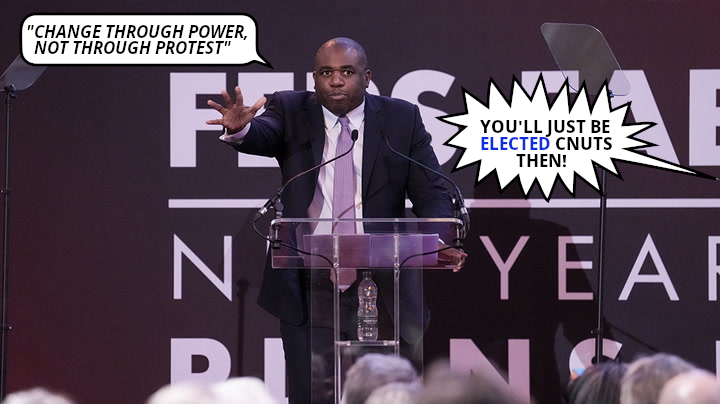
    UK Labour Party Shadow Foreign Secretary repeatedly heckled at a speech to the Fabian Society over his and the Labour Party's support for and complicity in Israel's genocide of Gaza.
    UK Labour Party Shadow Foreign Secretary repeatedly heckled at a speech to the Fabian Society over his and the Labour Party’s support for and complicity in Israel’s genocide of Gaza.
  • German ministry dismisses lawyer for supporting Gaza, rejecting genocide

    Spread the love

    This work by Middle East Monitor is licensed under a Creative Commons Attribution-NonCommercial-ShareAlike 4.0 International License. 

    Thousands of people carrying Palestinian flags and banners march as they protest Israel’s attacks on Gaza and Germany’s arms support to Israel in Unter den Linden Street, Berlin, Germany on April 13, 2024 [Halil Sagirkaya/Anadolu via Getty Images]

    The German federal ministry has dismissed a lawyer in Berlin due to her opposition to the Israeli assault on Gaza, the Palestinian Information Centre reported.

    On Saturday lawyer Melanie Schweizer posted a video on X stating: “Yesterday I got fired as a civil servant working at the Federal Ministry in Germany. Why? In a nutshell because I was speaking out against the genocide in Palestine committed by Israel, against the German support thereof, against the violence and crimes happening there.” Highlighting the German government and police’s efforts to silence pro-Palestine voices, she added: “This is where we’re at in Germany. This is a blatant attack on our constitutional rights to freedom.”

    She called on supporters of Gaza to make their stance clear and “keep speaking up, keep using your voice, losing your job is not the worst that can happen to you, losing your life is. Losing your freedom right is.”

    Many European and American companies have previously dismissed employees over their stance on the war on Gaza and their opposition to genocide.

    In October 2024, Microsoft dismissed two employees after they organised a sit-in at its headquarters in Washington, D.C., in solidarity with the victims of the Israeli assault on Gaza.

    On 22 January, the Washington Post reported that Google had dismissed more than 50 employees last year after they protested against the “Nimbus” contract, citing concerns that the technology could support military and intelligence programmes used by the Israeli occupation army in its war on Palestinians in Gaza.

    In September 2024, the Noguchi Museum in New York announced the dismissal of three employees for allegedly violating the dress code by wearing keffiyehs, which have become a symbol of solidarity with the Palestinian cause.

    READ: Protesters show their opposition to Germany’s pro-Israel bias

    This work by Middle East Monitor is licensed under a Creative Commons Attribution-NonCommercial-ShareAlike 4.0 International License. 

    Experiencing issues with this image not appearing. I suspect because it's so critical of Zionist Keir Starmer's support of and complicity in Israel's genocides.
    Genocide denier and Current UK Prime Minister Keir Starmer is quoted that he supports Zionism without qualification. He also confirms that UK air force support has been essential in Israel’s mass-murdering genocide. Includes URLs https://www.declassifieduk.org/keir-starmers-100-spy-flights-over-gaza-in-support-of-israel/ and https://youtu.be/O74hZCKKdpA
  • New German leader signals seismic shift in transatlantic relations

    Spread the love

    https://www.bbc.com/news/articles/cpv4n0dg3v3o

    Friedrich Merz says he is eager to re-engage with international partners

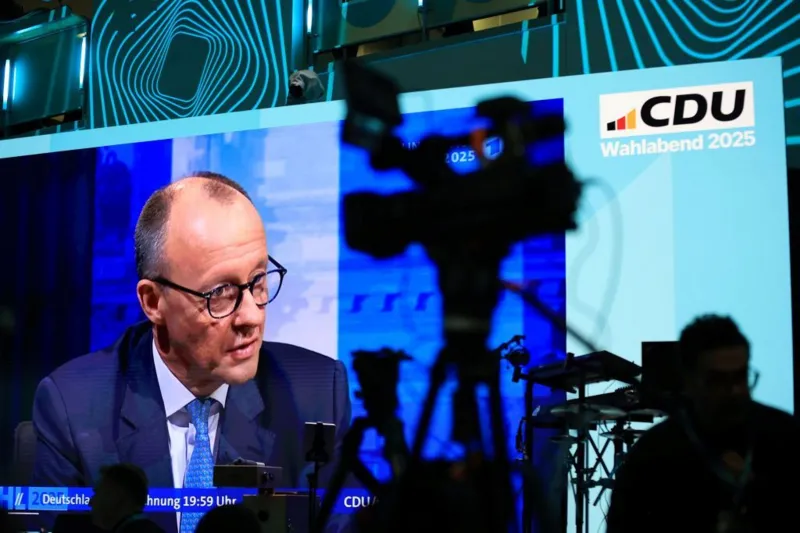
    Germany’s chancellor-in-waiting didn’t wait for the final results of his country’s election on Sunday to herald a new era in Europe.

    Declaring the US indifferent to this continent’s fate, Friedrich Merz questioned the future of Nato and demanded Europe boost its own defences. Quickly.

    This tone from the close US ally – and from Friedrich Merz who is known to be a passionate Atlanticist – would have been unimaginable even a couple of months ago.

    It’s a seismic shift. That may read like hyperbole, but what we are now experiencing in terms of transatlantic relations is unprecedented in the 80 years since the end of World War Two.

    Big European powers have been shocked to the core by the Trump administration, which suggests it could revoke the security guarantees to Europe in place since 1945.

    “I would never have thought that I would have to say something like this in a TV show but, after Donald Trump’s remarks last week… it is clear that this government does not care much about the fate of Europe,” Friedrich Merz said during a post-election debate on Sunday.

    “My absolute priority will be to strengthen Europe as quickly as possible so that, step by step, we can really achieve independence from the USA,” he added.

    …

    Original article continues at https://www.bbc.com/news/articles/cpv4n0dg3v3o

    Who is Friedrich Merz, the man now most likely to lead Germany? Eight things to know

  • Elon Musk’s Embrace of Far-Right Energizes Transatlantic Climate Denial 

    Spread the love

    Original article by Adam Barnett republished from DeSmog.

    “I think you really are the best hope for Germany,” Elon Musk told the thousands attending the far-right Alternative for Germany party’s rally on January 25. France 24 English/YouTube

    The tech billionaire is invigorating groups in the U.S. and Europe aiming to sabotage climate action, a DeSmog media analysis shows.

    In December, a Chicago-based organization called the Heartland Institute, which for decades has attempted to undermine the scientific consensus on climate change, devoted an episode of its daily podcast to Elon Musk. 

    As recently as 2022, Heartland figures had ridiculed the Tesla CEO as a member of the “billionaire climate elite” based on Musk’s claim that as a top manufacturer of electric vehicles, his company was “doing the most to solve climate change.”

    But perhaps, the podcast guests speculated, Musk was finally “abandoning the climate cult.” 

    The episode was recorded after Musk had given upwards of $277 million to get Donald Trump elected president, argued that “we don’t need to rush” on addressing climate change, and vowed to cut $2 trillion of federal government spending. One guest on the show was cautiously optimistic, saying: “I’m coming around on Musk.” 

    Heartland, which didn’t respond to a request for comment, isn’t the only anti-climate group embracing Musk these days. 

    DeSmog journalists in the European Union, the UK and the United States reviewed public materials from prominent climate deniers referencing Musk over recent months. Taken as a whole, these podcasts, opinion pieces, social media posts, newsletters, YouTube videos, and interviews with legacy media reveal an unmistakable trend: Musk’s public embrace of right-wing populists is invigorating a transatlantic movement aiming to spread doubt about the reality of climate change and sabotage action on the crisis.

    His interventions ahead of Germany’s elections on Sunday have energized the far-right Alternative for Germany, or AfD, which says that climate policy “threatens our freedom,” a January poll suggests. 

    His courtship, along with Trump, of hardline leaders in Europe threatens to torpedo hopes of progressive climate action by the EU, think tanks warn. 

    And in the U.S., Musk’s ongoing war against the federal bureaucracy “erodes our collective ability to adapt to climate impacts,” Amanda Fencl, director of climate science for the nonprofit Union of Concerned Scientists, has warned.

    Some longtime climate deniers are thrilled, however, recognising that even a brief endorsement from Musk to his 217.9 million followers on X — the social media platform formerly called Twitter, which he bought in 2022 — can confer instant visibility and excitement. 

    “We welcome Elon Musk into the climate red pill group,” Climate Depot executive director Marc Morano stated in December, using a phrase popular among Trump supporters that refers to rejecting liberal viewpoints.  

    Musk, contacted via Tesla, did not respond to a detailed list of questions about his shifting climate views.

    ‘Windmills of Shame’ 

    When Germans vote for a new government on Sunday, the EU’s most populous country is widely predicted to shift to the right. Leading the polls at about 29 percent of voters is the centre-right Christian Democratic Union, or CDU, which intends to prioritise economic growth over accelerated climate measures endorsed by the ruling Greens and Social Democrats, or SPD.

    Less certain is the influence that the surging far-right AfD will have on the next German government. On X, Musk has openly endorsed and platformed the party, which wants to ditch Germany’s climate commitments.

    As migration and economic stagnation dominate German politics, the AfD is now polling close to 21 percent — potentially doubling the 10 percent of votes it won in the last national elections in 2021. The party states that the level of human contribution to global warming is “not scientifically proven,” and opposes state support for renewable energy and electrification of heat and transport, while advocating for Germany’s gas and coal power sectors.

    The CDU says that it will not form a coalition government involving the AfD, and maintains its commitment to Germany’s 2045 net-zero emissions target. But despite its opposition status, the AfD is already shaping national political discourse — and even decision-making. 

    While the CDU and Germany’s other mainstream parties have traditionally refused to vote with the AfD due to its extreme stances on immigration and Germany’s Nazi past, the CDU broke this so-called “firewall” last month by voting with the AfD on a resolution to restrict migration. 

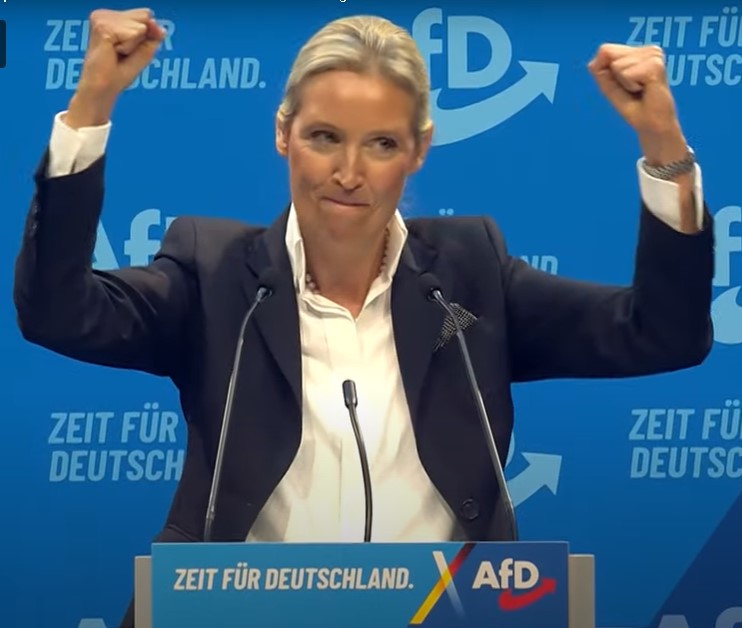
    Musk has sided with the AfD on its hard-line immigration stance and nationalist messaging. In December, Musk openly endorsed the party, shocking liberal Germans by writing on X that “only AfD can save Germany.” He went on to join a 9 January livestream with the AfD co-leader Alice Weidel, who has attracted controversy for Islamaphobic remarks, such as in a 2018 Bundestag speech when she said “burqas, headscarf girls, publicly-supported knifemen, and other ‘good-for-nothings’ will not secure our prosperity, economic growth, and the social state.” 

    AfD co-leader Alice Weidel. Credit: France 24 English/YouTube

    In terms of climate policy, Weidel has suggested that if the AfD takes power in Germany, it could dismantle wind turbines, recently calling them “windmills of shame,” The wind sector produced a third of the country’s electricity last year. 

    During their conversation, both Musk and Weidel expressed support for nuclear power — with Musk also saying he was a “big fan” of solar energy — and Weidel stating that Germany’s CO2 footprint was “obnoxiously very very high.” Both steered clear of the AfD’s official climate-denialist party platform. 

    Then, less than two weeks later, Musk sparked a global furore by raising his arm to the crowd at Trump’s January 20 inauguration in a gesture that many likened to a Nazi salute. The Amadeu Antonio Stiftung, a German organisation which advocates against right-wing extremism and anti-Semitism, saw no ambivalence in Musk’s move, describing it as a “Hitler salute.” Musk responded to the outpouring of criticism by posting on X: “The ‘everyone is Hitler’ attack is sooo tired.”

    Five days after Trump was sworn-in, Musk ramped up his support for the AfD by addressing a party rally via videolink. He urged supporters to “take pride” in being German over “some sort of multiculturalism that dilutes everything”, and told them that there’s “too much of a focus on past guilt” — remarks condemned by Polish prime minister Donald Tusk. 

    YouTube Influencer

    Musk had previously enjoyed support from Germany’s centrist parties. When Tesla opened a multi-billion dollar electric car factory in the State of Brandenburg in 2022, the move was billed as a boost to both the country’s manufacturing sector and climate credentials. But during his January livestream with Weidel, Musk expressed his disdain for the bureaucratic procedures needed to build the Tesla factory, which he said amounted to “25,000 pages”.

    Musk’s public support for the AfD can be traced back to his interactions with Naomi Seibt, a 24-year-old German influencer who built a sizeable social media following attacking “climate alarmism” and cultivating a brand as the anti-green doppelganger of Swedish climate activist Greta Thunberg. Her rise to prominence was aided by the Heartland Institute, which featured her in a YouTube video it published in February 2020. Seibt has since told Reuters that the organisation had paid her $4,000 a month for three months as a “scholarship.” (Seibt no longer appears to be affiliated with the group). 

    German influencer Naomi Seibt appears on the Heartland Institute’s YouTube channel on February 11, 2020. Credit: Heartland Institute/YouTube

    When Seibt posted on X last June that she’d voted for the AfD in the EU elections, which saw the formerly fringe party rise to 16 percent of the total vote — its best-ever result — Musk began sending her private messages asking for more information, according to Seibt. “And then he started following me,” Seibt told the BBC, noting that “it took him many months to decide to support the AfD.”

    Musk’s backing could boost a party that’s heavily critical of the country’s decarbonization efforts. A January poll of German voters from the U.S.-based Democracy Institute think tank suggested that 28 percent of respondents say they are “more likely” to vote AfD due to Musk’s support, while 23 percent said it made their support “less likely.”

    Germany’s center-right and center-left leadership have condemned Musks’s interventions. Friedrich Merz, head of the CDU, told The Wall Street Journal last week that Musk would face consequences for boosting the AfD. Chancellor Olaf Scholz, a member of the centre-left SPD, last month called Musk’s support for European far-right parties “disgusting.”   

    The new Trump administration is already mirroring the billionaire’s embrace of the AfD. Last week, U.S. Vice-President JD Vance met with Weidel, the AfD co-chief, on the sidelines of a security conference in Munich, while snubbing Scholz. 

    With the U.S. playing a major role in German trade and security, this budding transatlantic alliance could bode poorly for climate action in Europe’s biggest economy.

    Neither Seibt nor the AfD responded to questions.

    Courting the European Far-Right

    Musk’s electrifying impact on the AfD builds on his years of dabbling in far-right politics in other European countries. 

    In December 2023, Musk appeared as a guest of honour at an annual convention in Rome hosted by the Brothers of Italy, the right-wing populist party of Italian Prime Minister Giorgia Meloni, who had said earlier that year that “ultra-ecological fanaticism” was an economic threat. 

    Santiago Abascal, leader of Spain’s far-right Vox party, also attended the 2023 convention. He had recently predicted that Spanish citizens would hang their current Socialist Prime Minister, Pedro Sánchez, by his feet, remarks that were so controversial that some Brothers of Italy members asked for his invitation to be withdrawn, the Spanish newspaper El País reported.

    But whereas Abascal’s presence threatened to create divisions at the event, “Elon Musk’s case is somewhat different, arousing only enthusiasm and selfie fervor,” noted El País. “The tycoon is nowadays the darling of almost all those on the ultra-right who seek media and economic backing, and a cutting-edge image.”

    A month later, in January 2024, Musk again signalled his interest in European politics.

    With German farmers protesting the end of government diesel fuel subsidies and a new tax on agricultural vehicles, Anthony Lee, who had stood for the European Parliament as a candidate for Free Voters, a German conservative populist party, gave an interview to right-wing Dutch influencer Eva Vlaardingerbroek. Lee told Vlaardingerbroek that politicians “want our land to build industry, houses. Houses for refugees, whoever, I don’t care what for.” 

    After Musk reacted to the video on X, writing “Support the farmers!” Lee said in a video message that “I think it’s just awesome that Elon Musk himself tweeted this…This is only possible because we stand together.” The video was viewed over 200,000 times. Lee did not respond to a request for comment.

    A year later, Musk was rubbing shoulders at Trump’s inauguration with a who’s-who of right-wing European politicians, including Spain’s Abascal, France’s Éric Zemmour and Reform UK leader Nigel Farage, all of whom have questioned the science and urgency of climate change. 

    Analysts with the independent European Policy Center think tank in Brussels sees the inauguration guestlist as a worrying sign that Trump and Musk are helping strengthen “ideological ties between significant radical forces on both sides of the Atlantic.” They are concerned about the impact a second Trump administration may have on a host of EU-wide initiatives, including a raft of climate reforms known as the European Green Deal. 

    “The most concerning possibility,” the analysts argue, is “Trump’s probable exploitation of far-right leaders or governments to block EU policies or advance his agenda.” 

    Musk’s Shift to ‘Climate Skeptic’ 

    For years, Musk enjoyed a reputation as a crusading green energy entrepreneur on a mission to render the internal combustion engine obsolete, celebrated by climate activists and cleantech investors alike — despite growing signs of his right-ward political leanings. As recently as last August, the online news outlet E&E News ran a story speculating that “Musk might be the only person Trump listens to on climate.”

    But Musk’s politics and business interests seemed to decisively converge during a 2024 meeting of Tesla executives in Palo Alto, California, where he shelved plans to develop a more budget-friendly compact car that could be marketed to lower-income customers around the world, according to a report in the Washington Post. This had previously been a key part of Tesla’s plan to “accelerate the world’s transition to sustainable energy.” 

    Instead, Musk approved a plan worth billions of dollars to purchase computer chips that could improve Tesla’s luxury vehicles, the Washington Post report said. Musk had shifted from calling for “a popular uprising” against the fossil fuel industry in 2016 to stating that there were more important global problems to address. 

    In a livestream with Trump last year, Musk stated that ​​“we don’t need to rush” in fixing climate change.

    This also happens to be the message of Bjørn Lomborg, a longtime Danish climate crisis denier (and apparent “friend” of Trump administration energy secretary Chris Wright) whose 2023 book Best Things First argued that there were more important global priorities to address than climate change. According to a recent edition of Lomborg’s newsletter, the Canadian conservative influencer Jordan Peterson shared a copy of Lomborg’s book with Musk in 2024.

    Within U.S. denial networks, some leaders link Musk’s shift to the flourishing of anti-climate messages on Twitter after the billionaire purchased the platform, and renamed it X. “I mean, there are thousands, if not hundreds of thousands of climate skeptics on X/Twitter, and they’re constantly posting content that we put out here,” the Heartland Institute’s Anthony Watts argued on the group’s podcast. “Musk has had to have seen some of this stuff.”

    Musk’s former critics in climate denial circles now see him as the best bet for implementing their most extreme ideas. Musk’s so-called Department of Government Efficiency has been attempting to shut down key climate-related agencies like the United States Agency for International Development, or USAID. 

    On the website of the conservative group CFACT, prominent denier Paul Dreissen — who previously accused Musk of holding “sanctimonious” views on “the alleged climate crisis” — has offered policy suggestions to the billionaire as he wages war on the federal bureaucracy: End subsidies for renewable energy; terminate funding for environmental and climate justice programs; and require applicants for climate research funding to “provide computer codes and analyses so that reviewers can view and evaluate their work.”

    Parts of Musk’s plan seem to rely on two recent, pro-industry Supreme Court decisions to unwind regulatory authority long held by federal agencies — an overarching goal of the Heritage Foundation’s Project 2025 initiative, retooled with Musk’s Silicon Valley spin. 

    If successful, these cuts will dismantle decades of clean air and water protections, and hamstring the country’s ability to respond proactively to the worsening climate crisis, said Fencl, the director of climate science at the Union of Concerned Scientists. 

    Hurricane Helene made landfall in Florida in October 2024, but caused deadly and destructive flooding hundreds of miles from the coast due to extreme rain. At least 219 people died, and the damages are estimated at $78.7 billion. Credit: PBS NewsHour/YouTube.

    “Our infrastructure systems are not going to withstand the climate impacts we’re expecting, and taking away the government’s spending in these spaces really erodes our collective ability to adapt to climate impacts,” Fencl said.

    Raising the UK’s Political Temperature

    Since throwing his fortune and social media influence behind Trump, Musk has teased the possibility of attempting a similar campaign in the UK.

    In December, Musk met with Reform UK leader Farage, who also co-founded and formerly led the Brexit Party, at Trump’s Mar-a-Lago resort in Florida. 

    The two were in talks about Musk offering a £100 million (over $125 million) donation to Reform, The Times of London reported. Farage has said he finds it “extraordinary that people call carbon dioxide a pollutant, and Reform UK’s latest party manifesto recycles a long-debunked claim that “scientists disagree as to how much” human activity is causing climate change. So such a donation would have been a major investment by Musk in transatlantic climate denial.

    Then, in January, Musk used X to call for the release of Tommy Robinson, a far-right British influencer serving an 18-month contempt of court sentence for making false accusations about a Syrian schoolboy. When Farage rejected his calls to join forces with Robinson, Musk tweeted that, “the Reform Party needs a new leader. Farage doesn’t have what it takes.” 

    Farage was not sufficiently swayed by Musk’s comments to support Robinson’s return, although he struck a conciliatory note by saying the tech mogul didn’t know “the full story” about the provocateur’s criminal past. By the end of January, Farage was signalling to the press that his rift with Musk was over, telling The New York Times that the billionaire was still open to donating to Reform UK. “We’ve got very similar goals on some areas, slightly different emphases in others,” Farage said, adding that Musk was sharing valuable information about how Trump won over swing voters during the U.S. election. 

    Farage is also collaborating with the Heartland Institute, which has claimed credit for working with hard-right parties in Austria and Hungary to attempt to stall the EU’s Nature Restoration Law, which sets targets for restoring damaged ecosystems, as well as other green policies. Farage helped  launch the pro-Trump institute’s new UK-Europe branch in December.

    Farage’s newly formed Reform UK won just five of the 650 seats in the lower house of parliament in last year’s elections, and  was unsuccessful  in generating a backlash against the country’s net-zero emissions goal. Nevertheless, the party appears to be pushing the historically weakened Tories to the right on climate change — echoing Farage’s previous strategy to rally support for the 2016 Brexit referendum. 

    Regardless of how much tangible backing Musk might provide to right-wing figures in the UK, his winning bet on Trump, and assault on federal government spending, has inspired Farage and his allies with a sense of the possible. “There’s a heck of a lot we’ve learned from that we will implement over the next few years,” Farage told The New York Times.

    Some European leaders are looking for ways to neutralize Musk’s efforts to sway voters. 

    In January, as Musk posted false allegations that UK Prime Minister Kier Starmer had let child sex abusers escape justice, France called on the European Commission to take action against Musk and X for election interference. According to The Financial Times, Musk was also investigating how to get Starmer out of office before the country’s next election, and replace his center-left government with right-wingers.

    Members of the European Parliament, who are elected representatives of their respective nations, are also criticizing the Commission for failing to use its authority under the EU’s Digital Services Act to investigate and fine Musk and X, as well as other major social media platforms, for spreading disinformation.

    Asked about Musk’s tirade during a public event in January, Starmer did not name the billionaire directly in his response. “Those that are spreading lies and misinformation as far and as wide as possible, they’re not interested in victims,” said Starmer. “They’re interested in themselves.”

    Additional reporting by Emily Gertz

    Original article by Adam Barnett republished from DeSmog.

    Nigel Farage explains the politics of Reform UK: Racism, Fake anti-establishmentism, Deregulation, Corporatism, Climate Change Denial, Mysogyny and Transphobia.
    Nigel Farage explains the politics of Reform UK: Racism, Fake anti-establishmentism, Deregulation, Corporatism, Climate Change Denial, Mysogyny and Transphobia.
    Elon Musk urges you to be a Fascist like him, says that you can ignore facts and reality then.
    Elon Musk urges you to be a Fascist like him, says that you can ignore facts and reality then.
  • Talking about Palestine “not a crime,” reminds UN Rapporteur Albanese

    Spread the love

    Original article by Ana Vračar republished from peoples dispatch under a Creative Commons Attribution-ShareAlike 4.0 (CC BY-SA) license.

    Francesca Albanese during the event “Reclaiming the Discourse: Palestine, Justice, and Truth”. Source: screenshot

    UN Special Rapporteur Francesca Albanese’s talks have faced intense state pressure across Europe, with Germany at the forefront

    Talks by UN Special Rapporteur on the occupied Palestinian territories Francesca Albanese in Europe continue to face fierce pressure. Following the withdrawal of an invitation by some Dutch parliamentarians, German authorities have gone to great lengths to obstruct events where Albanese was scheduled to speak. Two German universities canceled events that had already been announced and had garnered widespread interest. However, activists secured alternative venues, ensuring Albanese could still present the results of her work.

    Yet even non-institutional venues were not spared from pressure. The publisher of Junge Welt, which stepped in to host the event “Reclaiming the Discourse: Palestine, Justice, and Truth“ after it was cast out from its original location, found itself facing nearly 100 police officers. Inside the hall, around 200 attendees gathered to hear Albanese speak. Despite protests, the police remained stationed at the venue throughout the event, serving as a clear reminder of the dire state of free expression in Germany. While the hosts are considering legal action against the police, such repression is expected to persist, as left-wing activists remain under surveillance and students organizing Palestine solidarity events at universities face persecution.

    Read more: German state continues crackdown on Palestine solidarity

    Organizations hosting Albanese, including the political platform DiEM25, have described these pressures as “a direct assault on the rule of law and the core principles of democracy.” Similarly, the Sahra Wagenknecht Alliance – Reason and Justice, along with members of the left party Die Linke, condemned the suppression of academic freedom and the silencing of discussions on Palestine soon after the news of the cancellations.

    According to Albanese, Germany is the first country she has visited recently where universities have capitulated to pressure and canceled her speeches. “This gives me a sense of the state of the debate in this country,” she told attendees of Reclaiming the Discourse. Throughout the discussion, the UN Special Rapporteur emphasized the lengths to which many European governments are willing to go to suppress debates on Palestine—Germany, in particular, leading the charge. Despite the authorities’ repressive actions, she insisted that “it’s not a crime to talk about Germany’s implications and responsibilities vis-à-vis what’s happening in Palestine.”

    She also urged participants to reject fear and organize against the climate of repression surrounding discussions on Palestine in Europe, describing it as an atmosphere lacking oxygen. “It’s no longer [just] about Palestine,” she continued. “When I see police officers in Europe using the stick against people standing against injustice, when I see Jewish people in this country being lectured about what antisemitism is—I say something has gone wrong.”

    “I wouldn’t feel comfortable living in a country where you cannot talk about a people who are being genocided,” she added.

    Read more: A year of struggle for Palestine in the belly of the beast

    In their attempts to silence Albanese, Zionist groups and other right-wing organizations have attempted to smear her as antisemitic. Some have fallen for this ruse, but many more continue to stand by her and amplify her work. While audience members noted that university staff largely failed to publicly support her or defend academic freedom following the cancellations, Albanese pointed to the legal and academic experts, including in the Global South, who have spoken out, urging institutions to refuse such repression.

    “While our politicians and universities fail to show respect for a UN Special Rapporteur, we, as international lawyers, fail a colleague and a luminary in these dark times by not standing up for her against false and unfounded accusations,” wrote public and international economic law expert and professor Isabel Feichtner. “Most of all, however, we fail our students, broader society, and the very idea of human rights, which—if they are to have any meaning—must serve the powerless.”

    Original article by Ana Vračar republished from peoples dispatch under a Creative Commons Attribution-ShareAlike 4.0 (CC BY-SA) license.