Original artticle republished from MIMO under a Creative Commons Attribution-NonCommercial-ShareAlike 4.0 International License.
Ireland’s Prime Minister Simon Harris attends a press conference at Government Buildings in Dublin on April 12, 2024 [PAUL FAITH/AFP via Getty Images]
Ireland’s Prime Minister, on Thursday, said that 40,000 dead in Gaza is a “milestone the world must be ashamed of”, Anadolu Agency reports.
“International diplomacy has failed to protect innocent children, some only days old,” Simon Harris said on X.
He called on Israel to stop the bombings in Gaza and asked Hamas to release the hostages.
In addition to his call for a ceasefire in Gaza, Harris urged the EU to reassess its association agreement with Israel.
Flouting a UN Security Council resolution demanding an immediate ceasefire, Israel has faced international condemnation amid its continued brutal offensive on Gaza since a 7 October, 2023 attack by Hamas.
The Israeli onslaught has since killed over 40,000 people, mostly women and children, and injured over 92,400 others, according to local health authorities.
Over 10 months into the Israeli onslaught, vast tracts of Gaza lie in ruins amid a crippling blockade of food, clean water and medicine.
Israel is accused of genocide at the International Court of Justice, whose latest ruling ordered it to immediately halt its military operation in the southern city of Rafah, where more than 1 million Palestinians had sought refuge from the war before it was invaded on 6 May.
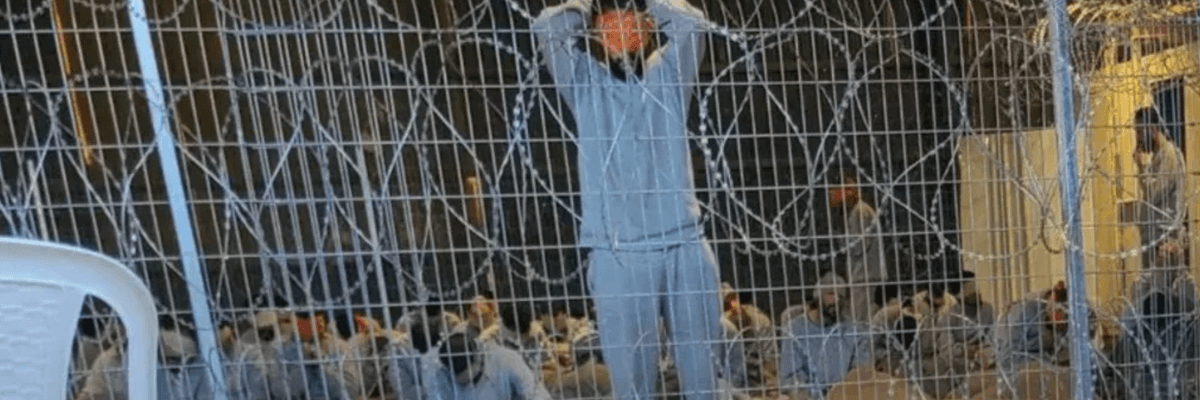
A leaked photograph obtained by CNN shows a blindfolded man with his arms over his head at the Sde Teiman detention facility. (Photo: CNN)
“Can you imagine the response if Palestinians were holding Israelis in mass rape camps and torturing them to death?” asked one critic.
Human rights defenders are calling out Western news outlets and political leaders for their conspicuous lack of coverage and vocalized condemnation after leaked video footage appeared to show Israeli soldiers gang-raping a Palestinian detainee in the notorious Sde Teiman prison and the release of a new report documenting systematic torture of prisoners held by Israel.
Earlier this week, Israel’s Channel 12 aired a video showing Israel Defense Forces (IDF) reservists assaulting a Palestinian man at Sde Teiman, which is often called “Israel’s Guantánamo.” The victim was reportedly hospitalized with a severe anal injury, ruptured bowel, broken ribs, and lung damage. In addition to torture, former Sde Teiman detainees have described rampant rape and sexual abuse, allegedly often committed by female soldiers.
Instead of avoiding the Sde Teiman rape story, Israeli media have aired an interview with one of the IDF suspects—who are being hailed as “heroes” by far-right Israelis including multiple Cabinet ministers—and panel discussions including one in which a journalist called for “institutionalized” rape of Palestinian prisoners. This, as Israeli leaders demanded an investigation of the rape video to find and punish whoever leaked the footage, and as Israeli lawmakers argue that it’s permissible to rape Palestinian prisoners.
It’s wild how mainstream US media is still ignoring the Israeli gang rape of a Palestinian on video while in Israel the rapist is invited on TV to defend the rape.
At this point the US media silence looks like a conspiracy, much like how they refuse to touch Israel killing its… https://t.co/NsLWUA5Oyu
Meanwhile, there has been very little coverage of Sde Teiman on U.S. broadcast media, which have come under fire for allowing Israeli officials to censor their coverage of the Gaza onslaught. This stands in stark contrast to the myriad—and sometimes outright false—reports of Hamas militants raping Israeli women during the October 7 attack, which have prompted embarrassing corrections.
“Can you imagine the response if Palestinians were holding Israelis in mass rape camps and torturing them to death? Every U.S. politician would condemn it, there would be congressional resolutions, countless CNN segments, and celebrity outrage,” Palestinian American poet Remi Kanazi said Thursday on social media. “But the victims are just Palestinians.”
Dazed politics editor James Greig said on social media Wednesday that “it feels redundant to complain about double standards at this point but still, the contrast between the silence about Sde Teiman and the months of lurid, detailed, and at best factually dubious reporting published when Hamas was accused of sexual violence is extremely stark.”
Syrian British journalist Richard Medhurst wrote Thursday on social media that “the silence by mainstream media on the IDF’s rape culture is deafening.”
“These journalists are literally covering for the most violent form of rape, recorded on camera, and documented by doctors,” he added.
Israel’s Channel 12 TV has exposed video of Israeli soldiers in Sde Teiman detention (= torture/rape/death) camp, gang raping a Palestinian prisoner and using their shields to obscure videos of their assault. The silence of US media is deafening.https://t.co/27pX8rfNA9
When there is coverage of alleged Israeli crimes in the U.S. media, it is often presented in a manner that casts doubt upon the veracity of Palestinian claims—which are increasingly beyond doubt amid an avalanche of evidence.
On Monday, asCommon Dreamsreported, the Israeli human rights group B’Tselem released a detailed report, ominously titled “Welcome to Hell,” which documented widespread torture and abuse of Palestinians across Israeli’s detention apparatus. The report found that “there is no room to doubt” that Israel’s torture methods are a systematic, organized policy of its prison authorities.
Israeli whistleblowers have described having to frequently amputate Sde Teiman detainees’ limbs due to damage from constant shackling. IDF officers have admitted that dozens of Palestinians have died at the prison. IDF soldiers allegedly murdered one detainee by shoving an electric baton in his anus. United Nations experts and the Israeli human rights group B’Tselem have confirmed what the latter described as the “systematic” torture of detainees “that amounts to a war crime and even a crime against humanity.”
Meanwhile, Israeli protesters have rallied for the right to rape Palestinians, and a far-right mob whose members included a Cabinet minister and multiple Knesset lawmakers stormed two military bases last month in an attempt to free the alleged IDF rapists after nine suspects were arrested.
Yet “there is still no international outcry,” journalists Lubna Masarwa and Peter Osborne wrote in a Middle East Eyeopinion piece published Friday. “This collective omerta from politicians and the media about Israel’s monstrous conduct is hard to comprehend, given that we are talking about systematic war crimes committed on a horrifying scale by a country already under investigation at the International Court of Justice for potential genocide.”
“Their silence amounts to complicity,” the authors continued. “As for Israel, the majority of the political and media classes do not appear to think there is much wrong in the torture and abuse of prisoners, with some ministers actively defending the abusers.”
“These are the signs of a very sick society indeed—one that has passed through an invisible barrier into savagery,” they added. “There are no red lines, no respect for international law, and no accountability. The silence of the West shows that we, too, have entered the same nightmare universe.”
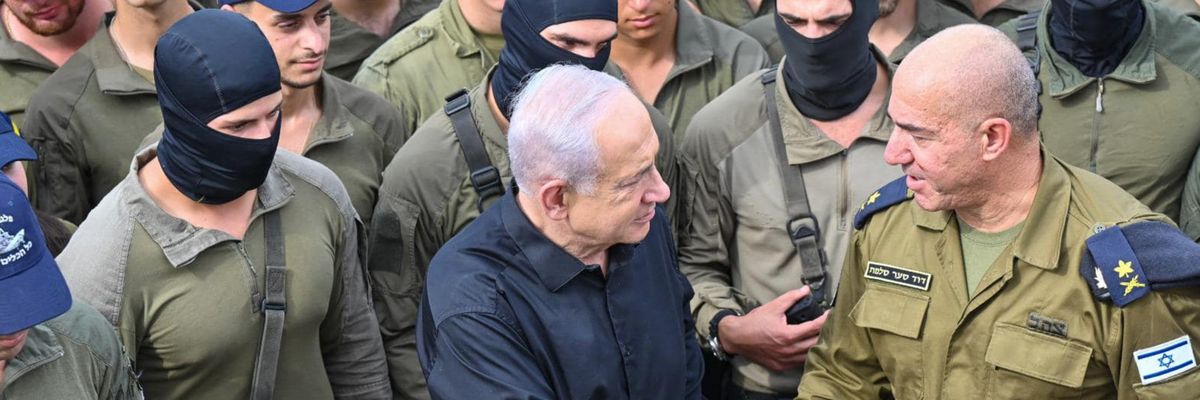
Israeli Prime Minister Benjamin Netanyahu shakes hands with Rear Adm. David Saar Salama at the Ashdod Naval Base on October 29, 2023. (Photo: Office of Benjamin Netanyahu)
Instead of turning a blind eye to Israel’s behaviors that are deliberately designed to provoke more war, the U.S. needs to stop playing games and get serious about holding Israel accountable.
Why—in the midst of critical negotiations to implement U.S. President Joe Biden’s plan to bring about a cease-fire in Gaza, release Israelis held captive by Hamas and a significant number of Palestinians held by Israel, and move toward a negotiated permanent end to the conflict—would Israeli leader Benjamin Netanyahu decide to assassinate the chief Hamas negotiator while he was visiting Iran? And why—while the U.S. says it was working to deescalate tensions with Lebanon’s Hezbollah—would Israel choose to up the ante by assassinating Hezbollah’s number two?
We know the answers to both questions: Benjamin Netanyahu isn’t interested in peace. He doesn’t want a negotiated deal to release hostages and end the war on Gaza. He doesn’t want to deescalate the conflict there or in the north with Hezbollah. And he most certainly doesn’t want a “two-state solution” that would grant the Palestinian people independence in a sovereign state of their own.
There are two things Netanyahu does want, and, at this point, both are perversely connected. Above all, he desperately wants to remain in office, because should he lose his post as prime minister, the prosecution of the corruption charges against him will continue in full force. As the charges are so serious and the evidence so clear, he will likely be convicted and humiliated. This is not speculation—it’s widely discussed in Israel and was even hinted at by President Biden in a May 28 interview with Time Magazine. When he was asked “Is Netanyahu prolonging the war for political reasons?” Biden responded, “There is every reason for people to draw that conclusion.”
Why hasn’t the administration condemned the assassinations in Beirut and Iran when they know that they will surely sabotage the efforts of negotiators?
The second reason is that Netanyahu wants the war to continue and even be accelerated. He made this clear in his remarks before U.S. Congress and in an address to the Israeli public a few days ago. He seeks “total victory,” which he defines as more than the military defeat of Israel’s enemies. Without acknowledging any Israeli culpability, he charged that the Palestinians had created a hate-filled culture which in the post-war period would require massive deradicalization—the outcome of which would have Palestinians accepting Jewish hegemony in Eretz Israel and understanding their place as a conquered and subordinate people.
This is the messianic Zionist vision that has long driven Netanyahu and which he now sees as possible, but only if all of Israel’s enemies—meaning Iran and its surrogates—are brought to heel. And this can only be realized if Israel can involve the U.S. in their regional conquest.
Netanyahu’s worldview raises several additional questions that must be considered. If we know that Netanyahu has never accepted the terms of the Biden plan, why has the president continued to maintain that it was “Israel’s plan” and placed the burden on Hamas to accept it? And if we know that Netanyahu is unwilling to make any peace agreement for fear of losing his other extremist coalition partners (who have threatened to abandon his government should he accept any terms leading to peace), why do we continue to dance around that fact? Why hasn’t the administration condemned the assassinations in Beirut and Iran when they know that they will surely sabotage the efforts of negotiators? Why, when we know that Netanyahu has no intention of completing a deal to release those held captive, do we continue to allow him to exploit the pain of their families, pretending that negotiations are close to completion, when we know they aren’t? And why, when we know that the demands and actions of Netanyahu’s extremist coalition partners are wreaking havoc in the West Bank and Jerusalem—terrorizing the Palestinian population, annexing more land, building more settlements, and erasing the possibility of Palestinian self-determination—have we been so passive and tolerant in response?
Let’s be clear: Hamas and Hezbollah are not good actors. The former was born of the brutal and sustained Israeli occupation of Palestinian land. It was nurtured by Israel to create division in the Palestinian ranks and fueled by Israel’s ruthless decades-long strangulation of the population of Gaza. The latter was born of Israel’s invasion of Lebanon and by that country’s corrupt sectarian system that denied the Shia community adequate representation and resources. It was fueled by Israel’s decades-long occupation of Lebanon’s south and massive devastation of the country’s infrastructure in 2006. To be sure, both have engaged in condemnable actions. But to criticize only them, while absolving Israel of its far greater crimes, is hypocritical at best.
If the U.S. were serious about ending conflict in the region, instead of turning a blind eye to Israel’s behaviors that are deliberately designed to provoke more war, we need to stop playing games and get serious about holding Israel accountable. This leads to one final question: Why, when we continue to massively supply Israel with weapons and block all efforts to sanction their deplorable behaviors, do we expect that anything will change?
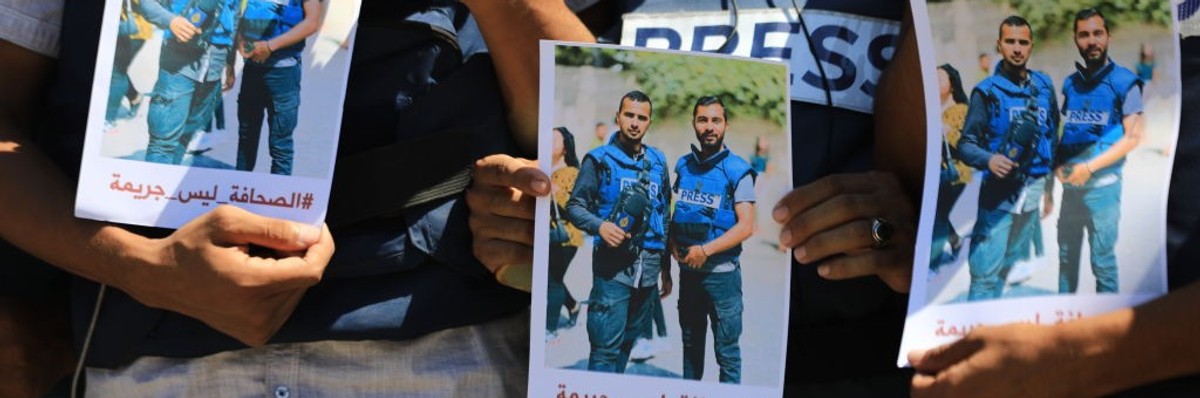
Palestinian Al Jazeera journalist Ismail al-Ghoul and cameraman Rami al-Rifee were killed by Israeli forces on July 31, 2024. (Photo: Dawoud Abo Alkas/Anadolu via Getty Images)
International outcry and a reporter’s pointed questions weren’t enough to get the State Department to denounce the killings of Al Jazeera journalists.
A Palestinian journalist on Thursday pressed a U.S. State Department spokesperson to characterize the killings of two Al Jazeera journalists by Israeli forces as summary execution.
The heated press briefing followed an airstrike on Wednesday that killed Al Jazeera reporter Ismail al-Ghoul and cameraman Rami al-Rifee, and sparked global outrage. Israel’s military acknowledged targeting al-Ghoul, saying he was “eliminated” because he was a Hamas “terrorist,” an allegation the Qatar-based network said was “baseless.”
The death toll of Palestinian journalists and media workers now stands at least 108, including several intentionally targeted by Israel forces, according to the Committee to Protect Journalists (CPJ).
Said Arikat, the Washington bureau chief of Al-Quds, an Arabic-language newspaper based in Jerusalem, called the strike a “premeditated crime to kill a journalist for doing their job” and a “summary execution” in the press briefing, but State Department spokesperson Vedant Patel declined to affirm the characterizations or condemn the airstrike.
.@SMArikat: Al Jazeera journalists were told to leave by the Israelis, they got in their car and moved and they were bombed, that is summary execution
Patel: We continue to engage with our partners in Israel
Al-Ghoul and al-Rifee were killed in northern Gaza after reporting from near the home of Ismail Haniyeh, the Hamas political leader who was assassinated in Tehran earlier on Wednesday. They wore press vests and had signs on their vehicle identifying them as journalists; they had last contacted their news desk just 15 minutes before the strike, Al Jazeera reported.
The Israel Defense Forces (IDF) presented no evidence in a social media post claiming that al-Ghoul was a terrorist and Hamas operative. In March, al-Ghoul reported being stripped, handcuffed, and blindfolded during the course of a 12-hour detainment by Israeli forces; he had been covering an Israeli attack on al-Shifa hospital in Gaza City. Witnesses said Israeli forces severely beat al-Ghoul at the hospital before arresting him.
Anas al-Sharif, another Al Jazeera reporter in Gaza, was on site at a different hospital on Wednesday when his colleagues’ bodies were brought in, and he spoke about the role al-Ghoul had played in the outlet’s war coverage.
“Ismail was conveying the suffering of the displaced Palestinians and the suffering of the wounded and the massacres committed by the [Israeli] occupation against the innocent people in Gaza,” he told his own news outlet.
“The feeling—no words can describe what happened,” he added.
In protest of the killings, Palestinian journalists gathered to throw off their press vests and vowed to continue showing the suffering of Gazans through their work, despite the dangers they faced.
Palestinian journalists in Gaza threw their press vests to the ground in protest against Israel’s killing of Al Jazeera correspondent Ismail al-Ghoul and cameraman Rami al-Rifi. pic.twitter.com/Dmi4D1MoQ3
Condemnation of the killings of the two Al Jazeera journalists came not just from Gaza but all over the world.
CPJ CEO Jodie Ginsberg said in a statement that she was “dismayed” by the killings and that journalists are civilians who should never be targeted.
Defending Rights & Dissent, a U.S.-based civil liberties nonprofit, also condemned the killing of al-Ghoul and said the reasons for it were clear.
“When you ‘eliminate’ journalists, it’s much easier to hide war crimes, it’s easier to spread lies, it’s easier to commit genocide,” Sue Udry, the group’s executive director, said in a statement.
In response to the killing, the International Committee of the Red Cross (ICRC) said that journalists “must be protected, and we decry attacks against them.”
William Schomburg, head of the ICRC’s sub-delegation in Gaza, said in a statement that his team had just met with al-Ghoul the previous week to get an update on the humanitarian situation in Gaza. “Journalists in all wars play a central role in highlighting the plight of civilians and in speaking for the voiceless,” Schomburg said.
Reporters Without Borders (RSF, in French), a Paris-based nonprofit, wrote in unequivocal terms about the need for Israel to stop killing journalists.
“RSF is deeply disturbed to see the Israel Defense Forces using social media to justify their targeted killing of Al Jazeera journalist Ismail al-Ghoul,” the organization wrote on social media. “Journalists are not terrorists. This campaign of violence against media in Gaza must stop now.”
The Freedom of the Press Foundation also responded forcefully to the IDF’s claim about al-Ghoul.
“Documenting a war isn’t terrorism, it’s journalism,” the group wrote on social media. “If the IDF can prove al-Ghoul was working for Hamas’ military, it should do so immediately. If not, this looks like a flimsy excuse for intentionally murdering a journalist from an outlet Israel dislikes.”
Israeli forces have killed at seven journalists or media workers affiliated with Al Jazeera during the war, and Israel shut down the network’s local operations in May, citing a security threat, though critics said it was a case of censorship—an attempt to hide the brutality of the assault on Gaza.
In total, 113 journalists and media workers have died since the war began, including two Israelis and three Lebanese, according to CPJ, which says this has been the deadliest period for journalists anywhere in the world since it began collecting data in 1992.
The international outcry over all of the killings has ramped up pressure on the U.S.—which has backed the Israeli assault with weapons and diplomatic support— to condemn them, and Wednesday’s strike on al-Ghoul and al-Rifee has only increased that pressure. Still, Patel, the spokesperson, wouldn’t issue any such condemnation on Thursday.
Arikat also pressed Patel to call for the release of Palestinian journalists being held in Israeli detention centers without charges, but Patel didn’t do so.
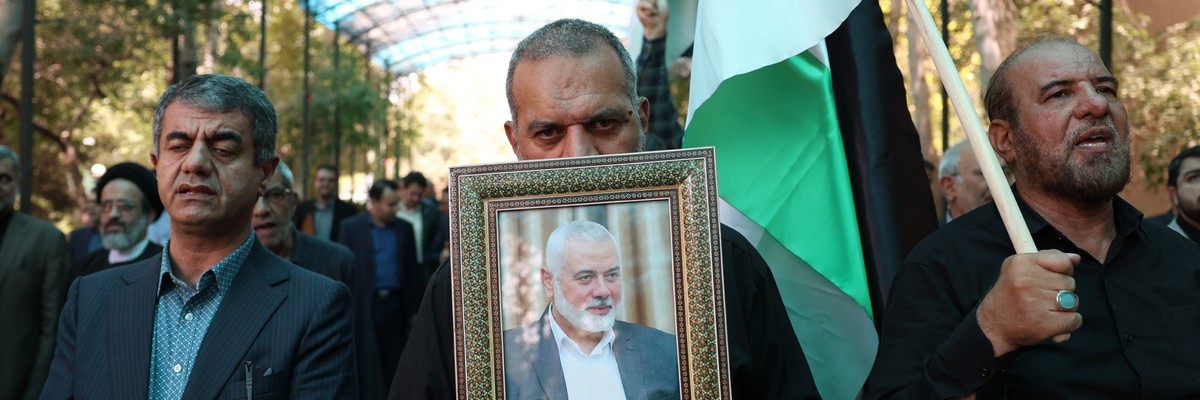
People hold up a portrait of assassinated Hamas political chief Ismail Haniyeh in Tehran, Iran on July 31, 2024. (Photo: AFP via Getty Images)
“Netanyahu isn’t playing chicken, he wants to crash the car,” said one observer.
The political leader of Hamas was assassinated early Wednesday in what the group said was an Israeli attack on his residence in the Iranian capital of Tehran, which he was visiting to attend the inauguration of the country’s newly elected president.
The killing of Ismail Haniyeh, who became the head of Hamas’ political arm in 2017, sparked warnings that Israeli Prime Minister Benjamin Netanyahu is doing all he can to undermine cease-fire talks with the Palestinian group after they showed signs of progress in recent weeks.
“Netanyahu has systematically sabotaged cease-fire talks because ending the war will likely end his political career,” Trita Parsi, executive vice president of the Quincy Institute for Responsible Statecraft, said following the assassination of Haniyeh, a key figure in the negotiations.
“The assassination buys Netanyahu several weeks, if not months, in which there will be no serious expectation of a cease-fire deal,” Parsi argued. “Thus, the war will continue, as will Netanyahu’s reign as prime minister.”
Haniyeh’s killing prompted fury from Iran, whose supreme leader vowed a “harsh response”—heightening the chances of a long-feared all-out war between Israel and Iran. Earlier this year, Israel killed several Iranian commanders in a strike on Tehran’s consulate in Syria’s capital, prompting Iran to retaliate with a drone attack.
Iranian lawmakers are expected to hold an emergency meeting about Haniyeh’s assassination later Wednesday. As of this writing, the Israel Defense Forces (IDF) has yet to comment on the killing.
The International Criminal Court’s (ICC) top prosecutor, Karim Khan, was seeking an arrest warrant against Haniyeh for war crimes committed on October 7. Khan has also applied for an arrest warrant against Netanyahu and Israeli Defense Minister Yoav Gallant.
“How can mediation succeed when one party assassinates the negotiator on the other side?”
The suspected Israeli strike in Tehran on Wednesday was launched just hours after Israel’s military bombed the Lebanese capital of Beirut, killing several people—including two children—in retaliation for a deadly attack on the occupied Golan Heights. Israel claimed its attack on Beirut killed Hezbollah commander Fouad Shukur, but subsequent reporting suggested he may have survived the strike.
News of Haniyeh’s assassination in Tehran came days after top officials from Israel, Egypt, Qatar, and the United States met in Rome over the weekend to continue negotiating a possible deal to end Israel’s assault on the Gaza Strip.
The New York Times reported that “despite progress in recent weeks, the monthslong negotiations remain stalled over several critical issues, particularly the extent to which Israeli forces would remain in Gaza during a truce.”
“Earlier in July, Israel hardened its position on maintaining checkpoints along a strategic highway south of Gaza City, weeks after suggesting that it could compromise,” the Times added. “It was unclear on Sunday if Mr. Netanyahu had allowed negotiators to show greater flexibility on the matter during the talks. Mr. Netanyahu faces pressure from members of his right-wing government to stick to a tougher line. The length of the truce is also a source of dispute: Hamas wants a permanent truce, while Israel wants the option to resume fighting.”
Egypt said Haniyeh’s killing is a signal from Israel that it lacks “political will for deescalation,” according toAl Jazeera.
Qatar’s prime minister, meanwhile, wrote on social media: “Political assassinations and continued targeting of civilians in Gaza while talks continue leads us to ask, how can mediation succeed when one party assassinates the negotiator on the other side?”
Jamal Abdi, president of the National Iranian American Council, warned that with the assassination of Haniyeh, “Netanyahu isn’t playing chicken, he wants to crash the car.”
U.S. Secretary of State Antony Blinken said Wednesday that the United States was “not aware of or involved in” the assassination of Haniyeh.
Belén Fernández, a contributing editor at Jacobin, wrote in an op-ed for Al Jazeera that “Israel made its intention to continue and expand the war clear” by killing Haniyeh.
“By assassinating Haniyeh in Tehran, Israel is literally playing with fire,” Fernández wrote. “In order to derail cease-fire prospects and keep up the killing in Gaza, then, it seems Israel is going to end up with a whole lot more regional blood on its hands.”
This story has been updated to include new comment from U.S. Secretary of State Antony Blinken.