Tag: Human Rights Watch

  • ‘End This War Crime’: HRW Says Israel Is Starving Children to Death in Gaza

    Spread the love

    Original article by JAKE JOHNSON republished from Common Dreams under Creative Commons (CC BY-NC-ND 3.0).
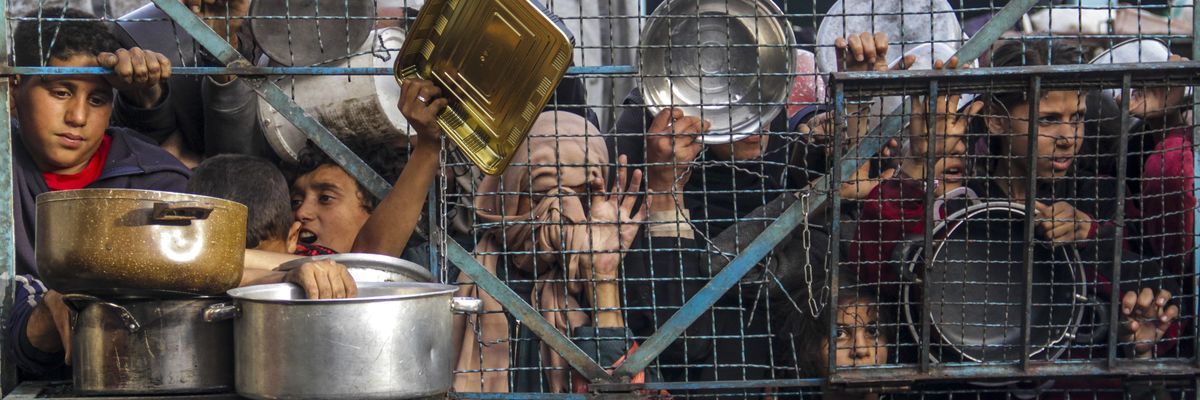
    A crowd of starving Palestinians, including children, waits to receive food distributed by charity organizations amid Israel’s blockade at the Jabalia refugee camp in Gaza on March 27, 2024. (Photo by Mahmoud Issa/Anadolu via Getty Images)

    “The Israeli government’s use of starvation as a weapon of war has proven deadly for children in Gaza.”

    The Israeli government is starving children to death in the Gaza Strip with its deliberate and systematic obstruction of food aid, Human Rights Watch said in a report released Tuesday, citing firsthand accounts from doctors and families in the besieged enclave.

    At least 32 people, including 28 children, have died of malnutrition and dehydration so far in northern Gaza, which is facing famine conditions due to Israel’s illegal blockade.

    HRW’s new report builds on its December assessment that Israel was “using starvation of civilians as a method of warfare” in Gaza, with disastrous consequences for the territory’s civilian population.

    “The Israeli government’s use of starvation as a weapon of war has proven deadly for children in Gaza,” said Omar Shakir, HRW’s Israel and Palestine director. “Israel needs to end this war crime, stop this suffering, and allow humanitarian aid to reach all of Gaza unhindered.”

    For its new report, HRW interviewed doctors who have treated malnourished patients and family members of children who have starved to death in recent weeks. The group also reviewed photographs and video footage showing emaciated children who have died of malnutrition.

    Dr. Hussam Abu Safiya, the head of the pediatrics unit of a northern Gaza hospital targeted by Israeli forces, said that 26 children in his facility alone have died from starvation-related health complications. Safiya told HRW that at least 16 of the children were under five months old, and one of them was just two days old.

    The mother, he said, “had no milk to give him.”

    “Israel’s allies like the U.S., U.K., France, and Germany need to press for full-throttle aid delivery by immediately suspending their arms transfers.”

    Already badly hindered by Israel’s siege, aid deliveries to Gaza have been further disrupted by Israeli attacks on humanitarian workers and convoys. Israeli forces’ killing of seven World Central Kitchen workers last week led several aid groups to suspend their operations in Gaza.

    While Israel agreed in the wake of the deadly attack—and in the face of massive international pressure—to reopen a key border crossing in northern Gaza, aid groups say far more is needed to prevent mass starvation.

    “Governments outraged by the Israeli government starving civilians in Gaza should not be looking for band-aid solutions to this humanitarian crisis,” Shakir said Tuesday. “Israel’s announcement that it will increase aid shows that outside pressure works. Israel’s allies like the U.S., U.K., France, and Germany need to press for full-throttle aid delivery by immediately suspending their arms transfers.”

    Israel’s six-month war on Gaza has been catastrophic for the territory’s children. According to one recent analysis, over 2% of Gaza’s child population—nearly 26,000 kids—has been killed or wounded during the assault, with at least 1,000 children losing one or both of their legs.

    The war has also taken a devastating psychological toll on Gaza’s kids, many of whom have been displaced repeatedly and seen family members maimed or killed by Israeli bombs.

    “The emotional distress of dodging bombs and bullets, losing loved ones, being forced to flee through streets littered with debris and corpses, and waking up every morning not knowing if they will be able to eat has also left parents and caregivers increasingly unable to cope,” Save the Children said last month.

    Speaking to HRW, the father of newborn twin girls said that one of his babies died of malnutrition at northern Gaza’s Kamal Adwan Hospital eight days after she was born.

    “He said that he struggled to feed his family prior to the girls’ birth, but that they only had bread to eat, without meat or protein,” the human rights organization noted in its new report. “He said that after the twins’ birth, his wife could not produce milk to breastfeed the girls and that store-bought milk was scarce.”

    One mother of a 6-year-old boy with cystic fibrosis told HRW that “because of the Israeli blockade, she struggled to obtain the necessary medication and provide adequate nourishment.”

    “By mid-January, Fadi’s health had deteriorated to the point where he could no longer walk, prompting his hospitalization,” HRW said. Late last month, the boy was evacuated from Kamal Adwan Hospital to receive treatment at a facility in Cairo.

    Lama Fakih, HRW’s Middle East and North Africa director, said Tuesday that Israeli officials upholding the blockade that is starving children in Gaza “are committing war crimes.”

    “Governments should impose targeted sanctions, including travel bans and asset freezes, against responsible officials,” said Fakih.

    But the U.S., Israel’s top ally and arms supplier, is refusing to take concrete action even as damning evidence of Israeli war crimes mounts.

    Asked during a Monday press briefing “how many Palestinian citizens should be killed, whether by fire or starvation, so you can seriously intervene,” U.S. State Department spokesperson Matthew Miller said that “we do not want to see a single Palestinian killed.”

    “And that is why we have made clear that Israel needs to do more to improve its deconfliction and coordination measures,” Miller said, brushing off the idea of imposing strict conditions on U.S. military aid. The Biden administration is currently pressing Congress to sign off on an $18 billion sale of F-15 fighter jets to Israel.

    Earlier in Monday’s briefing, Miller said the U.S. has “not yet at this time concluded that Israel has violated international humanitarian law.”

    Original article by JAKE JOHNSON republished from Common Dreams under Creative Commons (CC BY-NC-ND 3.0).

    World Marks Six Months of ‘Relentless Death and Destruction’ in Gaza
  • One Month Later, Israel Has ‘Simply Ignored’ ICJ Ruling and Continued to Starve Gazans

    Spread the love

    Original article by JAKE JOHNSON republished from Common Dreams under Creative Commons (CC BY-NC-ND 3.0). 

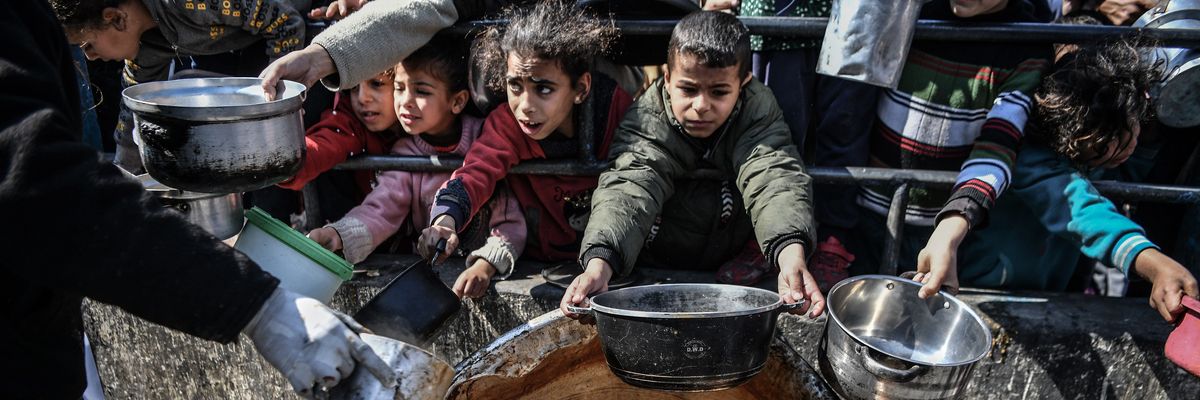
    Palestinian children hold out their empty containers to be filled with food in Rafah, Gaza on February 25, 2024. (Photo by Abed Zagout/Anadolu via Getty Images)

    A new report by Human Rights Watch accuses the Israeli government of defying the International Court of Justice’s order to ensure the flow of humanitarian aid to Gaza.

    In the month since the International Court of Justice handed down its interim ruling in the genocide case brought by South Africa, the Israeli government has continued to impede the delivery of humanitarian aid to the Gaza Strip in violation of the court’s order, Human Rights Watch said Monday.

    The ICJ’s January 26 ruling, which is legally binding, requires Israel to do everything in its power to prevent acts of genocide in Gaza and ensure that basic assistance flows to the enclave’s population.

    But according to Human Rights Watch (HRW), “the daily average number of trucks entering Gaza with food, aid, and medicine dropped by more than a third in the weeks following the ICJ ruling: 93 trucks between January 27 and February 21, 2024, compared to 147 trucks between January 1 and 26, and only 57 between February 9 and 21.”

    HRW’s analysis comes on the day the Israeli government is set to deliver its own 30-day assessment of compliance with the ICJ decision, which stated that Israel is plausibly committing genocide against Palestinians in Gaza. The Times of Israel reported late Sunday that the government report “is being drafted by the Justice Ministry and the Foreign Ministry but will not be released to the press or general public, and both ministries have been extremely tight-lipped about the information in the document.”

    Observers don’t expect the government’s self-assessment to reflect the catastrophic reality on the ground in Gaza, where most people are starving and at growing risk of infectious disease due to the scarcity of clean water and adequate shelter. Israel has been accused of firing on aid convoys and targeting crowds of civilians gathering to receive food and other assistance.

    In desperation, some Gazans have resorted to eating grass and animal feed and drinking contaminated water. A majority of Gaza’s population is currently crowded into the city of Rafah, which Israel plans to invade whether or not there’s a cease-fire deal with Hamas.

    “The Israeli government is starving Gaza’s 2.3 million Palestinians, putting them in even more peril than before the World Court’s binding order,” Omar Shakir, HRW’s Israel and Palestine director, said in a statement Monday. “The Israeli government has simply ignored the court’s ruling, and in some ways even intensified its repression, including further blocking lifesaving aid.”

    “Failure to ensure Israel’s compliance puts the lives of millions of Palestinians at risk.”

    HRW’s analysis notes that in addition to blocking food aid and medicine shipments, Israeli authorities have also obstructed the delivery of fuel, the lack of which has forced many of Gaza’s hospitals to shut down.

    “Between February 1 and 15, Israeli authorities only facilitated 2 of 21 planned missions to deliver fuel to the north of the Wadi Gaza area in central Gaza and none of the 16 planned fuel delivery or assessment missions to water and wastewater pumping stations in the north,” the group said. “Fewer than 20% of planned missions to deliver fuel and undertake assessments north of Wadi Gaza have been facilitated between January 1 and February 15, as compared with 86% of missions planned between October and December.”

    Israel’s mass killing of Gazans has also not stopped in the wake of the ICJ order, HRW said Monday. Pointing to figures from Gaza’s health ministry, the group noted that Israeli forces killed more than 3,400 people in the Palestinian enclave between the day of the ICJ ruling and February 23.

    “Israel’s blatant disregard for the World Court’s order poses a direct challenge to the rules-based international order,” Shakir said. “Failure to ensure Israel’s compliance puts the lives of millions of Palestinians at risk and threatens to undermine the institutions charged with ensuring respect for international law and the system that ensures civilian protection worldwide.”

    The Geneva-based Euro-Mediterranean Human Rights Monitor similarly concluded in a report released over the weekend that Israel is in “flagrant violation” of the ICJ’s order.

    The group implored the international community “to uphold its legal and moral duties to the people of the Gaza Strip, and to ensure that the ICJ ruling is carried out to prevent the crime of genocide in the Gaza Strip.”

    Original article by JAKE JOHNSON republished from Common Dreams under Creative Commons (CC BY-NC-ND 3.0). 

    ‘If This Isn’t Genocide, I Don’t Know What Is,’ Says Lula of Israeli Attack on Gaza

    ‘I Will No Longer Be Complicit in Genocide’: Man Sets Himself on Fire Outside Israeli Embassy in DC

    Israel’s Forced Starvation Leads Desperate Gazans to Eat Horse Meat, Animal Feed

    UNRWA Says Funding Cuts Have Pushed It to ‘Breaking Point’

  • Pressure rises for Biden to drop military aid to Israel

    Spread the love

    Original article republished from Peoples Dispatch under a Creative Commons Attribution-ShareAlike 4.0 (CC BY-SA) license.

    After over two months of genocide, support for the US’s usual policy of unconditional aid to the Zionist state is dwindling

    Image from demonstration outside of Secretary of Defense Lloyd Austin’s house on Christmas morning, protesting US policy in Israel

    Since October 7, Biden has added to Israel’s massive US-made military arsenal and sent more weapons to Israel as it carries out its genocide in the Gaza Strip, even bypassing Congressional review to do so. After nearly three months of war, however, support for the US’s usual policy of unconditional aid to the Zionist state is dwindling.

    Some of the most bloody attacks against Palestinian civilians have been made possible with US-made bombs, such as the attack that leveled an apartment block in the Jabalya refugee camp, killing over 100 people.

    Many of the atrocities perpetrated by Israel with US-made weaponry and funded by US money have been broadcast internationally across communications channels for even the people of the US to see. As a result, mass protests have erupted in the streets for months, often disrupting major commercial centers and events throughout the busy holiday season. 

    A recent poll shows that popular support for US aid to Israel has dropped since November. According to a poll from Quinnipiac University released on December 20, less than half (45%) of registered voters support sending “military aid to Israel for their efforts in the war.” This is a significant drop from the results of Quinnipiac’s previous poll from a month ago, in which 54% of voters expressed their support for military aid to Israel. A comparison of the two polls reveals that support for aid to Israel has dropped among voters in both the Republican and Democratic parties. In the November poll, 71% of Republicans and 45% Democratic voters said they were in favor of further military aid to Israel. Those numbers dropped in December, with 65% of Republicans and only 36% of Democrats supporting more US aid to Israel.

    The dwindling support for US support to the Zionist state follows the trends of other polls in the growing popularity of the Palestinian cause, such as an early December Date for Progress poll which found that 61% of voters support calls for a permanent ceasefire—including nearly half, 49%, of Republicans. 

    Pressure for the Biden administration to shift its policies on Israel has also been coming from within Congress itself—not even necessarily from the most progressive elements of the legislature. Six members of security-oriented committees of the House of Representatives, including the Intelligence, Armed Services or Foreign Affairs committees, none of whom are known progressives, penned a letter to Biden on December 18, calling on the President to “use all of our nation’s leverage to shift the Israeli military’s strategy.” 

    “The mounting civilian death toll and humanitarian crisis are unacceptable and not in line with American interests,” the letter reads. The representatives also reference the history of “America’s war on terror” as a warning for the future, stating, “We know from personal and often painful experience that you can’t destroy a terror ideology with military force alone. And it can, in fact, make it worse.”

    Several prominent humanitarian organizations, including Human Rights Watch, Médecins Sans Frontières/Doctors Without Borders USA, Oxfam America, and Amnesty International, have also penned a letter to Defense Secretary Lloyd Austin, urging him to halt military aid to Israel. The organizations urge the Pentagon to “withhold U.S. assistance, in accordance with U.S. law and policy, that would facilitate violations of international humanitarian law.” 

    Biden himself has not responded to any of the outside pressures against his Israel policy, and has only dug his heels in. As his administration told CNN earlier this month, the US has no plans to place conditions on Israel aid as it carries out genocide in Gaza.

    Original article republished from Peoples Dispatch under a Creative Commons Attribution-ShareAlike 4.0 (CC BY-SA) license.

  • Israel Is Starving Gaza Civilians as ‘Method of Warfare’: Human Rights Watch

    Spread the love

    Original article by JULIA CONLEY republished from Common Dreams under Creative Commons (CC BY-NC-ND 3.0). 

    A view of empty shelves are seen at a supermarket amidst Israel’s bombardments as Palestinians have trouble finding necessary food in Khan Yunis, Gaza on November 11, 2023.  (Photo: Mustafa Hassona/Anadolu via Getty Images)

    “It’s critical to understand this is not simply a byproduct of the conflict, an unfortunate result of a terrible situation,” said one campaigner. “It is Israeli government policy.”

    From bombing food production hubs and systematically razing crop fields to halting aid deliveries, Israel is waging a multi-pronged effort to starve the people of Gaza amid the Israel Defense Forces’ bombardment of the enclave, Human Rights Watch said in a report Monday—with evidence drawn from the Israeli government’s own statements as well as survivors’ accounts.

    The group demanded that countries such as the United States, United Kingdom, Canada, and others that have provided Israel with military aid and other support since the country began its latest escalation against Gaza in October speak out against the use of starvation as a weapon of warfare—a war crime under the Rome Statute of the International Criminal Court.

    “For over two months, Israel has been depriving Gaza’s population of food and water, a policy spurred on or endorsed by high-ranking Israeli officials and reflecting an intent to starve civilians as a method of warfare,” said Omar Shakir, Israel and Palestine director at Human Rights Watch (HRW). “World leaders should be speaking out against this abhorrent war crime, which has devastating effects on Gaza’s population.”

    HRW pointed to satellite imagery it has collected in northern Gaza since the IDF began its air and ground assault in retaliation for an attack by Hamas on southern Israel on October 7.

    The images have shown orchards, greenhouses, and farmland that have been razed over the last two months, “apparently by Israeli forces, compounding concerns of dire food insecurity.”

    Only sand and dirt have been left behind where farmers in northeastern Gaza grew citrus, potatoes, dragon fruit, and prickly pear since Israeli forces took control of the area in mid-November and “systematically razed” the fields, said the group.

    Palestinians in Gaza, home to about 2.3 million people, have lost the ability to grow their own food as Israel has refused to allow food, water, and fuel deliveries into the enclave, leaving bakeries and grocery store shelves empty.

    Before the Israeli bombardment began, about 500 aid trucks filled with food and other goods entered Gaza on a daily basis to provide sustenance amid Israel’s unlawful occupation and its land, air, and sea blockade that began 16 years ago. Israel has allowed only 100 aid trucks to cross through Egypt’s Rafah crossing since October 7. The U.N. humanitarian coordinator for the Occupied Palestinian Territory, Lynn Hastings, said earlier this month that fuel deliveries—needed for farming, cooking, water desalination, healthcare operations, and other necessities—have been “utterly insufficient.”

    Prior to the current escalation, about half of Gaza’s population was facing acute food insecurity and 80% were reliant on humanitarian aid.

    The World Food Program (WFP) at the U.N. said earlier this month that 9 in 10 households in northern Gaza and 2 in 3 homes in the south had been without food for at least one full day and night since Israel’s assault. It also warned that 38% of families who had been displaced from their homes in northern Gaza were experiencing “severe levels of hunger” and that the enclave faces a “high risk of famine.”

    “It’s critical to understand this is not simply a byproduct of the conflict, an unfortunate result of a terrible situation. It is Israeli government policy,” said Andrew Stroehlein, European media and editorial director for HRW.

    In addition to the halting of aid and the destruction of Gaza’s agricultural sector, the last operational wheat mill was bombed on November 15 ensureing “that locally produced flour will be unavailable in Gaza for the foreseeable future,” said HRW.

    The group interviewed 11 civilians who described their struggles with finding sufficient food in recent weeks.

    A man identified as Taher said that after his family fled south to Gaza City in November, they resorted to eating “just once a day to survive.”

    “The city was out of everything, of food and water,” he told HRW. “If you find canned food, the prices were so high… We were running out of money. We decided to just have the necessities, to have less of everything.”

    Majed, who left his home in the north after his house was bombed, killing his six-year-old son, said he, his wife, and their four surviving children had no way of making bread for more than a month when they temporarily stayed in Gaza City.

    “In those 33 days we didn’t have bread because there was no flour,” he said. “There was no water—we were buying water, sometimes for $10 a cup. It wasn’t always drinkable. Sometimes, [the water we drank] was from the bathroom and sometimes from the sea. The markets around the area were empty. There wasn’t even canned food.”

    HRW noted that the Israeli government itself has made numerous statements in recent weeks pointing to the deliberate destruction of Gaza’s food access and the starvation of civilians.

    Defense Minister Yoav Gallant infamously called Palestinians in Gaza “human animals” when he announced the “complete siege” and cutting off of aid into the enclave on October 9.

    “No electricity, no food, no water, no fuel—everything is closed,” Gallant said.

    Col. Yogev Bar-Shesht, deputy head of the Civil Administration, said in an interview that eliminating Palestinians’ ability to grow food is a deliberate tactic.

    “Whoever returns here, if they return here after, will find scorched earth,” he said. “No houses, no agriculture, no nothing. They have no future.”

    HRW’s report came as the death toll in Gaza hit at least 19,453, with more than 50,800 injured and thousands believed to be buried underneath rubble.

    Article 54(1) of the First Additional Protocol to the Geneva Conventions and Article 14 of the Second Additional Protocol both prohibit starvation of civilians as a method of warfare.

    “Although Israel is not a party to Protocols I or II, the prohibition is recognized as reflective of customary international humanitarian law in both international and noninternational armed conflicts,” said HRW.

    The worsening humanitarian catastrophe, and Israel’s refusal to operate within the bounds of international law, “calls for an urgent and effective response from the international community,” said Shakir.

    “The Israeli government is compounding its collective punishment of Palestinian civilians and the blocking of humanitarian aid,” he said, “by its cruel use of starvation as a weapon of war.”

    Original article by JULIA CONLEY republished from Common Dreams under Creative Commons (CC BY-NC-ND 3.0). 

  • Report Details ‘Toxic’ Fossil Fuel Pollution in COP28 Host UAE

    Spread the love
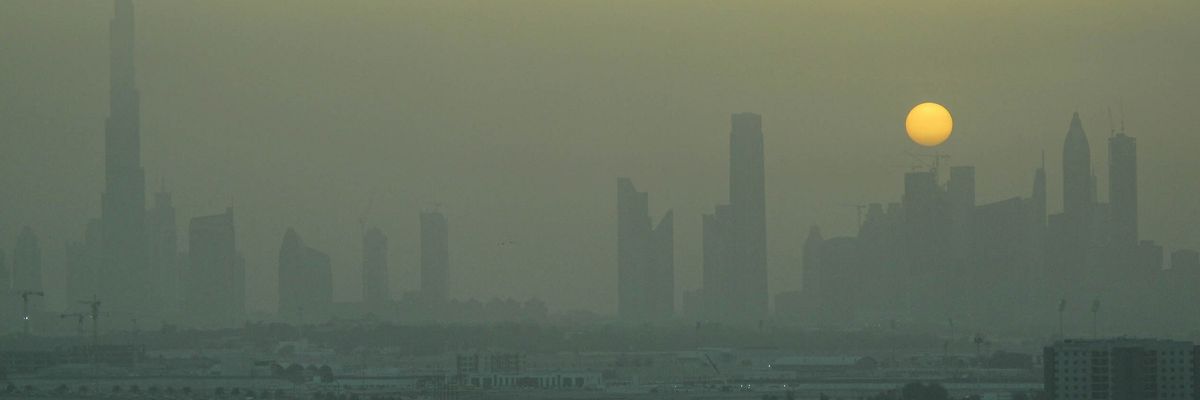
    The sun sets amid heavy air pollution in Dubai. (Photo: Forbes Johnston/flickr/cc)

    Original article by BRETT WILKINS republished from Common Dreams under Creative Commons (CC BY-NC-ND 3.0). 

    “Nobody will ever hold the government to account publicly,” said one climate campaigner. “We do not have the privilege of speaking out against the government.”

    Despite greenwashing efforts like hosting the ongoing United Nations Climate Change Conference, the United Arab Emirates—the world’s seventh-biggest oil producer and sixth-largest exporter—is contributing heavily to toxic air pollution, creating a “devastating impact on human health.”

    That’s according to a Monday report from Human Rights Watch (HRW) report—entitled ‘You Can Smell Petrol in the Air’: UAE Fossil Fuels Feed Toxic Pollution —which “documents alarmingly high air pollution levels in the UAE” and how toxic air caused by oil and gas production creates “major health risks” for the country’s 9.4 million people.

    As the report details:

    The UAE government says that the country has poor air quality but mainly ascribes this to natural dust from sandstorms. However, academic studies have shown that natural causes are not the single, or in some cases even the major, factor in air pollution. A 2022 academic study found that, in addition to the dust, emissions including from fossil fuels contribute significantly to the problem in the UAE. Air pollution and climate change are directly linked, as the extraction and use of fossil fuels are the sources of air pollution and greenhouse gas emissions.

    The report’s researchers analyzed levels of PM2.5 —fine particulate matter measuring 2.5 micrometers or smaller that can penetrate human lungs and blood—at 30 UAE government monitoring stations and found that they were, on average, three times higher than the World Health Organization’s (WHO) daily recommended exposure.

    According to the latest available data from the World Bank, the UAE’s mean annual PM2.5 exposure is over eight times higher than what the WHO says is safe .

    The WHO estimates that approximately 1,870 people die each year from outdoor air pollution in the UAE.

    “Fossil fuels pollute the air people breathe in the UAE,” HRW environment director Richard Pearshouse said in a statement . “But the obliteration of civil society by UAE’s government means that no one can publicly express concerns, let alone criticize the government’s failure to prevent this harm.”

    The report explains:

    Those in the UAE wanting to report on, or speak out about, the risks of fossil fuel expansion and its links to air pollution face risks of unlawful surveillance, arrest, detention, and ill-treatment. Over the last decade, authorities in the UAE have embarked on a sustained assault on human rights and freedoms, including targeting human rights activists, enacting repressive laws, and using the criminal justice system as a tool to eliminate the human rights movement. These policies have led to the complete closure of civic space, severe restrictions on freedom of expression, both online and offline, and the criminalization of peaceful dissent.

    “Nobody will ever hold the government to account publicly,” said one climate activist interviewed by HRW. “We do not have the privilege of speaking out against the government.”

    Pearshouse argued: “Air pollution is a dirty secret in the UAE. If the government doesn’t allow civil society to scrutinize and speak freely about the connection between air pollution and its fossil fuel industry, people will keep experiencing health conditions that are entirely preventable.”

    Most of those affected by air pollution in the UAE are migrant workers, who make up nearly 90% of the country’s population. In addition to enduring widespread serious labor abuses, these workers—many of whom hail from some of the world’s most climate-vulnerable countries—face deadly dangers from air pollution.

    Migrant workers interviewed by HRW said they breathe air that burns their lungs, are often short of breath at work, and suffer from skin and other ailments they believe could be caused by pollution. However, migrant workers told HRW that they were given no information about the risks of air pollution or how to protect themselves.

    One migrant worker told HRW: “Sometimes, the environment becomes dark and murky. We discuss among friends why it is that way… The conversation ends there. During such times friends also fall sick.”

    While the UAE government has submitted a recently revised domestic climate action plan as required by the 2015 Paris agreement, the plan has been criticized for its continued reliance upon fossil fuel production.

    “Sometimes, the environment becomes dark and murky. We discuss among friends why it is that way.”

    The choice of the UAE and the CEO of its national oil company— Sultan Ahmed Al Jaber —as host and president of the U.N. Climate Change Conference also stunned and angered many climate campaigners around the world. In the United States, climate activists were also outraged after U.S. climate envoy John Kerry glowingly endorsed Al Jaber as “a terrific choice” for the COP28 presidency.

    Late last month, internal records leaked by a whistleblower showed that Al Jaber used meetings about COP28 to push foreign governments for fossil fuel deals. In response to the allegation, former Marshallese President Hilda Heine resigned from COP28’s advisory board.

    Al Jaber stoked further controversy over the weekend when he insisted there is “no science” supporting the effort to rapidly phase out planet-heating fossil fuels.

    Original article by BRETT WILKINS republished from Common Dreams under Creative Commons (CC BY-NC-ND 3.0).