Tag: Human Rights Watch

  • Israel Accused of ‘Blatant War Crime’ as HRW Confirms White Phosphorus Used in Gaza

    Spread the love
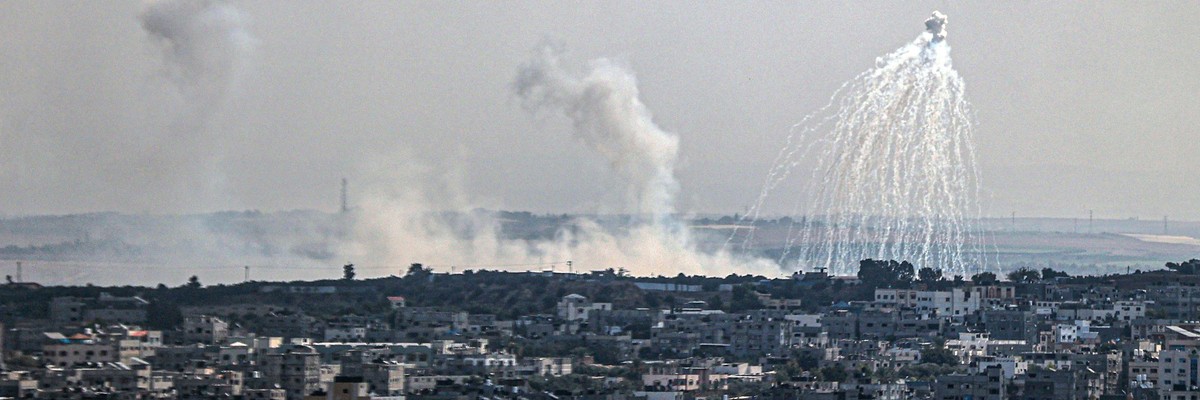
    An Israeli white phosphorus round (right) airbursts over densely populated Gaza City, Palestine on October 11, 2023. 
    (Photo: Ali Jadallah/Anadolu via Getty Images)

    Original article by BRETT WILKINS republished from Common Dreams under Creative Commons (CC BY-NC-ND 3.0). 

    “Any time that white phosphorus is used in crowded civilian areas, it poses a high risk of excruciating burns and lifelong suffering,” said one Human Rights Watch official.

    Human Rights Watch on Thursday said it has confirmed reports that Israeli military forces unleashed white phosphorus munitions during artillery attacks on targets in Lebanon and Gaza this week, including over a heavily populated civilian area of the besieged Palestinian strip—an apparent war crime.

    HRW said it has interviewed witnesses and verified video footage shot in Lebanon and Gaza on Tuesday and Wednesday “showing multiple airbursts of artillery-fired white phosphorus over the Gaza City port and two rural locations along the Israel-Lebanon border.”

    The HRW announcement came as Israeli forces continue to bombard Gaza from air, land, and sea in an assault that has killed more than 1,500 Palestinians, including at least 500 children, in retaliation for Hamas’ surprise infiltration of Israel and killing of over 1,300 Israeli soldiers and civilians.

    As HRW explained Thursday:

    Upon contact, white phosphorus can burn people, thermally and chemically, down to the bone as it is highly soluble in fat and therefore in human flesh. White phosphorus fragments can exacerbate wounds even after treatment and can enter the bloodstream and cause multiple organ failure. Already dressed wounds can reignite when dressings are removed and the wounds are reexposed to oxygen. Even relatively minor burns are often fatal. For survivors, extensive scarring tightens muscle tissue and creates physical disabilities.

    WP burns as hot as 1,500°F. Water does not extinguish it.

    “Any time that white phosphorus is used in crowded civilian areas, it poses a high risk of excruciating burns and lifelong suffering,” HRW Middle East and North Africa director Lama Fakih said in a statement. “White phosphorous is unlawfully indiscriminate when airburst in populated urban areas, where it can burn down houses and cause egregious harm to civilians.”

    “To avoid civilian harm, Israel should stop using white phosphorus in populated areas,” Fakih added. “Parties to the conflict should be doing everything they can to spare civilians from further suffering.”

    HRW previously accused Israel of war crimes for using WP munitions in densely populated areas—including over a United Nations school—during the 2008-09 Operation Cast Lead invasion of Gaza. In response to a 2013 petition to Israel’s High Court of Justice filed by human rights groups including HRW, the Israel Defense Forces said it would no longer use WP in populated areas, with “very narrow exceptions” that it would not disclose.

    Other countries’ militaries also use WP, most notably the United States, which fired the incendiary rounds during the 2004 battle for Fallujah and elsewhere in the so-called War on Terror.

    In 2016, Saudi Arabia was condemned for allegedly firing U.S.-supplied WP munitions against Houthi rebels in Yemen. WP and other incendiary weapons have also been used by Syrian government and Russian forces fighting Islamic State and other militants during the Syrian civil war. Turkey has also been accused of firing WP rounds at Kurdish civilians in Syria.

    Original article by BRETT WILKINS republished from Common Dreams under Creative Commons (CC BY-NC-ND 3.0). 

  • Rich Nations Have Delivered Mere ‘Pittance’ to Help East Africa Tackle Climate Crisis: Oxfam

    Spread the love

    Original article by JAKE JOHNSON republished from Common Dreams under Creative Commons (CC BY-NC-ND 3.0).

    “We have an abundance of clean, renewable energy,” said one African activist. “But to unlock it, Africa needs funding from countries that have got rich off our suffering.”

    As the first-ever Africa Climate Summit kicked off in Nairobi, Kenya on Monday, an analysis by the humanitarian group Oxfam found that rich nations have delivered just a small fraction of the aid that East African nations say they need each year to meet their climate goals.

    Unlike rich countries that account for a disproportionate share of planet-warming greenhouse gas pollution, East Africa has contributed “almost nothing” to global carbon emissions that are driving record-shattering heat worldwide, Oxfam’s new report notes. In 2021, according to one recent estimate, the average North American emitted 11 times more carbon dioxide than the average African.

    The World Meteorological Organization pointed out Monday that Africa is responsible for less than 10% of global carbon emissions.

    Yet “East Africa is one of the world’s worst-hit regions by climate change and is now experiencing its worst climate-induced extreme weather, fueling an alarming hunger crisis,” Oxfam’s report states. “Over 31.5 million people are currently facing acute hunger across Ethiopia, Kenya, Somalia, and South Sudan.”

    Those countries, which suffer billions of dollars worth of climate-related damage each year, have said they will need at least $53.3 billion annually to meet critical targets under the Paris Climate Agreement. According to Oxfam, wealthy countries provided just $2.4 billion in aid to East African nations in 2021.

    More broadly, Oxfam noted, high-income countries pledged that they would provide $100 billion a year by 2020 to help lower-income countries fight climate chaos.

    “Oxfam estimates that in 2020 the real value of financial support specifically aimed at climate action was only around $21 billion to $24.5 billion—much less than officially reported figures suggest,” the group’s report states.

    Fati N’Zi-Hassane, Oxfam’s Africa director, said Monday that “even by their own generous accounts, polluting nations have delivered only pittance to help East Africa scale up their mitigation and adaptation efforts.”

    “Nearly half the funds (45%) they did give were loans, plunging the region further into more debt,” N’Zi-Hassane added.

    Climate finance is expected to be a major topic of discussion at the Nairobi summit, which comes after months of scorching heat on the continent.

    “Africa is seen as a sunny and hot continent,” Amadou Thierno Gaye, a research scientist and professor at Cheikh Anta Diop University in Dakar, toldBloomberg in July. “People think we are used to heat, but we are having high temperatures for a longer duration. Nobody is used to this.”

    The Associated Press reported Monday that “there is some frustration on the continent about being asked to develop in cleaner ways than the world’s richest countries—which have long produced most of the emissions that endanger climate—and to do it while much of the support that has been pledged hasn’t appeared.”

    Mohamed Adow of Power Shift Africa told AP that “we have an abundance of clean, renewable energy and it’s vital that we use this to power our future prosperity. But to unlock it, Africa needs funding from countries that have got rich off our suffering.”

    In addition to calling on rich nations to contribute the aid they’ve promised to support Africa’s renewable energy transition, African civil society groups are urging their leaders to reject fossil fuel expansion, specifically warning against the completion of TotalEnergies’ East African Crude Oil Pipeline (EACOP).

    A recent Human Rights Watch report warned that more than 100,000 people in Uganda and Tanzania are set to “permanently lose land to make way for the pipeline and Tilenga oilfield development.” One analysis indicates the pipeline could result in 379 million tonnes of planet-warming emissions over its lifespan—more than 25 times the combined annual emissions of Uganda and Tanzania.

    Zaki Mamdoo, coordinator of the Stop EACOP Coalition, said Monday that “the African Climate Summit could provide the platform needed for the continent to dramatically shift its trajectory and future—from one that is set to bear the brunt of climate collapse, to one of energy security and prosperity driven by decentralized and people-centered renewables.”

    “For this to happen,” said Mamdoo, “African leaders will need to rise to the occasion and make firm commitments to significantly upscale renewable energy developments while resisting and withdrawing any and all support for exploitative and destructive projects like the East African Crude Oil Pipeline.”

    Original article by JAKE JOHNSON republished from Common Dreams under Creative Commons (CC BY-NC-ND 3.0).

  • Human Rights Watch reports new evidence of Ukrainian use of anti-personnel landmines

    Spread the love

    https://www.eureporter.co/world/human-rights-category/2023/07/03/human-rights-watch-reports-new-evidence-of-ukrainian-use-of-anti-personnel-landmines/

    Human Rights Watch (HRW) said on Friday (30 June) that it uncovered new evidence of the indiscriminate use by Ukrainian forces of banned anti-personnel landmines against Russian troops who invaded Ukraine in 2022.

    The group called on Ukraine’s government to follow through with a commitment made earlier this month not to employ such weapons, investigate their suspected use and hold accountable those responsible.

    “The Ukrainian government’s pledge to investigate its military’s apparent use of banned anti-personnel mines is an important recognition of its duty to protect civilians,” Steve Goose, Human Rights Watch’s arms director, said in a statement.

    HRW said it shared its findings with the Ukrainian government in a May letter to which it received no response.

    …

    https://www.eureporter.co/world/human-rights-category/2023/07/03/human-rights-watch-reports-new-evidence-of-ukrainian-use-of-anti-personnel-landmines/