Wes Streeting faces a backlash over his support for Israel. (Photo: Imageplotter / Alamy)
Labour’s shadow health secretary has a long history of supporting Israel going back to his days at the National Union of Students—and has been rewarded handsomely for it.
Streeting was Keir Starmer’s first shadow minister to visit Israel
His visit in 2022 was paid for by Labour Friends of Israel, which “works really closely” with Israeli embassy in London
He has taken over £20,000 from Israel lobbyists Sir Trevor Chinn, Lord Mendelsohn and David Menton, with donations as recently as April
Pro-Israel newspaper said Streeting’s “track-record on Israel is clear” and called him “our friend at the NUS”
Streeting is being challenged by British-Palestinian independent Leanne Mohamad
Wes Streeting has received nearly £30,000 from Britain’s powerful pro-Israel lobby, Declassified has found.
Two years ago, Streeting became the first member of Keir Starmer’s shadow cabinet to visit Israel, in a move designed to signal a break with Jeremy Corbyn’s pro-Palestine position.
The trip was paid for by Labour Friends of Israel (LFI) and cost £4,700. LFI also paid for Sarah Harrison, one of Streeting’s staffers, to visit Israel with him.
Another Streeting staffer, Anna Wilson, was paid an undisclosed amount to visit Israel last July.
Her trip was funded by the European Leadership Network, a group whose UK branch is run by Joan Ryan, former chair of LFI.
LFI is a secretive organisation that does not disclose its funders, although undercover reporting revealed Ryan, then a Labour MP, discussing a £1 million payment from Israel with Shai Masot, an Israeli diplomat, in 2016.
In another covertly filmed conversation outside a London pub, LFI’s Michael Rubin said that he and Masot “work really closely together…but a lot of it is behind the scenes”.
Masot was eventually forced to quit his job at the Israeli embassy and return home after he was caught on camera plotting to “take down” British MPs.
…
Israel is a serial violator of international law, and is judged to be practising apartheid against the Palestinians by both the US and UK’s top human rights groups, Human Rights Watch and Amnesty International. Leading Israeli group B’Tselem has also reached the same conclusion.
It is currently being investigated by the International Court of Justice (ICJ) for genocide, while the International Criminal Court’s prosecutor Karim Khan is seeking arrest warrants for prime minister Benjamin Netanyahu and defence minister Yoav Gallant for war crimes in Gaza.
Streeting described the ICJ case as a “distraction”.
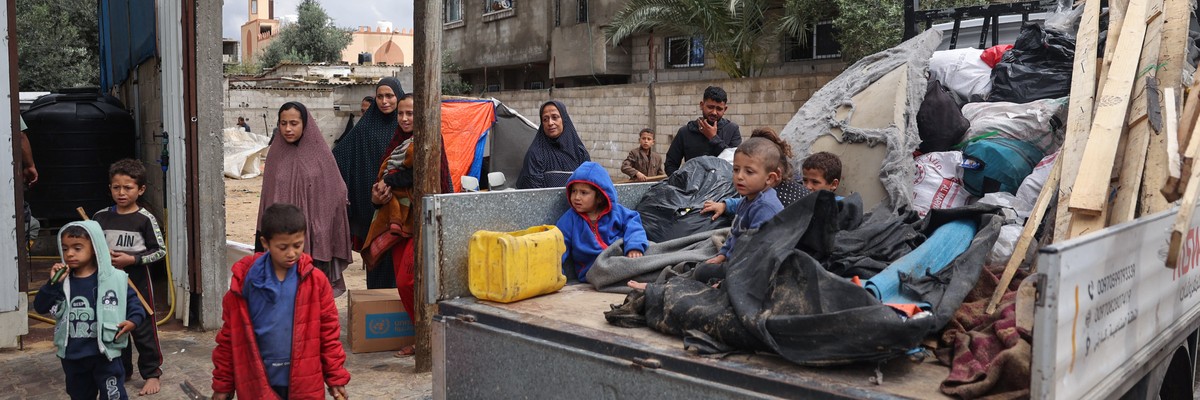
Displaced Palestinians in Rafah in the southern Gaza Strip gather their belongings following an evacuation order by the Israeli military on May 6, 2024. (Photo: AFP via Getty Images)
The head of one humanitarian group called the Israeli military’s directives “a serious violation of international law.”
Israel’s army on Monday ordered roughly 100,000 people living in eastern Rafah to evacuate ahead of an imminent military assault on the area, terrifying families who have been forcibly displaced to the southern Gaza city in recent months and intensifying warnings of a bloodbath.
The Israel Defense Forces (IDF) dropped leaflets over Rafah ordering some of its 1.4 million residents to move to a strip along Gaza’s coast, a signal that a long-feared ground assault on the overcrowded city is set to begin in the face of vocal opposition from the international community and humanitarian organizations.
The U.S., Israel’s top arms supplier, has said it would oppose a Rafah assault without a credible plan to evacuate civilians from the city. Humanitarian groups and analysts have said such a plan is impossible because there is no genuinely safe place for Gazans to go. Israeli forces have repeatedly attacked so-called “safe zones” and designated routes Palestinians have used to flee in compliance with past IDF orders.
“Israel’s military offensive in Rafah could lead to the deadliest phase of this conflict, inflicting horrific suffering on approximately 1.4 million displaced civilians in the area,” said Jan Egeland, secretary-general of the Norwegian Refugee Council. “The relocation orders issued by Israel today to thousands of Gazans, directing them to move to Al-Mawasi, are beyond alarming. The area is already overstretched and devoid of vital services. It lacks the capacity to house the number of people currently seeking refuge in Rafah, with no assurances of safety, proper accommodation, or return once hostilities end for those forced to relocate.”
“The absence of these fundamental guarantees of safety and return, as required by international humanitarian law, qualifies Israel’s relocation directives as forcible transfer, amounting to a serious violation of international law,” Egeland said. “Any Israeli military operation in Rafah—which has become the largest cluster of displacement camps in the world—will cause potential mass atrocities.”
“If large-scale military operations start, not only will children be at risk from the violence, but also from chaos and panic, and at a time where their physical and mental states are already weakened.”
Israel reportedly notified the U.S. of the evacuation orders overnight, and CIA Director William Burns is set to arrive in Israel on Monday to discuss the operation in Rafah, a city along Gaza’s border with Egypt that has become a critical point of entry for humanitarian aid. The new evacuation orders, expected to be just the first round of directives, include Rafah’s largest medical facility.
The United Nations Relief and Works Agency for Palestine Refugees in the Near East (UNRWA), the main relief agency in Gaza, said in response to the IDF’s orders that it would not leave Rafah.
“An Israeli offensive in Rafah would mean more civilian suffering and deaths. The consequences would be devastating for 1.4 million people,” the organization wrote in a social media post. “UNRWA is not evacuating: The agency will maintain a presence in Rafah as long as possible and will continue providing lifesaving aid to people.”
BREAKING: #Israel drops leaflets over #Rafah southern #Gaza, ordering inhabitants of eastern Rafah to immediately move to Al Mawasi (a desolate strip along the Gaza coast), cautioning them from moving to north Gaza or towards its southern and eastern perimeter fence. pic.twitter.com/tBum9ULewF
The far-right Israeli government, led by Prime Minister Benjamin Netanyahu, has been threatening a ground invasion of Rafah for months, characterizing the city as Hamas’ last major stronghold. Avichay Adraee, an IDF lieutenant colonel, said Monday that the Israeli military would use “extreme force” in the evacuation areas and warned that “anyone who is close to terrorist organizations puts his life and the life of his family at risk.”
According to the United Nations Children’s Fund (UNICEF), around 600,000 children are currently sheltering in the city, including many who have been displaced multiple times since Israel’s assault began in October following a Hamas-led attack.
“More than 200 days of war have taken an unimaginable toll on the lives of children,” Catherine Russell, UNICEF’s executive director, said Monday. “Rafah is now a city of children, who have nowhere safe to go in Gaza. If large-scale military operations start, not only will children be at risk from the violence, but also from chaos and panic, and at a time where their physical and mental states are already weakened.”
Omar Shakir, Israel and Palestine director at Human Rights Watch, called the IDF’s evacuation push in Rafah “unlawful and catastrophic.”
“There’s nowhere safe to go in Gaza,” Shakir added. “The international community should act to prevent further atrocities.”
The IDF began issuing its evacuation orders in Rafah a day after the Netanyahu government voted to shut down Al Jazeera‘s operations in the country, a brazen attack on press freedom.
“The fact that Israel banned Al Jazeera hours before beginning its assault on Rafah is not a coincidence,” said author and Middle East analyst Assal Rad. “After everything we’ve seen in the last seven months, imagine what they’ll do when they think no one is watching.”
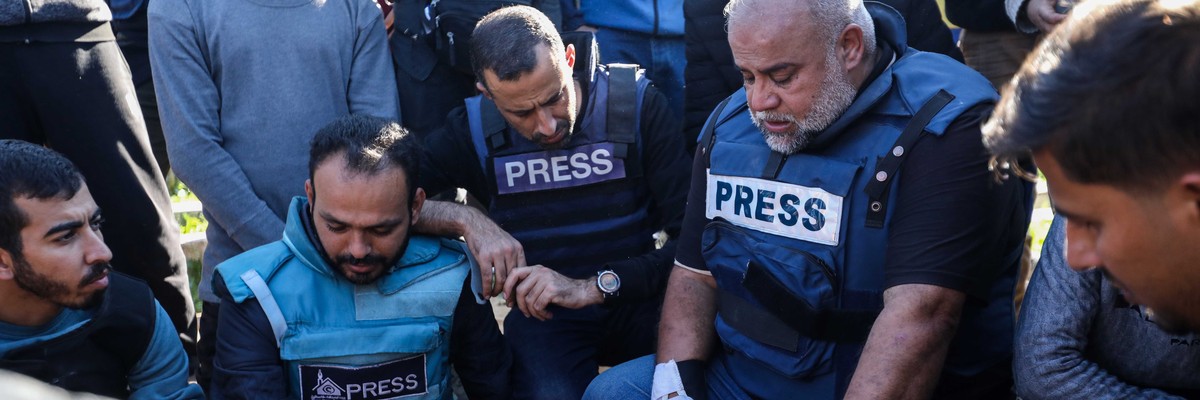
Al Jazeera correspondent Wael Dahdouh mourns his son Al Jazeera correspondent Wael Dahdouh mourns his son and another journalist killed by an Israeli airstrike on January 7, 2024 in Rafah, Gaza. (Photo: Ahmad Hasaballah/Getty Images)
“Rather than trying to silence reporting on its atrocities in Gaza, the Israeli government should stop committing them,” said one observer.
The Jerusalem offices of Al Jazeera were raided Sunday after Israel’s far-right Cabinet banned the Qatar-based satellite news network—the sole international media outlet providing 24/7 live coverage from Gaza—from operating in the country.
“If you’re watching this… then Al Jazeera has been banned in Israel,” correspondent Imran Khan said in a pre-recorded report from occupied East Jerusalem preempting the Israeli Cabinet’s unanimous vote to shutter the network.
The order—which does not affect Al Jazeera’s ability to operate in Gaza or the illegally occupied Palestinian territories—is believed to be the first of its kind targeting a foreign media outlet operating in Israel. It comes after the Knesset, Israel’s parliament, recently voted 71-10 in favor of a law empowering the Israeli communications minister to ban foreign news organizations from working in Israel and to confiscate their equipment.
“The time has come to eject Hamas’ mouthpiece from our country,” Israeli Prime Minister Benjamin Netanyahu said in a televised address.
"You cannot, in a democratic country pass such a specific law that singles out one network."
Israeli author Akiva Eldar says his gov't’s move to close Al Jazeera’s operations in Israel is to cater to the radical right and control the narrative concerning Israel's war on Gaza ⤵️ pic.twitter.com/SRJcXoGhL2
Ofir Gendelman, Netanyahu’s Arab media spokesperson, said Sunday that the closure would be “implemented immediately.”
Gendelman said that the network’s “broadcast equipment will be confiscated, the channel’s correspondents will be prevented from working, the channel will be removed from cable and satellite television companies, and Al Jazeera‘s websites will be blocked on the internet.”
In a statement, Al Jazeera vowed to “pursue all available legal channels through international legal institutions in its quest to protect both its rights and journalists, as well as the public’s right to information.”
“Israel’s ongoing suppression of the free press, seen as an effort to conceal its actions in the Gaza Strip, stands in contravention of international and humanitarian law,” the network added. “Israel’s direct targeting and killing of journalists, arrests, intimidation, and threats will not deter Al Jazeera.”
Remember when the Israeli military shot and killed Palestinian-American journalist Shireen Abu Akleh and targeted other journalists with her, the military spokesman said "they were armed with cameras."
The New York-based Foreign Press Association issued a statement slamming the move and saying it “should be a cause for concern for all supporters of a free press.”
“With this decision, Israel joins a dubious club of authoritarian governments to ban the station,” the group said. “This is a dark day for the media. This is a dark day for democracy.”
Human Rights Watch Israel and Palestine director Omar Shakir called the order “an assault on freedom of the press.”
“Rather than trying to silence reporting on its atrocities in Gaza, the Israeli government should stop committing them,” he added.
AlJazeera's offices have been bombed in Gaza. Their staff has been beaten in the West Bank. They've been killed in the West Bank & Gaza. Israel is trying to muzzle @AlJazeera. But precedent is larger & threatens to cover up Israeli atrocities in Gaza. @hrwpic.twitter.com/IOVhAdf51P
Al Jazeera is the only international news network providing nonstop on-the-ground coverage of Israel’s war on Gaza, often being the first to report Israeli atrocities in what many experts worldwide say is a genocidal campaign in the besieged, starving strip.
Its correspondents and other media professionals work under constant risk to life and limb. More than 100 journalists, the vast majority of them Palestinians, have been killed by Israeli forces since October 7 in what the Committee to Protect Journalists (CPJ) and others say are often intentional targetings of not only media workers but also their families.
In December, Israeli forces killed Al Jazeera cameraman Samer Abudaqa as he reported on the war in southern Gaza, an attack that also wounded Al Jazeera Gaza bureau chief Wael Dahdouh—whose wife, son, daughter, and grandson were killed in a separate Israeli strike.
Previous probes—like the investigation into Israeli troops’ 2022 killing of renowned Palestinian American Al Jazeera reporter Shireen Abu Akleh—have confirmed that Israel has deliberately targeted journalists.
Last May, CPJ published Deadly Pattern, a report that found Israeli troops had killed at least 20 journalists over the past 22 years with utter impunity. While some of the slain journalists have been foreigners—including Italian Associated Press reporter Simone Camilli and British cameraman and filmmaker James Miller—the vast majority of victims have been Palestinian.
Israeli forces have also attacked newsrooms in every major assault on Gaza, including in May 2021 when the 11-story al-Jalaa Tower, which housed offices of Al Jazeera, The Associated Press, and other media outlets, was completely destroyed in an airstrike.
On Friday—World Press Freedom Day—Palestinian journalists covering the war on Gaza were awarded this year’s UNESCO/Guillermo Cano World Press Freedom Prize after being recommended by an international jury of media professionals.
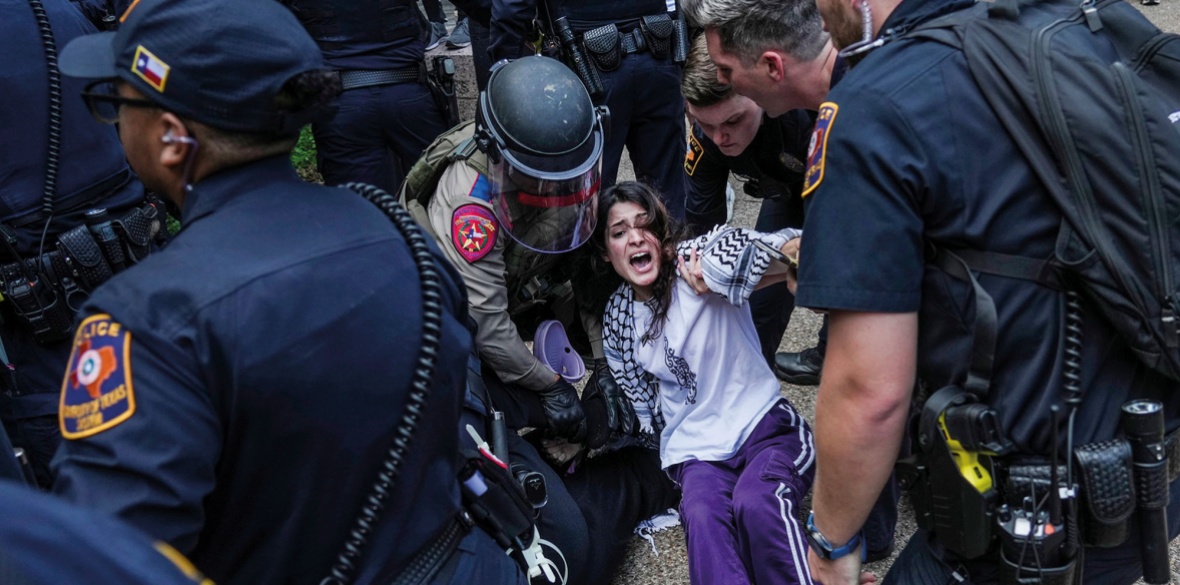
FREE SPEECH NATION? Arrests are made as pro-Palestinian students and protesters are pushed off campus at the University of Texas, Wednesday April 24
While people across the world have been taking bold action in support of Palestine, the global North ruling class has used all tools at its disposal to support Israel’s genocide and criminalise solidarity writes VIJAY PRASHAD
ISRAELI BOMBS continue to fall on Gaza, killing Palestinian civilians with abandon. Al-Jazeera published a story about the destruction of 24 hospitals in Gaza, each of them bombed mercilessly by the Israeli military. Half of the 35,000 Palestinians killed by Israel were children, their bodies littering the overwhelmed morgues and mosques of Gaza.
The former UN assistant secretary-general for human rights, Andrew Gilmour, told BBC Newsnight that the Palestinians are experiencing “collective punishment” and that what we are seeing in Gaza is “probably the highest kill rate of any military, killing anybody, since the Rwandan genocide of 1994.”
Meanwhile, in the West Bank section of Palestine, Human Rights Watch shows that the Israeli military has participated in the displacement of Palestinians from 20 communities and has uprooted at least seven communities since October 2023. These are established facts.
Yet, these facts — according to a leaked memorandum — cannot be spoken about in the “newspaper of record” in the US, the New York Times. Journalists at the paper were asked to avoid the terms “genocide,” “ethnic cleansing” and “occupied territory.”
Indeed, over the past six months, newspapers and television shows in the US have generally written about the genocidal violence using passive voice: bombs fell, people died.
Even on social media, where the terrain is often less controlled, the axe fell on key phrases; for instance, despite his professions of commitment to free speech, Elon Musk said that terms such as “decolonisation” and phrases such as “From the river to the sea” would be banned on X.
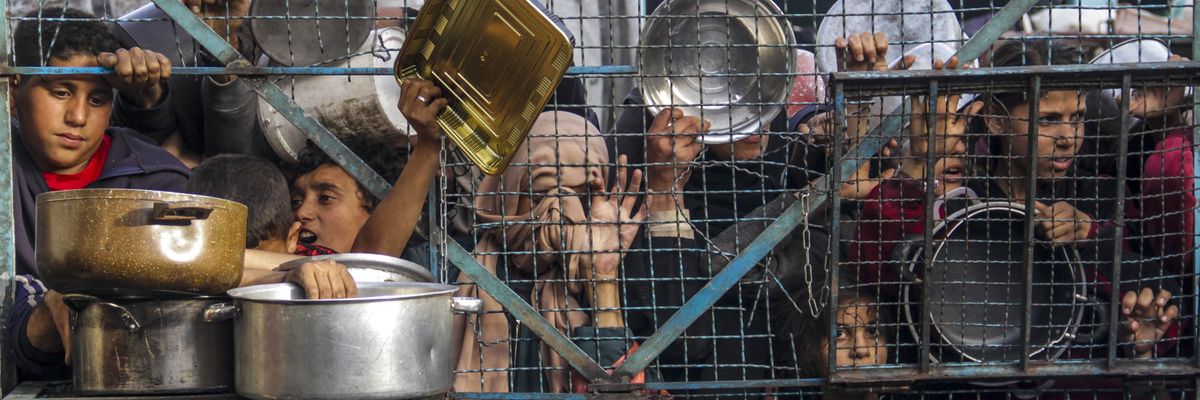
A crowd of starving Palestinians, including children, waits to receive food distributed by charity organizations amid Israel’s blockade at the Jabalia refugee camp in Gaza on March 27, 2024. (Photo by Mahmoud Issa/Anadolu via Getty Images)
“The Israeli government’s use of starvation as a weapon of war has proven deadly for children in Gaza.”
The Israeli government is starving children to death in the Gaza Strip with its deliberate and systematic obstruction of food aid, Human Rights Watch said in a report released Tuesday, citing firsthand accounts from doctors and families in the besieged enclave.
At least 32 people, including 28 children, have died of malnutrition and dehydration so far in northern Gaza, which is facing famine conditions due to Israel’s illegal blockade.
HRW’s new report builds on its December assessment that Israel was “using starvation of civilians as a method of warfare” in Gaza, with disastrous consequences for the territory’s civilian population.
“The Israeli government’s use of starvation as a weapon of war has proven deadly for children in Gaza,” said Omar Shakir, HRW’s Israel and Palestine director. “Israel needs to end this war crime, stop this suffering, and allow humanitarian aid to reach all of Gaza unhindered.”
For its new report, HRW interviewed doctors who have treated malnourished patients and family members of children who have starved to death in recent weeks. The group also reviewed photographs and video footage showing emaciated children who have died of malnutrition.
Dr. Hussam Abu Safiya, the head of the pediatrics unit of a northern Gaza hospital targeted by Israeli forces, said that 26 children in his facility alone have died from starvation-related health complications. Safiya told HRW that at least 16 of the children were under five months old, and one of them was just two days old.
The mother, he said, “had no milk to give him.”
“Israel’s allies like the U.S., U.K., France, and Germany need to press for full-throttle aid delivery by immediately suspending their arms transfers.”
Already badly hindered by Israel’s siege, aid deliveries to Gaza have been further disrupted by Israeli attacks on humanitarian workers and convoys. Israeli forces’ killing of seven World Central Kitchen workers last week led several aid groups to suspend their operations in Gaza.
While Israel agreed in the wake of the deadly attack—and in the face of massive international pressure—to reopen a key border crossing in northern Gaza, aid groups say far more is needed to prevent mass starvation.
“Governments outraged by the Israeli government starving civilians in Gaza should not be looking for band-aid solutions to this humanitarian crisis,” Shakir said Tuesday. “Israel’s announcement that it will increase aid shows that outside pressure works. Israel’s allies like the U.S., U.K., France, and Germany need to press for full-throttle aid delivery by immediately suspending their arms transfers.”
Israel’s six-month war on Gaza has been catastrophic for the territory’s children. According to one recent analysis, over 2% of Gaza’s child population—nearly 26,000 kids—has been killed or wounded during the assault, with at least 1,000 children losing one or both of their legs.
The war has also taken a devastating psychological toll on Gaza’s kids, many of whom have been displaced repeatedly and seen family members maimed or killed by Israeli bombs.
“The emotional distress of dodging bombs and bullets, losing loved ones, being forced to flee through streets littered with debris and corpses, and waking up every morning not knowing if they will be able to eat has also left parents and caregivers increasingly unable to cope,” Save the Children said last month.
Speaking to HRW, the father of newborn twin girls said that one of his babies died of malnutrition at northern Gaza’s Kamal Adwan Hospital eight days after she was born.
“He said that he struggled to feed his family prior to the girls’ birth, but that they only had bread to eat, without meat or protein,” the human rights organization noted in its new report. “He said that after the twins’ birth, his wife could not produce milk to breastfeed the girls and that store-bought milk was scarce.”
One mother of a 6-year-old boy with cystic fibrosis told HRW that “because of the Israeli blockade, she struggled to obtain the necessary medication and provide adequate nourishment.”
“By mid-January, Fadi’s health had deteriorated to the point where he could no longer walk, prompting his hospitalization,” HRW said. Late last month, the boy was evacuated from Kamal Adwan Hospital to receive treatment at a facility in Cairo.
Lama Fakih, HRW’s Middle East and North Africa director, said Tuesday that Israeli officials upholding the blockade that is starving children in Gaza “are committing war crimes.”
“Governments should impose targeted sanctions, including travel bans and asset freezes, against responsible officials,” said Fakih.
But the U.S., Israel’s top ally and arms supplier, is refusing to take concrete action even as damning evidence of Israeli war crimes mounts.
Asked during a Monday press briefing “how many Palestinian citizens should be killed, whether by fire or starvation, so you can seriously intervene,” U.S. State Department spokesperson Matthew Miller said that “we do not want to see a single Palestinian killed.”
“And that is why we have made clear that Israel needs to do more to improve its deconfliction and coordination measures,” Miller said, brushing off the idea of imposing strict conditions on U.S. military aid. The Biden administration is currently pressing Congress to sign off on an $18 billion sale of F-15 fighter jets to Israel.
Earlier in Monday’s briefing, Miller said the U.S. has “not yet at this time concluded that Israel has violated international humanitarian law.”