Original article by Abdul Rahman republished from people dispatch under a Creative Commons Attribution-ShareAlike 4.0 (CC BY-SA) license.
Source: IRNA
Israel is one of only four countries in the world that refuse to ratify the Chemical Weapons Convention. It has also been accused of using banned substances against civilians in Gaza and Lebanon
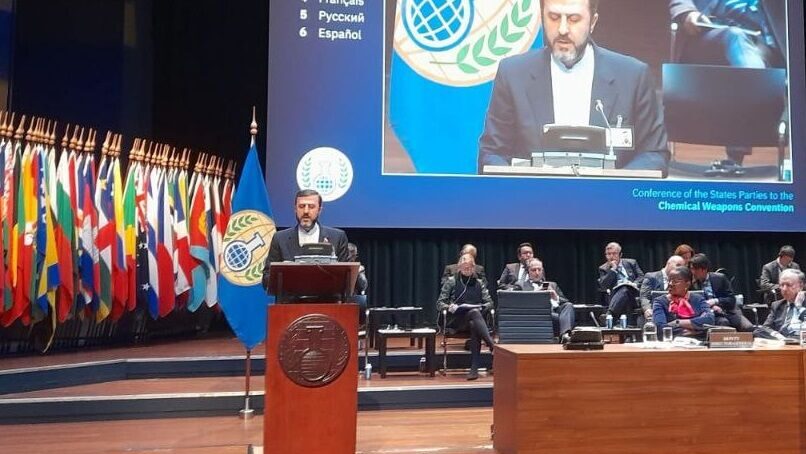
Iran raised the issue of Israel’s refusal to ratify the Chemical Weapons Convention (CWC) on Monday, November 25, claiming that this lack of accountability poses a grave risk to global peace and stability.
Iran’s Deputy Minister for Legal and International Affairs, Kazem Gharibabadi, addressed the 29th session of the Conference of the State Parties to the CWC, which began in The Hague on Monday. He also called for international action against Israel for using chemical weapons, which are banned by international conventions, in Palestine and in Lebanon.
The CWC prohibits the development, production, storage, and use of all types of chemical weapons. It came into force in 1997 and has been signed and ratified by 193 countries. The Organization for the Prohibition of Chemical Weapons (OPCW), based in The Hague, serves as the implementing body of the CWC.
Gharibabadi alleged that Israel has used chemical weapons and other hazardous substances, including white phosphorus and depleted uranium, against Palestinians in Gaza and against people in Lebanon during its ongoing genocidal war. He called on the OPCW to conduct an investigation and take necessary steps to protect civilians.
“This regime, with the unconditional support of some Western countries, especially the United States, continues its crimes and enjoys immunity,” Gharibabadi said.
Israel is one of only four countries in the world that are not party to the CWC. While it has signed the convention, it has refused to ratify it. Egypt, North Korea, and South Sudan have neither signed nor ratified the treaty.
There have been several instances where international investigations have established Israel’s use of chemical weapons against civilians in Gaza and Lebanon. During the ongoing war, Human Rights Watch (HRW) has reported Israel’s use of white phosphorus, a highly toxic substance, against civilians in Gaza. Although white phosphorus is not banned under the CWC, its use against civilians is considered illegal. Similarly, in September, the Syndicate of Chemists in Lebanon accused Israel of using depleted uranium during the bombings in Beirut. The use of depleted uranium is prohibited under international law.
Iran called for immediate UN sanctions on Israel for its continued violations of international humanitarian laws, as well as a complete economic, political, and military boycott of the Zionist regime.
The CWC should be universal
Iran emphasized the need for the universality of the CWC, claiming that Israel possesses a chemical weapons arsenal that threatens global peace and stability. It demanded the establishment of mechanisms to hold Israel accountable. Iran urged the international community to pressure Tel Aviv to join the CWC and place all its chemical weapons under the supervision of the OPCW.
Gharibabadi also rejected allegations made by the US and other Western countries regarding Iran’s alleged use of chemical weapons. He asserted that Tehran has fully complied with its obligations under the CWC and has placed all its chemical weapons under OPCW supervision.
The US has repeatedly accused Iran of developing chemical weapons. In July this year, the US imposed sanctions on an Iranian company, alleging that it was assisting the Iranian government in developing such substances.
In turn, Iran accused the US of violating the CWC on multiple occasions, including during its 2003 invasion of Iraq and by supplying weapons to Israel that are prohibited under OPCW regulations. The US has supplied billions of dollars worth of weapons to Israel since the beginning of the genocide in Gaza in October 2023, despite acknowledging that their use by Israel may have violated international humanitarian laws.
Gharibabadi claimed that the allegations against Iran are intended to divert global attention from the repeated use of chemical weapons by Israel or by groups supported by the US in the Middle East, such as armed factions fighting against state forces in Syria and Iraq, IRNA reported.
He also highlighted the US support for Iraq’s President Saddam Hussein during the war against Iran in the 1980s, despite being aware of Iraq’s use of chemical weapons against Iranian forces. Estimates suggest that over 7,000 Iranians were killed as a result of these attacks. Nearly 75,000 Iranians are still receiving treatment for injuries caused by chemical weapons during the Iran-Iraq war.
Gharibabadi called for accountability for all countries, including the US, that supported Iraq’s use of chemical weapons against Iran. He demanded that they be held responsible for their “illegal actions” and urged them to “take steps to compensate” Iranian victims.
Iran also highlighted how illegal US sanctions, imposed over time, have hindered the treatment of Iranian victims affected by chemical weapons attacks. It called on the OPCW to intervene and assist the victims.
Original article by Abdul Rahman republished from people dispatch under a Creative Commons Attribution-ShareAlike 4.0 (CC BY-SA) license.
A bomb remnant retrieved following Israel’s October 25, 2024 attack on a compound housing journalists in southern Lebanon. (Photo: Anoir Ghaida via Human Rights Watch)
“Israel’s use of U.S. arms to unlawfully attack and kill journalists away from any military target is a terrible mark on the United States as well as Israel,” said a researcher from Human Rights Watch.
A leading international human rights organization said Monday that Israel’s deadly bombing of a Lebanese residential compound housing journalists last month was carried out using a munition guidance kit supplied by the United States.
Human Rights Watch (HRW) said its investigation determined that the October 25 strike in southern Lebanon, launched in the early hours of the morning as most of the journalists staying in the compound slept, was “most likely a deliberate attack on civilians and an apparent war crime.”
The group’s investigators visited the Hasbaya Village Club Resort, the target of the strike, and found no evidence that the compound was being used for military activity, undercutting Israel’s initial claim that it hit a building from which “terrorists were operating.”
HRW also said it reviewed information indicating that Israel’s military “knew or should have known” that journalists were staying in the compound. Journalists who were at the compound when Israel’s strike hit said the Israeli military did not issue a warning ahead of the attack.
“All the indications show that this would have been a deliberate targeting of journalists: a war crime.”
The airstrike killed at least three journalists and injured several others. Remnants from the scene of the strike collected by the targeted resort’s owner were “consistent” with Joint Direct Attack Munitions (JDAMs) that the U.S. has provided to the Israeli military.
One fragment, according to HRW “bore a numerical code identifying it as having been manufactured by Woodard, a U.S. company that makes components for guidance systems on munitions.” Boeing, a major U.S. military contractor, assembles and sells JDAMs, which are attached to bombs with the stated goal of making airstrikes more precise.
Other remnants HRW reviewed were consistent with materials from a 500-pound bomb equipped with a JDAM.
A bomb remnant retrieved following Israel’s October 25, 2024 attack. (Photo: Anoir Ghaida via Human Rights Watch)
Richard Weir, a senior researcher at HRW, said in a statement Monday that “Israel’s use of U.S. arms to unlawfully attack and kill journalists away from any military target is a terrible mark on the United States as well as Israel.”
“The Israeli military’s previous deadly attacks on journalists without any consequences give little hope for accountability in this or future violations against the media,” said Weir. “As evidence mounts of Israel’s unlawful use of U.S. weapons, including in apparent war crimes, U.S. officials need to decide whether they will uphold U.S. and international law by halting arms sales to Israel or risk being found legally complicit in serious violations.”
The Guardian conducted a separate investigation of the Israeli strike and reached conclusions mirroring HRW’s, reporting Monday that “Israel used a U.S. munition to target and kill three journalists and wound three.”
“On 25 October at 3:19 am, an Israeli jet shot two bombs at a chalet hosting three journalists—cameraman Ghassan Najjar and technician Mohammad Reda from pro-Hezbollah outlet al-Mayadeen, as well as cameraman Wissam Qassem from the Hezbollah-affiliated outlet al-Manar,” the newspaper observed. “All three were killed in their sleep in the attack which also wounded three other journalists from different outlets staying nearby. There was no fighting in the area before or at the time of the strike.”
Nadim Houry, a human rights lawyer and executive director of the Arab Reform Initiative, told The Guardian that “all the indications show that this would have been a deliberate targeting of journalists: a war crime.”
“This was clearly delineated as a place where journalists were staying,” Houry said.
The findings were published just days after the U.S. Senate voted down an effort led by Sen. Bernie Sanders (I-Vt.) to block new sales of American weaponry to Israel. One of the resolutions put forth by Sanders would have blocked the imminent transfer of over $260 million worth of JDAMs to Israel’s military.
In a fact sheet, Sanders’ office pointed to six examples in which Israel’s military used JDAMs in deadly attacks on civilians in Gaza and Lebanon, including children.
“The United States is complicit in these atrocities,” Sanders said in a floor speech ahead of last week’s vote. “That complicity must end.”
A worker with the United Nations Relief and Works Agency for Palestine Refugees in the Near East and displaced Palestinians check the damage inside a U.N. school-turned-shelter near Gaza City after a reported Israeli strike on October 19, 2024. (Photo: Omar al-Qattaa/AFP via Getty Images)
“This legislation not only contravenes the basic principles of human rights that led to the U.N. General Assembly’s founding of UNRWA, but also violates a range of Israel’s international legal obligations.”
Over a year into Israel’s obliteration of the Gaza Strip, Israeli lawmakers faced sharp criticism on Monday after voting for a pair of bills targeting the United Nations agency responsible for humanitarian aid in the illegally occupied Palestinian territories.
The first bill, which says that the United Nations Relief and Works Agency for Palestine Refugees in the Near East (UNRWA) “will not operate any missions, won’t provide any service, and won’t hold any activity—directly or indirectly—in the sovereign territory of the state of Israel,” passed the Israeli parliament 92-10.
The second legislative proposal—under which the Israeli agency that handles humanitarian issues, the Coordinator of Government Activities in the Territories (COGAT), will have to cut off contact with UNRWA—passed the 120-member Knesset 87-9. Critics called the votes “grotesque” and “outrageous.”
The Israel-based organization Adalah said in a statement that “despite widespread international pressure and condemnation, the Knesset has nearly unanimously passed two bills aimed at dismantling UNRWA, all while Israel continues its genocidal assault on Gaza and intensifies violence across the West Bank, including East Jerusalem.”
“This legislation threatens a vital lifeline for over 2.5 million Palestinian refugees throughout the occupied Palestinian territory,” the group warned. “It represents a deliberate attempt to fundamentally undermine UNRWA and its essential mission of supporting the relief, education, and human development of Palestinian refugees. Specifically, the laws aim to strip Palestinians—who were forcibly displaced from their homes during the 1948 Nakba and the 1967 war—of their status as refugees and their right of return.”
The United Nations General Assembly created UNRWA in 1949, in the wake of the Nakba, or “catastrophe,” when more than 750,000 Palestinians fled or were forced from their homeland to establish the modern state of Israel—whose officials have claimed without providing evidence that a dozen of the agency’s 13,000 staffers in Gaza were involved with the Hamas-led October 7, 2023 attack on Israel.
“This legislation not only contravenes the basic principles of human rights that led to the U.N. General Assembly’s founding of UNRWA, but also violates a range of Israel’s international legal obligations, including those under the Genocide Convention and the Rome Statute of the International Criminal Court,” said Adalah. “The international community must hold Israel accountable.”
The US allegedly asked Israel not to ban UNRWA, but it did so anyway.
The Biden-Harris administration must take real action to stop Israel from killing even more Palestinians.
Although Israel faces a South Africa-led genocide case at the International Court of Justice over its war on Hamas-controlled Gaza—which has killed at least 43,020 people and injured another 101,110 since last October—governments around the world have not acted to stop the bloodshed. The U.S. Congress and President Joe Biden’s administration have even provided Israel with billions of dollars in military aid and blocked cease-fire resolutions at the United Nations.
Earlier this month, the Biden administration finally threatened to cut off weapons if the Israeli government does not take “urgent and sustained actions” to improve humanitarian conditions in Gaza within 30 days. U.S. Secretary of State Antony Blinken and Secretary of Defense Lloyd Austin’s letter specifically raised concerns about the legislation that passed the Knesset Monday.
Asked about the Israeli bills on Monday, Matthew Miller, a U.S. State Department spokesperson frequently slammed for his statements about Israel, pointed to the secretaries’ criticism of the legislation in the recent letter and acknowledged that UNRWA serves the West Bank and plays “an irreplaceable role” in Gaza, where Palestinians are starving to death.
.@leobruneau asked StateSpox about Israel voting to ban UNRWA earlier today.
Miller: The passage of this legislation could have implications under US law…UNRWA plays a critical role in delivering humanitarian assistance
Sally Abi Khalil, Oxfam’s regional director in the Middle East and North Africa, said Monday that “Israel has bombed Palestinians to death, maimed them, starved them, and is now ridding them of their biggest lifeline of aid. Piece by piece, Israel is systemically dismantling Gaza as a land that is autonomous and liveable for Palestinians.”
“Its banning of UNRWA today is condemnable and another step in this crime,” she argued. “The decision will further undermine the ability of the international community to provide sufficient humanitarian aid and to save lives in any safe, independent, and impartial way. UNRWA was not only the biggest and most established agency that has been delivering aid and sustenance to the people of Gaza for years, it was also a thread that connected them in some hope of solidarity and security to the United Nations.”
“We are in no doubt that Israel and its allies are fully aware of the terrible consequences that this decision will have on Palestinians living in Gaza, many of whom are already starving,” she added. “We join others in warning again that this will result in more death, more suffering, and more forced displacement of people from their besieged homeland. It is impossible not to believe that this is their aim.”
Leading up to the votes, human rights advocates have been sounding the alarm. On Saturday, over 50 groups including Oxfam, Human Rights Watch, and ActionAid released a joint statement demanding action and warning that “dismantling UNRWA would be catastrophic for Palestinians especially in Gaza and the West Bank as they are deprived of essentials such as food, water, medical aid, education, and protection. It will also have catastrophic consequences for millions of Palestinian refugees in Lebanon, Jordan, and Syria, where essential humanitarian aid is crucial for both the refugees and the host communities.”
How can the Israelis remain a #UN member when they not only violate the most basic laws of the @UN Charter but declare UN Secretary General @antonioguterres persona non grata and expel the UN refugee agency that millions of #Palestine refugees depend on, @UNRWA, as well as… https://t.co/8VZat2Gqt3
Philippe Lazzarini, the UNRWA commissioner-general, delivered a similar warning on social media Monday, declaring that the Knesset action not only “is unprecedented and sets a dangerous precedent” but “it opposes the U.N. Charter and violates the state of Israel’s obligations under international law.”
“This is the latest in the ongoing campaign to discredit UNRWA and delegitimize its role towards providing human-development assistance and services to Palestine Refugees,” he continued. “These bills will only deepen the suffering of Palestinians, especially in Gaza where people have been going through more than a year of sheer hell.”
“It will deprive over 650,000 girls and boys there from education, putting at risk an entire generation of children,” Lazzarini added. “These bills increase the suffering of the Palestinians and are nothing less than collective punishment.”
A view of Google Headquarters in Mountain View, California, United States on March 23, 2024 [Tayfun Coşkun – Anadolu Agency]
A damning report, “Palestinian Digital Rights, Genocide, and Big Tech Accountability”, by 7amleh, a Palestinian-led non-profit organisation that is focused on protecting the human rights of Palestinians, has laid bare the disturbing and active role that major online platforms and big tech companies play in perpetuating human rights abuses against Palestinians. While the world watches the horrors unfold in Gaza, the role of these digital accomplices cannot be ignored. The report highlights that platforms like Meta, X, YouTube and tech giants Google and Amazon have enabled, facilitated and even profited from these atrocities, effectively shielding war crimes under a digital smokescreen.
The findings are a harrowing indictment of how big tech companies, under the guise of neutrality, have become active participants in censorship, disinformation and incitement to violence. They have provided crucial infrastructure that underpins Israel’s military actions, allowing their platforms to be weaponised, silencing Palestinian voices while amplifying hate speech and calls for genocide. The complicity of these platforms is not a mere oversight; it is an entrenched system of deliberate decision-making that prioritises profits over human rights.
Systematic censorship of Palestinian voices
At the heart of the report’s findings is a shocking pattern of systematic censorship targeting Palestinian voices. Between October 2023 and July 2024, over 1,350 instances of censorship were documented on major platforms, including Facebook, Instagram, X and TikTok. These platforms disproportionately targeted Palestinian journalists, activists and human rights defenders, with Meta’s platforms being among the worst offenders. The censorship took many forms: accounts were suspended, content takedowns became routine and distribution of pro-Palestinian narratives was heavily restricted.
Meta’s manipulative algorithm changes played a key role in this censorship. The report reveals that during the ongoing war in Gaza, Meta altered its content moderation policies to lower the threshold for flagging Palestinian content, reducing the accuracy of its filters and triggering unnecessary takedowns. For Palestinian content, Meta’s filters operated with a mere 25 per cent certainty of a violation, compared to the usual 80 per cent applied elsewhere. These so-called “temporary risk response measures” were never lifted, allowing for an outsized level of scrutiny on Palestinian content creators. This is not an isolated incident – it’s a calculated, discriminatory policy that silences marginalised voices and hinders the free flow of information at a time when it’s needed the most.
As 7amleh’s report highlights, Meta’s broken promises to safeguard free speech, coupled with its biased content moderation, exacerbated the situation for Palestinians. Human Rights Watch had already condemned Meta for its systemic censorship of Palestinian voices during the war, with over 1,050 instances of content removal on Facebook and Instagram. In nearly all cases, this censorship targeted peaceful, pro-Palestinian content while allowing violent, anti-Palestinian content to flourish unchecked. Comments like “Free Palestine”, “Stop the Genocide” and “Ceasefire Now” were removed under Meta’s spam guidelines, reflecting a dangerous double standard that stifles legitimate political discourse.
Platforms as instruments of genocide
The report makes clear that online platforms are not simply neutral forums but have become instruments of incitement to genocide. Between October 2023 and July 2024, over 3,300 instances of harmful content – including incitement to genocide – were documented, the majority on X and Facebook. These platforms allowed high-level Israeli officials and other users to openly call for the extermination of Palestinians, dehumanising them as “sub-humans”, “animals” and worse. This genocidal rhetoric wasn’t limited to obscure corners of the internet. It was promoted, amplified and left unchallenged by the very platforms that claim to be committed to community standards and human rights.
For instance, on X, a December 2023 post by the deputy mayor of Jerusalem described blindfolded Palestinian detainees as “ants” and called for burying them alive. Although this specific post was eventually removed, countless others like it remain, fuelling a climate of violence and dehumanisation against Palestinians. This failure to combat hate speech directly contravenes international law, particularly in light of the International Court of Justice’s January 2024 order, which directed Israel to prevent and punish incitement to genocide.
These platforms are not just failing in their duty to protect free speech; they are actively facilitating the spread of genocidal propaganda. In the case of Meta, the report details how over 9,500 takedown requests from the Israeli government were sent to Meta between October and November 2023, with a shocking 94 per cent compliance rate. This high level of cooperation with a state actively committing war crimes raises serious concerns about the ethical boundaries of these companies. Meta’s decision to comply with such requests without transparency or accountability reveals a deeper issue: these platforms are willing to become tools of state oppression when the price is right.
The role of Big Tech: Project Nimbus and the automation of killing
Beyond the sphere of social media, Google and Amazon’s collaboration with the Israeli military under Project Nimbus casts an even darker shadow over the tech industry’s role in this conflict. The $1.2 billion cloud computing contract, as the report highlights, provides critical infrastructure to power Israel’s AI-driven Lavender and Gospel targeting systems – systems that are directly linked to the mass civilian casualties in Gaza.
The Lavender system, in particular, functions as a tool for automated killings, identifying targets based on massive data inputs and feeding them into the Israeli military’s bombing campaigns. The report describes how Lavender alone identified over 37,000 potential targets, contributing to the deaths of thousands of civilians, including women and children. By providing cloud services to facilitate this mass-scale targeting, Google and Amazon are directly implicated in these violations of international law. Despite mounting global pressure, both companies continue to support Israel’s military operations under Project Nimbus, even as the civilian death toll in Gaza rises.
Hate speech and disinformation: A coordinated assault on truth
The report goes on to document a deluge of hate speech and disinformation campaigns, often spearheaded by Israeli officials and amplified by online platforms. These campaigns, which include the systematic dissemination of dehumanising content on Telegram, X and YouTube, have targeted Palestinians both inside Gaza and across the diaspora. The report cites three million instances of violent content in Hebrew aimed at Palestinians on X alone, much of it coordinated by Israeli state actors.
Perhaps most troubling is the Israeli government’s influence operation known as STOIC, which ran a disinformation campaign targeting US and Canadian lawmakers to undermine the work of The United Nations Relief and Works Agency for Palestine Refugees in the Near East (UNRWA). This campaign, orchestrated with the help of AI, spread false narratives that led to the defunding of UNRWA, cutting off critical humanitarian aid to Palestinians. This is not merely a failure of moderation but an example of how platforms can be weaponised for state-driven disinformation, with devastating consequences for innocent civilians.
Profiting from genocide: Advertising amidst war crimes
As if censorship and disinformation weren’t enough, the report also exposes how platforms like Facebook have profited from harmful advertisements promoting violence against Palestinians. The investigation found that Facebook ran ads calling for the assassination of pro-Palestinian activists and the forced expulsion of Palestinians from the West Bank. Meta profited from these campaigns, further entrenching its complicity in the human rights violations unfolding in Gaza.
Meanwhile, YouTube ran ads from the Israeli government that used graphic imagery to sway public opinion in favour of its military actions in Gaza. Despite YouTube’s policies against violent content, these ads flooded social media with incendiary narratives, particularly in Europe and the US, contributing to the normalisation of war crimes under the guise of counter-terrorism.
Time for accountability
The findings of this report should compel the international community to act. It is no longer acceptable for tech companies to hide behind vague policies and empty commitments to free speech while facilitating the mass killing and silencing of a besieged population. The complicity of Meta, X, YouTube, Google and Amazon in these atrocities must be brought into the spotlight and held accountable for their role in enabling these crimes.
These platforms are not neutral arbiters of truth – they are corporations driven by profit, willing to accommodate genocidal regimes and turn a blind eye to the suffering of millions if it serves their bottom line. As the report makes clear, it is time for the world to demand that these companies stop profiting from the destruction of Palestinian lives. The silence and complicity of big tech are unforgivable, and they must not be allowed to escape responsibility any longer.
The views expressed in this article belong to the author and do not necessarily reflect the editorial policy of Middle East Monitor.
The broadcaster’s in-house content studio has been paid to promote fossil fuel firms and petrostates with a history of persecuting journalists.
The BBC has produced dozens of films and articles for oil and gas companies, agricultural giants, fossil fuel states, and high-emission transport firms in recent years, DeSmog can reveal.
Experts say the BBC has been “greenwashing” the image of companies and countries contributing to global emissions by trumpeting their dubious climate credentials and promoting their favoured solutions to the crisis.
The content was produced by BBC StoryWorks, a studio that produces videos, podcasts, and articles paid for commercial clients, which it publishes on BBC channels outside the UK.
On its website, BBC StoryWorks boasts that it leverages the reputation of the BBC – “our century-long pedigree as the world’s most trusted storytellers” – to create content for commercial clients “that moves and inspires curious minds, across platforms and across the globe”.
BBC StoryWorks produces traditional adverts for its clients, as well as content “with an editorial style” (known as “branded” or “native” content).
Branded content appears outside the UK on the BBC website – the most viewed news platform in the world – and on its non-UK broadcast channels, in a similar format to normal editorial output. However, branded content promotes the paying client and typically features interviews with the client’s senior executives. It is only distinguished by a disclaimer that it has been paid for by an external organisation.
BBC Studios – which includes StoryWorks – generated £1.8 billion of sales in the year 2023/24, according to the broadcaster’s annual accounts. The BBC‘s financial deficit is projected to reach nearly £500 million next year, with the licence fee – its primary funding source – having been frozen for several years by the last Conservative government.
In recent months, the BBC has created content for a number of oil and gas companies, including the French fossil fuel company Engie, which owns a number of coal-fired power plants and relies heavily on gas for its energy production.
BBC StoryWorks has also produced content for liquified natural gas (LNG) companies, and has touted the energy source as a cleaner alternative to other fossil fuels. This is despite experts warning that the booming LNG industry could contribute more heavily to the climate crisis than the ongoing use of coal, the most carbon-intensive fossil fuel.
Agriculture accounts for 21 percent of global greenhouse gas emissions, and BBC StoryWorks has produced films for some of the world’s biggest food and farming firms, including Nestlé and Bayer, often promoting the disputed green technologies backed by the industry. As previously revealed by DeSmog, BBC StoryWorks has produced dozens of documentaries sponsored by the pesticide giant Corteva, publicising the technologies developed and sold by the firm.
Petrostates with a history of human rights abuses – including the imprisonment of journalists – have also been promoted by BBC StoryWorks.
An investigation by DeSmog and Drilled previously revealed that many of the world’s most trusted English-language news outlets regularly promote the fossil fuel industry’s narratives on climate-related topics. Bloomberg, The Economist, the Financial Times, the New York Times, Politico, Reuters, and the Washington Post all have internal commercial studios that create advertising content for fossil fuel firms.
The BBC is committed to science-led climate reporting and in 2021 signed the Climate Content Pledge, promising to do “more and better climate story-telling on screen across all genres.”
However, critics say that BBC StoryWorks is using the broadcaster’s reputation – including its role as a public service broadcaster – to make money from commercial content that often flouts its editorial values.
“The contracts to make this sort of content are won on the back of the BBC’s reputation as an honest and impartial broadcaster,” Patrick Howse, the BBC’s former Baghdad bureau chief, told DeSmog. “Accepting money from sources like this, to make content like this, risks undermining the BBC’s own hard-won reputation and will ultimately put it on the wrong side of history.
“This is a huge disservice to the BBC’s audiences, and a betrayal of the many brave and conscientious BBC journalists around the world who see holding power to account and telling the truth as their raison d’etre.”
Last year was the warmest year since global records began in 1850. The world’s foremost climate science body, the UN’s Intergovernmental Panel on Climate Change (IPCC), has said that “immediate and deep emissions reductions” are needed “across all sectors” to limit global warming to 1.5C – the global target established by the 2015 Paris Agreement.
In June 2024, UN Secretary-General António Guterres said that advertising agencies had “aided and abetted” the fossil fuel industry, “acting as enablers to planetary destruction”.
“Fossil fuels are not only poisoning our planet – they’re toxic for your brand,” he said.
A BBC StoryWorks spokesperson said that the studio “operates entirely separately from the BBC’s editorial operations” and that its output “is clearly labelled as commercial content”.
However, content labelling doesn’t always help readers and viewers to understand that it has been paid for by a commercial client. A 2018 Boston University study found that only one in 10 people recognised native advertising – which includes branded content – as advertising rather than reporting.
The BBC StoryWorks spokesperson added that, “BBC StoryWorks operates under robust and established governance and is required to comply with the BBC’s guidelines as set out in the publicly available Advertising and Sponsorship Guidelines.
“Central to these guidelines is a commitment to factual accuracy in any piece of content. All of the content cited in this article was approved as compliant with the BBC’s advertising guidelines prior to its publication.”
Fossil Fuel Firms and False Solutions
In April and June, BBC StoryWorks published two articles paid for by Engie, a global energy company with annual revenues of $60 billion, which is part-owned by the French state. The articles promoted Engie’s green credentials, claiming it has a mission “to accelerate the energy transition”, despite the firm’s extensive fossil fuel interests.
Though ENGIE has ambitious renewable development objectives, it plans to expand its LNG terminals in Europe, is one of the top European developers of gas power plants globally, and has agreed to import American shale gas beyond 2040.
Between 2016 and 2022, the firm sold 16 of its coal plants – a 60 percent reduction in its coal capacity. However, Engie chose to sell these assets rather than close them down. This transferred the polluting plants to different owners, meaning that the plants will still contribute to global emissions.
The BBC StoryWorks articles didn’t provide information about the company’s existing polluting activities, or the global need to rapidly scale-down oil, gas, and coal production.
Professor Peter Newell, an academic at the University of Sussex specialising in environmental politics, told DeSmog: “Because branded content looks like regular BBC journalism which the public trust as independent, it compromises the integrity of the organisation and its public role, including to help society respond seriously to the climate crisis.”
In 2021, the broadcaster launched a “Humanising Energy” series “presented by” the World Energy Council, a global forum for sustainable energy development, followed by a second series in 2023.
The two series featured dozens of five-minute films paid for by individual firms, showcasing their supposed climate solutions. These films typically involved one-on-one interviews with people either creating or benefiting from these green innovations, as well as cinematic shots of the technologies being deployed.
A screenshot of a BBC StoryWorks film from its ”Humanising Energy“ series. Credit: BBC
Sponsors of films in the two Humanising Energy series included the fossil fuel companies Engie Brazil, Gasum (the largest distributor of LNG in the Nordic countries), CLP Holdings (which has said it won’t phase out its coal assets before 2040, and hasn’t committed to phasing out its gas assets), Mabanaft, and Invenergy, the energy services firm Voith, and the engine manufacturer Cummins.
All of these films touted the supposed climate credentials of the featured companies, without examining their contribution to global emissions or the viability of the featured technologies.
In January 2024, Cummins agreed to pay a record $1.7 billion fine – the second largest environmental penalty ever in the U.S. – after facing charges that it equipped roughly one million vehicles with devices that bypassed emissions sensors. The company didn’t admit wrongdoing.
Just a few months earlier, BBC StoryWorks produced a film for Cummins boasting of the firm’s efforts to help decarbonise commercial vehicles.
The Invenergy film focused on its construction of an LNG plant in El Salvador. While the content attempted to show how the plant was providing energy and jobs to the local community, it also tried to tout the environmental benefits of natural gas.
During the film, an Invenergy spokesperson suggested that natural gas generates 30 percent less carbon dioxide than other fossil fuels, neglecting the fact that natural gas is composed largely of methane, which is over 80 times more potent than CO2 across a 20 year period. Even relatively small methane leaks during the process of extracting, shipping, and processing natural gas contribute significantly to global emissions.
One of the films in the Humanising Energy series – “The evolution of home energy” – promoted the role of hydrogen in supplying home heating. Yet, while green hydrogen is widely accepted as necessary for decarbonising heavy industry and other sectors where alternative renewable energy sources are unworkable, it is not considered viable for heating homes.
A peer-reviewed assessment of over 50 independent studies in 2024 concluded that hydrogen use in domestic heating is inefficient, costly and resource-intensive compared to other low-carbon options such as heat pumps.
The BBC StoryWorks film was paid for by DNV, a Norwegian company that claims to be “the world’s leading resource of independent energy experts and technical advisors”, including the oil and gas sector. DNV says on its website that it “delivers broad technical expertise and experience to enable hydrogen to play a key role in the energy transition”.
A DNV spokesperson said that, “While DNV does work with oil and gas companies and organisations across renewable energy production, it is not involved in the direct production or distribution of energy… Our approach to energy solutions is rooted in comprehensive research and rigorous testing, and our position as an independent third party is a central part of our identity and our work.”
The Humanising Energy series also featured twofilms advocating for the development and deployment of sustainable aviation fuels (SAFs) – one paid for by the aviation giant Boeing, and one paid for by the energy and chemicals company Sasol alongside the gas company Linde.
A screenshot of a BBC StoryWorks film, sponsored by Boeing, from its ”Humanising Energy“ series. Credit: BBC
SAFs have been criticised as being environmentally damaging and currently economically unviable. The Advertising Standards Authority this month banned a Virgin Atlantic advert for making the “misleading” claim that it had developed a “100 percent sustainable aviation fuel”.
In August 2022, the International Council on Clean Transportation (ICCT) said that the amount of money invested by airlines in SAFs was “insufficient” and that it seemed as though the technology was simply “about burnishing airlines’ images” by inflating their environmental credentials.
Sasol told DeSmog that its SAF initiatives were not an example of greenwashing and that it believes SAFs hold the “promise to be an enabler of our own decarbonisation and contribute to decarbonising aviation.”
Aviation contributes approximately 2.5 percent of worldwide greenhouse gas emissions, yet BBC StoryWorks has produced content for a number of airlines in recent months and years, including Uzbekistan Airways (March 2024), China Southern Airline (2022), and Korean Air (2017).
BBC StoryWorks has also worked extensively with other polluting transport companies.
It produced an advertising campaign for the shipping and cruise company Cunard that appeared on BBC StoryWorks social media pages in July 2024. Europe’s 218 cruise ships emitted as much sulphur oxides as one billion cars in 2022.
BBC StoryWorks has also produced brandedcontent for the car company Hyundai, as well as for Lexus, Volkswagen, and Jaguar. In addition, the studio has produced a six-part series paid for by the Indian multinational motorcycle company Royal Enfield.
Transport contributes roughly one quarter of all energy related greenhouse gas emissions, while outdoor air pollution is estimated to cause more than 3.2 million premature deaths worldwide every year.
“This important investigation reveals that BBC StoryWorks has been doing the greenwashing work of major polluting firms driving the climate crisis by obscuring their role and promoting their preferred ‘solutions’, however discredited by science,” Professor Newell told DeSmog.
Greenwashing is when a company falsely brands something as eco-friendly, green or sustainable. In 2017, the BBC itself produced a guide to the “seven ways to spot businesses greenwashing”.
Big Ag Polluters
BBC StoryWorks has also been paid to produce content for major agricultural polluters and their lobbyists. This content has often promoted the technological hacks that food and farming giants claim will reduce the sector’s emissions, rather than the more fundamental changes in production and consumption that scientists say will be crucial in limiting Big Ag’s climate impact.
In 2023, BBC StoryWorks produced an advertising campaign for the pesticides giant Bayer, the world’s second largest crop chemicals company, boasting of the firm’s efforts to facilitate “scientific breakthroughs”.
In addition, as part of a branded content series in late 2023 entitled “The Climate and Us”, BBC StoryWorks was paid by Bayer to produce a film on the digital apps helping farmers to monitor and reduce their emissions.
The film, which featured an interview with Bayer’s vice president of digital farming operations, promoted the firm’s technologies with no additional comment from experts on its efficacy, or Bayer’s stance on climate change.
A screenshot of a BBC StoryWorks film, sponsored by Bayer. Credit: BBC
According to the Pesticides Action Network, over a third of Bayer’s sales derive from products that are highly hazardous to the environment, animal or human health. (The methodology for this classification is strongly disputed by Bayer on the grounds that it uses different criteria to internationally accepted rules).
Bayer told DeSmog that it is “committed to ambitious sustainability goals and has a positive track record while recognising the ongoing challenge.”
Experts say that the overuse of chemical pesticides is harming the future of food production. Biodiversity is in sharp decline across the world, and numbers of birds and pollinators are plummeting in Europe.
Bayer, which makes almost $10 billion in agrochemical sales every year, has also faced millions of dollars in lawsuits over health issues allegedly related to its products, including from farmers.
In 2023, DeSmog revealed that BBC StoryWorks had produced three documentary series and 26 articles – viewed at least 65 million times – sponsored by Corteva, one of the world’s largest pesticide firms.
The BBC said that the Corteva-sponsored content, which focused on sustainable food production, was editorial in nature and not influenced by its corporate client. However, experts said the documentaries gave a “totally biased” picture of global food problems, while the content promoted a number of the technologies developed by Corteva.
BBC StoryWorks also produced two articles in 2023 paid for by Australian Dairy – the country’s industry trade group.
The first article promoted the supposed contribution of milk and dairy to a healthy diet, while the second advocated for “precision farming” – in other words, using technology to ensure that resources are used efficiently and to track climate impacts.
Scientists and health professionals agree that dairy products are not necessary for a healthy diet, and they agree that for people who are able to have a varied diet, lower meat and dairy consumption is healthier than diets higher in milk and dairy.
Experts also doubt that precision farming can be rolled out widely enough to meaningfully reduce agricultural emissions. The environmental group Friends of the Earth has said that: “Faced with global climate and biodiversity emergencies, better ‘optimisation’ of existing production processes cannot possibly go far enough to meet the challenges we face.”
According to a March 2024 Harvard Law paper, which surveyed more than 200 environmental and agricultural scientists, meat and dairy production must be drastically reduced – and fast – to align with the Paris Agreement. The report concluded that global emissions from livestock production need to decline by 50 percent during the next six years, with “high-producing and consuming nations” taking the lead.
Sophie Nodzenski, a senior campaign strategist on food and agriculture at Greenpeace International told DeSmog: “Tinkering with the status quo is no longer an option. Meat and dairy companies are climate killers. The livestock sector is one of the leading sources of human-made methane emissions, which move us faster and further past the 1.5C threshold, worsening global heating.
“Meat and dairy companies must stop misleading the public with pseudo solutions and focus on reducing their livestock herds drastically to bring down emissions instead. This reduction can give us a fighting chance against climate chaos.”
In 2023, BBC StoryWorks also produced content for the world’s largest food and drink company Nestlé, boasting of the company’s efforts to support sustainable farming through “regenerative agriculture”.
The film failed to acknowledge that Nestlé – whose 87.5 million tonnes of annual emissions are similar to those of Chile – spent 14 times more on “marketing and administration” in the last year than it did on regenerative agriculture over the previous five years combined.
A screenshot of a BBC StoryWorks film, sponsored by Nestlé. Credit: BBC
“Nestlé’s strong focus on using regenerative agriculture to compensate for the greenhouse gas emissions from livestock farming – one of Nestlé’s main strategies to achieve net zero – is not backed by robust scientific evidence,” Nodzenski said.
“Increasing carbon storage in soils, as well as forests and other vegetation, is necessary, but should not replace a drastic reduction of greenhouse gas emissions from livestock farming – one of the main sources of Nestlé’s emissions.”
The Nestlé film was part of a “Food for Thought” series backed by the trade body FoodDrink Europe, whose members feature major polluters including Cargill, Coca-Cola, and Unilever.
A Nestlé spokesperson said: “We continue to invest in and deliver on our net zero roadmap. By the end of 2023, we had reduced our greenhouse gas (GHG) emissions by 13.5 percent in absolute terms since 2018. Our GHG reduction targets are third-party approved by the Science Based Targets initiative and include a 20 percent absolute cut by 2025 and 50 percent by 2030 covering all sources of agricultural emissions in our supply chain.
“We continue to ramp up our climate efforts using world class research and development, including via the Nestlé Institute for Agricultural Sciences.
“Nestlé has committed to invest $1.2 billion to pay premiums to farmers for ingredients grown using regenerative agriculture practices, provide technical assistance and support investment.”
Petrostates
Over recent years, BBC StoryWorks has also produced content for some of the world’s leading fossil fuel states, many of which have a poor record on human rights and press freedom.
This year’s flagship COP29 climate summit will be held in Baku, Azerbaijan. The country is a petrostate with oil and gas production accounting for roughly half of its GDP and over 90 percent of its exports. The country, run under an authoritarian system with little effective political opposition, plans to increase fossil fuel production by a third over the next decade.
Azerbaijan’s government has also been accused by of a media crackdown by the advocacy group Human Rights Watch ahead of November’s summit, arresting 25 journalists and activists in the past year.
However, since November 2023, BBC StoryWorks has produced several adverts promoting Azerbaijan as a place to visit, while greenwashing its image.
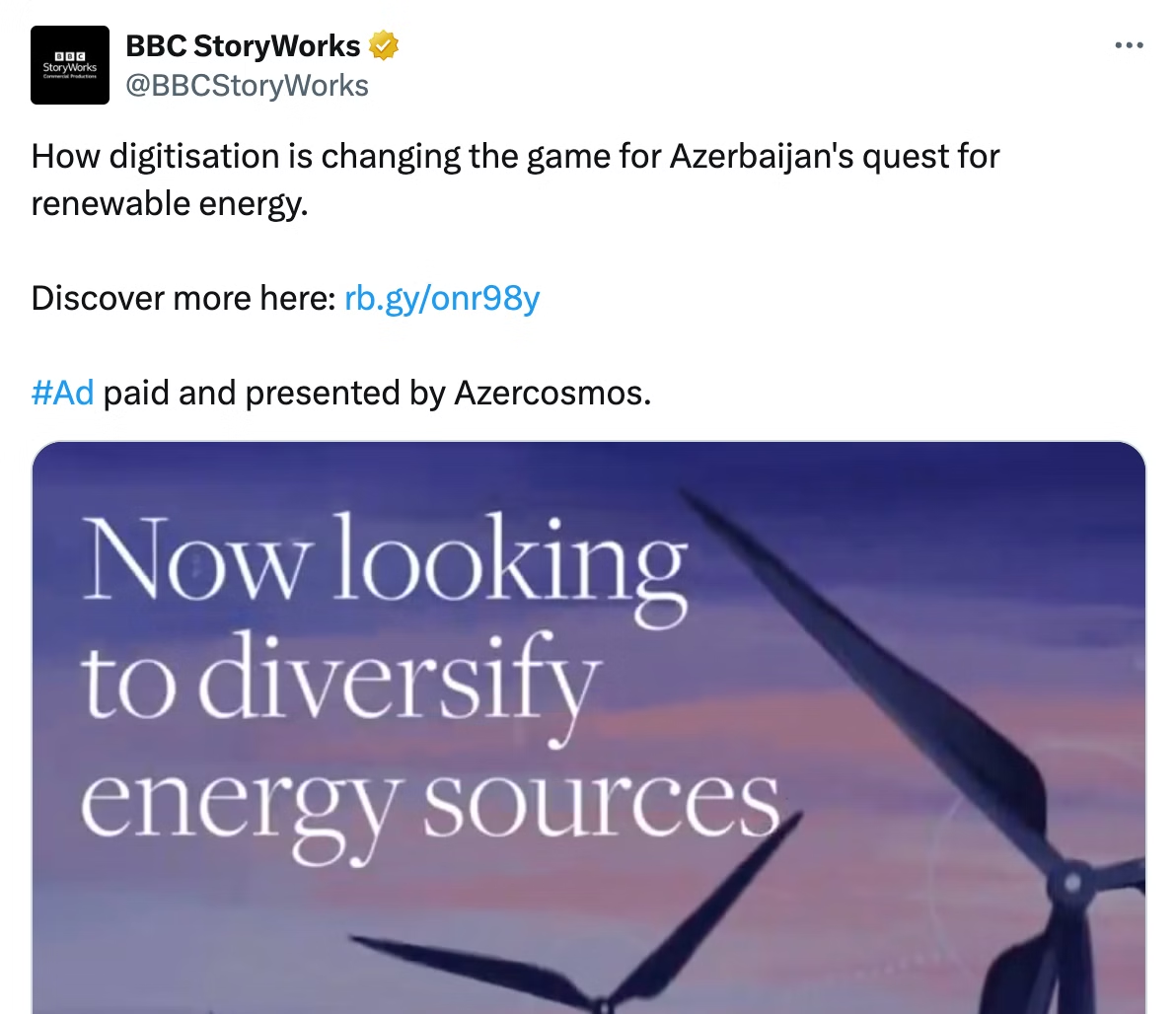
For example, in December 2023, the studio released an advert paid for by the country’s space agency Azercosmos, attempting to show “How digitisation is changing the game for Azerbaijan’s quest for renewable energy.”
The advert was accompanied by an article claiming that Azerbaijan plans to transition “from an oil- and gas-based economy into a thriving modern hub.” The article did not mention the country’s plan to expand fossil fuel production, which contravenes globally agreed efforts to limit rising temperatures.
A screenshot of a BBC StoryWorks advert, sponsored by Azercosmos. Credit: BBC
BBC StoryWorks has also produced content promoting the United Arab Emirates (UAE), the host of the 2023 COP28 climate summit and another petrostate with a poor human rights record.
In 2023, the studio produced a branded content podcast series on behalf of Abu Dhabi Tourism, featuring five 20-minute episodes each “highlighting the message that Abu Dhabi [the capital of the UAE] is a destination for every kind of traveller”.
The series was shortlisted for a 2023 World Media Award and, in the award submission, the BBC said it “challenged preconceived notions and [positioned] the city as a cultural gem worth exploring”. The series was downloaded 115,000 times, according to the BBC.
The UAE derives roughly 40 percent of its income from oil and gas, and this isn’t the only time that BBC StoryWorks has produced content promoting the petrostate.
The story stated that the UAE is “planning to increase oil production to more than five million barrels a day by 2030”, but said that the country “has been looking toward more sustainable energy sources”. It went on to say that “Clean energy projects are coming of age” in the UAE, “from record-breaking solar parks and green hydrogen to waste-to-energy plants”.
The UAE’s overall climate action has been rated as “critically insufficient” by the Climate Action Tracker, an independent scientific project that monitors government climate action and measures it against the Paris Agreement.
Weeks before COP28, the country’s national oil company, ADNOC, awarded contracts worth $17 billion for the development of new offshore gas fields.
The Gulf state also has a poor record on human rights and press freedom. The UAE continues to arrest and imprison activists, academics, and lawyers who speak out against its monarchic rulers. UAE authorities also continue to discriminate against women, LGBTQ communities, and migrants.
According to Reporters Without Borders, “The government prevents both local and foreign independent media outlets from thriving by tracking down and persecuting dissenting voices.”
“The rise of renewable energies in oil-rich regions” article also attempted to promote the ways in which “women are playing an increasing role in the renewable energy sector”. The story cited the fact that women are leading green initiatives in Kuwait, and Jordan.
However, many Gulf states routinely discriminate against women. In Kuwait for example, the country’s personal status laws discriminate against women in matters of marriage, divorce, and child custody.
Despite this, BBC StoryWorks has frequently promoted the country. In December 2023, the studio published an advert from the Kuwait Fund, the country’s state-run development agency, boasting of its efforts to help “disadvantaged regions, women and minorities”.
Reporters Without Borders states that Kuwait’s censorship laws prohibit journalists “from criticising the government, the emir, the ruling family, its allies or religion”. In particular, it is “difficult for journalists to tackle migrant worker rights, women’s rights and corruption.”
Oil and gas revenues account for roughly 60 percent of Kuwait’s GDP.
BBC StoryWorks has also produced content for the petrostate Qatar, promoting the country as a tourist destination despite its record of discriminating against women and minorities.
BBC StoryWorks has a history of working for repressive regimes, including China. The U.S. publication Deadline reported in December 2022 that BBC StoryWorks had partnered with at least nine Chinese state-affiliated bodies, including a media outlet banned from broadcasting in the UK.
“Those commissioning and paying for this content are deliberately using the BBC’s brand to greenwash or whitewash their own reputations. It’s an exercise of cynical manipulation,” the BBC’s former Baghdad bureau chief Patrick Howse told DeSmog.
“Commissions like this are lucrative and therefore attractive to a corporation that has been deliberately and severely financially squeezed by the UK government over a long period. This has forced the BBC to seek money from wherever it can find it, and this poses a risk to its editorial independence and honesty, which will ultimately undermine the trust of the BBC’s audience.”