Tag: Intergovernmental Panel on Climate Change

  • Pro-Trump Platform Promotes Climate Science Denial Ads to Millions Across Europe

    Spread the love

    Original article by Joey Grostern republished from DeSmog.
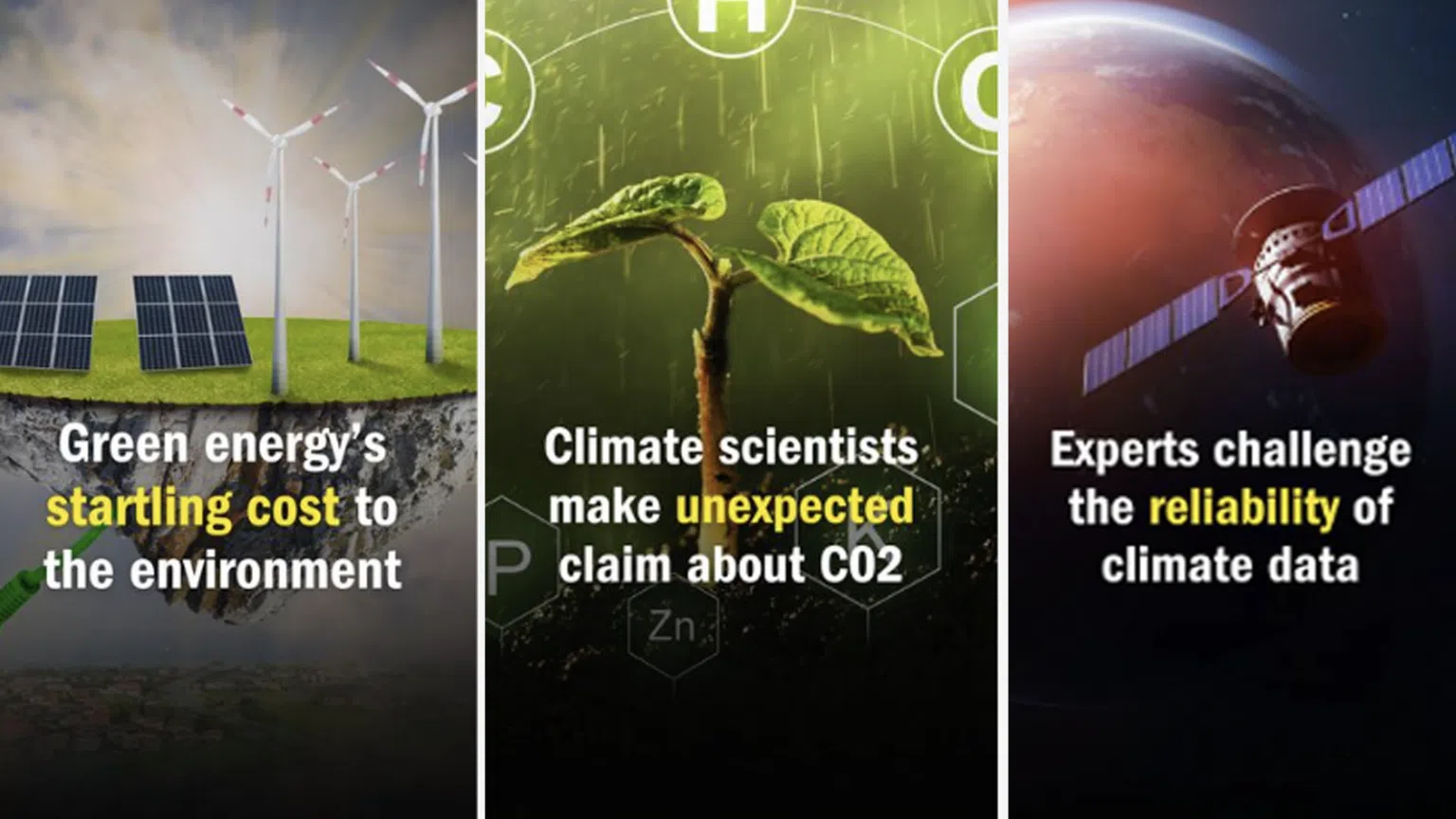
    A mashup of three Epoch Times adverts posted on Meta. Credit: The Epoch Times / Meta

    Campaigners have referred the Epoch Times to the UK advertising regulator for “stoking the climate culture war” on social media.

    The pro-Trump Epoch Times has run hundreds of anti-climate social media adverts in Europe since the beginning of 2024 that have been seen millions of times, DeSmog can reveal. 

    Epoch Times accounts in Europe have run 425 adverts on Facebook, Instagram, and X (formerly Twitter) that have attacked or undermined climate science, green energy, or climate action since the start of the year. These adverts have been run in the UK, Germany, Slovakia, and Bulgaria, appearing on social media feeds at least 2.3 million times across Facebook and Instagram, and 3.1 million times on X. 

    These anti-climate ads were active for 22 days on average on Meta platforms (Facebook and Instagram), while they were displayed for 9.5 days on average on X.

    Four of the adverts posted by Epoch Times on Meta have now been referred to the Advertising Standards Agency (ASA), a UK watchdog, by the campaign group Global Witness. The group is calling for the ASA to open an investigation into whether the Epoch Times breached the Committee of Advertising Practice (CAP) Code and, if so, to ban these adverts.

    The Epoch Times claims to be the fastest growing independent news outlet in the United States. It claims to host websites across 22 languages in 35 countries, publishing online and in print. The publication has gained a substantial online following in recent years, amassing more than 10 million followers across its various Facebook accounts.

    Based in New York, the Epoch Times is affiliated with the Falun Gong new religious movement in China and is staunchly anti-communist. Though the source of its income isn’t publicly declared, former employees told the New York Times that the publication was financed “by a combination of subscriptions, ads and donations from wealthy Falun Gong practitioners.”

    The publication has propelled itself on Facebook by filling its feeds with viral, feel-good videos alongside its often partisan news coverage. 

    According to NewsGuard, an independent company that rates the credibility of news sites, Epoch Times articles “frequently include distorted, misleading, or unsubstantiated claims.” The Epoch Times claims on its website that its reporters are “guided by the highest code of conduct and ethics”.

    The Epoch Times spent at least $1.5 million on adverts in support of then Republican President Donald Trump from 2018 to 2019 – more than any group other than the Trump campaign. 

    The publication was banned from advertising by Meta following these revelations, and the social media company told DeSmog that it ”continues to enforce this ban”. However, a number of Epoch Times offshoots have been allowed to promote climate science denial across Europe this year. 

    Many of these adverts have explicitly questioned the contribution of carbon dioxide (CO2) to climate change. The adverts have featured statements including “Several climate scientists say CO2 is essential and higher levels are not a problem”, and “What if more CO2 is actually good for the environment?”
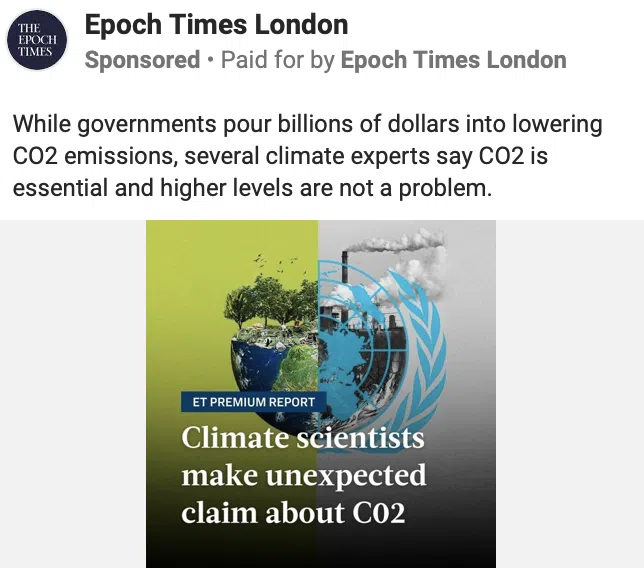
    The UN’s Intergovernmental Panel on Climate Change (IPCC), the world’s foremost climate science body, has stated that carbon dioxide “is responsible for most of global warming” since the late 19th century, which has increased the “severity and frequency of weather and climate extremes, like heat waves, heavy rains, and drought”.

    The adverts ran for months, and reached millions of people, despite Meta’s pledge to tackle climate misinformation. Ten were removed prior to DeSmog contacting Meta, of which six were removed over a failure to include an appropriate advertising disclaimer.

    “After sowing division and disinformation in the U.S., everyone in the UK should be alarmed that the Epoch Times is using the same playbook here,” said Nienke Palstra, campaign strategy lead at Global Witness. “We have already seen politicians trying to stoke a climate culture war and the Epoch Times is spending big to tap into this sentiment. We cannot allow the future of our planet to be put at threat for the political gain of extremists and populists.”

    A spokesperson for the Epoch Times told Global Witness that scientists have always differed in their opinion on climate change and that “To ban different opinions does not help a civilised open society and erodes freedom of speech.”

    Climate Denial Content

    The bulk of the anti-climate adverts seen by DeSmog were posted by Epoch Times London, a Facebook page created in October 2023 that has fewer than 600 followers. 

    Many of the adverts posted by Epoch Times London questioned climate science, for example claiming that “the greenhouse effect is real but irrelevant”, and that “new studies undercut the ‘scientifically empty’ global warming narrative.”

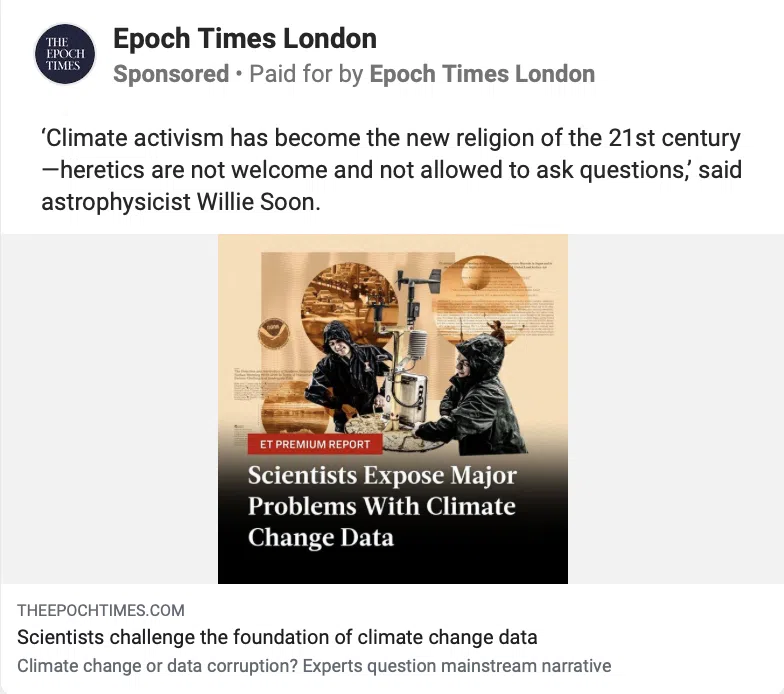
    One advert entitled “Scientists Expose Major Problems With Climate Change Data” was linked to an Epoch Times article that claimed climate change can be best explained by “natural variation”. The article also said that attempts to create a scientific consensus around human-caused climate change are the product of “deliberate fraud” according to “some experts.”

    The same article quoted Willie Soon, a scientist who has cast doubt on climate science and who has openly admitted accepting research funding from fossil fuel interests.

    A number of the Epoch Times London adverts suggested that the consensus on climate change is based on a wilful misinterpretation of evidence by the scientific community, asking questions such as “Climate change or data corruption? Experts question mainstream narrative.”

    DeSmog’s analysis found that Epoch Times London ran at least 392 unique adverts on Meta since the start of the year that attacked or attempted to undermine climate science, green energy, or climate action.

    Of those adverts, 146 were still active prior to DeSmog contacting Meta. According to an analysis of Meta’s ad archive, Epoch Times London has spent between £12,600 and £51,715 on its anti-climate advertising since the start of the year, with those adverts having been seen between 1.9 million and 2.5 million times. Meta has now blocked Epoch Times London’s ability to post adverts.

    According to Companies House, Epoch Times London was incorporated in 2014. The publication drew criticism in the UK in 2020 for posting free editions of its paper to Brighton and Hove residents, the front page of which included claims that the Chinese Communist Party had deliberately covered up evidence of COVID-19’s existence. 

    Following complaints from constituents, Lloyd Russell-Moyle, the Labour MP for Kemptown in Brighton, publicly criticised the Epoch Times in the House of Commons and called on Royal Mail to stop posting its print edition.

    Epoch’s European Operations

    Elsewhere in Europe, DeSmog has seen evidence of anti-climate advertising from Epoch Times-affiliated accounts. 

    The most prolific source of these adverts has been the German Epoch Times account on X, which has run 61 anti-climate adverts since the beginning of the year, reaching at least 1.5 million people and appearing 3.2 million times on X feeds across the German-speaking world. 

    Of the adverts that made a funding declaration, all stated that they were paid for Epoch Times Europe Gmbh, a company that has existed in Germany since at least 2009 according to the country’s company register. 

    A number of these adverts directly questioned the role of CO2 on climate change, saying that “CO2, especially anthropogenic emissions, hardly play a role”, “Climate change: CO2 not to blame”, “Climate change is too complex to blame on CO2”, and “CO2 is the most expensive fraud in history.”

    While there were fewer ads run on Meta in Germany than in the UK, they still generated at least 100,000 impressions, representing an ad spend of between €1,500 and €3,777. 

    An account run by German Epoch Times journalist Erik Rusch has also run at least 24 anti-climate adverts since its creation in January – though the adverts state that they were paid for by Rusch. 

    Some of the adverts run by Epoch Times Germany suggested that wind turbines produce nefarious health effects, including claims such as, “Don’t ignore the health effects: Doctor warns against wind turbines”, and “Wind energy under scrutiny: Dr Bellut-Staeck on the low-frequency risks to humans and animals.”

    One of the German adverts quoted Fritz Vahrenholt, who is a scientific advisor to the UK’s leading climate science denial group, the Global Warming Policy Foundation (GWPF).

    Other adverts promoted by the German Epoch Times, as well as Epoch Times London, quoted fellow GWPF advisor Richard Lindzen. In one of these adverts, Lindzen was quoted as saying: “If we could get rid of 60 percent of CO2, we would all be dead.” 

    Germany Epoch Times adverts also linked back to articles on its website, directing readers to the claim by climate science denier John F. Clauser that the perceived climate threat is a “dangerous corruption of science.” 

    Another advert quoted Lindzen as asking, “Is climate change the existential threat we’ve been led to believe?” and linked to an Epoch Times interview with Lindzen on its YouTube series “American Thought Leaders”. 

    Former UK Prime Minister Liz Truss was recently interviewed on this series, while a parallel series, “British Thought Leaders”, has interviewed a number of climate science deniers. Since the beginning of March, this series has featured Martin DurkinRupert Darwall, and GWPF advisor Gwythian Prins. These interviews were headlined: “The Science Simply Does Not Support the Ridiculous Hysteria Around Climate At All”, “This Obsession With Carbon Dioxide Emissions Has Led to Tragedy”, and “The World Is at War – The West’s Green Policies Are Playing Into Our Enemy’s Hands”.

    Epoch Times Bulgaria has posted three anti-climate ads since the beginning of the year, one of which was entitled “scientists alarmed that there is no real evidence that CO2 is causing climate change”.

    Meta has pledged to take action against false narratives on climate change, and the platform has committing to using a “suite of tools, such as fact checking and labels, to help combat climate misinformation.”

    In May 2021, Facebook said that it would begin attaching informational labels to posts about climate change, directing users to the platform’s new “Climate Science Information Center”.

    However, research conducted in 2022 by the Center for Countering Digital Hate found that Facebook is failing to flag at least half of climate misinformation content.

    “Despite claiming to take climate misinformation seriously, Meta has a history of allowing climate disinformation posts with high-engagement to go unchecked,” said Ilana Berger, senior climate and energy disinformation researcher at the misinformation watchdog Media Matters. “If Meta is committed to combating climate disinformation on its platform, it must at the very least consistently enforce its existing policies.”

    Meanwhile, following his takeover of Twitter in 2022, Elon Musk has slashed the number of staff who identify harmful content and misinformation. X did not respond to DeSmog’s request for comment.

    “Climate misinformation threatens all of our futures – and with elections pending across Europe, the stakes could not be higher,” said Richard Wilson, director of the campaign group Stop Funding Heat. “But the same money that is fuelling this problem could also be the key to a solution. If enough advertisers speak out, and urge Facebook and Twitter to stop climate lies being promoted through their platforms, they will have to clean up their act.”

    Original article by Joey Grostern republished from DeSmog.

  • The disagreement between two climate scientists that will decide our future

    Spread the love

    Vladi333/Shutterstock

    Robert Chris, The Open University and Hugh Hunt, University of Cambridge

    Getting to net zero emissions by mid-century is conventionally understood as humanity’s best hope for keeping Earth’s surface temperature (already 1.2°C above its pre-industrial level) from increasing well beyond 1.5°C – potentially reaching a point at which it could cause widespread societal breakdown.

    At least one prominent climate scientist, however, disagrees.

    James Hansen of Columbia University in the US published a paper with colleagues in November which claims temperatures are set to rise further and faster than the predictions of the Intergovernmental Panel on Climate Change (IPCC). In his view, the 1.5°C target is dead.

    He also claims net zero is no longer sufficient to prevent warming of more than 2°C. To regain some control over Earth’s rising temperature, Hansen supports accelerating the retirement of fossil fuels, greater cooperation between major polluters that accommodates the needs of the developing world and, controversially, intervening in Earth’s “radiation balance” (the difference between incoming and outgoing light and heat) to cool the planet’s surface.


    You can listen to more articles from The Conversation narrated by Noa.


    There would probably be wide support for the first two prescriptions. But Hansen’s support for what amounts to the deliberate reduction of sunlight reaching Earth’s surface has brought into the open an idea that makes many uncomfortable.

    Michael Mann from the University of Pennsylvania in the US and another titan of climate science, spoke for many when he dismissed solar radiation management as “potentially very dangerous” and a “desperate action” motivated by the “fallacy … that large-scale warming will be substantially greater than current-generation models project”.

    Their positions are irreconcilable. So who is right – Hansen or Mann?

    Earth’s radiation balance

    First, an explanation.

    There are only two ways to reduce global warming. One is to increase the amount of heat radiated from Earth’s surface that escapes to space. The other is to increase the amount of sunlight reflected back to space before it lands on something – whether a particle in the atmosphere or something on Earth’s surface – and is converted to heat.

    There are many ways to do both. Anything that reduces the amount of greenhouse gas in the atmosphere will let more heat escape to space (replacing fossil fuels with renewables, eating less meat and tilling the soil less for example). Anything that makes the planet brighter will reflect more sunlight to space (such as refreezing the Arctic, making clouds whiter or putting more reflective particles in the atmosphere).

    But the key difference between the two, in terms of their impact on global warming, is their response time. That is, the time it takes for a change in the factors that allow more heat to escape or sunlight to be reflected to appear as a change in Earth’s surface temperature.

    Intervening to speed up the loss of heat from Earth’s surface cools the planet slowly, over decades and longer. Intervening to increase the sunlight Earth reflects back to space cools the planet more or less immediately.

    The essence of the dispute between Mann and Hansen is whether reducing greenhouse gases, by a combination of reducing new emissions and permanently removing past emissions from the atmosphere, is now enough on its own to prevent warming from reaching levels that threaten economic and social stability.

    Mann says it is. Hansen says that, while doing these things remains essential, it is no longer sufficient and we must also make Earth more reflective.

    When will warming end?

    Mann aligns with IPCC orthodoxy when he says that emissions reaching net zero will result, within a decade or two, in Earth’s surface temperature stabilising at the level it has then reached.

    In effect, there is no significant warming in the pipeline from past emissions. All future warming will be due to future emissions. This is the basis for the global policy imperative to get to net zero.

    In his new paper, Hansen argues that if the atmospheric concentration of greenhouse gases remains close to its current level, the surface temperature will stabilise after several hundred years between 8°C and 10°C above the pre-industrial level.

    Of this, at least 2°C will emerge by mid-century, and probably a further 3°C a century from now. A temperature increase of this magnitude would be catastrophic for life on Earth. Hansen adds that to avoid such an outcome, brightening Earth is now necessary to halt the warming in the pipeline from past emissions.

    Crevices in an ice sheet.
    Bright surfaces, like ice sheets, reflect light to space.
    Tobetv/Shutterstock

    But at the same time, we must also largely eliminate emissions if we are to stop recreating this problem in the future.

    Still getting hotter…

    We are scientists who study the feasibility and effectiveness of alternative responses to climate change, addressing both the engineering and political realities of enabling change at the scale and speed necessary.

    We find Mann’s rebuttal of Hansen’s claims unconvincing. Crucially, Mann does not engage directly with Hansen’s analysis of new data covering the last 65 million years.

    Hansen explains how the models used by IPCC scientists to assess future climate scenarios have significantly underestimated the warming effect of increased greenhouse gas emissions, the cooling effect of aerosols and how long the climate takes to respond to these changes.

    Besides greenhouse gases, humanity also emits aerosols. These are tiny particles comprising a wide range of chemicals. Some, such as the sulphur dioxide emitted when coal and oil are burned, offset the warming from greenhouse gases by reflecting sunlight back to space.

    Others, such as soot, have the opposite effect and add to warming. The cooling aerosols dominate by a large margin.

    Hansen projects that in coming months, lower levels of aerosol pollution from shipping will cause warming of as much as 0.5°C more than IPCC models have predicted. This will take global warming close to 2°C as early as next year, although it is likely then to fall slightly as the present El Niño wanes.

    Underpinning Hansen’s argument is his conviction that the climate is more sensitive to greenhouse gases than previously reported. The IPCC estimates that doubling atmospheric CO₂ raises Earth’s temperature by 3°C. Hansen calculates it to be 4.8°C.

    This, and the much longer climate response time that Hansen calculates from the historical record, would have a significant impact on climate model projections.

    Time for reflection

    The differences between Mann and Hansen are significant for the global response to climate change.

    Mann says that allowing emissions to reach net zero by mid-century is sufficient, while Hansen maintains that on its own it would be disastrous and that steps must now be taken in addition to brighten the planet.

    Brightening Earth could also reverse the reductions in reflectivity already caused by climate change. Data indicates that from 1998 to 2017, Earth dimmed by about 0.5 watts per square metre, largely due to the loss of ice.

    Given what’s at stake, we hope Mann and Hansen resolve these differences quickly to help the public and policymakers understand what it will take to minimise the likelihood of imminent massive and widespread ecosystem destruction and its disastrous effects on humanity.

    While 1.5°C may be dead, there may still be time to prevent cascading system failures. But not if we continue to squabble over the nature and extent of the risks.


    Imagine weekly climate newsletter

    Don’t have time to read about climate change as much as you’d like?

    Get a weekly roundup in your inbox instead. Every Wednesday, The Conversation’s environment editor writes Imagine, a short email that goes a little deeper into just one climate issue. Join the 20,000+ readers who’ve subscribed so far.The Conversation


    Robert Chris, Honorary Associate, Geography, The Open University and Hugh Hunt, Professor of Engineering Dynamics and Vibration, University of Cambridge

    This article is republished from The Conversation under a Creative Commons license. Read the original article.

    Roger Hallam was involved in starting the climate activism groups Extinction Rebellion and Just Stop Oil. He is still involved with Just Stop Oil and often gets arrested and imprisoned. [22/3 Apologies had a typo calling Roger Roget]

    https://rogerhallam.com/starmers-treason/

    I used to be a social science researcher at King’s College, London. The name of the game in that trade is to look at everything in context. So I will provide some context. There is overwhelming evidence that the climate science industry is structurally underestimating the realities we face. “Worst than expected” is the standard phrase of just about every article as new stats are published. A few years ago we were going to pass 1.5C around 2050 – now it is already happening. I remember reading reports that the Arctic will melt in the summer around 2100. Papers now predict 2035, if not before. AMOC – the ocean current that stops the 60 million people on these islands from starving to death – was going to collapse at some point next century. Now a recent paper tells us the odds are it will collapse by 2050. If you have not been paying attention, this will create a collapse of temperatures overnight of 3-8C across Europe. So don’t be surprised if it happens before your pension comes due. 

    I’m like you. I don’t like to believe things are true if they conflict with my baseline beliefs – like “we will muddle through”. But then it becomes more difficult when it actually comes true. Scientists have been telling us privately and then publicly for years that staying under 1.5C was bollocks – and now here we are. For two decades or more the best kept secret of the climate space has been that aerosols (pollution from burning fossil fuel emissions) have been holding down temperatures by .5C-1C. As we passed 1.8C last September the pretence started to collapse as scientists raged about each other on a dark corner of Twitter. It’s the start of the exposure of the world’s biggest cover up. That they knew we were fucked a decade or more ago. Not that the media is interested. Everyone is still in on the pretence, it seems.

    Roger Hallam https://rogerhallam.com/starmers-treason/ An interesting article. [22/3 Apologies had a typo calling Roger Roget]

  • Pro-Coal MP Appointed to Lead Influential Cross-Party Environment Group

    Spread the love

    Original article by Phoebe Cooke and Sam Bright republished from DeSmog.

    Conservative MP Trudy Harrison. Credit: Justin Goff/UK Government (CC BY-NC-ND 2.0)

    Conservatives accused of a “stitch up” as Trudy Harrison replaces Green Tory Chris Skidmore.

    A Tory MP who backed the UK’s first new coal mine in over 30 years has been elected to chair the all-party parliamentary group (APPG) on environment.

    Desk-banging and jeering were heard in the House of Commons committee room on Wednesday night as lawmakers voted in Trudy Harrison, who represents Copeland in West Cumbria – where the proposed mine in Whitehaven is located. 

    Harrison replaces former Conservative MP Chris Skidmore, who resigned from the Commons in January in protest at the government’s move to issue new North Sea Oil and gas licences.

    The Copeland MP’s selection was welcomed on social media by the all-party group, which tweeted: “We look forward to working with Trudy as we continue to provide an ambitious, cross-party voice for climate and nature in Parliament.”

    Around 40 MPs and peers elected Harrison in the raucous voting session, which was open to all members of the Commons and Lords. 

    DeSmog understands that a large number of Conservatives turned out to sway the vote in Harrison’s favour, with several people in the room reporting a frenetic atmosphere. “Hordes of Tories” were said to outnumber Labour MPs, many of whom were running late and barred from entry.

    “They clearly felt it a point of principle that they keep control of the chair, regardless who the candidate was – the whole thing was a stitch-up,” a source said, adding: “I think if the public saw how things really work here they would be horrified.”

    All-party parliamentary groups have no formal role in Parliament but can often act as an influential forum for debate, and also produce reports, and make policy recommendations. The chair is a pivotal role, tasked with providing direction to the secretariat – the body that formally runs the APPG – as well as leading on the execution of its agenda. 

    The appointment of a pro-coal MP in this role comes after a week of shattered climate pledges from both main Westminster parties. On Thursday, the Labour Party announced it would scrap its commitment to spend £28 billion a year on green investments, days after it was reported the Conservatives are poised to ditch a mechanism that could slash emissions from domestic heating.

    In January, DeSmog revealed energy secretary Claire Coutinho had accepted thousands of pounds from Michael Hintze, one of the early backers of the UK’s main climate science denial group, the Global Warming Policy Foundation. A member of the group’s board was also appointed to a parliamentary committee on climate change.

    “Slowly, slowly, fossil fuel interests are taking over our institutions,” Jolyon Maugham of the Good Law Project told DeSmog. 

    Alice Harrison, head of fossil fuels campaigning at Global Witness, said: “it seems the new chair of the All-Party Parliamentary Group on the Environment is also a big fan of coal. The Conservatives want to take us back to the 19th century.”

    Coal mine controversy

    Harrison, who served as an environment minister until November last year, advocated passionately for the proposed mine in Whitehaven as it became a political flashpoint in discussions over the UK’s commitment to net zero. 

    At the 2021 planning inquiry she described the coal as an “environmentally friendly” domestic source for steel. She characterised opposition to the mine as “simply gesture politics”, adding that the coal would help “build the technologies powering us to net zero”.

    Levelling up Secretary Michael Gove finally approved plans for the mine in 2022, but it remains deeply controversial. 

    Coal is the most polluting fossil fuel, releasing more carbon dioxide than oil or gas when burnt. It also produces toxic elements like mercury, arsenic and soot, which contribute to air pollution. If it went ahead, the mine would emit nine million tonnes of carbon dioxide and 15,000 tonnes of methane a year.

    Despite the green light, the mine still only has four percent of the funding required to operate, according to campaigners. A number of legal challenges are also pending.

    Scenarios laid out by the Intergovernmental Panel on Climate Change (IPCC) make it clear that global coal use has to collapse to limit global heating to 1.5 degrees and avoid the most devastating impacts of climate change. This week, it was reported that global heating had for the first time  averaged more than this temperature over a 12-month period.

    Harrison, like other supporters of the mine in Whitehaven, has argued that the “coking” coal from this mine is suitable for use by the UK steel industry. But industry bosses have said that the Cumbrian coal is too high in sulphur, which rules it out for use  in British and European steelworks. 

    West Cumbria Mining, the company behind the project, claims the project will create around 500 jobs. However, Westmorland and Lonsdale Liberal Democrat MP Tim Farron said the government was giving the false hope of jobs for political reasons. The jobs, he said, would be short term because the mine’s business case “didn’t stack up”.

    Anne Harris from Coal Action Network told DeSmog: “This appointment makes a mockery of the Environment APPG and shows that this government can never be trusted with this enormous crisis facing humanity.

    “In supporting a new coal mine in Cumbria, Harrison is in a minority, and out of touch with the full impacts of climate change and how fossil fuels cause it. It’s a lie to say the proposed coal mine in West Cumbria would be anything other than a climate disaster.”

    The all-party parliamentary group exists to “strengthen the influence of parliamentarians on public policy and public debate on the environment, and to assist parliamentarians by improving their access to specialist information.”

    Prior to its latest meeting, the Environment APPG had 25 officers (MPs and peers) who participated in its work. These included Green Party MP Caroline Lucas, Shadow Minister for Energy Security Alan Whitehead, Liberal Democrat energy and climate spokesperson Wera Hobhouse, and former Labour environment minister Barry Gardiner. 

    Harrison, and the Department for Energy Security and Net Zero did not respond to requests for comment. The APPG for Environment declined to comment.

    Original article by Phoebe Cooke and Sam Bright republished from DeSmog.

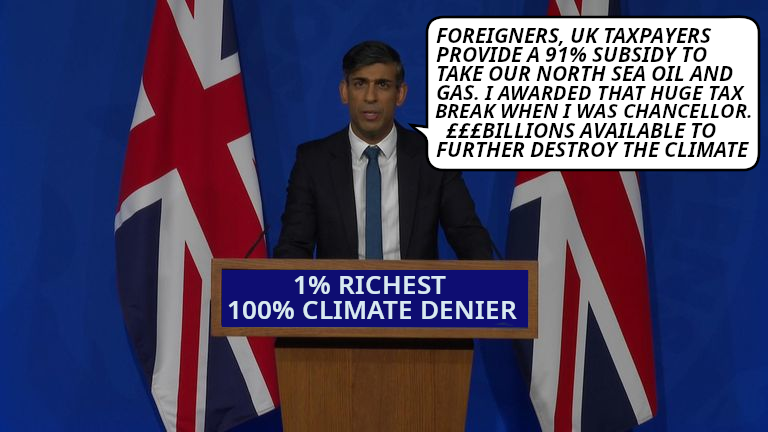
    Rishi Sunak offers huge fossil fuel subsidies to develop fossil fuel extraction in UK.
    Rishi Sunak offers huge fossil fuel subsidies to develop fossil fuel extraction in UK.
  • Scientists Say Risk of 5 Climate Tipping Points Means ‘Business as Usual Is Now Over’

    Spread the love

    Original article by OLIVIA ROSANE republished from Common Dreams under Creative Commons (CC BY-NC-ND 3.0). 

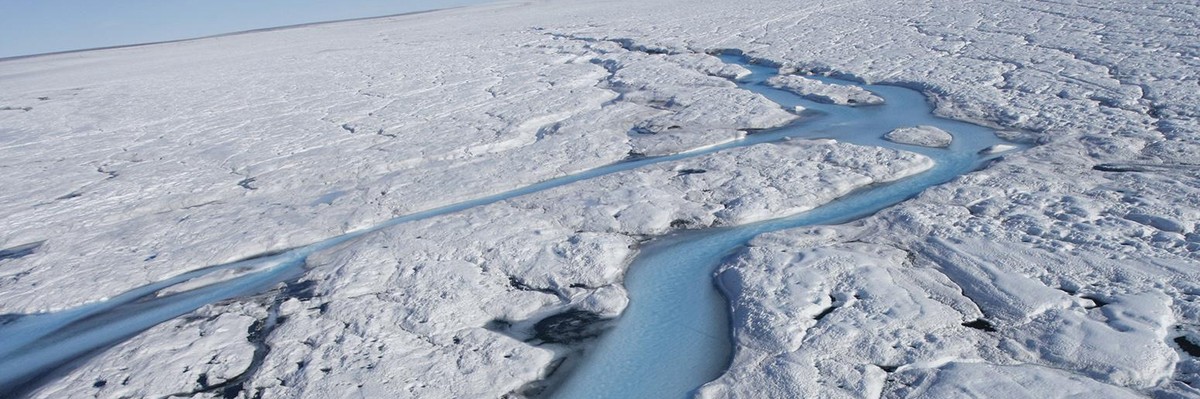
    The collapse of the Greenland ice sheet, shown here, is one of five tipping points that could be triggered by current levels of warming. (Photo: Patrick Robert/Corbis)

    “Averting this crisis—and doing so equitably—must be the core goal of COP28 and ongoing global cooperation,” one expert said.

    An earlier version of this article said the sea levels could rise by 656 feet by 2100 if the Antarctic ice sheet started to melt. It has been corrected to reflect the fact that they would rise by 6.6 feet.

    Current levels of global heating from the burning of fossil fuels and the destruction of nature risk triggering five tipping points that could throw Earth’s systems further out of balance, with three more at risk of toppling in the next decade.

    The Global Tipping Points Report, released Wednesday at the United Nations Climate Change Conference (COP28) in the United Arab Emirates, argues that policymakers have delayed climate action long enough that “linear incremental change” will no longer be enough to protect ecosystems and communities from the worst impacts of the climate crisis. However, world leaders can still choose to take advantage of positive tipping points to drive transformative change.

    “The existence of tipping points means that ‘business as usual’ is now over,” the report authors wrote. “Rapid changes to nature and society are occurring, and more are coming.”

    “Crossing these thresholds may trigger fundamental and sometimes abrupt changes that could irreversibly determine the fate of essential parts of our Earth system for the coming hundreds or thousands of years.”

    The report defines a “tipping point” as “occurring when change in part of a system becomes self-perpetuating beyond a threshold, leading to substantial, widespread, frequently abrupt and often irreversible impact.” A group of more than 200 researchers assessed 26 different potential tipping points in Earth’s systems that could be triggered by the climate crisis.

    “Tipping points in the Earth system pose threats of a magnitude never faced by humanity,” report leader Tim Lenton of Exeter’s Global Systems Institute said in a statement. “They can trigger devastating domino effects, including the loss of whole ecosystems and capacity to grow staple crops, with societal impacts including mass displacement, political instability, and financial collapse.”

    Because current emissions trajectories put the world on track for 1.5°C of warming, this is likely to trigger five tipping points, the report authors found. Those tipping points are the melting of the Greenland and Antarctic ice sheets, the mass die-off of warm-water coral reefs, the thawing of Arctic permafrost, and the collapse of the North Atlantic Subpolar Gyre circulation.

    The melting of just the Antarctic ice sheet, for example, could raise global sea levels by 6.6 feet by 2100, Carbon Brief reported, meaning 480 million people would face yearly coastal flooding. Three more tipping points could be triggered in the 2030s if temperatures rise past 1.5°C. These include the mass death of seagrass meadows, mangroves, and boreal forests, according to The Guardian.

    “Crossing these thresholds may trigger fundamental and sometimes abrupt changes that could irreversibly determine the fate of essential parts of our Earth system for the coming hundreds or thousands of years,” co-author Sina Loriani of the Potsdam Institute for Climate Impact Research told The Guardian.

    Contributor Manjana Milkoreit of the University of Oslo said in a statement that “our global governance system is inadequate to deal with the coming threats and implement the solutions urgently required.”

    But that doesn’t mean the report authors believe that hope is lost. Rather, they see it as a call to ambitious action at the current U.N. climate talks and beyond.

    “Averting this crisis—and doing so equitably—must be the core goal of COP28 and ongoing global cooperation,” Milkoreit said.

    One way to do this is to take advantage of positive tipping points.

    “Concerted actions can create the enabling conditions for triggering rapid and large-scale transformation,” the report authors wrote. “Human history is flush with examples of abrupt social and technological change. Recent examples include the exponential increases in renewable electricity, the global reach of environmental justice movements, and the accelerating rollout of electric vehicles.”

    The report authors made six recommendations based on their findings:

    1. Immediately phasing out fossil fuels and emissions from land use changes like deforestation;
    2. Strengthening plans for adaptation and loss and damage in the face of inevitable tipping points;
    3. Taking tipping points into account in Paris agreement mechanisms like the global stocktake and national climate pledges;
    4. Collaborating to trigger positive tipping points;
    5. Organizing a global summit on tipping points; and
    6. Increasing research on tipping points, including through a special report by the Intergovernmental Panel on Climate Change.

    “Now is the moment to unleash a cascade of positive tipping points to ensure a safe, just, and sustainable future for humanity,” Lenton said.

    Original article by OLIVIA ROSANE republished from Common Dreams under Creative Commons (CC BY-NC-ND 3.0). 

  • More than 1,000 climate scientists urge public to become activists

    Spread the love
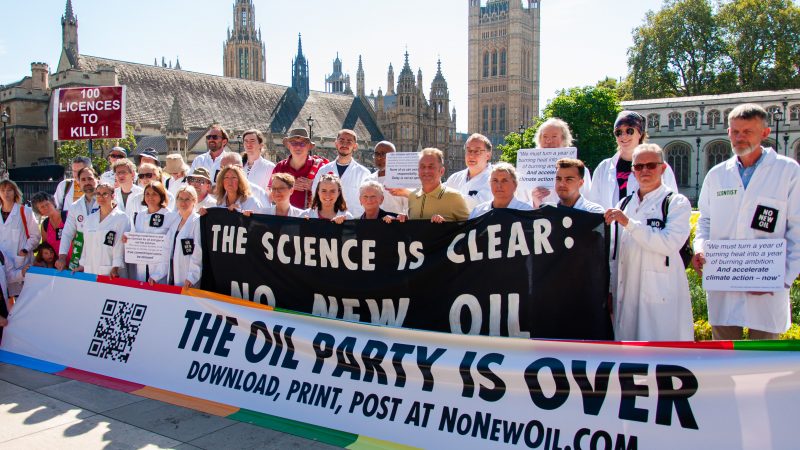
    Scientists protest at UK Parliament 5 September 2023.
    Scientists protest at UK Parliament 5 September 2023.

    https://www.theguardian.com/environment/2023/dec/04/more-than-1000-climate-scientists-urge-public-to-become-activists

    ‘We need you,’ says Scientist Rebellion, which includes authors of IPCC reports on climate breakdown, as diplomats meet for Cop28

    Wolfgang Cramer’s first involvement with the Intergovernmental Panel on Climate Change was in the 90s. He worked on the second assessment report, delivered in 1995, which affirmed the science of anthropogenic climate breakdown. At that point, no one could say they did not know what was happening.

    Almost three decades on, Cramer was part of the international scientific team that prepared the sixth IPCC report. Its conclusion, delivered in March, issued human civilisation a bleak “final warning” – the biosphere stands on the brink of irrevocable damage.

    Now, as diplomats meet in Dubai for the 28th round of the Cop climate talks, in a year predicted to be the hottest on record, and as carbon emissions continue to rise, Cramer is one of 33 IPCC authors among 1,447 scientists and academics in signing an open letter calling on the public to take collective action to avert climate breakdown.

    “We are terrified,” they warn. “We need you.”

    “Wherever you are, become a climate advocate or activist,” the letter, published on Monday by Scientist Rebellion, a climate activist group, implores. “Join or start groups pushing for policies that help secure a better future. Contact groups that are active where you are, find out when they meet and attend their meetings.

    “If we are to create a liveable future, climate action must move from being something that others do to something that we all do.”

    https://www.theguardian.com/environment/2023/dec/04/more-than-1000-climate-scientists-urge-public-to-become-activists